Monthly Archives: June 2016

Nostalgia for a Time that Never Was – more of why I love sf/f

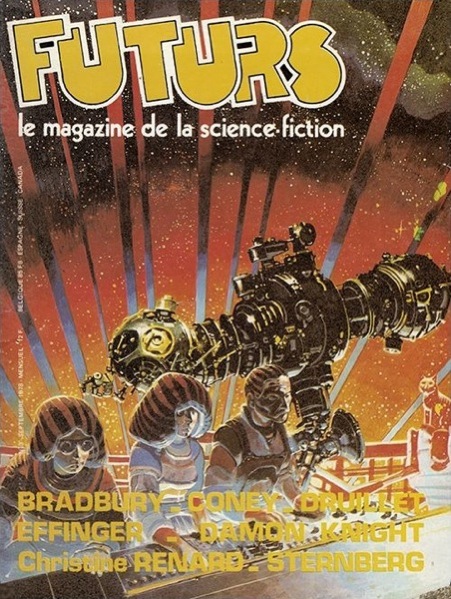
The cover of Futurs No 3, an anthology of translated science fiction published in Paris, September, 1978.
The cover of Futurs No 3, an anthology of translated science fiction published in Paris, September, 1978. (Click to embiggen)
One day, back when I was in high school, I found a paperback copy of The 1977 Annual World’s Best SF edited by Donald Wolheim in the used bookstore I frequented. I already owned several of Wolheim’s earlier annual anthologies, so I knew they usually the contained a lot of good stories. The table of contents of this issue featured several authors I loved, including at least a couple of titles that I remembered reading elsewhere and liking. So, of course, I picked it up.

The third story in that anthology, “Those Good Old Days of Liquid Fuel” by Michael G. Coney did not wow me on the first reading. Honestly, the thing that I found most interesting in the first paragraph was the revelation that it was apparently set in Western Washington state. The story is told by a first person narrator, who is taking a ferry to go to a port to meet a shipment of some sort of alien creature. We never learn much about them, other than that he raises them for their pelts, which he can sell for a profit. Though the way he describes his farm, he is mostly just getting by in this endeavor.

Most of the first two pages of the stories consists of the character describing his ferry trip in such a way that we learn that Earth is part of some kind of Galactic society, that only recently have they replaced rockets with antigrav for vessels that move from ground to orbit, and so on. The hook of the first paragraph is him noticing on his “newspocket” that all the old shuttles at the abandoned Pacific Northwest spaceport are to be scrapped, finally.

He arrives at his destination early, finding himself with five or six hours to kill, and decides to drive up to the old space port. During the drive he rambles some more, dropping hints about what his life was life before, and telling us more about how things have changed since then. It isn’t until halfway through the fifth page that he gets to what appears to be the meat of the story, as he flashes back to junior high school, when he and his best friend used to sneak onto the grounds of the spaceport to watch shuttles land and take off.

The narrator, as a young man, loved everything about the shuttles: the roar of the engines, the sleek shapes of the ships themselves, et cetera. His friends was obsessed with identifying and checking off the shuttles from a book he had of every registers craft that ever landed on Earth. There are a few anecdotes about the mild misadventures the narrator, his friend, and a few other people who liked to sneak onto the grounds of the space port had watching the shuttles land and take off.

Then everything is ruined when his friend gets a crush on a girl. Who just happens to be the same girl that the narrator once got into an altercation with in grade school and of course they hate each other. To say the friendship is strained is an understatement. Then there is a disaster involving the girl’s pet, with is a cat-like animal imported from across the galaxy, which happens to be telepathic, but only with members of its own species.

After the disaster, we flash back to the present, and then the narrator—who has lamented about five dozen times so far in the story how much he misses his old friend, and how astonished his middle-school-aged self would be to know that he doesn’t even know where the friend lives any longer—sees said old friend. The friend, it turns out, owns the wrecking company that is going to tear down the spaceport. But the narrator, of course, doesn’t say hello. He skulks away.

There are a lot of things not to like about this tale. The rambling expository lumps. The lack of characterization. The clichéd use of flashback to tell most of the story. The extremely dated boy vs girl dynamic of the tale. The ludicrous ways that chauvinism pops up and is even defended at one point.

Then in the category of merely cringeworthy, there is the fact that the only female characters who appear in the story all dress and act as if they are characters out of the 1950s. Remember, this was written in 1975—women’s lib had been a thing for many years by then! Even in 1978, when I read this story, that section seemed terribly dated!

I read the story one more time, when I found it in another anthology years later. I didn’t recognize the title, or I might not have read it. The second time I didn’t remember the story until fairly late into it, just about the time of the disaster near the end of the tale. I read it to the end, hoping to have a bit more insight, but still wasn’t impressed.

When I re-read it again last week, I was having the same reaction as before all the way until the end. And then I finally had an epiphany about what the author may have been trying to do. It had never occurred to me during my earlier readings that the narrator was unreliable. The section early on where he defends men’s only clubs and no girls allowed spaces as not being sexist at all should have tipped me off. It was too over the top. And there were several other hints throughout the story where our narrator is being very defensive in describing the events.

That’s when I realized that the ending, where he decides he doesn’t have anything in common with the old friend anymore is supposed to be tragic or ironic (depending). The narrator drives many hours out of his way and spends the entire tale wallowing in a nostalgic lament for the good old days. He goes into inordinate details on fairly minor stuff, is very defensive of himself and goes to pains to describe every other character in the narrative as betraying him or at least not treating him right. He had these great dreams and aspirations, which have all come to naught because the world is just not fair to nice guys like him.

Meanwhile his old friend is now a successful businessman, and is literally in the business of tearing down the obsolete relics of the past so that something new can be built.

Now, finally, the story makes sense when I think of it as a critique of nostalgia and clinging so hard to the past that you can’t move forward. And those expository ramblings sound an awful lot like an old bad way that some sci fi stories in the 30s, 40s, and 50s would do their world building: by having two characters say such unnatural things (while riding a subway or something), “Thank goodness for modern convenience! Can you believe that our ancestors used to have to connect their appliances to receptacles in ways with physical cables to draw power! What a primitive nightmare!”

As an indictment of nostalgia, “Those Good Old Days of Liquid Fuel” isn’t quite so bad. I’m not sure I agree with Wolheim that it was one of the best story published that year, but it did make me think, even before my epiphany. Struggling with a story is good mental exercise.

And I have to admit that the descriptions of the shuttles taking off and landing and the sense of wonder the narrator had as a child was pretty good.

You need to pick your dragons…

“Complaining about political correctness: It's just inoculating the public to get used to, and feel reluctant to call out, more racism, sexism, and homophobia.” BettyBowers.Com
“Complaining about political correctness: It’s just inoculating the public to get used to, and feel reluctant to call out, more racism, sexism, and homophobia.” BettyBowers.Com (click to embiggen)
In the game of chess, it is traditional at the end of the game for the loser, upon realizing that the other player has placed their king in checkmate, to tip the king over and concede the game. The point of the game is to protect your king and take the other player’s king. If the other player has maneuvered you into a place where no matter what move you make, your king will be taken, you’ve been defeated.

I never liked that bit about tipping my own king over and conceding the game. I’m not merely saying that I don’t like to lose (because no one does), what I had was a visceral revulsion to the idea of surrendering. I think when I see that I’m in checkmate, I should move my king, and then the other person should be the one who moves one of their pieces in and takes the king. And technically you can do that, but a lot of chess players consider it gauche to do so. You’re supposed to be civilized and logical and recognize that you have been beaten. When I was in my teens I once had a much older chess player lecture me about what an insult it was to insist on taking my last move and make him take the king. Another told me that taking my final move signaled that I wasn’t smart enough to recognize my loss, and therefore not being smart, I was not an opponent anyone would care to play against.

I don’t think that guy was terribly happy when I replied,“If you can’t tell until the very last move how good a player I am, I’m not sure I’m the one whose intelligence is in question, here.” (For the record, I beat that guy the first time we played, it was our second game where he discovered my idiosyncrasy, so, having beaten him once, I don’t think he could say I didn’t understand the game).

I was never great at chess, and I suspect my inability to dispassionately end the game without one player actually taking out the other player’s king is a symptom of why. And it’s all probably related to why my single favorite moment in all of cinematic history, is the second time Captain Kirk says, “I don’t like to lose” in The Wrath of Khan.

So I have a lot of sympathy for my fellow Bernie Sanders supporters who have been angry that one media outlet explicitly called the Democratic nomination one day before California, Montana, New Jersey, New Mexico, North Dakota, and South Dakota weighed in. I get it. Really, I do. But it isn’t the evidence of either corruption or incompetence that many of my fellow Sanders supporters are trying to make it out to be… Continue reading You need to pick your dragons…

Who’s offended? Why?

Promote QUEER Visibility. Queer Nation.
“Promote QUEER Visibility. Queer Nation.” (Click to embiggen)
I’ve seen a couple of different discussions going around Tumblr about the use of the word Queer to describe members and/or allies of the LGBT/ LGBTQ/ LGBTIQ/ et cetera, et cetera, et cetera community or communities. Some people advise against it because some of the LGBT people are offended by the word. Some people insist the word doesn’t apply if the person being described falls into (or appears to fall into) a specific one of the L, G, B, or T categories. And some people insist that the only people offended are those who want to exclude one portion of the community or another. I find it simultaneously amusing and exasperating to see that this debate still iterating 24 years after I most dramatically confronted my own resistance to the term.

I’ve written before about how, after divorcing my wife and months of counseling and so forth I decided I needed to do something definitive or symbolic about coming out, so I went to a National Coming Out Day march. I didn’t realize until I got there that it was sponsored by Queer Nation, which was controversial for both their radical attitude but mostly (among the LGBT people I knew at the time) just for insisting on using the word “queer.” I marched, because, damn it, it was National Coming Out Day and I was doing it!

For a variety of reasons that don’t bear repeating at this juncture, my late partner, Ray, and a bunch of our friends saw me marching (actually, we were doing the Queer Hokey Pokey at that point) past a restaurant in the gayborhood. For a while I got teased mercilessly by those friends who despised Queer Nation. And while discussing why I wasn’t embarrassed to have marched with Queer Nation, I went from being ambivalent about that word, to saying, “I am going to call myself Queer if I want to, and fuck you if you don’t like it!” to one friend who was getting in my face about it.

I had been teased and bullied just as much as he had with that word (and many others) as a child. So I understood the reasons that friend (and many other people) didn’t want to embrace the term. But I had also been teased and bullied with a lot of other synonyms for “homosexual” including “gay.” And some of my friends who were girls or young women during those years had been harassed and bullied with the word “lesbian.” So if we could use those two words to describe ourselves proudly—hell, the official name of the Seattle Pride Parade at the time was the “Lesbian, Gay, Bisexual, Transgender Pride Parade, Freedom Day March and Rally”—then why couldn’t we use the word “Queer?”

Another reason I happen to prefer the term Queer is because of intersectionality and bi-erasure. I’m gay. I’m a man who loves other men. I am not bisexual, despite having once been married to a member of the opposite sex (no, seriously, I mean it!). My husband is a man who is married to me, a man. We’ve only legally been married a bit over 3 years, but we’ve been together for more than 18 years. People assume my husband is gay. He is not. He is bisexual. Saying that he is gay, at least to me, feels as if it is erasing part of his identity. And I love all him, not just half of him, so I take it kind of personally.

I have a rather large number of friends who are bisexual who have married members of the opposite sex. People assume they are straight. They aren’t. Some of them have told me they aren’t terribly bothered by that assumption, but some of them really chafe under the label. I have friends who have transitioned after marrying a partner who was opposite sex when they married, and they’ve stayed together since. Calling either of them gay or lesbian again, at least to me, feels like I’m erasing part of their identity or history. I have a few polyamorous friends who present as straight, and describe themselves as mostly straight… but who sometimes have threeways with their primary partner and one of the partners of their primary who happens to be of the same gender.

And then there’s one straight friend who once told me, “Describing myself as a straight ally doesn’t feel true, because I think I have a queer perspective—and I feel a closer connection to LGBT people—even though I don’t want to have sex with another guy.”

And as I mentioned recently, in the ’90s everyone in the LGBTQ community who wasn’t a cis white male seemed to be offended if we tried to use “gay” as an umbrella term for the whole bunch. So, for the record, I’m a cis white (and old and fat) same-gender-loving man who identifies as queer, uses queer to encompass the whole community (including allies who consider themselves part of the community), and I don’t intend to stop. I mean, yeah, if you tell me that you, specifically don’t like the term, I will try not to call you that… But I refuse to stop using the term in front of you. Because it is who I am.

We’re here, we’re queer, and we’re FABULOUS!

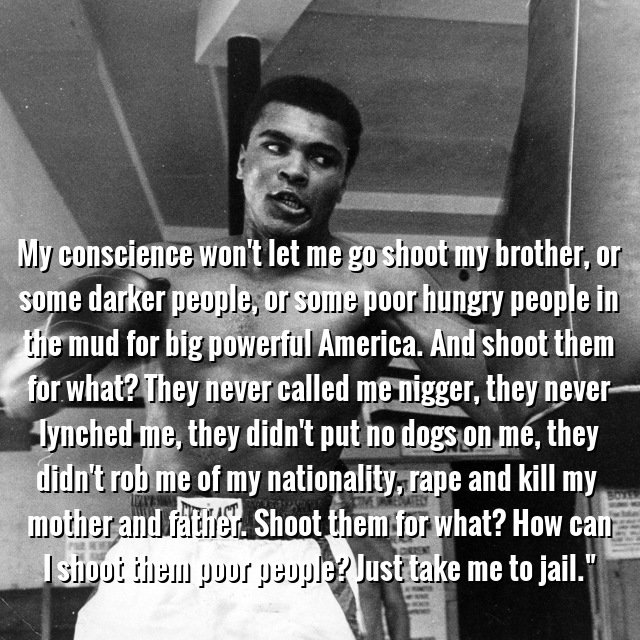
Weekend Update 6/4/2016: “My conscience won’t let me…”

“My conscience won’t let me go shoot my brother, or some darker people, or some poor hungry people in the mud for big powerful America. And shoot them for what? They never called me nigger, they never lynched me, they didn’t put no dogs on me, they didn’t rob me of my nationality, rape and kill my mother and father… Shoot them for what? …How can I shoot them poor people, Just take me to jail.” One of Muhammed Ali's statements when asked why he refused the draft.
“My conscience won’t let me go shoot my brother, or some darker people, or some poor hungry people in the mud for big powerful America. And shoot them for what? They never called me nigger, they never lynched me, they didn’t put no dogs on me, they didn’t rob me of my nationality, rape and kill my mother and father… Shoot them for what? …How can I shoot them poor people, Just take me to jail.” One of Muhammed Ali’s statements when asked why he refused the draft. (Click to embiggen)
I used to say that I was old enough that I remembered when three-time world heavyweight boxing champion Muhammed Ali still fought under the name Cassius Clay. I recently learned that that probably isn’t true. The reason I thought so was that, after Ali converted to Islam and changed his name in 1963, all sportscasters (with the exception of Howard Cosell—another great in his own right) refused to call him by the name—for several years! So I watched boxing matches on TV where the announcer and commentators called him Clay, even though that was no longer his name.

I had a bunch of other news links and such gathered yesterday after posting Friday Links that I had planned to post as weekend update this morning. But Muhammed Ali died last night. And he deserves a post all his own.

Muhammed Ali represented a lot of things. The best obituary I’ve found for him today is by Dave Zirin posted at The Nation: ‘I Just Wanted to Be Free’: The Radical Reverberations of Muhammad Ali. Zirin does a great job explaining the many ways Ali shaped the discussion of race, equality, war, peace, and even religion during the 60s and 70s.

The big one was his refusal to be drafted to fight in Vietnam. He made a lot of statements about it, before he was arrested and after his initial trial. One is quoted on the meme I included at the top of this post, but here’s another:

“Why should they ask me to put on a uniform and go 10,000 miles from home and drop bombs and bullets on Brown people in Vietnam while so-called Negro people in Louisville are treated like dogs and denied simple human rights? No I’m not going 10,000 miles from home to help murder and burn another poor nation simply to continue the domination of white slave masters of the darker people the world over. This is the day when such evils must come to an end. I have been warned that to take such a stand would cost me millions of dollars. But I have said it once and I will say it again. The real enemy of my people is here. I will not disgrace my religion, my people or myself by becoming a tool to enslave those who are fighting for their own justice, freedom and equality…. If I thought the war was going to bring freedom and equality to 22 million of my people they wouldn’t have to draft me, I’d join tomorrow. I have nothing to lose by standing up for my beliefs. So I’ll go to jail, so what? We’ve been in jail for 400 years.”

When he was drafted in 1967, he reported at the induction station as ordered, but he refused to step forward when his name was called, and declared himself a conscientious objector. When he was warned that he was committing a felony by refusing to step forward, he repeated his statement to take him to jail. He was arrested and stood trial. The jury deliberated less than a half hour before convicting him. His lawyer appealed, and Ali was released pending the appeal. Ali was stripped of his Heavyweight Championship title, had his passport revoked, and was systematically denied licenses to box in every state.

Federal appeals courts all upheld the conviction and it went to the U.S. Supreme Court. In 1971 in an 8-0 ruling (Thurgood Marshall recused himself from the case), Ali’s conviction was overturned. By that point, public opinion had shifted considerably against the war, and some have tried to tie the court’s decision to that shift. Possibly, but the court’s reason for overturning the conviction was pretty simple: the draft board had never given a reason as to why they refused to grant him conscientious objector status (which would have had him serve in an unarmed capacity). The law required that the board cite at least one of three reasons why objector status is refused, and they never did.

The evidence of the shift in public opinion toward the Vietnam War in general and Ali in particular actually came a few months before the Supreme Court ruling: 1) in September 1970 a federal court ordered the New York State Boxing Commission to reinstate Ali’s license, and 2) in August 1970 the City of Atlanta Athletic Commission granted him a license to box. In October of that year Ali returned to the ring, defeating Jerry Quarry after three rounds. Ali then defeated Oscar Bonavena in December at Madison Square Garden, which set him up to take on then reigning heavyweight champ Joe Frazier. It was called the Fight of the Century for many reasons, one being that neither Frazier nor Ali had ever been defeated in a professional fight.

Ali was famous for trash-talking his opponents, which reached some odd heights in the lead up to this match. Frazier and Ali were both African American. Ali had been raised on a “two-mule farm” in Kentucky, while Frazier was the 12th child of South Carolina sharecroppers. But Ali kept saying to the press that the only people rooting for Joe Frazier are white people in suits, Alabama sheriffs, and members of the Ku Klux Klan, while claiming that Ali was fighting for the kids in the ghetto. At one point this caused Frazier to remark within earshot of several reporters, “What the fuck does he know about the ghetto?”

Whether Ali knew anything about the ghetto, I can attest to the fact that racists like my dad and his Klan friends (yes, my dad had friends who were klansmen, though every time my Grandpa derided him for it, he insisted that he wasn’t a member; I don’t think Grandpa believed him any more than I did) were all rooting for Frazier. I know this because, while watching football with my dad was never a fun experience when I was a child, we somehow managed to watch boxing together just fine. He didn’t mind answering questions about what was happening when we watched boxing. I’m not sure why. So the most positive sports memories I have with my dad are all around boxing bouts. I’d watched boxing a lot with Dad before the Fight of the Century. I was ten years old the first time Ali fought Frazier, and I watching the whole thing with Dad. It was a little surreal, watching my dad cheer Frazier on.

Frazier beat Ali by decision. My dad’s only disappointments with the match were that Ali hadn’t gotten knocked out, and that dad hadn’t found anyone willing to bet against Frazier for the bout. A few years later, after Ali had won many more bouts, lost one and got a broken jaw out of it, and won some more, Frazier and Ali had a rematch, which Ali won. Dad had found someone to bet with this time. To say that he was pissed off at Ali’s win is putting it mildly.

Dad refused to watch Ali fight George Foreman for the world championship. He said boxing wasn’t any fun when it was only black guys fighting (he didn’t say it so politely, though). So I watched the Rumble in the Jungle with Grandpa, instead. Partway through the match, I remember telling Grandpa that I thought I was becoming an Ali fan. At the end of the match, Grandpa talked about the kind of endurance and bullheadedness it took to survive Foreman’s impossibly powerful blows, and told me he was an Ali fan now, too.

After winning the World Heavyweight Boxing championship that second time, he went on to more matches, most of which he won (Ali’s win by decision over Chuck “The Bayonne Bleeder” Wepner is the bout which Sylvester Stallone said inspired the film Rocky), before losing the title to Leon Spinks in a split decision, then win it a third time. After retiring, he even tried to win the world championship for a fourth time in 1980. Though everyone knew that his health wasn’t really up to it. His performance in the loss to Larry Holmes caused Stallone to describe it ringside as “like watching an autopsy on a man who is still alive.”

For me, Ali’s greatest acheivments happened outside the ring, as documented in articles like this: Muhammad Ali’s bouts outside the ring: Embrace of Islam and refusal to fight in Vietnam.

CNN has posted a lot of good videos (including a great interview with one of his daughters) along with their obituary: Muhammad Ali, ‘The Greatest,’ dies at 74.

Ali’s daughter, Maryum, said that her father, despite his very arrogant public persona, was always surprised long after his retirement, when strangers would come up to tell him how much he had inspired them, or how his life had convinced them to abandon the racism they’d been raised in. “He was never certain that people would remember him.”

I, for one, hope his memory outlives us all.

Friday Links (mantis shrimp update)

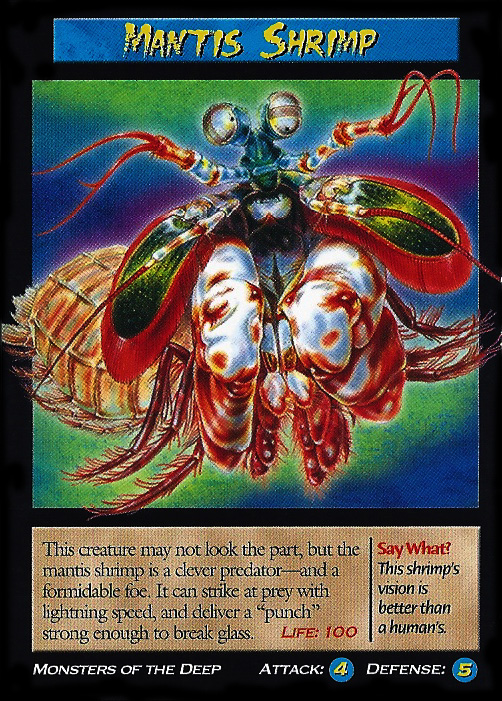
“This creature may not look the part, but the mantis shrimp is a clever predator—and a formidable foe. It can strike at prey with lightning speed, and deliver a punch strong enough to break glass.”
“This creature may not look the part, but the mantis shrimp is a clever predator—and a formidable foe. It can strike at prey with lightning speed, and deliver a punch strong enough to break glass.” (Click to embiggen)
It’s Friday! June is finally here. Happy Pride Month! Yes, it’s Queer Pride Month. You don’t have to be lesbian, gay, transgender, bisexual, pansexual, asexual, aromantic, genderfluid, polyamorous, intersex, transsexual, questioning, two-spirit, genderqueer, same-gender-loving, or flexual to celebrate and join in on the fun.

I’m still not happy with my Pride Playlist for this year, but it’s getting closer!

Meanwhile, here are links to some of the interesting things I read on the web this week, sorted into various topic areas.

Links of the Week

How did public bathrooms get to be separated by sex in the first place?

Transgender kids can’t wait for adults who need to take their time to accept them.

HOLDING MANY TRUTHS: THE LOSS OF NUANCE TO VICIOUS POLARITY.

Happy News!

The Pirate’s Graveyard.

This week in tech

Supermarket sues banks over chip card shift, says it lost $10K in 4.5 months .

This week in History

The Barely Remembered Gay Victims of the Nazi Concentration Camps.

This week in Health

Unpaid, stressed, and confused: patients are the health care system’s free labor.

This Week in Diversity

Hollywood Can’t Seem To Find Hot Asian Actors, Allow Us To Help.

There’s nothing wrong with being politically correct.

Welcome to America — where even our math tests are racist.

News for queers and our allies:

Americans Are Having More Gay Sex: Study. “And it looks like the “B” in LGBTQ has played a major role in the change…”

This gay high school athlete wasn’t a distraction to his team that just won a state title.

Presidential Proclamation — LGBT Pride Month, 2016.

LGBT veterans and band march in Chicago’s Memorial Day observance.

‘I never wanted to be gay’: Christian musician comes out, in moving letter to fans.

Science!

Storm Chasers, Stay Home: Rural roads are getting crowded during tornado season, and the dangerous conditions are all your fault..

Scientists crack mystery of shrimp packing such a punch it can split your thumb.

Scientists Just Updated Their Warnings About Zika and Sex.

Predator or prey? Why pupils are shaped and oriented the way they are.

Alzheimer’s could be caused by past infections, researchers say.

Science Fiction, Fantasy and Speculation!

The Ghostbusters Are Girls Now — But No One Told the Toys.

Geek culture isn’t ‘broken,’ but it does have a harassment problem.

The ‘Sense8’ cast is in Brazil for Gay Pride and everyone is wondering what it means.

The Power of Cautionary Questions: Neil Gaiman on Ray Bradbury’s ‘Fahrenheit 451,’ Why We Read, and How Speculative Storytelling Enlarges Our Humanity.

This week in Writing

Notes to My 12-Year-Old Self: Don’t Wait Till You’re Older.

Culture war news:

Giving our transgender children a voice.

Why Utah’s LGBT Youth Need Our Help.

Probing the Straight Fear of Gay Gaze in Locker Rooms.

Man Booker Prize Winner Marlon James Was Tortured By ‘Ex-Gay’ Exorcism.

Author, ex-prosecutor slams critics of Child Victims Act, urges New York to stop protecting abusers. Note: the Catholic Church is leading the charge to keep the law child molester statute of limitations in place.

Trolls threaten to ‘gas’ PinkNews CEO for reading pro-gay children’s book to nieces.

How trans people could help free the nipple.

Massachusetts Gov. Baker Says He Would Sign House Version Of Transgender Bill.

Massachusetts House passes transgender bill after heated debate.

Mississippi governor: ‘Secular’ world angry over LGBT law.

Federal Court Upholds Ruling Affirming Trans Student’s Equal Access.

Ken Starr, After Demotion for Failure to Investigate Rape Allegations Against Football Players, Abandons Reins at Baylor U. in the Wake of Campus Rape Scandal.

Catholic Church spent $2M on major N.Y. lobbying firms to block child-sex law reform.

Awful News

Friends remember UCLA shooting victim as ‘gentle soul’.

UCLA shooting: Gunman’s wife found dead in Minnesota.

Pilot killed in Navy Blue Angels jet crash.

This week in Politics:

SC Gov. Nikki Haley Warns Divisive Rhetoric Like Donald Trump’s Led to Charleston Church Massacre.

New York Attorney General Eric Schneiderman: Trump University Was A Fraud From Beginning To End.

Trump Didn’t Give Money to Vets Until the Press Reported that Funds Hadn’t Been Distributed.

A Message to the #BernieorBust Movement.

Libertarian candidate strips naked on live TV.

Trump’s Attack on a Federal Judge Is an Open Appeal to Racism.

Hillary Clinton Delivers Major Foreign Policy Speech, Slams Donald Trump Throughout.

Rachel Maddow Laments Trump’s Open Racism.

This Week in Misogyny

Teenage Girls Are Playing Video Games. You Just Might Not Hear Them.

Things I wrote:

Weekend Update 5/28/2016: Haters show true colors.

A cup, a cup, a cup, a cup, a cup… boy!

Memorials, reposting.

Evil Captain America and other bad writing hacks.

I feel a Tingle, tingle, tingle….

Very Big Questions and Very Small Epiphanies – more of why I love sf/f.

Videos!

Incredible trailer brings gay superheroes to life:

(If embedding doesn’t work, click here.)

Man Sets Swimming Pool on Fire, Extinguishes It With Liquid Nitrogen:

(If embedding doesn’t work, click here.)

Lovestarrs – Get Your Sexy On:

(If embedding doesn’t work, click here.)

Very Big Questions and Very Small Epiphanies – more of why I love sf/f

A cover of a later paperback reprint of the 1977 Annual World's Best SF anthology edited by Donald A. Wolheim.
A cover of a later paperback reprint of the 1977 Annual World’s Best SF anthology edited by Donald A. Wolheim. (Click to embiggen)

Some opening lines are better than others. “Something very large, something very small: a galactic museum, a dead love affair. They came together under my gaze.” Those are the opening sentences of Brian W. Aldiss’ short story, “Appearance of Life” and they’re one of the better examples. The opening tells you, thematically, where the story is going, without giving anything away.

“Appearance of Life” by Brian W. Aldiss is another story that I first encountered in the pages of the 1977 Annual World’s Best SF anthology edited by Donald A. Wolheim. So I was a junior in high school, 17 or 18 years old, when I discovered it. The story is narrated in first person by a character who is on their way to a museum. The character never gives us their name, identifying them self only as a Seeker, which is either a job title or avocation.

The Seeker tells us first about a long lost alien race, the Korlevalulaw. We don’t know what they looked like and virtually nothing about their culture. Because they had vanished by the time humans reached the worlds they once colonized. And the aliens left behind only empty buildings. But they are vast empty buildings. Our narrator is traveling to one such building, which is a single structure that completely encircles a planet exactly on its equator. The building it over 1600 kilometers long, and at different parts of the equator, it is between 15 and 22 kilometers tall. It is called a museum because humans have decided to start filling the empty space with artifacts they have gathered from around the galaxy. Not artifacts left behind by the Korlevalulaw, but artifacts left behind by previous human civilizations.

The story slowly reveals that by the Seeker’s time humans have changed a lot. The Seeker makes references to both the First Galactic Era and Second Galactic Era as distinct long periods of interstellar civilization. He or she makes references to how much smaller humans were at the time, and to other limitations of human bodies. But the Seeker never describes what humans look like, now. The gender of the Seeker is never given… the narrator does refer to every android they interact with as she. And there is a point when a reference computer points out that current human engineered breeding produces a ratio of ten women to every man, which is why “modern humans” don’t understand the importance more primitive humans placed on being husbands and wives.

The Seeker has been commissioned by several academic institutions to explore the museum and look for evidence to shed light on various questions these academics have. The Seeker spends several days exploring the museum.

The Seeker finds a holocube in one of the exhibits which contains a recording of the personality of a long dead human woman. When activated, she informs him that she is only for use by her husband, and to please put her back on the shelf rightside up. A while later the Seeker finds more holocubes, and one of them contains a male memory recording that says he is only for his ex-wife.

The Seeker notices that the names are similar, and so tries an experiment. Placing the cubes next to each other, the Seeker activates them and observes as the two holograms have a discussion. During the exchange of messages, the Seeker has an epiphany about the place of humans in the galaxy, and what the ancient disappearance of the Korlevalulaw means about the fate of human society.

The Seeker is so disturbed by the epiphany, that they abandon their mission, flee the museum, and find a mostly uninhabited world to hide out on, lest they accidentally reveal the epiphany to others and hasten the end of current civilization.

I was a little bit disappointed in the ending. The epiphany as described by the Seeker didn’t seem that alarming or profound, to me. I had been enjoying the story up to that point. It was very interesting to recognize how my image of the narrator and the situation kept changing as certain details were casually revealed. In the beginning, I was imagining a person much like myself. By the end, my imaginary version of the Seeker was only vaguely humanoid, and neither male nor female. Similarly, at the beginning of the story I assumed the human civilization was a kind of standard space opera interstellar empire, or multiple competing federations, something like that. But by the end I was trying to imagine a civilization that barely understood the idea of nations and political systems and even the concept of ownership.

I don’t know if Aldiss meant for the reader to think the Seeker’s epiphany only made sense because we didn’t, still, fully understand the Seeker’s frame of reference, or something else. I thought the way Aldiss built up the idea of this very alien culture, and how they didn’t really understand us, and therefore how we likely don’t understand previous generations, either, was really well executed. I didn’t realize that’s what was happening until I reached the end and was trying to figure out if I misunderstood the ending.

The story is very cerebral, with the conflict being something that the narrator doesn’t even realize is happening until the end. The Seeker wants the answers to particular questions, and doesn’t realize that he/she lacks the frame of reference to understand most of the evidence being examined. So you could describe the plot as Man vs His Own Ignorance. And the resolution is that the Seeker gains just enough insight to realize that none of the answers are pleasant ones.

And though I have been reminded of this story from time to time while reading other sci fi tale, I never realized until I was writing this post that it has more in common with a classic Lovecraft horror story than a science fiction tale. The Seeker gets a glimpse of a much bigger truth about their place in the universe, and that glimpse destroys their sense of self. It’s just a bit less melodramatic than a typical Lovecraft tale would have been. I don’t know if Aldiss was doing that on purpose, but it’s an interesting question.

The story left me pondering and debating with myself how I might have tried to tell the story better. Except I think the best part of it isn’t the traditional form of a story. The best part of the tale is how the writer made me slowly deconstruct my own assumptions about who the narrator was and what his/her world was like and the way the story made me uncomfortable to give the narrator a gendered pronoun.

It didn’t translate as a big epiphany for me. But it did change the way I viewed many stories afterward. It affirmed my suspicions that much of what we thought we knew about our own history, and about ourselves, was way off. And reminded me that we should never be satisfied with the easy answers.

I feel a Tingle, tingle, tingle…

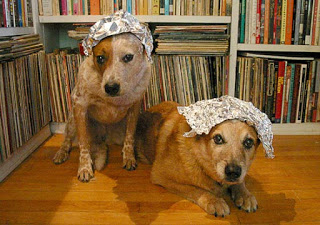
Puppies in tin foil hats
Puppies in tin foil hats (Click to embiggen)
It’s Hugo voting season again, and as I’m reading through the stories that have been nominated, I’m once again confronted with a number of choices that were placed on the ballot by the bloc-voting scheme of the Rabid Puppies. I’ve had at least one friend ask why I even care, which I suppose is a legitimate question. There are several reasons, but one of the biggies is this: it has been demonstrated that being nominated for a Hugo can have a significant impact on the sales figures for a book and/or author who was not previously really well known. In other words, folks who are mid-listers and below receive an immediate improvement in sales when they are included in the short list for the Hugos. If such a person goes on to win, there is a bigger increase in sales. And many authors have attested to the fact that when they won at a point when their career was struggling, that agents or editors who previously hadn’t shown any interest come knocking at the door.

Because no one has ever taken the equivalent of exit polls when people leave physical bookstores or log off of online stores to determine why people buy specific books, we have less hard data about the long term effects winning awards on someone’s sales. Library data indicates that books which have won the Hugo, Nebula, or Clarke awards have much higher circulation rates (more people check them out, they remain on the shelf for shorter times between check-outs, et cetera). Some marketing research seems to support the idea that when browsing, people are more likely to pick up and look at book that says “award winner” on it than those that don’t.

Which is all to say that one of the reasons I care is because getting nominated or winning the award can significantly benefit a writers’ career, particularly one that is not otherwise well known. So spiteful schemes to push works of dubious quality onto the ballot causes actual harm to the people who otherwise would have made the short list. Super spiteful schemes, like this year’s Rabid Puppy slate, which push material that the organizer chose precisely because of how bad it is, are even worse.

Which brings us to one of this year’s nominees: “Space Raptor Butt Invasion” by Chuck Tingle. Tingle (not his real name) is a niche erotica author who produces a lot of really weird erotic fiction that is clearly not meant to be taken seriously. He had never even heard of the Hugo Awards before his nomination was announced, and had to have it explained to him by an interviewer who was asking him for a reaction. His immediate reaction was to say that he despite getting nominated for an award because of it, he is definitely not in favor of bloc voting.

Tingle said his son told him he needed to look into the folks behind the puppies, especially Vox Day.
He has since educated himself on the topic. This inspired a series of Gif- and video-illustrated tweets mocking Vox Day, the racist & misogynist guy running (and profiting off of) the Rabid Puppy campaign.

Tingle also wrote a new “book” for the occasion: “Slammed In The Butt By My Hugo Award Nomination.”

That wasn’t the end of his trolling of the Sad and Rabid Puppies. He has since asked Zoe Quinn, who is hated by the puppies and their allies the GamerGaters, to attend this year’s WorldCon and if Tingle’s story should win, to accept on his behalf and give a speech about whatever she wants. So if the puppy loyalists vote for Tingle’s story, they give one of their most hated people another public forum to talk about the issues they hate being talked about: Weird porn author who was dragged into Hugo Awards mess pulls off epic troll.

He didn’t stop there. He realized that despite the fact the Vox Day has managed to use the Rabid Puppy campaign to radically increase traffic to his blog and publishing site, and to sell more books to the sorts of racist, homophobic, misogynist fans who apparently previously didn’t know how to find them, Vox had never purchased the Rabid Puppy web domain. So Tingle bought it and set it up as a site to mock Vox and to promote some of the authors that Vox has so often publickly denigrated: Chuck Tingle thwarts devilman Vox Day, buys TheRabidPuppies.com for HARD buckaroos.

sometimes devilmen are so busy planning scoundrel attacks they forget to REGISTER important website names. this is a SOFT WAY of the antibuckaroo agenda but is also good because it makes it easy for BUDS WHO KNOW LOVE IS REAL to prove love (all).

please understand this is website to take DARK MAGIC and replace with REAL LOVE for all who kiss the sky.

Tingle hasn’t just turned his unique satirical eye toward the puppies. His commentary on the transphobic bathroom laws and similar nonsense, “Pounded In The Butt By My Irrational Bigoted Fear Of Humans Who Were Born As Unicorns Using A Human Restroom” is available (as all of his delightfully weird titles are) on Kindle.

I don’t think that there is anything particularly award-winning about “Space Raptor Butt Invasion,” but Tingle’s actions are definitely award-worthy. I know I’m not the only regular Hugo vote who is considering putting Tingle’s story above No Award on my ballot because he’s been both a good sport about this, and so delightfully entertaining in his take down of the Rabid Puppy ringleader. And for a man who finds many weird ways to put the phrase “pounded in the butt” into story titles, he’s been much more civil in his attacks on Vox Day than Vox has ever been to anyone.

If you want more details on Tingle’s campaign against the bigots: Satirical erotica author Chuck Tingle’s massive troll of conservative sci-fi fans, explained.

When I first started to draft this post, I had more information and links about the Rabid Puppies and Sad Puppies, but I think that Cory Doctorow was right on the money when he recently said, “the two groups who want to kill the Hugos call themselves “Rabid Puppies” and “Sad Puppies” for fantastically tedious reasons you can look up for yourself if you care to.” Re-hashing the reasons they’ve launched these campaigns and the inconsistencies and contradictions in their arguments is tedious. We’ve all written way more about it than they deserve.

Tingle’s bizarre and hilarious response reminds me that life, reading, and storytelling are far too important to take seriously. It’s much easier to enjoy a good story if I laugh about something frivolous first than it is if I’ve been ranting about someone being a jerk.

So I’m going to go read another of Tingle’s stories, then get back to the serious work of reading and writing sf/f.


ETA: Chuck Tingle isn’t the only person who writes silly stuff that is more worth your time than the rantings of outraged people. May I humbly suggest:

Monster Mashed by Grave Robbers from Outer Space, or

John Scalzi Is Not a Popular Author And I Myself Am Very Popular