Once when I vented about this misconception on line, someone replied that their mother kept thinking that his wife’s need to eat gluten free meant always having a vegetarian option.
My mom isn’t the only person who buys into this myth that diabetics can never ever eat this, that, or the other. I’ve met plenty of diabetics (and a doctor or two) who also buy into it. I’ve seen plenty of people who take it the other way: since they’ve been told they can “never” eat anything they think is good, they just say “screw it” and eat themselves to death.2
So, for instance, most mornings I have a cookie or nice piece of chocolate. We’re supposed to eat a small snack each time we take our insulin, and I have found my blood sugar is most stable if I eat something with less than 10 grams of carbs for that first snack of the day. And there are lots of snack foods which are NOT sugar-free where a single serving falls in that range.
Everyone’s body varies, but I’ve found that as long as my total carbs for the day stay under 150 grams and no single meal has more than about 40, (and I take my meds on time) my blood sugar readings stays in the desired range. That’s true whether those carbs come from things like lentil soup, tangerines, and icelandic yogurt or chocolate, Dry soda, and beef stroganoff with noodles.
Keeping track of the carbs takes work, I get that. People keep asking me if I have an app the tells me how many carbs are in things and I reply, “Safari!” Yes, the defalt web browser on my iphone. I can just type “how many carbs in french fries” and get a useful answer–a serving of this size contains this many carbohydrates, that much fibre, et cetera. I’ve been doing it long enough that I don’t have to look up a bunch foods, because the numbers and serving sizes have started to stick in my memory. I can eyeball a lot of servings and come up with a good guess.4
I’m just enough of a creature of habit with a bit of obsessive compulsive leanings that once the behavior was established, making a not of how many carbs I’m eating happens almost without thinking. But there is time and effort involved. And let’s be honest, eating healthy isn’t cheap. Our society has gotten really good at serving massive amount of calories cheaply in forms that are almost tailor-made to make you fat. Finding health alternatives, that are easily to keep with you, easy to store, won’t spoil before you can eat them all, and so forth is more expensive the just grabbing the reasonably priced pre-packaged foods, or a cheap (and delicious) meal from a food truck or whatever.
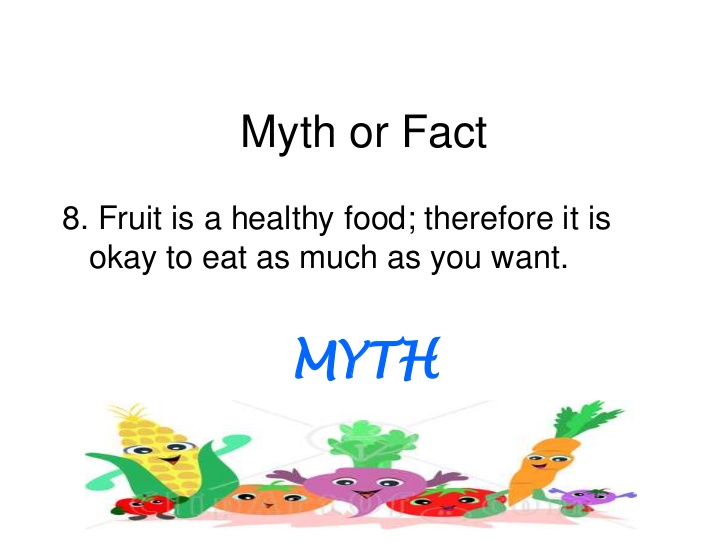
Another myth I hear a lot is, “You can eat all the fruit you want!” in various forms. I can’t tell you how many times I’ve had a conversation that includes the claim, “But fruit doesn’t have sugar!” and when it’s pointed out that fruit contains a lot of sugar, “Well, but it’s nature sugar, so it’s good for you!” I’ve had engineers who I know had to pass basic chemistry to get their degrees insist that the naturally occurring sugar in fruit doesn’t elevate your blood sugar reading, because it “isn’t the bad stuff.”
News flash: all sugar is natural. Really. That beautiful white crystalline power you buy at the store and put in sugar bowls is natural sugar. It’s simply squeezed out of plants, such as sugar cane, or beets. The science is very clear that nothing about the process of extracting it and purifying it makes it any more or less dangerous than the sugars you ingest if you take a bite of an apple or a banana. At all.5 This is really just the flip side of the myth I opened with: you can never have certain foods, others are always good for you, no matter what.
So, no, just because it’s “healthy” doesn’t mean I can eat as much as I want.
The biggest adult-onset diabetes myth I keep running into is the notion that being obese causes diabetes. For decades people (and doctors) said that because there was a strong correlation. But try as they might, no medical study could ever establish the causal link. Not only that, as options other than just injecting insulin became available, a lot of people started noticing that diabetic patients who had been struggling to lose weight (and failing), starting losing weight easily once they were on the correct medicine for them. Turned out there was a reason for both of those facts: for several types of diabetes, it isn’t the obesity that caused the diabetes, it’s the underlying genetic issue that will eventually turn into diabetes that is causing the obesity.
There is a relationship. Being obese makes many of the other symptoms of diabetes worse. But a huge number of studies have shown that the old way of treating the disease: basically fat-shaming the pre-diabetics and refusing to start them on medication until their blood sugar levels were so out of control that permanent damage had accrued in the liver, kidneys, and other internal organs–wasn’t helping anyone. Whereas starting patients on medication early, and focusing on diet, exercise, and the results of blood tests rather than worrying about weight, often leads to the patient losing weight, and sometimes bringing function back to the pancreas.
While we’re on that. There’s another related myth. For a long time when treating patients who were developing adult-onset diabetes, doctors put off starting the patient on insulin for as long as they could. The reasoning was a combination of the obesity-causation myth and the anecdotal experience of watching adult-onset diabetics’ health decline sharply after starting the insulin. The problem was the waiting, not the insulin.
There’s a number that is generated from the routine blood tests, your A1C. You don’t need to know what that means to understand what I’m about to explain. The average healthy person’s A1C will be about 4. If it’s over about 5.7 you’re considered pre-diabetic. If it’s over 6.5 you’re considered diabetic. In the old days, doctors would wait until an adult patients’ A1C was over 12 before starting them on insulin. The problem is that when the A1C is greater than 7, internal organ damage starts happening. So waiting until a patient is consistently at an A1C of 12 means the body is already so damaged that the patient was already dying. So it created this mass of anecdotal evidence that people were associating with the insulin.
That’s why the guidance now is to start medications early. Try the various meds that can be taken as pills when a patient is in the upper end of pre-diabetic stage, but don’t wait so long. Again, lots of studies are available on this.
Anyway, besides just trying to reduce the number of people who argue with us about what we’re eating, I hope that this will encourage you to think about how the body works and how many of medical and biological facts you’ve absorbed over your life are actually just widely believed myths. Everyone should have a basic understanding of how human bodies work, in my opinion.
Footnotes:
1. Well, except almonds, but that’s an actual allergy I’ve had forever.
2. One reason I asked my doctor for a nutritionist referral when I was diagnosed pre-diabetic 17 years ago was watching my Dad,3 some uncles, and cousins who didn’t take care of their illness lose their eyesight or toes or entire lower legs along with their swiftly declining health. Contrasted with a great-uncle who had watched his diet and took his meds faithfully since his diagnosis at age forty who lived to the age of 99, spry enough to play nine holes of golf with some younger buddies just a few days before he dropped dead.
3. I should mention that Dad wasn’t diagnosed until 13 years after the divorce, so my Mom has never lived with someone with this particular disorder.
4. Usually. Sometimes I realize partway through eating something that it is sweeter than I expected, and I can stop at half a portion. Other times I didn’t realize there were hidden extra carbs in something until later, when I start feeling that high sugar buzz, then check my blood sugar and confirm that it’s shot up a lot higher than it should have if what I’d eaten a bit ago had been what I thought.
5. And all sorts of natural substances are poison, while lots of manufactured substances are life-saving medicines. Stop assuming that natural somehow means magically healing or whatever.
 Font Folly