I've loved reading for as long as I can remember. I write fantasy, science fiction, mystery, and nonfiction. For more than 20 years I edited and published an anthropomorphic sci-fi/space opera literary fanzine. I attend and work on the staff for several anthropormorphics, anime, and science fiction conventions. I live near Seattle with my wonderful husband, still completely amazed that he puts up with me at all.
View all posts by fontfolly →
“Remember when floppy disks could save/destroy the world?” (click to embiggen)Several years ago I went on a rant about what a horrible idea it was to switch to digital music. I had a whole slew of reasons why keeping my music library on disc was a better idea. I liked my portable music player and headphones. I could carry a bunch of albums with me, and I could be sure that those discs would play in either my computer, or in the stereo or most stereo music players that most people had. I didn’t have to worry that they would get erased, or that a new player I had would have compatible software.
So it was ridiculous that people where carrying around iPods! Or any other digital music player, for that matter! What if the digital format in question was abandoned or obsoleted? How would you play your music on another player when this one wore out? Did owning music even mean anything when it was just a file on your computer?
Now, to be fair, I had converted a small number of my music discs to digital to play on my computer1, so I didn’t have to walk across the room while I was in the middle of writing something to change music. That was all right, but it was an alternative. It would never replace my real music library.
Then my husband bought me a pretty pink iPod Nano for my birthday.
“Writing a book is like wrestling a bear. Some days you’re on top. Some days the bear’s on top. And some days the bear is on top, dancing around the room, ordering lattes.”—Neil GaimanWriters approach writing in different ways. When I’m on writing panels at conventions, I try to slip in the disclaimer that no one can tell you how to write. All I (or anyone else) can do is tell you how I write. What works for me might not work for you. I can also give encouragement, share some tricks and techniques that other writers have shared, I can share certain abstracted observations about technique or perception, or I can be a sounding board when you’re trying to sort a scene or story out. But everything I say (even though I may sometimes say it very emphatically) is ultimately a suggestion. If it works for you or helps, great. If not, I’m sorry.
The way your brain works will not be precisely the same as mine. What motivates you will be different than what motivates me. The problems and plotholes and stalling points in your story will be different than in mine.
“You might not write well every day, but you can always edit a bad page. You can’t edit a blank page.”—Jodi PicoultIt’s a sentiment that many writers far more accomplished than I have expressed over the years: “You might not write well every day, but you can always edit a bad page. You can't edit a blank page.” I’m quoting Jodi Picoult in this instance. And she’s right. It is better to get something written down, even when you think it’s horrible, than not to write anything at all. It is much easier to revise a completed story than it is to write the story to begin with. And it is also true that no one, no matter how talented, experienced, or inspired they are, writes wonderfully every single time they sit down to write.
John Oliver and the Cookie Monster presenting news on “Last Week Tonight.”The first time I did one of these weekend updates, it was because after I posted that week’s Friday Links (just before going to bed Thursday night), there had been a rather big development in one of the stories. Specifically, I’d posted at least one link about yet another planned anti-gay march being sponsored by NOM and some of the related hate groups. And that was the second year that the small number of people who showed up was significantly smaller than any previous year. The shocking development, for me, was that all of the the rightwing so-called news sites reported on the march truthfully, admitting that almost no one showed up and that support for the anti-gay cause was going away.
I didn’t intend this to become a weekly thing, but some how, at least a few times every month, something happens after I post Friday Links something turns up in my twitter timeline or on the news that I either really wish I had included, or that substantially improves upon something I did include. So, yesterday I linked to the story of Rialto, an orphaned sea otter pup found nearly dead on a beach several weeks ago, who has been nursed back to health at the Seattle Aquarium.
I’m also sorry I didn’t include any links about Taco Truck Nation, because it is a perfect example of just how weird the otherworldly perspective held by supporters of the orange-skinner white supremacist buffoon are compared to the rest of us: Trump supporter’s ‘taco trucks’ remark draws mockery. Because people with a non-racist, non-fearful, non-xenophobic viewpoint just associate taco trucks with delicious food.
Hitting all the right notes. “I want to see children do better in school. I want to see children have better lives. But I don’t want to belittle that I’m also seeking the joy of music for everybody.”
Miss Cora M. Strayer’s Private Detective Agency. It started out when someone posted a vintage newspaper ad, sending the writer on a search that unearthed a truly kickass woman who ran a successful detective agency from 1902-1938, taking a break to form the First Volunteer Women’s Calvary Regiment to take up arms and join the fight in the Border War with Mexico in 1814…
Maybe 2016 Will Be the Year Voters Elect an Openly Gay Republican to Congress. I know the author thinks this is good news, but racist self-loathing gays aren’t really an improvement over the run-of-the-mill anti-gay Republican. And being willing to vote for a token guy who shares all their other bigoted views doesn’t prove the Republican base is becoming more enlightened.
How do you become “white” in America? “As the history of the Poles in America shows, whiteness has always been a malleable category, used for political exploitation.”
Gene Wilder, Gilda Radnor, and Dom DeLuise on the poster for Haunted Honeymoon. The poster art copyright is believed to belong to the distributor of the film, Orion Pictures, the publisher of the film or the graphic artist. (Click to embiggen)For many years, Haunted Honeymoon has been my go-to movie for fixing a bad mood. Written, directed, and starring Gene Wilder (along with Gilda Radner, Dom DeLuise, and Jonathan Pryce), it is a silly thrilling tale set in the 1930s. Radio actors Larry Abbott and Vicky Pearle are the stars of the wildly successful Manhattan Mystery Theatre and are engaged to be married, but Larry’s recent erratic behavior has their sponsor ready to cancel the show. Larry’s uncle, Paul Abbott is a “famous psychiatrist” who claims that Larry’s recent engagement had opened a crack in Larry’s mind which can only be cured by forcing Larry to confront his worst fears—to scare him “to death.” Which he’s going to attempt to do while the entire Abbott family is gathered at the country estate of their Great-aunt Katherine.
Aunt Kate (played hilariously by Dom DeLuise in drag), meanwhile, has recently changed her will so that Larry inherits everything. Unless Larry predeceases her, at which point the inheritance goes to all the other Abbotts equally. And someone is stalking Kate’s home in a cheesey werewolf mask, and has already killed one person…
I can’t explain why the show works so well for me. Is it the banter and onscreen chemistry between Gilda and Gene (this was the last movie they made together; mysterious pain she kept feeling during filming was later diagnosed as the ovarian cancer that eventually killed her)? Is it Dom’s hysterical performance as Aunt Kate? Especially the song and dance number Kate and Vicky perform in the music room after dinner? Is it Jonathan Pryce’s delicious performance as the slightly sleazy cousin Charlie? Or Eve Ferret’s vampy turn as Charlie’s girlfriend (and Larry’s ex-) Sylvia?
I don’t know. But I love the movie. My husband always makes certain that we have a copy on more than one of our computers when we go on long trips, in case I wind up in a dismal or vicious mood because things go awry.
Last night I watched it, and I enjoyed it as always. But for the first time I was crying at the end. Because yesterday the world learned that Gene Wilder had died the night before.
I love other movies Gene made. I was ten years old when Willy Wonka and the Chocolate Factory came out. The town we lived in at that time didn’t have a movie theatre. But a mere thirty miles away, just over the border in neighboring Colorado, my grandparents lived in a town that did have a theatre. And I and my sister and Mom all went to see the movie along with my paternal grandmother one summer evening. I loved it, of course. I had read book, Charlie and the Chocolate Factory a couple of years previously. I remember early on in the movie thinking that they weren’t following the book very faithfully. But once Wilder came out and started playing the mad, bewildering Willy Wonka, I decided that the movie got it right.
I don’t watch this movie as often. Although many people love Wilders’ Willy Wonka even more than I do, my husband had a very different reaction to the film as a child. It gave him nightmares—severe enough that he just can’t watch the show even now as an adult.
And of course I re-watch Young Frankenstein at least once a year. Quoting along and laughing throughout. It’s a brilliant comedy and parody.
The only other of his films I currently own is Blazing Saddles which I hadn’t watched in a long while, so I watched it as well, last night. Gene was good in that, though with not nearly as much screen time as I’d have liked.
Gilda and Gene from a scene early in Haunted Honeymoon. Gene is literally “awoo”-ing in this one.I love Gene isn so many of his roles: Willy, Dr. FRON-ken-STEEN, Larry, the Waco Kid… We have his movies to enjoy again and again. And we need to remember the sentiment his family expressed in their official announcement, along with the explanation for why Gene didn’t publicly reveal his health problem: he couldn’t stand the thought of even one less smile in the world. He put many smiles into the world. And yes, many of us shed some tears yesterday, but I know re-watching his movies will bring smiles and laughs instead of tears again. Just not today.
Mostly I’ve ignored them. If someone I follow on social media makes a comment ridiculing one of those clickbait headlines I might re-blog it or click “Like.” I don’t have to read the articles or the commentary to know that rather than looking at the actual socio-economic forces at work, the article is just going to make a lame connection between some out of context statistics in a way that will make clueless people of a certain age nod and congratulate themselves on being a better, more mature person those “those darn kids!”
The one that broke me was soap. I kept seeing slightly outraged comments on Twitter about bar soap vs other kinds of soap that I didn’t quite understand. Clearly all these folks were commenting on some article or something that I hadn’t seen. Then I saw one comment tied the term millennials to soap, and I thought, “Oh, no! Now what?” So I had to go find the articles in question.
“Millennials Aren’t Buying Bar Soap and It’s Killing the Industry!” —it really isn’t any more ridiculous than the others, I suppose, but I found myself feeling a little outraged, too. The actual statistics buried in the article are this: sales of bar soap have been going down an average of 2.2 percent per year for the last five years or so, and the vast majority of bar soap that is still being sold is being purchased by people over the age of 60. But the other statistic buried right along in there: sales of soap overall have been increasing over the same period of time at a rate of 3% a year. And the same companies manufacture and sell body wash and liquid hand soap, so there actually isn’t any problem for the industry at all. But they tried to hide even that part by changing the time scale of how they described it.
Before I’d reached the point where the article undermines its own headline, I was already getting irritated because I’m under 60 and we buy bar soap regularly. And let’s be honest, it’s my husband, who is ten years younger than me who buys most of them because he prefers bars. I’m the older one who loves body wash and keeps multiple dispensers of liquid soap next to every faucet in the house. (Not because I believe the myth that soap bars harbor dangerous bacteria; it’s because I’m clumsy and drop bars all the time, and because I like having a choice of scents when I wash my hands or hair or whatever. The shower has four or five different scents of shampoo and matching conditioners and complimentary body washes because I’m a weirdo.)
So it’s ridiculous clickbait you can dismantle in a few minutes. I decided I’d already wasted enough time thinking about it and I should definitely not write a blog post about it. Then, this weekend, I couldn’t look at any social media stream (unless I used the filters that only showed me the tiny subset of those streams being written by people I know personally) without seeing all the backlash. There was a lot of backlash–joke after joke about how clueless Boomers are. Many were at least chuckle-worthy. But I kept seeing, again and again, jokes that mentioned specific ages. It was clear that a lot of the people posting them thought that the term Baby Boomer referred to anyone older than, say, mid-thirties.
That’s how I found myself typing out an explanation about the definition of the Baby Boom, the sociological arguments for why one of the definitions made more sense than others, the economic arguments why yet another definition was better, and so on. The fact is that the whole “generation” thing is a silly mess no matter how you look at it. And I was ranting about why these jokes were as intellectually-shallow to the situation as the original headlines and… and… and…
Of course the jokes are parodies. A parody is supposed to be even more ludicrous than the thing being parodied. Meanwhile, if I posted my mansplaining, I would be even more ridiculous, still!
But, there are a couple of things I do have to get off my chest. One of the academic definitions of the term, “Baby Boomer” puts both myself and my mother in the same generation. And it puts my father in the generation before the Baby Boom, yet he was only 10 months older than my mom. I know we’re a weird case. I was born six days before my father’s 18th birthday. My parents were both 17 years old when I was born. On the other hand, my dad was 34 when my youngest half-sister was born. Going strictly by the arbitrary dates some people use, then, dad was a Silent Generation man who married a two different Baby Boomers, sired another Baby Boomer, and sired a bunch of Gen X-ers.
If you, instead, use the dates on the info graphic I swiped from Price Consulting, well, we spread out a little more, with me landing smack in the middle of Generation Jones, my oldest sister almost getting in the same generation as me, and then the younger siblings all solidly in Generation X.
Any cut-off dates have to be arbitrary.
My childhood didn’t include any of the 1950s. That makes my culturally programmed expectations different than those of my parents’ generation, for instance. My childhood includes the assassinations of John F. Kennedy, Martin Luther King, and Bobby Kennedy. That gives me a slightly different impression of the world than my husband who was born after all three. I voted against Reagan—twice! And was close to tears the night he was re-elected. That gives me a different impression of the 80s than friends who were born while Bill Clinton was in the White House.
But, due to a variety of complications (including the fact that my father refused to sign financial aid applications) I didn’t go to university until I was in my mid-twenties. So friends I graduated from High School with came out of college practically debt-free, whereas I had student loans that added up to more than the assessed value (at the time) of my dad’s house or my grandparents’ house. Which means economically I have a bit more in common with the cliché Millennial than my own generation (whichever one you stick me in).
All of which is a really round-about way to get to this: the economy is f—ed up for almost everyone.
Maybe the stereotypical Boomer owns their own home, but not all of them by any means. And even the ones that do are finding themselves being buried under medical bills and the like, can’t afford to retire, and often are trying to help their own kids and grandkids keep their heads above water. Folks a bit younger than that are sandwiched between aging parents or other relatives whose failing health (and sometimes mental faculties) are throwing unexpected responsibilities on them while they’re still trying to get their own kids out of the nest. Folks a little younger still are stuck in jobs they hate, paying rent that keeps going up faster than their wages, trying to explain to their grandparents why they don’t feel the need to own (and try to pay upkeep, insurance, et al for) a car, trying not to be a burden on their parents who they see are spending a lot of time worrying about the grandparents, and don’t see how they’re ever going to get their heads above water to begin with.
And the clickbaiters have succeeded in getting us all making fun of each other. Meanwhile parasites like Donald Trump and Peter Thiel and Martin Shkreli are happily siphoning billions out of the pockets of middle and working class people of all ages, and into their off-shore tax-sheltered accounts.
Maybe we should find a way to unite against the actual enemy?
Top 5 Reasons Churches End Up in Court. Surprise, Sexual abuse of minors is the number one reason five years running! Source: ChurchLawAndTax.com (click to embiggen)It’s happened yet again. Homophobic pastor has been saying reprehensible/non-Christian things about queers, and now he’s been arrested: GEORGIA: Pastor Who Said Pulse Victims “Got What They Deserved” Arrested For Child Molestation. Maybe this is what all the whacky anti-gay preachers and other so-called leaders of the religious right mean when they say that people who speak out against queers are being arrested? They’re just leaving out the part where the arrest isn’t for their anti-gay beliefs?
For several years Dan Savage ran a recurring column at the Stranger called Youth Pastor Watch, where he would publish stories of youth pastors convicted of sexual molesting (usually) underage church members of either gender. And I’ve linked to and commented on the phenomenon of both anti-gay religious leaders and anti-gay political figures who have later been caught up in sex scandals, again, usually involving underage victims. Savage has also frequently said, “If children were sexually molested at Dennys’ restaurants as often as they are assaulted at churches, it would be illegal in all 50 states to take your children to Dennys’.” It isn’t that all religious people are child molesters, but most child molesters find communities willing to turn a blind eye toward their suspicious behavior among organized religion.
A perfect example is the story of former New Jersey Assemblies of God paster Gregorio Martinez: American Preacher Molested a Teen Boy, Then Fled 2,000 Miles. Martinez was convicted of sexually molesting a 13-year-old member of his congregation, and between the reading of the jury’s verdict and the sentencing hearing, he fled the country. For many months no one knew where he was.
A couple of reporters working for the news site NJ.com got a tip, and when they presented it to their editor, he authorized a trip to Honduras to try to catch the guy. Note! It wasn’t U.S. law enforcement who went looking for him, it was a pair or reporters! By the time the reporters located the church where Martinez had been working, he had fled again. But here’s the truly astounding part: the reporters learned that 1) Martinez was given a job at another church based solely on the recommendation of one other pastor—no other vetting was attempted, but even worse, 2) with several church members googled the pastor and learned he had been convicted of molesting children in the U.S., the response of church leaders was to claim it wasn’t their responsibility to report a criminal wanted by a foreign country!
Unfortunately, after he fled, it was discovered that Martinez had molested a 15-year-old boy there in Honduras. Martinez was eventually captured, but only because the reporters from New Jersey filed a lot of stories that got a lot of attention online about their attempts to find him, which shamed the law enforcement people into taking action.
I’ve also posted before links to stories about how many times various churches have lobbied for laws that shield child molesters from prosecution:
As I said of anti-gay politicians and vocally anti-gay religious leaders many times: “I really don’t understand why anyone, particularly in the media, doesn’t immediately assume that a legislator or prosecutor or governor or preacher who pushes for anti-gay bills has a scandalous sexual secret. I mean, when someone can create an entire web site devoted to chronicling the prominent anti-gay folks who are later caught in a gay sex scandal: GayHomophobe.com, it’s time to stop turning a blind eye to the issue!”
It has happened so many times, that I’m getting a little impatient at both law enforcement and the media. Seriously, if the media just moved a few resources into looking into the backgrounds of the most vehemently anti-gay religious leaders, all the evidence indicates that they would find dozens of scandals. Scandals generate ratings, right? I’m at the point of saying that not looking into these guys should be considered a breach of journalistic ethics. I’m sorry, the evidence is fairly clear: the more they preach against queers in the name of Jesus, the more likely they are to be sexual predators.
Emphasis on predator. Real people, often children, are victims as institutions such as these churches and the Republican party enable these molesters. And as I said when I posted one of these weekend updates on a related topic, the sexual dysfunction and community denial and cover-ups are not a bug, they are a feature of the rightwing ideology.
Speaking of people claiming to be religious, I love this article from the Washington Post: Where in the Bible does it say you can’t be transgender? Nowhere. I’ve done the article one better in past posts and pointed out that the Bible seems to be pro-genderfluidity (or maybe agender?):
“There is neither Jew nor Gentile, neither slave nor free, nor is there male and female, for you are all one in Christ Jesus.”
—Galation 3:28
But then, I actually read the Bible all the way through more than once—unlike most of the people on the anti-gay right.
Astronaut Stan Love accepted the John W. Campbell Award on behalf of Andy Weir last weekend. Love even wore the traditional Campbell Tiara while he read Andy’s remarks.It’s Friday! The fifth Friday in August and things are… well, the weather is too hot for me. I’ve been sleeping at weird times and feeling as if I’m unstuck in time.
I’ve done very little writing and a lot of revising this week.
Anyway, here are links to some of the interesting things I read on the web this week, sorted into various topic areas.
A Feel Bad Story in Disguise: Two Florida Hospitals Won’t Bill Orlando Pulse Shooting Victims. “The news out of Orlando this morning shouldn’t make us feel good. It should make us feel bad. It is an indictment of our society, an indictment of our health care system, an indictment of each and every one of us. Because we don’t care enough about shooting victims to do something about guns and we don’t care enough about shooting victims — or people with cancer, or children with broken bones, or our fellow citizens at the end of their lives — to create an equitable health care system that doesn’t bankrupt and destroy families by design for the crime of getting sick or the crime of getting shot in the wrong place, at the wrong time, and by the wrong maniac.”
Dee Dee Wanted Her Daughter To Be Sick, Gypsy Wanted Her Mom To Be Murdered. “Dee Dee Blancharde was a model parent: a tireless single mom taking care of her gravely ill child. But after Dee Dee was killed, it turned out things weren’t as they appeared — and her daughter Gypsy had never been sick at all.”
My WisCon 40 Guest of Honour Speech. “You’d think the shared bond of loving books would diminish the hatred and suspicion of teenagers and the things they like. You’d be wrong.”
The past through tomorrow. ‘“You got the impression that for him, it was still 1937.” You could say much the same thing about the current crop of reactionaries, both in the positions that they take and the means that they use to express them.’
Michi Trota: 2016 Hugo Awards Acceptance Speech from MidAmeriCon II. “Nurturing a community isn’t just about throwing open the gates and expecting others to walk in merrily, especially when there’s been a long history of systemic barriers to entry. It’s essential to both create a space that welcomes and encourages others to come in, and to venture outside your comfort zones to find new people, invite them to share their voices and visions with you, and provide them with support and opportunities.”
This Site Under Construction. Some people are trying to archive the old Geocities sites before the all vanish. This page contains hundreds of the old ‘This site under construction’ animated GIFs that were popular at the time…
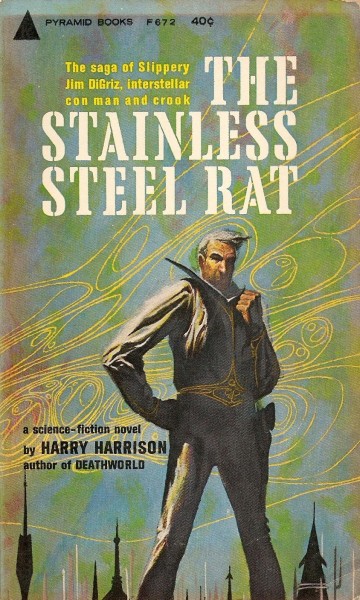
The 1961 paperback edition of The Stainless Steel Rat, cover art by John Schoenherr (click to embiggen)I was in middle school when I found a copy of Harry Harrison’s The Stainless Steel Rat in a pile of cheap used books for sale. It was missing the front cover, which I didn’t know at the time probably meant it had been stripped. When a bookstore decides that a book has been sitting on the shelf too long and isn’t going to sell, their distribution contract usually allows them to destroy the book without selling it and get a refund from the publisher. To prove that they’ve destroyed the unsold copies, the store is required to send back the covers from each book destroyed. Shipping back just the cover was cheaper than shipping entire books. This is why many books carry a warning on one of the opening pages that if the book is sold without a cover, it is considered stolen property. (Hardbacks usually are not destroyed, as they will be remaindered, specifically sold at super cheap prices at certain chain stores.)
I didn’t know that at the time. I just knew that whenever damaged books showed up at the used book store, they were sold for a lot cheaper than the others.
If my first copy of The Stainless Steel Rat was a stripped copy, it is highly appropriate, because the star of the book (and its many sequel), was Slippery Jim DiGriz, the slickest conman and thief of the 346th Century.
DiGriz lived in an interstellar society with very high technology that made it nearly impossible for petty criminals to escape prison and “psycho surgery” for long. It took a special kind of criminal to thrive in that society. As the blurb on most of the paperback versions said:
“We must be as stealthy as rats in the wainscoting of their society. It was easier in the old days, of course, and society had more rats when the rules were looser, just as old wooden buildings have more rats than concrete buildings. But there are rats in the building now as well. Now that society is all ferrocrete and stainless steel there are fewer gaps in the joints. It takes a very smart rat indeed to find these openings. Only a stainless steel rat can be at home in this environment.”
The book’s written from first person narrative, beginning while Jim is in the middle of yet another insanely daring robbery. Things start going wrong, of course, and it isn’t too many pages in before Jim realizes that the dreaded Special Corps is onto him. The Special Corps is a shadowy agency that was responsible for catching one of the greats, a thief DiGriz admired from affair, Inskipp the Uncatchable… so, of course, when Special Corps hauls DiGriz in to be interrogated by the head of operations, it turns out it’s Inskipp himself. And he has a deal for DiGriz, the same deal Inskipp was offered years ago when he was captured: join the Corps and help catch dangerous criminals, or have his brain altered…
DiGriz was chosen, just as Inskipp was, because DiGriz always planned his heists to very carefully avoid causing and physical harm to any people involved. A few of his previous operations he had even abandoned the heist when it became clear that complications had put people in danger. DiGiz’s first assignment (and the rest of the book) is to try to catch a serial killer.
But this isn’t like a gritty modern bloody serial killer story. The book is written as a light caper, with comedic bits. So the book was a romping adventure story, and far more concerned with the puzzle aspects. The character arcs and interaction are the focus, along with some humor.
It wasn’t just humor. The story explored issues of identity, free will, and what does it mean to be a member of a social species. Jim had always been careful not just to avoid hurting people, but he also always picked targets that were fully insured. He rationalized his existence as providing entertainment or spectacle. He kept security people and police on their toes and in practice. At least that’s what he told himself. Buried in that, along with his eventual confrontation with the killer, were also serious questions about privacy vs security, and control vs freedom.
So it made me think about many things. At different times in the narrative, I found myself agreeing with Jim more than I thought I would. And as I read the book again and again (because it was yet another one that I re-read many times), I found my sympathies seesawing back and forth as I considered the questions. The Special Corps protecting people from sometimes quite serious threats, but they operated in almost complete secrecy, and apparently answered only to themselves.
On the other hand, they had a number of agents like Slippery Jim, who broke ranks from time to time, and demonstrated a willingness to take down the agency if it went too far. Was that enough of to balance things out? In a real world, probably not. And it’s the kind of question still very relevant today.
In my later teens I found the sequels, and after I enthused about them to friends, someone bought me a shiny new copy of the first book for my birthday. The first few sequels cover the next several years in the life of Special Corps (occasionally rogue) Agent DiGriz… and his wife, and their eventual children. Then in 80s Harrison wrote some prequels, showing us events in the life of young Slippery Jim, how he learned his craft and became a legendary thief.
Harrison returned to the older DiGriz for the rest of the series, writing 12 Stainless Steel Rat books total before his death (the last one published posthumously). The Stainless Steel Rat wasn’t the only multibook series the Harrison wrote, but Slippery Jim was the first of his books that I remember reading, and the likable, extremely smart, and capably rogue is a character type that I became very fond of.
The book gave me another way to wrestle with the idea of my own identity. Harrison argued colorfully but persuasively for the idea that the law and customs aren’t always right. Morality and ethics have to come from a sense of empathy and a willingness to do right by people. And those were notions that gave me some more hope, as a closeted queer kid growing up among fundamentalists.










 Font Folly