All posts by fontfolly

Unknown's avatar

About fontfolly

I've loved reading for as long as I can remember. I write fantasy, science fiction, mystery, and nonfiction. For more than 20 years I edited and published an anthropomorphic sci-fi/space opera literary fanzine. I attend and work on the staff for several anthropormorphics, anime, and science fiction conventions. I live near Seattle with my wonderful husband, still completely amazed that he puts up with me at all.

An Alternate NaNoWriMo

Image of typewriter keys and the words The Alternate NaNoWriMo.
The Alternate NaNoWriMo, as proposed by Cafe Aphra.
I frequently encourage people to participate in National Novel Writing Month (NaNoWriMo), and occasionally get asked why I don’t participate myself.

Several years ago, I explained it this way: “…because I do more writing than that every month already. Examples: a few years ago I had a month, at work, to produce a 75,000 word installation manual, most of it completely new material. And I didn’t actually have the whole month, because half my work time for the month was allocated for designing covers, disc art, etc, editing all of the other documentation for the product (including the 150,000 word administration guide), updating a document in another project, and doing all the pre-press work on all the docs being written by the entire department for all the products going to press for that month. And I didn’t get most of the information I needed for the main guide until four days before the deadline. I wrote about 45,000 words in four of those days.”

Plus I’ve participated many times in Writers’ Round Robins where we work on old manual typewriters, where erasing and revising is very difficult, and you just have to keep going, keep the story moving until it reaches an end.

I have several times used the month as an excuse to do something I called GeneStoFinMo (Gene’s Story Finishing Month) instead, and was only moderately successful. This year I’m participating in The Alternate NaNoWriMo as proposed by the bloggers at Cafe Aphra. Each writer participating is setting their own goal and going for it.

My goal is to write a minimum of 1000 words every day on my current novel in progress, The Trickster Entanglement, and finish the first draft by the end of the month! I had 35,000 words done before November. If I only do 1000 words a day this month, and actually reach the end in that time, it will be only 2/3 the length of the novel to which it is a sequel. If it is to come in at the same word count as the previous book, I’ll need to write 60,000 words this month, or twice the total if I only meet my daily goal each day.

So I am going to try to exceed my daily goal as often as possible.

As of midnight of November 1, the first day of Alternate NaNoWriMo, I had completed 1305 words. Not a bad start.

Wish me luck!

Friday Links!

Today is the first day of National Novel Writing Month! If you’ve never tried NaNoWriMo I highly encourage it.

9 Rules for the Black Birdwatcher.

Wyoming’s smallest town, population 1, is set to become the birthplace of a Vietnamese coffee empire.

Surfers ride ‘biggest ever’ waves at Nazare during St Jude’s Day storm (and barely live to tell the tale).

Senate intelligence committee chair Dianne Feinstein, who has been a loyal defender of the NSA, breaks ranks to oppose US spying on allies.

“Lost World” Discovered in Remote Australia.

Creating Great Guerrilla, Sabotage and Ambient Marketing.

Op-ed: LGBT Kids In The Bible Belt Need Our Help.

I’ve had this song on my phone for six weeks… and this is not how I imagined he might make a video of it. And it’s a little freaky how a costume and facial hair change can transform someone:
.


.
And a couple of naughty songs from Mister Chase:
.

.
This is incredibly wonderful (and thanks to Rahirah for the link!)
.

Because you’re evil

The word evil and a rose.
Sometimes evil is attractive and enticing. (Cover image for “Evil” by Matt Goss.)
Most stories involve a conflict. At the beginning of the story the protagonist is confronted with a problem, an obstacle, or a riddle, which will be resolved by the protagonist’s own actions at the end, and which is the thread that connects everything that happens in between together. Resolving that problem usually involves a struggle with other characters or forces, and some sort of inner conflict.

Protagonist is another word for hero. Because we often think of the main character of the story as a hero, and because stories usually involve the hero in some kind of conflict, it is tempting to think that every story needs a villain, too…

Continue reading Because you’re evil

Plot speaks louder than words

Sometimes a story isn’t about what it says it’s about.

I’ve written before about readers who contacted me about one of my stories and believing that the opinions of some of my characters are also my opinions. They don’t understand that one can convincingly write a character who has a substantially different worldview than oneself. So just because characters say something, that doesn’t mean it is the author speaking to you.

Similarly, just because the narrator says something, no matter how authoritative the narrative voice of a story may be, that doesn’t necessarily reveal to you the beliefs of the writer. The writer may be intentionally ironic, for instance, having the characters and narrator say something which the action of the story directly contradicts.

More often, the writer isn’t trying to profess any profound beliefs, he or she is just telling you a story. Where the writer’s beliefs are revealed are in the consequences that befall characters for their actions. Which isn’t to say that stories are always intended to be fables. It’s just that when we are weaving a story, the action is going to be driven by what feels right to us, what feels like would be a reasonable outcome. And what feels real or right or reasonable is going to be determined by our fundamental beliefs.

Most writers don’t think about stories from the point of view or philosophy or morals. We have an idea about a situation, or there’s a question we’re pondering, or maybe we just think it would be interesting to put a pair of characters together and see what happens.

So, for instance, a writer might have the protagonist say something like: “It’s impossible to really understand somebody, what they want, what they believe, and not love them” while discussing his or her enemies. But if the character subsequently slaughters each and every one of those enemies without mercy, and if the reward for doing this within the story is the hero being proclaimed a hero, and so forth, well, that story isn’t about learning to love your enemies. At best, it is a demonstation of one way someone might rationalize genocide, but it isn’t about learning to love.

Of course, a story isn’t just about what the writer thinks. A story is just a collection of words until an audience hears it or reads it. So even those readers who have been mistaken about what my beliefs were, or who concluded that I was sending a particular message which was never my intent, once I put the art out there, the meaning is no longer mine alone.

If story inspires a particular meaning or feeling for you, then that’s what the stroy means to you. And what the author meant shouldn’t be relevant to your enjoyment of the story.

But if you are curious about what the writer actually believes, don’t pull out lines of dialog or specific sentences. Look at the plot. What happens to characters as the results of their actions? What kind of actions lead to success or failure? And what is the tone the story takes with those actions? Sometimes a character does what everyone agrees isthe right thing and fails anyway. Does the tone of the tale imply the failure is an regrettable tragedy or or just desserts?

That’s where you get clues to the writer’s heart.

“Why’d ya do it?”

Ant colonies in temperate regions will close off all the entrances to the colony at night to prevent the interior temperature from dropping to fatal levels. In order to properly seal the entrances, a small number of ants have to push material into the entrance and pack it down from outside. Trapped outside, they die when the temperature drops. Their sacrifice contributes to the ongoing survival of the colony, so from a genetics and evolutionary viewpoint, the death of a few members of the colony is a good thing.

Not that the ant actually thinks of that. They aren’t nobly volunteering to make this sacrifice for the rest of the colony. The species has evolved a series of behaviors in response to various stimuli, and they just do it when it’s time.

When a person like me—a very analytical guy prone to introspection, and who watches everything amd everyone looking for patterns and drawing conclusions—talks about the behavior of other people, the reasons I ascribe for their behavior are an awful lot like our academic analysis of the ants. We understand the benefit which the colony as a whole gains from the sacrifice of a few ants, but the ant doesn’t.

Most of people don’t spend a lot of time thinking about why we do the things we do. Even someone as notoriously over-analytical as me doesn’t spend much time thinking about why I’m doing something while I’m doing it. A person on the street asks me a question, and I answer. How I answer, from my tone of voice, to my body posture and facial expressions, are the result of a complicated process going on mostly unconsciously.

If I saw the person before they asked the question, likely part of my brain did an assessment of them based on how they looked and acted. I may be in a slightly defensive mode if my brain has seen similarities between them and people who have harassed me on the street in the past, for instance. I will be very defensive if my subconscious assessment has tagged them as a certain kind of prostelytizing jerk (lately more likely to be some sort of teabaggy political sort, but I’ve also been harassed by nuts of a religious variety).

I may feel quite friendly and welcoming if I recognize them—even if it is only as a stranger who has nodded and said, “good morning” when we’ve passed on that street before.

Similarly, how they behave toward me is going to be influenced by their own subconscious assessment of me based on the same sort of superficial features. I’m a short, overweight, grey-bearded white guy. Depending on the other person’s past experiences, that might mean I look harmless, or annoying, or potentially a source of unwanted attention.

So they might frown at me because I seem likely to cause them some annoyance or inconvenience. Or they may only appear to be frowning at me, but they are actually just trying to figure out what is written on the t-shirt of a person walking behind me. Or maybe they’re just squinting because of a blinding reflection from the windows on a building across the street.

So, if when they ask me a question, my tone of voice might sound annoyed or even angry, while inside I’m only aware that I’m worried that this person is going to make me late. And because I sound angry, they may give me a less than enthusiastic thank you after I give them directions to the place they can’t find.

And we both walk away thinking the other person was rude.

I try to remind myself of that when I rant about someone like the guy on the bus last week. I remember the experience from my perspective. Which has its own biases. Maybe I was the one giving off attitude and expecting other people to respect my wish to listen to my music and read my book.

Missed signals and entitlement

Otter with his paw up.
“No, thanks. I’m fine.”
Before overhearing the conversation the other night, where I heard a young man cajoling a woman of his acquaintance for not liking one of their mutual acquaintances enough to date him, I had been thinking of the many ways that we are all socialized to accept, excuse, and even enable a lot of socially aggressive behavior from guys. And also how we, as guys, are socialized to aggressively take what we think is ours.

It started at the end of a previous weekend, but I’m going to save that story for later, because it involves a topic that causes some people to stop listening and start arguing. Instead, I will start nearer the end of the week, and rant about bit about a guy on the bus…

Continue reading Missed signals and entitlement

“Why don’t you like him?”

Creepy smiling guy with "I like your hair, it smells nice"
A creepy guy meme.
I now know who the creeper/proto-rapist in my neighbors’ social group.

I was half asleep late Friday/early Saturday, when a vehicle pulled into the driveway between our building and the next one. I heard the voice of the 20-something guy that lives with his girlfriend in the unit behind us talking with several other people of both genders while they unloaded something from the vehicle with the engine still running.

As the number of voices dwindled down to just a woman I didn’t know and the neighbor (I believe she was driving the vehicle and the other friends were from a separate vehicle out on the street, perhaps?). The neighbor suddenly asks, “So are you going to go out with Adam?”

And she replied, “I don’t like Adam.”

“Why not? He’s a nice guy!”

“He always acts creepy around me.”

“Oh, he doesn’t mean anything by it…”

“I don’t like him.”

“Why don’t you like him?”

Ah! There we have it. The classic attitude guys have been socialized to have when other guys of their acquaintance sexually harass, touch without permission, and otherwise creep on girls of their acquaintance.

Otherwise known as, rape culture…

Continue reading “Why don’t you like him?”

Friday Links!

First, read this: THE BILL AND TED SHOW AT UNIVERSAL STUDIOS IS SUPER HOMOPHOBIC (AND ALSO RACIST AND TERRIBLE).

Then this: Universal Studios axes ‘Bill & Ted’ show with gay, mincing Superman.

And this: Black Teen Cuffed, Put in Cell After $350 Barneys Purchase Because Cops Don’t Believe a Black Kid Can Make That Much Money.

And this: How Texas’ Voter ID Laws Affect Women.

And then tell me again that there is no discrimination or bigotry any more?

Meanwhile, McDonald’s helps workers get food stamps. Um, instead of, maybe, paying a living wage?

Little evidence yet that Obamacare costing full-time jobs.

Undercover Seattle cop trained as drywaller to investigate abusive contractor.

Enough of the serious stuff, here’s a silly interview with Elvira, Mistress of the Dark.

Cat vs Windshield Wipers:
.


.
Stalking Kitten vs Cat:
.

.
And why do we have to wait until next year for this:
.

A Halloween playlist

Sometimes I don’t know why I try.

So, I saw in iTunes radio a new station called Halloween Party, and I felt like listening to something different, so I clicked it. First song? Stevie Wonder singing “Superstition.” Nothing the slightest bit spooky or Halloween-like about the song. Oh, sure, the word “superstition” could be related to something Halloween-like, the actual lyrics? No.

Almost any time someone posts a so-called Halloween playlist, the songs are chosen because the titles of the song have some tenuous connection to sort of scary-ish concepts, regardless of the content of the song. If you’ve ever done such a thing, I have a news flash for you: the title of a song is not the song. There are some songs whose titles don’t even appear in the lyrics, so when I’m listening to the playlist, if I don’t happen to remember the title, the reason it has been included will be a complete mystery.

Now, you have the right to create a playlist anyway you want. If you want to collect songs together with altogether incorrect criteria and name said playlist a Halloween playlist, of course you can do that.

I happen to believe that a Halloween playlist should consist of tracks where the content of the track has some connection to ideas, moods, et cetera, that people associate with Halloween, trick or treating, monsters, and so forth. So, my 2013 Halloween playlist (yes, I make a new one each year) is:

1. “Theme from the Ghost and Mr. Chicken” – if you aren’t familiar with this comedy send up of various Hitchcock-esque movie tropes starring Don Knotts, you really need to Netflix it or something. And the organ music is suitably spooky and silly, at the same time.
2. “It’s alive!” From the Young Frankenstein soundtrack. This isn’t a song, it’s the dialog for one of the funniest scenes in the movie, when Dr Frahnk-in-steen finds out that he put an abnormal brain in the body of his creation.
3. “The Homecoming Queen’s Got a Gun” by Julie Brown. “Everybody run! The Homecoming Queen’s got a gun!” and “…it’s like the whole school was totally coked or something!”
4. “Over at the Frankenstein Place” from The Rocky Horror Picture Show.
5. “”Scooby Doo, Where Are You?” Yes, the theme song from the original cartoon series.
6. “Body Snatcher” by Billy Idol. With lyrics about demons, creeping shadows, and so forth, this is where the list segues from the strictly comedic.
7. “Double Trouble” from Harry Potter and the Prisoner of Azkaban. Spooky.
8. “I Can’t Decide (whether you should live or die)” by Scissor Sisters. Includes lyrics like, ” I could bury you alive but you might crawl back with a knife and kill me” which is definitely creepy!
9. “I Can Make You a Man” from the Rocky Horror Picture Show.
10. “Dark Shadows” the original eerie, spooky, haunting theme song from the ’60s gothic horror soap opera.
11. “Rest in Peace” from Once More, With Feeling, the Buffy the Vampire Slayer musical episode. “Whisper in a dead man’s ear doesn’t make it real.”
12. “Funeral March of a Marionette” an orchestral piece which was used as the theme for the old Alfred Hitchcock show.

This year’s is silly and harkens to horror movies and horror-related TV shows. Last years was a bit different, with songs like “Zombies Ate Her Brain” by The Creepshow and “Zombie Jamboree” by the Kingston trio.

Many years my list includes “Monster Mash” or “Thriller.” Which are obvious choices, but sometimes obvious is good.

Deciding how much to tell

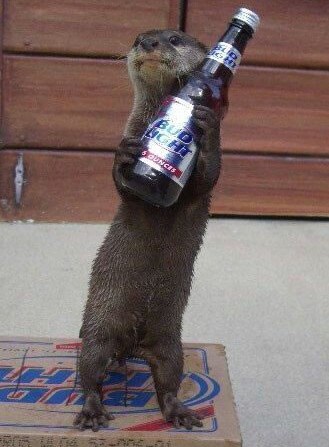
An otter holding a bottle of beer.
Now how is he going to carry the hot dogs back from the concession stand?
A few days ago my second blog post about the meaning of persecution included an anecdote about a figure of speech. The explanation I gave for the figure of speech, “caught in a suicide squeeze,” was intentionally truncated and simplified. I didn’t explain that a suicide squeeze specifically begins with having a runner on third base with less than two outs and the runner leaving the base at the same time (or milliseconds before) the pitcher releases the ball…

Continue reading Deciding how much to tell