I've loved reading for as long as I can remember. I write fantasy, science fiction, mystery, and nonfiction. For more than 20 years I edited and published an anthropomorphic sci-fi/space opera literary fanzine. I attend and work on the staff for several anthropormorphics, anime, and science fiction conventions. I live near Seattle with my wonderful husband, still completely amazed that he puts up with me at all.
View all posts by fontfolly →
Jon Pertwee was the Third Doctor (1970-74).I’m a big nerd and long-time Doctor Who fan. For years my favorite was Jon Pertwee, and not just because he totally rocked a velvet jacket, ruffled shirt, and opera cloak. I was watching years before the BBC revived the show with Christopher Eccleston playing a decidedly dark and delicious doctor. I’ve got piles of DVDs with at least some of the adventures of all the doctors (William Hartwell, Patrick Troughton, Jon Pertwee, Tom Baker, Peter Davidson, Colin Baker, Sylvester McCoy, Paul McGann, Christopher Eccleston, David Tenant, Matt Smith, and even both of the 60s movies starring Peter Cushing as a Doctor Who that was not a time lord, but traveled in a Tardis and fought Daleks).
Okay, that’s still not complete. I don’t have a DVD of Doctor Who and the Curse of the Fatal Death,in which the Doctor was protrayed by Rowan Atkinson, Richard E. Grant, Jim Broadbent, Hugh Grant, and Joanna Lumley. I’ve seen it, they’ve just never released this parody special for charity on DVD.
I am an enormous Doctor Who fanboy. In the years since many of the old adventures have become available on disc, I have reached the point where I now frequently say that my favorite Doctor is whichever one I happen to be watching right now.
Despite that, I don’t think every episode or serial has been awesome. There has been more than once that I thought the new actor cast to play the Doctor was a terrible mistake. There have been companions that I wanted to strangle, stories that made me embarrassed on behalf of the actors, endings that made me want to drown the writers (or at least shake them by the throat and yell, “That really insipid, self-indulgent pile of refuse you spewed out there could have been saved with just two lines of dialog!”).
Doctor Who and the Curse of the Fatal Death.So I’m a super fan, but not a blindly-love-anything-they-put-out fan.
I understand why I watched the announcement of the new actor who will take over the role at the end of the 50th anniversary Christmas special. I understand why I, and many other fans, may have been disappointed, or are feeling apprehensive about the new actor chosen.
What I don’t get are the people (and there was more than one being re-tweeted around the internet yesterday) who say they have never watched a single episode, and that they are angry about the actor who was cast.
The eleven official Doctors.(Click to embiggen)“Why do you care?” isn’t really the question, because they have an answer to that. They are upset that the actor cast was a white man. They wanted either an actor of color or an actress cast as the next Doctor. And I understand that, boy do I understand not feeling included when you don’t see actors who look like you in lead roles or even recurring roles.
I was not terribly happy when Matthew Smith’s casting was first announced specifically because I really wanted to see a comedienne cast. Someone like Jennifer Saunders was what I had in mind. I didn’t see any reason the Doctor couldn’t regenerate as a gal instead of a guy. Smith won me over, and I’ve been very sad since learning that he is leaving the show.
I’ve also wanted to see someone like Idris Elba or Adrian Lester or Paterson Joseph play him, because I like their work in other shows, and I don’t see why, even if the Doctor does regenerate as a dude, he has to be white.
I really do understand the diversity/inclusivity issue. For instance, even though at the time I was amazed that they let Eccleston flirt with and eventually kiss John Barrowman, I’ve grumped a bit since then at how little non-heterosexuality has been allowed (other than as a joke or misunderstanding) in the main Doctor Who show unless Captain Jack is visiting.
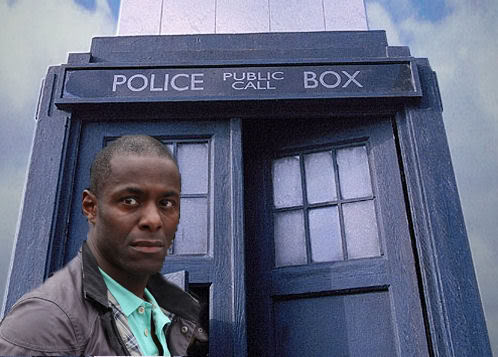
Seriously, why couldn’t Paterson Joseph play the Doctor? (Click to embiggen)So while I agree with the point that it’s disappointing that they haven’t gone outside the white dude box in the casting, I don’t understand why someone who has never, ever watched a single episode out of the 798 that have been made during its 50 year run, feels the need to express a public opinion on this casting decision.
What fuels your sense of entitlement? Seriously. I have plenty of friends and acquaintances who share your disappointment or outrage for exactly the same reason, and I sympathize with them. I share, to a lesser extent, their disappointment (not really the outrage, but I understand the outrage). I have absolutely no objection to them posting long screeds about it, tweeting about it, re-tweeting other disappointed fans comment about it, and so on.
But why expend time, effort, and bandwidth (not a lot of bandwidth to post, I know, but every one of your followers and the followers of your re-tweeters have also had to use bandwidth for this) for a show that you have never, ever watched? If you can’t be bothered to watch the show, even once, then please don’t bother those of us who have with your “opinion.”
Someone’s going to respond to this either accusing me of censorship or at the least harassing someone just for expressing an opinion. I’m not in a position to silence them, so the censorship argument doesn’t apply as a matter of definition. This is nothing to do with whether you have a legal right to express yourself. It does have to do with whether you ought to be commenting on something you’ve never seen.
Freedom of expression does not mean freedom from disagreement or from other people expressing the opinion that you are a complete and utter git.
One of my math professors began one of our classes with a lament about the loss of the word “discriminate.” She didn’t have a problem with any of the various movements to stop discrimination, of course. Having been a woman pursuing a career in science from the 1940s on, she had experienced her fair share of gender-based discrimination.
Discrimination ultimately means to perceive or distinguish the differences between things. “It’s unfair discrimination that’s the problem,” she said. “Someone’s race or gender has no bearing on how qualified someone is for a particular job. It’s perfectly legitimate to fire someone for incompetence, or for stealing on the job. In those cases you’re distinguishing between good employees and bad.”
While dictionaries still list the “distinguish between” definitions, in most modern discourse, people almost always use it to mean “an unjust or prejudicial distinction.”
When the largest ex-gay organization out there, Exodus International, disbanded recently, several of the smaller groups went into a bit of a panic. The spokesman for on the International Healing Foundation, Christopher Doyle, was right at the forefront. And then he announced that his organization, in concert with groups like the Family Research Council, was going to sponsor Ex-gay Pride in July, as a “balance” against Gay Pride. He even announced a banquet and reception at FRC’s headquarters, and so forth.
Except none of the more generic anti-gay groups he named would confirm they were attending the banquet. FRC wouldn’t even confirm that such an event was happening in their building! Next thing you know, they announced that they were re-scheduling it, claiming that they’re received death threats. Except, of course, they wouldn’t provide proof of the threats, nor could any news organization get any spokesperson from the other groups to confirm that they have planned to participate.
Doyle won’t be deterred, though. In radio interviews he repeated the charge of threats and talked a lot about how oppressed and discriminated ex-gays are.
“We want federal protection just as gays are given. Ex-gays also need to be given protection.” —Christopher Doyle, International Healing Foundation
There are several problems with that. First, at the time of this writing, gay people aren’t explicitly given much in the way of federal protections. The two big Supreme Court rulings that all the anti-gay organizations point to in this regard don’t extend anti-discrimination protection to people based on sexual orientation.
Lawrence v. Texas: struck down sodomy laws in 2003. The Court held that intimate consensual sexual conduct between adults was part of the liberty protected by substantive due process under the Fourteenth Amendment. The ruling invalidated sodomy laws regardless of the gender. Most of the sodomy laws in question in theory could have been applied to opposite sex partners (remember that the original definition of sodomy is any sexual act that can’t result in pregnancy, it doesn’t just refer to anal sex between men, contrary to popular belief), though in practice they were almost never used against straight couples.
United States v. Windsor: struck down section three of the Defense of Marriage Act. The court ruled that if a state recognizes a marriage, then the federal government must also recognize the marriage. The ruling skirted around the issue of defining exactly what level of scrutiny should apply to cases of applying rights based on sexual orientation, though it implied a level greater than the lowest level, rational basis.
Neither ruling created any federal protection against discrimination. In fact, the second ruling was written in such a way as to completely sidestep the question of whether gay rights rise to the level of a constitutional right requiring strict judicial scrutiny.
Even their decision that effectively restored marriage equality in California didn’t create any federal protection. The ruling was specifically that the anti-gay groups didn’t have standing to appeal a lower court ruling.
The second problem with Doyle’s plea is what do they need protection from? As several people have pointed out, if what they say about their therapy is true, than an ex-gay is merely a straight person. So who is discriminating against them? No one is beating them or shooting them for holding hands in public with an opposite-sex person. No one is prohibiting them from marrying an opposite-sex person. No one is denying them any legal rights at all.
When confronted with these arguments, Doyle says that ex-gays are harassed by gay people. “There are tens of thousands of ex-gays out there, but they are afraid to go public because they are harassed, and threatened, and called liars.”
Here’s the thing. Every time that an ex-gay therapist or organization has been put under oath in a court of law, they have had to admit that they don’t cure gay people. Ever. For a while they claimed a 15% success rate (which seems dismal by any standard), until they had to defend the methodology in a court of law, at which point it was learned that the one study they pointed to was of 73 patients who enrolled in the same year with one ex-gay organization. They only got the 15% rate by excluding 98 other enrollees who dropped out before completing therapy, and by defining success as “the person reports that they feel their same-sex attraction is less than it used to be.”
More recently, they admitted their success rate was less than 0.1 percent. That means that 99.9% of people who try therapy, or pray-away-the-gay programs, et cetera, are unable to change from being gay. And even then, success is defined as refraining from same-sex sexual activity, not actually ceasing to be attracted to members of the same sex.
One of the former leaders of a couple of these groups published a book chronicling a couple of case studies of young men he treated from adolescence into adulthood. The book concluded by declaring great victory in one case, naming the boy as proof that god and therapy could cure homosexuality. The problem was that the young man in question had committed suicide, six years before the doctor published the book. The young man’s suicide note indicated that all the years of therapy (including aversion therapy, drugs to deaden his libido, et cetera) and praying hadn’t changed how he felt. And he would rather die than face rejection from his family.
Hardly a success.
Just google ex-gay and see how many news stories pop up of “famous” ex-gays who have been caught trying to hook up for sex in gay bars, or using hook-up apps, or hiring young male prostitutes to accompany them on overseas lecture tours. You’ll also find stories of once prominent ex-gays having quietly left the movement and taken up with a same-sex partner.
Even a superficial attempt to research this topic will make it clear that the only living ex-gay they can name are people who now make their living entirely by peddling ex-gay therapy or working for things like anti-gay political action committees.
When you make your living selling a therapy that has been proven not to work, when you prey upon people who fear rejection from their families and communities by promising a cure that has been proven not to work, when you sell people $300+ “introductory kits” and charge them exorbitant fees for therapy sessions that have been proven not to work, you are lying.
That makes you a liar.
Pointing out the fact that you are a liar when it has been demonstrated again and again and again that you are lying is not subjecting you to unjust or prejudicial discrimination. It’s an accurate description.
If we go further and point to people like that one young man who committed suicide (and there are far, far more than just him) as a result of your failed therapy, that isn’t unjust or prejudicial, either. That’s called holding you accountable.
After canceling Ex-gay Pride, Doyle announced an Ex-gay Rights Rally in Washington, D.C. He did the arch-conservative radio circuit confidently predicting that thousands of ex-gays would show up to demand their rights.
Speakers at the big Ex-gay Rights Rally earlier this week. (Click to embiggen)They came up a little short.
And to be clear, this isn’t a picture taken from in front of an enormous crowd of the oppressed masses of ex-gay people. There was no crowd. At all.
Afterwards, Doyle admitted that only nine ex-gays attended, but he declared it a success, because those nine people overcame great fear of discrimination to bravely show their faces. He failed to mention that he was including himself and eight other employees of ex-gay ministries in that count.
They didn’t just outnumber the crowd, there was no crowd. (Click to embiggen)In the second picture I’ve included, everyone you see in that wide shot is an employee of one of the ex-gay groups, or someone there covering the “news” event. And please note, the camera crew was hired by one of the ex-gay groups hosting the event. Even Fox News couldn’t bother to send a camera man, they later ran the video shot by the organizers. The Wonkette news blog went so far as to issue an apology for its earlier story about the announcement which had predicted “maybe tens or even dozens” of attendees.
Just as accurately being described isn’t discrimination, trying to appear relevant so donations will keep coming in isn’t fighting discrimination.
I had a post about other things scheduled for today, but then I got caught up watching the live feed from city hall in Minneapolis, where same sex marriage became legal today. And I think it would be better if we all just rejoiced with these couples:
I think my favorite from the live blogs is the tweet from sometime in the early morning from a person watching at City Hall: “I’ve got this down: cheer, clap, cry, repeat.”
The flying cars vs cyberpunk dystopia dichotomy is a great example. Given how many friends felt the need to point out to me that Blade Runner, clearly depicting a cyberpunk dystopia, also had flying cars, I’m not the only one to notice this oversimplification. Flying cars and dystopias are not mutually exclusive.
I chose to into interpret “flying cars” as short hand for “utopian future which includes flying cars,” which is why I kept referring to a “flying car utopia” throughout the post. Since “oppresive cyberpunk dystopia” was clearly presented in the original meme as a contrast, I didn’t think it was much of a stretch to assume they meant the two choices as mutually exclusive notions of the future.
The issue I focused on was the age which the meme asserted one must be to have been “promised” the one over the other. I didn’t talk about what prompted so many people to think that the age assertion was reasonable.
The clear implication of choosing 60 as the cut-off was that all that optimisim about the future was only happening in the 1950s. Clearly, such shiny hope couldn’t have existed during the 1960s, when everyone was either protesting the Vietnam war, or rioting over civil rights, or dropping out and tuning in, right?
If that’s what you think the entire 1960s was like, you’ve fallen prey to a massive rewrite of the collective memory.
For instance, the first protest march against our presence in Vietnam was in 1964, but the anti-war movement didn’t become a large scale phenomenon until 1966. Even then, it wasn’t until 1969 that a majority of college campuses had seen protests.
On the other hand, major civil rights events were happening from the mid-50s. Rosa Parks and the Montgomery bus boycott were in 1955, not during the 60s. The lunch counter sit-ins and boycotts got underway in 1958 and had given way to other activities by 1960. Yes, the Freedom Rides, Selma, the March on Washington, and the horrors of Freedom Summer in Mississippi (where local authorities teamed up with the KKK using arrests, beatings, arson, murder, and more to drive out the civil rights volunteers and prevents blacks from registering to vote) all happened during the first half of the 1960s, that’s true. But there was plenty of racial civil rights unrest in the 50s, as well.
A lot of the popular culture trends that people ascribe to the 60s didn’t really become widespread until the very end of the decade. As late as 1974, for instance, most public high schools still forbade boys from having long hair. A lot of the clothing styles people think of as 60s is really early 70s.
And what about those 70s? It was all disco fever, with people snorting cocaine between dances, or popping quaaludes while organizing their omnisexual orgies, right? Well, briefly. There is a lot of proto-disco music running from the mid- and late-60s, but the first indisputably disco songs to chart in the U.S. were in 1974. It wasn’t until ’75 that disco music really starting holding its own in popularity, and not really until ’77 that it and the associated styles were dominant. And by that point, the “Disco Sucks” movement was gaining steam, culminating in an anti-disco event that was organized at a baseball double-header, but turned into a riot in 1979. Disco’s time as a defining characteristic of pop culture was only about three-and-a-half years.
Club drugs had always included both cocaine and pills such as Quaaludes, but they definitely were most strongly associated with disco for a while. And while it was true that the enormous gay dance clubs came into being—and straight people going to those gay clubs hit its peak when disco was king—New Wave was the music scene that was most accepting of bi and gay people, not disco.
Another way to look at it: it was no accident when the creators of That 70s Show began their nostalgic recreation of what being a teen-ager in the 70s was like with the week that Star Wars was released (May 25, 1977).
My point is that the entire 1950s wasn’t an idyllic, innocent Pleasantville time. The 1960s wasn’t all strife and discord and a clash of cultures. And the 70s wasn’t all a decadent time of dancing and drugs and hedonism as a reaction to all that seriousness in the 60s. A bit of each was true throughout all three decades.
All sorts of news sites and blogs and individuals have been spreading the “news” far and wide that Pope Francis said, “Who am I to judge gay people?” As if this represents a significant softening of the church’s anti-gay stance.
There are three problems with that: one, that sentence isn’t quite what he said even as a out-of-context quote; two, once you put what he did say in context, it’s pretty much the exact opposite of what everyone is reporting he said; and three, it isn’t an actual change at all.
First, what did he actually say? “If someone is gay, who searches for the Lord and has goodwill, who am I to judge?”
It might seem like a subtle difference, but there are two qualifiers in the sentence which can be unpacked in a variety of ways. What constitutes searching for the Lord, for instance? If he means striving to adhere to current church teachings that homosexuality is disordered and sinful, then that right there means that the kindest spin you could put on what he said is, “Who am I to judge ex-gays?”
Second, what was the context? The pope was responding questions from reporters about a person who was recently hired to sort out problems at the Vatican Bank, but there are allegations the person was involved in a gay relationship a decade ago. And while repeating that homosexuality is a sin but gays shouldn’t be marginalized, he made the above comment, and then went on to chastise the reporters from bringing up someone’s past sins that are behind them. Once again, the kindest way one can interpret the statement in context is either “Who am I to judge ex-gays?” or “Who am I to judge people who are discreet?”
Third, it has always been the case that the church overlooks the past sins of its own people in leadership positions, so long as they make a token statement that they won’t do it again. That’s why there are all those thousands of pedophile priest scandals out there, for goodness sake! And it has always been the case that the church overlooks homosexuality among its own clergy so long as they deny it or pretend to hide it (Pope Benedict XVI, for instance).
In full context, keeping in mind that he began the answer with a sort of bizarre observation that no one has ever handed him their business card with the business card proclaiming the person to be gay, the statement isn’t even really about either sexual orientation or sexual activity. It is about whether a person is closeted. It’s the same song-and-dance haters always retreat to when confronted about either their bigotry or a seeming double-standard: I don’t care what someone does in private, why do they have to flaunt it?
Even the section of the answer where he mentions the church teaching that calls for homosexuals to be treated with dignity and not marginalized doesn’t earn him any tolerance points. That line has been repeated whenever the church unloads a new condemnation of gay people, gay rights, and so on. It was even mentioned by that Bishop last year in his statement about a bunch of pedophile priests whose crimes the church (under his watch) had covered up when the Bishop blamed all those crimes on the homosexual nature of the children whom the priests abused.
So, no, I don’t think this qualifies as a softening of tone. And it certainly doesn’t signal any new kind of tolerance. And it most certainly doesn’t count as a baby step.
What would count as a baby step? Here’s one, and it really wouldn’t be that difficult. I wish that this pope would take a page from an American priest who spoke up last year at a county commission meeting where the public was weighing in on a proposed gay rights ordinance. The priest said that the church’s teaching on the matter should not be taken into account on an ordinance. “We do not have authority over people outside our own flock,” he said. A baby step would be for this pope to say the church would stop weighing in on such matters of civil law. That the church would stop trying to prevent governments from decriminalizing gay activities. That the church would stop trying to get laws passed banning gay people from adopting. That the church would stop trying to keep the law from recognizing marriages between same sex couples.
The church doesn’t have to approve any of those things in order to stop trying to blackmail lawmakers into enforcing its disapproval by means of the law. The church doesn’t approve of divorce, but it long ago stopped trying to pressure governments into outlawing it. The church doesn’t approve of divorced people remarrying, but it long ago stopped trying to pressure governments to outlaw such marriages. The church considers children born to remarried couples as illegitimate, but it doesn’t pressure governments to label children that way, nor to deny the children of a remarriage Social Security benefits if the remarried parent dies, for instance.
Seriously, when was the last time an Archbishop directed priests to deny communion to law makers who didn’t vote for laws to declare the children of remarried parents illegitimate?
Treating gay people and gay relationships the same way that it treats divorced people would be a baby step. It wouldn’t be approval. It wouldn’t be a change of theology. It would be a simple admission that the church doesn’t have the authority to enforce its doctrine on people who are outside of its flock.
As a writer, sometimes you want a character to be mysterious. In good writing this mysteriousness should either further the plot, or speed along one or more of your main character’s emotional arcs. Sometimes, the character just is mysterious because that’s how she or he first came to you, the writer. Whatever the case, once introduced, a mysterious character must be handled with care.
Hulk #181, Nov 1974, first appearance of The Wolverine. (Click to embiggen)Back in 1974 I stopped at the only drugstore in town and looked through the comic rack. This was my only means of buying comics, and while I was a fan, I wasn’t able to follow anything very faithfully because which comics came into the store from month to month seemed to be completely random. That I was a middle school student, with limited funds and easily distracted didn’t help.
Anyway, there hadn’t been an issue of Hulk in the rack in several months, so I had missed the previous few issues, and I didn’t know how the story line had gotten to this point, but there the Hulk was, and some strange guy in a yellow and blue costume seemed to be fighting him. Of course, I bought the issue. We didn’t learn much about this Wolverine guy in this issue. He apparently worked with the Canadian government and had been parachuted into the wilderness to try to stop the Hulk from rampaging, or something like that. Note the text in the black arrow on the cover: the world’s first and greatest Canadian super-hero!
Note that this is not an X-men comic. In 1974 the X-men were on hiatus. Their magazine was being printed, but it was reprinting stories from the 1960s, for reasons that must have made sense to an accountant, somewhere. The team had never been terribly successful before that. It would be a couple more years before the team was Re-booted (though we didn’t use that term back them), with a lot of new members and only a few of the old, and Wolverine began his off-again, on-again relationship with the X-teams.
For a long time he was a cool character precisely because he was mysterious and always seemed very reluctant to get involved with other people. It’s not exactly an original character type, but generally it worked pretty well. He’d come to help with a specific problem for reasons that weren’t always entirely clear, be gruff and business-like and morally ambiguous, betray a glimmer of affection or respect for one or two characters, then disappear for awhile, only to turn up again and repeat the process.
The problem with mysterious characters is that, if they catch the reader’s attention, the reader wants to know what’s behind the mystery. A writer may keep tantalizing and teasing readers for a while, dropping hints here and there, but you have to be careful, because there’s an extremely thin line between tantalizing and annoying to the point of wanting to take the writer by the throat and squeeze the life out of them.
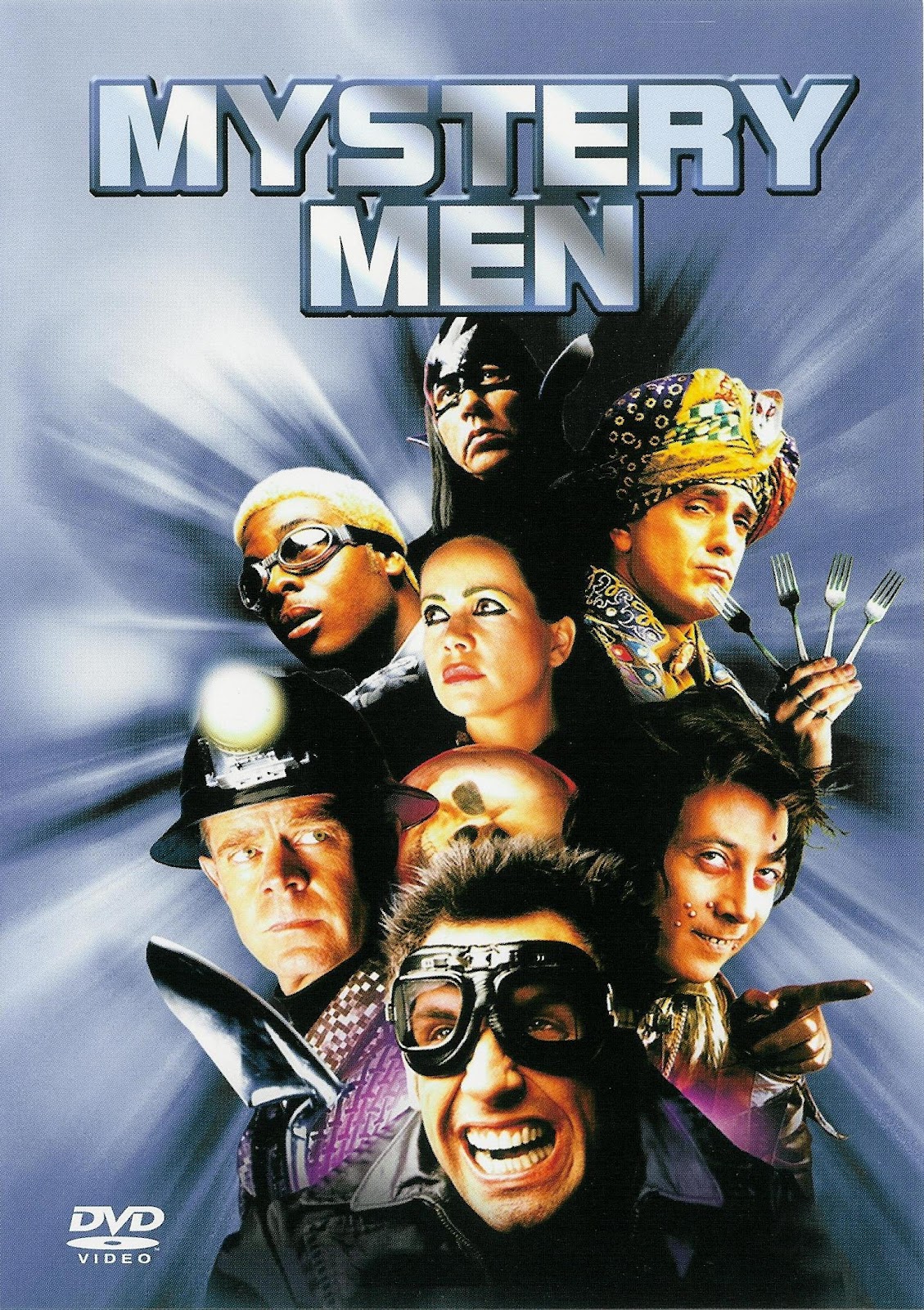
The Sphinx – so annoying, you want him to die.The latter type of annoying character was rather nicely parodied in the moveie, Mystery Men, in the person of the Sphinx. He tries so hard to be cryptic that he’s transparently shallow. His wisdom doesn’t even come up to the level of bad fortune cookies. He’s not just mysterious, he’s “well, terribly mysterious,” as the Blue Raja is at pains to tell his colleagues more than once.
You don’t want your mysterious character to turn into the Sphinx.
Mystery Men – one of the greatest movies of all time. (Click to embiggen)There comes a point where a writer decides to show the reader the truth, to whisk off the shroud of mystery and intrigue, and reveal all. This can go badly. And in the case of the Wolverine, in both comics and movies, has gone, not just badly, not just very badly, but terribly badly.
One problem is that the revelations have been contradictory. Subsequent attempts to make the revelations less contradictory pushed his backstory into pure ludicrousness. And his characterization has consequently become worse and worse. He’s a loner, except that he’s joined pretty much every team Marvel has ever published. And has picked and consistently abandoned a disturbing number of adolescent female protegés/sidekicks. He’s supposed to be a highly skilled assassin, except he’s a chaotic brawler. He’s supposed to be an honorable Samurai (with all the training in the ritualized combat/politics of same), except he’s also a savage killing machine. He’s amoral, except he’s noble and self-sacrificial.
Now, when a character is appearing in a series, and written over a number of years by different writers, this sort of thing might appear to be unavoidable. Except that it doesn’t have to be. Batman, for instance, has a much longer publishing and movie history (first appearance in comics in 1939, first movie in 1943 {a delightfully cheesy serial that I happen to have a copy of, if you want to watch the WWII era special effects and dumb cliffhangers}), but despite all those reboots, retellings, et cetera, the central core of the character has been kept intact: witnessing the murder of his parents as a child, he obsessively trains and studies, eventually becoming a dark detective and vigilante who prowls Gotham at night, foiling criminals and bringing the worst to justice. At various points they’ve wandered into the quite campy, to the darkly romantic, and other odd places, but all of the writers have managed to bring the character back to that core.
I’m working with a mysterious character in my current novel in progress. The previous novel, to which this is a sequel, also had a mysterious character—one of my two protagonists. But she wasn’t a dark, brooding person with hints of a tragic past. She’s one of the most cheerful and optimistic characters in the whole book. There were simply mysteries about her from the beginning, hints were dropped here and there, until during the big battle at the end (it’s a light fantasy with epic fantasy tropes, so there has to be a big battle!) a chunk of the mystery was revealed. It was not revealed in a big bunch of exposition. A crisis was reached, and in an act that resolved her internal conflict at the same time as saving one of her comrades (and temporarily thwarting the big bad), her true nature was revealed. I think it worked. It is currently in copy edit, and does not yet have a publication date, so I will have to wait for the readers’ verdict.
I’m a bit more nervous about the mysterious character in this one. He’s specifically hiding his identity for reasons that are both in character and important to the plot. He’s not a protagonist, he is helping one of the protagonists. Because he is specifically hiding his identity, and because his sub-plot is built around trying to protect a young woman who various people want dead, a lot of his scenes tend to be dark, grim affairs. I hope, when his identity is revealed, that the reader goes, “Oh! Oh! Why didn’t I realize that? Of course it’s ______!” rather than, “Yeah, yeah, we saw that coming a mile away…”
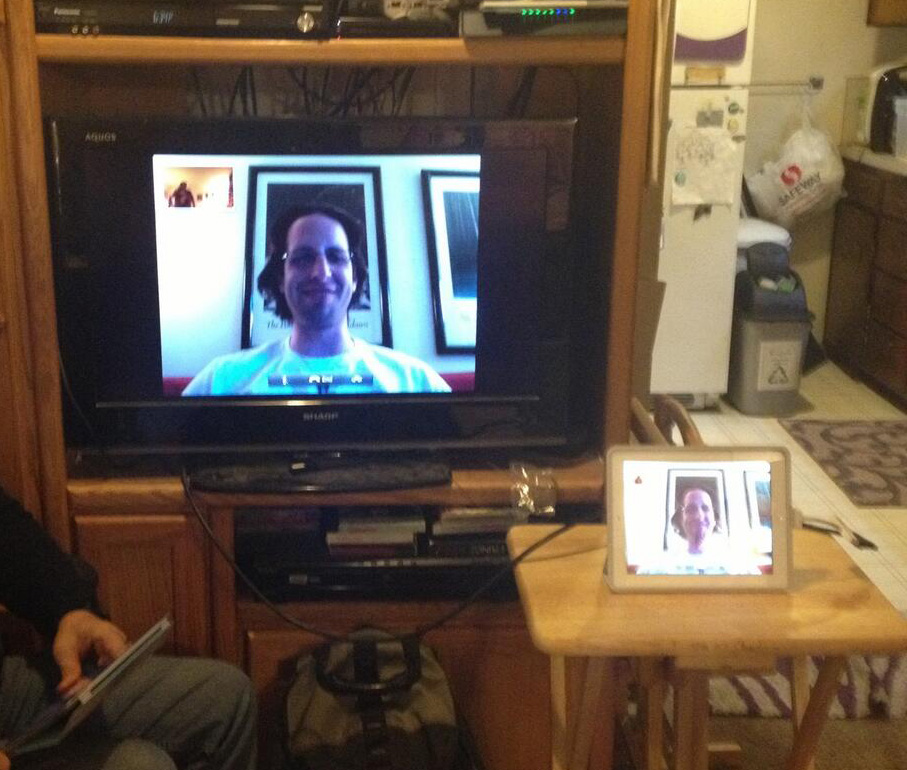
Jared attending an editorial meeting via FaceTime. (Click to embiggen)I like living in the future.
We had an editorial board meeting last night, and it being busy, crazy summertime, we almost didn’t have quorum. Fortunately, Jared was able to join us via FaceTime. We’ve done it a couple of times before, propping up my iPad so the person could see most of us. Chuck thought we should do it on the big screen, and I almost never hook the iPad up to the TV, so we did.
Now the future hasn’t quite turned out as we were promised. If I mention “flying cars” certain people will snarkily repeat a meme that’s been going around lately. The first variant I saw was, “Unless you’re 60 or older, you weren’t promised flying cars. You were promised an oppressive cyberpunk dystopia.”
That’s simply wrong, on many, many levels. The “we were promised {fill in the blank} in the future!” is a reference to things we learned during our childhood from popular culture about what the future would be like. The first appearance of cyberpunk, in any way, shape, or form, was the 1980 novel Web of Angels, by John M. Ford. Therefore, a person who is 59 now, would have been 26 years old when the first hint of a cyberpunk dystopia could have appeared in any popular culture. Twenty-six is not childhood.
The Jetsons, broadcast Sunday nights from 1962-63, reruns Saturday mornings from 1964-73.I’m still a half-dozen years below 59, and I can assure you that my childhood pop culture did, indeed, promise me flying cars.
The Jetsons was the first show to be broadcast in color on ABC-TV. A cartoon set 100 years in the future, the show ran during primetime beginning in 1962. That’s right, it was not meant to be a children’s show. After it complete its primetime run, the existing episodes were re-run as a Saturday morning cartoon for nearly 10 years. The screen shot is a frame from the opening seconds of the opening theme song of the show. Right there, flying cars. The show depicted a fairly utopian future, with robot maids, devices that could create an entire new outfit, on your body, in seconds, and so forth.
If your childhood included any of the years from 1962-1974, you were, indeed promised flying cars. If we assume one needs to be a minimum of four years old to recall a television series, that means anyone 43 or older can legitimately claim that The Jetsons, at least, promised them a utopian flying cars future.
Jonny Quest flying in a jet pack (some of his villains had flying cars).That time period also included the iconic TV series Lost in Space, the original Star Trek, and Johnny Quest. Not to mention such films as 2001: A Space Odyssey. They didn’t all have flying cars (some had transporters—even better!), but their futures are each the opposite of an oppressive cyberpunk dystopia.
But let’s loop back to that first cyberpunk book. How many people who know what cyberpunk is have even heard of Web of Angels? Most people think of cyberpunk as beginning with either Blade Runner (1982) or Neuromancer (1984). And while Blade Runner is the greatest movie ever made, bar none, the sad truth is it didn’t do well in theaters the first time, and didn’t start developing a cult following until it started appearing on cable in late 1983. So I’m going to say that the beginning of the switch-over to cyberpunk dystopias becoming dominant in pop culture was 1984.
That means 1983 is the last year in which the flying car utopia was promised as a future to kids, so anyone who was at least four in 1983 would be the actual cut-off age, rather than 60, so that means the meme should state: “Unless you’re 34 or older, you weren’t promised flying cars. You were promised an oppressive cyberpunk dystopia.”
Marty McFly, trying to get back to the future…But wait! That calculation assumes a very simple binary situation. Cyberpunk dystopias became one possible future in 1984, but it wasn’t the only one. Because in 1985 we got Back to the Future! While the movie primarily follows the adventures of our young hero, Marty McFly, trapped in the 1950s in a time traveling car, trying not to screw up his own future before getting back to his own time. At the end of the movie, Doc Brown goes 30 years into the future, and then comes back, showing off a much upgraded version of the time-traveling car. So, as my friend, Matt, pointed out, if your formative years include Back to the Future, then not only were you promised flying cars, you were promised time-traveling fusion-powered flying cars fueled by household garbage!
So, no, we were promised flying cars!
I’ve had more than one person bring up the fact that Blade Runner had flying cars. I know that. When I said that Blade Runner was the greatest movie ever? Implicit in that statement is the fact that I owned several different cuts on VHS back in the day, and I watched at least two of the tapes so many times that they wore out. I am well aware of the flying cars in Blade Runner. But as I explained on Twitter, the invalidity of the assertion of a dichotomy between flying cars and cyberpunk dystopias is worthy of a posting of its own.
Several years ago I was laying in a bed at the emergency room. The doctor who had triaged me was fairly certain it was my appendix. A nurse had been tasked to draw blood for some tests. So I told her what my regular doctor said I should always tell someone about to draw my blood: “My veins are troublemakers. They roll. They collapse. They move. They hide. The secret is to ignore the ones you can see, and go for Old Faithful here that you can feel, but can’t see.”
“Uh huh,” the nurse said. And proceeded to stick me about a half dozen times in that arm, move to the other arm to repeat it, move back to the first arm to try a couple more times before, in a very exasperated voice asking, “What was that advice, again?”
She got it on the next try. She apologized profusely.
A bit later, just as another nurse was giving me the pre-anesthetic prepping me for surgery (it was the appendix, and they got it before it burst, but only just), she came back to apologize again. “I just found out from one of the other nurses that your G.P. is Dr. Cahn. Dr. Cahn put himself through college and medical school working as a phlebotomist. Most doctors know nothing about drawing blood, and are always giving bad advice. I’m really sorry.”
Some years later I gave the usual advice to a lab tech about to draw my blood, and he said, “Oh, don’t worry about that!” A second later he said, “See! Got it on the first stick…” and his voice trailed off, because it was true that blood had started to flow into the first test tube right away, but it had suddenly stopped, before he could finish the sentence. He also apologized profusely for ignoring the advice, and then spent several minutes trying to follow the advice so we could get on with it.
I have lots of stories like these. Occasionally the people tasked with drawing my blood listen, but far more often, they don’t.
Once a year I see a specialist to evaluate my meds. The usual routine is that I go in for lab work, where they draw about 7 tubes (All different sizes with different color-coded tops; I used to be able to rattle off the colors, but a few years ago there was a change in the color-coding system and I haven’t quite got the new ones down). Then, three to five days later, I have the appointment with the specialist where she goes over the results, asks a lot of questions, we discuss some things, and so on. Occasionally she gives me a list of things to talk to my regular doctor about.
When I went in on Monday to get the lab work, I recited my usual advice. The woman listened to me, asked a couple of questions, then went to work. She spent a lot of time feeling around my arm before deciding she was ready to pick up the needle. It worked perfectly the first time. It was great.
I saw the doctor later in the week. I’ve been on the same meds for a long time, and everything has been nice and stable. This time there was one thing she’s a little concerned about. She immediately amended that to, “I don’t think it’s worrying, but I want to be certain we don’t need to be concerned.” So she ordered more tests, telling me to stop at the lab on the way out.
I got a different woman. I told her my advice. She laughed, “That’s what I do with everyone,” she said. “Lots of people who have the tricky veins don’t even know it. I just assume everyone has tricky veins. I never thought about calling the deeper vessel ‘Old Faithful,’ though. I like that.”
Opening the Skies to Everyone “…I have long advocated that the best way to hook someone on astronomy is to get them outside, and get them to look up. People see the stars all the time, but they don’t see them…”
Time at your own pace You may be familiar with the web comic, xkcd. Months back they posted a single panel black and with image of two stick figures on a slope. Not caption, no word balloons. If you hovered your mouse over the image you saw the alt-text said “Wait for it.” It took a while for people to figure out, but it slowly changed. It is an animated story posting one frame an hour. The first link will take you to a page the has all 3000+ frames gathered together. You can press play and watch it go. It will pause automatically at the frames that have word balloons. Or you can use the controls on the right and go through at your own pace. It’s very cool, with an interesting story. And it hasn’t come to an end, yet!








 Font Folly