I've loved reading for as long as I can remember. I write fantasy, science fiction, mystery, and nonfiction. For more than 20 years I edited and published an anthropomorphic sci-fi/space opera literary fanzine. I attend and work on the staff for several anthropormorphics, anime, and science fiction conventions. I live near Seattle with my wonderful husband, still completely amazed that he puts up with me at all.
View all posts by fontfolly →
Gold Dust Applejack, from Equestria Rags.Yes, I’ve already posted a con report. Plus a couple of other blog posts related to the convention. But I always have more to say, and in this case there are some photos I still want to put up.
I’ve mentioned before my friend, Joi, who makes these fun rag doll ponies. She makes them from scraps. Her rules are that she only uses fabric from scrap bins, remainder piles, and thrift stores. So she finds fabric and says, “Oh, that would make an interesting Twilight Sparkle,” or what-have-you. She makes ponies based on characters in the series, or on original characters (by way of commission), and she makes ponies based on other things. I’ve seen her make a pony version of Carl Sagan, the classic Roman poet Virgil, Neil Gaiman’s Death, or the Mars Curiosity Rover. And she sells them online at Equestria Rags.
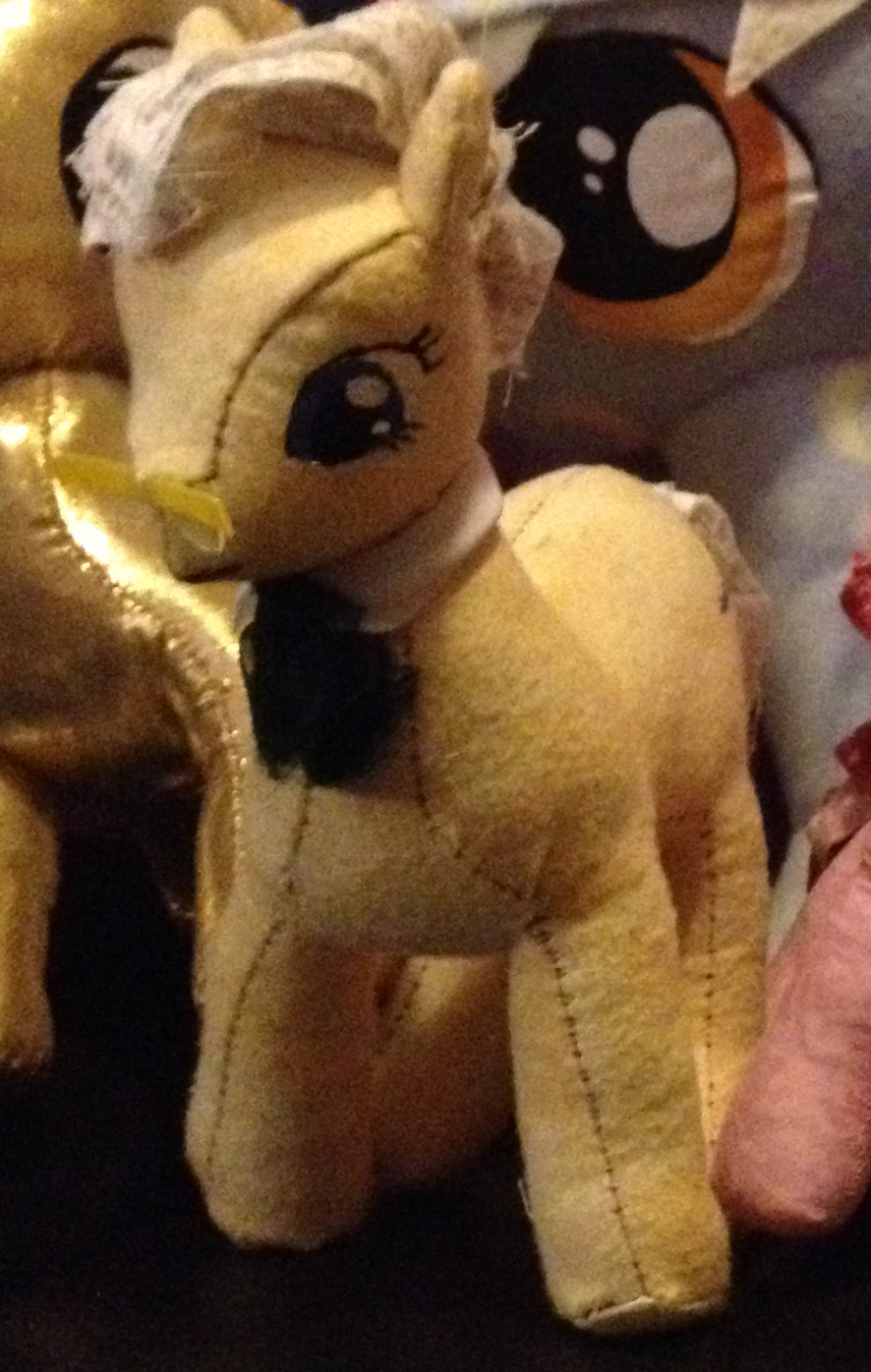
The Mayor Mare pony by Joi.The first pony I bought from her wasn’t for me. It was a pony version of Mayor Mare from the My Little Pony: Friendship is Magic series. I had to plead a bit, because it was one of her early models where she was still figuring out how to make ponies, so she hadn’t started selling them, yet, and hadn’t planned to offer it for sale. But I really wanted to give it as a present to my husband, and I talked her into it.
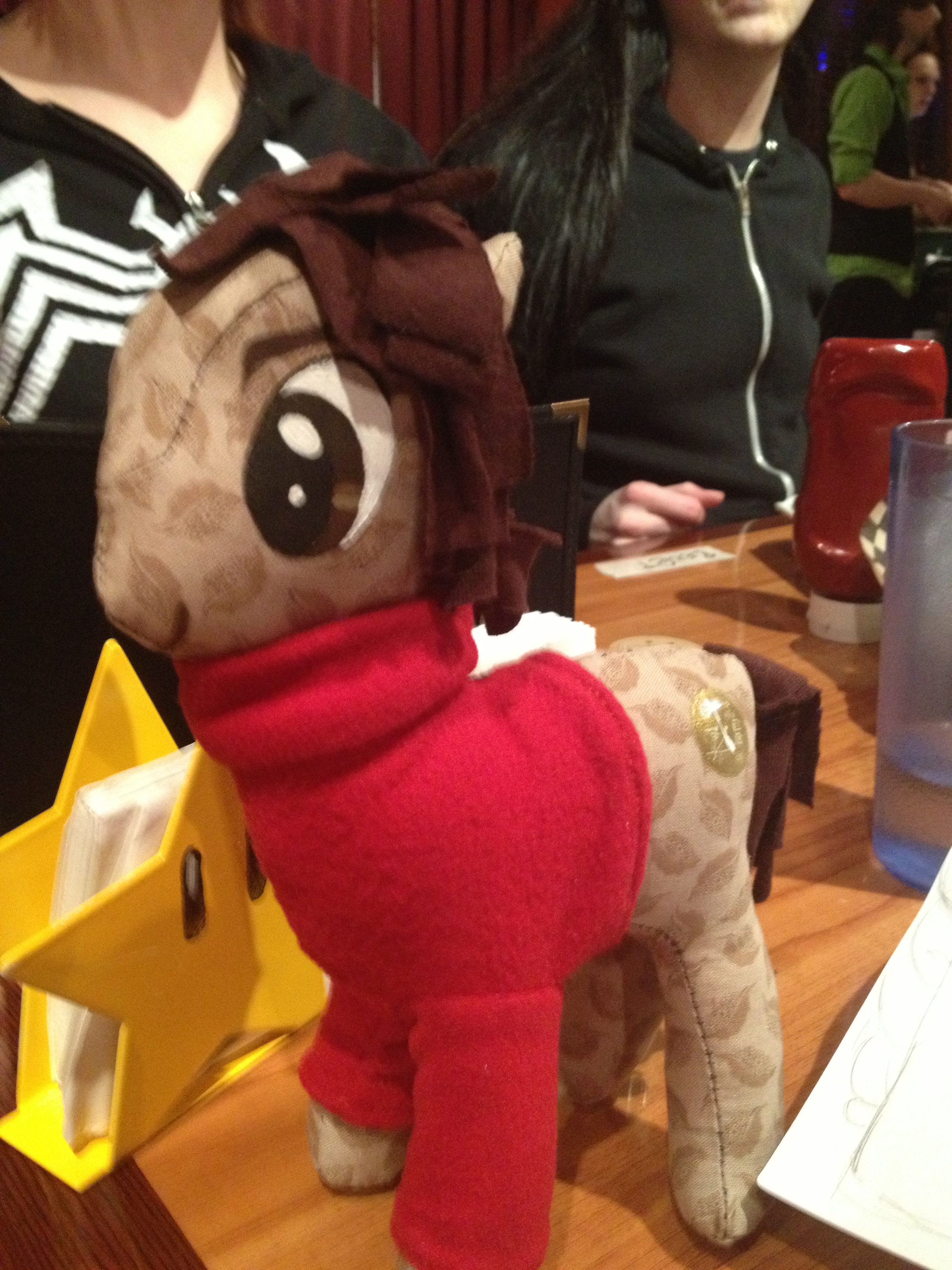
A pony version of Carl Sagan that Joi made for Jared for his birthday.We’ve bought more ponies since.
A few weeks before the convention, she posted pictures online of a new pony she had just finished: Applejack made from gold lamé-style fabric.
Of the characters on the show, Applejack is my favorite. Or most-favorite, since I’m the kind of person who always winds up with about five or forty favorite characters in any book or series that I get into. Anyway, of course I wanted to buy Applejack in shiny, shiny gold! Who wouldn’t?
But she was one of the ponies Joi was making explicitly for the convention. To be a successful vendor at any convention, you have to have a variety of stock. Since these are handmade (hand cut, hand stitched, hand painted, et cetera), each one is a serious investment in time. Since she makes them from scraps, that means it is very unlikely she’ll be able to make multiple ponies exactly the same.
I wanted that gold Applejack. But I also wanted her to have a successful sales experience at the con. So I had to wait until the convention to buy her, and technically I had to wait until the Dealer’s Room opened.
Squeaky Derpy was tempting me all day.I had planned to just stand in front of her table starting a few minutes before the room opened (since I would be inside setting up my own table), just waiting there with money to hand her. This was before we discovered that we were at adjacent tables. Because of where we were, getting in and out from behind our table meant climbing over other people, so it would have been a bit awkward. At the two minutes ’til ten a.m. mark, I asked her if she was going to make me go to the other side of the table. She laughed and said we could just do the exchange now.
So for the rest of the day I had my golden Applejack on my table as a second mascot and to show folks. I had to tell several people she wasn’t for sale, but that Joi had lots of other ponies right there, and she takes commissions.
While sitting at my table, getting some writing done and occasionally selling buttons and pony toys to people, I kept watching a cute version of Derpy Hooves (a supporting character from the cartoon series) that had a squeaker. The squeaky fruit bats and ponies that Joi had were very popular. People kept squeezing them to show their friends while deciding which one to buy. I had already abused my position as a Vendor to buy one of her ponies out from under customers. And she was selling well. I figure the more people who buy her things and tell their friends, the more business she’ll get online, right?
Ponies I’ve gotten from Joi: Bedtime Derpy in the back, then (l to r): Gold Dust Applejack, Mayor Mare, Pinkie Pie, Gift Applejack, and Squeaky Derpy.Michael and I also already own a lot of plushies: scores of teddy bears, tigers, otters, ponies, and so on. We didn’t really need more, right? But when I asked Michael in the evening whether it would be okay for me to buy another pony to take up room around the house, he said fine. So the second morning of the con, when I saw that Squeaky Derpy was still there, I asked if I could buy her. Which meant I had two Derpies as mascots on the table Saturday.
It’s an addiction, I know. But I ain’t going to rehab! (And these are just the ones I’ve acquired. My husband also has several!)
This is a beautiful short film, amazingly written by a 17-year-old. I don’t want to spoil it. So I’ll put my comments out of sight. Don’t read them until you watch.
The table I was sharing with Edd (MU Press) at EverfreeNW 2013.I had a lot of fun at EverfreeNW. As mentioned earlier, I spent most of the time behind a table in the “Vendor’s Room.” I’m used to the place where people sell stuff at a con being called “Dealer’s Room” or “Dealer’s Den.”
My half of the table was selling buttons, small My Little Pony: Friendship is Magic toys, some MLP:FIM coloring and sticker books, a couple of pony-themed bumper stickers, and a few of the most recent publications from the Tai-Pan Literary & Arts Project.
Joi was at the next table, selling rag doll ponies.We drove down and checked into the hotel midday on Thursday the 4th. Our friends Jwyl, Sky, Anthony, RJ, Wendy, and several others (I don’t remember how much of the gang was actually there at that time) were hanging out in the lobby of the hotel so they could see people as they arrived.
The convention was happening at the Seatac Hilton, but several of us like the Marriott next door better. So a bunch of us took rooms there. It was like having our own convention within a convention. We discovered that there was a gaming convention going on at the same time in the Marriott, so both places there were lots of people walking around the hotel wearing badges on lanyards around their necks.
A close up of Bedtime Derpy.When I had assembled our merchandise into a display the weekend before the convention, I’d put a super cute plushie pony I’d purchased from Equestria Rags on top.
Our friend, Joi, is the genius behind Equestria Rags, and she was sharing a table with Sky in the Dealer’s Den. I made up a little sign that identified the doll as Bedtime Derpy, made by Joi, and encouraging people to go see her table. I thought that 1) Bedtime Derpy is just too cute not to be seen, 2) it would be a way for me to direct people to Joi’s work, and 3) if someone with a kid expressed interest in the doll, I would be willing to part with her, because I really think she needs to be held and cuddled by a child.
Nami, Sky, and the back of Xen’s head. View from behind the tables.The only problem with my brilliant plan was that I had completely forgotten that Sky and I had both asked, on our Vendor Applications, to have our tables next to each other. So if anyone was at my table, they were likely already looking at the ponies on Joi’s table. Oh, well, I still had a lot of fun getting people to hug Bedtime Derpy and look more closely at the rag doll ponies.
We brought my large format printer in case Sky or some of our other friends needed to print more prints or buttons. I have an Epson color inkjet that will print sizes up to 13″ by 19″ posters. I didn’t realize until we were unloading the car that I have forgotten to pack the extra ink cartridges. But we’d come down a day early, and since it was a holiday traffic had been clear, so while Michael went off to work in Con Registration, I drove back home and grabbed a few other things we’d forgotten. And Sky did need to make some new buttons, so it was a good thing.
Anthony goofing off in our room.The weather wasn’t really hot, which was a big improvement over last year. But it’s warm, sunny, and high pollen season. When you combine that with sleeping in a hotel room, which always make my sinuses either dry up and ache or clog up and ache (I always assume it’s the mostly closed-system air conditioning that does it), I often feel as if I’m coming down with a cold when I’m at a con. Other people get sick after they come home, but usually not me.
The coming down sick feeling was especially bad on Saturday. I was getting cranky. My head, sinuses, and throat hurt. My eyes were itchy. And I was dozing off at the table. I was convinced I was sick. Anthony was trying to organize a run to a restaurant he liked, but we didn’t have enough transportation for everyone, and I just wanted to go curl up in bed and die by that point. So, Michael got me up to the bar at the Marriott. We’d eaten a few meals at the Marriott restaurant, and I’d been disappointed that the burgers and sandwiches I liked from earlier stays weren’t on the menu. They were on the bar menu, now!
So, I ordered soup, the Oregon Bleu Burger, and a coffee nudge. People keep asking me what a coffee nudge is. I can never remember: it’s coffee, some kind of booze, and whipped cream. And it’s really nice to drink when you’re feeling sick. According to the interwebs, a coffee nudge usually has brandy and dark creme de cacao, and sometimes coffee liqueur. I essentially inhaled the soup and the nudge, and felt a lot better.
Xen as Ninja Fluttershy at AFK Tavern.Members of the gang that I thought were being ferried to the off-site restaurant started show up at the bar and joining us. I learned that our friend, Nami, had never had a coffee nudge, and since I was about to order my third by that time, talked her into trying one. She seemed to enjoy it.
One of the only pics I got of Jared, shooting between a bunch of people.As usual, I’m always forgetting that I have a camera in my pocket all the time, so I didn’t take many pics. I’m especially irritated that I didn’t get pictures of several of our friends.
Jwyl spent most of the weekend down in Oregon visiting Katrina and Terry. Then Katrina and Jwyl drove up and joined us for the last few hours of the convention, and more importantly, the excursion to AFK Tavern. Even more people came up from the con for that this year. Which is cool, but made it difficult to actually enjoy any one’s company at the tavern.
I know several folks left early because it was just too crowded, too loud, and some folks had other problems related to those things. I’m not as much of an introvert as some of our friends, but the whole thing got to be a bit much for me, as well, so Michael and I left early, too.
It was a fun convention. We sold pretty well. Several of our friends sold a lot of stuff. A few of us have begun to more seriously conspire to have a book to sell next year. Yes, I’m planning on coming back. I hope a bunch of our friends are, too. Jwyl at the center of things at AFK Tavern.
Anytime a group of geeks get together, they wind up exchanging tech support horror stories. Whether one has ever worked in a tech support type job or not, if you are a geek, there have been times when you’ve wound up helping a non-geek out of a bad situation which they created for themselves through ignorance of, ultimately, basic laws of physics.
For instance, on the bus this last week, a couple with a baby in a stroller got on in front of me. It was clear they were both bus newbies. They headed back looking for some empty seats, with space for the stroller.
This was a double-length bus, which means it is a normal bus pulling, essentially, a second bus’s worth of seats. The two pieces are joined in the center by the section that bends and flexes. The walls are accordian-style rubber, the floor consists of a round section which turns as the front half of the bus goes around the corner, then starts to straighten again as the second half follows it around the corner.
They put the baby and the carriage right on the flex. A place which, as soon as the bus took a right turn, would cease to exist temporarily. Anything in that space would be crushed between a row of seats in the front half, and a single seat mounted on the rotating part of the floor.
Crushed.
So I quickly told them that that was the part of the bus that flexed, and it was not a good place to put a child. They moved back to a different spot.
A lot of people think of geeks as computer techs, but being a geek is about being fascinated with how things work. Whether it’s the mechanics of how a pair of connected vehicles behave going around a curve, or the physics of moving a heavy weight up on incline, or how electronic devices communicate with each other, it’s all a subset of “How does it work?”
In my early days in the tech industry, I worked at a small start up. My official title was a vague Coordinator position, what I actually did was supervise the production and shipping department, write and design all the technical documentation, test some of the hardware and software, help the less tech-savvy employees with computer problems, and then fill in anywhere else as needed. Which included one day a week taking tech support calls from customers while the tech support department had their weekly meeting and training session.
We produced voice messaging/auto attendent systems back at a time when most offices still had typewriters rather than desktop computers. Our systems, which ran on a dedicated desktop computer running DOS (this was years before Windows existed), would connect to a small-to-medium company’s internal phone system in various ways. And we had a lot of tech support horror stories from our customers.
There was the customer who kept turning off the “fan box” because he didn’t think the room was too hot, and couldn’t figure out why the system stopped working. He kept forgetting that the biege-colored metal box that the “TV thing” sat on was the actual computer. And I hasten to explain that this guy was president of a company with a few hundred employees. He wasn’t the employee in charge of the equipment, he just had this bad habit of wandering around in the evening after most of his employees had left for the day, turning things off to save electricity.
But one of my favorites is about fundamental physics, though it didn’t seem like it at first.
A lot of those phone systems back then (and a lot today, because a lot of those medium-office size switches are simple enough electronic systems that they work just fine decades later) use a couple of serial (RS-232) ports for programming and data exchange. You’d plug dozens or more standard phone lines in to connect all the phones, but for other things you’d use the data port. They were originally designed for someone to hook up a dumb terminal or teletype to program and monitor the phone system, because this was back when what laptops did exist often cost more than a relatively new car.
Our system could connect to those ports as well as a couple of phone ports to do all the call transferring and message taking and so forth. But often it wasn’t convenient or even possible to set up the computer running our software right next to the switch. So we recommended a particular 100-foot long RS-232 cable in case the systems had to be really far apart and you needed to run the cable around something.
The one we recommended had really good, clean signal because the individual wires were thicker than in cheap cables (wider diameter wire means lower resistance to electrical signal, for one thing), with really thick, durable insulation, so the cable wouldn’t be ruined simply by being stepped on a few times.
We strongly suggested that the systems be set up as close together as they could and to use a shorter cable, just because it was easier.
We had an experienced dealer who had sold one of our systems in a larger office with one of these systems that needed the serial connector, and they had ordered one of the 100-foot cables, because they thought they would need it. They set everything up, but when they were testing the system, things weren’t working right, and it was doing it in an inconsistent way.
The cable used had 25-pin connectors, whereas the phone system used 9-pin, but adaptors for that were usually reliable. The computer had one of each type, for a while we thought they had enabled the wrong port on the computer. Ports were tested, software was re-installed, the whole configuration process was gone through step-by-step. They finally decided that the cable was the problem, because they could make everything work with an 8-foot cable they happened to have, but the shorter cable was stretched tight across the room, right where people needed to walk, so they couldn’t use that one.
Because we had sold them the long cable, we wound up sending them a new one.
A different dealer technician went back to the site with the new cable a few days later. He walked into the room, and immediately knew what the problem was.
Whereas the 8-foot cable had been too short, the 100-foot cable was too long. So when they had installed the system, the other technician had carefully coiled up the extra 50-feet of cable, secured the coil with twist ties, and set the coiled middle part of the cable on a very large, humming box that was midway between the two system.
The very large box had “Danger! High Voltage!” labels on all sides. It was a big transformer for power for the entire building. And the technician had set a multiple-wound cable that was supposed to be carrying a low-voltage data signal, right on top of it.
For those that don’t know: a large electrical device such as a transformer will generate a cycling magnetic field. If you move a metal coil through a magnetic field, the field will induce electrical currents into the coil. If you place a stationary coil into a cycling magnetic field, the same thing happens.
Setting the coiled excess cable on the transformer sent an extra current into the cable, messing up the signal.
It would be like two people were trying to have a quiet, complex conversation, while four rock bands and a jet engine are pumping out all the noise the can, right on top of them.
I understand after the tech explained it, they then had to explain that, no, you couldn’t just open the transformer and remove the magnets, because there weren’t any magnets. The magnetic field is generated by the electricity. “But I thought you said the magnets made electricity?” Which apparently turned into something resembling the old Who’s On First Routine.
A few months ago I wrote about my decades long struggle with a specific incident of separating the art from the artist. A writer some of whose work I had enjoyed back in the eighties, removed all doubt about the hints of his extreme homophobia in 1990 when he published a long essay explaining how he didn’t hate anyone, but homosexuals deserved death and worse punishments, which god would mete out upon them some day.
At the time of my earlier post, DC Comics was facing a boycott by comic book stores and fans for having hired Orson Scott Card to write a Superman series. That deal has since been indefinitely suspended. Now, as news of a boycott of the movie adaptation of Card’s most famous work has surfaced, Mr Card is pleading for tolerance, because it’s a policy decision that has now been settled, and it would be unfair for people to punish a book written before this topic was even a political issue.
Card is doing what several of the anti-gay organizations and politicians have been doing the last year, trying to claim that they simply have a disagreement on this one tiny area of policy, and that now they are being punished for holding this reasonable opinion. The truth is, that Card, the National Organization for Marriage (of which he is a board member), and all the others oppose all gay rights, as well as opposing the laws allowing adults (straight and gay) to make a whole slew of decisions about their own sexual and reproductive behavior.
Orson Scott Card is a hateful homophobe who has actively campaigned for (and given money to) efforts to criminalize such behaviors. And it’s something that he has been doing for a lot longer than he would like you to believe.
At the time he wrote Ender’s Game and its sequel, Speaker for the Dead, he stated multiple times that he believed his writing was god’s work. He believed in moral absolutes, he said. He thought any society that didn’t enforce his moral absolutes would collapse, and he wanted to write fiction that demonstrated those ideas. He wrote more than once disparaging the moral relativism of much of science fiction, particularly the original Star Wars movies and novels of Iain Banks.
In that 1990 essay I mentioned above, Card wrote:
Laws against homosexual behavior should remain on the books, not to be indiscriminately enforced against anyone who happens to be caught violating them, but to be used when necessary to send a clear message that those who flagrantly violate society’s regulation of sexual behavior cannot be permitted to remain as acceptable, equal citizens within that society.
The 1990 essay was written as the culmination of years of defending comments he had made shortly after the publication of Speaker for the Dead to the effect that homosexuality is all about domination and control of others, so of course he had to include homosexual villains in his world, even though he thought homosexuality was a sin and that homosexuals who didn’t repent would deserve whatever bad things that happened to them. Or, as he put in in that essay:
True kindness is to be ever courteous and warm toward individuals, while confronting them always with our rejection of any argument justifying their self-gratification. That will earn us their love and gratitude in the day of their repentance, even if during the time they still embrace their sins they lash out at us as if we were their enemies.. And if it happens that they never repent, then in the day of their grief they cannot blame us for helping them deceive and destroy themselves. That is how we keep ourselves unspotted by the blood of this generation…
In 2003 Mr Card was really angry at the Supreme Court for saying that laws which criminalized private sexual behavior between consenting adults were unconstitutional, and among other things he wrote:
There is no such thing on this earth as a human society that does not closely regulate the sexual and reproductive behavior of its members, to one degree or another.
In 2004 Mr Card wrote in The Rhinoceros Times:
However emotionally bonded a pair of homosexual lovers may feel themselves to be, what they are doing is not marriage. Nor does society benefit in any way from treating it as if it were… In fact, it will do harm. Nowhere near as much harm as we have already done through divorce and out-of-wedlock childbearing. But it’s another nail in the coffin.
In 2008 Mr Card wrote in an op-ed piece for the Mormon Times:
Regardless of law, marriage has only one definition, and any government that attempts to change it is my mortal enemy. I will act to destroy that government and bring it down, so it can be replaced with a government that will respect and support marriage, and help me raise my children in a society where they will expect to marry in their turn.
In 2012, again writing for the Rhinoceros Times, he said:
Heterosexual pair-bonding has been at the heart of human evolution from the time we divided off from the chimps. Normalizing a dysfunction will only make ours into a society that corrodes any loyalty to it, as parents see that our laws and institutions now work against the reproductive success (not to mention happiness) of the next generation.
You can read a whole lot of this on his own site, because he reposts most of his essays. He has disavowed some of his previous positions, but he’s also demonstrated a remarkable ability to change his tune back and forth as seems appropriate. Back in 2004, for instance, in an interview he disavowed some of the lies about gay people he had previously spouted in his editorial writings, and said that he no longer supported reinstating sodomy laws. Then he turned right around and as a Board Member for NOM voted to use those same lies and tactics in campaign commercials against the repeal of Don’t Ask, Don’t tell, and the passage of civil unions and marriage equality laws. As recently as the 2012 election, he’s authorized the same arguments for restoring sodomy laws as part of those campaigns supposedly defending traditional marriage.
On his web site he appeals to democracy a lot, decrying most of the civil rights progress (not just gay rights — he opposes divorce, access to birth control, and thinks that unmarried woman who have babies should face substantial penalties from society) because he thinks it is largely imposed by the courts.
Which I find particularly hilarious since a deep loathing for the notion of allowing people to make their own choices is obvious in every piece of fiction Card wrote, especially Ender’s Game. If you don’t remember that theme, and feel an urge to tell me how I fail to appreciate the brilliance of his work, go back and read your old copy of Ender’s Game, paying especial attention to the story arc of Peter, who eventually becomes a “benevolent dictator.”
Then we can talk.
Orson Scott Card is a hypocrite and a bigot who has used distortions and outright lies to hurt innocent people. He has renounced those lies and distortions when it is politically convenient, and then gone right back to using them as soon as possible. Now, he’s just a sore loser who hopes to make some decent money in Hollywood. And how much would you like to bet that he’s going to keep pouring part of his money into groups like NOM, and go right back to spreading the lies and distortions?
It’s time to stop giving him a pass. It’s time to stop giving him money, no matter how indirectly.
I was going to write about all the people wailing about the harm that marriage equality is causing the world, such as an email from the National Organization for Marriage which asked for donations eight times. Eight pleas (each with a link to the donate button back on their web page!) in a single email message!
But then Mark Fiore posted this funny video that says it better than I could:
The concept of businesses as public accommodations which cannot discriminate against customers has been around for a lot longer than the gay marriage debate—the 1964 Civil Rights Act, for instance. If you are open to the public and offering goods and services for sale, you can’t discriminate. To a lot of people this sounds odd, until you frame it this way:
Imagine a grocery store owner in a small rural community, it’s the only grocery store for miles. Should that grocery store owner be able to refuse to sell food to someone because of his personal beliefs? “No Lutherans Allowed,” for instance?
You buy a business license, you hang your sign out, you open your doors (accessed by public roads and public sidewalks), and you say, “Come in and buy!” Then you have to open those doors to everyone who will pay, behave civilly, and so on. It doesn’t matter if you’re a grocery store, or a restaurant, or a bakery, or a flower shop. You have offered your merchandise to the general public, you have to allow the general public to buy them.
I’m queer. I end up writing a lot about LGBT issues because:
I’m gay;
society is still pretty messed up in how it deals with lesbian, gay, bisexual, trans, and otherwise queer people;
many parts of society are becoming less biased about all of that, so there is frequently cool news to share about that;
and the parts of society that aren’t feel threatened by all this change and are going to ever more ridiculous efforts to make us go away, which also generates news items worth sharing (or ranting) about.
I’m a nerd. I write slightly less frequently about fantasy, science fiction, and related subjects. But a rather larger portion of my life is involved in pursuing various forms of the fantastic than everything else. It forms another of my tribes. Or a loose confederacy of a bunch of related tribes. Or something.
I’m a geek. I majored in mathematics in university, and took some classes that were supposed to be only for engineering and physics majors. I work with computers. I was a LAN administrator back when most companies didn’t have IT departments, I have racked and stacked, I’m reasonably fluent at the command line of UNIX and Linux systems, I’ve done a bit of programming, I design interfaces, and I routinely figure out (and by figure out, I mean digging into configuration files and scripts and sometimes compiled components and making the software do stuff they don’t tell you it can do) large complicated software systems without consulting manuals.
I’m a writer. By avocation I’m a storyteller. I’ve been lucky enough that my day job has been about writing/creating/designing documentation for a quarter of a century now. I’m at a point in my career where I do a lot more information architecture than actual typing of words, but it’s all about telling someone about something and how to use it. At home I write fantasy, science fiction, and mysteries. Sometimes I get them published. Sometimes I publish them myself.
I make art. I’m not great at drawing or painting, though I do both. I am pretty good at designing books and book covers. I’m inordinately fond of fonts. I sing, I compose music, I play some instruments. I assemble unrelated bits and pieces into weird wholes which some people find interesting.
I’m a collector:
Books
Dictionaries
Dice
Plushies
Gadgets
Pencils
Encyclopdias
Music
Tigers
Toys
T-shirts
Otters
Reference books
Sketchbooks
Ponies
Movies
I love purple. Of all the tribes to which I belong, the purple tribe is perhaps the hardest to explain to non-members. It isn’t just about the color, but purple is everything.
I believe. I believe that the universe makes sense on a fundamental level, even though it is also deeply weird and fuzzy. I believe in the power of mathematics, which is just a way of saying that I believe in the power of thinking, because mathematics is simply an extremely formalized way of applying our thinking processes. I believe that people are capable of breathtakingly beautiful acts of love and kindness. I believe that there are absolute matters of right and wrong, but an infinite variety of mitigation; and by absolute I do mean absolute—morality doesn’t come from a divine being, if divine beings exist he/she/they are subject to morality and just as capable as we are of screwing up.
I’m sharing a table at the vendor’s room of EverfreeNW, a My Little Pony: Friendship Is Magic convention.
I love going to conventions. I love going to conventions in order to spend time with friends who I don’t get to see as often as I like, to see and occasionally buy cool and odd things, to get away from mundanity for a few days, and sometimes to learn new things. Because I am a big introvert, I don’t really do well at the kinds of convention activities where one is required to interact in an open-ended way with a lot of strangers.
Oddly enough, I have discovered that the best way to see all the cool costumes, nifty artwork, and so on, while avoiding too much stranger interact is to staff a table at the convention and try to sell stuff. This may sound like a contradiction, but the structure of the dealer’s den means that generally I am only interacting with strangers in a limited number of ways. I am usually simply answering questions about the merchandise at the table. I’m not a hard-sell kind of guy. I will try to make eye contact and smile or greet people who are looking at the merchandise, but then I let them make the next move.
It is easy to spend the time when people aren’t asking questions writing. The last many years I usually have either my Macbook or my iPad with a bluetooth keyboard. Previous years I would have a notebook and a pencil. I wrote the first draft of one of the funniest, horror/epic fantasy/Christmas ghost story cross-over pieces ever entirely by hand in a dealer’s den in Chicago one con, for instance.
I got a lot of writing done on the first day of EverfreeNW.
I also had a lot of cool conversations. One of things I’m selling are a bunch of our duplicate 2-inch vinyl pony toys. We bought several extra boxes of them last year to do our pony-themed Christmas tree. So I had a box full of them which people were picking through looking for their favorite characters. One woman kept holding up some of the obscurer (“background ponies”) characters and asking me their names. I had to confess that I don’t recognize a lot of them, either.
At one point I said, “I’m sorry. My husband knows the names of most of the background ponies, not me.”
“Why isn’t your husband here, then?” she asked.
I pointed to the enormous line of hundreds of people waiting for registration. I had been hearing stories all day that people were waiting in line for hours to buy their memberships. I said, “My husband is on registration staff. I don’t know when I’ll see him again.”
“Oh, yeah, you may not see him again until the con is over.” She went back to looking at the ponies. “I must say, even though they’re being slammed, the people who waited on me were all very nice and helpful.”
She bought about half a dozen ponies.
Several other fun conversations were with younger kids about buttons. My husband has recycled a lot of the packaging material for some of the pony toys by turning them into pin-back buttons. The buttons are popular with lots of folks, but the kids seem especially enamored of the buttons. Most of the conversations centered around which is their favorite character, and what the best picture of said character was that we had on a button.
I noticed that the younger kinds most liked the inch-and-a-quarter size. Though the slightly older ones would pick the small buttons, then realize that the price was the same for a big one, and go looking for a large one with the same character. Because the buttons have been made by cutting out pre-printed packaging, we seldom have the exact same pose in both sizes.
One girl tried to talk her younger sister into switching to a bigger one of the same character. “No! This one’s better!”
I’m a fan of lots of things, and I’m used to most people not quite understanding my obsessions. Many of the other kids watched Lost In Space, for instance, while it was running in prime time during first and second grades, but didn’t understand why I still liked to watch the reruns in sixth grade. And none of them seemed to be watching Star Trek when it was on prime time, so I got a lot of blank looks if I talked about it, until years later when it became a big hit in syndication. Similarly, all the kids knew who Superman and Batman were, but thought I was weird for reading the Avengers and Doctor Strange.
Once we finally moved to a town big enough to have a significant sci fi contingent (10th grade), I started feeling a little less like a freak. And when, that summer, the original Star Wars came out, it seemed for a while as if everyone was at least a bit of a freak. Though I still got some funny looks and rolled eyes when people found out that I had driven to a large screen theatre in another state 13 times just to see Star Wars on the highest quality screen and sound system I could find.
And so for the last couple of years I’ve found myself having to explain the appeal of My Little Pony: Friendship is Magic, a show originally intended for little girls.
The truth is, I resisted watching it. When I first heard about the Brony phenomenon, I thought it was mildly amusing, but more because other people were making such a big deal out of young adult men watching a kid’s cartoon. Then one of my friends started showing episodes to my husband while we were all at a comics con together, and though I tried not to watch, I couldn’t resist.
The answer to “why ponies?” is simply that the scripts were well written. Yes, Lauren Faust, the producer for this relaunch of My Little Pony, had wanted to create a show for little girls, but specifically she wanted to get away from the sexist assumptions of most toys and shows aimed at little girls. She wanted a story that treated girls as humans, not little princesses who are only interested in dolls. So the six main characters, all female, are written as six young adults with diverse interests and occupations. We have an athlete, a baker, an animal caretaker, a farmer, a designer/seamstress, and a librarian. The emphasis, in the first season, at least, was less on outlandish mystical villains (though, yes, there are a couple of those) and more on personality conflicts, misunderstandings, and mundane misadventures.
More importantly, the writers don’t generally talk down to the audience. Instead of writing stories that will appeal only to children (or what some adults think would appeal to children), they write character-driven stories.
It reminds me of a theme I read again and again back in the days when I regularly read Writers Digest and The Writer magazine: a good children’s story was a good story, period. Every established children’s author or editor of children’s publications has tons of stories of meeting aspiring writers who have the mistaken notion that writing for children is a good place to start, because children’s writing is easier, because children are simple, right?
Children are people, they just don’t have as much experience as adults. Yes, there are areas of the brain that don’t reach full development until mid-to-late twenties, there are topics that children may not have the emotional maturity or context to handle easily, and there are topics that society generally agrees aren’t appropriate to share with children. Their priorities and perspectives are different, but they aren’t stupid and they aren’t simple-minded. Their stories, therefore, shouldn’t be dumbed-down versions of adult stories.
And that was certainly the case in the first couple seasons of the show.
Another thing I like about the show is the utter lack of cynicism within the stories and so far as I can tell in the execution of the series. It’s just a fun, often joyful experience.
I understand why some people don’t like the show. I understand why some people think it is strange that adults follow the show, organize conventions to talk about it, and so forth. But then, I also think that more people should ask just what the appeal is to so many otherwise intelligent adults of the by-the-numbers, totally unchallenging, practically sleep-written Law & Order franchises.
Here’s an interesting video for this Independence Day:
.
.
Steve Grand, the performer, doesn’t have a label, yet, but you can buy this song here http://stevegrand.bandcamp.com.
.
What music post from me would be complete without Kazaky?
.
.
No Independence Day is complete without Ray Charles’ “America the Beautiful”
.
.
And I always have to post a song from the musical 1776 on this day:
.




 Font Folly