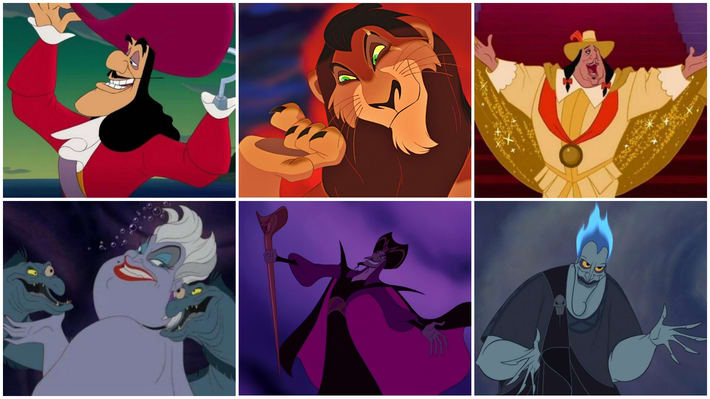
The Disney library (like that of most big studios) is already full of coded gay characters, as either villains, jokes, or both. (click to embiggen)It’s happened twice so far this year: big media company makes an announcement about how they’re adding an explicitly gay character to an upcoming release, then reveal that it’s a character that everyone outside the company already assumed was gay and has been the butt of homophobic jokes about said media property for years. The one that’s getting all of the attention right now is Disney’s announcement that in the live action remake of Beauty and the Beast it will be revealed that Le Fou is “exclusively gay.” I think they meant explicitly, but lets ignore that weird phrasing for a moment, because it gets worse. The director clarified that Le Fou is confused about his feelings for Gaston. He’s oddly attracted to this man who abuses him and uses him to do his dirty work.
Which is exactly what homophobes have been sniggering and making fag jokes about with Le Fou since Disney released the animated version of the movie. Gaston is a parody of hetero hypermasculinity, and Le Fou is is craven, clownish sidekick willing to do anything at all to get the slightest bit of attention from Gaston. Le Fou’s lack of manliness in the animated film could be rationalized as being there to throw Gaston’s exaggerated masculinity into sharp contrast. Okay. Except that is exactly what the Hollywood sissy/coded gay sidekick has always been: he’s the example of what a “real man” isn’t. His whole point it to prove that unmanly men are jokes, at best. Not real people, but punchlines.
So they are taking the implicit hateful characterization and making it an explicitly hateful characterization. Thanks, but no thanks.
Le Fou is a typical unmanly minion.There will be people who insist that we shouldn’t judge it until we see it, but they’ve given me enough information that I already know they have messed this up. The fact that they decided to announce it, for one. Just as if a person begins a statement with, “I’m not a bigot, but…” we all know that pure bigotry is going to follow, if you feel the need to announce you’re enlightened and inclusive, you don’t know what those words mean. The director has described the classic negative stereotype (confused, obsessed with a straight man) is what they’re going for. Worse, they’ve referred to it more than once as a moment. Just a moment. You know why it’s a moment? Because they are already making plans to edit that moment out of the international release, because they knew as soon as word got out that countries would start threatening to ban the film. Heck, Alabama is already up in arms about it!
That means that it’s a tacked on joke. It’s not part of the plot. It’s not a meaningful part of Le Fou’s characterization.
Even if they do something with it. Let’s say that at the end of the film they have a moment that implies maybe Gaston is ready to return his feelings? What message does that send? It tells us that hating women (Gaston’s exaggerated masculinity includes a lot of misogyny in the animated feature, just sayin’) or being rejected by women is what makes men gay. And, oh, isn’t that great inclusion?
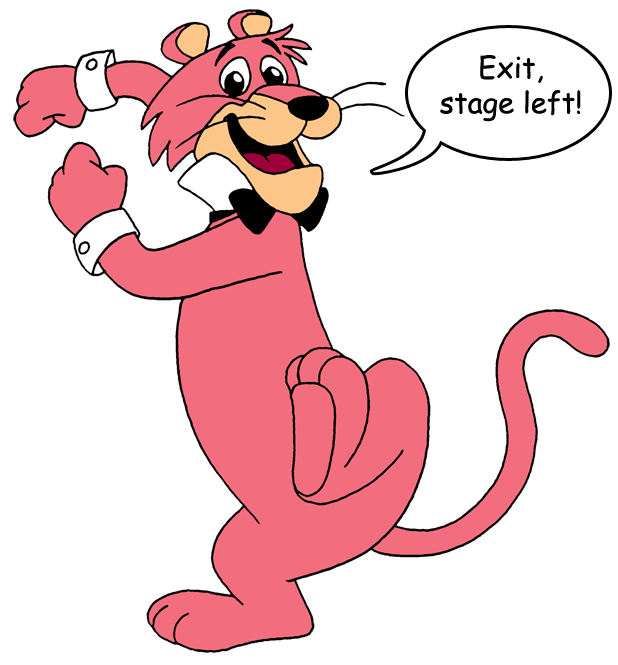
He was a pink lion without a mane wearing a string tie and cufflinks (despite not otherwise having clothes) whose dialog was littered with theatre jargon, delivered in a fey/swishy voice. He was a classic sassy gay character already!I mentioned that the Beauty and the Beast revelation was the second time this has happened this year. Previously it was Snagglepuss. Yes, DC Comics/Warner Brothers announced that the Hanna-Barbera cartoon character, Snagglepuss, was going to be reimagined in a new comic book series as “a gay Southern Gothic playwright.” Literally my reaction on twitter a nanosecond after I saw the first person retweeting the headline was, “reimagined? But that’s what he already was!”
Snagglepuss was a version of the sassy gay friend from the beginning. He was protagonist of his cartoon series, which wasn’t typical for the sassy gay friend (who is more typically a sidekick to one of the lead characters), but Snagglepuss broke the fourth wall constantly, addressing the viewer with his arch asides and sardonic observations. He was the viewer’s sassy gay friend, in other words. And he was cheerful and optimistic and always trying (but usually failing) to improve his life in some way. Despite the many setbacks, he remained cheerful and upbeat.
So the DC Comic (besides being drawn by an artist who has apparently never seen an athropomorphic character before—seriously, go hit that link above and tell me if that isn’t the worst comic book artwork you’ve ever seen!) takes the happy, upbeat fey lion and turns him into a bitter old queen. Again, thanks but, no thanks!
Coded queer characters have been appearing in pop culture for decades. Their portrayal as comic relief or as villains (and sometimes both) sent a clear message that they were not normal people. They are never the heroes. They can be loathed as villains, or tolerated and laughed at as sidekicks, but they will be lonely and unloved in either case. Neither of these supposedly inclusive announcements changes that homophobic message. It’s not, contrary to what certain evangelical hatemongers are saying, indoctrinating kids to be accepting of gays. It’s instead reinforcing the same old bigotry: we don’t matter, we are jokes, we are never the heroes, we are never loved.
Just another means of erasing the truth of our existence. No thanks!
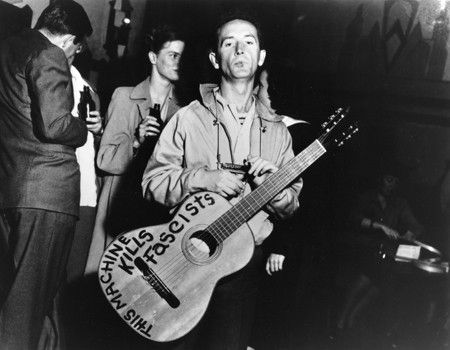
Woody Guthrie holding his guitar infamously inscribed “This Machine Kills Fascists”. (Creative Commons) (click to embiggen)So apparently some people are angry that Lady Gaga sang the Woody Guthrie song, “This Land Is Your Land” at the Superbowl, though I think they were mostly angry at first about the fact that her medley included her pro-gay rights pop song, “Born This Way.” It was clear from the early headlines about the show being apolitical that no one remembered that Guthrie’s song was actually about the oppression of working people. Which the Washington Post explains really well: If you thought Lady Gaga’s halftime show was apolitical, consider the origin of ‘This Land is Your Land’.
As the article I linked points out, Guthrie wrote “This Land Is Your Land” in a fit of pique from constantly hearing Kate Smith’s “God Bless America” everywhere along with rhetoric which would sound very familiar to anyone clamoring to make america great again as if the deprivation and suffering and oppression of the working class, particularly during the oppression, had never happened. Guthrie’s original title (and lyric) was “God Blessed America for Me.”
And if you don’t understand that it’s a protest song, you might want to read these original verses that people almost never sing any longer:
Was a high wall there that tried to stop me,
A sign was painted said: Private Property,
But on the back side it didn’t say nothing —
That side was made for you and me!
In the squares of the city, In the shadow of a steeple;
By the relief office, I’d seen my people.
As they stood there hungry, I stood there asking,
Is this land made for you and me?
Can you imagine if Lady Gaga had sung the verse about the high wall? Ha!
Guthrie put the slogan on his guitars in many different ways over the years (Photo by Lester Balog)Guthrie’s song is an especially good choice to subtweet the trumpkins, because back in the day, Guthrie was famous for writing “This Machine Kills Fascists” on his guitar. So it wasn’t just Captain America who was advocating punching Nazis at the time. Guthrie first wrote those words on his guitar after writing the song, “Talking Hitler’s Head Off Blues.” Guthrie argued (I think correctly), that fascism is a form of economic exploitation comparable to slavery, and that fascist leaders are essentially gangsters out to rob the world. He explicitly included within the category of fascist leaders all of the wealthy elite who profited from social, political and economic inequality.
Guthrie also argued that people who protested those inequalities were not thugs or outlaws, but are heroes rising “in times of economic turmoil and social disintegration” to fight “a highly illegitimate criminal endeavor intended to exploit the common people.”
We’ve all heard it before when certain topics come up:
“I don’t see color. I see people.”
“I don’t care how you pray. All religions lead to god.”
“I don’t like labels like ‘gay’ or ‘straight.’ We’re all human.”
“When I look at you I don’t see a man or a woman. I see a friend.”
“It doesn’t matter who you vote for. The important thing is to participate.”
They are usually intended as a statement of support for marginalized people. It’s a way to say, “I’m not intolerant!” It sounds so warm, fuzzy, and affirming, right? Obviously if we don’t perceive a person as different, we must perceive them as equal? Right?
Well, not really. I suspect that most everyone reading this felt at least a little bit uncomfortable reading one of those statements. Or at the very least wanted to quibble with one. Which one rubs you the wrong way and why it does will be different from person to person, but the truth is that each of the statements is just as problematic. Even the ones you agree with.
First, let’s talk about labels. The person who ordered blood tests and prescribed medicine for me when I was sick is a doctor. The person who gives me assignments at work is my boss. The man I stood beside and said “I do” about when the officiant asked is my husband. The woman who gave birth to me is my mom. The man who adopted and raised my mother and her sister was my grandpa. We don’t have trouble with labels 99% of the time. Labels are how we communicate and make sense of just about everything in the world.
We only notice labels when those labels are perceived to promote or impede an agenda that we have a vested interest in. We only want to ignore labels when acknowledging them makes us uncomfortable. If, for instance, we benefit from a particular societal preference, acknowledging that difference implies that maybe our success isn’t solely due to our individual merits.
Ignoring labels is an act of denial or dismissal. Race, gender, religion, socio-economic status, sexual orientation are essential ingredients in our identity, whether we acknowledge it or not. Because we are confronted with and shaped by societal expectations from the day we are born. Just look at how outraged a lot of people got a few years ago when one couple tried to raise their baby genderless and refused to tell strangers the child’s sex. Or the many, many studies that have shown are very differently people interact with a baby depending on what gender they’ve been told the child is.
“To overcome racism, one must first take race into account.”
—Supreme Court Justice Harry Blackmun
The truth is that society discriminates against people based on race, gender, sexual identity, socio-economic status, religion, and many other factors that the people who are most likely to claim they don’t care about labels would agree shouldn’t make one unequal in the eyes of the law. We can’t make society more equitable if we don’t acknowledge both the inequalities and the things which trigger the unequal treatment.
So trying to ignore these labels—specifically either saying or implying that ignoring them is a better idea than using them—is a way to try to silence members of marginalized groups. It’s telling them that their lived experience of being discriminated against is less important than your comfort. And quite often it is often a way to say that you’re perfectly okay with the inequality as long as it doesn’t affect you.
Second, claiming that you don’t care. The more often someone repeats a statement that they don’t care about something, the harder it is to believe them. If they really didn’t care, they wouldn’t say anything. This has been demonstrated most clearly recently by people who get defensive about video games, claiming that the games aren’t sexist; besides, if you don’t like them, don’t play them. Then the same people threw a hissy fit and called for boycotts when someone cast four women to play the leads in the new Ghostbusters movie. If sexism and representation didn’t matter to them, they wouldn’t have gotten upset.
Now, I’ve had people claim that the only reason they say anything is because we keep talking about it (whichever category it is). This has happened to me personally most often in relationship to sexual orientation. The cliché that I have heard millions of time is, “why do you have to keep shoving your sexually in my face?” Most ironically it came from the co-worker who had plastered an entire wall of his office with pictures of himself, his wife, and their five children—and he was objecting to a single picture of my late first husband (in an ugly Christmas sweater, no less) that I had discretely tucked in a frame on my desk where most of the time no one but me could see it.
Humans are social animals. We often are defined by our relationships to other people. People mention spouses, children, parents, friends, niece and nephews, and so forth all the time, without thinking about it. Studies have shown that if people we work with are reluctant to share these sorts of real life details, that they are perceived as stand-offish and not team players. It affects the likelihood that they will get raises, get promotions, and even the likelihood that they will be the person chosen to be let go if there are layoffs. So queer people are caught in no-win situation. If they are honest and open about who they are, they get accused of shoving their sexuality on people. If they evade the topics, they’re not team players.
If labels really don’t matter, then you shouldn’t mind hearing about them.
Third, claiming that you don’t want to take sides, you just want to live and let live. Why does this have to be a conflict, you may ask? Or “being intolerant of bigotry isn’t very tolerant,” you may say. This is a false equivalency. It is logically identical to saying that the person who reports a theft to the authorities is making a victim of the thief.
“If you are neutral in situations of injustice, you have chosen the side of the oppressor. If an elephant has its foot on the tail of a mouse and you say that you are neutral, the mouse will not appreciate your neutrality.”
—Bishop Desmond Tutu
When inequalities exist, live and let live just perpetuates injustice. You aren’t being tolerant or neutral or impartial, you are actively supporting the side of the bigot. You are aiding in the oppression. You aren’t helping the oppressed, you are doing quite the opposite.
“Life’s most persistent and urgent question is, What are you doing for others?” —Marin Luther King, Jr.Stop telling me what you don’t care about or don’t see. Show me what you’re doing to make the world a better place.
A couple of years ago I set myself a personal goal to “Reduce the Outrage.” I modified it and combined it with another last year, and carried it over again this year1. I’ve been sick off-and-on2 for about nine weeks, which means I’m cranky and prone to overreact a lot of the time. In one of the social/cultural spheres I inhabit, certain events are underway which increases the number of things being said about topics in which I have a lot of personal investment. Add to that the histrionics of the U.S. presidential campaign season, and it is really easy for me to find myself in an outraged state.
I’ve written before about letting oneself become outraged in unproductive ways, becoming resentful rather than doing something constructive, for instance. And I’ve quoted before the old proverb, “Resentment is like drinking poison and then waiting for the other person to die.”
The whole reason I set those goals about reducing outrage is because unproductive outrage is toxic and self-destruction and does no good to anyone.
But anger is a symptom of pain, and it is just as self-destructive to ignore pain. Finding something to do to alleviate the harm isn’t always easy. Root causes of many problems are beyond our control. I’m a writer; language is my primary toolset for tackling many problems. Unfortunately, analysis is something of an obsession with me, so I will over-analyze things and easily fall into a toxic spiral of writing, revising, ranting, revising, trying to be reasonable, revising some more—feeling increasingly frustrated and more outraged at every step.
I’ve been stuck in one such spiral for about two weeks.
Then, through a series of fortuitous clicks (reading one article, clicking a link in it, reading the referenced blog post, clicking a link in it, et cetera), I came across this post from Steve Saus4 from last May that said one of the things I’ve been thinking about so much perfectly: And you shall know them by their works. It says it so well, and more importantly, so succinctly, that I’m just going to quote the whole thing here:
There are two sides in our current culture wars.
But don’t decide which side is which by their names.
You will know them by their actions.
One side works so that everyone should have an opportunity to do something – get married, be nominated for an award, pee in whatever bathroom, be on television.
The other side already can – and has – done all those things. That side works so that only their group can get married, be nominated for an award, pee in a bathroom, or be on television.
Forget the labels for a second.
Are you working to give more people the same chances and opportunities… or to deny chances and opportunities to someone else?
It all comes down to that. Are you working to give people opportunities, or are you trying to keep opportunity out of their hands?
Footnotes:
1. A post has long been brewing about my failure to post monthly goal reports the last two months of last year, and how I’m handling my goals this year.
2. Or maybe it’s continuously and those stretches of several days when I thought I was well in between the symptoms were just pauses in the illness. We’re not sure.3
3. Adding to the uncertainty is the fact that my husband has been sick much of the same time, though frequently our symptoms are out of synch. So when I’ve been feeling almost recovered, he’s been at his worst.
4. Steve Saus is a writer, editor, and publisher who blogs at Idea Trash. A blog which has now joined my regular reading list.
http://www.glaad.org/publications/debunking-the-bathroom-bill-mythSo-called “bathroom bills” are getting passed by cities, counties, and states lately, and it feels as if most of the queer community isn’t noticing. A lot of them are still tied up in various state legislatures, and since some of the misleadingly-named religious liberty laws have been killed once big companies threatened to take their businesses out of said states, it’s possible that a lot of queer folks just assume the same thing is going to happen with them.
At least I hope that’s what’s happening. I hope that it’s merely a lot of folks still feeling giddy about the Supreme Court ruling legalizing marriage equality nationwide thinking that the big battle is won and queer people are equal, now. We won one big battle, but there’s still a long way to go. I hope, I sincerely hope, that it is not true (as some fear) that a substantial portion of the queer population doesn’t think that trans issues matter.
Because we really do seem to be letting the haters say whatever lies they want about trans people, and a lot of the media just repeats that factually incorrect information as if it is true.
Especially not when Conservative Trolls Have Been Suggesting Men Go into Women’s Restrooms to Help Legislators Discriminate Against Trans People. That’s right, as a few people have gotten the word out that there are states which have explicitly allowed trans people to use the bathroom that matches their gender identity for upwards of ten years, and that there has never, ever been a single instance of someone trying to use that law to go into a restroom and rape someone, the paragons of virtue have decide to manufacture some fake instances.
And make no mistake: these bills aren’t just aimed at trans people. It’s an attempt to get a wedge in to find other ways to discriminate against queer people of all kinds. If they normalize the idea (once again) that simply making some conservative people feel uncomfortable is an adequate defense to criminalize a behavior, trans people in bathrooms aren’t where they’re going to stop. Holding hands with a same sex partner in a public place makes those same people uncomfortable, after all.
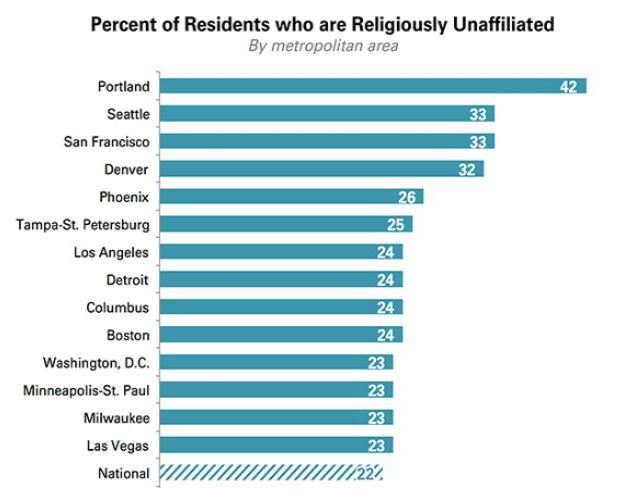
World Net Daily’s graph of just how godless some cities are (click to embiggen).World Net Daily has the headline (here’s the DoNotLink if you want to see it): “These are the most godless cities in America,” and I was a bit disappointed to find that my beloved home, Seattle was merely tied for second, falling behind Portland, Oregon. The World Net Daily and the American Family Association has made the determination of godlessness based primarily on the percentage of inhabitants who describe themselves as “religiously unaffiliated” in a recent survey. A whopping 42% of Portland residents say they are religiously unaffiliated, with Seattle and San Francisco tied for second at 33%, followed by Denver at 32% and Phoenix at 26%.
I have a few quibbles. At several points the original AFA press release and WND story conflate “religiously unaffiliated” with atheist. Even though other parts of the story make the distinction that only about 15% of of the nation’s population identifies as atheist. Conflating unaffiliated with atheist is simply wrong. I, for example, am not atheist—I’m taoist. But on a survey like this, depending on exactly how the question was phrased, I would almost certainly pick the religiously unaffiliated option because I don’t belong to any church or temple or similar organized religious institution.
I realize, since I’m:
a big homo,
have been a firm believer in the separation of church and state since at least the age of 10,
believe in science,
usually vote Democrat,
support pro-choice candidates and policies,
…et cetera—that the AFA would of course classify me as godless. But I suspect they would classify my queer friends who regularly attend Christian churches (decidedly liberal ones) as godless, as well.
My point, however, is that there are people who believe in god, and even believe in the same god the AFA claims to believe in, who would describe themselves as religiously unaffiliated because people like the AFA have done everything in their power to redefine Christianity to mean hating gays and people who support them to the point that they’re driving people from their congregations.
The original article also asserts as one of the harms of all this godlessness the following: “religious groups, spiritual environmentalists, and secularists… sometimes must cooperate with each other to address the region’s pressing economic, environmental and social issues.”
Horrors! People must cooperate with other people who may not agree with them on some other things to get things done? Say it ain’t so! Too bad we have all this cooperation going on! If we didn’t, we might have the insanely high infant mortality rates, childhood poverty, and teen pregnancy rates like the more godly cities in the Bible belt have. You just gotta love that strong religious culture, right?
I’ve known plenty of misogynist, racist, and/or homophobic atheists, just as I know a lot of Christians who are feminist, pro-queer, pro-equality, and otherwise in favor of most of the things of which scolds like the AFA disapprove. So we can’t use religious affiliation to unerringly predict someone’s stance on public policy issues. And as I observed a couple weeks ago (Confesses of a recovering evangelical), most of the religious right isn’t terribly devout. They’re far more motivated by their conservatism, which manifests as a reactionary opposition to change. And they don’t really pay that much attention to anything that the Jesus actually said, as evidenced by their breathless enthusiasm for military intervention, condemnation of any unarmed people of color who have the audacity to get wrongfully killed by police, and so on.
It’s why Bill O’Reilly was able to say with a straight face that Jesus promoted charity, but not to the point of self-destruction. Except, of course, since Jesus’ whole reason for coming to earth was to get killed on the cross for the sake of imperfect humans, he was indeed promoting charity not just to self destruction, but to literal self sacrifice.
The World Net Daily story is also interesting in that the comment sections is overflowing with homophobic comments, because of course no place can be godless without us homos there egging the nonbelievers on, apparently. Just like Pastor Manning who is insisting today that the foreclosure auction ordered on his church building because of more than one million dollars in unpaid utility bills has nothing to do with money. No, he claims, it’s an illegal plot of the sodomites to silence him. (By the way, the Ali Forney Center has raised more than 58% of their goal to attempt to participate in that foreclosure auction. If you can donate to this opportunity to turn hate into love, please do!)
Amazingly, New York City doesn’t make it onto the AFA’s list of cities with a higher unaffiliated percentage than the national average of 22%. I guess “New York Values” aren’t completely unholy, after all. Equally amazing, Las Vegas barely exceeds the national average of godlessness! Who knew?
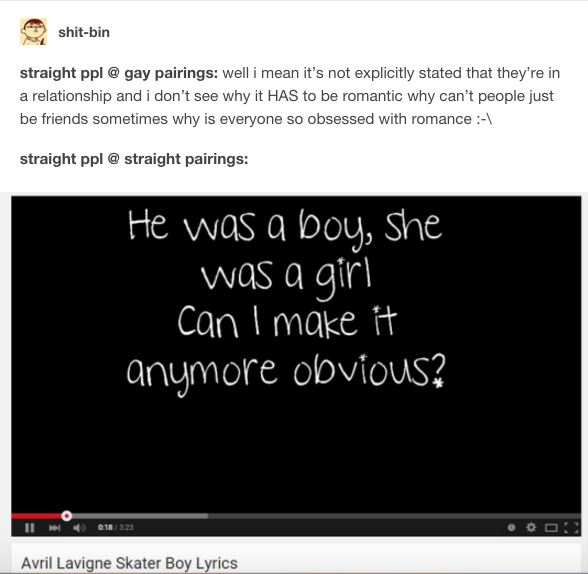
A blog post that appeared on my Tumblr dashboard. Click to embiggen.
A lot of Tumblr is about reblogging and liking stuff other people have posted. Or more realistically, reblogging stuff someone you follow reblogged from someone the follow who reblogged it from someone else, ad nauseum, that someone else posted.
A certain amount of commentary happens, though the tools aren’t really designed to foster conversation. But that’s another topic for another day.
Earlier this week the writer/director of Star Wars Episode VIII re-tweeted this cartoon drawn by Jeffrey Winger (jeffreywinger.co.vu). Click to embiggen.The first time I saw the original Star Wars I didn’t consciously have a strong feeling about the apparent love triangle being set up between Luke, Leia, and Han. I was frankly a bit surprised when some of my friends started talking about it. I mean, yes, there was the cute scene when Han realized that Luke was developing a crush, and he asked, “Do you think a princess and a guy like me–?” But he was so obviously teasing Luke. Clearly he wasn’t actually interested in the princess, right? I mean, what other possible interpretation could you have to that indulgent, slightly condescending smile?
And Han, being a much more experienced man, also, to my mind, knew that there was never any chance that a guy like Luke could win the princess, either. That was the other meaning of that smile. And during the dozens of times I re-watched the movie over the next three years, I was still convinced that there wasn’t going to be a serious conflict between Luke and Han trying to win Leia’s heart.
I was definitely in the minority. Lots of people expected, if there was a sequel, that a love triangle would figure heavily in the next movie.
I would like to be able to argue that I had somehow perceived some hint of the revelation that was going to come along later that Leia was Luke’s twin sister. But that wasn’t it. It wasn’t until after I first saw The Empire Strikes Back, that I realized what had been going on in my subconscious. Empire remains my favorite movie of the series for a lot of reasons, but after the first showing I had very mixed feelings about one subplot.
I was still deeply closeted at that point, but I was quite aware that I had a crush on Harrison Ford (or at least all the characters he played), while I had also very strongly identified with Luke, but didn’t have the same kind of feelings for Mark Hamill. I realized that my subconscious had been rooting for a romance, all right, but one between Luke and Han. Which in 1980, when Empire was released, was absolutely impossible in a mainstream film. Heck, even the most radical art house films seldom portrayed mutual same sex romances. They might show a homo obsessed with another man, but it was unrequited and tragic and depressing.
But that was what my subconscious saw precisely because we never saw it on the screen. I’ve written before about why queer people read same sex attraction into all sorts of characters in movies, television, and books. Because if we didn’t imagine them, we never got them. The unrelenting message of culture and media is that queers don’t exist, queers don’t matter, queers don’t love, and if they dare to, they deserve whatever horrible things befall them.
That’s why it’s homophobic when straight people roll their eyes or demand to know why we “do that” to characters who aren’t explicitly identified as gay. It isn’t necessarily malicious or intentional, but being annoyed that we dare to imagine such relationships perpetuates our erasure and is condescending at best.
But to get back to Empire, the movie did such an excellent job of portraying the complex emotional relationship between Han and Leia, that by the time of Han’s famous, “I know” answer just before he was frozen in carbonite, I was cheering for them. Of course they were in love! They were perfect for each other! At least that’s what one part of my heart said. Meanwhile, another part was mourning the loss of the love between Han and Luke that I’d hoped for, even though I knew it wouldn’t happen in a mainstream movie.
But once I got over my disappointment, I was totally on the Han and Leia train, and was happy to see them decades later (“You still drive me crazy”) as a realistic older couple who have had their ups, downs, and a falling out but still caring for each other in The Force Awakens.
I don’t only ship same sex couples. The first two seasons of Buffy the Vampire Slayer I was totally a Willow/Xander shipper. I so wanted Xander to pull his head out and realize that Willow loved him. At different times in the series, yeah, I was elsewhere. I’ve written Xander/Spike fic (and if I ever finish my WIP there’s also some steamy Graham/Riley action and hot Gunn/Buffy action in there). I adore well written Buffy/Spike fic. For a while I was a Xander/Scott shipper, but have often been completely onboard both the canon Xander/Anya and Willow/Tara relationships. I realize if you’re not familiar with the show that you won’t know that half of those are opposite sex couples. In another fictional universe, I remain an unapologetic Parker/Hardison/Spencer One-true-threesome shipper!
But yes, I saw the chemistry between Finn and Poe during my first viewing of The Force Awakens, and given how many millions of other fans saw it, it clearly isn’t an unreasonable inference. I get that other people see the Rey/Finn pairing, and I’m not saying I wouldn’t be able to enjoy that, but I would really, really like for a galaxy filled with aliens of all shapes and droids and so forth the acknowledge that queer people exist, too. (Also, hey! Why can’t we have a Finn/Poe/Rey triad? Polyamory is real, too!) That’s why I enjoyed reading Rian Johnson Gets It, where I first saw the cartoon I linked above.
As Chuck Wendig said in a post I’ve linked to before regarding people who were angry he put gay characters in an official Star Wars novel:
“…if you’re upset because I put gay characters and a gay protagonist in the book, I got nothing for you. Sorry, you squawking saurian — meteor’s coming. And it’s a fabulously gay Nyan Cat meteor with a rainbow trailing behind it and your mode of thought will be extinct. You’re not the Rebel Alliance. You’re not the good guys. You’re the fucking Empire, man. You’re the shitty, oppressive, totalitarian Empire. If you can imagine a world where Luke Skywalker would be irritated that there were gay people around him, you completely missed the point of Star Wars. It’s like trying to picture Jesus kicking lepers in the throat instead of curing them. Stop being the Empire. Join the Rebel Alliance. We have love and inclusion and great music and cute droids.
Also, I was really pleased with this: when a fan recently asked Mark Hamill on line if Luke was bisexual, Mark replied, “His sexuality is never addressed in the films. Luke is whatever the audience wants him to be, so you can decide for yourself.”
Slippery slope arguments get thrown around a lot. As a queer man I’ve been on the receiving end of more ridiculous slippery slope accusations than I can count. A surprisingly large number of them always end in something about man on dog sex (though the wingnut who kept typing in all caps about lesbian witches eating babies was actually giggle-worthy!).
The reason the slippery slope is considered a logical fallacy is because the predicted end result is usually an extreme event which would require a rather large number of increasingly improbable steps to get to from whatever current proposal is under discussion.
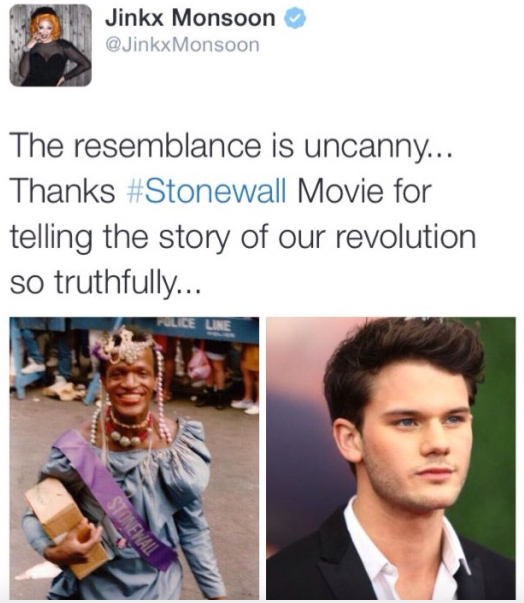
Marsha P. Johnson (on the left) was an African-American drag queen/street queen who actually participated in the Stonewall riot and was seen by several witnesses smashing a police car with a brick that night. Later she was a co-founder of the Street Transvestite Action Revolutionaries. The actor on the right is portraying the only brick-thrower seen in the trailer for the new Stonewall movie. (click to embiggen)I have a confession to make. When I first saw the trailer for the new Stonewall movie set to come out next month, the white-washing and cis-washing were not the first things that jumped out at me. At least not directly.
If you aren’t familiar with the controversy: the trailer for the new movie focuses on a white, cisgendered young man as the viewpoint character, and more specifically, causes some people to infer that he is the one who threw the first brick and starts the Stonewall Riot on that June night in 1969. The Stonewall Riots being the event usually credited with starting the modern gay rights movement. This is a problem because, while no one knows for certain who threw the first beer bottle, we do know is that the first person seriously fighting back that night was a butch lesbian who got away from the cops (and was chased down, beaten, and dragged back) while resisting being put in the paddy wagon (it was probably Stormé DeLarverie, though some witnesses claim that it was someone else). A transwoman of color, Miss Major Griffin-Gracy, also fought back, was clubbed unconscious, and was one of the few actually taken to jail that night. And no one disputes that it was Marsha P. Johnson (who was at the bar that night with friends to celebrate her birthday) who smashed one of the police cars with a brick…Continue reading Please don’t ask me to applaud mighty whitey→






 Font Folly