Category Archives: life

Confessions of a bad son, part 2

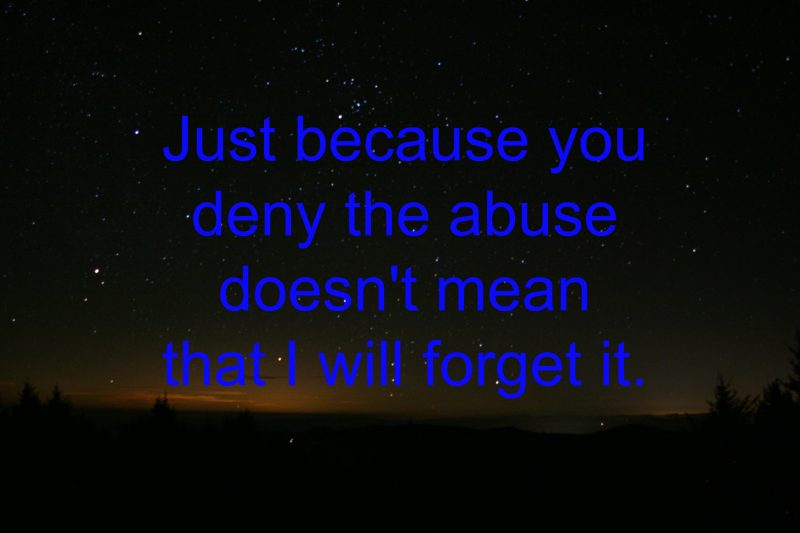
“Just because you deny the abuse doesn't mean that I will forget it.”
“Just because you deny the abuse doesn’t mean that I will forget it.”

It’s impossible at this time of year to avoid all the spam, emotionally manipulative articles, targeting advertising, saccharine memes, and heartfelt testimonials about fathers. This is fine (maybe even great) for people who have admirable dads and are happy to be reminded about how marvelous a good father can be. It is not so good for people whose fathers have died (especially recently), making all this hype a reminder of their grief for the father they loved. It’s not a delight for those of us who had terrible fathers.

I was lucky enough to have two incredible, wonderful, and loving grandfathers as well as an incorrigible (but still loving) great-grandfather who were all three very involved in my life throughout my formative years. I’ve written about my two grandpas on this blog: Rinse, don’t wash and What do you mean, real father?. I’ve mentioned my great-grandpa many times, but haven’t written about him. I need to do something about that.

“If you need violence to enforce your ideas, your ideas are worthless.”
But not today. This blog post is for all the people who, like me, had a terrible father. Please note my use of the past tense. One of the few bright spots to this holiday is that since he has died, I don’t have relatives (sometimes those who almost never contact me otherwise) trying to guilt me into calling him, or sigh disapprovingly when I tell them I haven’t talked to him in a long while. Two Father’s Days ago I did get a lot of cringeworthy messages from well-meaning relatives trying to offer me comfort in the grief that they assumed I must be experiencing. I was spared that last year, and so far I have been spared it this year.

It’s one thing when people who don’t know me very well express condolences when they learn he is dead. I can accept those sorts of things fine—especially after one friend made me practice saying “We weren’t that close; we’d hardly spoken in forty years.” But it is another thing altogether when it comes from the people who knew he was a physically and emotionally abusive man, who terrorized his wives and children, who regularly spouted racist and misogynist beliefs often phrased with the foulest slurs, who sneered at religious or liberal expressions of compassion for the downtrodden, and who never apologized to any of those he hurt.

I mentioned in an earlier post the mind-boggling series of messages I got from some relatives that all followed the same pattern right after his death:

  • Recitation of two or more anecdotes of what a sweet, loving young man he was when he first started dating my mom,
  • Reference to how excited he had been to learn he was going to be a father when mom became pregnant,
  • Skip to urging me to try to remember the good times “before the troubles began” because of reasons.

Not a single one of the extended family members who sent me messages and cards like that included any memories or examples of him being that wonderful person that occurred after I was born. And that’s the thing, I don’t remember a time in my childhood when I wasn’t deeply afraid of being alone with him. The first time he beat me severely enough that I had to be taken to an emergency room I was only four years old. I and all my younger siblings experienced at least one beating that required emergency medical care. So I have trouble believing the claims that before he became a father he was a paragon of kindness and love.

Even if they are right, most of the people on that side of the family have previously expressed a narrative of how he became the angry, manipulative, bitter man I knew. Most of them say it stemmed from a single betrayal that happened to him which involved the pastor of the church he had grown up attending. This betrayal happened when my mom was about seven months pregnant with me. The fact that she was pregnant and that this betrayal cost my father a job that he had been looking forward to as a way to properly provide for his wife and soon-to-be-born child is one of the central details in the story as they always retold it.

They claim this one single event transformed him from an angel to a monster, they know it happened before I was born, and yet, they expect me to have memories of the alleged angel.

I get it. Denial isn’t a rational process. If they consciously admit that they knew he was violently abusive for my entire childhood, they have to also admit that they stood by in silence as I, my sister, my mom, and later his second wife and my three half-siblings, were subjected to his abuse. And that is a very scary thing to face.

If the only way they can look themselves in the mirror each day is to be in denial, I guess that’s their business. But trying to erase my past in order to assuage their conscience isn’t something I am willing to enable.

I only have some inklings of what made my father tick. Maybe he was a sweet kid. But all the evidence and research out there about abusers is that they don’t just one day go from being a kind empathetic puppy to an angry beast. It’s something that happens over a long time. My maternal grandmother was an emotionally abusive and manipulative person, which I assume was a major contributing factor to Dad’s abusive personality. I also know that as an adult, Dad could be charming and friendly toward people whose approval he sought. So I suspect the sweet, kind young man my various older relatives remember was simply him being on his best behavior toward people who he had no other power over.

I try not to dwell too much on all this. As I said shortly after his death, I thought I was mostly over it. Until the moment I was told he had died, and I felt not just an incredible sense of relief and peace, but also a bit of gratitude.

I am truly happy for all the people out there who have good, loving fathers and wish them joy in celebrating their love for those fathers today. And Just as I wish comfort for those others who have lost their wonderful fathers and find today a reminder of their loss.

But don’t ask me to pretend my father was a good man. Don’t ask me to pretend to be grieving. Don’t expect me to smile and agree with any sentiments of admiration for him you may feel compelled to express. The only thing I have ever mourned with regard to my father, is that I didn’t have the good father that they want to imagine he was.


To Conquer the Kingdoms of Sin — more confessions of a queer ex-evangelical

Jesus doing a facepalm next to a rainbow: “Guys, I said I hate FIGS”
Jesus literally never said anything about gay people. And in fact, the 6 Biblical passages that seem to say so now do not at all in the original languages. (click to embiggen)
I saw this interesting article being shared this morning: The Southern Baptist Church is in a multi-decade decline and it is accelerating. That article is by Ed Stetzer, who is a statistics guy who has held a job with the Southern Baptist Convention with responsibility to study membership and so forth. This article is his farewell as he accepts a distinguished teaching position at Wheaton College. In the article, he tries to dispel the myths that some within the church keep bringing up as part of a mass denial of the fact that the denomination has been shrinking for many years and there is no sign that the bleeding of the membership is going to stop1.

He tries in the article to layout the problems that denomination is failing to address. And he makes a nice point that simply praying for something without doing the work to make it happen is not merely impractical, it’s actual contrary to the teachings of the Christ they claim to follow.

But he doesn’t come out and say what really needs to be said. I can’t tell for certain if he is being vague in his comments about how they need to engage with the culture and spend less time pursuing culture wars because he knows the article wouldn’t be published if he is blunt, or if he is afraid to say it, or if he’s in denial himself.

He tiptoes around it, saying things like “As of yet, we’ve not made it to the point where we have… become known for what we are for rather than what we are against.”

But the clue that leads me to believe he probably is still in a bit of denial is when he says, after implying that the church is waging battle on two many fronts of the culture war, “For many of our neighbors, our warring is interpreted as being against them.”

No, Mr. Stetzer, it is not an interpretation or perception that you are warring on us. Fundamentalist evangelical churches and affiliated organizations are literally attacking a whole lot of their neighbors.

The attacks on queer rights are the ones I most often link to or comment on, but that isn’t all of it. And even if they were, the way the fight is waged is a series of assaults on the lives and well-being of the queer people in question. At the same time that the church and related institutions keep cozying up to the special interests of big business and billionaires. So they are both ignoring Jesus’s teachings of “Let him who is without sin cast the first stone,” as well as “sell that you have, and give to the poor, and you shall have treasure in heaven: and come and follow me.”

Long before I reached a point where I could fearfully say outloud to a friend, “I think I might be gay3” I chafed at the church’s political choices. It wasn’t until my midteens (the early 1970s) that the SBC officially stopped opposing racial segregation. Even after that, a lot of churchs and affiliated organizations actively opposed civil rights laws, including the Voting Rights Act. That didn’t seem to line up with the command to Love Thy Neighbor.

I’m old enough to remember when official Baptist theology was not pro-life. In fact, among those Baptists willing to voice their anti-Catholic beliefs, the Catholic Church’s strong stand against abortion was used as an argument that Catholics were not a Biblical faith. Seriously! Southern Baptists used to look at the verse in the old testament which stated that a person who injured a pregnant woman such that she lost the baby was not the same as fatally injuring a child and was no worse than injuring a non-pregmant woman as proof that unborn babies were not yet people.

The shift in abortion doctrine was a calculated one by a number of evangelical leaders who met in the 70s to discuss what to do about fundraising now that segregation didn’t whip up the troops to donate. Again, that sudden about-face made no sense to teenaged me.

When Falwell’s so-called Moral Majority rose as a political force and allied itself strongly with the Republicans and doubled down on opposing women’s rights, gay rights, medical treatment for AIDS patients, and nondiscrimination laws in general, that was the final straw.

If there are people in the fundamentalist evangelical community in general–and Southern Baptists in particular–who want to turn around this downward spiral in membership, they have to change. They have organizations like Alliance Defending Freedom suing left and right to thwart gay and trans rights as well as lobbying politicians to pass anti-queer laws. Jesus never said a thing about queer people, but he commanded his followers take care of the poor, the sick, prisoners and even to welcome refugees4. Where is the evangelical organization suing government officials for withholding funds for the poor or the homeless or the disabled? Where is the evangelical organization lobbying politicians for more funding for the poor, the homeless, the sick, the disabled or resettlement of refugees?

Their usual argument is some BS about charity being a private duty, rather than a governmental one. But you can’t demand that government enforce your private religious beliefs about marriage and gender and so forth while claiming to believe that government shouldn’t do these other things your holy book actually demands.

Evangelicals got themselves into this ridiculous hypocrisy because of two things: leaders who are addicted to money or power of both; and the dearly held evangelical myth that they are always the persecuted. The nakedly greedy leaders like Joel Osteen and Franklin Graham harp on the culture war issues and characterize any gains for “other” people as an assault against “true Christians” and rake in the dough. More sincere leaders like the late Billy Graham become so blinded by the thrill of access to Presidents and Congresspeople and other leaders, that they let their proximity promote the fearmongering of unscrupulous politicians.

And too many of their congregants eat up the rhetoric, becoming so inflamed with the fervor to fight so-called evil, that they don’t see the real evil they are inflicting on others. Instead of looking at other people as the neighbors they are commanded to love and care for, they see them as armies of sin. And their advocacy, donations, and rhetoric constitute very real attacks on people, not sin.

If they want to stop this decline, it won’t come from a new emphasis on evangelizing, as Stetzer asserts in his article. That would be as meaningless as praying without working. Instead, they need to focus on things their Christ actually told them to do: love your neighbor, feed the hungry, take care of the sick, clothe those who have nothing, be kind to the meek and powerless.

Do good, and people will see those good works and will stop feeling like enemies under attack.


Notes:

0. The title of today’s post is a lyric from the hymn “The Kingdom is Coming” words by Mary B. Slade, music by Rigdon M. McIntosh, # 409 in the 1956 Baptist Hymnal.

1. When I first read his assessment that the church will cease to exist for all intents and purposes in decades, my only thought was, “Darn! Not sooner?”2

2. Don’t get me wrong, I was raised Southern Baptist and I have a lot of fond childhood memories of deep friendships there. But as I have said many times, I didn’t abandon the church, the church drove me away.

3. Which didn’t happen until I was 25.

4. Again, I learned my strong sense for social injustice by reading the Bible they claimed to follow.

That’s Dr. Freak to you — more adventures in dictionaries

“Kiss in public; dance at gay clubs; do drag; do glitter; wear rainbows; love your boyfriend; love your girlfriend; love yourself; be yourself; flaunt your uniqueness; be proud; reject fear; embrace love”
(click to embiggen)
Pride Month hadn’t even started before complaints about why we even have Pride started crossing my various news and information streams. There are many, many reasons I can give, but the most important one is simply visibility. We still live in a society where queer kids are bullied by their own parents, thrown out on the streets at the encouragement of their churches, and told again and again that who they are and who they love is shameful and abnormal. And those messages don’t come just from overt bigots who spew anti-gay hate. That message also comes from so-called allies and even from other queer people who disparage those queers who dress outrageously or otherwise flaunt their uniqueness.

A couple months ago Newsweek used this picture to illustrate a story entitled, “The Street Skirmishes, Bar Brawls and Drunken Violence of American St. Patrick's Day”
A couple months ago Newsweek used this picture to illustrate a story entitled, “The Street Skirmishes, Bar Brawls and Drunken Violence of American St. Patrick’s Day”
The funny thing is that they never say such things about participants of St. Patrick’s Day parades. Even though a typical American Pride Parade is far less rowdy and has far less public drunkenness than the typical St. Patrick’s Day parade. Pride events have a whole lot less sexuality than typical Super Bowl commercials. Pride events have a lot less nudity than, say, Seattle’s annual Fremont Solstice Parade. But because the sexual innuendo and nudity in those other events are aimed at straight people, the outrageous costumes are being worn by straight people, and intoxicants are being publicly consumed by straight people, it seldom gets the same kind of coverage in the news, and certainly doesn’t provoke the public tut-tuting on social media that Pride events do. Remember that the original St. Patrick’s Day parades were political marches protesting discrimination against Irish people in America. When was the last time you heard of someone being fired for being Irish?

A person crossed my social media this week (I presume because I reblogged a bunch of pride comments and memes on my tumblr) to admonish me for provoking normal people by celebrating the freaks of the queer community. They claim that they aren’t at all homophobic, yet they use the same tactics and the same language as the rabid bigots. Just like the bigots, they say that being visible is flaunting our sex lives. They say we are freaks. As a certain famous man from Galilee once warned us to beware of people who claimed to be our friends: “by their fruits shall you know them.”

Since I promised that this would be an adventure in dictionaries, let’s look at that word, freak. I call your attention to the following excerpt from the Shorter Oxford Dictionary’s definition:

4 Something fanciful or extravagant; (more fully freak of nature) an abnormal or irregular occurrence, an abnormally developed person or thing, a monstrosity.
b A person regarded as strange because of their unusual appearance or behaviour.

This so-called ally is hardly the first person to call me a freak. One of my uncles used to refer to me as an over-educated freak as early as age 9, for instance. It was one of the mildest insults my eighth grade Reading and Literature teacher called me. Other teachers and school administrators told my parents that the bullying I experienced was impossible to stop as long as I failed to act like a normal boy.

What was the behavior they were referring to? Was I showing up at school wearing bondage gear or dressed as a drag queen? No, of course not. The sorts of behavior that was called out were things like:

  • I would rather read a book by myself than play sports
  • In elementary school when most boys hated the girls in class, I got along great with them
  • I knew more about cooking than I did about horsepower and gear ratios
  • My favorite TV shows were things like The Carol Burnett Show or The Partridge Family or The Mary Tyler Moore Show instead of Gunsmoke or The Streets of San Francisco
  • My favorite books were mostly science fiction
  • In middle school I treated girls I talked with as friends, rather than as objects of desire (and didn’t understand for a long time what the difference was between the way I interacted with girls and the way most of the other boys did)
  • I liked to draw and write fiction
  • I laughed at the wrong things
  • I liked to wear clothes that were interesting colors

Some of that list will not strike many people as gender nonconforming, particularly the science fiction bullet. But you need to understand that before 1977 and the advent of the original Star Wars movie (when I was a junior in High School), normal boys did not like sci fi.

The first Freedom Day Marches didn’t happen until I was in fourth grade, and they were not being covered on news stations and the like until several years later. All the bullying and teasing I got for being a sissy or a freak or “not a normal boy” was deeply rooted in homophobia that was hateful and destructive long, long before the first Pride. So don’t tell me that Pride causes homophobia. Anti-gay hatred was around for centuries before Pride.

And kids like me—kids who could never figure out why the way we talked or the way we walked or the things we found interesting were wrong—were subjected to that hatred and bigotry without appearing in public in fishnet stockings or elaborate make-up. We were bullied and mocked and scorned and ridiculed because our behavior wasn’t the usual expected of our gender. I was bullied because I didn’t understand why it was unusual for a boy to think that a pair of burgundy pants was cooler to wear than plain blue jeans. I was bullied because I thought a girl’s ideas were more interesting than what was hidden by her clothes. I was bullied because I would rather sing along (and dance or pretend to be a member of the band) to the radio than play cops and robbers.

Not all queer kids are gender nonconforming (but studies show that at least 75 percent of boys who were consistently identified as “sissies” during childhood will come out as gay as adults), just as not all queer male adults are into show tunes. But the scant number of queer athletes who have come out of the closet, as well as the large numbers of “straight acting” and “non-scene” gays, have been free to do so because the nonconforming or freakish queers decided not to take the hate and loathing lying down. The freaks decided to stop being ashamed of who they were and who they loved. The freaks decided to stop pretending to be non-freaks.

If those freaks hadn’t stood up, none of the assimilationist queers, none of the suit-and-tie or “masc for masc” gays would have the right to be out—they would all still be hiding in the closet and secretly having sex on the sly deeply steeped in self-loathing and guilt. And those folks who say that the freaks should stop flaunting who they are are no different and no less deplorable that the folks who fire gay bashing victims for talking about their assault or stab men for holding hands in public or murder trans people just for being who they are.

I’m not a drag queen and I don’t wear fetish gear to Pride. I wear my purple hats and various rainbow or unicorn-adorned t-shirts year round. I’m unashamed of my fabulous rainbow parasol and my purple earrings. But I cheer and clap for the people who do dress in drag or other outrageous clothes at Pride. I support their right to be there and be out and dress however they want without being harassed. Just as a woman wearing certain clothes in public doesn’t make it all right for someone to harass or sexually assault her, neither do queer and trans people wearing whatever they’re comfortable in make it right to exclude or denigrate them.

If my love of bright colors, glittery earrings, and silly t-shirts makes me a freak, I’m proud to join that fanciful and extravagant legion of the out and proud. If you’re going to call me a freak, fine, but that’s Doctor Freak to you, and don’t you forget it!

Too much coffee, you say? Here, have some nice black tea…

“I like to have a cup of coffee to relax after a long cup of coffee.”
(Click to embiggen)
This week is not going at all as expected. Midday Monday I noticed that my throat felt a little scratchy and I seemed to be more distractible than usual. I coughed a bit later in the day, but it didn’t feel like anything serious. When I clocked out and left the office I did my usual thing, which is to launch an open-ended walk on my workout app then walk semi-randomly until I’d logged a mile. Because of the geography of the part of town my office is in, it isn’t that random. First I go uphill three blocks (because it is a very steep hill between the office’s street and the street where the nearest bus stops are), then I start the semi-random bit. At most corners I choose which way to go based on which crosswalk shows “Walk” then continue down that block until the next corner. If I get too many blocks away from the bus stop, rather than cross the street, I turn the corner and walk 3/4s of the way around the block to get me headed back, then start crossing streets based on the cross-walk sign. Then, when my watch taps my wrist and dings to tell me I’ve gone a mile, I take the quickest route from that point to the bus stop.

I do this because for years one important source of exercise was that I would walk all the way home from downtown on most workdays. When I lived in Ballard, that meant walking for a bit over an hour four or five times a week, right. Now that I’m in Shoreline the walk is closer to 10 miles and much of it would not be along pedestrian-friendly routes. So I do this walking thing that usually gets me a bit over 25 minutes of walking each day.

Anyway, on Monday the first problem was that I was wheezing more than a bit on the steep uphill part and coughed for a while. Later, when my watch binged to indicate a mile I continued to the corner, stopped, looked around, and literally muttered, “Where the heck am I?”

Instead of looping back when I reached certain streets as I usually do, I had just let the random crosswalk signs guide me. And I wasn’t really anywhere that I didn’t know—it was just that I was at a part of downtown that I haven’t walked through in many years, back when I worked at a different workplace. And businesses have been replaced and some buildings have been torn down and I had to look at the street signs to figure out where I was, instead of recognizing my surroundings. So then I turned around and made as short a walk back to the bus stop as I could.

That should have been a sign. But even when I got home and my husband told me he was afraid he was coming down with something, and I confessed to being a bit worried about the scratchy throat and cough, I still clung to the notion that it was just worse than usual hay fever because we’d gotten a shift in the weather on Sunday.

A couple hours before my alarm went off Tuesday morning, I woke myself up having a coughing fit. There were other symptoms the made it clear I had caught something. Once my alarm did go off, I did my usual morning meds, then logged in to the work system to send my boss a message that I was sick and wasn’t sure I’d be up to working from home. There were already messages from co-workers who were sick and not coming in. I crawled back into bed and for all intents and purposes slept through the rest of the day. Yeah, I woke up a few times to eat, run to the bathroom, chat with my husband when he got home, and even make dinner (if heating two frozen prepared things from counts as making), but mostly I just slept.

I had hoped to wake up feeling better and only having to decide whether to try to go into the office or work from home (so as to decrease the chances of infecting other people). But I felt much worse when I woke up than I had yesterday.

Napping, cold tablets, and coffee seem to have alleviated the symptoms a bit. Since I’ve woken up enough to bang out a silly blog post, I think I might be able to be productive this afternoon, so guess it’s time to give that a go.

Formerly known as Decoration Day, or Memorial for Grandma

My aunt sent me this picture of the flowers she put on Grandma's grave this year.
My aunt sent me this picture of the flowers she put on Grandma’s grave this year.
I’ve written many times before about why Memorial Day shouldn’t be confused or conflated with Veteran’s Day — and I am hardly the only person to draw attention to that distinction (Washington Post: Why Memorial Day is different from Veterans Day, CNN: Get it straight: The difference between Memorial Day and Veterans Day, Washington Examiner: Why you shouldn’t confuse Memorial Day and Veterans Day NPR: Memorial Day Dos and Don’ts.

Long before the Uniform Monday Holiday Act of 1968 made Memorial Day an official federal holiday, and even before the first federal observation of a day to decorate Union Soldier’s grave at Arlington National Cemetery back in 1868, and even before the Ladies’ Memorial Association of Columbus, Georgia suggested a day to honor those who died in the civil war there was another holiday observed in many parts of the country—long before the Civil War—called Decoration Day, which was a day to have family reunions and celebrate the lives of all of our deceased family members. It was usually observed on a Sunday in the spring, and frequently involved picnics in the cemeteries or potlucks at church. And my Grandmother was someone who observed that version faithfully her whole life, long before the official creation of the modern Memorial Day.

Eleven years ago this week my nice Grandma died literally while in the middle of putting silk flowers on the grave of one of my great aunts—which has contributed to my determination that the original holiday not be forgotten. In memory of Grandma, I’m reposting this (originally posted on Memorial Day 2014):

Memorial, part 2

copyright 2014 Gene Breshears
Flowers for Grandma’s grave.
Grandma always called it by the older name, Decoration Day. As I’ve written before, the original holiday was celebrated in many states as a day to gather at the grave sites of your parents, grandparents, et cetera, to honor the memory of their lives. It was often a time of picnics and family reunions. At least as much a celebration of their lives as a time of mourning. The connection to military deaths didn’t happen until 1868, and particularly in the south, was often seen as a pro-Union, pro-war, anti-southern celebration.

I didn’t understand most of those nuances when I was a kid. The modern version of the holiday, celebrated on the last Monday in May, didn’t even exist until I was a fifth-grader, when the Uniform Monday Holiday Act went into effect.

Grandma observed it faithfully. Every year, as May rolled around, she would begin calling distant relatives and old family friends. Grandma knew where just about every person descended from her own grandparents was buried, and she made certain that someone who lived nearby was putting flowers on the graves of those relatives by Memorial Day. She took care of all the family members buried within a couple hours drive of her home in southwest Washington.

She was putting flowers on the grave of my Great-aunt Maud (Grandma’s sister-in-law) seven years ago on the Friday before Memorial Day when she died. My step-grandfather said he was getting in position to take a picture of her beside the grave and the flowers (there are hundreds and hundreds of photos of Grandma beside graves with flowers on them in her photo albums) when she suddenly looked up, said, “I don’t feel good!” and pitched over.

One weekend she had blown out the candles on the cake celebrating her 84th birthday. The following Friday, while putting flowers on Great-aunt Maud’s grave, she died. And one week after that a bunch of us were standing at her graveside. It was just down to a few family members, and we were at that stage where you’re commenting on how pretty the flowers that so-and-so that no one had heard from in years were, when someone asked, “Isn’t grandpa’s grave nearby?”

Grandpa had died 23 years earlier, and was buried in one of a pair of plots he and Grandma had bought many years before. And after Grandma re-married, she and our step-grandfather had bought two more plots close by.

Anyway, as soon as someone asked that, my step-grandfather’s eyes bugged out, he went white as a sheet, and said, “Oh, no!” He was obviously very distressed as he hurried toward his car. Several of us followed, worried that he was having some sort of medical issue.

Nope. He and Grandma had been driving to various cemeteries all week long before her death, putting silk-bouquets that Grandma had made on each relative’s grave. Aunt Maud’s was meant to be the next-to-the-last stop on their journey. Grandpa’s silk flower bouquet was still in the trunk of the car. My step-grandfather was beside himself. He’d cried so much that week, you wouldn’t have thought he could cry any more, but there he was, apologizing to Grandma’s spirit for forgetting about the last batch of flowers, and not finishing her chore—for not getting flowers on Grandpa George’s grave by Memorial Day.

The next year, several of us had the realization that without Grandma around, none of us knew who to call to get flowers put on Great-grandma and Great-grandpa’s graves back in Colorado. None of us were sure in which Missouri town Great-great-aunt Pearl was buried, let alone who Grandma called every year to arrange for the flowers. Just as we weren’t certain whether Great-great-aunt Lou was buried in Kansas or was it Missouri? And so on, and so on. One of my cousins had to track down the incident report filed by the paramedics who responded to our step-grandfather’s 9-1-1 call just to find out which cemetery Great-aunt Maud was in.

copyright 2014 Gene Breshears
Flowers from us, Mom, and my Aunt Silly on Grandpa’s grave.
Mom and her sister have been putting flowers on Grandma’s and Grandpa’s graves since. Our step-grandfather passed away three years after Grandma, and he was buried beside her.

Some years before her death, Grandma had transferred the ownership of the plot next to Grandpa to Mom. So Mom’s going to be buried beside her dad. Mom mentions it whenever we visit the graves, and I don’t know if she realizes how much it chokes me up to think about it.

We had put the flowers in place. We had both taken pictures. Mom always worries that she won’t remember where Grandpa’s grave is (it’s seared in my head: two rows down from Grandma, four stones to the south). Michael helped Mom take a wide shot picture that has both Grandma’s and Grandpa’s spots in it.

I thought we were going to get away with both of us only getting a little teary-eyeed a few times, but as we were getting back into the car, Mom started crying. Which meant that I lost it.

Grandma’s been gone for seven years, now. But every time we drive down to visit Mom, there is a moment on the drive when my mind is wandering, and I’ll wonder what Grandma will be doing when we get there. And then I remember I won’t be seeing her. It took me about a dozen years to stop having those lapses about Grandpa. I suspect it will be longer for Grandma. After all, she’s the one who taught me the importance of Those Who Matter


And if you are one of those people offended if I don’t mention people who served our country in the armed forces on this day, please note that my Grandpa mentioned above served in WWII in Italy. Grandpa drove the vehicle that towed tanks that couldn’t be repaired in the field, and one of the two medals he was awarded in the war was for doing a repair of a tank while under fire. After the war, he came back to the U.S., met Grandma (who was at that point working as a nurse and trying to support her two daughters), and eventually married Grandma and adopted my mom and my aunt. Many years later, he was the person who taught me how to rebuild a carburetor (among other things). He was a hero many times over. And this post is also dedicated to his memory.

Believability isn’t just about fiction, or Let me tell you about my Evil Grandmother

Sometimes the difference isn’t this obvious. (click to embiggen)
This post meanders a bit before I get to the point. Sorry.

Over the years people have reacted with everything from amusement to confusion to disbelief to my references to my Evil Grandmother. I had two grandmothers, a Nice Grandma and an Evil Grandma. Sometimes when I would comment about something going on with one of my grandmothers, a friend who had heard me use the phrase “Evil Grandma” would ask if this grandmother who had done this annoying thing was her, and I would say, “Oh, no! This is my Nice Grandma!” And they would freak out, “What do you mean, this is the Nice Grandma? That doesn’t sound nice at all!” To which I would reply, “Let me tell you about my Evil Grandmother…”

Here is a mild example. My Evil Grandmother (who was my paternal grandma, i.e., my dad’s mother) believed that all mental illness was just the person selfishly vying for attention. There are a surprising number of people out there with a belief very close to this. Any person who responds to someone else struggling with depression or recovering from trauma by telling them to get over it, for instance. They don’t see it as a real illness that requires treatment or recovery, right? But my Evil Grandmother was even worse than that. My Evil Grandmother believed that epilepsy was the same. So when one of my sisters started having seizures, my Evil Grandmother was constantly undermining the doctors. She would scold my sister for having a seizure after the fact, for example.

Oddly enough, she also believed that mental illness was hereditary and a sign of poor moral character. Which she also believed was hereditary. When my parents finally were getting a divorce, after my Evil Grandmother found out I had told the judge that I definitely did not want my (alcoholic, physically abusive) father to have custody, she sat me down and gave me a long litany of all of the mental health issues that plagued many of my mom’s distant relatives. One example was a great-uncle who we would now say was suffering from severe PTSD because of his experiences during World War II.

Now, if I wrote a novel in which a woman who had a college degree and worked as the City Treasurer for many years and was a respected member of her community, who punished her nine-year-old grandchild for having a seizure on a day where said grandmother had prevented the grandchild from taking her prescribed medication, I would get irrate messages from people telling me that this was completely unbelievable.

But I would also get comments from people who would tell even more horrific stories from their own childhood.

This is just one example of why having a bunch of editors tell you a story is too far-fetched is not indicative that the story is, in fact, too far fetched.

The editors or critics may have a valid point that you, as an author, hadn’t done a proper job of laying the groundwork to help the reader suspend their disbelief, but it doesn’t mean the notion is objectively and universally unbelievable. Even if they focus on the groundwork aspect, they still may be letting their personal perspective override things.

For example, there’s the tale of the male writing professor who once gave a woman in his class the advice that merely showing that one character had raped a young woman was not enough to justify the young woman killing him later in the story. “You haven’t convinced me he’s truly evil. Show him being cruel to a dog or something to make this evil real.”

Being cruel to a dog is worse than raping a woman? Irrational disconnect much?

Preception isn’t just a matter of taking in the information offered. It is heavily influenced by our prejudices, past experiences, expectations, fears, and hope. This doesn’t mean that there is no such thing as objective reality, it just means that it takes a lot of work to sort through all that subjectivity…

And it means that there will always be some things no one will agree on. Likewise, there will always be some people who will refuse to see something, no matter how much evidence we provide.

This doesn’t mean they are hopeless, it just may mean that we have to walk away and expend our energy elsewhere.

I have two codas to the saga of my Evil Grandmother. First, 20 years after my parents’ divorce and the subseqeunt exodus of myself, Mom, and one sister to the west coast, Mom, Nice Grandma, and my step-grandpa took a road trip back to the town where my parents met to attend the christening of my oldest sister’s first child. At one point in the visit, Mom found herself alone with my paternal grandparents, her ex-in-laws. Mom told them that she was sorry that my parents’ marriage had ended the way it had. Grandpa admitted that saying goodbye to Mom, myself, and my sister when we left was the hardest and most painful thing he had ever done.

Evil Grandmother muttered something, and she had tears in her eyes. She cleared her throat a couple of times and eventually said something about the time for blame being past. Now, I should mention that long before my parents divorced, Evil Grandma, on two occassions, set up appointments for Dad with a divorce attorney without consulting him first, and tricked Dad into meeting her at the law office on pretexts to do with her business. When I say that Evil Grandma had wanted my parents to split, that’s an understatement. So, Mom took this “time for blame” as a way to change the topic and avoid taking any blame.

But then some more extended family members arrived, and as people were picking places to sit and talk, my Evil Grandma moved from the seat next to Grandpa, to sit next to Mom. And she grabbed Mom’s hand and in Mom’s words, “squeezed it like she was afraid to let go.” She didn’t say anything, and didn’t really join in with the rest of the conversation for the next couple of hours, but she refused to let go of Mom’s hand. And later, when Mom needed to leave, Evil Grandma gave her a hug. Her eyes were full of tears again, and she murmured, “I’ve missed you all.”

Mom said that she decided that that was the closest Evil Grandma could come to saying she was sorry.

Second coda: About ten years after that I was out with friends at a bowling party when my phone rang. It was a call from one of my aunts. She was at a hospital with Evil Grandma. Evil Grandma had had both a stroke and some sort of heart issue. She’d been revived and was on a resporator, but she was alert and had demanded the my aunt call me. I need to add here that when I came out of the closet in 1991, other than one handwritten note that said, “I hope you’re happy now,” Evil Grandmother had stopped talking to me (and I would later learn she had forbidden other family members from mentioning my name in her presence). My aunt handed the phone over Evil Grandma. Because of the resporator, she had to speak in short bursts. She could speak on the exhale then wait for the machine to push in the next breath. She said my name. I replied, “Yes, Grandma it’s me.” She repeated my name on the next two exhales, and each time I told her it was me and I could hear her.

I, meanwhile, was moving to try to find a quiet place thinking the noise of the bowling alley was confusing her.

Finally she said, “I love you.” And I replied that I loved her. She repeated it a couple more times, and each time I replied. I was sobbing at this point. How could I not be? No matter what had happened between us, here she was, possibly on her death bed, using perhaps her dying breaths to reach out?

After about the fourth ‘I love you’ exchange, she said. “I know you…. I know you do… but do you know…. do you know… I love you?”

I said, “Yes.” She repeated my name and said “I love you” again, and then my aunt was back on the phone.

That turned out not to be her deathbed, but she had at least one more stroke before being released from the hospital, and her ability to talk was severely impaired for her remaining years.

But, Christmas cards started arriving every year. The outside of the envelopes were clearly addressed by the aunt who was caring for Grandma by then, but the inside always had very jittery writing that was clearly Grandma’s. Some years Christmas presents (usually ornaments) would also arrive, sometimes with Grandma’s writing on the tag. There would sometimes be a note from my aunt saying that Grandma had seen it in the store and wanted to get it for me because it reminded her of something I had once talked to her about as a child.

One is left wondering, which her was the real her? Is it simply that years of regret and an acute awareness of her mortality caused a change of heart? Is such a deathbed conversion, as it were, believable? Or as much a product of our hopes and wishes?

I know she had always been extremely concerned with keeping up appearances and not doing things that would make the right sort of people look down on you. So had she been suppressing inconvenient feelings for years–feelings that went counter to her hopes and aspirations–and only later in life as neurological changes occurred she started letting them out?

Wrestling with these questions have not led me to stop referring to her as my Evil Grandmother. She just did too much too many times to hurt people–often people she should have been protecting. But I am reminded of an observation which I once put into the mouth of one of the characters in one of my fantasy novels: “Evil isn’t something you are, it’s something you do.”

One year of being an ex-Seattleite

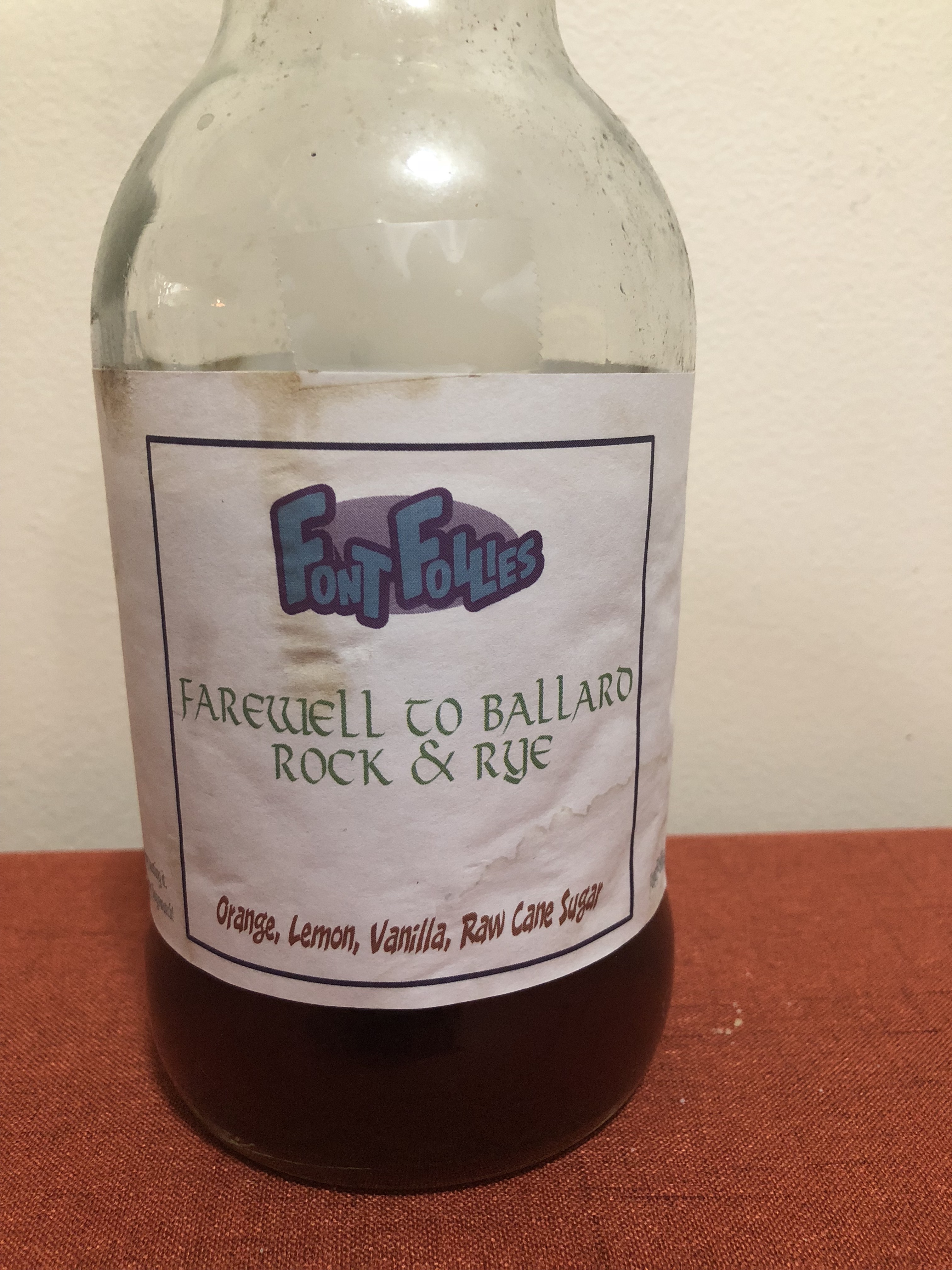
During the weeks we were shuttling car loads of stuff from the old place to the new, I poured the last bits of a couple of bottles of bourbon into jars with a sliced orange, lemon, a couple of vanilla beans, and various spices to infuse for a few weeks to make a batch of Rock n Rye. After filtering and decanting, I made this label when we set out the libations at the Christmas party.
One year ago we made the official move from the place I had lived at since 1996. We had been packing for months, and then after signing the lease for the new place, started bringing car loads of boxes and small things for three weeks. We had a bunch of friends help us move many boxes on two Saturdays, but hired professional movers to move all the heavy furniture and similar big awkward things on May 4. Since that’s when the bed moved, that was the first night we slept at the new place, and officially that was the first day that I no longer lived within the Seattle city limits. For thirty-two years I lived in Seattle—a few different places in the Queen Anne neighborhood, a couple in Fremont, and then 21 years in Ballard. I wasn’t happy about the move (no one likes to move, right?) but I wasn’t exactly happy about how much stuff I found squirreled away in the back of closets and such that we never used and I’d forgotten we ever owned.

I expected that moving from a residential neighborhood in the city to a suburb to be a bit of an adjustment. I wasn’t quite prepared for how quickly the new neighborhood became familiar.

There are lots of things that I love about the new place, and I’ve babbled about those things probably too much on this blog. For instance, the new place is bigger. We got rid of a lot of stuff before, during, and after the move, which helps make most of the rooms feel even larger than they were.

A few of the surprises are how quickly some of my driving habits changed. One of the major thoroughfares in the region is state highway 99, which is known as Aurora Avenue in Seattle, Shoreline, and Edmonds. Several of the other suburbs of Seattle label it Pacific Highway (which is nearly the same as old federal name for the highway as it existed before the founding of the Interstate System). Within the Seattle city limits, no U-turns are permitted on Highway 99. During the 32 years that I lived in Seattle, I always thought it was weird when I drove into suburbs either north or south of the city, to suddenly see “U-turn Permitted” signs at every intersection. It seemed like a quaint throwback to a bygone era. I’m not sure why. Maybe because so many places I’ve lived (not just Seattle) banned U-turns.

But in the city I now live in, most of the highway has a median with trees running down the middle of the road, rather than a turn lane that can be used to get to a business on the other side of the road. The u-turn becomes a necessity in that case, and since almost all the intersections where u-turns are permitted have stop lights, it isn’t a particularly risky maneuver. Now I find myself deeply affronted when I cross the city limit and start seeing the “No U-turn” signs.

I keep being a bit amazed at just how much I love the veranda. We had a small yard and were allowed to plant whatever we wanted in two flower beds, but the lawn was so small and right next to the sidewalk in a neighborhood that had a lot of foot traffic, I just always felt a little weird if I set up a chair and tried to read or something. Also, having no patio limited furniture options. Our veranda, a 38-foot long deck, is completely different. I have a lot more flowerpots and planters than I had before, and I’m growing a lot of flowers. We have more comfortable lawn chairs and a really cool folding wood table my hubby found at Ikea. So I can do things such as sit out on the veranda, enjoy the cool breeze, and watch the trees and squirrels while I type up this blog post on my laptop.

Then there’s cooking summer dinners on the stand-up George Foreman electric grill. A lot easier to deal with than digging out a grill from the basement, trying to set it up so it was level on the lawn, and having to clean it and pack away at the end. I can clean the smaller electric grill quickly and leave it out on the veranda each night. And yeah, in the summer grilling outside is very preferable to heating up the house further by cooking inside.

We have a lot more windows. And when I open a couple we get an immediate and very pleasant breeze running through the house. That’s not just about the number of windows, but also the open floor plan of the apartment and the fact that every window has mini blinds rather than very heavy curtains.

I was disappointed during the move when I found we would have to give up the sweet deal we had on internet and TV service with the CenturyLink fibre-optic service and Prism TV and have to switch back to Comcast. Funny thing, though, two years of having actual competition in many markets once it was ruled that the streaming services over internet, including Prism, didn’t violate the monopoly deals that the traditional cable companies have with many cities brought Comcast prices way down. I’m paying even less for internet and the parts of cable TV that I kept after the move that I was with Century Link/Prism — and Century Link/Prism had been literally half of what I had had to pay Comcast four years ago for comparable service. So that was a win!

Yeah, the package I have now has fewer channels… but I’m using Netflix and Hulu for a lot more shows, and their subscription rates added to the cable bill adds up to less than the previous price.

Another surprise was the refrigerator situation. I won’t bore you (further) with the story of how Ray and I wound up with our own fridge plus the one provided by the landlord at the old place (which Michael and I upgraded a few years after Ray died), but since there wasn’t really a good place for the second fridge in the new apartment (and it was getting old enough that it was going to need replacing soon) we were going to have to get by with just the one. I’d had two fridges for 22 years, and wasn’t sure how I’d adjust. Turns out the problem wasn’t fridge space, but freezer space. It was easy to adopt habits about the sorts of things kept in the non-freezer compartment, but we were constantly chafing at the lack of adequate space to hold the stuff I wanted to freeze.

There was an obvious solution, but we had to wait. When we were securing the new place, the property manager emphasized that the first lease period was considered probationary. So we decided that certain purchases would have to wait until we were offered a second lease. Those were: extra large planters suitable for planting my grandma’s irises in, a storage cabinet for the veranda, and a small chest freezer for that one spot in the kitchen.

Just how much relatively each of those things felt like a burden to both Michael and me? Well, while we were walking back from the property manager’s office a few months ago with a copy of our just sighed new lease, we said almost simultaneously to each other, “So, which freezer do we want to buy and when?” Less than 5 days later we had the 5.5 cubic foot freezer in the kitchen, and less than a week after that between us running on separate shopping trips we had filled it up. Now I have to check the freezer each time I leave the house to go to the grocery store to get a good picture in my head of what we could fit in there if I happen to find something on sale at a really good price.

I should also mention how much I loved, loved, loved being able to host the Christmas party at our place this year. There were a lot of things I liked about renting the suite at the hotel the last three years, but dang, I so love having my best friends under my roof at that time of year.

I can’t believe I’ve gone nearly 1500 words on this and not mentioned our library. Having a space to set aside and call The Library (though it is only most of the non-fiction books) and having enough room to re-arrange all the books and get them sorted in a way that we can find books without digging through piles of books in front of some of the cases is just wonderful. It doesn’t hurt that being able to geek out about book sorting with my husband fills me with a warm fuzzy feeling.

There are things I miss about the old neighborhood, to be sure. We haven’t found replacements for all of our old fave restaurants, for instance. And I’m still a little miffed at just how far apart the various grocery stores I shop at are now, compared to the old place. But, moving was good for many reasons. And I feel very lucky we found a place that we both like so much.

A sneaky oral surgeon – or, adventures with the dentally anxious

I’m hardly the only person who dislikes going to the dentist. I usually spend the entire time I’m in the chair gripping the arms tight, my eyes closed, and fighting with all my might not to run away. Couple that with the fact that I almost never feel pain in my teeth, no matter how badly they are abcessed, has usually meant that when I would see a dentist, there were always a lot of teeth that needed some work. So there rest of this post is going to be about the procedure I had this week, along with a lead-up to how I got there. If reading about dental stuff isn’t your thing, don’t click through… Continue reading A sneaky oral surgeon – or, adventures with the dentally anxious

Now is the month of Maying…

Some of the plants growing on the veranda...
Some of the plants growing on the veranda… (click to embiggen)
Our weather continues to be a little weird. We’ve been in this cycle for some months now where we’ll have a week or two of weather this is markedly colder and/or wetter than usual, followed by a week or so of weather that is markedly warmer and drier than usual, with the occasional string of days that is almost exactly average for this time of year. It’s like spring and winter have gone on a bit of a bender together, spring is stumbling around a bit disoriented, while winter his hanging around at the door, meaning to leave, but it keeps thinking of one more thing it wants to say.

But despite this stuttering stop-and-start spring, trees are pollinating, flowers are blooming, other plants are coming up.

On my veranda I have a pots with lavender, pansies, violas, and a few fuchsias mostly going strong. My four larger planters that have a bunch of the irises I dug up on the last day we were cleaning the old place in Ballard have some shoots coming out. Two of the planters are still recovering from me leaving them out in the heavy rain too many days in a row. Fortunately irises are flood tolerant.

The picture above is one of the planters that did not get flooded. It’s also the one I transplanted the contents of one of the smaller flower pots into. That’s the pot I’ve mentioned before that a squirrel in the old neighborhood planted a filbert. I let the little tree grow in the pot last year, then moved it (and the two pansies it had shared the pot with) to the larger planter. Both of the pansies have perked up and blooded along with the tree which is getting very leafy. There are five of the irises coming up in this planter, which is really good.

I should mention that these are the irises I refer to as “Grandma’s irises.” Many’s years ago my grandmother dug up the irises in her yard to thin them out, and handed off about a dozen or so rhizomes to anyone who would take some off her hand. I planted my twelve in one flower bed at the old place. A few years later, I dug them up to thin out and gave away about half the the 70-some plants that I had by then, and replanted the half I kept. I did it again a few more times over the years. Anyway, just before we finished moving out at the old place, I dug all of them up, trimmed off the leaves, and transported the rhizomes to the new place. I gave bunches of them away to several friends (and mailed two batches off to sisters-in-law), and wound up with a bunch in a box here.

Ideally, you’re supposed to dig them up in the fall, when they’re going dormant, then replant them sometime before the next spring gets too warm. For a variety of reasons (one being that I didn’t want to spend a bunch of money buying really large planters while we were still in our initial probationary lease period at the new place) I decided not to try reburying the ones I was keeping last summer, but rather hoped they would go dormant and make it to this year.

Given how quickly irises multiply, I really only need a few of them to come up in order to, a few years from now, have a large mass of beautiful purple flowers again. The fact that as of last night’s count, between the four planters, I have 13 healthy-looking new sprouts coming up makes me quite happy that I’ll have Grandma’s irises for years to come.

At least two of the lavenders from last year are not looking terribly healthy this year. One of them is in a flowerpot without a drain, and I think the plant has just been drowned. It’s still showing just a bit of life, but I’m not at all confident I’m going to be able to save it. The other one I’m less sure why it isn’t coming back as strong as the others. I may try re-potting both and see if that helps.

We’re still getting a steady stream of chickadees, juncos, and sparrows at the bird feeder. Lately they’ve been getting into scuffles with each other around the feeder more than usual. I’m assuming that that’s hormones because it’s nesting/breeding season. Not that I need bird song and such to remind me of that. The high pollen counts are keeping my hay fever it high gear.

Isn’t nature grand?


ut t
(If embedding doesn’t work, click here.)

Water for the temple plants

Raindrops and ripples

A Zen master asked a young student to bring him a pail of water to cool his bath.

The student brought the water, and after cooling the bath, threw the remaining water over the ground.

“Think,” said the master to the student. “You could have watered the temple plants with those few drops you have thrown away.”

The young student understood Zen in that exact moment. He changed his name to Tekisui, which means drop of water, and lived to become a wise Zen master himself.

The lesson most learn from the story of A Drop of Water is that as we struggle with the big problems and seek answers to big questions, that we sometimes forget the importance of small, ordinary moments. I often write on this blog about problems that many people face, or wrestle with questions of how to be a better story teller, or talk about great moments in history or my favorite genre. It is easy to get lost in worrying about some of the injustices in the world or dangers looming over one segment or another of the population. For me it is just as easy to get lost in my routines and personal goals. I have to get to work and finish certain things, and want to make progress on my writing, while putting my thoughts about all of those big things and many of the small things into blog posts.

I’m pretty good at hauling buckets around, but still not great with the drops.

I knew someone who seemed excellent with both the buckets and the drops. Last week she passed away. It wasn’t a surprise, she had been dealing with an illness for some time. But it was still a shock.

Ann was the mother of my good friend Kehf. I met her at Kehf’s wedding (or was it a rehearsal before?). You don’t get to know a person well under those circumstances. Mostly you come away with an impression. It was a few years later that I got to know her as someone other than that nice woman whose eyes sparkled when she smiled.

When I started an earlier version of this blog, she would occasionally comment. We might exchange a couple emails with follow up discussions. And then I started getting comments from people I didn’t know, often with someone saying something along the line of “I’m so glad Ann shared this link.” And the people who commented came from many different parts of the world, and many different backgrounds. I came to realize that Ann seemed to know everyone. Well, not literally everyone—more accurate to say she had friends everywhere.

I started to get a numerical inkling of the vastness of her network of friends when I moved this blog to WordPress. The previous hosts hadn’t given me very good statistics, but with WordPress every time I log in I see a bar graph of the hits on my blog for today and the previous 29 days. Most of the time my blog putters along with a fairly stable number of hits per day. there’s a little variation: days that I don’t publish anything new are lower than new post days, for instance. But every now and then, I will log in and see the bar for either that day or the previous day literally ten times as tall as the usual. And almost every time, it turned out to be because Ann shared that particular post.

I understand why it works. Any time Ann sent me a link (unless I recognized it as a story or blog or whatever that I had just recently looked at) I clicked on it to see what it was, and then had to send her a comment. Because she never sent me something that wasn’t interesting. Not just interesting in a general sense, but usually targeting to some of my particular interests. In the last several days as I’ve read several tributes to her, I notice how many people talk about the news and links and information she shared, with the same observation that it was always interesting or useful to the person receiving it.

She was really good at remembering what was important to every person she knew.

Relationships were her super power.

Ann was an episcopal priest. During her lifetime her church went from refusing to contemplate the ordination of women, to allowing women to be priests, then bishops, and eventually presiding bishop. It was a tough fight, but Ann didn’t back away from fights. She later brought that same cheerful determination as an ally of the queer communities in our fights. There were several times when I wrote about my frustration and fears about our fight for equality, when Ann would send me a message with words of encouragement gleaned from the fight for the ordination of women—it was worth the fight, even if it didn’t seem victory wasn’t getting closer.

I once wrote a post trying to explain my feelings about religion and spirituality, and why my particular journey had taken me away from the religion in which I’d been raised to my own variant of Taoism. I compared spirituality to water: how some people love the ocean, while others prefer rivers and streams, and others are more happy with well-maintained pools. I compared traditional churches (of any religion) to community swimming pools. They are there for those who want them, and they can be wonderful. While I’m more of a run out into the rain kind of guy.

After reading the post, Ann sent me an email: “Just call me your local community pool lifeguard!” Yes, mostly she was saying she understood what I was saying, and that her calling to be a priest was just as viable a spiritual position as my more freewheeling approach. But she was also being a bit modest. Because Ann didn’t limit herself to just ministering to the congregations of the churches she worked in. That way she had of collecting friends near and far, of remembering what was important to each of us, of sending us articles we’d find interesting, and commenting (sometimes debating) things we posted, that was another form of ministry.

And this queer ex-Christian/recovering Baptist felt extremely lucky to be at least occasionally on the receiving end of her vocation.

Rise in Glory, Ann.