Category Archives: life

Ill humours and untangled threads – more adventures in dictionaries

I’ve been listening to the NPR show, “Wait, Wait, Don’t Tell Me” since, I think, the very first broadcast. And it was while walking home from work one day many years ago, that I first heard a particular use of a word when a listener contestant described herself as a “gruntled postal worker.” She was a mail delivery person, driving a small mail truck around a rural community, and she said he loved her work. That self-description elicted laugher from the panel for a couple of reasons. First, a series of unfortunate workplace violence incidents beginning in the mid-80s in which angry post office employees violently attacked supervisors, co-workers and so forth, the phrase “disgruntled postal worker” and “going postal” had become colloquialisms used in describing workplace violence issues. Second, it sounded like a back-formation of an existing word. Disgruntled describes a state of ill-humor, moody dissatisfaction, or sulky discontent. And since the prefix dis– usually indicates a negation, then removing the syllable ought to reverse the meaning of the word, right?

Just look at that definition of disgruntled: dissatisfaction is the opposite of satisfaction and discontent is the opposite of content. It seems obvious.

But it’s not that simple.

Because discontent and dissatisfaction come to us from Latin and Latin-derived languages. In Latin dis- is, indeed a synonym for “not” or “bad” or “separate.” But disgruntled does not come to English by way of Latin. Disgruntled is based on an Old English word which in turn came from the Old Saxon word grunt meaning literally a low, short, gutteral sound. And the dis- in disgruntled also comes from Old Saxon, where it means “very or a large amount.” The Old English word that I alluded to above is gruntle, which was a verb meaning to make those gutteral sounds–literally to moan and groan. To be gruntled, then, meant to be in a mood or state that causes you to moan and groan with dissatisfaction, while to be disgruntled meant not just a little bit unhappy and cranky, but to be extremely unhappy.

It’s not surprising that modern English speakers aren’t familiar with the Old Saxon prefix, dis– , because digruntled is the only common English word in which that prefix still appears. Nearly every other English word beginning with the letters d i and s Derive from Latin. There are a few rare words we’ve swiped from Dutch and Turkish and the like which begin with those three letters and don’t mean “not-” something.

Disgruntled, then, can be thought of as an orphaned Saxon word—a sort of living fossil in the language, if you will. And there is one other such fossil word hiding in modern English among the dis-es. Distaff, meaning the female branch or side of a family, has also survived intact from Old English. However, the dis– in distaff has almost no relationship to the dis– in disgruntled. Because the Old English distaff didn’t come from Old Saxon, but rather from Middle Low German. In Middle Low German dise meant a bundle of flax. And the disestaff was a specially shaped stick that was used to wind lengths of flax or wool or similar fibers to keep them from tangling until they could be woven or knitted into a cloth or garment.

The rather sexist reason that the English word distaff now refers to the female side of a family or to the female realm is because winding thread or yarn and turning it into garments was considered women’s work. The word isn’t considered completely archaic at this point, but fortunately it isn’t a terrbbly common word, any longer. We could do with a bit less of the dominance of the patriarchy in our language.

Despite my explanation above about the original meaning of gruntle, you will not find me angrily lecturing people for misusing the word. Gruntled is a perfectly servicable colloquialism to refer to a feeling of happiness. And I strongly suspect that the humorous way people tend to use it means that it’s going to stick around for a while. And that’s a good thing. Because if gruntled continues to catch on, that increases the likelihood that the fossil disgruntled will avoid linguistic extinction for a while longer.

And I’ve always had a soft spot for fossils.

Great-grandma’s Gun

My sister and I with Great Grandma St, John. I'm 9, my sis is 4, and Great-grandma is 74 in this picture.
My sister and I with Great Grandma St, John. I’m 9, my sis is 4, and Great-grandma is 74 in this picture.

I have often found myself in weird discussions/arguments with people who assume that because I favor many extremely liberal policies, I must be one of those evil anti-gun people. So before I get into this tale, let me begin by saying that I used to be a card-carrying member of the NRA. I have owned guns. I have fired guns. I have almost never fired guns on a gun range, because we didn’t have many in the Rocky Mountain towns where I grew up. I was taught how to shoot a gun by being taken out into the wilderness by my father and grandfather and firing it for a couple of hours at various things we set up as targets. Then after the third of fourth weekend of doing that being told I needed to go shoot a rabbit or two if I wanted to eat that night.

Long before we got to that point there had been many, many gun safety lectures, because there were lots of guns (mostly hunting rifles) in the homes of most of my extended family. I knew how to take apart, clean, and put back together a bolt-action rifle and how to re-load bullet cases (by which I mean, measure out gunpowder, put it into a spent casing, align a new bullet and insert it with a hand operated press, and install a primer cap) years before I was allowed to hold a loaded gun and shoot it.

There were winters when the only reason there was enough food on the table for the whole family was because some of us had gotten a deer or elk during the appropriate season (not to mention rabbits, pheasants, and grouse). I should also mention that I was raised to look down my nose in disdain at people who hunted pheasant and other birds with a shotgun. As my Grandpa said, “If you can’t hit a flying grouse or dove or pheasant with a rifle, you have no business pointing a gun at anything.”

I should also mention, in case it isn’t obvious from the part about learning how to turn spent cartridges back into bullets, missing was considered wasteful. We couldn’t afford to waste a lot of bullets getting the food.

But as the title of this post suggests, today I need to tell you the story of Great-grandma’s Gun… Continue reading Great-grandma’s Gun

“But he wasn’t a very good illusionist” — or, all is fair in camp, love, and war

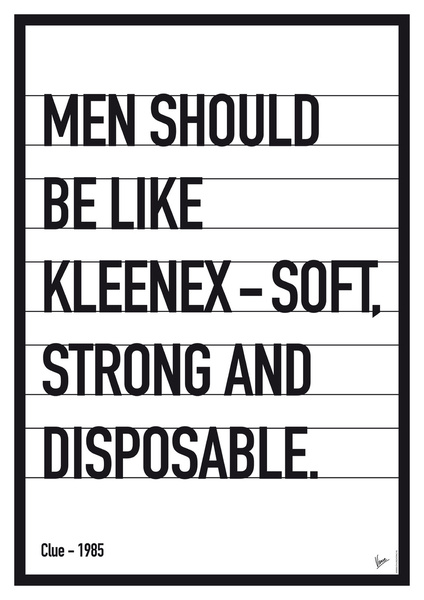
“Men should be like Kleenex — soft, strong, and disposable.”
One of many awesome quotable lines from the movie Clue. (click to embiggen)
Despite the fact that some people have accused me of being a hopeless romantic, one of my favorite fictional characters of all time is Mrs. White as portrayed by Madeline Kahn in the 1985’s Clue the Movie. Mrs White is a multiply-widowed woman who is assumed to have murdered several of her husbands. And those aren’t the only relationships she seems to have carried out in less than exemplary fashion. At one point in the movie she is asked how many husbands she has had, and immediately rejoins, “Mine or other women’s?” Afterward, she admits to five of her own, and then observes, “Just the five. Husbands should be like Kleenex: soft, strong and disposable.” And in more than one way she’s right. At least, what I mean is, when you realize that a relationship has reached its end, you should feel no guilt moving on, so long as you’re both able to be civil and neither of you behave abominably or do anything unethical to the other.

The truth is that the course of love and romance seldom runs true, as the old saying tells us. Mostly people misunderstand that saying, however. A lot of people operate under the mistaken notion that a relationship ending is the same thing as a relationship failing. Which is crazy. Living in a relationship is a whole series of tasks requiring multiple skills. And the only way to learn how to do a skill well is to try, fail, and try again.

Depending on your viewpoint, I can think of many reasons one could argue I’m a terrible spokesperson for Valentine’s Day or the topic of romance. I’m an out queer man, and there are a lot of people (including the man currently sitting in the office of Vice President of the U.S. not to mention a number of my relatives) who would insist that I don’t understand love because queers can’t love. A related group of people would say that because my first marriage ended in divorce (ignoring the whole orientation thing), that means I obviously suck at relationships. Others might quote Mrs. White from Clue and argue that “Life after death is as improbable as sex after marriage!” and therefore since I and my husband have been together for 20 years now that I have long forgotten what real romance is. And so on.

I feel compelled to point out that in college I was active in Debate and Speech competitions and in 1980 I won a number of awards in the After Dinner Speaking category, including eventually winning the Western Region Championship (beating out every other competitor west of the Mississippi) with a speech entitled, “How To Pick Up Girls.” So, this queer guy may know a thing or two about romance?

Of course, there is that divorce. But it may not mean what you think. You may be surprised to learn that some years after my divorce from Julie, that she asked me to be the Maid of Honor at her second wedding. Just as you may be surprised that we remain friends to this day. There are many reasons for that, not least being that Julie is an incredibly warm, loving person who is able to empathize with others and truly see things from multiple perspectives. I consider myself lucky to know her, and remain endlessly grateful that once we realized that I wasn’t bisexual we were able to stick the dismount.

Now, before she married her second husband (who is an awesome man who is perfect for her in thousands of ways that I was not), she had another relationship. This one with a man that, well, as soon as I met him I realized that he was NOT in her league intellectually and otherwise. But I was the ex-husband, and the queer ex-husband, at that, so at the time my opinion belonged tightly clamped behind my lips. But when that relationship fell apart, as a good friend, I was ready to offer sympathy, support, and to openly hate the ex (which was really easy because he was an idiot who didn’t deserve her).

So one evening she, I, and a bunch of our friends from the (now defunct) Seattle Lesbian & Gay Chorus, were standing around smoking (yes, I used to smoke, it has been 23 years since I quit, if you’re curious), and offering our condolences and so forth. She told a story of a particularly douche-y thing that he did to her during the break up, flaunting one of the women he had been cheating with. We all expressed our low opinion of him, and she equivocated, thinking maybe we were being too hard on him. I jumped in to say, “All men are pigs!”

One of the other friends, an extremely butch bisexual woman, laughed and said, “Oh, honey! He knows! Listen to him!” Several others chimed in all agreeing that I was right, all men are pigs.

And I was sincere. I’m a man who has dated a lot of men, and I can testify to the universal truth that men are pigs. As Mrs. White observed. “Flies are where men are most vulnerable.” She’s right. Sometimes we’re ruled by the wrong head. And when we let that head get us into trouble, we seldom manage to get out of such situations without hurting some of the people around us.

All men are pigs. Really and truly. It’s something I’ve known for many years.

However…

I’m addicted to pork. And I ain’t the only one!


Because some years ago a humorous post misled at least one of our friends to think that my husband and I was breaking up, I feel compelled to add this clarification: I love my husband with all my heart and we are still happy and together and I continue to remain astonished that he stays with me, because I don’t deserve him.

Offended offenders — the joke is on who, exactly?

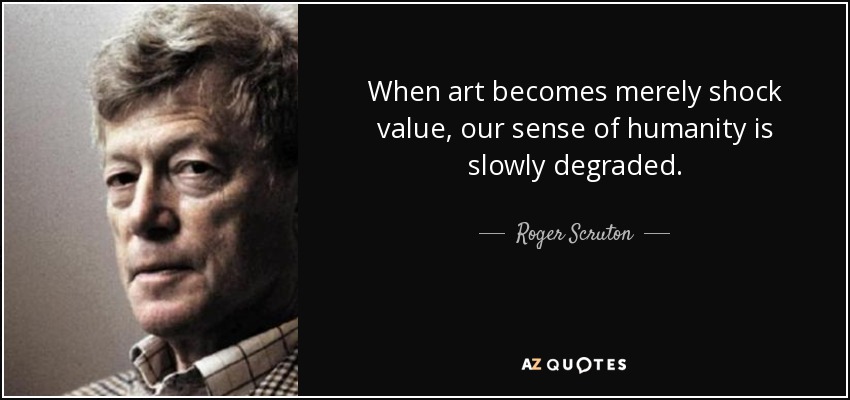
“When art becomes merely shock value, our sense of humanity is slowly degraded.” — Roger Scruton

We hear it all the time: “How dare you call me racist! I don’t hate anyone! I was just making an observation.” And there’s: “It is so rude of you to call me a homophobe! I’m just advocating for my beliefs {that queer people don’t deserve legal rights/to exist openly in public spaces if at all}. You’re the real haters!” Let’s not forget: “Can’t you take a joke? You’re trying to silence me!”

People behave like jerks, make threatening remarks, harass people, advocate for policies and propositions that will cause actual harm to others, and then get angry if other people take offense. They try to hide behind the idea of free speech—they’re just expressing themselves, and everyone has a right to do that, right? But the defense is built on one or more false equivalencies. The most basic is equating disagreement with censorship. If you say that all Freedonians are criminals, and I point out that isn’t true, and show the statistics to prove it, you haven’t been silenced. If other people decide the don’t want to listen to your rants about the evils of the Freedonians anymore, they stop inviting you to their social events and if you show up uninvited they ask you to leave, that also isn’t silencing you. The right to express an opinion doesn’t obligate other people to listen. Then there’s the false equivalence that accurately describing some of their statements as bigoted is just as bad as the bigotry we’re decrying. And so on.

But the defense that really annoys me is the, “But I’m only joking!”

I have several responses to that. The first is: every bully and abuser who ever lived has tried to claim that they were only joking, or they were just playing around. They didn’t meant to cause those bruises or broken bones or to break that laptop or whatever. It’s a lie. Maybe the bully and the bully’s audience were laughing, but real harm is being done.

The second response is: the fact that you think a particular topic is suitable for joking demonstrates the ignobility of your intentions. They only way that one can think the sexual assault is a joking matter is if they either don’t think the sexual assault is a bad thing, or if they think the victims of sexual assault are worth less than other people. There are topics that go beyond the pale, understanding that requires moral fiber and empathy. Not knowing that tells us you possess neither.

The third response is that doing something like “ironically” pretending to believe neo-Nazi ideology is indistinguishable from actually doing it. In other words, if you’re pretending to be an asshole, it doesn’t sound or feel any different to your targets than when a “real” asshole behaves that way. It also has a very scary normalizing effect. The more people feel it is acceptable to express racial bias, for instance, the more likely some of them are to act on the racial bias.

And my fourth response is that jokes are supposed to be funny. Calling entire classes of people inferior, saying they are a waste of space and so on isn’t funny. The objection that is usually raised around this point is that they are just trying to make people think, and they have to shock people out of their complacency to do that. I’ll agree that good political humor pokes at us to get us to think outside the box, but these guys aren’t quite getting it.

“Have you ever noticed that anyone driving slower than you is an idiot and anyone driving faster than you is a maniac?” “Electricity is really just organized lightning.” “Fighting for peace is like screwing for virginity.” “At a formal dinner party, the person nearest death should always be seated closest to the bathroom.” “'I am' is reportedly the shortest sentence in English. Could it be that 'I Do' is the longest sentence?”
Several classic George Carlin one liners. (Click to embiggen)

Let’s look for a moment at the work of a comedian who was often characterized as offensive. The Late George Carlin said things that shocked some people’s sensibilities. Go listen (many recordings abound) to his notorious “Seven words you can’t say on TV or the radio” routine and tell me that wouldn’t give people in the Religious Right conniptions. And sure, you can pull out individual lines from his routines and make him sound almost like some of this current generation of jerks with their racist or homophobic or misogynist rants on their Youtube channel. But that’s taking him out of context. Look over the classic Carlin corpus (excluding the last few years where he seemed to turn into a prophet of doom and things got a little weird) and you’ll find the most prevalent underlying theme is summed up in one of his best one-liners:

“Have you ever noticed that anyone driving slower than you is an idiot and anyone driving faster than you is a maniac?”

While the line works great on its own, it was actually the introduction to a longer bit, where he went on to make humorous observations about foolish and dangerous and weird things that people do while driving. It ranged around for a bit, and the audience laughed. You could certainly characterize the routine as making fun of bad drivers. And that doesn’t seem all that different from someone else having a comedy routine where they make fun of women, or immigrants, or queer people, right? But that’s not what the routine does. Every version of it I ever heard him perform varied a bit, but all stuck to one underlying theme. And it’s in that line I quote. That line isn’t just a joke, it’s a thesis statement.

Read it again: “Have you ever noticed that anyone driving slower than you is an idiot and anyone driving faster than you is a maniac?” Explicitly it says that we classify and judge people in categories like stupid and maniac by extremely subjective criteria. But implicitly it is also saying that sometimes all of us are idiots, and sometimes all of us are maniacs. Because implicitly everyone that we observe is an idiot for driving too slow, knows they we are maniacs. And every person that we can see is a maniac for driving too fast, can observe that we’re driving slow and therefore we are idiots.

Yes, the point of his routines is that some people do very foolish things and isn’t it ridiculous that such people exist? But by the time he has covered the subject, there is a point where he says something that hits close to home. We, the listeners, see ourselves in some part of that routine. In that way, his routines adhere to the classic definition of political humor: to hold a mirror up to society.

That is humor with a purpose. That is how you jostle people out of their complacency. You hold up a mirror, so that we look into it and see our own foibles and flaws. But what these other guys are doing? They aren’t working with mirrors. No, they are putting targets on other people, aiming their fans at those targets, and encouraging the fans to pull their triggers.

That is why the rest of us don’t listen to their rants. We disinvite them from our events. We tell them that their behavior is not welcome at our conventions or on our forums and so forth. That isn’t censorship, that is making a choice of who we will associate with. It’s deciding that we don’t need jerks and abusers in our lives.

Confessions of a whiny patient

(click to embiggen)

I have two more writing-related posts half written, one of which I hoped to queue up for Tuesday, but I was cranky, exhausted, and still sick when I got home from work. So I’m just going to whine about feeling sick and how I cope and related things. Which means that this post is going to be, as one friend calls them, a “what I had for breakfast post.” I probably won’t talk about breakfast, but if you’re not interested in just mundane stuff, don’t click through: Continue reading Confessions of a whiny patient

Confessions of the sometimes clueless

“You can do it” —Coffee

So, I was in either my late 30s or early 40s before I learned what pot smoke smelled like. It was at a convention in a particularly maze-like hotel and I commented to my husband about a weird odor I had run into out in the hall. He asked about where it was, then laughed and said he’d walked through that section of the hall a few minutes before and it was reeking of pot smoke. “Oh,” I said, sheepishly. The next time someone sat near me on the bus and had that particular stale pot smoke odor, it took all my willpower not to exclaim ‘So that’s what that smell is!’ because I’d encountered it many times before, but never knew what it was.

Over the years I’ve had numerous opportunities to vote on various aspects of marijuana law–each time I voted in favor of decriminalization or legalization. When some early attempts in our state to decriminalize pot outright through initiative failed, activists took new tactics. There was a successful city initiative to make simple pot possession the lowest priority of law enforcement, for instance. That one had a lot of interesting side effects. The city attorney at the time had vehemently opposed the initiative, so after it passed, he actually drastically increased the number of cases they prosecuted. So the next time he was up for re-election, a guy ran against him who vowed to enact the initiative… and he won by a big margin, and proceeded to dismiss cases and so forth.

The first statewide initiative to make pot a lower priority failed, but we passed a medical marijuana initiative eventually. Then finally in 2012 we legalized recreational pot completely. And while there are still some cities that have banned legal pot stores, and a few groups still trying to get weed re-criminalized, the industry appears to have done well.

Despite voting in favor of people having access to weed a bunch of times, I’ve still never actually used it, myself. Caffeine and cocktails remain my personal drugs of choice.

Last spring when we were looking for a new place to live, I didn’t even notice the first time we came to this apartment building that there was a pot store just around the corner. At least one of our friends commented on it as if it were an exotic thing. Another friend pointed out that there is about one every five or ten blocks on the major thoroughfare nearby, that they aren’t really that uncommon. It’s just another of the businesses I walk past every morning on my way to the bus, right?

I don’t remember when it was that I first started noticing the odd business trucks that would park on the street in front of our building on work-from-home days. The first time I saw the Roto-rooter type trunk, for instance, I wondered if one of my neighbors was having plumbing troubles. It seemed as if every work-from-home day I would notice, when I went to refill my coffee mug, and thus walked past the dining room window, that there was some weird delivery truck out there, such as the bottled water truck, or the plumbing related truck, or (this was the one that really confused me) the pool cleaning company’s truck.

One sunny day a few months ago I was getting another mug of coffee when I saw a bottled water delivery truck pulling over to park at the curb in front of our building. So I stopped to watch and see where the drive went. Did one of my neighbors have a water cooler in their apartment, perhaps? The guy got out of his truck, looked around with a definitely surreptitious air, and then turned and walked to the corner. At the corner, he turned left. Which is when I finally made the connection.

It was maybe five minutes later he came walking back, then climbed into the truck, started the engine and drove off.

Now I understood. A guy’s at work, driving around doing his job, and while it might be okay to have your truck seen parked at a coffee shop or fast food place in the middle of the day, you might not want to be seen popping into one of the local pot stores to pick up some stuff for the weekend. Sure, it’s legal, and yes, you are allowed to take breaks on the job, but there’s still a bit of a worry about how it might be perceived. So, you don’t ever pull into the store’s parking lot with the company truck. But, if there is a residential street which often has plenty of empty curb space in the daytime just around the corner from one of the pot shops in the part of town where you work, well, on the occasional Friday you may stop and park there and go on a short walk, right?

It probably would be obvious to anyone else, but it just didn’t occur to me until I watched the one guy go around the corner.

Ah, well, at least now when I give my coffee mug a warm-up on work from home days and notice an odd truck outside, I just smile instead of wondering why they’re there.

Magnanimous oppressors and two-way streets

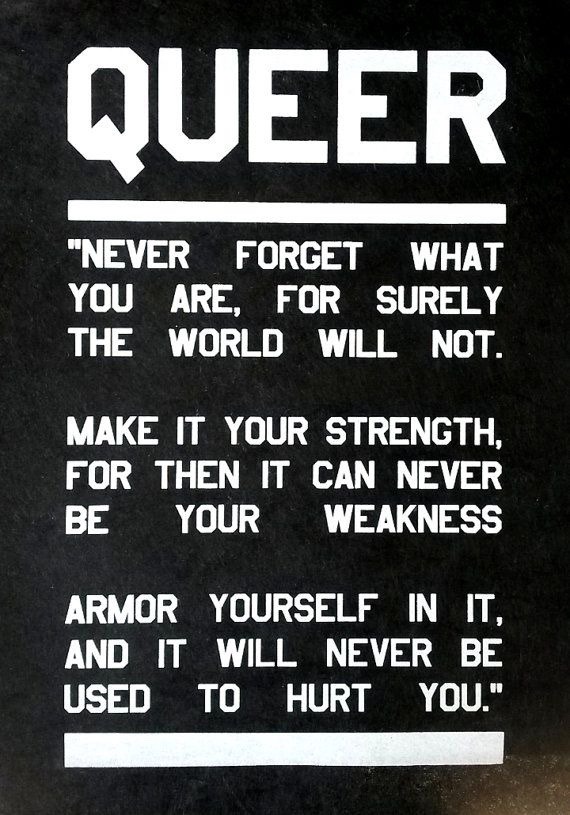
“QUEER: Never forget what you are, for surely the world will not. Make it your strength, for the it can never be your weakness. Armor yourself in it, and it will never be used to hurt you.”

One of the things I love about tumblr is how easy they make it to share something cool, interesting, or informative you find on someone else’s tumblr blog with your followers, while maintaining a history of who all has shared it and where it was originally posted. Especially of someone says something that I’ve been thinking or trying to write a post about, but here is someone else’s words saying this thing I’ve been thinking for a while so well. And I know that now if I try to finish my own blog post, even if I try not to phrase things the same way as this other person, I’m going to repeat key phrases and so forth. So I’d much rather quote the whole thing, then add a few comments of my own.

Such as this interesting post from the blog the only living boy in new york:

The thing I hate about coming out is the way society expects it to go down.

When gay people come out, more often than not they are expected to almost have to beg for their families love, and if they receive it without having to, they are expected to be over the moon and rejoice and be thankful and think, “what loving family and friends I have”.

The way coming out should go down is the exact opposite.

Families and friends should almost have to beg for your love, and should most definitely be apologetic for the homophobic shit they most likely put you through whilst you were still in the closet. They should be like, “I’m sorry I was a bigoted prick all these years, I hope you can still love me and forgive me”.

The thing that bothered me the most when I came out was that my families reaction was just, “of course we have no problem, we love you no matter what”… when what I really wanted was an apology. An apology for having been ignored for years, an apology for having to sit though homophobia not only by them, but by my extended family and their friends. But what I got was, “of course it’s not a problem, now lets not talk about it again and lets not bring up all the horrible shit that we said to you openly or allowed to be said about gay people openly because we don’t want to feel bad”.

It bothers me so much to this day how much society loves to praise straight people for being so accepting of gay people but no one ever praises gay people for accepting and loving their families through the years despite all the homophobia.
—the only living boy in new york

While the beginning of the post focuses on coming out, that isn’t the only part of a queer person’s life this is limited to.

Yes, it is more than just annoying that people who spent years regurgitating anti-gay myths and homophobic stereotypes around us when we were closeted (and in many cases ridiculed us directly using homophobic slurs) act as if they are doing us a favor by being tolerant or accepting when we do come out. But the truth is that they are never as tolerant as they think they are. The homophobia becomes a bit more subtle. They use dogwhistles rather than bluntly bigoted language.

If we point out that something they said is unintentionally homophobic, we get accused of being too sensitive. If we point out that a politician they support advocates homophobic policies, or that a charity they support has actually contributed to the deaths of queer teens, we’re told that we’re overlooking all the good things because of one little bad thing. Never mind the queer people are denied needed healthcare, or lose their jobs or homes, and so forth. It’s not important.

And we’re supposed to be grateful?

The same people who accuse us of being too sensitive throw hissy fits because some businesses say “Happy Holidays” in their advertising rather than “Merry Christmas.” They’re the same people who tried to organize boycotts of businesses that chose to provide health care coverage to the partners and kids of their queer employees. They’re the same people who do call for boycotts if a movie and television show includes a queer character (usually supporting character who is given little screen time and is never shown with a same sex partner except in such ambiguous ways that the casual viewer will think it’s just a friend or a sibling).

And they expect us to explain why something is offensive, no matter how many times we’ve already explained it. Besides the fact that if they applied the teeniest tiniest bit of empathy they should be able to see it on their own. Heck, they get angry at us if we hold hands with our partner in front of them, and think it is horribly thoughtless of us not to realize they were uncomfortable, but don’t expect them to know they shouldn’t tell an AIDS joke in front of us!

It’s exhausting.

And I don’t have an answer. Except to urge you, if you think that you are a supportive friend or co-worker or family member of a queer person, to stop and check yourself. If you start looking at your own words and actions from an outside perspective, you may be in for a sobering surprise.

I’ll give you a couple of suggestions for some ways to do this:

1. If you’ve ever said, “no offense!” to an LGBT+ acquaintence…

2. If you’ve ever said, “I’m not talking about you, of course, I’m talking about those bad people” or “Present company excepted”…

3. If you’ve ever dismissed anything as being politically correct…

4. If you’ve ever said, “I’m not homophobic, but…”

5. If you’ve ever noticed that your queer relative declines your social invitations again and again…

…you may not be nearly as accepting as you think you are.

Words and Images: untreatable case of I don’t give a sh*t

I keep finding myself writing either cranky and dark stuff, or fluffy weird holiday stuff. And then not wanting to post it. Meanwhile, the interesting images I swipe from various parts of the internet pile up. So here are a few of the more thought-provoking ones:

Carrie Fischer on stage speaking: “I'm what psychology journals refer to as batshit crazy. It's a delicate mix of bipolar disorder, which I'm able to control through serious medication, and a completely untreatable case of I don't give a shit. Unfortunately, for a woman, the side effects of this condition include: reduced employment, phone calls from terrified PR flack, and tremendous difficulty getting myself down to a weight that's acceptable to some 35-year-old studio executive whose deepest fantasy and worst nightmare somehow both involve me in a gold bikini.”
“I’m what psychology journals refer to as batshit crazy. It’s a delicate mix of bipolar disorder, which I’m able to control through serious medication, and a completely untreatable case of I don’t give a shit. Unfortunately, for a woman, the side effects of this condition include: reduced employment, phone calls from terrified PR flack, and tremendous difficulty getting myself down to a weight that’s acceptable to some 35-year-old studio executive whose deepest fantasy and worst nightmare somehow both involve me in a gold bikini.”

This next one was being shared several places but without the attribution of whose book is shown. Fortunately, feeding an entire sentence into Google got me the name of the author and the book in question.

“The people we surround ourselves with either raise or lower our standards. They either help us to become the best version of ourselves or encourage us to become lesser versions of ourselves. We become like our friends. No man becomes great on his own. No woman becomes great on her own. The people around them help to make them great.  “We all need people in our lives who raise our standards, remind us of our essential purpose, and challenge us to become the best version of ourselves.”  ― Matthew Kelly, The Rhythm of Life: Living Every Day with Passion and Purpose
“The people we surround ourselves with either raise or lower our standards. They either help us to become the best version of ourselves or encourage us to become lesser versions of ourselves. We become like our friends. No man becomes great on his own. No woman becomes great on her own. The people around them help to make them great.
“We all need people in our lives who raise our standards, remind us of our essential purpose, and challenge us to become the best version of ourselves.”
― Matthew Kelly, The Rhythm of Life: Living Every Day with Passion and Purpose
Click to embiggen, but I'm going to re-write it below...
Click to embiggen, but I’m going to re-write it below…

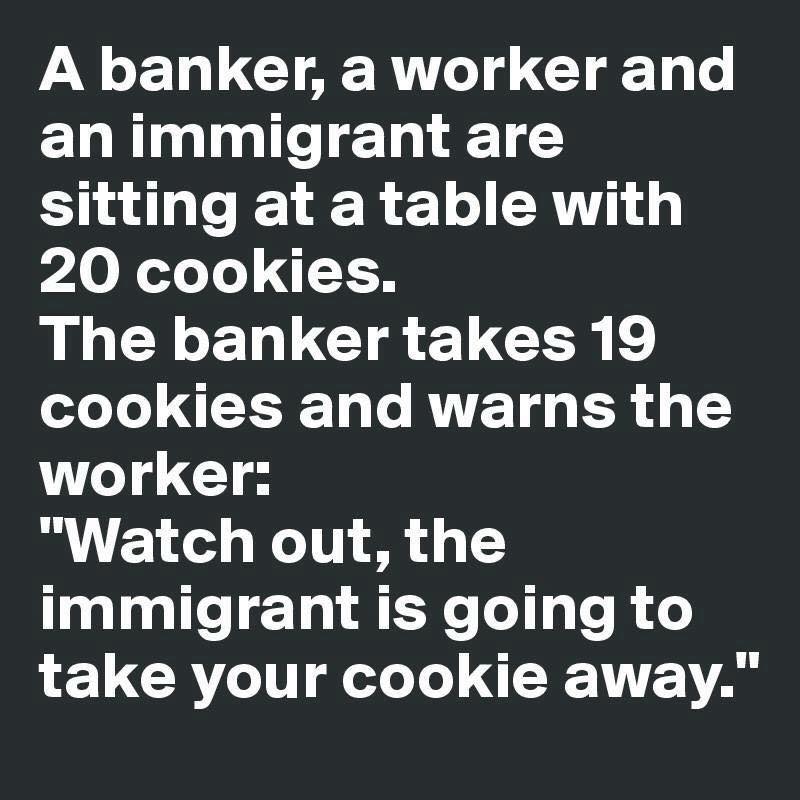
This one should more accurately say: “A banker and two working class people—one white, and one not—are sitting at a table with 20 cookies. The banker takes 19 cookies and warns the white worker: ‘Watch out, that other guy (who I bet isn’t even a real american) is going to take your cookie away.’” Because there is a long history of the rich pitting people against each other along color lines. The recent use of variants on immigrants are dog-whistles for the racism.

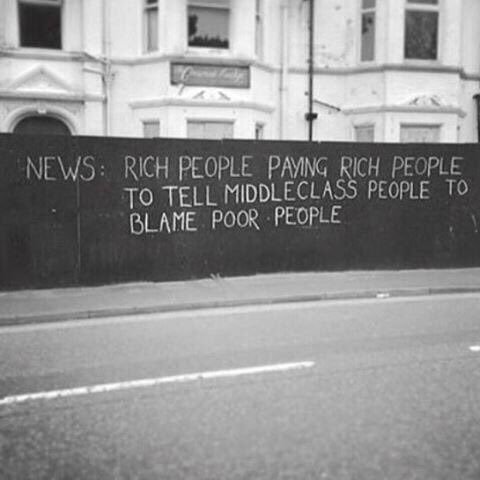
“News: Rich people paying rich people to tell middleclass people to blame poor people.”
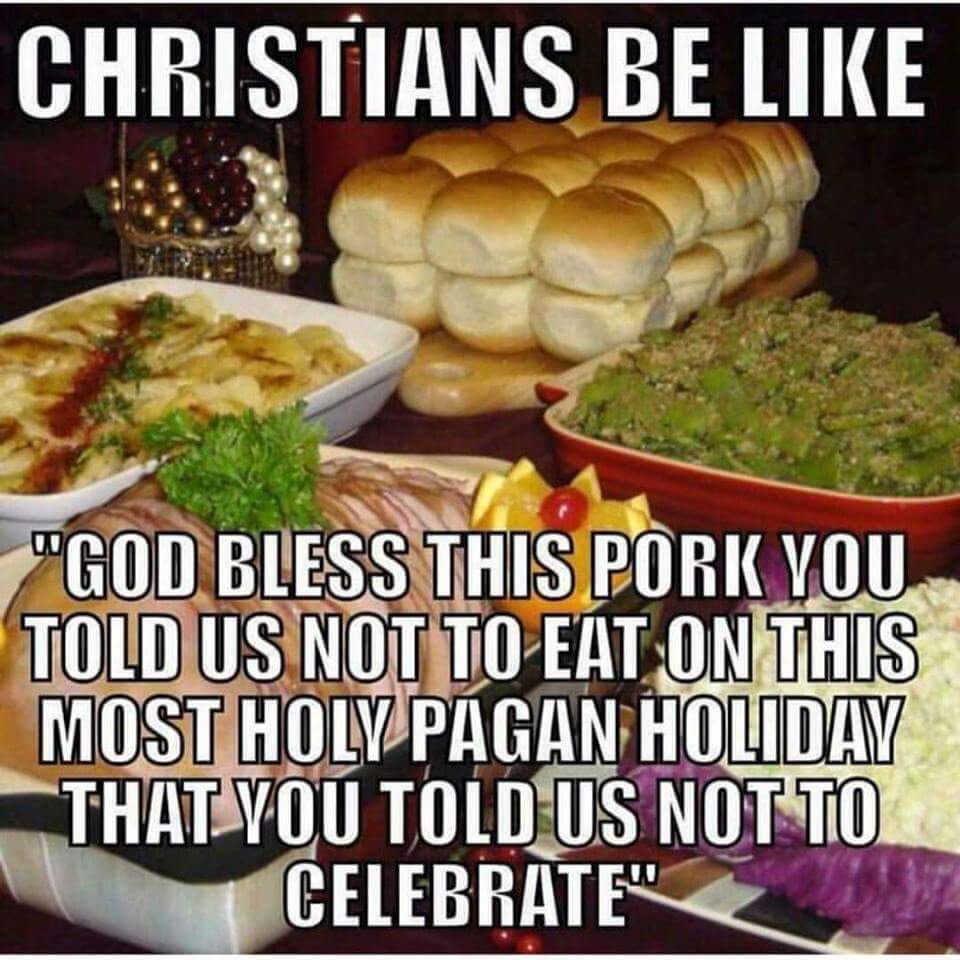
“Christians be like 'God bless this pork you told us not to eat on this most holy pagan holiday that you told us not to celebrate.'”
“Christians be like ‘God bless this pork you told us not to eat on this most holy pagan holiday that you told us not to celebrate.’”

And finally:

“I find your lack of cheer disturbing.”

We need a rainbow Christmas…

“I would suggest you make the Yuletide gay, but you clearly don't need any encouragement.”
“I would suggest you make the Yuletide gay, but you clearly don’t need any encouragement.”
We need a rainbow Christmas,
Right this very minute!
Egg nog at the brunch bar
With lots of bourbon in it!

Yes we need a rainbow Christmas,
Right this very minute!
My lyrics may be getting slurry,
But Santa dear, we’re in a hurry!

Fling ’round the glitter!
Put up more twinkling lights than the whole Vegas strip!
No need for fruitcake,
We’ve got a great big table of deliciousness,
here!

Cause we’ve grown a little rounder,
Grown a little bolder,
Grown a little prouder,
Grown a little wiser,

And I need a toasty lover,
Snuggling by the fire,
I need a rainbow Christmas now!

We need a rainbow Christmas now!

Merry Christmas!

© 2017 Gene Breshears
Happy Christmas! Shabbat shalom! Blessed Yul! Happy Hogswatch! Joyous Kwanza! Festive Festivus! Feliz Navidad! God Jul! Mele Kalikimaka me ka Hauʻoli Makahiki Hou! Beannachtaí na Nollag! Buon Natale! Priecīgus Ziemassvētkus un laimīgu Jauno gadu! Felix Dies Nativitatus!

What’s on your list?

“My Xmas list is short this year: 1. $1,000,000 in cash 2. The souls of all who have displeased me 3. A kitten”
“My Xmas list is short this year:
1. $1,000,000 in cash
2. The souls of all who have displeased me
3. A kitten”
While I agree with the sentiment behind the meme here, this actually isn’t my list. I wouldn’t turn down a million bucks, obviously. And well, certain souls do deserve some sort of torment. I love kittens and puppies and other baby animals, but the sad truth I learned many years ago is that my allergies are much less horrible if I’m not sharing living space with cats. I loved the various cats who owned me (Fiona and Woody), and those I grew up with, but I love breathing, too. Similarly cut Christmas trees aren’t good for the old bronchial tubes and sinus passages.

What’s actually on my list are lots of things that aren’t going to happen, such as Congressional Republicans finding moral spines and impeaching the traitors in the Oval Office, real peace coming to several parts of the world that haven’t known it in many years, homophobic relatives seeing the light, and so forth.

“When you stop believing in Santa you get underwear.”
Otherwise, when I try to come up with lists, it’s fairly mundane things such as books I want to read, movies I would like to own, nice warm fuzzy socks, or some nice new Andrew Christian underwear. Things that it would be nice to have, but not that I necessarily need. I mean, yeah, socks wear out—particularly for someone like me who has to wear warm socks for medical reasons during cold parts of the year, and thus runs around the house in socks all the time. So, when I put fuzzy socks on my wish lists every year, I really appreciate the folks who get them for me.

I find myself, instead, thinking about things that I’m thankful for and things that I wish I could give to others. Yes, I gave people presents, and the gifts seem to be appreciated. But while I can go to a store and buy someone some chocolate, or that electronic thing they put on their list, or a nice sketchbook, and so on, I can’t give people the job with benefits that they really need, or a non-dysfunctional family, or just health. So I can offer my love and support.

So, this is my list, things I wish for everyone who reads this:

  1. Warmth
  2. People in your life who love you
  3. Beauty
  4. Someone who appreciates you
  5. Peace

Bless us, every one.