Category Archives: life

Confessions of a recovering evangelical, part 2

Man dressed as Jesus stands in front of a group of anti-gay protestors. Jesus-guy holds a sign that says, “I'm not with these guys.”
“I’m not with these guys.” (Click to embiggen)
When I was a teen-ager our church had a debate about locks. I think the precipitating event was the purchase of a new organ for the main sanctuary, but I also know there had been an incident of one of the other churches in the neighborhood being vandalized. The upshot was, someone had proposed that we put locks on the main doors of the church. We had long had locks on some specific rooms inside the building, and the auxilliary wing of the church was locked up when not in use, but the main building and specifically the sanctuary (which is the official name of the large room with the pews, pulpit, and baptismal) were always unlocked and open to everyone.

There was a lot of talk during the meeting about insurance—either that our current insurance carrier didn’t want to cover us against theft and vandalism for parts of the building that were unlocked at night, or they were going to raise our rates significantly, I don’t recall which. There were a number of people in the congregation who felt maybe we should start locking the main building. “We aren’t in a tiny town and it isn’t the fifties,” is how I think one person put it. Another person told a story of homeless people routinely sleeping in churches and sometimes not being careful about where they went to the bathroom.

One of the associate pastors rose to his feet on that one and said, “Call me foolish if you want, but I think the proper response to finding a homeless person sleeping in your church should be to offer them a meal, and then ask what other help do they need!”

I grew up in Southern Baptist Churches where the tradition is that all business decisions related to the church are decided by the congregation as a whole. At regular intervals the usual Wednesday Prayer meeting would begin with a business meeting. Any congregation member, no matter their age, who attended the meetings had a vote. I had been attending business meetings at the many churches we attended (as my family moved) for as long as I could remember. I seldom remembered one that became more impassioned than that debate about whether to put locks on the sanctuary door.

It was beginning to look as if the majority was leaning toward adding the locks. And then one elderly member of the congregation struggled to stand up. She had been frail and needed a walker to get around for some years, but she never missed a service at the church. She let the person sitting next to her help her to her feet, but then she sort of shook him off and raised her face as if she was speaking to the heavens themselves, and I hadn’t heard her voice sound so firm in years. “For I was hungry and you gave me nothing to eat, I was thirsty and you gave me nothing to drink, I was a stranger and you did not invite me in, I needed clothes and you did not clothe me, I was sick and in prison and you did not visit me. And they will answer, ‘Lord, when did we see you hungry or thirsty or a stranger or naked or sick and in prison and did not help you?’ And he will reply, ‘Truly I tell you, whenever you did not do it for the least of these, you did not do for me!'” She paused, looked around at all of us, and then added. “We call it a sanctuary! That is what it is supposed to be! This isn’t our house, it is His house, and he already told us what we ought to do!”

And then she sat down.

Every one was very quiet for a moment, then someone said, “I move that we do not put locks on the sanctuary.” About forty of us said, “Seconded!” And the deacon conducting the meeting said, “Everyone in favor, signify by saying ‘amen’?” That was a very loud chorus of “amens.” Then the deacon asked, “Any opposed?” And I think one person said “Nay,” and he was immediately admonished by his wife.

Before I move on, a few notes. It has been many years since I considered myself a Christian. I usually say that I didn’t reject the church, but my denomination (which is still anti-gay decades later) rejected me. At that time, I felt I had no choice but to look for spiritual fulfillment elsewhere. I usually define myself as Taoist, now. But when that woman started quoting the Gospel of Matthew, chapter 25, I found myself murmuring along with her. I wasn’t the only person, by any means, but my point is that I was the kind of kid who could quote entire chapters of the Bible from heart. Some of those passages still speak strongly to me.
If it isn’t a sanctuary, it is not a house or worship.
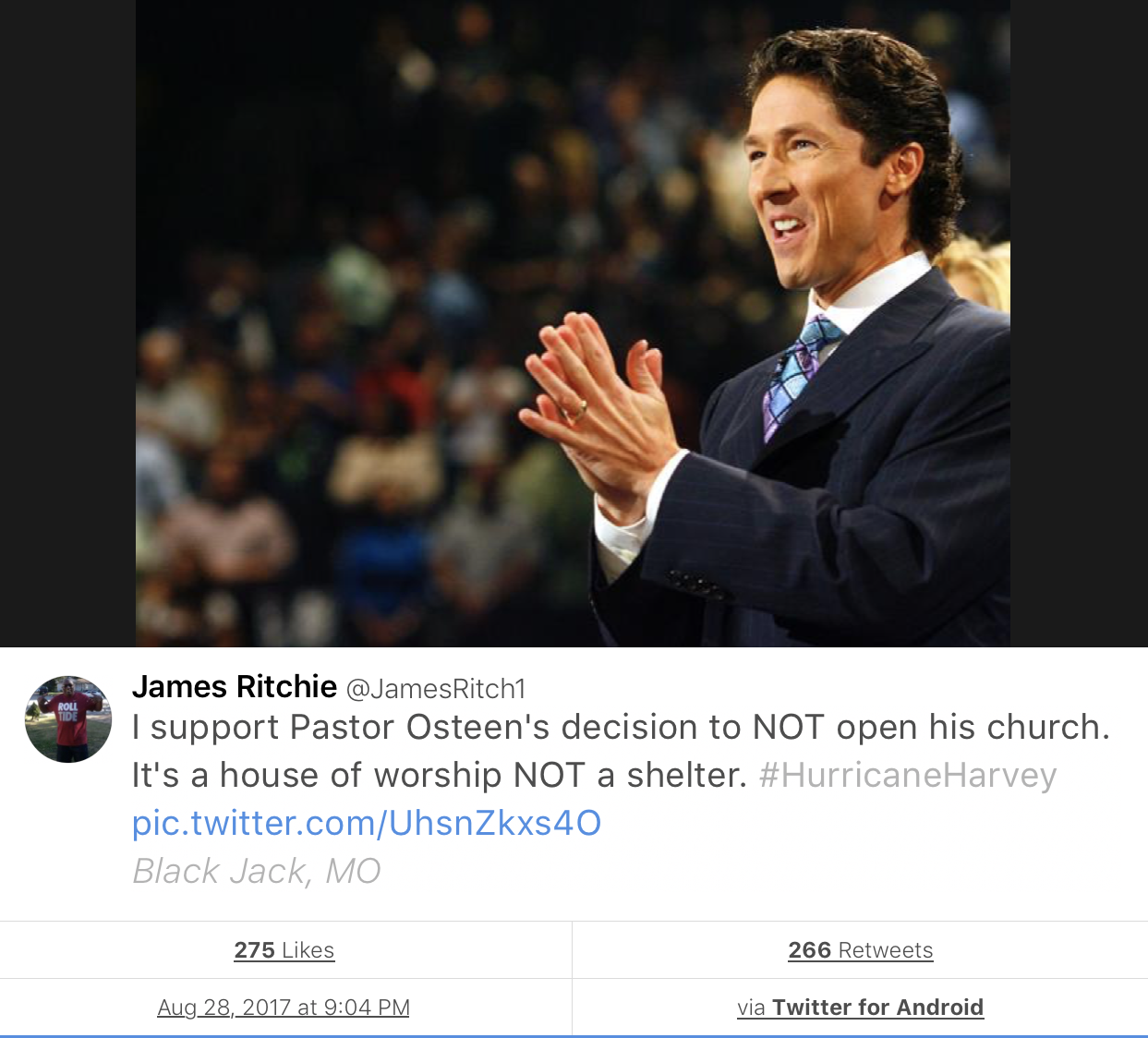
So, yes, I was one of the people a bit outraged when so-called christian televangelist Joel Osteen, mega church pastor in Houston, Texas, refused to open his building as a shelter to his neighbor flooded out of their homes: Joel Osteen’s Houston megachurch opens to Harvey victims only after backlash. The church’s statements have been slightly contradictory. There are plenty of posts on the internet you can track down of people living nearby walking to the church during the time when the church claimed it was flooded to show there wasn’t any flooding. And during the time when they said it was not locked people walked up and took videos of themselves trying doors and so forth.

So let’s get a few things straight. Osteen’s “ministry” preaches so-called prosperity gospel, the essence of which is: if you’re rich, that’s a sign God likes you. If you’re not, maybe he doesn’t. This runs absolutely counter to almost every word Jesus actually said. The church in question isn’t just a megachurch, it is a former sports arena that the “ministry” purchased for millions of dollars, then spent at least 70 million more renovating. The renovations include installing two artificial waterfalls inside the church, yet somehow in all of that they neglected to put in any symbols of Christianity: there are no crosses or any other signs inside the sanctuary that indicate in any way that it is a christian house of worship. Thousands of TV cameras and screens and a top-notch sound system so that you can always see and hear Osteen, though.

While the child inside me who used to love reciting John 16:33, or Matthew 5:3-16, or Matthew 25:31-46 gets outraged at Osteen’s actions, I can’t really say that he is much of an outlier of typical evangelical christian thought. Most evangelical christians believe, whether they say it aloud or not, in the Just World Fallacy: if bad things happen to you, they are almost certainly a punishment from god. In other words, if you’re poor, it can’t possibly be because the entire system of the economy and society is geared to transfer wealth and resources from everyone else to the rich, it’s because you’re probably secretly doing something sinful. If you get a horrible disease, it isn’t caused by a virus or chemicals you’ve been exposed to in your deregulated workplace, et cetera, it’s because you’re doing something sinful, et cetera. And therefore, poor people, sick people, and so forth don’t deserve help and compassion. Like Osteen’s prosperity BS, it is the opposite of what Jesus actually taught.

As if one object lesson in just how uncompassionate and unchristian many of these so-called religious leaders are, at the same time this was unfolding, another group of evangelical leaders were doubling down on their anti-gay, anti-trans, anti-sex, anti-joy hateful rhetoric: Evangelical Leaders Release Anti-LGBTQ Statement On Human Sexuality. The fact that some of those “leaders” have been involved in serious scandals trying to cover-up rampant sexual abuse within their organization is really all anyone needs to know about them.

But someone else described these situations far more eloquently long ago:

“Not every one that saith unto me, Lord, Lord, shall enter into the kingdom of heaven; but he that doeth the will of my Father which is in heaven. Many will say to me in that day, Lord, Lord, have we not prophesied in thy name? and in thy name have cast out devils? and in thy name done many wonderful works? And then will I profess unto them, I never knew you: depart from me, ye that work iniquity.”
—Jesus, as quoted in the Gospel of Matthew, chapter 7, verses 21-23.
“Oh, it’s not that bad!” and other adventures in being human

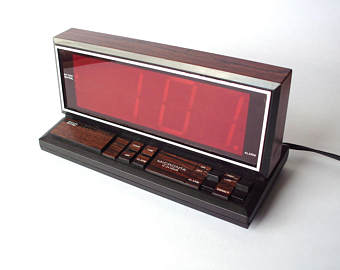
This picture of a “vintage alarm clock” was as close as I could find to the old clock on line, but this looks a bit more modern than that one.
There are many little aspects of our move that I haven’t written about. Not that every little anecdote is worth a blog post, but we had a few discoveries/epiphanies during the course of the packing and sorting and reducing and hauling and unpacking and replacing that are at least a little amusing. For example, there’s the matter of our alarm clocks. Way, way, way back when Ray and I first moved in together, we had two alarm clocks. Since Ray’s job at the time sometimes required him to get up earlier on some days than others, while I generally tried to catch the bus at the same time every day to get to the office by 9-ish. So we each had an alarm clock on each side of the bed.

Both were digital alarm clocks with that formerly ubiquitous red LED display, though Ray’s was a large print display, because without his glasses, even if he picked up a regular alarm clock and held it so close that his nose was almost touching the display, he still couldn’t read the numbers. My alarm clock was a clock radio, and I always set it to start playing NPR about a half hour before I needed to wake up, then the alarm when I had to get out of bed. Because I was less likely to be a Grouch Monster™ when the alarm went off if I’d been eased into waking up by the radio. After Ray died, I kept both alarm clocks. For one thing, while my eyesight had never been quite as bad as Ray’s, I liked the fact that I could read the large print clock from the far side of the bedroom when I didn’t have my glasses on.

When Michael moved in with me the year after Ray died, he already owned an alarm clock. And since he also had a job where he needed to get up at different times each day for work, it made sense to have a separate clock. But we didn’t get rid of my second clock. Instead we moved the clock radio to the far side of the bedroom, which I found made it less likely that I would hit the snooze alarm a bunch of times and oversleep. Over the years, the clock radio had to be replaced a couple of times. And Michael’s clock’s display went wonky and had to be replaced, but the large print clock which had been Ray’s just kept chugging along.

Or at least, that’s what I told myself.

I don’t know how old the clock was, because Ray already owned in when we started dating in 1990. But that means it was at a minimum 27 years old this spring when Michael and I were packing. Not surprisingly, after 27+ years of use, some things didn’t work as well any longer.

  • One of the features the large print clock had which was innovative and unusual in 1990 was a battery compartment in the bottom of the clock so that if you kept fresh batteries in there, the clock wouldn’t lose time during a power outage. The clock wouldn’t actually stay lit up or sound its alarm when it was on battery back up, but you didn’t have to reset it once the power came back on. Now it is pretty standard for electronics to have a in-built mini rechargeable battery for this purpose, but back then it was unusual. The battery backup stopped working years ago. You don’t want to know how many times I changed the batteries and cleaned the contacts in the battery compartment, or shone a flashlight into it while I peered through a magnifying glass trying to fix it before I admitted to myself that the memory chip or whatever it was that the batteries powered must have failed.
  • A couple years after the battery backup stopped working, the alarm became inconsistent. You could set the alarm, and when it came time for the alarm to go off, the clock would try to sound an alarm. But sometimes all you got was a click and a single weird little chirping noise. other times the buzzer would sound, but it wasn’t very loud. Other times it chirped and chirped and chirped until you turned the alarm off. Very rarely did the buzzer just buzz loudly. But since by this time I had a clock radio that had two alarms in addition to the radio, I didn’t really need the alarm on this clock any longer. But the large print display I still had a use for.
  • More recently, the power cord had gotten twitchy. By which I mean, if you bumped the power cord, it would temporarily lose power. And because the battery backup wasn’t working any longer, that meant that basically if you sneezed in the vicinity of the clock, the display would go dark until you jiggled the cord again, and then you had this enormous blinking 12:00 on the screen. Now, I’m not saying the cord was frayed or otherwise showed any sign of the sort of wear that would make it a fire hazard, I think the iffy connection was actually inside the body of the clock on one side or the other of the rectifier (this is the part inside most electronic devices that converts the household 110-volt alternating current into the much lower voltage direct current that circuit board and chips and such use). So this didn’t represent a fire hazard, just an annoyance.
  • Cosmetically, the faux-gold coating on some parts of the plastic bezel around the display had been wearing off. The labels on some of the switches and buttons necessary to setting the time had faded to the point of being difficult to read, and there was a half-inch-long crack in one corner of the display.

When I actually type these things up, it seems really ludicrous that I hung onto the clock as long as I did, right? And it is ridiculous. But it’s not that unusual for people to let small annoyances like this build up to a ridiculous point and try to keep muddling along. How many times have you known someone in a relationship which had obviously soured or become awful over time who didn’t notice the thousands of little ways they were walking on eggshells to keep the peace?

Yeah, part of the reason I was more willing than was reasonable to overlook the growing list of problems with this clock is because it had belonged to Ray. And I am a sentimental fool, so of course I don’t want to get rid of something that had any fond memories attached. And yes, the alarm clock did have fond memories associated with it. Not to get too graphic, but it was the only light on in the room the first time we made love, after all. But the other part was the human tendency to make-do with something because it seems easier to keep the thing we’re familiar with than to replace it.

As it was, the clock radio, though many years newer than the large print clock, was also beginning to develop some issues, and the alarm clock on Michael’s side of the bed had a crack in the display that made it difficult to read from some angles. And so Michael bought a brand new bedroom clock for the new house within a day or two of the move. And he found a single clock that replaced the functions we had actually been using on the three old ones. The main display shows time, day, date, and the temperature in the room. It has a radio, multiple alarms, alarms you can specify for different days of the week, and it has an adjustable, focusable laser display that projects the time on the ceiling or a wall in very large print so I can read it in the dark (and it doesn’t have to be that dark, just dim in the room) from across the room without my glasses.

It’s a very big improvement, it wasn’t expensive, and one little clock takes up a lot less space than the three old things we had before.

Change doesn’t have to be bad!

We mistake our privilege for something earned, and think the worst of those without pedestals

Who knows what self-delusion lurks in the hearts of white men? The Shadow knows...
Who knows what self-delusion lurks in the hearts of white men? The Shadow knows… (click to embiggen)
My dad was the kind of racist that was almost too easy to spot. He threw around the n-word and other racial slurs not just casually, but with great frequency. It was impossible to talk to him without also hearing how all those people were the cause of anything and everything bad that he perceived was happening in the world. Friends and acquaintances didn’t always believe me when I would describe the phone conversations where I had to ask him, multiple times, to stop talking like that or I would hang up.It was simply toxic to talk to him, which is why I literally stopped speaking to him at all about seven years before he died. My dad was the kind of racist who made it easy for other people to congratulate themselves that they weren’t racist because they didn’t talk as crudely as he did. We look at guys like my him, or the people waving Nazi flags and throwing Nazi salutes in Charlottesville, Virginia this last weekend, and tell ourselves that we aren’t like that, so clearly we aren’t racist.

Who speaks truth about the evil that lurks in the hearts of men?
Who speaks truth about the evil that lurks in the hearts of men? (click to embiggen)
But we live in a racist society. We’ve been conditioned to believe all sorts of things about each other based on the color of their skin. Studies show that when we’re shown photographs of black teens of either sex we consistently over-estimate their age, for instance. We’ve been conditioned so that if we look at a young black man, we don’t see a kid, but a thug. We’re pre-disposed to believe that a young black man is not only capable, but likely to hurt someone. We see a video of a dark skinned person carrying a toy gun getting gunned down by police (even though he has dropped the toy and has his hands in the air), and say, “Well, he still looked dangrous.” Then we see video of hundreds of white guys showing up at a political rally carrying rifles and guns and say, “They’re just exercising their rights.”

It is impossible to grow up in a racist society and not absorb a lot of racism. It is also impossible to grow up in the U.S. as a white person and not benefit from all that racism. Part of it is the generational thing: we lived in nicer neighborhoods than we otherwise would because our parents, grandparents, and so on benefited from preferential hiring practices, redlining of mortgages, and unequal distribution of resources for public schools. And it’s easy for us to say, “Well, that was the bad old days. Things have changed, now, and besides, I can’t do anything about it.” But it isn’t just the bad old days. Racist assumptions are baked into all of our social conventions, institutions, and business practices. Studies have shown again and again that changing something as simple as making a name look less ethnic on a resume substantially improves the odds that a submitted resume will get result in a call for a job interview, for instance. We see it in statistics of which people cops decide to stop and question, let alone the ghastly statistics about police shootings.

So if you’re like me, looking at this news this weekend and being horrified that an angry white man who drove his car into a crowd killing a woman (and wounding at least 19 other people), while people ranging from ordinary citizens to news anchors and even the president are bending over backward to say that bigotry isn’t involved—it isn’t enough to say, “Aren’t they terrible people?” We have to be willing to admit that these terrible people were enabled by a society which explicitly benefits white people, whether we individual white people think of ourselves as racist or not.

Some other folks have explained it quite well: How “Nice White People” Benefit from Charlottesville and White Supremacy:

“For white people who don’t self-identify as disciples of Richard Spencer, David Duke, and/or the ancient demon Beelzebub, there is extreme anxiety around the accusation of racism. We see this fear of blame in Trump’s statement. “Not Donald Trump, not Barack Obama” seems to say, ‘Hey, there’s been a tense racial climate in this country forever. It’s not anyone’s fault!’ Except the opposite is true. American white supremacy has been a problem forever, and it is all of our fault, fellow white people.

“White people benefit from white supremacy. Period. Peggy McIntosh spelled this out for us in 1989, but apparently we’re still not quite getting it. Her famous piece, “White Privilege: Unpacking the Invisible Knapsack,” lays out undeniable ways that it is simply easier to be white in this country, like always having a boss who is a fellow white person, or, you know, being able to eat Skittles at night without getting shot. Most white people didn’t ask for this privilege. Actually, that’s the whole idea. White privilege is an inherent advantage that easily goes unnoticed and unacknowledged. Rather than stuffing down the sense of shame associated with this obvious unfairness, why not work to even the playing field?”
—Lauren Duca

The referenced article by Peggy McIntosh is also a very good read: White Privilege: Unpacking the Invisible Knapsack.

“I was taught to see racism only in individual acts of meanness, not in invisible systems conferring dominance on my group.”
—Peggy McIntosh

We can’t just shake our heads and blame it all on those people. Society as a whole, including us, are to blame. The first step is recognizing that the problem isn’t something which was forced on our country. The problem isn’t something that just appeared recently. The problem has always been there. It has been growing and getting angrier for years. We are part of the problem, so we have to be part of the solution. We have to find ways to oppose this racist authoritarian movement with more than just words.

It’s not a food allergy & other misconceptions about diabetes

I run into this one all the time...
I run into this one all the time…
Since my diagnosis , whenever a planned visit to my mother’s approaches I start getting texts from Mom with various food questions. “I forget, can you eat pineapple?” “I know you can’t eat regular bread, but what about biscuits?” And so forth. And each time I have to explain, yet again, that I can eat anything.1 It isn’t about what kinds of food I can and can’t eat, it’s about how much carbohydrate is in each food, and how much I’ve already eaten.

Once when I vented about this misconception on line, someone replied that their mother kept thinking that his wife’s need to eat gluten free meant always having a vegetarian option.

My mom isn’t the only person who buys into this myth that diabetics can never ever eat this, that, or the other. I’ve met plenty of diabetics (and a doctor or two) who also buy into it. I’ve seen plenty of people who take it the other way: since they’ve been told they can “never” eat anything they think is good, they just say “screw it” and eat themselves to death.2

So, for instance, most mornings I have a cookie or nice piece of chocolate. We’re supposed to eat a small snack each time we take our insulin, and I have found my blood sugar is most stable if I eat something with less than 10 grams of carbs for that first snack of the day. And there are lots of snack foods which are NOT sugar-free where a single serving falls in that range.

Everyone’s body varies, but I’ve found that as long as my total carbs for the day stay under 150 grams and no single meal has more than about 40, (and I take my meds on time) my blood sugar readings stays in the desired range. That’s true whether those carbs come from things like lentil soup, tangerines, and icelandic yogurt or chocolate, Dry soda, and beef stroganoff with noodles.

Keeping track of the carbs takes work, I get that. People keep asking me if I have an app the tells me how many carbs are in things and I reply, “Safari!” Yes, the defalt web browser on my iphone. I can just type “how many carbs in french fries” and get a useful answer–a serving of this size contains this many carbohydrates, that much fibre, et cetera. I’ve been doing it long enough that I don’t have to look up a bunch foods, because the numbers and serving sizes have started to stick in my memory. I can eyeball a lot of servings and come up with a good guess.4

I’m just enough of a creature of habit with a bit of obsessive compulsive leanings that once the behavior was established, making a not of how many carbs I’m eating happens almost without thinking. But there is time and effort involved. And let’s be honest, eating healthy isn’t cheap. Our society has gotten really good at serving massive amount of calories cheaply in forms that are almost tailor-made to make you fat. Finding health alternatives, that are easily to keep with you, easy to store, won’t spoil before you can eat them all, and so forth is more expensive the just grabbing the reasonably priced pre-packaged foods, or a cheap (and delicious) meal from a food truck or whatever.

Another myth I hear a lot is, “You can eat all the fruit you want!” in various forms. I can’t tell you how many times I’ve had a conversation that includes the claim, “But fruit doesn’t have sugar!” and when it’s pointed out that fruit contains a lot of sugar, “Well, but it’s nature sugar, so it’s good for you!” I’ve had engineers who I know had to pass basic chemistry to get their degrees insist that the naturally occurring sugar in fruit doesn’t elevate your blood sugar reading, because it “isn’t the bad stuff.”

News flash: all sugar is natural. Really. That beautiful white crystalline power you buy at the store and put in sugar bowls is natural sugar. It’s simply squeezed out of plants, such as sugar cane, or beets. The science is very clear that nothing about the process of extracting it and purifying it makes it any more or less dangerous than the sugars you ingest if you take a bite of an apple or a banana. At all.5 This is really just the flip side of the myth I opened with: you can never have certain foods, others are always good for you, no matter what.

So, no, just because it’s “healthy” doesn’t mean I can eat as much as I want.

The biggest adult-onset diabetes myth I keep running into is the notion that being obese causes diabetes. For decades people (and doctors) said that because there was a strong correlation. But try as they might, no medical study could ever establish the causal link. Not only that, as options other than just injecting insulin became available, a lot of people started noticing that diabetic patients who had been struggling to lose weight (and failing), starting losing weight easily once they were on the correct medicine for them. Turned out there was a reason for both of those facts: for several types of diabetes, it isn’t the obesity that caused the diabetes, it’s the underlying genetic issue that will eventually turn into diabetes that is causing the obesity.

There is a relationship. Being obese makes many of the other symptoms of diabetes worse. But a huge number of studies have shown that the old way of treating the disease: basically fat-shaming the pre-diabetics and refusing to start them on medication until their blood sugar levels were so out of control that permanent damage had accrued in the liver, kidneys, and other internal organs–wasn’t helping anyone. Whereas starting patients on medication early, and focusing on diet, exercise, and the results of blood tests rather than worrying about weight, often leads to the patient losing weight, and sometimes bringing function back to the pancreas.

While we’re on that. There’s another related myth. For a long time when treating patients who were developing adult-onset diabetes, doctors put off starting the patient on insulin for as long as they could. The reasoning was a combination of the obesity-causation myth and the anecdotal experience of watching adult-onset diabetics’ health decline sharply after starting the insulin. The problem was the waiting, not the insulin.

There’s a number that is generated from the routine blood tests, your A1C. You don’t need to know what that means to understand what I’m about to explain. The average healthy person’s A1C will be about 4. If it’s over about 5.7 you’re considered pre-diabetic. If it’s over 6.5 you’re considered diabetic. In the old days, doctors would wait until an adult patients’ A1C was over 12 before starting them on insulin. The problem is that when the A1C is greater than 7, internal organ damage starts happening. So waiting until a patient is consistently at an A1C of 12 means the body is already so damaged that the patient was already dying. So it created this mass of anecdotal evidence that people were associating with the insulin.

That’s why the guidance now is to start medications early. Try the various meds that can be taken as pills when a patient is in the upper end of pre-diabetic stage, but don’t wait so long. Again, lots of studies are available on this.

Anyway, besides just trying to reduce the number of people who argue with us about what we’re eating, I hope that this will encourage you to think about how the body works and how many of medical and biological facts you’ve absorbed over your life are actually just widely believed myths. Everyone should have a basic understanding of how human bodies work, in my opinion.


Footnotes:
1. Well, except almonds, but that’s an actual allergy I’ve had forever.

2. One reason I asked my doctor for a nutritionist referral when I was diagnosed pre-diabetic 17 years ago was watching my Dad,3 some uncles, and cousins who didn’t take care of their illness lose their eyesight or toes or entire lower legs along with their swiftly declining health. Contrasted with a great-uncle who had watched his diet and took his meds faithfully since his diagnosis at age forty who lived to the age of 99, spry enough to play nine holes of golf with some younger buddies just a few days before he dropped dead.

3. I should mention that Dad wasn’t diagnosed until 13 years after the divorce, so my Mom has never lived with someone with this particular disorder.

4. Usually. Sometimes I realize partway through eating something that it is sweeter than I expected, and I can stop at half a portion. Other times I didn’t realize there were hidden extra carbs in something until later, when I start feeling that high sugar buzz, then check my blood sugar and confirm that it’s shot up a lot higher than it should have if what I’d eaten a bit ago had been what I thought.

5. And all sorts of natural substances are poison, while lots of manufactured substances are life-saving medicines. Stop assuming that natural somehow means magically healing or whatever.

You never know where you’re goin’ ’til you get there! (or, Revising my goals)

“People with goals succeed because they know where they're going.”
“People with goals succeed because they know where they’re going.”
When I set my goals for this year, I pledged to do monthly updates, since the years I’ve done that has resulted in better results than years I haven’t. This year has been complicated by the move, my husband’s surgery, and more craziness in my work schedule than usual. So there was a month that I didn’t post an update because we were swamped in the actual move. Then I declared June a reset month as we still had a lot of unpacking to do and were still trying to settle into new routines. By the end of June I’d realized that I really needed to reassess and reframe some of the goals, which is why in July’s update I only talked in really general terms.

The big goals now are mostly the same, but I’ve tweaked them a bit and decided to rearrange their priority:

Take care of us: reduce and prioritize. The move has changed a lot of things, and left us with a bunch of new tasks. People kept warning me before the move that it always takes longer to unpack than you think, for instance. And so far they’ve been right. It’s important to remember to take rests, not to let ourselves stress about things, and so on. However, not having the house quite as organized as we would like and so forth contributes to our stress level. So I’m going to count everything we do to further the unpacking and organizing of the house in this category, too. Which means this is no longer a separate main goal.

Don’t get mad, stay busy. My tasks are: write about things I love; listen to music and audiobooks more and podcasts less; spend at least half of my lunch break writing; set specific monthly writing/editing goals in each check-in.

Write, submit, and publish. More than half the year is gone and I’ve only submitted to two places. I have consolidated all of my notes for the revisions to the first novel. I spent much of July trying to get the editing/revision pass finished. While I need to work on finding other places to submit shorter work, I also need to get the big stuff done.

My specific tasks for June and July were:

  • Get back into the rhythm of editing the novel. Only so-so. I got work done, but I haven’t got new habits. Considering eight weeks of unplanned overtime as a mitigating factor, I’m going to consider this a mixed success.
  • Write at least two blog posts each month about things I like, rather than rants or commentaries. Done. Two one month and three the other!
  • Get the iris bulbs, monitors, and other things that we want to give away handed off to people who said they wanted them. We got a lot of stuff handed off, but there are still several people who wanted iris bulbs that I haven’t hooked up with since digging up the irises. So, half done.
  • Go through the rest of the Christmas decoration bins and finish that purge. Done! Finished! Completed! They are out of here, and the small number of boxes we had room for in the walk-in closet contain all the Christmas ornaments we kept.
  • Write something that isn’t in one of the novels. Sort of. I’ve written several things that I’m calling “prose skits.” They are stand alone vignettes that don’t have a traditional plot an resolution. But all of them are at least related to my fantasy novel series thus far.
  • Make significant progress on revising the first novel. Another sort of. I got through several more chapters, but a lot less than I hoped for.

It’s a mixed bag, but there was at least some progress on every task.

So, for August my tasks are:

  • Revise, revise, revise the novel.
  • Write at least two blog posts about things I like, rather than rants or commentaries.
  • Write at least two blog posts about the writing process.
  • Complete my action items from the last Corporate Board meeting.
  • Get more stuff handed off and finish cleaning out the veranda.
  • Get gaming sessions scheduled.
  • Review calls for submissions and figure out something to write for one of them.

Wish me luck!

Settling in to the new place

Fair Warning: This post falls into the “what I had for breakfast” category for some people. If you don’t want to read me rambling about things I like about our new home, things I’m getting used to about our new home town, how the move motivated us to take care of overdue tasks, and related topics, you’ll want to skip this. I’ll get back to the craft of writing, my love of all things sf/f, and various culture war issues soon.

So, in case you haven’t been following: we had to move from the place in Ballard that I had lived in since 1996 (and that Michael had shared with me since 1998) this year. On the one hand, it wasn’t our decision to move; on the other, the process by which the new owners of our old building went about it, we had many months notice to prepare and plan. On the gripping hand, we had to also fit in my husband’s surgery and recovery time, plus my work was even crazier with long hours than usual.

And now, after 32 years, I am no longer a resident of Seattle… Continue reading Settling in to the new place

Being reactionary – bad rules and good expectations

“Sorry but your password must contain an uppercase letter, a number, a haiku, a gang sign, a hieroglyph, and the blood of a virgin.”
“Sorry but your password must contain an uppercase letter, a number, a haiku, a gang sign, a hieroglyph, and the blood of a virgin.” (Click to embiggen)
I was reminded this week of the Dumbest Password Policy Ever™. I was working at a company that was a subsidiary of a large company that had a bunch of divisions and subsidiaries all over North America and was in turn a subsidiary of a multi-billion dollar international company. And one day we got an email in the form of a memo from the President of all the North American divisions informing us of the new updated employee manual and drawing our attention to the new password policy included in the handbook which everyone was expected to read and conform to immediately. So I downloaded the handbook and found that policy and read with both horror and amusement: every employee is required to write down their passwords for all company owned systems, and are to keep this hardcopy of their passwords hidden somewhere in their work area, and are to show their supervisors where that password list is, and the password list must be updated whenever a password is changed.

Which anyone who knows anything about security knows is the most insecure way to treat passwords.

My boss called everyone in our department together and said, “Do not write down your passwords! If we get audited, I will tell them that of course we comply with the policy and of course each of you showed me where your passwords are hidden, but darn, I seem to have forgotten.” Which is what every other manager in our division told their direct reports (And I suspect a whole lot of managers in all of the divisions).

I understand how a policy like that comes into being. Someone who was the only person with admin privileges on some important system in one of the other division was out sick or on vacation or maybe even had died and there was a great deal of trouble that wound up costing a lot of money (either just from all the time spent by a lot of people trying to fix the problem and/or other people not being able to do certain tasks for a while). The solution to that is not to make every single bit of proprietary information available to anyone who can sneak into an office and snoop for a while. The solution is to make sure every system always has multiple people with admin rights. As long as you have someone with admin rights who can reset other account passwords or give other people rights to access files or whatever that are only accessible ordinarily to the one employee who is unavailable, you can solve any of the other problems.

Right?

Trying to avoid repeating a mistake is a natural (and not unreasonable) reaction when something goes wrong. Unfortunately, in some circumstances involving certain sorts of people a very simple “solution” that is worse than the original problem is adopted.

I’ve been worrying about this a little bit because as part of the move we’ve been trying to make some changes in our behavior to avoid problems we kept having at the old place. Some are fairly east: don’t let dishes pile up in the sink; it’s all right to run the dishwasher when it isn’t completely full. Others are a little more difficult to stick to: take out the trash or recycle as soon as we notice it’s full.

Those are examples of things we kept meaning to change before. There were issues with the outside garbage and recycle bins at the old place that provided an excuse to put off dealing with the trash at certain parts of the week, but the real issue was procrastination and habit. Habits are reinforced by all sorts of things, for example, getting used to seeing dishes piled in that sink. So maybe the change in visual cues will help us develop a new habit.

Some of the new ways of doing things are because of issues we didn’t realize were happening until we packed up. We discovered all sorts of unexpected things lurking in the back of closets, or the back parts of shelves we couldn’t see easily, or behind furniture that was seldom moved.

But I also recognize that slavishly adhering to rules without regard to unintended consequences can create worse problems. So I’ve been trying to think of this as merely establishing new norms: not strict rules, just expectations.

And maybe that’s the secret: don’t be inflexible!

Confessions of a gift-guilty packrat

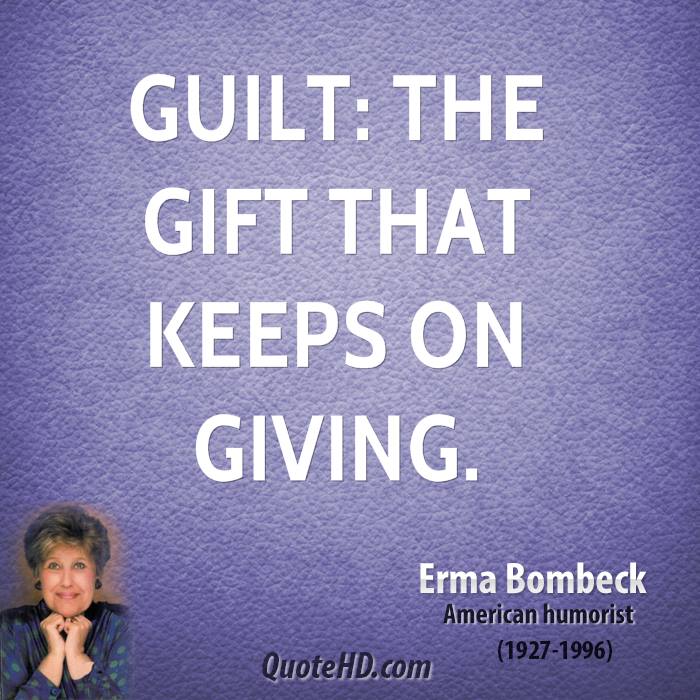
“Guilt: the gift that keeps giving.” —Erma Bombeck
I’ve written more than once about being a packrat, especially recently, as the process of packing, purging, moving, unpacking, purging some more has really driven home just how much stuff we had squirreled and stashed away all over the place. One aspect of the packrat I’ve only touched on briefly is the guilt over gifts. Anxiety comes in many forms for packrats. We worry that if something we need breaks, or is stolen, or stops working or whatever that we won’t be able to afford to replace it. We feel guilt at the thought of spending money to replace something that we could have avoiding spending if we had simply kept a backup. We worry that someone we care about will be left in the lurch if something they need breaks and they can’t afford to replace it. We grow up being taught that people who waste money, or who don’t plan for an equipment or other failure, or who aren’t in a position to help a loved if/when something breaks down are bad people. And so on.

It’s a really complex web of guilt trips that we’re programmed with. And while most of those guilt trips are about necessities, not all of them are. We also have been taught to feel guilt over a lot of useless stuff. Specifically: anything that has ever been a gift. Don’t get me wrong: I love gifts. I love finding gifts for people I love. I love giving them. I love when someone gives something to me. Most people do. But we’ve all gotten those gifts that leave us scratching our heads. Why did this person think I would love this strange, ugly thing whose only purpose is to hang on a wall or sit on a shelf and isn’t like anything else I own at all?

The truth is, we know that we’ve made similar mistakes in gifting to other people. We found something we thought was cool, or thought they would like, but it’s really not. So when we get gifts like that ourselves, we smile and say “thank you.” And we are grateful that they thought of us and went to the trouble and expense of getting this thing for us, even if we have no clue what we’re going to do with it.

But no matter how useless or inappropriate the gift is, we packrats have a very hard time getting rid of it. Years later it will still be on a shelf or in a closet somewhere, next to a bunch of other things I never use. Even if I’ve decided that it’s time for a purge and I’m specifically going through a part of the house looking for things to take to the thrift store, I’ll pick up the thing I never use that was a gift and immediately hear my grandma’s voice in the back of my head: “You can’t get rid of that! So-and-so gave it to you, and what sort of ungrateful person would get rid of a heartfelt gift?” Getting rid of the gift would be the same thing as saying I don’t love that person as much as I think I do. Getting rid of the gift would mean I don’t appreciate how lucky I am that people think of me fondly enough to get a gift. Getting rid of the gift means that I’m a very bad person.

All of that runs through my head at the thought of getting rid of any gift. Even a silly old knick knack that I don’t merely don’t like, but actually think is repulsive. Even gifts given by people who are no longer a part of my life.

When my parents, grandparents, great-grandparents, and various aunts and uncles were inducing all this guilt, they weren’t meaning to turn me into a borderline hoarder—they were trying to teach me not to be ungrateful. They wanted me to treasure friends and value friendship and be thankful for the love that came into my life. Just as they had been taught. The fact that they were all packrats because of it didn’t even cross their minds.

Every single weird little kickknack and odd odject d’art that was crammed into the homes of each of my great-grandparents had a story. If I pointed at something and asked about it they would tell a story about the dear friend or long-deceased relative or whoever that had given them the thing. The story they told didn’t always involve the gift itself. But it was about the person and how wonderful or funny or dear they had been. Each dusty item was a memorial to someone they cared about.

And it isn’t just gifts that do that. My late husband, Ray, was even more into plushies than I am. Some of the plush tigers and bunnies and such he owned for a very long time before we met. Many of them had spent years in storage while he was living in a series of rented rooms in other people’s houses. But some went with him to each of those rooms. Some were later kept near his favorite chair in the apartments he and I shared.

The problem is that Ray was a heavy smoker—like his mom and sister and brothers who liked to visit a lot. And many of those plushies became badly nicotine stained. I’ve spent years periodically taking the stained ones out and trying various cleaning solutions on them. Some cleaned up easily, but other have just resisted.

But every time I thought it was time to throw in the towel and admit they couldn’t be cleaned, I would immediate think, “But Ray adored it! What kind of heartless widower would throw away something your husband loved!?” So they would go back into the closet or the back of a shelf until the next time I tried to clean them.

The process happened again during the move. For the first time in a long while I had all of the stained ones in a single place and I went through trying to clean all of them yet again. As before, they resist the commercial soap and various homemade concoctions I’ve put together from recipes on the web and so forth. They just won’t come clean. And since they are so badly stained, they shouldn’t be donated to a thrift store. When I mentioned this to Michael, he very delicately suggested it was time to “retire” them. I probably should have made a Bladerunner joke, but instead I just said, “I know. I just may have to hold a funeral for them.”

When Grandma died, we found literally hundreds and hundreds of teddy bears, easter bunnies, and assorted other plushies, each packed in plastic bags and crammed impossibly densely into a couple of closets. A lot of them had little notes attached in Grandma’s handwritting with some person’s name and a date. The vast majority of the names were people none of the family recognized. Grandma did lots of volunteer work at church, and over the years she helped and came to know a dizzying array of people who were there for a while and moved on with their life when they got through whatever calamity had brought them to the charity program. And Grandma seemed to remember them all.

For a few years after her death, everytime I saw either my mother or my aunt, they would try to foist some of those plushies off on me. “It belonged to your grandmother!” they would protest if I suggested donating it to a thrift store. It didn’t matter that many of them looked like they had come from a thrift store before Grandma got them. It didn’t matter that they had been hidden away somewhere in some cases for many decades. It didn’t matter that none of us had any knowledge of their existence before Grandma’s death; not one of us had a fond memory of Grandma telling the story of how this one was given to her. To my mom and my aunt, suggestions that we didn’t want them amounted to saying we didn’t want to remember Grandma, or something.

I don’t want to be that person. I recognize that hanging onto these things that I don’t and can’t enjoy simply because they were his is as irrational as my Mom being upset when I suggested a hunk of junk that had clearly once been a dime store window display that one of Grandma’s charity cases had picked up as salvage somewhere and given to her wasn’t a family heirloom.

There’s a difference between hanging on to something that you love or reminds you of someone you love (and that you have room for and you can enjoy and/or it serves a purpose), and hanging on because you feel guilt toward someone who is not going to be harmed in any way if you don’t keep it.

But I’m still probably going to hold a little funeral for the plushies…

Finding a new equilibrium: writing, life, and more

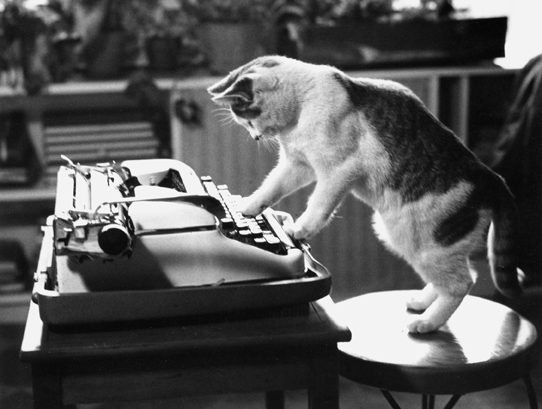
Cat with a manual typewriter.We’re still in the process of unpacking. My husband told me that when he mentioned our unpacking activities to some friends, someone commented that if you get all the boxes opened within 5 years you’ve done a good job. When I told people we were moving, I had had a couple different co-workers and other acquaintances tell me things of how many years it’s been since they moved to their current place and how many boxes still haven’t been unboxed.

I found none of these comments either inspiring nor comforting.

The number of boxes we have left to unpack is pretty small, and there are little stacks of artwork and framed photos all around the house waiting to be hung up. My goal at the moment is to have the living room, library, dining room, and kitchen free of any unpacked boxes or other moving detritus by the 15th of this month–when we are hosting the monthly writers’ meeting at our place.

One thing that has been worrying me about the move is my exercise level and related health issues. For most of the previous 20 years I bused in to work each day and walked home (the walk taking a bit over an hour). That long walk was an important source of exercise. I learned a long time ago that exercise of its own sake (such as going to a gym) is just not something I can motivate myself to do. But walk somewhere instead of taking the bus or driving? That I’ll do.

The new place is much further from downtown, so walking isn’t practical. The nearest bus stop is only three-tenths of a mile from the office. The next closest is only five-tenths of a mile… and then because the bus is an express, the next is a mile further out but up on a highway overpass and not really a pleasant place to walk to. On the other hand, the first couple blocks of any walk to those bus stops is up a very steep hill (extremely steep, even), so I get my heart up to a respectable rate no matter what.

I’ve been experimenting since we started staying at the new place, and I now walk up that steep hill, and then keep walking up the less steep next four blocks, going past the nearest bus stop until I reach the place where normal streets merged with highway, then I turn and do a semi-random serpentine for several blocks winding my way back to the bus stop I walked by earlier. I say semi-random because I decide which way to go at several intersections based on the cross-walk signs. I can fairly easily get in a mile of walking this way (using the fitness app on my watch to keep track) before I get to the bus stop.

According to the fitness app (which uses a combination of how much you seem to be moving and your heart rate to determine how much exercise you’re getting) the entire 20-ish minutes this takes (no matter what I do there is time spent waiting to cross several streets) counts as good exercise. Which is funny, because my old route home, which was mostly flat (or at least such a shallow hill that it might as well have been flat) even though it took a bit over an hour to walk, the app usually only counted about 20 minutes of it as exercise. Clearly the early steep hill climb getting my heart rate up is a better start.

Anyway, while I hoped this was a good replacement for the longer walk, I wasn’t entirely certain I believed the watch app. I got some reassurance this weekend. I had a two-day visit with my mom and other relatives, and thus took a limited amount of clothes with me. I kept trying to tighten the belt I was wearing Saturday. It took me a few times before I realized that the reason I couldn’t get it snug was because I’d run out of notches on that belt.

I’ve been slowly losing weight for the last two years. I’d been exercising and trying to follow the prescribed diet for years without success on the weight front. Then once I was on new meds for my diabetes, suddenly weight starting melting away on its own. I’ve been being conservative. When I noticed pants were getting baggy the first time, I didn’t run out and buy all new stuff. I bought a couple of new, smaller pairs, and tossed the two older pairs that looked most worn. Then then I lost some more, I bought a couple more pairs and replaced a few more of the larger. I started buying smaller shirts as well. Then downsized another bit on the pants and so forth. The upshot is that I have several sets of clothes in the current size and one size larger at any time.

Anyway, I had another belt at the house that was shorter than the one I’d taken on the trip, and I can get is snug. But at this rate, in a couple months it will be too big, too. Clearly time to get a few more items of clothing the next size down and to get rid of some of the larger ones. So the weird walk to the bus seems to be providing an adequate amount of exercise.

During the intense parts of the move, I was often really low on energy during those few times I had time to sit and work on either writing or editing. I still got some done, but my productivity was way down. And it still is. There’s something about the new bus route that makes it harder for me to open up an editor on my phone and get some writing in during the ride. That writing time seldom produced huge amounts of work, in part because the old bus ride wasn’t really long. I had thought the new longer route would make writing easier. It hasn’t. I don’t know why. As soon as I open the app and start at the phone, I find myself looking away and not able to focus on any word-making.

To be fair, it’s only been about a month since the really exhausting part of moving and cleaning the old place and such ended. And then we immediately hit rush mode on our main project at work and I started working a lot more long hours than usual. So it’s possible that I just need a week or two of more normal job workload and more manageable home workload before I can get back into the swing of things.

We’ll see. Wish me luck!

It’s the task that matters: catching up and assessing

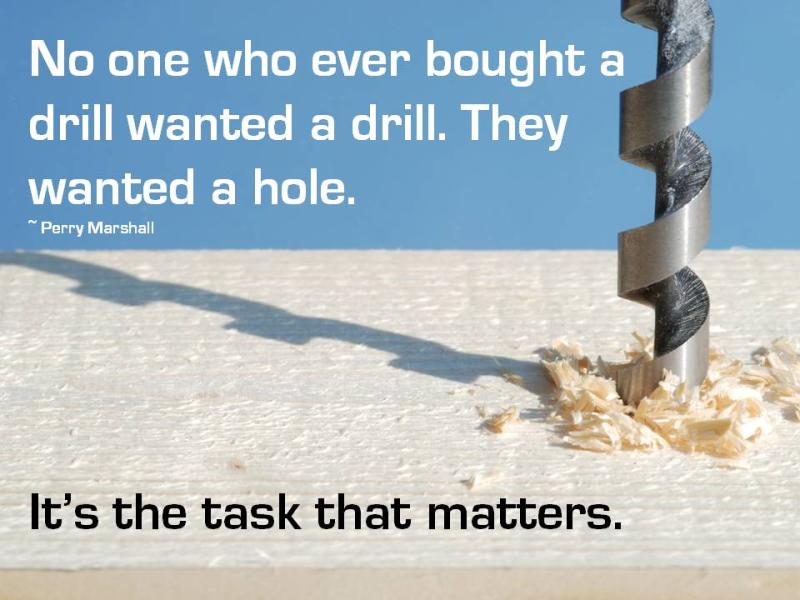
“No one who ever bought a drill wanted a drill. They wanted a hole. It's the taks that matters.”
“No one who ever bought a drill wanted a drill. They wanted a hole. It’s the taks that matters.”
There was no Friday Links post last week, no Weekend Update, and I didn’t even post any Happy Independence Day posts. Last week every workday was way longer than usual. I was therefore completely beat at the end of each day. While I collected links that I meant to make into a Friday Links post, it was a smaller group than usual and I was just too wiped on Thursday to finish it. Then I spent Saturday and Sunday down at my Mom’s delivering and configuring her new computer, fixing some network issues, helping her with other things, meeting my grand-nephew who was only born three weeks ago, and seeing other family members and friends. Michael stayed home while I was on my mini road trip. He got a ton of work done on the house (set up the last closet organizer, unpacked a bunch of boxes in the computer room, and got out and sorted most of our artwork and hung a lot of it up) while I was gone. Then on Monday we ran to Ikea to pick up a couple of things we still needed. Michael did most of the work assembling furniture and installing the earthquake straps on both the new and existing tall bookcases. I cleaned and did more unpacking… and we declared a moratorium no working on the house for the holiday.

I have only gotten a bit of work done on my writing/editing project for the month. I started to work on a post to report on my goals for the year when I realized that I’ve changed a couple of them significantly, or maybe a better way to put it is to say I’ve made completely new resolutions during the course of our unpacking that have taken precedence? Anyway, I feel a need to process a bit more about my goals, our joint goals, and so forth. As they saying goes, I don’t really know what I think about something until I write it out, so that’s what the rest of this post will be. Click to read the rest: Continue reading It’s the task that matters: catching up and assessing