Interior: Gene’s mind, wee small hours of Saturday morning.
I’m dreaming. I’m hanging out with a friend who died not quite two years ago.
We have a lovely talk about things I’m writing now, people we both care about, things I’m worrying about.
We went for a long walk in a lovely wooded area.
We stopped to sit somewhere and look at the view. One of my favorite pencils is sitting on a table. Along with a bunch of very small slips of paper.
I start writing. I write an entire… something. A scene? A story? I’m not sure.
I look up.
She smiles.
I tell her it’s all finished. Then I look down, and see that all of the slips of paper covered with my writing are in a small box, but all jumbled.
“You’ll have to put them back into order,” she says.
“I can do that now,” I say. I look back up.
She’s standing again. In different, but still comfy clothes. “Yes, but not here,” she says. She points into the woods. “I’m going this way.” She points behind me. “You’re going that way.”
I look, and there is an ordinary road. One I sort of recognize. It looks a bit like the winding road down a hill that I used to drive on a lot when I was a teen-ager. I had three different friends who lived on the hill above the town we all attended school in, back then.
There is a car. It has one of the Lyft light things in the front. There is a driver, but I can’t really see him.
“But I don’t want to go back,” I say.
“I’m going this way,” she repeats. “You’re going that way.”
And I can see down at the bottom of the road home: my home, now. Where Michael and all of our friends are waiting.
(click to embiggen)It’s nearly the end of my fourth week of working from home full-time because of the pandemic. The state’s “Stay Home, Stay Healthy” order hasn’t been in effect that long. I chose to work from home four Mondays ago on a day when I would normally go in because I had developed a cough1 over the weekend, just to be safe. I didn’t want to be the person who infected other people if I happened to have this thing, right? Later that week, my boss encouraged everyone to work from home… and then we had the first request (not an order) from the state to all the tech companies to let employees who could work from home do so, and so the executives sent out the message to that effect.
I regularly worked from home at least two days a week for quite some time before then, so I didn’t expect it would be much of an adjustment3. And I’m an introvert, who while I like spending time with my friends, need to spend quite a bit of time alone in order to not be mega-cranky.
My husband, in the meantime, was still having to go into work five days a week4, which of course had me fretting. I’ve been fretting about all my friends and loved ones throughout this mess. Earlier this week, he and most of his co-workers were furloughed, so he’s going to be home with me all the time for the foreseeable future. Which means slightly less fretting, right? Of course it also means we need to figure out some new routines.
On the one hand, it helps that he’s also an introvert, and we already have a habit of spending most of our time at home ignoring each other. He usually sits at his computer and I sit at mine. If I’m watching TV he’s usually playing games on his computer, or designing 3D figures to print on his 3D printer, or sitting at the table painting said figures. So we’ve got that part sorted, for now.
But worrying about everyone else does wear on you. And even though I have been a news junkie5 since I was a kid, I’ve noticed that I’m starting to avoid some of my usual news sources during my daily reading. But even though I’m trying to avoid some of those external sources of anxiety, stuff still comes across my stream that just demands a comment.
For instance, White nationalist planned to bomb a Missouri hospital as revolt against coronavirus lockdowns. Seriously? Geeze. If you don’t want to click through, the guy was under surveillance by the FBI for some time because he was active on some of the same neo-Nazi message boards as several other people arrested over the last few months for similar plans. He had been in communication with someone he thought was building a bomb that could be installed in his car, and he showed up to pick up the bomb, not realizing it was an FBI sting. He resisted arrest, and got shot and killed in the process.
Speaking of angry white men who may finally be held accountable for some bad stuff they’ve done: Alex Jones Loses Sandy Hook Court Appeal, Must Now Pay Nearly $150,000 In Legal Fees. I hope he keeps losing lawsuits from the families of those murdered children until he’s homeless8.
Another feature of angry white men we don’t spend enough time talking about is just how stupid they are. And it’s the kind of stupid that causes real harm to others. So I’m going to close with this video, where Rachel Maddow talks about one such stupid angry white guy. Take it away, Rachel!
Rachel Maddow blasts Mississippi governor for banning cities from coronavirus business closures:
1. A couple days before that tree pollen count went into the deep red, and what few other symptoms I had were consistent with a severe hay fever attack, so I was fairly certain I didn’t have the coronavirus2. But, better safe than sorry, right?
2. I have been following the advice from the World Health Organization of checking my temperature several times a day ever since. I have had no fever in that time. The cough went away for a while, then came back, and then went away. No other symptoms have shown up, so knock wood!
3. And when some people on some of the podcasts I regularly listen to were talking about how difficult it was coming up with things to do to amuse themselves while avoiding going out, I admit I chuckled. I have so many books in my to-read pile, for instance! And there are all those shows I have been trying to get to on the various streaming services! The problem isn’t finding things to do, the problem is still not having enough time for the things I want to watch, read, or listen to!
4. Riding the bus back and forth twice a day. At least he doesn’t work directly with the public like he used to. He even pointed out that because his workbench in in a cage (because he works on hard disk and other highly valuable things that are easy to pocket), most of the time all of his co-workers are far enough from him to prevent casual infection.
5. I sometimes blame Weekly Reader6, which was this sort of mini newspaper that we used to get in some of the elementary schools I attended. The idea of Weekly Reader was to provide age-appropriate versions of the big news stories kids might be hearing their parents talking about or whatever. It was an interesting publication.
6. Though my paternal grandfather was a big fan of reading the newspaper, as well as the nightly news. And most of the radio stations in most of the places we lived during my childhood had an hourly news break provided by one of the major networks. And there always seemed to be a station that carried the Paul Harvey show at noon7.
7. Which I now realize had a quite skewed viewpoint and was as likely to report urban legends as it was real news, but there was something entertaining about it.
Many, many years ago, my late-husband, Ray, made some disparaging comments about our vacuum cleaner. When I suggested we could buy a new one, he immediately scoffed, saying that the one we had worked fine for our needs, since our place was so small and we didn’t need to spend the money. “Okay,” I said, and made a mental note to research vacuum cleaners so I could buy him one at the next gift-giving opportunity.
Which I did.
And when he first tore open the wrapping paper he gave me such a look… so I thought I had really screwed up. But when I tried to apologize for getting the wrong thing he brushed it off. Later, after we’d unboxed it together and I vacuumed our living room with it, he commented that at least it was a lot quieter than the old one. And later still, after we had been using it for a few months, he apologized to me for being less than enthusiastic about the present. He claimed that the lack of enthusiasm was because he assumed that I was expecting him to do all the housecleaning from then on. Which was a bit odd, given how long we’d lived together and that we’d both always tried to split the chores.
He seemed to become quite fond of that vacuum cleaner over the next few years.
After he passed away, and a few years after that after Michael and I had been living together for a while, Michael once commented on the vacuum cleaner. When I suggested we buy a new one, he countered that maybe we should look at getting a Roomba… which eventually we did. And it was upgraded a few times over the years. But we still used the stand-up vacuum occasionally, for the carpeted stairs and the upstairs hallway.
During the many months of our move from Ballard, we made a lot of decisions about things to keep and things to get rid of. The vacuum cleaner didn’t come up until after we had signed the lease at the new place. For the first three weeks after signing, we were transporting car loads of medium-sized boxes until we had enough of them out of the way that the professional movers could handle all the furniture and a bunch more of the boxes. At which point there were still odds and ends to move from the old place, but mostly a lot of cleaning to do.
At some point in that interval, Michael brought up the vacuum and the fact that he didn’t think we needed it. The new place was not split level, as the old one had been, so the Roomba could, in theory, get everywhere without human intervention. And since the new place was larger, had a more open floor plan, and we had already decided to get rid of a few pieces of furniture, Michael’s reasoning was that the Roomba would probably be less prone to trapping itself.
For spot cleaning, he had a handheld Dyson which he felt was adequate to the job. And by that point, the stand-up vacuum cleaner was over 20 years old. So we left the stand-up at the old place, and it was used to vacuum up there while we were cleaning each of the rooms as we cleared out the final stuff and so forth.
At the end of the last day of cleaning, Michael removed the full bag, which I carried out to the dumpster. He put a new bag onto the cleaner, and then attached the pack that had a couple more unused bags and a replacement belt (they came in multi-packs, so when we had had to replace it, we had spares). And it was one of the things we dropped off at Value Village on our last drive between the old place and the new.
We’ve been here for almost three years, and mostly Michael has been right. The Roomba does a good job keeping the floors clean. We have replaced the Roomba once in that time (the old one had been due for replacement when we got the news of the old building selling, so we had put off buying a new one), and Michael has had to replace a few parts on the new one. It is a very busy little robot here.
But the Dyson hasn’t quite worked out for spot cleaning. The two main troubles are that 1) I forget where Michael has it stashed in the computer room, so if I decide I need it when he’s not home I wind up looking around for it for a while, and 2) half the time when I find it, the charging cable has come loose so the battery is dead, so it won’t run. And no, you can’t run it directly from the charger.
So recently, I happened upon a very cheap vacuum cleaner which is, design wise, a Dyson knock-off. It can be used as either a hand-held vacuum or with the longer attachment a traditional floor vacuum. But the big advantage is there is no battery. You just plug it in and it goes.
And when I say cheap, I mean, less than the cost of a replacement battery for the handheld Dyson.
It arrived in the middle of one of my work-from-home days (of course, right now, every one of my work days is a work-from-home day), and I assembled it, but hadn’t used it, yet when Michael got home from work. I had to run to the pharmacy, and he decided to try out the vacuum while I was gone. There were about three places in the house that the Roomba can almost never get to, and he vacuumed those up.
He says it works great, he understands why I bought it, and can’t argue with the price.
The Roomba still does most of the work. But now we can reliably clean all the weird corners. Which is a minor load off my mind. Sometimes it little things like that, you know?
Every time I’ve sat down this week to try to compose a blog post that isn’t somehow related to the pandemic, I’ve found myself digressing into the topic, anyway. A comment about it crept into the draft of my Star Trek: Picard review, even. I think I need to just admit it’s a part of my life right now and deal with it.
I’ve seen a lot of people sharing tips about staying productive while working from home. I’ve been working from home at least one day a week for many years, now, but I still have been reading those posts and twitter threads because 1) it’s always interesting to see how other people handle things, 2) they may have some ideas I’ve never tried, and 3) it never hurts to brush-up a skill set.
Now, just like writing advice, what works for some people doesn’t work for everyone. And pitfalls that trip up some people don’t interfere with others. For instance, a lot of folks are advising against working in your pajamas or such. To which I say, “pffft!” I wear sweats or shorts (depending on the ambient temperature) with no problem of thinking of it as a work day. OTOH, I always grab a clean t-shirt and do a runs a comb through what little hair I still have before I log in to work. But I admit mostly that’s because I’m paranoid that I’ll accidentally turn on video conference while I’m in an on-line meeting.
I realized while I was reading the various posts that I haven’t been doing a very good job of sticking to at least one of my own rules about working from home lately. And it started before the semi-quarantine.
That rule is that there is a point in the middle of the day when I close the work laptop, go make my lunch (or pull it from the fridge, whatever), and sit somewhere away from the workspace to eat lunch and scroll through some news sites OR do some writing.
Since we’ve moved to Shoreline, that also almost always meant that I take a fresh mug of coffee, my food, and my iPad out on the veranda, so I’m technically outside. Even in cold weather, a few minutes outside with hot coffee was a great break. But this year we had a small version of the snowpocalypse, again, and I wound up working from home for at least one week. It was a bit too cold to sit outside that week. I did go out every morning and make sure the hummingbird feeder wasn’t frozen, and that the other feeders all had food, but that was in the morning before logging in.
Then I had another two week period not long after that where I had the flu so I didn’t go into the office my usual days. And I didn’t do my lunch outside during that time, either.
Since the current work-from-home stretch started a bit more than two weeks ago, I have occasionally thought, after finishing lunch inside (usually wolfing it down quickly, often at my desk) that I ought to have gone outside to eat. It occurred to me that maybe the reason my work days aren’t feeling as productive and I’m being more cranky late in the day might not be merely ambient anxiety because of the pandemic or all the network lag I’ve been experiencing since everyone is working from home.
So today, Thursday, is the second day in a row that I have made myself stop, close the laptop, get a fresh mug of coffee, and take my lunch and iPad outside to sit at my silly IKEA outdoor table, watch the birds at the feeder, listen to the nearby traffic, and have a real lunch break.
And I’m really glad I have. I think Wednesday afternoon went much better because of it!
So: tricks and tips to put your mind in the work-day mood are good. Just as important, though, are to take regular breaks and a little self-care.
Many years ago I was walking from the bus to my place of work, when I saw a woman holding a microphone standing with a guy with a TV camera on his shoulder up ahead, talking to another pedestrian. My workplace at the time happened to be across the street from the headquarters of one of the three local network affiliate TV stations, and two others were within a three or four block radius, so it hadn’t been the first time I saw a pair like that interviewing passers-by. By the time I got close, the young woman asked, “Excuse me, sir, can we ask you a couple of questions?”
I said, “Sure.”
Camera guy points the camera at us, the woman smiles and asks, “Are you aware that today is a primary election, and did you vote?”
“Oh, yes!”
Her smile got even broader. “Why did you vote? Is there something special on the ballot this time that compelled you to turn out?”
I think I blinked stupidly for a second before I said. “It’s an election. I always vote. That’s what you’re supposed to do if you’re a responsible citizen.”
I hadn’t finished before her face fell, she turned to the cameraman and made a slashing motion with her hand. The cameraman stopped filming. Then the young woman said, “Thank you, sir,” and started scanning the sidewalk looking for someone else.
I was telling a co-worker about it later that day, and he asked, “How often do you think you forget to vote?” And I explained that I had only ever missed one election—the very first primary that happened the year I moved to Seattle to attend University—and only then because I didn’t get my registration updated in time for the primary, but I did vote in the general that year.
He explained that he did a lot of volunteer work for several election campaigns over the years, including the get-out-the-vote stage of such campaigns and he said, “They have this term, a ‘perfect voter’ by which they mean a person who voted in every general, primary, and special campaign in the last four-year period. That’s you!”
My state is one of the six states holding a Presidential primary or caucus today. We have been an all-mail-in voting state for some years now, so that usually means my husband and I sitting down at the kitchen table with voter pamphlets and the like on the weekend before election day to fill ours out (and make a lot of snarky comments about some of the candidate statements in the pamphlet). When we lived in Ballard we would usually walk together the 10-ish blocks from our place to the local library branch to drop the ballots in the big drop box. Now that we’re in Shoreline, I drive to the nearest library (it’s about two and a half miles away, so I don’t walk) to drop them off.
Which I have already done.
Since the only thing on the Presidential Primary ballot is President, we didn’t need to actually read the pamphlet. I have had the Democratic nominees ranked in my head for some time. The only reason I didn’t fill out my ballot as soon as it arrived was because I was pretty sure a bunch of candidates would drop out after Super Tuesday last week. Which they did. So I wound up voting for the candidate that had started out around fifth or sixth place on my list back during the early debates. And not because my opinion of him has changed, but because every other candidate I liked more has since left the race.
I love the graphic at the top of this post because it so brilliantly illustrates the difference between people’s perception of the political spectrum, and the reality. The media loves to paint Bernie Sanders as a far left liberal, and Elizabeth Warren as nearly as far left, while the truth is that Bernie and Liz would barely be considered left of center in any European country, and when you look at policies most Americans support on various polls, they are pretty much smack dab in the middle compared to the voters.
And if my face was on that graphic, I would be very far to the left of Bernie.
As much as I loved Barack Obama, he wasn’t a liberal. He was right of center, by a bit. Most of his foreign policy was very similar to that of the George W. Bush admin during its second term, for goodness sake! When Bill Clinton was in office, he was actually further to the right than Obama would be. And yeah, the entire Republican party isn’t merely rightwing, it is extremely far rightwing (and quite a lot of it alt-right).
Anyway, I’ve voted for the least conservative option still in the race. Let’s see what happens!
Click to embiggenA couple of years ago I was chatting with a new co-worker, who noticed the photo of my husband on my desk. The picture was taken on our wedding day. Michael was wearing his top hat and other formal wear, and a friend was helping him tie his cravat. The co-worker asked who the person in the picture was, I said it was my husband, and the co-worker asked, “How long have you been married?” And I said that we had been together (at that point) nearly 20 years, but had only legally been married for 5 years. The co-worker looked confused, and then asked, “Why did you wait so long?” To which I replied, “Because it wasn’t legal for us to get married until 2012.” The co-worker’s eyes went wide, and then they said (in what I interpreted as a very embarrassed tone of voice), “Oh, right. Um, yeah, that makes sense.”
And that 2012 date was for the state of Washington. For the majority of the U.S. marriage was still not available to same sex couples until the Supreme Court ruling in 2015.
I told you that story so I can tell you this one:
A couple of weeks ago I was busy at work updating documents. I had to type the day’s date several times, and one of those times it struck me, “Oh! Wow! Today’s the anniversary of our first date.” It was, specifically, the 22nd anniversary of our first date. As it happened, we already had plans to meet a bunch of friends a couple of days later, at which event I was already planning to hand out some Christmas presents that had not be collected at the party, and a birthday present, and other things, so during my lunch break that day, I ran out to a store and also purchased an anniversary card to give to Michael, along with a silly present to give him with the card (I also ordered a couple the more substantial gifts online).
As it happened, that same day, while typing the date into a database at his workplace, Michael also remembered that it was the anniversary of our first date. He went online later and ordered an anniversary present for me. And, yes, we do that kind of weird parallel thinking a lot, and every time it happens, I remember all the times that close friends said (that year that we finally got to marry for real) that it was a little strange to think of us as newlyweds, because we had seemed to be an old married couple for so very long before hand.
I understand that not many people who have been in long-term relationships remember the exact date of their first date, nor the date of when they first met, et cetera. One reason that we do is because for most of history, queer relationships have been excluded from the societally-approved institutions related to anniversaries. So, for a few years, we celebrated the anniversary of our first date as our anniversary as a couple.
Then, the company I was working for decided to allow same sex partner benefits but only if you registered with some sort of government agency, and it so happened that the City of Seattle was offering such a registry (though it conveyed no legal benefits), so we filed the appropriate paperwork so I could get Michael on my medical and dental… and then a few years after that the State of Washington offered a similar registry, though initially with virtually no legal rights, but we signed up for it anyway, and so on…
So, technically we have a bunch of anniversaries… but which one to celebrate? And that question isn’t trivial. Go back to the story I started with. Without really thinking about it, a person who had just met me had asked how long I’d been married. That is an extremely common question for people who are just getting to know each other to ask once they find out you are in a relationship. And humans are social animals, and social customs often have a much stronger impact on one’s success, health, and similar things than mere laws.
I’m proud of the fact that we’ve been together for 22 years—if for no other reason than that I know what a complete jerk I can be sometimes (I really don’t know why he puts up with me sometimes!). I’m also extremely happy that we were able to get legally married at last, and getting to spend that day with so many friends that we love was just incredible.
There are still people who think that long-term queer relationships don’t exist, or are so rare that they don’t matter. The fact that the people most likely to publicly declare that are pundits and politicians who have divorced and re-married many times (and often have been proven to have engaged in a lot of affairs along the way) for some reason almost never gets reported. Let alone the sociological and psychological damage we’re all operating under because of decades of bullying, discrimination, hatred, and simple erasure.
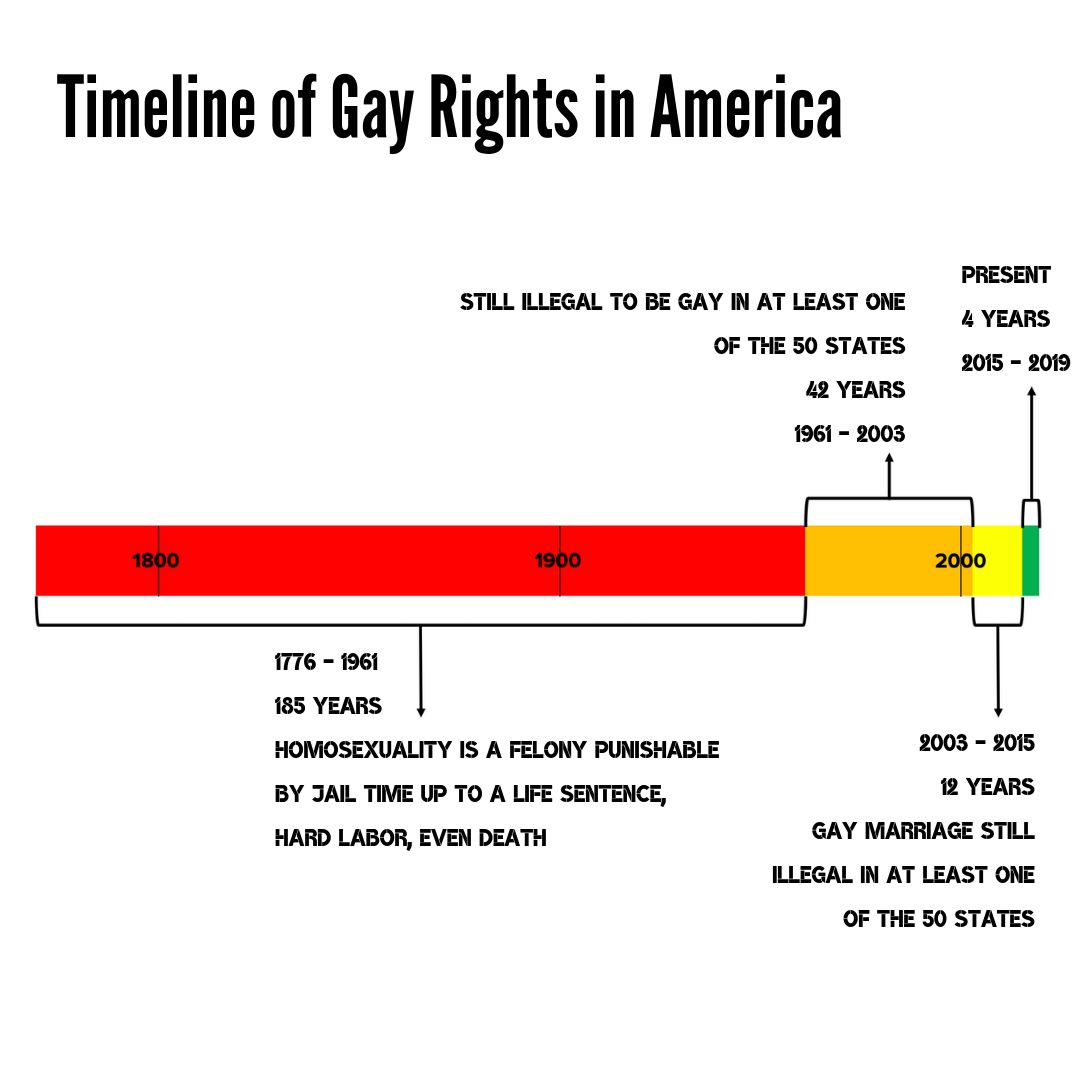
That graph I include above is informative, but also a bit misleading. That last bit of the graph shouldn’t be green, IMHO, because it is still legal in at least 28 states to fire someone (or refuse to rent a home to them, et cetera) just because they are gay. And don’t get me started on all the state and local officials in various places that are trying to undo the marriage ruling, or at least ignore it.
Some people, like the co-worker in my opening anecdote, simply aren’t aware of how recent any legal or societal acceptance has been (and are also frequently clueless about how much still exists). In some cases, that lack of awareness are exacerbated by the histrionics that some bigots have gone into every single time we made any progress at all. It’s easy to think that because the bigots were screaming about us destroying marriage for two decades before we actually started getting that right to marry, that we’ve had the right longer. And a lot of people still don’t realize that in 28 states it is completely legal for an employer to fire someone simply because they suspect they might be gay.
We’ve come a long way, but there’s a long way to go. Fortunately, several of us have demonstrated that we’re in it for the long haul.
“And that was only January!”Last year the plan was to report on my goals progress on both my Patreon and this blog… and for reasons mostly having to do with both my procrastination, over-thinking, anxieties, and good ol’ brain hamsters, posts didn’t get posted either place. Of the three big goals I set for last year, I made great progress on two, and mostly borked the third. I had scaled back to three because my experience for several years before that, where I set four big goals, was that I made great progress on three of them, but one of them always seemed to be neglected. Cutting back to three didn’t help.
I strongly suspect if I cut back further that it would just mean that I only make progress on one goal. Anyway, this year I went back to four goals.
Whether you call them new year’s resolutions or goals, I like giving myself targets for improvement. Some years ago a friend suggested the analogy of how one trains a dog: you can’t get rid of a bad behavior without replacing it with something else that fulfills the same need for the pup. In other words, replace a habit you don’t like with a new one that you do. This has helped me make a number of changes in my own behavior over the years since.
My goals for 2020:
Tell my friends that I love them. Usually my goals are more broad than this, and then I give myself individual tasks from month-to-month under the umbrella. But especially how exhausted with all the outrage, existential threats, and general awfulness of the work the last few years, I’ve felt that I keep forgetting that each of us has the power to encourage each other. Also, it feels as if much of what is wrong with the world is a combination of toxic antipathy. So one of my goals for the year is to remember to tell my friends that I love them. Because I do. And there should be no shame in telling people who are important to you how youf feel.
Acknowledge Rage, but Stay on Target. It has always been the case that I find it easy to rant and get outraged about injustices and the like in the world. Ranting burns up a lot of energy, especially when so many people who actively want people like me to cease to exist are in power. I think I’ve done a reasonably good job of paying enough attention to try to protect myself and my family, while not getting overwhelmed. So I’m going to again try this year to keep (and in some areas increase) my focus on things I can control. My tasks are: write about about things I love on my blog; continuing listening to music and audiobooks more than news podcasts and the like; join my husband in his painting project; donate to candidates running against the haters.
Engage. I have fallen back into the habit of only getting together with friends for things related to projects. I need to spend more time hanging with friends just to hang. My task is: set specific goals each month related to re-connecting with friends.
Make It So. Various writing and publishing projects have all stalled out. I need to actually finish more things and put them out in the world. My task is: set specific monthly writing/editing/publishing goals each month.
We’re barely into February and I already feel as if 2020 is a grueling year. My discussions with friends indicate that neither I nor the creator of the meme I link above or in the minority.
I’m tired of talking about infuriating stuff, however. So, let’s go in a different direction.
Last spring, on a whim, I picked up a hummingbird feeder at a nearby dollar store. Since we moved to this neighborhood almost three years ago, I had frequently seen hummingbirds in the summer months, through the fall, and well into winter, going from flower to flower on all my flower pots on the veranda. Our mild winters meant that we had at least some plants continuing to bloom throughout that period. So I figured a dedicated feeder would not go amiss.
Alas, throughout the summer and fall, though the feeder’s liquid level would steadily go down, I never once saw a hummingbird at the feeder. During last summer there were many days when I saw a bunch of bees clustered on the feeder, but the only times I saw hummingbirds on the veranda, they were visiting flowers. Still, given the difficulties bees are facing, I figured that it was fine if I was feeding bees.
Very late last fall, as some upgrades were being installed on our gutters and drain pipes, I took down the hummingbird feeder so it was out of the way of the workmen. That was on a weekend. A couple of days later, I was working from home, and I came out of the kitchen with my coffee mug, and found myself essentially face-to-face with a small brown-bodied hummingbird hovering at eye level just outside my sliding glass door. I stopped. She then flew to the spot where the hummingbird feeder used to hang, hovered there for a moment, and then she moved down the eave, stopped at each of the hooks in the eve… before flying back to the door and staring at me.
As one friend said when I was telling this story, the bird seemed to be saying, “Okay, monkey, what did you do with my food? Chop-chop!”
So I carried the hummingbird feeder inside, washed it out thoroughly, mixed up some more sugar water, then carried it out and hung it up. Since then, there are several points every day that I am home that I see at least one hummingbird at the feeder.
And then, we had our week of snow and ice. Every morning I went out and checked the feeder to see if it was liquid. It I had been a bit more proactive, I would have brought the feeder inside at night time so it wouldn’t freezer. But I didn’t. Anyway, there were only two mornings when the sugar water mix inside the feeder was frozen. Both times I whisked the feeder inside and used the microwave to thaw it out…
The problem was that the feeder felt as if it was about to collapse. It was extremely cheap plastic to begin with, and had spent nearly 10 months hanging outside exposed to sunlight and other elements before the freezing weather came in. Anyway, it felt as if it was going to disintegrate at any moment, so after a consultation with my husband, I ordered a higher end feeder, with the main reservoir made out of glass–and purple glass at that. The first day it was hanging up, hummingbirds were feeding at it, so it was a good purchase.
Since then, I have installed a dual-suet cage and after a couple of weeks many of the neighborhood birds have figured out that it is food. The squirrel feeder, on the other hand, kept getting very wet and food at the bottom of the feeder kept rotting… so I finally gave in and moved the feeder to a spot well under the eave of the building. Oddly enough, all of the squirrels come and get food from the feeder, but carry that food over to the edge of the deck near where the feeder used to be to eat it.
I have a few theories on why they do that, but no good way to test them. Oh, well.’
The important thing is that I’m feeding wild life in my neighborhood, AND I get to watch and listen to all these cool birds every day that I’m home. So, win-win-win, don’t you think?
Finally, my specific tasks for February are:
Schedule a painting day with my husband.
Host Writers’ Night.
Write at least four blog posts about things I like.
This picture of my dad was taken by my maternal grandmother the same year I was born.
Usually when I tell stories about my father, they aren’t pleasant. He was a physically and verbally abusive man for as long as I could remember. And I’ve often talked about the contrast between the man in whose home I grew up and stories that various relatives would tell about what he was like “before the bad times.” This is going to be one of those stories. While it is a story that was told with great warmth and fondness by more than one member of the family, I do feel obligated to offer a warning that the tale will include some discussion of near-fatal medical complications associated with childbirth, as well as the hunting and killing of animals many regard as cute, and related subjects.
The most entertaining version of this story was told by my maternal grandmother (aka Nice Grandma), who was Dad’s mother-in-law. The most disturbing version I ever heard was from my Dad. This retelling will adhere mostly to Grandma’s version, but a few details from all the versions contribute. Buckle up, mind the content warnings, and let’s begin… Continue reading Time to tell the Rabbit Story, or, what happened the day I was born→
(Click to embiggen)I get extremely tired of hearing the lament, “But children will be confused!” thrown out any time anyone suggests that maybe it might be all right for movies or TV shows or books or just adults who happen to be near children to admit that queer people exist. It is not the existence of same sex married couples that confuses children. It is not the existence of transgender people that confuses children. It is not the existence of nonbinary people that confuses children. It is not the existence of asexual people that confuses children. What confuses children is when adults lie to them and then try to obfuscate it. And that includes lying by omission by trying to keep children from knowing that any of those things exist.
And the thing is, the people who most adhere to this idea of protecting children from even knowing that non-cisgender or non-heterosexual people exist all do a really poor job of that. Because I guarantee you that the children of those parents are the ones at school bullying any classmate who seems gender-nonconforming by calling them homo or sissies or some other slur. Kids may or may not understand the intricacies of adult relationships, but they glean and infer a whole lot about same aspects of sex and romance and related topics from the adults around them.
Some adults seem to completely forget what it was like when they were children. And that manifests in a couple of different ways. To illustrate, I’ll tell the story of two playdates.
Now, according to the Merriam-Webster Dictionary, the word “playdate” meaning “a play session for small children arranged in advance by their parents” didn’t come into the language until 1975, and these two stories from my childhood predate that (one happened in 1969, and other in 1971). And I’m not sure that 9-year-olds or 10-year-olds fall into the definition of small children, but the idea was mostly the same.
The first one happened early in the third grade. It was the first time I recall that my Mom took me to the home of one of my friends from school or church for the explicit purpose of letting us kids hang out. Mom also visited with my friend’s mother for a bit before taking my little sister to some other event, but I and my friend hanging out was the purpose of the trip. It was a fun evening, we spent most of the time in his room talking about comic books, as I recall. No big deal. Eventually Mom came back to pick me up. We went home. We had a few more similar get-togethers like that, usually with me being dropped off at his place, but it least one time his parents dropped him off at ours.
The second one happened in the middle of fourth grade. Because of my dad’s work in the petroleum industry, we had moved three times between these two playdates. Two of the moves involved crossing a state boundary. All three moves involved me being enrolled in a new school. At some of those intervening schools, we hadn’t remained in the area long enough for me to make much in the way for friends. At the third place, though, I quickly became very good friends with a classmate. Both of us were in orchestra (it was the first year I could join), and our mothers had met when they came to pick us up after practice.
So eventually, a plan was made when my classmate would be dropped off at our place for an evening. But the plan quickly became weird. Dad and a few other people made strange comments. I was getting teased about this friend.
Why? Because she wasn’t a boy.
When she was dropped off, her dad made some comments that made both Dad and Mom laugh, but just confused me. Most of the fathers of kids I’d known most of my life had owned guns. So why did her dad tell me about his gun and how handy it was to get to?
We spent most of the time sitting at the dining room table talking about our favorite books (she and I shared an adoration for The Hardy Boys and Nancy Drew). At the end of the evening, Mom drove my friend home and I rode along so we could keep talking. When we pulled up in front of her house, Mom told me that I was supposed to walk my friend to the door. I said, “Sure.” We both got out of the car and walked up to the front door. I remember that her family’s dog was barking really loud in the house, and she made a comment about how we needed to make sure the gate was latched, in case the dog got out of the house.
We walked up to the porch. She said, “Good night.” I said, “See you at school!” She opened the door and went inside. I walked back to the car. I spent at least half a minute making certain I had latched the gate correctly, then I got into the car.
And Mom was very angry at me. “When you walk a girl to the door, you don’t just leave her there and walk away! You’re supposed to go inside and thank her parents for letting her go out with you!”
“I didn’t know that.” All of those times the year before when the other friend and I had gotten together, neither of us had been sent in to thank the others’ parents for letting us hang out. Why was this different?
There was some additional fallout, including a lot of teasing at school the following week. The upshot was that my friend didn’t want me to talk to her any more in class or at orchestra rehearsal. I was very confused about the whole thing. Not because I didn’t know why the other kids were teasing us. I knew what “girlfriend” and “boyfriend” meant. But I also knew that those words didn’t describe our relationship—we really were just two orchestra nerds who liked reading! Once that teasing started, I at least had a slightly better idea of what some of the weird comments from adults beforehand had been about.
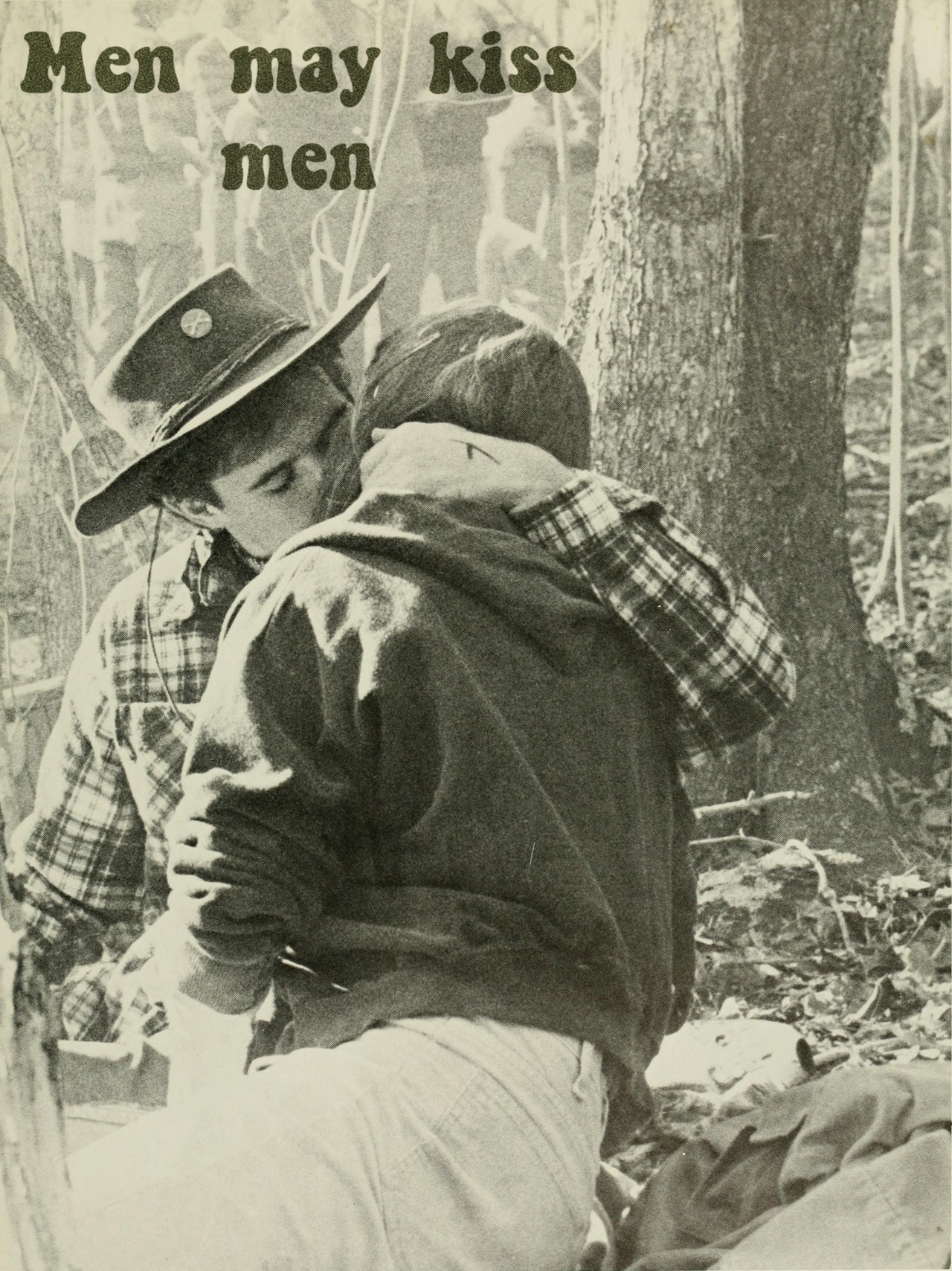
(Click to embiggen)I have no idea if the boy I was friends with during the first part of third grade was also queer. At the time I didn’t know that I was, for goodness sake! It is true that one of the reasons we got along so well is because we both tended to be frequent victims of the same playground bullies, so maybe he was. Or maybe we were both just 9-year-old comics nerds who happened to hit it off. But none of the adults around us ever worried about us both being in either his or my bedroom with the door closed for several hours. No one’s dad made shotgun jokes when we got together. At the time, I had no interest in kissing other boys (that would come up a couple years later, when puberty hit like a freight train), and certainly had never thought of kissing him. We were just two guys who thought Spiderman was cool.
But everyone, including apparently our own parents, assumed I and the second friend were romantically interested. I can’t speak for her, of course, but since I’m not merely gay, I’m really most sincerely gay, that was the furthest thing from my mind. And 10-year-old me was just happy to have found someone who liked reading some of the same books as I did.
To circle back to the opening topic: People who assume that grade school children are too young to know about romance and such are the same people who call small boys “lady killers” and cute baby girls “future heartbreakers.” They are the same people who assume any time a young boy is friendly with a girl that it’s a crush. They are the same people who make those stupid shotgun jokes.
If the kids are old enough to hear bullies calling other children “fags” or “homos” or “sissies”, they are old enough to know that actual LGBTQ+ people exist, that they are members of their community, and that they are humans who deserve respect and love just as much as anyone else. If kids are old enough for adults to tease them about their supposed girlfriends/boyfriends, they’re old enough to know that sometimes a guy can have a boyfriend or even a husband, that sometimes a gal can have a girlfriend or even a wife.
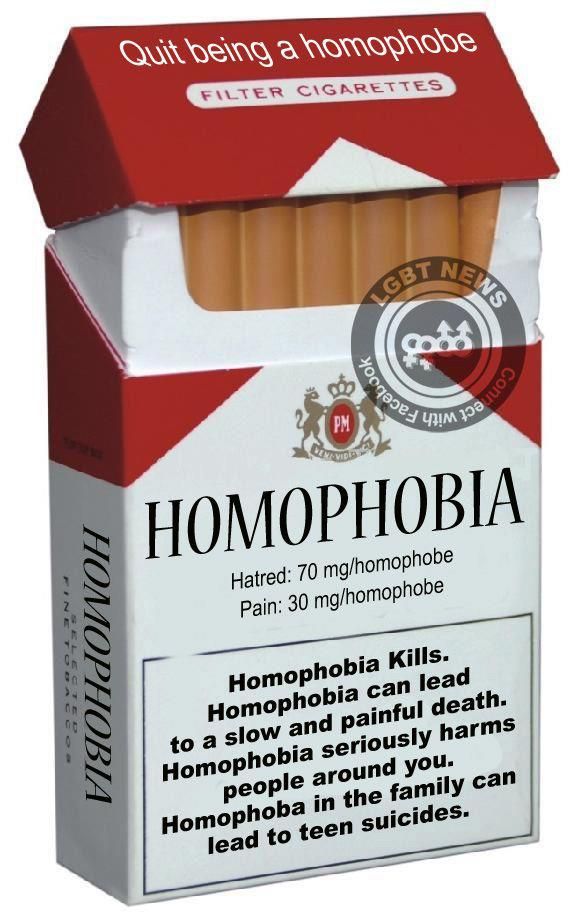
Quit being a homophobe (click to embiggen)There are people who firmly believe that because of the saying “sticks and stones may break my bones but words can never hurt me” that the only aspects of homophobia that cause harm are actual physical assaults, targeted arson, and the like—and that any of us who push back on anything less than a physical attack are overreacting. Not just overreacting, they say that us calling out the homophobes is worse than the original homophobia. And that’s just bull. Pointing out that a person is acting or saying bigoted things is not worse or somehow less civil than the original bigoted actions, comments, or policies. Facing blowback for things you do and say, especially in the public square, does not make you a victim. And while it is possible for a reaction to be disproportionate, there isn’t a simple, objective way to measure that disproportionality. But what I can say with certainty is, if you’re one of those people who have ever used that “sticks and stones” philosophy to excuse someone being a bigot, you have no right to criticize any words that are sent back to the bigot as being out of line.
All of this is true even if the bigot in question happens to also be a member of the community the bigot is expressing bigotry toward.
I’ve started a blog post with this title several times over the last two years, and then trashed most of it—usually extracting a small part out to use as the basis of a slightly less provocative blog post. A pair of news stories crossed my stream within the last week that got me thinking about this again, and once again I pulled this out of the drafts and tried to start writing it. I am not going to link to the news stories in question for reasons I hope become clear. The reason I have toned down previous blog posts on this topic can be summed up by something I saw this morning on twitter from Alexandra Erin, a writer and satirist I follow, in reference to a completely unrelated topic: “…when you put something out in the world, you are responsible for how it lands.”
Erin is talking about satire and how easily it can be misunderstood, but the principle applies to all writing. It doesn’t matter whether I intend something to hurt someone else, if it hurts them, it is still my fault. That doesn’t mean the intention doesn’t matter, it means that intentions don’t negate the fallout. Here’s a simple example (which I think I first read in a blog post on tumblr, but I don’t remember for certain): say you’re an adult tasked with watching some small children playing on a playground. One kid, in their excitement, inadvertently bumps into another kid, who falls off the jungle gym and skins their knee. Do you run up to the crying kid with the skinned knee and lecture them that they shouldn’t cry because the other kid didn’t mean it? No. You clean up and bandage the skinned knee, you comfort the hurt child, you caution the other kid to be more mindful of what they’re doing, and you have them apologize for their carelessness.
I’ve written more than once about self-hatingcloset cases who cause harm to our community and whether they deserve our sympathy. The whole reason they are self-hating is because of the homophobia they faced growing up. Our society is steeped in toxic notions about what is and isn’t acceptable for one to be interested in depending on one’s gender. And also steeped in just as toxic notions about mannerisms—including how one talks and walks—that are acceptable depending on your gender. Not all queer people are obviously gender non-conforming (and not all gender non-conforming people are gay), but gender non-conforming kids are bullied and harassed. Even the gender conforming queer kids are hurt by that, because they know that if anyone finds out about their same-sex crushes or whatever, that they will be subjected to the same kind of hatred from some classmates, some teachers, and some family members.
We are taught from a very early age to loath ourselves and to expect loathing from others. For many of us, the need to deflect at least some of that loathing causes us to denounce and participate in the shunning and bullying of others. Because if we denounce the faggots loudly, no one could possibly believe we’re queer ourselves, right?
Which means that I feel a lot of guilt for some of the things I said and positions I endorsed in my early teens.
So yes, I feel a lot of sympathy for kids who are living in terror inside those closets. The sympathy starts to go away when those kids grow up, are exposed to examples of how life can be better out of the closet, but they continue to attack other queer people even while cowering inside their own closet. There is a bit of pity, sometimes, but the longer they are exposed to better information (sexual orientation isn’t a choice, all those stories about health issues for queers are myths, queer people can live healthy and happy and long lives, et cetera), they less they deserve our consideration.
And that doesn’t change if they happen to come out of the closet but still insist on vilifying and otherwise attacking their fellow queers. A young man who comes out of the closet but lends his voice and face to campaigns to deny civil rights to his fellow queers—who goes on national news shows and records political ads saying, “I’m a gay man, and I agree with these people that think gay people don’t deserve equal rights” isn’t simply expressing an opinion. He is contributing to the hostile environment that sometimes literally kills other queer people.
Because we’ve long had proof—from medical studies first conducted by a Republican administration—that contrary to that sticks-and-stones saying, words do hurt. All that anti-gay rhetoric leads to the death of hundreds of queer and gender non-conforming kids every year, among other very real harms.
So-called homocons who assist anti-gay organizations in oppressing other queer people should not be surprised when they face blowback. Queers and allies standing up for themselves in the face of that oppression are not bullying. It isn’t a both sides thing, it’s self-defense. Particularly in a case where, say, the adult homocon who has already appeared on TV more than once to denounce gay rights campaigns, then leads a bunch of haters in a loud protest angrily chanting anti-gay slogans at a children’s event. That isn’t a “morally ambiguous transgression” it’s despicable—plain and simple. Especially when you go on TV again to defend your actions.
When other people call out the bigotry, that’s not mob violence, that’s consequences. Maybe you should have thought about that before agreeing to go on TV. Again.
Yes, when we say things we are responsible for how they land, regardless of our intentions. But that’s a two-way street. And when a self-loathing queer who assists bigots has been given a number of chances over a few years to reconsider his hateful words and deeds, there comes a point when there is no one to blame for any of the consequences except himself.





 Font Folly