Category Archives: news

That’s not what persecuted means

I have restrained myself from commenting on the nonsense that one branch of one party put us through with 16 days of what amounted to extortion, but there is at least one incident about the recent craziness in Congress that I have to comment upon: Stenographer in U.S. Congress disrupts debt ceiling vote to rant about Jesus or House Stenographer Seizes Microphone In Bizarre Rant.

So this woman, whose job it is to record the official things said in the House of Representatives, at the end of a 16-day fiasco that cost taxpayers billions of dollars, put hundreds of thousands of people temporarily out of work, cost the economy much more, contributed to some needless deaths, and very nearly put the credit of the entire nation in jeopardy, in the moments before a last minute vote to bring said idiocy to a close, she rushes the microphone and begins ranting about Freemasons and how the country ought to be a Christian nation but isn’t and “praise Jesus!”

When I say “rant,” I mean that it was, vehement, immoderate, and exceeding normal parameters of behavior. Continue reading That’s not what persecuted means

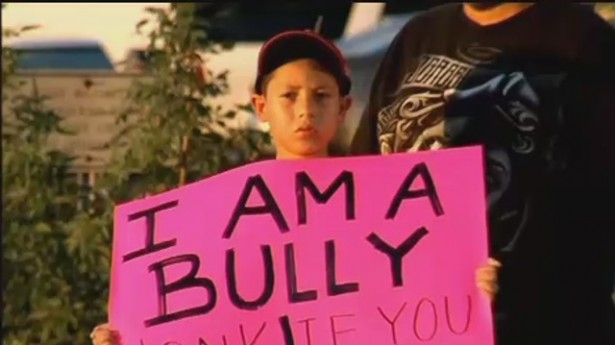
No one likes a bully (except just about everyone)

Kid holding I am a Bully sign.
Father forces son to hold pink ‘I am a bully’ sign on Texas highway.
In most action movies there’s a scene that everyone in the theatre cheers. One of the bad guys—one who has been portrayed earlier on the movie as being particularly cruel, heartless, otherwise repulsive—meets an especially grisly death, usually at the hands of the hero.

Of course we cheer, you say. He wasn’t just the bad guy, he was an extremely bad bad guy! No matter how egregious or overly cruel his final moments were, he had it coming! We’re just cheering the concept of justice.

I get it, truly I do. And I have certainly cheered many such scenes, myself.

However…

Continue reading No one likes a bully (except just about everyone)

Stripes and stars

Rainbow flag with a blue field and stars in the corner.
A star-spangled rainbow flag.
Symbols are important.

My coming out process had been slow and incremental. I spent most of my teens wrestling with the idea, trying to convince myself that I wasn’t gay. For a long time I tried to be either bisexual or resign myself to a life a celibacy. I don’t want to get into the psycho-social reasons that some of us gay people cling to a bisexual identity for a while (and the disservice that does to actual bi people). Julie and I became active in a very out lesbian & gay chorus while we were still married to each other. By then a lot of people knew that I wasn’t heterosexual. But a lot of people didn’t. Most of my friends who knew seemed to be all right with it, but no one in my family knew.

I had wanted to come out to the family (and some old friends who were still in the dark at the time) earlier, but had been talked out of it. After Julie and I legally separated and I was finally able to admit aloud that I was definitely not bi, I felt a need to make a definitive statement.

Continue reading Stripes and stars

Try to stop me!

Lynx running across snow.
Running lynx by Daniel J. Cox (www.wildthingsultd.org)
When I got the first email responding to my post earlier in the week about a weird search term that had been used to find my site, I figured I had just phrased something weird.

The person specifically referenced the post and said they hoped I would keep writing. I hadn’t intended to say anything that indicated I was considering not posting, but I know that sometimes when I’m writing a post in a hurry that I phrase things weird. Even when I’m not in a rush, I make odd typos (the words I type are correctly spelled, but they are the wrong word, usually a related word, but wrong), which can also lead to misunderstanding.

So I re-read the post, and read it again, and couldn’t find anything weird.

Then I got a second email from a different person, with the same sentiment…

Continue reading Try to stop me!

Friday Links!

I’ve been a bit out of it all week, recovering from the convention, trying to get back into the swing at work, and then coming down with a head/nose/throat thing. So this week’s links are a bit shorter…

This is from early in the week, so you may have seen it, but Amelia (mother of a 7-year-old who came out when he was 6) asks, “Who is in a gay family?” My favorite line: “And to those who think that my baby boy needs to be fixed: Fuck you. My kid is perfect just they way he is.”

Sad, but worth the read: Children and Guns: The Hidden Toll.

Need a job? Know how to sew? A Wave of Sewing Jobs as Orders Pile Up at U.S. Factories.

Have some Gender-swapped Disney Princesses.

Lewis Black has a hilarious take on the homophobic pasta maker:

.

Secret ‘Ex-Gay Awareness Dinner’ Fails Miserably Money quote: “Because.. making a belty, Broadway/Disney-style music video is the perfect way to prove to the world that you’re no longer gay.”
.
Lots of people were sharing the “I quit” video posted by Marina Shifrin. This work from home Mom decided to film her own version:
.

Friday Links!

Since I’m at RainFurrest, this edition of Friday Links was collected earlier in the week.

NOM’s Brian Brown, the ‘Bigocrite’ – Brian Brown claims to be the victim, but he and his organization have bullied so many people in the past.

Lip Sync Battle with Joseph Gordon Levitt, Stephen Merchant and Jimmy Fallon (Joseph is awesome both times)
.


.
Black Rhino Standoff
.

.
Stephen King Fans Get Duped Into Buying a Seven-Page Review of a Stephen King Book

Former President George H.W. Bush was an official witness at the same-sex wedding of two longtime friends.

Texas Voter ID Law May End Octogenarian’s 60-Year Voting Streak.

Ex-gay confused proudly rejected books with banned books.

Speaking of which, this is Banned Books Week. Go see what you can do to protect the freedom to read. Or at least what other people are doing.

Don’t forget to check out Deer Me for a new comic strip.

And, of course, Mr Cow.

Justin Timberlake covers the Jacksons’ Shake Your Body (Down To The Ground) on BBC’s Live Lounge:
.


.
This music video is a chilling commentary on oppression:
.

.
And for something a bit more uplifting, this is an awesome cover:
.

.
Finally, too awesome for words (Thanks to Seashellseller for the link!):
.

Loving condemnation

So everyone was quoting some statements that the newish Pope made in a very long interview this week, where he said that “we” shouldn’t focus only on fighting gay rights, stopping abortion, and stopping people from having access to birth control.

The shallow media reported it as a huge shift away from the church being politically active. The liberal blogosphere touted it as an admonishment of groups such as the Catholic League and the National Organization for Marriage who spend 99% of their time harping on those three subjects. The pseudo-liberal blogosphere touted it as a significant shift in both tone and objectives. And the various forces on the right, including those anti-gay, anti-abortion, anti-women’s rights organization all insisted that the Pope wasn’t changing anything at all.

Folks like the blustering jerk from the Catholic League, Bill Donahue, took the statements as encouragement to double-down on the hate and denial. He insisted, in fact, that organizations like his aren’t obsessed with only being anti-gay, anti-abortion, and anti-women. No, according to him it’s the liberal media and the Obama administration who somehow make it seem as if all the Catholic League cares about is gays, abortions, and birth control. Those things are still wrong, and they need to be fought, but the fight needs to continue as part of the overall mission of the church to love everyone, no matter how sinful.

And the thing is, the rightwing anti-gay catholic spokespeople are correct. That is much closer to what the Pope said. Maybe he is admonishing the most vocal political action organizations to soften their tone a bit, but the very best spin you can put on his words is still, “hate the sin, love the sinner.”

It reminds me of a sequence from the Sandman graphic novels by Neil Gaiman. There’s one long story line which involved the Devil resigning, kicking all the lost souls and demons out of hell, locking the gates of hell, and then handing the key over to Dream, who does not want it. At the end of the story, two angels receive a message from God to take the key, re-open hell, call all the souls and demons back, and start running it again.

There’s a scene after that where some souls are being tortured by a demon, and one of the two angels now in charge interrupts to admonish the demon. He explains to both the demon and the tortured soul that all of this is part of the creator’s plan. The souls sent to hell aren’t being tortured out of cruelty and hatred, but out of love. The demon will continue to torture the souls exactly the same way that they always have, except now they are doing it out of love. Because god loves everyone, even the souls he has condemned to an eternity of torment in hell. So the torture isn’t being administered for cruel reasons, but out of love.

As the angel departs and the demon resumes the torture, one of the souls says, “Actually, that makes it worse.”

Yes. Yes it does.


Update: This post rounds up more of the details in case you don’t understand just how anti-gay the pope’s position still is: Pope Francis Says More Nice Words About LGBTs, Changes Nothing


Why is it always an “agenda”?

So, an incident happens in the workplace. One person is late. Another person who is irritated that the other person is late, and is griping about having to wait. A co-worker suggests they just chill out and wait. The grumbler gets a bit angrier and makes a comment to the effect that he is tired of always having to wait for “that faggot.” The co-worker takes offense at the comment, the grumbler gets even angrier and grabs the co-worker by the throat.

Other co-workers break up the scuffle, everyone separates to cool off. The late person arrives and eventually people are back to work.

Would anyone be surprised after such a thing happening in a workplace, that the person who grabbed a co-worker by the throat and referred to another co-worker (in front of witnesses) as a faggot received some kind of discipline?

No, we wouldn’t.

And if the person who had both physically assaulted one co-worker and verbally assaulted another, then goes public and insists it was just a joke, would we be surprised if other people in the industry begin to be a bit wary in the presence of the person?

Then nearly all the rest of the co-workers, including the guy who was assaulted and the guy who was called a faggot try to minimize the incident. “Sometimes tensions get high.” “People say things that they regret.” When that happens, you would expect the first guy to be grateful that people are trying to let him get past it. You wouldn’t expect him to, at a public event, in front of reporters and with TV cameras rolling, to suddenly say, “I’m just glad we’ve all stopped talking about me allegedly calling him a faggot!”

But this is exactly what actor Isaiah Washington did three years ago. It resulted in him losing that job. He dropped out of sight for a few years. And this week he resurfaced and gave an interview in which he says:

“After the incident at the Golden Globes everything just fell apart. It literally stopped. Whatever the agenda, whatever the plan was it worked. I lost everything. I couldn’t afford to have an agent. I couldn’t afford to have a publicist for the crisis management to continue. I couldn’t afford to continue. I went from 2 million dollars a year to residual checks. Zero. I couldn’t get another apartment after I turned in my lease for my $3 million home. I had to put it in my wife’s name. No one wanted to touch the name of Isaiah Washington for three years.”

And everyone is supposed to be sorry, because it was just some silly incident, right? I mean, the poor man lost a 2-million dollar a year job, and had to survive on just $200,000 a year in residuals. All because of one thing he said at the silly awards show. Then the whole thing becomes “an agenda.” Like there was some sort of conspiracy aimed just at him.

There are still people trying to portray this as some sort of “he said, he said” thing. One of the problems is that Mr. Washington’s story has changed several times. At first he said the scuffle on set didn’t happen. Then he tried to make jokes about the scuffle, but insisted the word “faggot” hadn’t been mentioned. Then he admitted he used “an unacceptable slur” when he was tired and angry, but insisted that he wasn’t really like that.

Then he used the slur again, with a big grin on his face, in front of the cameras. Yes, it was at an awards presentation where just about everyone had been drinking. And also he was denying that he had used the slur, but it was a comment completely out of context, and rolled so easily off his tongue that it gave a very different impression.

And here’s the thing about both anger and alcohol: they don’t force you to say things that you have never, ever thought before. They do lower inhibitions and make it more likely that you’ll say things you ordinarily wouldn’t say. But those things will be things that you think all the time.

So it isn’t an agenda. A lot of people would understandably be uncomfortable being around someone like that after a series of incidents like those. Particularly given how poorly he handled the apology, and even re-ignited the issue when it was beginning to look like it might blow over, it shouldn’t surprise him that other production companies are going to be reluctant to hire him. No one wants a similar incident, right?

Now, to be fair, I’ll admit that there used to be a conspiracy around these things. It used to be the case that a straight man could count on getting away with calling a co-worker a faggot without facing any consequences. Plenty of workplaces still overlook that sort of thing all the time.

For a long time there’s been an unspoken agreement that real men can literally push other people around and call them names like “faggot” with impunity. Because that’s the sort of thing “real men” do when they’re stressed and angry. Other “real men” are supposed to just laugh it off and move on as if nothing happened—because nothing out of the ordinary did.

That “real men” conspiracy is starting to break down. And I imagine that when Mr. Washington found himself in a place where everyone didn’t just laugh and move on it did feel as if people were out to get him.

Everyone is difficult to work with at least some of the time. Those of us who weren’t there don’t know what he’s like day-in and day-out. But the series of events which are not in dispute, including the series of unconvincing and changing apologies, indicates a pattern of behaviors. I suspect, therefore, that there are many, many other incidents over the years of his career that we never heard about. So, of course people are reluctant to hire him.

There’s no agenda. There are only consequences.

Why would you even want…

Whenever a story is published about some horribly racist, or sexist, or homophobic law or outrageously bigoted action by a government official in certain parts of the country (usually, but not always, a southern state), some a**hole will ask, “Why would you even want to live in __________?”

Similarly, when a story is making the rounds about someone being fired or expelled because they are gay/lesbian/bi/et cetera, the same a**holes will ask, “Why would you want to work for someone who felt that way?”

But when a teacher at a conservative religious school gets fired for being gay, or a student at a conservative religious school is expelled for the same reason, it takes an uber-a**hole to ask, “Why should I feel sorry for them?”

I’d like to deal with each question:

Why would you want to live there? Despite how mobile our society has become, our geographic location is seldom a matter of pure, unadulterated choice. We don’t get to choose where we are born or grow up, to begin with. Not all young adults have the means to pull up stakes and move to wherever they want. There is a constellation of complex social and economic reasons for why we live where we do.

It is easier to land a job with a company where you know someone who is already employed there or has been employed there, for instance. And particularly when you’re just starting out, who you know is largely going to be determined by proximity. You know people because you have lived near them. It’s just easier to get jobs in the area where you already live.

People usually have relatives to whom they feel obligations, as well. Census data shows that the majority of adults in the U.S. live within 30 miles of one their parents, for example. (Interesting side note: if a person’s parents are divorced, 80 percent of the time the parent who is geographically closest is the mother.) Sometimes it isn’t just a feeling of an obligation. There is an extremely strong correlation between how anti-gay a state’s laws and social climate are, and the likelihood that a gay or lesbian person married someone of the opposite sex while relatively young, had children, then came out to themselves and their community and got divorced. In many cases, the only way to maintain custody or visitation rights is to remain in the state.

Not to mention that every place has beautiful places, and at least some wonderful people. So often the reasons a gay person lives in a state that doesn’t have gay-friendly laws are quite valid, if not optimal.

Why would you want to work for someone like that? No matter how good the economy is, we often end up in jobs that are less than our dream job. Sometimes you take the job that is offered, and hope things work out. Sometimes you start out with a very tolerant, professional boss, but because of promotions, re-orgs, transfers, and the like, you suddenly find yourself reporting to the jerk who keeps making fag jokes. And it isn’t always one’s boss that is the problem. A hostile co-worker can create situations that lead to you getting the blame, et cetera.

And most of these situations don’t come from those obvious situations. I’ve written before about a past co-worker who made a big stink because I had a single picture of my late husband tucked on a part of my desk where most people couldn’t even see it. None of my conversations or interactions with him ever gave me the slightest clue that he felt that way.

I suspect a lot of these people were in a similar situation.

And except when I was working in a very tiny office, I have never been the only non-heterosexual person working there. And I’ve seen plenty of examples of gay employees in one department being free to be open about the gender of their partners, et cetera, when people reporting to a different set of managers quickly learn that if they don’t keep “that stuff” to themselves, there will be problems.

Finding another job takes time and energy a person may not have, even when they know the employer is not accepting. And if you aren’t a well-connected person socially both within your industry and community, finding a new job is not a matter of simply picking somewhere to apply, sitting back, and waiting for the offer letter. Depending on how specialized your skill set is, finding a comparable job, that pays enough to meet your current financial obligations and provides the benefits you need, can be more difficult.

And no matter how much research you do in advance, there is no guarantee that the new employer won’t have a similar issue with your sexuality under some circumstances in the future.

Why should I feel sorry for them? They should have known what would happen! So a lesbian is a teacher at a conservative religious school. See everything I said about about jobs. Then add in the following factors: when she began her career, had she even come out to herself, yet? Are there as many jobs in her specific field of teaching at secular schools? Does her church have a fairly large population of congregants who are far more supportive of gay rights than the leadership? How did all of that contribute to her feeling about how safe it was to admit who she is?

The one that really ticks me off is blaming the student at a conservative Christian college for not knowing what would happen. First, they’re college age, and by definition not experienced enough to be sure how people might handle their coming out. It’s also even more likely that she hadn’t even admitted to herself at the time she first enrolled at the school that she wasn’t straight. Second, maybe a Christian school was the only option that her parents would support. There are so many reasons that we pick which college to apply to, and getting accepted is not under our control.

The process of coming out, more specifically, coming to terms with your identity when you aren’t heterosexual, and then reaching the point of sharing that understanding, isn’t a simple issue of weighing all the pros and cons, checking one’s calendar, and thinking about how this announcement will affect your other plans. There is usually an incredible amount of frustration, fear, and weariness boiling up inside the mind of the closeted person like steam in an overheated pressure cooker.

The need to stop lying about who you are overwhelms the fear, let alone any caution someone has about what effect the truth might have on one’s next performance review. And being raised in (and working in) a deeply religious community makes all that pressure even worse.

Maybe the question these critics ought to be answering is, “Why don’t you have enough empathy to realize your questions are backwards?”
Getting it right

I sat down to gripe a bit about news coverage, beating dead horses, and about being annoyed at people worrying about the wrong thing. That last one deserves a more thoughtful post than I would write today, seeing as I’m a little cranky—having forgotten to stop at the store to pick up my allergy meds last night, which I ran out of the day before.

I was trying to find a particular old story to link to, and instead happened across another one that I hadn’t read in a while. An acquaintance in one of the fan communities I’m active in was working as a reporter years ago, and had been assigned to do a story about the anniversary of a news event that had happened before she was born. She thought it was going to be a simple assignment, until… well, you need to go read it.

No, really, you do: I Remember Townsend….

The only other thing I have worth saying today: two good friends of mine happen to have fathers whose birthday is today. Lots of people have a birthday or wedding anniversary today, of course. To all of them I just want to say, “I’m sorry that we as a society have stolen your special day, and spend so much energy re-processing and politicizing that one event. Happy birthday/anniversary.”