Image from the 1954 Gojira (click to embiggen)I don’t remember precisely when I saw my first Godzilla movie. I was probably four or five years old. When we were living in the parts of Colorado where all the TV stations we received came from Denver, one of those channels had a Saturday afternoon movie called Science Fiction Theatre (or something like that) which seemed to almost exclusively show Japanese sci fi films. So there were a lot of Godzilla, Mothra, and other kaiju films that I saw during this time.
Often when there were parts of the plot that didn’t make sense to me, Mom would explain it away as the problems with translation. She had already explained about how the movies were originally filmed in Japanese, then dubbed into English. So anything else that seemed odd or illogical was because of that. It didn’t occur to me until later that part of the process of translating it for an American audience also sometimes involved editing the film, taking out scenes or cutting them short.
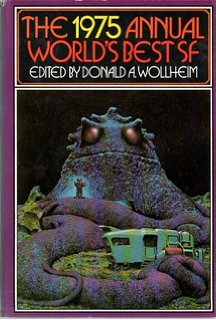
Cover of the Science Fiction Book Club edition of the 1975 edition of the Annual World’s Best SF series edited by Donald Wolheim.I joined the science fiction book club at three different points in my life. The first time was when I was about 13 or 14 years old, and had no idea what I was getting myself into. My mom was not very happy when the first package of books arrived. Fortunately, my paternal grandmother found out about it before my dad did and was able to run some interference for me. So this wasn’t one of the incidents that led to a beating, but it was a close thing.
I wound up doing extra chores at my grandparents’ house to earn the money to cover it. Dad let me remain a member for a year, strictly limiting what I was allowed to order until I’d met the obligation so I could quit the club. I wound up with a bunch of books. And they were hardcover—they were cheap hardcover, but still more sturdy than the paperbacks that most of my collection consisted of before then.
The second time was the summer just before I turned 18, and at least I had a job and was earning my own money.
The book club reeled you in with the introductory packet: for a token payment of two cents, you could choose something like six books from a list. There was a little asterisk statement about paying shipping and handling, which was always more expensive than you thought it would be. But compared to paying full price for the hardcover version when they first came out, it was still a bargain. After that you received a monthly mailing, and if you forgot to return the card that said, “send nothing at this time,” you’d get whatever that month’s book was. You could choose other books out of the mini catalog that came in each month’s mailing. And again, the prices weren’t bad, even with the shipping and handling.
The killer was if you didn’t return the card in time. Because you’d receive books you didn’t want, and usually wound up paying for them because returning them was more of a hassle.
The other downsides were that generally the books were a few years old. They usually didn’t become available to the book club until the original bookstore sales had dropped off for the hard cover, and then the paperback release. The amount of money the authors received was less than for bookstore sales, though most writers who have been willing to talk about it seem to take the attitude that a sale is better than no sale.
When I was living in redneck rural communities, back before the existence of the Internet, a book club was a means to get books that you otherwise might not ever know existed.
The second time I joined, I picked every anthology that was on the list for my initial package. Which included two different years of Donald Wolheim’s Annual World’s Best Science Fiction collections. I loved those kinds of anthologies, because I got a bunch of different stories by different authors. One tale might be a space adventure, another a dark exploration of the nature or identity, another a humorous examination of the future of crime, and the next might have a wizard outwitting a god. Anything could be between those pages!
And I didn’t even have to order one of the books to get a bit of that thrilling sense of wonder. Half the fun of the book club, for me, was reading the catalog each month. Because books and authors I had not heard of—even after I had moved to a slightly larger town that actually had a book store, and not only that more than one!—each received a paragraph or two of description, along with a picture of the cover. So even if I didn’t order the book at the time, later if I saw a copy in a used bookstore, or saw other books by the author, I had a better idea of what the book would be like than I would get just from reading the cover blurbs.
Every month I received a colorful display of dozens of imagined worlds, ranging from high fantasy to gritty near future sci fi thrillers to epic space battles between empires to individual journies of discovery. And all I had to do was, every now and then, buy one of those wondrous books. It was really a small price to pay for infinity.
No wonder 14-year-old me had thought nothing of the consequences when I taped two shiny pennies to a piece of card stock, scribbled my name and address on one side, then swiped an envelope and stamp from Mom’s desk. An infinity of wonder would be mine!
Cover of the 1980 paperback re-release of Dread Companion.I can’t narrow it down more than to say that I found Andre Norton’s Dread Companion on a library shelf during middle school. The cover blurb told me it was a tale of a woman living on another planet far in the future who was hired to take care of two children who had an “imaginary” friend that was something far more sinister.
I didn’t expect that it would be about faeries in space.
The blurb was a fairly accurate description of the set-up: Kilda is a young woman trying to find her place in the world. Her father was a spacer who had no interest in settling down with the woman who got pregnant during their brief political marriage. And her mother didn’t want to be saddled with a child like Kilda who was more interested in exploring and learning science and so forth than she was in being pretty and having babies of her own…Continue reading Changelings on Distant Worlds – more of why I love sf/f→
Original hardback cover of A Wizard of Earthsea by Ursula K. Le Guin, art by Ruth Robbins (click to embiggen).I think I was 14 years old when I found a copy of A Wizard of Earthsea on a library shelf. The novel tells the story of a boy named Sparrowhawk who lives on the island of Gont which is situated in an archipelago called Earthsea. Sparrowhawk’s aunt is the village witch, and she recognizes his innate magical talents when he is very young, so she teaches him as much as she can. When he is twelve he nearly dies saving his village from marauders using magic. Which attracts the attention of an older mage named Ogion. Ogion heals Sparrowhawk and takes him on as a student. Ogion is the person who gives Sparrowhawk his true name, Ged. Knowing someone’s true name gives one power over them in the magic of Earthsea, so people have to guard their true name. When it becomes obvious that Ged’s talents and impatience are more than the mage can handle, Ogion sends him to the island of Roke to see if he can join the school of mages, there…Continue reading The Original Wizard School – more of why I love sf/f→
Cover of the 1958 hardcover edition of Mr. Bass’s Planetoid by Eleanor Cameron, just like the one I found in the school library (click to embiggen).In 1970 (I was in the Fourth Grade) the oil company my dad worked for transferred us to a tiny town in eastern Utah. When my sister and I were enrolled in the public school there, we exactly doubled the number of children in the school district who were not members of the Church of Latter Day Saints. Over the next 10 months or so, as many more families (mostly from the south) were transferred to the town by various oil companies, the elementary school’s enrollment went from about 350 children to nearly 500 hundred. I’m not going to talk about the culture shock that occurred during that time, on both sides of the religious divide. But that incredible influx of unexpected kids to the school caused a lot of upheaval, including causing the school to pack up most of the books from the library to convert the library space into four classrooms. For a while, most of the library books were in storage, and a subset was rotated into the tiny old classroom which had been converted into the new library.
It was during one of those rotations that I first found a copy of Eleanor Cameron’s Mr. Bass’s Planetoid. Of course I had to check out right away because it had “planetoid” in the title! It was clear from nearly the first page that this was a sequel. Two best friends, Chuck and David, are friends with an eccentric scientist, Mr. Tyco Bass, who helped them with their homemade rocket previously. Another scientist, Prewytt Brumblydge, has stolen a sample of a mysterious metal Mr. Bass had discovered in a meteorite, and soon he is using this metal to power a machine with which he hopes to solve two of the world’s problems: the lack of safe drinking water in some parts of the world, and the need for electricity. Unfortunately, the machine has dangerous side effects that could destroy the entire planet. The boy’s learn this part from yet another scientist who happens to be Brumblydge’s former teacher, who is convinced the student is looking for the source of Mr. Bass’s mysterious metal.
Cover of the first edition paperback, World’s Best Science Fiction 1969 edited by Donald A. Wollheim and Terry Carr.I was either 13 or 14 years old when I acquired my copy of the 1969 edition of the World’s Best Science Fiction. As was so often the case, I picked up my copy at a used bookstore. I recognized several of the authors in the table of contents, though I don’t believe I had read any of the stories. That was the point! One book, a whole bunch of stories! Brilliant!
Once I got the book home, I read through the titles in the table of contents again, and one jumped out at me: “Time Considered as a Helix of Semi-Precious Stones.” It was just an interesting image: a helix of gemstones and the like as some sort of analogy or metaphor for time. And the author’s name, Samuel R. Delaney, seemed familiar, though I couldn’t think of any stories I had read by him.
A few weeks back when one of the serious news sites reported that people of color have only recently become involved in reading comics and science fiction, Arab-American past Hugo-nominated science fiction author Saladin Ahmed shared this historical photograph showing a bunch of African-American kids reading comics in the 1940s.So, one of the official new Star Wars universe novels came out last week, STAR WARS: AFTERMATH by Chuck Wendig, and it is getting flooded with one-star reviews. About a third of those reviews are along this line: “I don’t like the inclusion of so many gay characters because my personal opinion is that sodomy is not normal and I am tired of the liberal media trying to make me accept this lifestyle.”
Oh, dear. A galaxy that includes countless species and droids and races acknowledged the existence of homosexuality? WHAT WERE THEY THINKING? Can we PLEASE get back to giant slugs with a fetish for other species, green muppets, blue elephant people, and giant walking carpets? You know, characters who are normal.
Conservative pundit Earl Hall (here’s a DoNotLink link if you want to subject yourself to it) weighed in (including a really bad attempt to write some Yoda dialog), asking why there are suddenly so many gay characters everywhere: “Is there all of a sudden way more LGBT people in our population than we once thought? Is this really about diversity, or is it more about forcing a story line and lifestyle down our throats?”
First of all, yes, Mr Hall and all the bigoted one-star reviewers: there are more queer people in the population than you thought. But it isn’t suddenly. I’ve quoted before the CDC study in the 1990s about sexual activity that found that while Americans would rather admit to being heroin addicts than bisexual, if you just went by their sexual activity rather than asking them to identify their sexual orientation, about 45% of the population regularly engaged in sexual activity with both men and women. That and other studies indicate that only about 6% of the population engages primarily in sexual activity with members of the same gender. But that means that just (45% + 6 % = 51%) a bit over half the population of the planet is non-heterosexual.
That means that in the U.S. about 19,800,000 (that’s more than nineteen million) people are exclusively gay, while about another 148,500,000 (that’s over 148 million) people are bisexual/pansexual/whatever you want to call it.
And worldwide, the combined number would be 3,570,000,000 (that’s more than three-and-a-half billion) non-heterosexual people.
So, yes, a lot more than you think. And we’ve always been here. There was a wonderful scholarly article I read once that was dissecting clues in various documents and diaries and so forth from the 1890s that put forward a really good argument that men were having sex with other men more often in the U.S. in the 1890s for at least part of their adult lives than was happening in the 1990s. Just as an example.
If you can imagine a world where Luke Skywalker would be irritated that there were gay people around him, you completely missed the point of Star Wars. It’s like trying to picture Jesus kicking lepers in the throat instead of curing them. Stop being the Empire. Join the Rebel Alliance. We have love and inclusion and great music and cute droids.
And a bit later in the post:
And if you’re upset because I put gay characters and a gay protagonist in the book, I got nothing for you. Sorry, you squawking saurian — meteor’s coming. And it’s a fabulously gay Nyan Cat meteor with a rainbow trailing behind it and your mode of thought will be extinct. You’re not the Rebel Alliance. You’re not the good guys. You’re the fucking Empire, man. You’re the shitty, oppressive, totalitarian Empire.
Wendig also points out all the women and people of color appearing prominently in the trailers for the new movie, in case that kind of inclusion also upsets the one-star reviewers.
Finally, one last note about all those one-star reviews. Amazon’s algorithms push books to the top of recommendation queues based in part on the number of reviews, total. It does not take into account whether the reviews are good or bad. The algorithm cares only that lots of people feel strongly enough about a book to review it. And sales statistics seem to bear that out: readers are more willing to take a chance on a book that has lots of reviews, negative or positive.
I suspect a lot of those people read the negative reviews, see what the reasons a person dislikes a book are, and say, “Well, they may not like books like that, but I do!”
Regardless of that phenomenon, there’s an actual campaign on some conservative fan sites asking people who haven’t even read the book to go give it a one-star review. I don’t think the understand that just means that more people who haven’t heard of the book will have it recommended to them by Amazon.
But then, bigots have seldom been known for the brilliance.
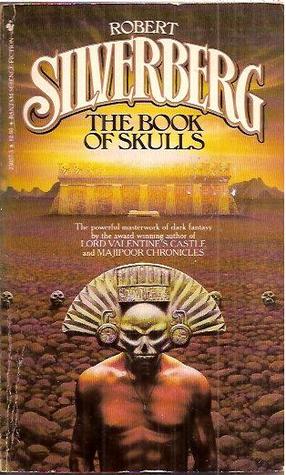
Cover for one of the paperback editions of The Book of Skulls by Robert Silverberg. (Click to embiggen)I was 16 when I found the Book of Skulls in a used book store. The cover blurb talking about four young men on a quest to find a mysterious cult and obtain immortality. I’d read some of Silverberg’s short fiction in both Galaxy magazine and The Magazine of Fantasy & Science Fiction and had generally enjoyed it. Plus it had a cool cover.
The novel is told in rotating first-person viewpoint from each of the four characters: Eli, the Jewish bookworm; Ned, the flaming homosexual; Timothy, the rich boy; and Oliver, the farmboy/jock. They are students at the same college who have formed somewhat unlikely friendships. Eli, who has a gift for languages, found and translated a book about the mysterious Brotherhood of the Skull and their secret of immortality. The book says that four people must present themselves together, and work together to endure the trials of the Brotherhood. Even if they succeed, only two will gain mortality. The other two lives are forfeit: one must willingly commit suicide, and the other must be sacrificed by his fellows…Continue reading Mortality, Im- and Otherwise: more of why I love sf/f→
Since we now have the rest of the nomination results, it is possible to see what works would have been on the ballot if not for the slates. Here is one such guess: Alternate Timeline Hugo Awards. This list includes some very interesting things that I wish we had had a chance to vote on.
The next headline isn’t entirely accurate. While George disapproves of any slate voting scheme, the purpose of his reviving his Hugo Losers party and this year handing out his own awards was to try to protest the deep schism and animosity: George R.R. Martin Holds Additional Ceremony After the Hugo Awards to Protest ‘Sad Puppies’. Years ago Martin founded the original Hugo Losers party, where people who were up for a Hugo that year could get together and tell each other they should’ve won… to wallow a little, yes, but also to commiserate, laugh at themselves and each other, et cetera. He let other people take over organizing it for years, but this year because of all the animosity flying around from every direction, decided to take it back. He rented a bar, invited anyone who has ever lost to the party. This year’s winners were also invited, but had to wear a conehead if they stayed. George had a bunch of trophies made, which he called Alfies, in honor of the late great Alfred Bester, and handed them out to people who would have been on the ballot, based on the nominating numbers, if you remove the slates. He handed out a few additional ones of his own choosing. By all reports, people had a good time.
Why We Need Queer Escapist Lit. I get tired of having to defend wanting to see characters that are like me in my favorite genre. But we have to keep doing it.
Equally problematic is that the frame of reference of people on one side is so utterly disjoint from the frame of reference of people on the other side, that a lot of our attempts to debate have merely resulted in us talking past each other. Hugos & Puppies: Peeling The Onion.
“When it comes to debating strangers with radically different perspectives, you sometimes encounter what I refer to as Onion Arguments: seemingly simple questions that can’t possibly be answered to either your satisfaction or your interlocutor’s because their ignorance of concepts vital to whatever you might say is so lacking, so fundamentally incorrect, that there’s no way to answer the first point without first explaining eight other things in detail.”
“We all have conservative friends and acquaintances who aren’t a-holes, and we don’t seem to have a big problem with them unless they’re crazy bigots like [Vox Day]. We have a problem with a-holes.”
“…I haven’t voted in several years, when I did I voted for stories that I loved (plus, to be honest, stories written by my friends)—as do most readers. If readers deliberately voted for stories about gay characters and people of color, perhaps it’s because [those stories] speak of “alienation,” which a great many readers of science fiction happen to have experienced (readers of science fiction tend to be natural outsiders).”
This may be my favorite read today: How the 2015 Hugos proved against all odds that SF is becoming more international and more diverse. There is just so much here to like. She links to some of the same posts I have above, but also to a whole lot of others. She pulls long quotes from people and does some analysis and rebuttal. One of my favorites is in response to a Sad Puppy supporter who agreed to be interviewed for one of the news site’s stories, but didn’t want his name used:
“In many ways this quote by the unknown puppy clearly illustrates the attitudes that already became obvious in Brad Torgersen’s infamous “Nutty Nuggets” post. A lot of puppies don’t just want works they don’t like to be excluded from the Hugos, they deny works they don’t like the right to exist period. They don’t want these works to be published, they don’t even want them to be written at all.”
She segues away from the Puppies and spends most of her post talking about the works that did win. I especially like this point:
[B]oth Hugos in the two fiction categories that actually were awarded went to translated works by non-anglophone writers, which is a first in Hugo history. Coincidentally, both are also the first Hugo wins for their respective countries of origin… I’m happy that they won, because their wins show that the Hugos are becoming a more truly international award. And yes, it’s problematic that a white Dutchman and a Chinese man, two writers who have nothing in common apart from the fact that English is not their first language, are both subsumed under the header “international SF”. But given how Anglo-American dominated the Hugos and WorldCon have traditionally been, it’s still a great step forward.
I’m skipping a lot. Her full post is really worth that read. I hope you give it a look.
Those of us who love science fiction and fantasy are going to be talking about this a lot over the course of the next year. Both the Sad and Rabid Puppies are vowing to be back. Vox Day, leader of the Rabids, is specifically threatening to leave a “smoking hole” where the Hugos once were. So the rest of us are going to have to make sure we participate in both the nomination portion and voting portion of the process next year.
Because the avalanche may have already started, but contrary to the Vorlon proverb, in this landslide, each pebble has a vote, and we can make them count.
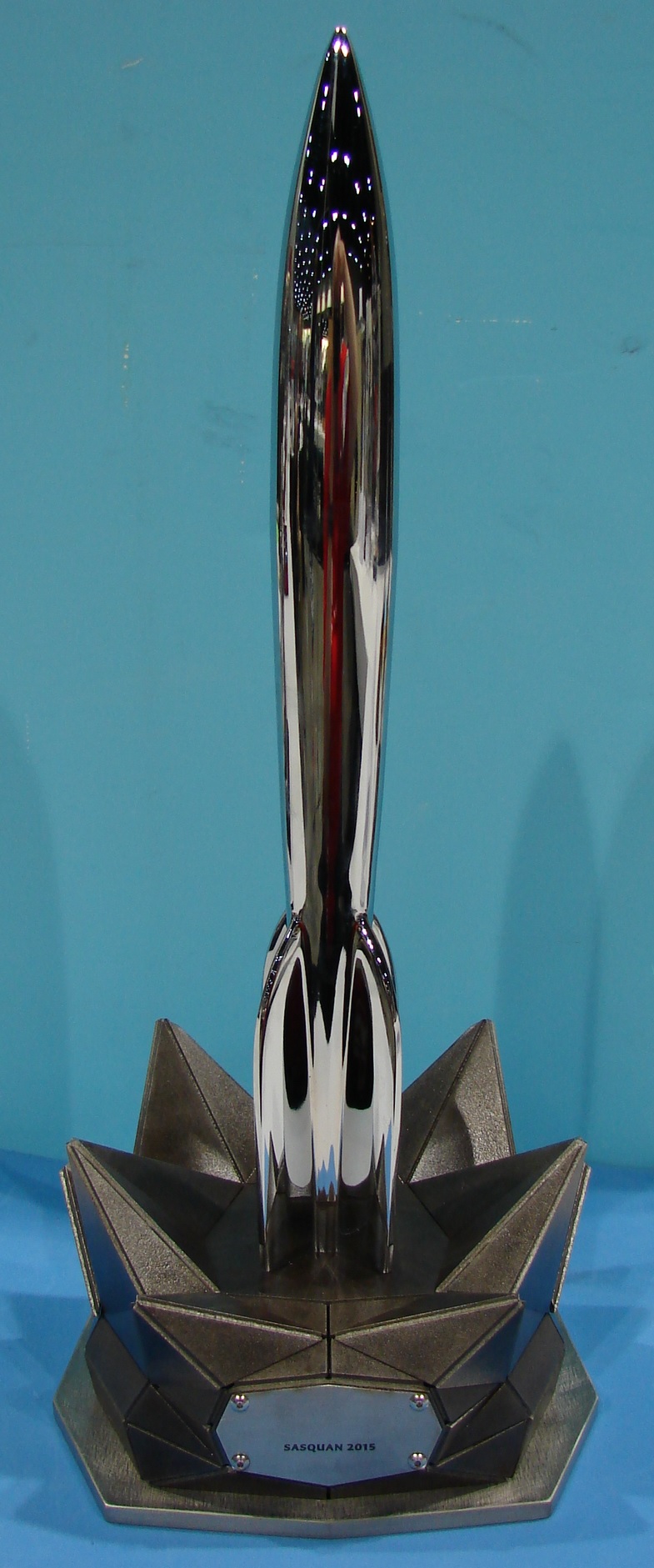
The Hugo trophy given out last night. Designed by Matthew Dockrey, photo by Kevin Standlee. (Click to embiggen)The 2015 Hugo Awards were announced last night at a ceremony at Sasquan, the 73rd World Science Fiction Con, held in Spokane, Washington. The hosts were David Gerrold and Tananarive Due.






 Font Folly