Category Archives: writing

Writer’s write: don’t let perfection be the enemy of the good

“If the pen fits, write it.”
Sometimes my posts grow out of a personal rant in response to something I read elsewhere, such as this one disagreeing with someone’s definition of what constitutes a writer. The definition I gave of a writer that time was someone who writes, specifically someone who tells stories in the form of sentences strung together into a narrative. And while I made a distinction between the act of writing background information and the like rather than the actual sentences comprising the story, I was focusing on the act of writing, and not talking about quality or merit. Which isn’t to say that quality isn’t an issue in writing. Anyone creating art of any kind hopes that what they create is good, right?

All too often, that wish for the artwork to be good becomes the greatest obstacle to finish the story. It’s like the proverb, “Don’t let perfect be the enemy of good.” It is easy to fall into the trap of rewriting and revising a story (or a single scene) again and again because it isn’t perfect. We may scrap what we’ve written already altogether and start over from scratch because we don’t think it’s good enough. We may refuse to ever show our work to anyone because we don’t think it’s good enough.

If you are caught in that kind of a cycle, it isn’t easy to get out. As frustrating as it is to be in that situation, let me tell you it is at least as frustrating for your friends and loved ones to watch you spin in circles. I don’t have a magic solution, but I have a suggestion. You need to let it go. Show the imperfect draft to someone you trust. Think of it as tearing a bandaid off all at once, so the pain is over quickly. If you can survive showing it to someone, that should tell you you can survive moving forward.

It’s okay if the person you show it to doesn’t like it. But it is even more important to make yourself believe this: it’s also okay if they like it. Don’t listen to the voices in your head telling you that they are just saying it to be nice—listen to this person (who you chose to show it to because you respect and trust them, right?) who is telling you they like it.

And if you’re having trouble believing someone who tells you they like something you wrote or drew or made, think about this: when you don’t believe them, you aren’t being self-deprecating, you are insulting them. You’re saying that your friend has poor taste or is too unsophisticated to judge quality.

Maybe one of the ways I’ve lucked out in life is that I never had people who told me everything I made was wonderful. My mom has absolutely no problem telling me which parts of my published works she wishes I had done differently, for example. Back when my nice Grandma was alive, she similarly had no trouble saying, “I don’t understand it, and didn’t really like it, but if you’re happy…” And don’t get me started on my evil grandmother!

Which gets me to the other part: if people don’t like it, that doesn’t mean it is awful. It may mean the story (or painting or whatever) simply isn’t for them. I think every author that I have ever said I loved, has written at least one book or short story that left me cold. I absolutely adore many other things they’ve made, but for one reason or another that one either put me off, or bounced me out, and left me unsatisfied. And that’s okay. It doesn’t mean that book or story was bad. It just means that story wasn’t for me.

Let go of the doubt. Let go of the fear. Rip off that band aid and let the art speak for itself. Don’t apologize. Don’t tell people it isn’t very good. And don’t reject any compliments you may get.

If you decide to shelve it after showing it to someone, fine. As long as you move on to the next story. Because a writer writes… and keeps writing!

Gentlefolk, start your (word processing) engines!

It’s nearly time!
Do you like stories? Have you ever thought about telling stories? Do already know that you like telling stories? Do words make you happy? Do you have a favorite word processor, or a favorite pen, or a favorite writing notebook or the like? Do you like a challenge? Have you ever wondered what it’s like to work on a creative project at the same time a bunch of other people are working on something similar? If any of the above applies to you, then you might want to give NaNoWriMo a try.

I’m participating in National Novel Writing Month (NaNoWriMo) once again this year! If you don’t know what that means, let me quote their website:

National Novel Writing Month (NaNoWriMo) is a fun, seat-of-your-pants approach to creative writing.

On November 1, participants begin working towards the goal of writing a 50,000-word novel by 11:59 PM on November 30.

There are rules, but for years I participated as a Rebel, until a few years ago when they dropped the one rule that kept making me a rebel.

  • Write one 50,000-word (or longer!) novel, between November 1 and November 30.
  • Start from scratch.
  • Write a novel. We define a novel as a lengthy work of fiction.
  • Be the sole author of your novel.
  • Write more than one word repeated 50,000 times.

That second bullet is the rule that they changed. Most years I use NaNoWriMo as a motivation to work on some stalled or otherwise unfinished projects rather than starting from scratch, which is why I was always over in the Rebel category. NaNoWriMo is a lot of fun, and I find that having a few friends participating and mutually cheering each other on (and in a couple of cases to try to race against, word-count wise) helps me get a lot of work done.

NaNoWriMo isn’t for everyone. But I’ve seen people who didn’t think they’d like it come out happy that they’d given it a go.

Usually about this point in this post I would veer into some advice about the virtues of getting a draft down and not worrying about quality. And probably will write something about that in the next few days, but a friend shared an interesting post that goes in a slightly different direction that I think many people might find valuable. I should note a couple of things. The Story Nurse gives out customized writing advice, and this particular letter writer talks about struggling with thoughts of suicide and other types of anxiety, and how trying to force themselves to power through stalled writing projects makes that worse. So, consider yourself warned.

Story Nurse #66: Getting Past the Confidence Sinkhole

Having more than one friend who has found that a lot of their frustrations with writing and similar projects were actually symptoms of untreated mental health issues, I can appreciate how the sorts of advice people like me often give out (“just put one word after the other, whatever it takes”) is not only not helpful, but can actually cause harm. I like the way that the Story Nurse breaks out some things to try that are completely different that just trying to force more words out. I am particularly enamored with this suggestion:

Set the goal of creating works that are explicitly for practice, rather than going directly to big projects that you care passionately about. The less emotionally attached you are to the work you’re doing, the less energy you’re feeding into that self-doubt dynamic.

She also suggests keeping a compliment file. That’s a place where you save kind things people say about your work or just about you.

Anyway, take a look at that column. I think several of her suggestions for this letter writer are good things to try. And check out the Story Hospital website for earlier columns.

And if you’re planning to participate in NaNoWriMo, and would like a writing buddy, you can add me: FontFolly. Let’s tell some stories!

The Night Was Sultry, part 4 — fitting the opening to the tale

A few weeks back I started this series (part 1, part 2, part 3) referencing a running gag from the movie Throw Momma From the Train, where one writer is hung up on his opening line, trying hundreds of variants of “The night was…” instead of just concentrating on the story itself, then fixing the opening later. The opening is important, of course. When your story is published, you won’t be there to whisper in the reader’s ear “It gets really good once it gets moving. Keep reading and scroll down. It’ll be worth it.” Your opening line (and paragraph, and scene) must do that for you.

The three classic openings are:

  • Into pot, already boiling.
  • The calm before the storm.
  • Opening statement to the jury.

Let’s look at each type:

Into Pot, Already Boiling

With an Into Pot, Already Boiling opening, you begin with something happening. In the first post I made on this topic, I called this method “when the protagonist is hit in the head with brick.” In that post, I talked about the classmate who buried the best opening line for his sports story on page 11: “We had to move the ball 20 yards in 8 seconds.” Into the pot already boiling doesn’t have to be an action-packed opening, there doesn’t have to be violence or fighting or even danger. For example, the opening to Raymond Carver’s short story, “Are These the Actual Miles” is:

Fact is the car needs to be sold in a hurry, and Leo sends Toni out to do it. Toni is smart and has personality. She used to sell children’s encyclopedias door to door. She signed him up, even though he didn’t have kids. Afterward, Leo asked her for a date, and the date led to this. This deal has to be cash, and it has to be done tonight.

Or how about this opening from Ptolemy’s Gate by Jonathan Stroud:

The assassins dropped into the palace grounds at midnight, four fleet shadows dark against the wall. The fall was high, the ground was hard; they made no more sound on impact than the pattering of rain.

Or this classic from Thirteen Days to Midnight by Patrick Carman:

Jacob Fielding stood in a small room and stared at a body.

This is the kind of opening that most people think off when they talk about a narrative hook. The advantages are that you engage the reader’s curiosity right away. This disadvantage is that you have to balance filling in background with keeping the story moving forward. The more intriguing the opening is, the more leeway the reader will give you in filling in those details. This kind of opening can work for any story, but it is particularly good for a story when most of the plot is driven by the external conflict.

The Calm Before the Storm

With the Calm Before the Storm you show the readers a situation that isn’t obviously a conflict. It seems like a perfectly ordinary day, at first. It’s okay to start by lingering over details–though you should at least hint that there is something else going on. If you hint that something is amiss, the reader will stick through the detail to find out what it all means. But you have to know that something is going to happen, you have to have those hints, and you need to stick to details that create a context for what’s going to happen. For example, the opening to Erich Maria Remarque’s war novel, All Quiet on the Western Front:

We are at rest five miles behind the front. Yesterday we were relieved, and now our bellies are full of beef and haricot beans. We are satisfied and at peace. Each man has another mess-tin full for the evening; and, what is more, there is a double ration of sausage and bread. That puts a man in a fine trim. We have not had such luck as this in a long time. The cook with his carroty head is begging us to eat; he beckons with his ladle to every one that passes, and spoons him out a great dollop. He does not see how he can empty his stewpot in time for coffee.

The hints are there: five miles behind the front, we have not had such luck in a long time. The reader knows that this peaceful situation can’t last. But this opening also demonstrates another trick of this kind of opening. The reader comes to a story expecting something to happen, for the character to have some kind of problem. So more you emphasize how good things are, the more the reader will suspect you’re about to drop on anvil on someone.

That isn’t the only way to start with a scene which seems to be calm, but really portends something worse. Last week I quoted the beginning of The Hunger Games by Suzanne Clark. Let’s look at that one again:

When I wake up, the other side of the bed is cold. My fingers stretch out, seeking Prim’s warmth but finding only the rough canvas cover of the mattress. She must have had bad dreams and climbed in with our mother. Of course, she did. This is the day of the reaping.

Something is amiss, but it isn’t clearly anything serious. The narrator’s little sister had a nightmare and went to sleep in Mother’s bed. It’s only at the end of the paragraph that you get that ominous mention of the reaping.

The Calm Before the Storm can also work with almost any story, though it does go really well with tales where the plot is driven more by the internal conflict–stories where the reader often fears more for whether the character will remain true to their principles or loyal to their companions than whether they survive the external conflift.

Opening Statement to the Jury

The Opening Statement to the Jury is is the hardest one to pull off, because you begin by explaining, in at least an abstract way, what’s going to happen. It’s not unlike when a stage magician tells the audience what the trick is going to be before it happens. But it can be very rewarding if you pull it off. Because by beginning with the statement of your theme, you can also tell the reader’s what’s at stake, and what the conflict is going mean. One example comes to us from Edgar Allan Poe, as the opening line to his short story, “The Mystery of Marie Roget”:

There are few persons, even among the calmest thinkers, who have not occasionally been startled into a vague yet thrilling half-credence in the supernatural, by coincidences of so seemingly marvellous a character that, as mere coincidences, the intellect has been unable to receive them.

It’s a little abstract, but it can be very effective, especially if what is at stake is a moral dilemma or personal tragedy. I was shocked some years ago when a story I’d been struggling with the opening to for years (and the middle of the story also had some problems in each draft), finally crystallized around a statement to the jury. This is how I finally opened the short story, “The Throne of Osiris”:

It was Karaya’s gift and curse to know the feelings of others better than her own. Perhaps this is what had first drawn her to Faust, in the months after he joined the crew. Despite the considerable talents of the geneticists who designed her, and the battery of experts who had trained her to derive reams of information from the subtlest nuances of body language, Faust had been opaque.

I tell you Karaya’s tragic flaw in the opening sentence, then distract you with those other details, so that as the plot of the tale unfolds, you almost forget the opening line. Until you reach the end of the story, and realize exactly what that opening sentence meant.

An Opening Statement to the Jury can be especially effective in a tragedy. Though I don’t necessarily mean where everyone dies. In my story, for instance, the external conflict is resolved victoriously: the protagonist and all the the supporting characters survive, the villains are defeated, and the population of an entire planet is saved. But, in the end, the protagonist fails to realize something important, and her internal conflict remains unresolved, though the reader has little doubt that that part of her tale is going to eventually lead to tragedy.

And that gets us to the main type of story you should consider this sort of opening for: if what the story is really about is something bigger than either the external conflict alone or the internal conflict alone.

How Do You Choose?

Remember what I said back in part 1, don’t make the mistake of trying to pick the perfect opening at the beginning, and don’t spin your wheels because you don’t know whether you have the perfect opening. In the first draft, just go with what first came to you and keep going until you reach the end. Then, as soon as you do, flip back to the beginning and read your opening once more. Does it still work with your ending? If not, analyze your opening a bit. Figure out which category it fits, then try writing a new opening paragraph or so of each of the other types. Is one of them better?

Spend some time thinking about what drives your plot. Is your story primarily concerned with the internal or external conflict? Is there something bigger going on? Give each a try, and see how those read.

If, after reading these four blog posts and following all the advice leaves you without a killer opening, then what? Well, we’ll talk about that next week!

The Night Was Sultry, part 3 — finding the emotional hook

The night was moistTwo weeks ago I started the discussion about beginnings in fiction by referencing a great running gag in the movie Throw Momma From the Train. I’ve covered when (in time) to start the story (The Night Was Sultry, part 1), and how to select an internal conflict to go with the external plot (The Night Was Sultry, part 2). In other words, we’ve talked about the narrative hook and setting the stakes.

But in addition to the narrative hook, you need an emotional hook.

Last week when I talked about the internal conflict, that was in relationship to how the protagonist feels about the process, what they care about, and what is going to drive them to solve the problem. While that involves the protagonist’s feelings, it isn’t what I mean by emotional hook. The emotional hooks is the answer to this question: why should the reader care about the protagonist’s success or failure? And most importantly, why should they care from the beginning?

The narrative hook engages the reader’s curiosity, but the emotional hook engages the reader’s heart. You want the reader to root for your protagonist to succeed, and to do that the reader has to care—the reader has to find redeeming qualities in your protagonist, something the reader will sympathize and/or identify with. This doesn’t mean that your lead character must be a paragon of virtue, or obviously heroic. Just that they are worth the reader’s time.

Two weeks ago I talked about a couple of notorious bad ways to begin a story, one of which is the dreaded alarm clock going off. The problem with that beginning isn’t that there is inherently something wrong with beginning with your protagonist waking up for the day, but that generally that sort of beginning doesn’t involve the character interacting with anyone or anything important. But, there are ways to start with the character waking up that do intrigue the reader, hint at the stakes, and deliver the emotional hook. And a particularly brilliant and sneaky one is this opening paragraph:

When I wake up, the other side of the bed is cold. My fingers stretch out, seeking Prim’s warmth but finding only the rough canvas cover of the mattress. She must have had bad dreams and climbed in with our mother. Of course, she did. This is the day of the reaping.

You may recognize that as the opening paragraph of The Hunger Games by Suzanne Clark. Just take a moment to marvel at the first sentence: ‘When I wake up, the other side of the bed is cold.’ You have no idea who this character is, but you infer that there should be someone in bed with the character, but they are missing. Who is it? What is their relationship to the narrator? If they’re sharing a bed, does that mean they are romantically involved? And why are they missing?

In the next sentence you get a name, but you also get the detail of the rough canvas cover of the mattress. Not a satin sheet—not any sheet at all. They sleep directly on the mattress cover, which implies things about their circumstances, probably indicating that they are poor, or at least struggling.

In the third sentence, ‘She must have had bad dreams and climbed in with our mother.’ Now we know it is a sibling, not a lover, and since they are sharing a bed in the home shared with their mother, they are probably fairly young. But also that guess at bad dreams tells us that our narrator knows the sibling cares enough to understand the sibling’s likely state of mind. This isn’t one of those sibling relationships where one resents the other or things of the other as a nuisance. The narrator’s first thought on waking is to notice their sibling is missing and to reach for them, tells us that the narrator cares, right?

Then we finally get to the ‘day of the reaping.’ We don’t know what that means, yet, but since it gives Prim nightmares, we can assume it doesn’t mean harvesting grain or vegetables.

By the time you reach the end of that paragraph, you’ve been hooked, you have an idea of what the stakes of the story might be, and you know that the narrator is someone who cares about their sister. You still don’t know the name or even gender of the narrator (you might infer that only sisters would share a bed, but that’s not necessarily so), but it’s likely that by the time you reach the end of that paragraph, you’re both curious enough and are beginning to suspect this character is worth caring about—at least enough to read for a few more pages.

How do you create the emotional hook? You do it by spending some time thinking about what your character cares about. Think about their admirable qualities. This may seem difficult at first if you’re telling a tragedy or a tale centered on an anti-hero, but remember that the character isn’t expected to be perfect, merely someone that the reader can identify and sympathize with. Who or what does your character love? What or who would they risk their life for? Who do they feel loyal to?

Once you’ve spent some time thinking about the protagonist’s yearnings and fears in a general sense, bring it back in: look at your narrative hook—the moment the brick hits your character. Ask yourself: before the brick hits the character, what are things they care about at that point in their life? Who does the protagonist care about? Were there any urgent matters on their mind before this issue surfaced? What does your protagonist worry about (and what will they worry about once the issue arrives)? What brings them joy at this point in their life? Who or what would they be happy to see?

Think about all of those things, then write a paragraph or two describing what is going on inside your character’s mind. This is before the brick, so don’t write about how they will feel once they realize that they are in a plot. You’re trying to get yourself into the head of the character without the conflict.

After you do that. Look at the opening sentences you had already written. Is there any hint of these things going on in the character’s head in there? Do you find yourself wanting to rephrase a couple of sentences now that you’ve been trying to think like your character? The emotional hook is about nuance and color. Look back at the example I pulled from Hunger Games, see how the narrator’s feelings are only hinted at in each sentence. That’s what you’re going for when you’re laying the emotional hook.

It’s something that is hard to plan. You have to feel your way into it. But doing so makes it much more likely that you will continue to write your character in a way that keeps the reader’s sympathies.

And that keeps them turning pages!

Now, once you’ve figured all of this out, how do you decide whether the opening you have is working? We’ll talk about that next week!

The Night Was Sultry, part 2 — more adventures in opening lines

“The night was humid”Last week I started the discussion about beginnings in fiction by referencing a wonderful running gag in the movie Throw Momma From the Train. I covered the first two things to remember when you are stuck about the opening of a story you’re trying to write: 1) Don’t let yourself get hung up trying to think of the perfect word—write what you can and get the first draft done, then worry about the best sentences in the edit phase, 2) Start the story at the moment your protagonist is hit with the brick (the moment she realizes something is terribly wrong, isn’t going to get something she needs/wants, et cetera) and not the moment that someone began manufacturing the brick.

I’m not saying that you have to start the story with gunshots ringing out or in the middle of hand-to-hand combat. The brick can be metaphorical. It can be very abstract. But the point of a story is that a protagonist faces a problem, obstacle, or riddle, and struggles with that problem to achieve something they want. So the story gets underway when the character knows there is a problem.

When people talk about opening lines, they often focus on the narrative hook—something that grabs the reader’s attention. And that something is usually an external conflict: the evil step-mother doesn’t want Cinderella to go the the ball, for instance. Or the dragon must be fed a virgin at regular intervals lest the kingdom be destroyed.

But if the only conflict in the story of Cinderella is her step-mother keeping her from the ball, why doesn’t the story end when Cindy arrives at the palace? The reason is that there is also an internal conflict: Cinderella doubts herself. Depending on which version of the story you read, Cinderella can be interpreted as not believing she is worthy of love. Why else do her stepmother and stepsisters treat her so cruelly? The point is that getting to the ball doesn’t solve Cinderella’s inner conflict.

If looked at this way, it can seem as if figuring out the inner conflict is only about how you keep the story going and how you find your ending, but it is just as important to the beginning of the story. Because the inner conflict tells you how the protagonist feels about the outer conflict. When the brick hits the the protagonist in your opening, is it a minor annoyance, or a serious problem? The difference between those comes down to how your main character feels about it. How important it is to her or to him. What are the stakes in this problem.

Of course, that’s what gives the problem drama, isn’t it?

So, don’t just think about what the conflict is. Think about what it means to your protagonist, how they feel, what’s at stake, why it matters, and why the solution isn’t obvious. Not just what’s going on outside, but what is happening in their head and heart.

If you’re having trouble figuring out what the inner conflict is, go back to the conflict. I said before that point of the story is a character facing a problem, obstacle, or riddle—struggling to achieve something they want. That’s the key. What do they want? And make sure that what the character wants is something, not nothing.

That may seem obvious, but surprisingly it isn’t. You don’t know how many times, when I was editing the ‘zine with the mission of fostering creative skills, that I would ask a writer what their main character wanted, and they would answer, “She wants to be left alone” or “He doesn’t want to be involved; he wants all this to go away.” That isn’t something the character wants. And it should be no surprise that the authors who said this were all struggling in the middle of their story with no idea how to move forward.

They didn’t know what the characters wanted. Above I suggested that Cinderella’s inner conflict can be interpreted as believing she is unworthy of love. So what does she want? She wants to be loved.

So rather than think that your character wants to be left alone, ask why? That’s where you should be able to find several whats that can be the inner conflict and drive your character to keep fighting. Does the character have family members they love and want to be happy? Does your character have a passion? Does your character long for something they don’t have? Figure out which of those things is threatened by your external conflict, and that will lead you to the inner conflict, and help you see how the story begins and how your character feels and behaves when that brick first hits.

So we’ve gone over how to decide where the beginning is, and now how to decide what it means to the protagonist. Next…? Well, we’ll talk about that next week!

What the heck does it mean when someone writes “coffee-colored skin”

A coffee mug with the word, “There is no such thng as strong coffee, only weak people.”
“There is no such thng as strong coffee, only weak people.” (click to embiggen)
I am both a coffee and a tea guy. I drink coffee mostly in the mornings to wake up, and tea in the afternoons to keep going. And most of the time when I drink coffee it’s just black, no sugar, no cream. The no sugar part is only partially because I’m diabetic. I seldom used sugar in my coffee during the decades before I was diagnosed. On the other hand, because my family is all from the south, I used to always put sugar or honey in my tea all the time. But now I’ve learned to enjoy it without. None of this means that I never put cream or similar additives in my coffee, it’s just most of the time I don’t.

I think the first time I ever read a story when the author described a character’s skin as “coffee colored” I was about 12 or 13 years old. And I remember pausing and thinking, “Is it plain coffee, or coffee with cream? And if it’s with cream, how much?” Because, for instance, I had one aunt who put almost a half a cup of milk or cream in her cup if she had it before pouring the coffee in, whereas one grandmother who made coffee only put a small dollop in hers, so the coffee was very dark. The description completely bounced me out of the story for several minutes while I puzzled over that. I eventually went back to reading the tale, but I had a difficult time visually the character, because I couldn’t decide how dark her skin was supposed to be.

I don’t remember the story, so I can’t go back and check, but don’t think any character other than her had their skin color described.

A few years later I was reading another story where the author described a character’s skin as coffee-colored, and also described another character’s skin as the color of cream. And I immediately imagined the second woman as albino, because I had a few classmates with that condition, and it was the only skin I had ever seen literally that color, right? I only thought that for a few minutes, then realized the author was being a bit metaphorical.

Anyway, a little later in the novel I noticed that most of the male characters had not had their skin described. One guy had been described at one point as “bronzed” and there was a reference to another man as being “red-faced” but their physical descriptions were not as detailed as the women. I was fifteen or sixteen years old at this time, and midway through the book I had started developing a crush on one of the male characters (though I didn’t quite realize it, since I was still deeply closeted and in denial about my own sexuality) and found myself being actively annoyed at the author for not giving my more of a description of him. Which I wanted to know purely for accuracy, and not at all for any lustful reasons, ahem.

Even with the frustration, it would be a few more years before I finally realized there was a pattern in lots of books, particularly when written by men: describe the women’s looks using various food metaphors, but virtually never describe the men in detail, unless those characters were supposed to be comical or villainous or otherwise disliked. Then, of course, the men would have various physical features that emphasized their inferiority to the blue-eyed hero.

And the hero was almost always blue-eyed, wasn’t he? Which should be another clue. Of course, I was a pasty-skinned blue-eyed cisgendered nerd myself, so it took me longer than it should have to notice just how skewed all these treatments, in the narrative, of characters of various genders and races were.

To answer the question in the title of this post: What does it mean when an author describes a character as having coffee-colored skin? Well, it means that the author is falling back on a cliche that is deeply steeped in racism. And since these descriptions are almost always reserved for women in those narratives, and the women’s characterizations all center on how attractive or unattractive the women appear to men in the story, it is also steeped in a whole lot of sexism and misogyny.

So you should avoid doing it.

And this isn’t about political correctness. It’s about bad and cliched writing. Seriously, I am not the only reader who will come across a description like that and stop to wonder what kind of coffee. Or if you use another food, no matter what it is, there will be some readers who are unfamiliar with it.

But it’s also pretty creepy to describe characters as food, as if they’re meant to be consumed—as if their appearance is the only thing they have to contribute to the narrative.

I know that I sometimes under-describe. I’m a more minimalist storyteller where my focus is on what the characters say and do; I only include description when I feel I have to. But, nothing should be in your story if it doesn’t advance the plot, develop or reveal a character’s personality, foreshadow events to come in the plot, and so forth. And 99.9% of the time, a character’s appearance has nothing to do with those things. Yeah, you need to set a scene, and you want the reader to imagine the character while reading about them. But how much detail does someone really need to follow your story?

Let the reader fill in the details that don’t matter to the plot.

And don’t perpetuate cliches, whether racist, misogynist, heteronormative or not.

The Night Was Sultry, part 1—adventures in opening lines

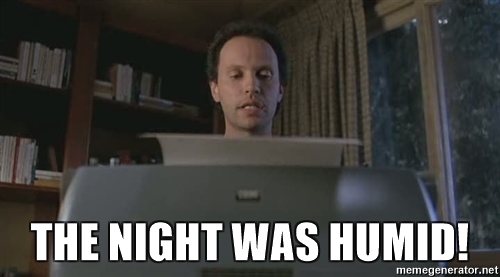
The movie Throw Momma From the Train begins with a writer who is having severe writer’s block. He keeps typing the opening line, “The night was…” and then he can’t decide. Was the night hot? Was it moist? Was it hot and moist? And since the movie was made before the era of cheap personal computers, we watch the character, portrayed by Billy Crystal, typing on a physical piece of paper, then tearing it out and throwing it away again and again and again and…

We learn that he’s been stuck unable to write for years since his ex-wife stole his previous novel, got it published under her name, then said novel became an international bestseller. Now the wife is living the high life in Hawaii. In his day job, he teaches creative writing at a community college, and one of his students misunderstands a conversation they have about writing as a proposal that the student kill the teacher’s ex-wife, and the teacher will kill the student’s abusive (and senile and otherwise seriously ill) mother. Various horrible misadventures ensue, culminating at a moment when the two are discussing opening lines again, the teacher talks about the whether the opening line should be “The night is hot” or “The night is moist” or “The night was humid” or “The night was foggy” at which point the ill mother says, “The night is sultry!” Which is, of course the word that combines both meaning the teacher had been trying to go for.

I could write multiple blog posts about the movie: about the problematic way it handles the declining mental and physical health of the mother; about the problematic way it portrays most of the women in the story; about the many myths of writing it perpetuates. But today’s topic is going to be opening lines. Or, more broadly, openings in stories, because it’s about more than just the first sentence.

Among the things the movie does get right is how frustrating and utterly debilitating writer’s block can feel.

As awful as it feels, you should never get as frozen on the opening line as Crystal’s character does in the movie. A completed draft of a story with a bad opening sentence is better than a blank screen with nothing because you can’t think of the perfect opening. And the truth is that most of the classic opening lines in literature—the ones that get quoted in all those articles about the best opening lines—weren’t in the first, second, or even third draft of that story. The writer figured them out later, once they’d wrestled with the entire story for a while.

There are several things to consider about the opening of your story that are more important than picking just the perfect word. Even the opening sentence isn’t necessarily important. If you’re working on a short story, then eventually, yes, you need to come up with a nice hook in the opening sentence. But if you’re writing a novella or a novel, you will wind up worrying more about the opening paragraphs. Readers expect a longer story of have more characters, subplots, and complexity, so they’re more likely to stick through several paragraphs before they need to be hooked.

The first question is where to begin. This may seem like an easy one, but let me tell you from my years reading the slush piles of several small publications, many people don’t have any clue where to begin the story. “But I started at the beginning!” is the usual response I would get when explaining to someone they had started at the wrong place. There is the classic of beginning in the wrong place: an alarm clock rings, the character wakes up and the author expects the reader to slog through many paragraphs (or pages) of description of the character brushing their teeth, eating breakfast and so on. But thats not the only way that writers start at a spot that seems like the beginning.

I encountered the best (or worst) example of how not to do this back when I was a university student. For reasons too complex to go into here, I was taking a Creative Writing class that was aimed at a much less advanced writer than I was, but that I needed to finish before I could get into other classes. And the professor had seen my work and knew it was too basic, so she had let me into the class on the condition that any time it was my turn to comment on someone else’s story I would tell the whole truth of what I thought. Yes, that’s right, she made me the designated bad guy. Anyway, one day a guy is reading a story, and it begins by describing the trophies and mementos of high school on his desk and shelves at home. At the bottom of the first page he finally mentions the game ball from a football game, his most prize possession, and then he starts describing the football game beginning from the opening kickoff. It was absolutely the most boring sh*t for nine more pages until finally he came to the line, “We had to move the ball 20 yards in 8 seconds.” Which should have been the opening.

The reasons why the first 10 pages of this story were awful was because first: none of the rest of the mementos from his school year had the slightest thing to do with the story. Second: to anyone who knows anything about football, knowing that our narrator has the game ball already tells us the ending—to wit, the narrator is going to make the play that wins the game. Third: even to a hard core football fan, a narration of a game whose ending we already know is just not interesting enough to sustain 10+ pages of following. The beginning of this kind of story is going to be where the drama hits. In that case, “We had to move the ball 20 yards in 8 seconds.”

Which isn’t to say that explaining any other parts of the game are worthless, you just need to hook the reader first. That line is something that even a non-football fan recognizes as a challenge. Then your second sentence can be explain that this was a game against your big cross-town rivals, and how every year for as long as you can remember this was the game that everyone attended, and then explain which position on the team the narrator plays, and then summarize some of the game up to that point, in order to set the scene and introduce characters. Up until that “We had to move the ball 20 yards in 8 seconds” moment, it was just one more sportsball game being played by people the readers doesn’t know or care about. And laid out in that order, the reader doesn’t know why he ought to care.

But if you first hook the reader with the drama, then you can fill in details. And the reader will understand that this is all stuff to help them understand the answer to the questions the opening lines raised: Who is this? Will they succeed? If they succeed, how will they?

So the first rule about opening lines is: the beginning isn’t necessarily the chronological beginning of your character’s day or involvement in the events, it is the moment where the protagonist is confronted by the problem. Some people like to put it this way: start the story the moment your character is hit in the head with a brick, not back at the moment someone started manufacturing the brick.

Which isn’t to say that every story has to begin with dramatic action… but we’ll get into that in part 2!

A writer writes!

“Write some letters make a word. Write some words make a sentence. Write some sentences make a page. Write some pages make a chapter. Write some chapters make a book.”
(Click to embiggen)
In the old days, when reading usually meant you were holding a physical book or magazine or manuscript in your hand, if something you read so infuriated you or was simply awfully written, you could literally throw it against the wall (or into the trashcan) in disgust. On Sunday this last weekend I really, really wanted to do that after reading a particular blog post. I’m not going to link to it or identify the author, because that would just be harassment—even though the author of the blog post is a professional who uses their blog to give advice and has (self) published books offering advice on writing. Instead, I need to follow the advice I give all the time: if you want more good things in the world for people to read, don’t complain about what’s out there, make something yourself.

Over the years I’ve had many conversations with aspiring writers. This happened especially a lot when I was the publisher of a small zine and attending sf/f conventions where I appeared on writing and publishing panels and usually had a table selling copies of the zine. A significant fraction of these random aspiring writers would talk about stories that they were working on but couldn’t quite figure out how to finish. And once I got into the details with them, it would eventually emerge that they hadn’t actually written any of the story. It was an idea they had and which they had talked about at length with friends. In many cases they would talk about the files they had full of descriptions of characters and an outline of the history of the world, but when pressed, they would admit that they hadn’t actually written a single word of the story itself.

Planning and thinking and even doodling about a story, gathering research and writing up background information are important tasks which are often necessary to the writing process, but none of that is the actual story. So I would tell these writers a few of rules:

  1. Stop talking about the story to other people, because that just makes the storytelling part of your brain think you’ve already written the tale. Sit down and start writing it.
  2. You don’t have to do world building before you start writing. Recently I saw a lot of people online passing around an excerpt from on old interview with one of Tolkein’s kids where the kid asserts that dad didn’t start writing the story itself down until the children started catching him in contradictions. I don’t know if the anecdote is true, but you can tell a lot of story before you have to stop and start making notes about the world building.
  3. Just sit down and put one word after the other. Don’t worry about whether you’ve started the story at the correct place. Don’t worry about the perfect opening line. You can figure that out later. Don’t get hung up (in the first draft) worrying about if people will understand the story or will like the story. Just start writing. The first draft is you telling the story to yourself. Worry about everything else after you have finished the first draft.
  4. Don’t stop and go back and re-write scenes again and again. Force yourself to leave things in the story until you reach an ending. Yes, you may scrap a ton of what you wrote later, but don’t fall into the trap of rewriting one scene for eternity.
  5. Write. A writer writes. Do it!

If you are writing a story, you’re writing. If you’re doing something else, you aren’t writing. Obviously, sometimes you have to take a break, or do some plotting, or jot down background information, or update a timeline, and so forth in order to know what to write next, none of that is actually writing. So if you’re spending more time on that than actually writing the tale, you need to stop, sit down at your favorite word processor or writing notebook, and start writing.

The blog post that angered me this weekend asserted that if you haven’t been published you aren’t a writer. I tend to have a knee-jerk reaction to gatekeeping, but even discounting that, I have problems with that distinction. I understand that the author was trying to address the issue of people who are merely daydreaming about writing. And I agree that we do a disservice to aspiring writers if we enable their mistaken notions that writing is easy or that it’s a sort of magic process of ideas coming to us from the ether.

But getting published is a very arbitrary and classist hurdle. And particularly in this age of self-publishing, it’s not a terribly useful distinction.

Are you writing? Not background notes, but an actual story with dialogue and a narrative moving forward? Then you are a writer. Maybe you’re still in the early stages of learning your craft. Maybe what you wrote this morning was completely awful. Maybe you’re still afraid to show it to other people. Maybe you showed it to someone and they didn’t like it.

That’s not important.

Are you writing? Are you doing the work of putting one word after the other striving to get to the end of the tale?

If you are writing a story, even if you don’t know what you’re doing yet, you’re a writer.

Go! Write! Finish that story!

Confessions of a writing tool addict—good intentions paving the way

“I know it's here somewhere...”
“I know it’s here somewhere…”
I’ve written a few times about some of the issues I face being a packrat who comes from a long line of packrats. One of the manifestations of the behavior is that I collect things, but not all of the things I collect are the sorts of things most people think of as collectable: keyboards, headphones, iPods, dictionaries, typewriters… and word processing programs. In a sense, my predilection for downloading and trying out new word processors is not unlike the way that many writers and artists and such like to try out new pens or buy new notebooks or sketchpads. You’re always looking for tools that will make some of your job easier, or are just nicer to use. And in the case of things like paper or pencils or brushes, they do get used up or wear out periodically, so having replacements already handy can be a good thing. When I see a cool-looking mechanical pencil, for instance, there isn’t much harm in picking it up and at least considering buying it. One of the pencils I already own might break, or get misplaced, right?

Software programs don’t usually work that way, but the non-rational part of my brain doesn’t quite get that. So seeing a review of a word processor that extolls features that appeal to me has the same effect on that impulsive part of the brain that makes me pick up a new pencil or pen or pocket notepad when it catches my eye in the store.

Many apps offer free trial versions, so it is literally a matter of just clicking or tapping a few times on my phone or laptop, and the next thing you know there’s a new word processor installed on my iPhone or iPad or Macbook Pro. And I will play with it for a bit, maybe find some things I like about it. If it works well and is cheap, well, I might buy it. If the free version has no time limit, I may just leave the free version on indefinitely.

All of that sounds mostly harmless, and it usually is. But… Continue reading Confessions of a writing tool addict—good intentions paving the way

But it made perfect sense when I was reading it to myself…

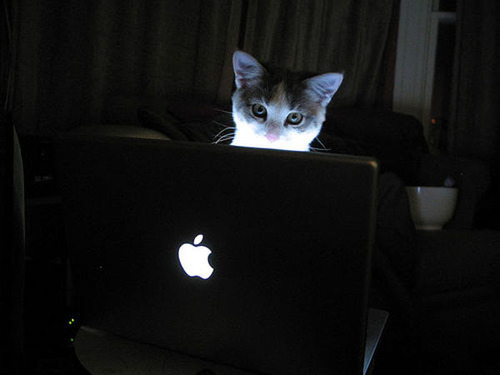
A cat peering at a Macbook Pro.
Sometimes there’s a lot more staring at the screen than pressing of the keys.
There have been stories I struggled with for years. There was this one story where I had this very interesting character whose voice just flowed from the fingertips at the speed of lightning when I wrote the opening scene for her story. I knew the trouble she was in and how she would eventually get out of it. She was a new character in an existing setting where I had a lot of great established character who could play the supporting roles. It just felt like magic every time I re-read the half dozen scenes I’d written. It was taking me longer to get to the resolution than I had originally thought when I had the story idea, but I figured that once I ironed a couple of plot issues out, I could probably trim a few of the scenes so far.

Then I read the story aloud to my monthly writers’ group.

I honestly don’t remember much of the critique I got from the group that night. And truth be told, I didn’t read everything I’d written. I only read the opening scene, and by the time I reached the end of the scene, I already knew that the story was a disaster. Part of it was the nonverbal reaction of the group, yes, but that wasn’t what killed the story for me. No, just hearing it aloud in my own voice revealed that it was an awful opening to an unpleasant story.

The character was in a very unpleasant situation, but that’s not what I mean when I say it was an unpleasant story. I mean that it was unpleasant to read the scene that I’d written. And I knew the rest of them suffered the same problem. I had picked the wrong place to start the story, and I was fairly certain that while my new character was interesting, she shouldn’t be the viewpoint character for this particular story. She might still be the protagonist, but she wasn’t the person who should narrate this particular tale.

And I learned all of that before any of the other writers in the group said a word. Just from the act of reading it aloud.

It’s advice I have received for as long as I can remember. Back when I was a grade-school student haunting the library’s magazine collection reading back issues of The Writer and Writer’s Digest I saw the advice again and again: read the story aloud to yourself before you show it to other people. It’s advice I’ve given many times. But I don’t always follow it. That particular story I really should have.

Reading it aloud, either to yourself or an audience, will expose awkward sentences at a minimum. There are all sorts of sentences you can write that make perfect sense, follow the rules of grammar and so forth, but when you try to say them out loud, your tongue trips on them. That’s why I always have a pencil or other writing implement in my hand when I read aloud, so I can circle the places I stumble over awkward phrasing.

But that isn’t the only thing you learn reading it aloud. There are numerous studies that show, for instance, the act of simply speaking about a problem you’ve been worrying about makes you think of it in a new light. Neurologically, they say, that’s because different parts of the brain interact differently. It’s not just the act of putting a problem into words, it appears to also be the fact that as you listen to yourself speak, different areas of the brain react differently than when you contemplate a problem in silence.

That process doesn’t just apply to solving real world problems, obviously. Listening to your story aloud makes you process it differently than reading it silently.

Reading it aloud to someone else brings in a different level of information, much of it non-verbal as I alluded to above. Your listeners may fidget, or become distracted, for instance. You’re not holding their attention. You’ll get other cues, as well.

That particular tale was re-written substantially several times, though I didn’t bring each draft back to the group. I tried telling the story from the points of view of three different supporting characters before I found the right viewpoint character and the right starting point. The fourth version, when it was read, got very positive responses. And eventually was published, and I got a few compliments from readers of the ‘zine.

The key to realizing my approach was wrong was to simply read the opening scene aloud–advice I have tried to follow much more faithfully ever since.