We’re snowed it, which seems to have made us more busy rather than less. I have not finished my WandaVision review. I started to write a post about the impeachment BS, but I’m just not in the mood.
Our original plans had been to get takeout from one of the restaurants we haven’t been to in a while, but the snow and ice and being in a hilly part of town (and watching both yesterday and today cars struggling to get up the hill at either end of our block) has left us both feeling much safer staying it. Besides, the chest freezer is so full we can’t squeeze any more food into it, so it’s not like we don’t have anything to eat.
Today also happens to be the birthday of one of my favorite people, and we already had plans to watch a movie (virtually) together tonight with him and a bunch of mutual friends. Among the silly thing my hubby gave me today is a pink and lavender and other fun colors hanging bird bath that will be going out on the veranda (I have the perfect place to hang it, midway between were the birdseed feeder and the hummingbird feeder hang) once the snow and ice are gone. I have been scattering a lot of birdseed out on the veranda, with is all really visible on the snow, so there have been lots of birds hopping around out there. I haven’t seen but one fleeting glimpse of a hummingbird since the hold weather hit, but since I’m bringing in the hummingbird feeder each eventing at sundown so it doesnt freeze, I’ve been measuring the nectar. I usually put a quart of nectar in when I refill, and ordinarily it takes the local birds about a week and a half to drink that much. The first two cold days they drank about half a pint. Yesterday it was a bit more than a pint. So they are definitely visiting, just not when I happen to be looking out.
We got a little bit of rain mixed with snow today. The weather service is predicting rain and warming temps tomorrow. But last time I checked they are still saying a bit most snow late tonight transitioning to freezing rain in the wee small hours.
I need to go check the squirrel feeder and maybe scatter some more seeds for the birds…
“It appears we have some breaking news.” “Good lord, what the fuck now?”
Time once again for stories that either didn’t make the cut for this week’s Friday Five, or broke after I finished that weekly news post, or update stores I have linked to and/or commented upon previously..
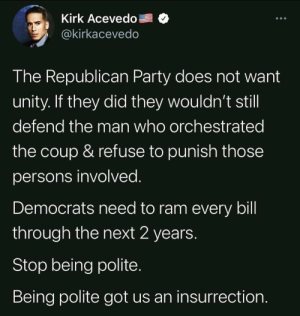
“The Republican Party does not want unity. If they did they wouldn’t still defend the man who orchestrated the coup & refuse to punish those persons involved. Democrats need to RAM every bill through through the next 2 years. Stop being polite. Being polite got us the insurrection.”
(click to embiggen)We’ve already reached the second Friday in February! Wow!
It has been getting colder and colder all week. We started getting snow Thursday. Overnight lows significantly below freezing, and much most snow is expected Saturday. And I live on a hillside with very steep hills the only way out of the neighborhood, so I probably won’t be leaving the house until next week when the temps are predicted to come back up.
Meanwhile, we have the Friday Five. This week I bring you: one story about why snow is such a catastrophe here, the top five stories of the week, five stories of interest to queers and our allies, five stories about the pandemic, five stories about threats traitos, five stories about bad people getting their due, and five videas (plus things I wrote and some notable obituaries).
They Stormed the Capitol. Their Apps Tracked Them. This story is not really about the murder mob, rather it is a fascinating and chilling example of what can be learned by aggregating anonymized ad network data. The graphics alone are worth the click.
Here I am, trying to finish tomorrow morning’s Friday Five, and a good friend sent me this link because her hubby was watching Lip Synch Battle and we both adhere to the sacred tradition…
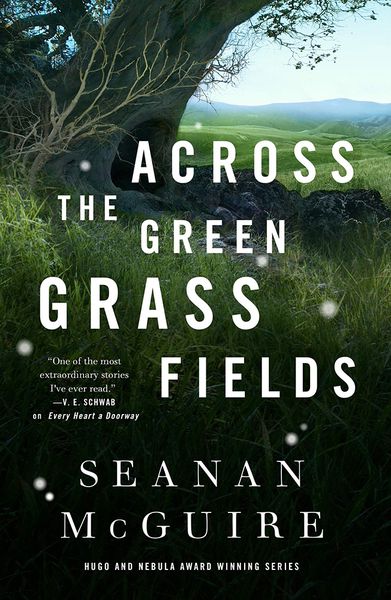
Across the Green Grass Fields is the sixth book in Seanan McGuire’s Wayward Children series;I read the sixth book in the Wayward Children series by Seanan McGuire a bit over a week ago. While I tried for several days to write a review, I realized that I couldn’t really talk about it without talking about the fifth book in the series, and how that left me feeling. But for some reason I didn’t write a review of the fifth book last year. My draft of the review of the sixth book wound up having more than a thousand words about the fifth book, so I decided to separate them and publish that review last week. And now I think I can tackle the sixth book.
There are spoilers ahead, though I try to avoid the biggest ones.
I was predisposed to love this series before I read the first bopok, after hearing the author explain that the inspiration for the first story was her own reading of tales (when she was a child herself) in which a child or group of children were transported to a magical world where they had a world-saving adventure but then were forced to go back home and just be ordinary kids again! And as a kid I had felt exactly the same way as I reached each of various fantasy books that I read.
For reference, I wrote about the first three novellas in this series here. And then I wrote about the fourth book (which left me sobbing uncontrollably) here, and the fifth here.
When Seanan McGuire explained how she came to write the award-winning first story in the series, she mentioned specifically the original My Little Pony cartoon as one of her inspirations. I was exactly the wrong age when the original series came out, but the more recent My Little Pony: Friendship Is Magic series roped me in. So much so that for several years now with a group of friends I have been running a tabletop roleplaying game using the Fate system to run a campaign in the My Little Pony: Friendship Is Magic universe, with the twist that we are crossing the series over with the Cthulhu Mythos (with a heavy sprinkling of things like Ash vs Evil Dead).
The upshot of all of this is, that once the title of the sixth book, Across the Green Grass Fields and the official blurb was released, I was essentially vibrating in great anticipation for the book. Because it was going to be about kids crossing through a portal to a world of adventure, but also specifically the original world which had inspired the author to start the series. So since this story would be about the aspect of this theme about which the author feels most passionate, presumably it would be one of the stronger entries in the series. Given that the fifth book was “merely” Really Good, but was therefore a letdown (for me) from the Stupendously Incredible that was the fourth book, I really wanted this book to wow me.
So, the book follows a young girl named Regen—who happens to be really into horses—who is having a bit of difficulty navigating grammar school. She had two very good friends, until one of those friends did something which the other friend felt wasn’t properly girlish and thus needed to be shunned. Regen feels very badly for the shunned friend, but also feels she can’t risk losing the regard of the bullying friend. There is some discussion to be had about whether deciding to stop being friends with someone should be regarded as bullying, but I’m afraid I come down on the side of the shunned girl’s mother that this behavior is a form of bullying.
Some years later, Regen begins feeling more insecure around her remaining friends because they seem to all be going through puberty and she isn’t. When she talks to her parents about it she finds out that she is intersex, specifically she has androgen insensitivity. They explain how the doctors discovered it, and reassure her again and again that this doesn’t mean anything is wrong with her. It’s just she won’t undergo puberty on her own, but she can with hormone replacement therapy.
This revelation bothers Regen even more. The next day at school she makes the mistake of telling the bully who she thinks is her friends. This does not go well, and she flees the school grounds, intended to go the long way back home. In the wooded area she is walking through toward home, she finds a mysterious door, which she goes through, and she winds up in another world.
She meets some of the inhabitants (a family of centaurs), and is informed that whenever a human comes to the Hooflands (which is what they call the world) something big will happen, and the human will save the world. Regen doesn’t want to save the world, particularly when she hears some of the stories of humans who came before her who all disappear after saving the world.
The Hooflands are inhabited by a lot of mythical creatures, all with some kind of hoof or other. The unicorns seem to be dumb animals (and are raised as livestock to be eaten by the centaurs). There are kelpies, fauns, perytons, and so forth. Some of species do not get along with others. Kelpies, for instance, are describe as mindless beasts and monsters.
Regen lives with the centaurs for a time. The happy family is disrupted because the Queen of the Hooflands puts a bounty on Regen. The centaurs relocate to a place where they think the Queen can’t find them and live there more or less happy for several years. Until it becomes clear that the Queen is evil and is hurting the other inhabitants of the Hooflands, so Regen sets out to try to save the world (without vanishing afterward).
There was, for me, a big problem with the book. The opening chapters, while Regen is dealing with the difficulties at school and discovering that she is intersex and so forth was extremely compelling. You know how some people yell at the TV when a character does something foolish? I was talking to the book when it became clear that Regen was about to tell the bully about her gender. I knew it was going to go badly, and McGuire had me on the edge of my seat about how badly it would go and what happened next.
But, again, this is how I experienced the book, not long after Regen arrived in the Hooflands almost all dramatic tension evaporated. I literally fell asleep while reading the second half of the book. Twice. It took me two more days than it ought to have to finish it because it just wasn’t grabbing me.
I’ve read other reviews of people who absolutely loved the book and found it rivetting to the end. The writing is good. There is not a big glaring plothole or anything like that. I just wasn’t able to make myself care about what happened to the Hooflands. I kept wanting to know what was going to happen when Regen got back. It just didn’t feel like anything important was at stake within the Hooflands part of the story.
This doesn’t mean that the book was badly written. It means this falls into the category of books that aren’t for me. This is not the first time that I have encountered this phenomenon with an author whose stories I otherwise adore. For whatever reason, this one didn’t grab me.
And I’m not happy about that! Because I really wanted to adore this book. I wanted it to move me the way book four did.
I might try to re-read it again later. Maybe I was just not in the right place mentally that week for it to resonate for me.
I still highly recommend the series. As mentioned above, there are people out there who absolutely loved this one. So maybe you will, too. I’m still looking forward to the next book. I hope it’s one that grabs me.
I need to get my other hosting issues sorted out and get a couple of my other sites back up on the web. But a conversation elseweb made me dig out this essay I wrote and first published 22 years ago and resurrect it on this blog. Homophobia is not a recent development in the sci fi community. But also neither is allyship, so:
(Originally published 18 June, 1999)
Theodore Sturgeon (1918-1985) was one of America’s finest writers. He was one of the great figures of the Golden Age of science fiction. During his lifetime he produced over 200 stories, several novels, film and tv scripts (including two of the most famous episodes of the original “Star Trek” series), plays, and dozens of non-fiction reviews and essays. His many literary awards include the Hugo, the Nebula, and the International Fantasy Award.
Sturgeon wrote such great fiction because his philosophy was “Always ask the next question.” He even created a symbol or personal shorthand for “Ask the next question,” a capital “Q” with an arrow through it. He was never satisfied with conventional wisdom or pat answers.
And that tendency got him in big trouble in 1953, making him the central target of an intense “anti-homosexual blacklist” within the publishing community. Prior to the 1970s, it was virtually unheard of for gay men, lesbian, or bisexual characters to appear in any kind of fiction, and when they did, they were either vile villains or tragically flawed creatures who committed suicide before the end of the story. While many science fiction authors were questioning racial stereotypes or decrying McCarthy’s rabid anti-communism, they closed ranks with the rest of the status quo on the question of homosexuality.
Not Theodore Sturgeon. At the time a father of four and somewhat notorious womanizer, Sturgeon still couldn’t help but ask the next question. If racism was wrong, why not sexism and heterosexism? He wrote three short stories in quick succession. The first, “The Silken Swift” was a twist on the unicorn legend that questioned society’s definitions of purity and innocence, while making some comments about the role of women in most cultures. It caused a slight stir, but didn’t seem too far out. Then “The Sex Opposite” started showing up in editor’s mailboxes, in which Sturgeon posited a whole subspecies of humans who could change their gender at will, and whom engaged in long term relationships with members of all three sexes. This provoked a mild uproar, and many editors shied far away from it. Sturgeon started receiving unsolicited advice, some of it implied that people were assuming he was homosexual (because only a “pervert” would even think of portraying such relationships as possible, let alone successful and happy) and suggesting that he tone it down, for the sake of his career.
Which seemed to firm up Sturgeon’s resolve. He sat down at his typewriter and created “The World Well Lost” in which homosexual characters were not only portrayed as normal, well-adjusted people in the future, the story came right out and referred to the homophobic past has a horrible time. Fear and loathing of homosexuals was a sign of an immature society, the story said. This was too much for some people. The editor of the magazine Fantastic, Howard Browne, was so outraged by the tale, not only did he reject it, he immediately started phoning all the other editors he knew to organized a boycott of Sturgeon. Browne wasn’t satisfied with bullying other editors into agreeing never to publish anything from Sturgeon again. He and his cronies promised to completely ruin the career of anyone who dared publish “The World Well Lost” itself.
Ray Palmer was a feisty man who was editor of Universe Science Fiction, a small pulp sci-fi zine at the time. Perhaps it was because Mr. Palmer had suffered from disfiguring disability since childhood, and had little sympathy for bullies, but in any case, Palmer put “The World Well Lost” into a fast track to get it published right away. And he publicly dared Browne’s group to make good on their threat.
Browne’s coalition quickly crumbled, and the “Homosexual Blacklist” faded away before it had a chance to damage any other careers.
Sturgeon kept on asking the next question, never afraid to broach topics just because they were controversial. And Palmer enjoyed a long and successful career in publishing. Thanks to them, other writers in the fifties, sixties, and seventies could explore the subject of homosexuality in a more balanced and tolerant fashion. While it was true that, even into the late seventies, most readers, critics, and editors assumed that any author who wrote such a story was probably gay, bi, or lesbian themselves, it was because of two courageous heterosexual men, Sturgeon and Palmer, that those authors could give us those rare, early glimpses into a world where homophobia was neither common nor acceptable.
This pride month, remember to raise a toast to Theodore Sturgeon and Ray Palmer, two people who knew it was better to do the right thing than to be perceived as the right kind of people. Where ever their spirits are now, I’m sure they are still asking questions.
Let’s play…I put all my blogging time over the weekend into finishing my WandaVision episode review and a book review that will publish later in the week. There were a number of news stories that broke or had new developments after I composed this week’s Friday Five, So here are a few of those stories that I want to share and comment upon before next Friday.
First up, we have a number of news stories involving media, social and otherwise:
I mean, it’s been clear for a while now the Rudy is woefully ill-informed, has very poor reasoning skills, and doesn’t actually understand the law very well. I keep running into people online who point out that Rudy was a successful prosecutor years ago. That doesn’t necessarily mean anything. He could well have been one of the guys who was completely reliant upon his staff to write all the briefs, draft this questions for witnesses, and so forth. He may have been really good when he was younger at delivering the lines that had been scripted for him by his staff, without much understanding. But clearly he doesn’t have that kind of assistance now. It is also possible that he’s just suffering some sort of mental decline/neurological issue. In any case, the radio station that pays him to make his show is not censoring him if they put a legal disclaimer in front of it. They are still broadcasting his show in its entirety.
Free speech has always meant the government can’t stop us from speaking in advance, and that many types of speech are protected from legal repercussions. It has never mean that there will never be any consequences when we shoot off our mouths. Sometimes the consequence is that someone argues with us. Sometimes the consequence is that make fun of us. Sometimes the consequence is they block us on social media. And in the case that we knowingly lie about someone in a manner that harms their reputation, and so forth, the consequence can be getting sued.
If the statement is false, is published (or broadcast, et cetera), caused harm to the person—then it is defamation. It could be argued that the two corporations qualify as public figures, and if so, to prevail in court they would have to prove that the statements were made and/or published with malicious intent. And it looks like they have a good argument for that.
Meanwhile: Trump Lost Twitter and the Presidency. Guess Which One Hurts More? One of the stories that almost made it into another post asserted that the Grifter has been writing down insulting things he wants to say about certain election officials and public figures and trying to get other people who haven’t been banned from Twitter to post them for him. That’s just so pathetic. But that also tells us both how twitter aided and abetted the Grifter’s agenda, and why he didn’t just start walking into the press room the make statements once he was suspended: his twitter account was never about communication. It was always about trolling, bullying, and harassing. And even the most sycophantic news networks would try to phrase things to have at least the appearance of being news.
And also: We Won’t Have Lou Dobbs To Kick Around Anymore. Dobbs was even more in the tank for the former Grifter in Chief that any other Fox host. A lot people are assuming the sudden cancelation of his show is because of the big lawsuits being filed about the false election stories. Dobbs is mentioned as a co-defendant and if the suit proceeds through discovery, he’s going to be deposed under oath. And Dobbs’ show was the highest rated of the Fox Business shows, so they didn’t cancel it because of bad ratings. There are other Fox hosts named in the lawsuits that haven’t been fired—at least not yet. On the other hand most of them have—after being forced by the network to read on air a statement disclaiming all those election stories—shift emphasis away from those election claims. Whereas Dobbs couldn’t seem to stop bringing them up. So maybe the network did fire him because of the lawsuit. It’s possible that Dobbs had become a problem in some other way that hasn’t been made public.
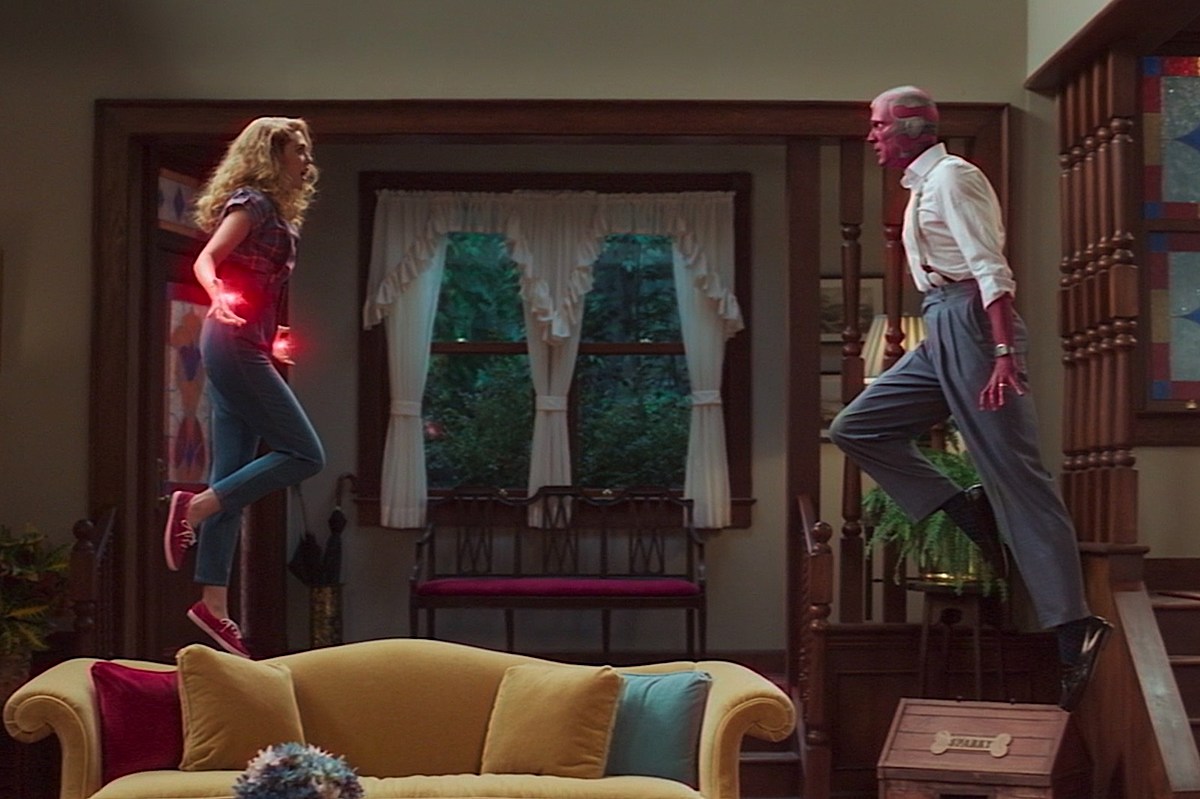
Time for a review of the latest episode of WandaVision: “A Very Special Episode…” Since I keep taking too long to finish these, I’m going to try to do a bit less verbose in my recapping and focus on reviewing. And before we get into that, I want to mention up front that while I thus far love this show playing on Disney+, it is still unfortunate that the Disney corporation is refusing to pay Alan Dean Foster and other authors money they are owed for media tie-in novels.
This week’s episode continues the trend seen in the first three where Wanda, Vision, and the town of Westview moves through the decades with styles, decor, and so forth evoking sitcoms of a particular era. This episode has moved into the 80s, and while i recognized the styles and at least the homages during the opening sequence to Family Ties, but I have to confess that while I am familiar with a lot of the sitcoms of the 50s, 60s, and 70s, I didn’t watch much TV during the 1980s1. So I probably missed a bunch of subtle stuff in this one.
This episode moved back and forth between the viewpoint of Wanda and Vision inside the reality bubble, and the scientists and agents outside. With some direct interaction that did not go very well. It was interesting, it was intense in places, and the mystery managed to deepen some more. I don’t think I can say more without spoilers, so if you don’t want to read those, stop now!
Randy’s parody gets the best recognition…We’ve already reached the first Friday in February! Wow!
It’s been very rainy, but the temps have been just a bit higher than average, and it is starting to look as if this might be the third winter in the last 100 years where the daytime high never fell below 40ºF… Meanwhile, both my husband and I have been having extra bad allergy symptom all week.
Meanwhile, we have the Friday Five. This week I bring you: one special story to bring a smile, the top five stories of the week, five stories of interest to queers and our allies, five stories about the pandemic, five stories about threats to the future of democracy, five stories about the seditious traitors, and five videos (plus things I wrote and some notable obituaries).
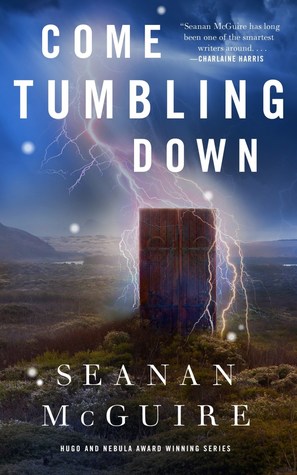
I have been trying to write a review of the sixth book in the Wayward Children series by Seanan McGuire, and realized that I couldn’t really talk about it without talking about the rest of the series, and I had somehow neglected to write about the previous book when I read it last year, so I need to talk about it before I jump into the latest. So, this will be a review of the fifth book. For reference, I wrote about the first three novellas in this series here. And then I wrote about the fourth book (which left me sobbing uncontrollably), here.
I should preface this with this statement: before I read the first book in this series I was predisposed to love them, as the author had explained on a panel at a sci fi convention I attended, that the inspiration for the first story was her own reading of tales (when she was a child herself) in which a child or group of children were transported to a magical world where they faced danger, monsters, and adventure but managed to save that world… and then were forced to go back home and just be ordinary kids again!
And I definitely loved the first book in the series, as well as the next several sequels.
The fourth book, In An Absent Dream was—for me—the most devastating, but the first three had been pretty moving.
When the first teasers for the fifth book came out, I must admit I had mixed feelings. The first book had introduced us to Eleanor West’s Home for Wayward Children, a refuge for those children who were not happy to be sent back to mundania after having slipped through the shadows into another world. Among the children we met in the first book were the twin sisters Jack and Jill, who had been to a world of horrors. And they had turned out to be central to the mystery of the first book. The second book in the series is a prequel to the first, and tells the story of how Jack and Jill (or Jacqueline and Jillian as they were known by their parents) went to that world, had their adventure, and come home.
It was clear from both the announced title of the fifth book and its official summary that we were going to be treated to yet another adventure involving Jack and Jill. And while I had enjoyed the first and second book in the series, there had been a whole lot of other characters introduced in the first and third books whose stories I really wanted to learn more of. So giving yet one more book to Jack and Jill, who had already had two books, seemed like it was giving the shaft to some of the other characters.
On the other hand, the magical world that Jack and Jill had traveled to, known as The Moors, was based on the old Universal Horror movies of the 1930s and 1940s. And I loved those particular movies, which had contributed quite a bit to how much I had loved the second book in the series, Down Among the Sticks and Bones. So I wasn’t really complaining about getting to spend more time there.
McGuire has explained several times that the series is set up thusly: odd-numbered books will be set at the school and involve groups of children who have already had at least one magical adventure on their own working together to solve a problem, while even-numbered books will be straight up Portal Fantasies where we see one or more children going to one of the magical worlds for the first time, and how that transforms them.
So. Come Tumbling Down begins with Jack unexpectedly coming back to Eleanor West’s school after taking her deranged sister back to the Moors and needing help. Several characters accompany Jack and her resurrected girlfriend, Alexis, back to the Moors to try to stop Jill from doing something truly horrible that will (among other things) cause great harm to her sister, Jack. Not to mention cause a lot of other bad things to happen to the mostly innocent bystanders trying to live their lives on The Moors.
It is clear right away that something is very wrong. Jack and Alexis explain the situation, and beg some of the students of Eleanor West’s school to come back with them to The Moors to stop Jill’s evil plan, because Jack can’t do it without them. A couple of the other wayward children we met in earlier books, as well as at least one we haven’t seen before this book answer Jack’s call and go back with her to the Moors.
We get to see aspects of this world that weren’t covered in Down Among the Sticks and Bones, which is cool. But as the rest of the quest unfolded I had a bit of a problem. Most of the characters that Jack persuaded to come back weren’t actually needed to complete the quest. Honestly, exactly one, and only that one and only for one specific task of the characters that Jack begged to come back with her did anything that actually contributed to solving the problem. All of the other actions that contributed to the solution were performed by Jack on her own. So most of the characters (including one who paid a very significant price) were not needed after all. Their only purpose in the plot was to get hurt (or worse) to create some tension, and not actually to contribute to the final solution.
It can be argued that Jack didn’t know that when she pled her case early in the book… but the author should have known that, and should have structured the story somewhat differently.
Mind you, I enjoyed the quest, its solution, and the new things we learned about the Moors. I just think the author dropped the ball at a couple of points in the plot, is what I’m saying.
However, the over all story—most importantly the explicit revelation that what some people call a monster can actually be the hero of the tale—was very entertaining and quite good. So like every other story I’ve read by this author, by the end despite some things not going the way I thought, I was still left mostly happy with that tale and looking forward to the next story in the series.
But it didn’t feel either as tight nor as poignant as the fourth book. And maybe I should just accept that sometimes an author hits their stride on every single aspect of a book in an incredible way, and other times they only hit it on say three out of five major components.
I mean, I liked the book. I went back to reread it and enjoyed it the second time. And as soon as I knew their was another book in the series coming out I preordered it. Which means, I guess, that I’m saying some of the books in this series are Incredible and Stupendous, and others are merely Really Good.
 We’re snowed it, which seems to have made us more busy rather than less. I have not finished my WandaVision review. I started to write a post about the impeachment BS, but I’m just not in the mood.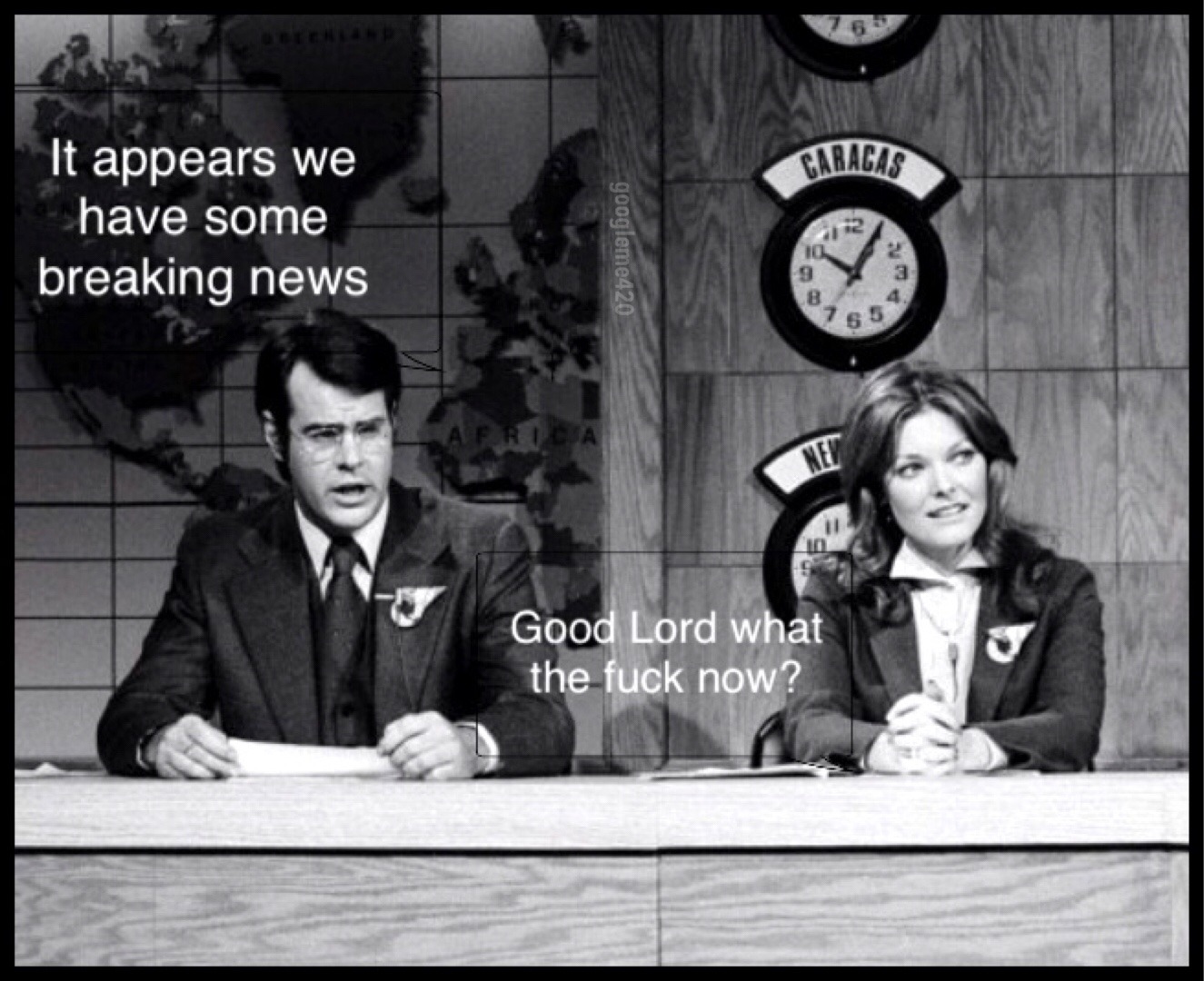



 Font Folly