Click to embiggenWe have reached the first Friday in June, aka Pride Month.
I’ve posted numerous times recently reminding folks that the first Pride was a riot, and specifically a riot about police brutality, and specifically a riot instigated by black and latinx queer people, and therefore no white gay people have a moral or ethical leg to stand on opposing the current protests and should all join wholeheartedly in the Black Lives Matter demonstrations. If you know any white cis gay men who aren’t supporting the resistance, shame them and if that doesn’t work, shun them. Because they don’t belong in any community other than the Nazis…
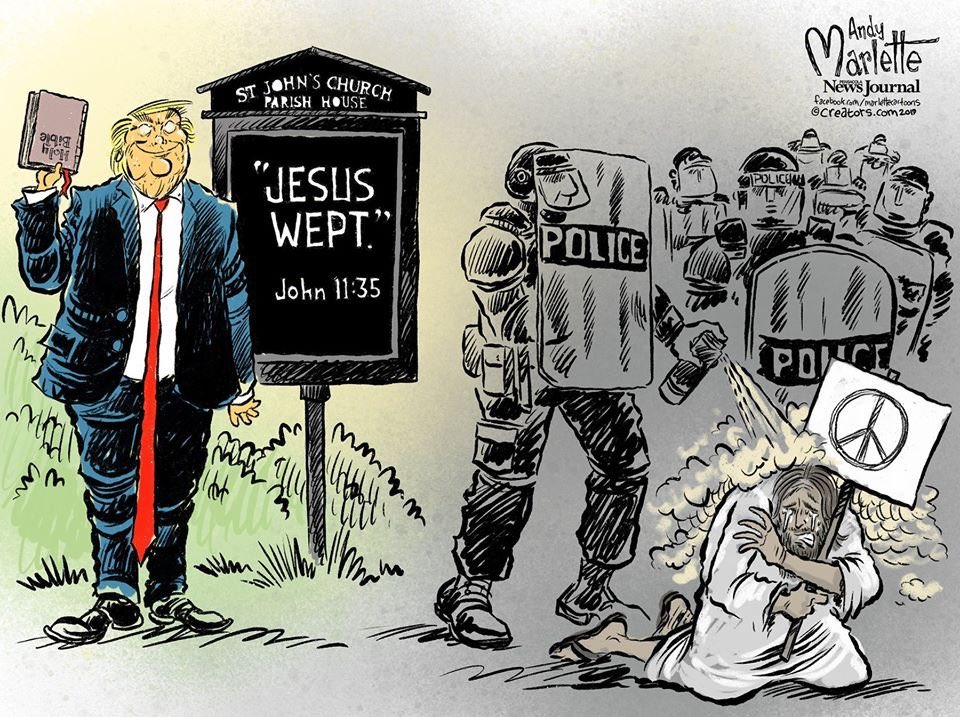
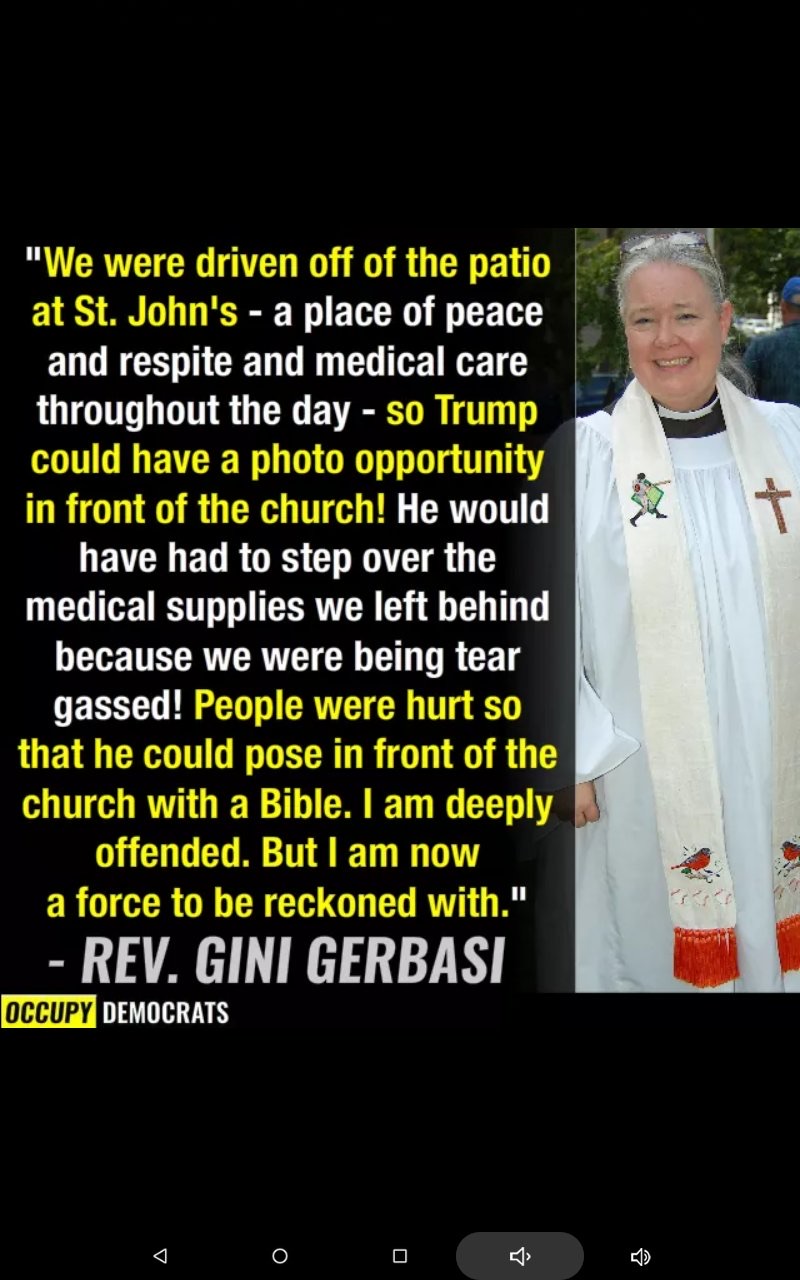
According to one of the priests present, the Reverend Gini Gerbasi, said, “We were literally DRIVEN OFF of the St. John’s, Lafayette Square patio with tear gas and concussion grenades and police in full riot gear,” Gerbasi said. “We were pushed back 20 feet, and then eventually – with SO MANY concussion grenades – back to K street.”Meanwhile, welcome to the Friday Five. This week I bring you: the top five stories of the week, five stories of interest to queers and our allies, five stories about demanding justice, five stories about the pandemic, five stories about the criminal pretending to be president, and five videos (plus notable obituaries and some things I wrote).
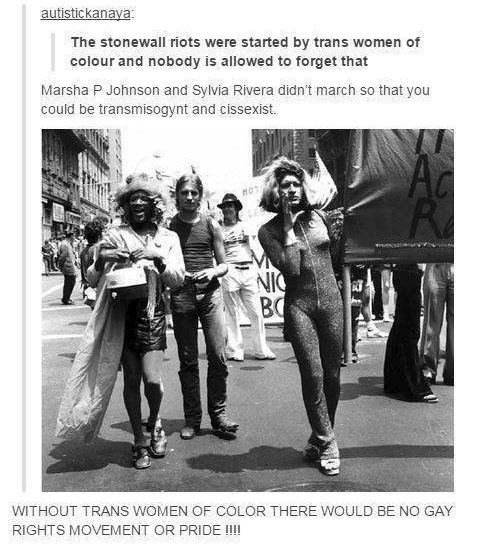
“The Stonewall Riots were started by trans women of colour and no one is allowed to forget that.” (Click to embiggen)
I’ve written more than once before about how who owe a huge debt to the people who stood up and fought back that night, 51 years ago, at the Stonewall Inn in New York City. Most of the legal rights that LGBTQ+ people have in the U.S. today is thanks to those Black and Puerto Rican queens who fought back, threw bricks, and so forth when the cops raided that bar.
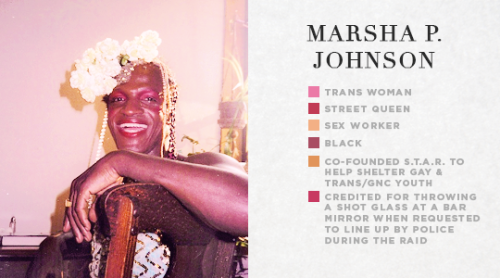
Miss Marsha P. Johnson (which is how she identified herself whenever asked), was impossible to ignore—always appearing in public wearing a flowered hat and flamboyant dresses. Once when appearing in court on a disorderly conduct charge, after the judge asked her what the middle initial P stood for replied airily, “Pay it no mind!” Some early accounts of the Stonewall Riots said she was the one who threw the first brick or the first shot glass at a cop. In interviews she would admit that she threw several things at cops that night, but wasn’t certain she was the first person to throw anything. After the riots, she was one of the founding members of the Gay Liberation Front, and also co-founded the gay and transvestite advocacy organization S.T.A.R. (Street Transvestite Action Revolutionaries), alongside close friend Sylvia Rivera. A note here about terminology: at the time several terms that would he considered slurs by transgender and gender nonconforming people today were commonly used within those self same communities. At different times Marsha identified herself as a street queen, a drag queen, and a transvestite. But she also always insisted on female pronouns and consistently introduced herself as Miss Marsha. Which is why most of us refer to her as trans.
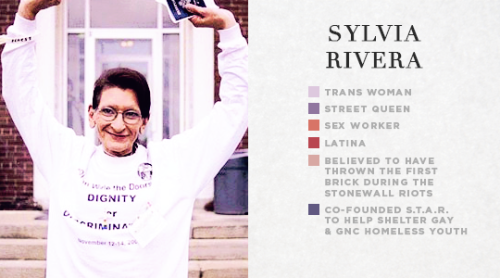
Silvia Rivera was only 17 and living as a self-described drag queen at the time of the Stonewall Riots. Most historians (and her friend Miss Marsha P. Johnson) agree that she wasn’t at the Stonewall Inn the night of the raid, being at a party at another location that night. Her whole life she asserted that she had been there. And there were others who agreed and said she was the person who threw the first brick at a cop car. She certainly joined the protests and rioting that continued the following nights, and later founded the Street Transvestite Action Revolutionaries (S.T.A.R.) along with Johnson. She was also a member of the Gay Activists Alliance. In a speech she gave at the 1973 Christopher Street Liberation Day Rally (what they called the annual event commemorating the riots for the first several years), she espoused a definition a belief that people such as herself belonged to a third gender.
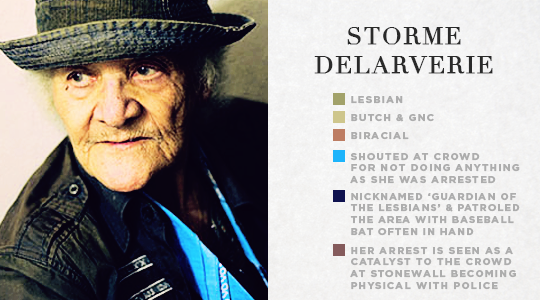
Stormé DeLarverie was often described as a butch lesbian. Before Stonewall, she had been part of a touring theatre troupe which, among other things, performed a number called, “Who is the one girl?” and audience members seldom guessed correctly that the tall latino “guy” in a tailored suit wearing a false mustache was the one woman in the dance number. She was one of several who resisted arrest the night of the Stonewall police raid. Many witnesses claimed she was the woman who broke loose from the cops before being loaded into one of the waiting paddy wagons several times, to run, get caught, and dragged back through the crowd, each time making the crowd more angry at the cops. Of the events at Stonewall that night, DeLarverie always argued that it should not have been called a riot: “It was a rebellion, it was an uprising, it was a civil rights disobedience – it wasn’t no damn riot.” She remained active in many gay rights groups and activities in the years after Stonewall, but was most often remembered as the self-appointed guardian of lesbians who patrolled the neighborhood at night with her baseball bat to drive off bashers.
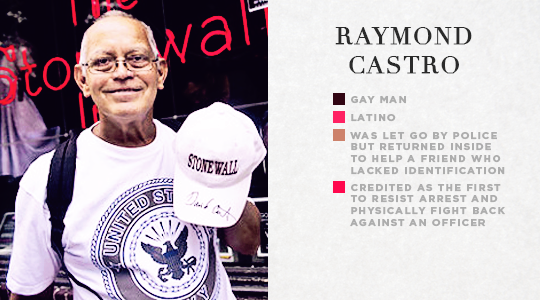
Raymond Castro was another Veteran of Stonewall. Because we was not dressed in gender nonconforming clothes, he was not arrested, and was told he could leave. When he realized a friend was being arrested, he went back inside to try to help the friend. This got him arrested and put in handcuffs. He struggled with the cops, managing to knock a couple of them down. This seemed to encourage several other people nearby to start struggling. One of the officers that eventually wrestled him into the truck commented that he was “some kind of animal.” Castro was active in several gay rights organizations in the years after Stonewall.
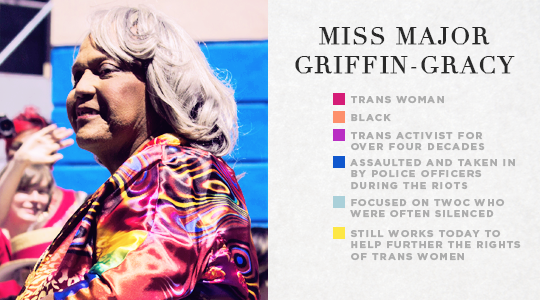
Miss Major Griffin-Gracy was at the Stonewall Inn with her girlfriend the night of the police raid. She was one of several to fight back. Unfortunately she was struck unconscious during the fight and was taken into custody. Miss Major has been active in a lot of transgender right organizations, civil rights organizations, and in the 80s became active in multiple HIV/AIDS organizations. She was the original Executive Director of the Transgender Gender Variant Intersex Justice Project, which advocates for the rights of incarcerated trans and nonbinary people. And Miss Major is still alive today, still fighting! Her Instragram account shows her at a Black Lives Matter protest earlier this week. She suffered a stroke last year and has a lot of medical expenses, which you can help with by donating here Miss Major’s Monthly Fundraising Circle.
President Donald Trump on Monday evening called for law enforcement across the country to dominate the ongoing protests and riots in response to the killing of George Floyd at the hands of police. The dark and authoritarian message delivered from Rose Garden was sharply juxtaposed on cable news with images of peaceful protesters just outside the White House gates who were fired on by police with tear gas.
The president threatened to send the military into the streets if the unrest could not be quelled by other means.
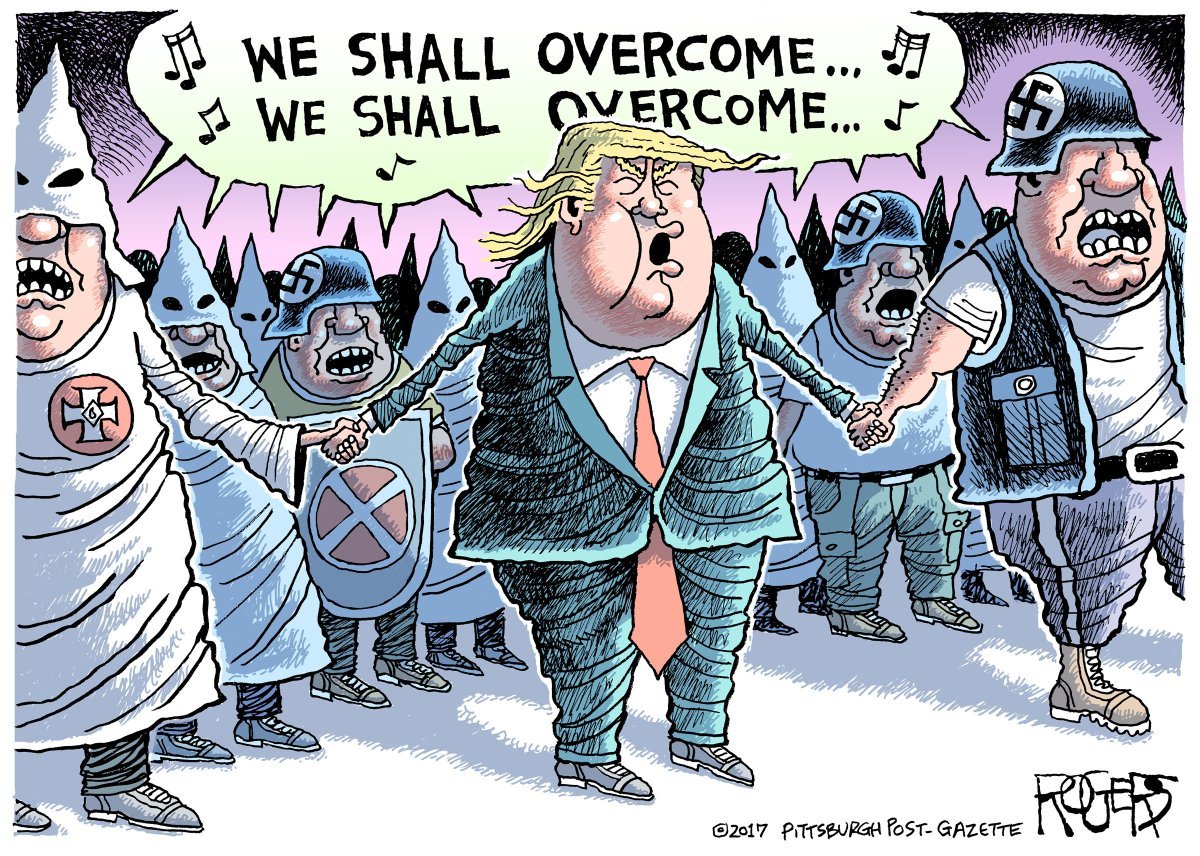
Between the alleged president’s fascist proclamations and the curfews and related emergency orders from mayors and governors everyone who isn’t a diehard trump supporter/neo-nazi (as if there is a difference) has lost the legal right to protest. I am not exaggerating.
“Sources are telling my colleague Kevin Liptak that, in part, the reason the president made this trip outside the gates of the White House — a really rare trip, where you do not often see the president walk out of the front door of the White House, walk across Lafayette Square, to St. John’s — was driven, in part, that he was upset by coverage of the fact that he had been rushed to the underground bunker on Friday night during the protests that you saw breaking out here, in front of the White House,” CNN’s Kaitlan Collins said.
For as long as I can remember, columnist/pundit George Will has been an arch-conservative who argued against my own rights and against everything I believe. The last couple of years as he slowly came out as a never-trumper I have occasionally found myself at least partially agreeing with him. I am more than a little bit dizzy to read this piece from him where he finally comes up fully anti-trump, anti-neo-nazi and recognizing that that means become anti-republican: George Will: There is no such thing as rock bottom for Trump. Assume the worst is yet to come.
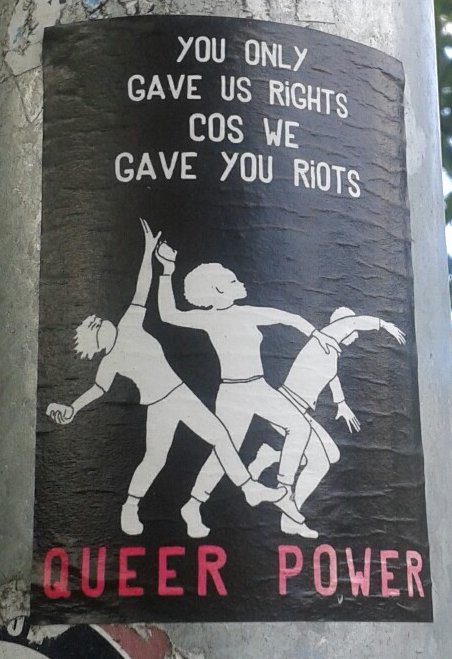
“You only gave us rights because we gave you riots. Queer Power” (Click to embiggen)Most of this last weekend’s update was concerned with the protests. But not all. I posted a link about the death of an infamous homophobe who shaped anti-gay attitudes and legislation for several decades. Another blogger was even more blunt that I was: Lou Sheldon was an evil, homophobic SOB and I hated his guts.
Alvin McEwen of Holy Bullies and Headless Monsters has spent many years exposing the lies and distortions of various anti-gay hate groups. And his take on Sheldon’s death did not disappoint:
Lou Sheldon was an evil homophobic son of a bitch. His rhetoric mutilated our minds while encouraging others to mutilate our bodies. With him, there was no nonsense about wanting to save our souls or loving the sinner while hating the sin. Lou Sheldon HATED LGBTQ people. And he made it his life’s work to disrupt our lives and cause us as much turmoil as he possibly could.
I kind of wish I had been this blunt on Saturday.
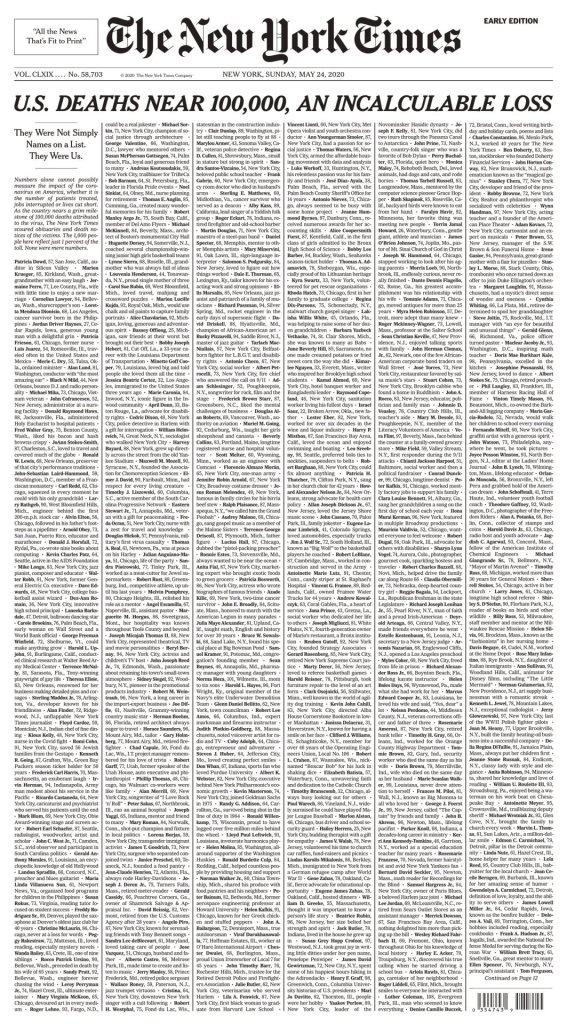
Meanwhile, we passed that horrific milestone of 100,000 dead due to the corona virus some days ago. It’s difficult to know how to wrap our minds around such a thing. The New York Times approached it this way:
The New York Times has gathered 100 obituaries of people who have died from Covid-19 as an attempt to wrestle with the magnitude of 100,000 Americans dead. Click on the image to be taken to the page. The Times is making all their Covid-19 coverage available free.
“They speak to a nation where too often just the color of your skin puts your life at risk. They speak to a nation where more than 100,000 people have lost their lives to a virus and 40 million Americans have filed for unemployment — with a disproportionate number of these deaths and job losses concentrated in the black and minority communities. And they speak to a nation where every day millions of people — not at the moment of losing their life — but in the course of living their life — are saying to themselves, ‘I can’t breathe.'”
—presumptive Democratic presidential nominee, Joe Biden
This year’s Nebula Awards were announced at a live streaming event on Saturday. The Nebulas have been given annually by SFWA, the Science Fiction and Fantasy Writers of America since 1966. They are meant to recognize the best works of science fiction and fantasy published in the previous year. The winners are selected by the members of SFWA.
This year’s winners are:
Novel
A Song for a New Day, Sarah Pinsker (Berkley)
Novella
This Is How You Lose the Time War, Amal El-Mohtar & Max Gladstone (Saga)
Novelette
Carpe Glitter, Cat Rambo (Meerkat)
Short Story
“Give the Family My Love”, A.T. Greenblatt (Clarkesworld 2/19)
The Andre Norton Award for Outstanding Young Adult Science Fiction or Fantasy Book
Riverland, Fran Wilde (Amulet)
Game Writing
The Outer Worlds, Leonard Boyarsky, Megan Starks, Kate Dollarhyde, Chris L’Etoile (Obsidian Entertainment)
The Ray Bradbury Award for Outstanding Dramatic Presentation
Good Omens: “Hard Times”, Neil Gaiman (Amazon Studios/BBC Studios)
The Damon Knight Memorial Grand Master Award
Lois McMaster Bujold
The Kevin O’Donnell, Jr. Service Award
Julia Rios
The Kate Wilhelm Solstice Award
John Picacio
David Gaughran
I’m not a SFWA member so I don’t get a vote in these. But it’s always interesting to see what wins. Since the winning Novella and Novelette are both stories that I including in my nominations for a Hugo, I am clearly happy to see them win. And, of course, I quite love the Good Omens mini series (and I nominated the series as a whole for the Dramatic Presentation, Long From, as well as one episode [but a different one than got the Nebula] in Short Form), so I’m quite happy to see that win. And I’ve long been a fan of Lois McMaster Bujold’s books, so I’m very happy to see her officially recognized as a Grand Master of Science Fiction.
Because I don’t participate in the voting for the Nebulas, I am much less familiar with the rules defining the categories. They don’t have the all the categories that the Hugos do, and while there are a number of times when the same book or story that won a particular category in the Nebulas goes on to also win in the Hugos, it isn’t at all common. The voting pool is a different set for each award (though there is some overlap), so that’s to be expected.
Having the Hugo Voters packed become available the same weekend as the Nebulas were announced–when I am already well into the act to reading as many of the Hugo nominees as I could without the packet (I finished Gideon the Ninth about a half hour before I noticed the email telling me the Hugo Packet was available to download), it was a very science fiction heavy weekend.
Even while the world seemed to be falling down around us.
My typical Weekend Update post features stories that either didn’t make the cut for this week’s Friday Five, or that broke after I completed the Friday Five post, or update a news story/event that I have linked to and/or commented upon in an earlier post. Today I’m focused almost entirely one one story, which was one of yesterday’s “Stories of the Week” and deserves more than just being linked to.
Officer Kept Knee on George Floyd’s Neck for Nearly 3 Minutes After He Was Non-Responsive. Here’s what we know: a clerk at a store called police to report that a black man had tried to pay for his purchase with a counterfeit bill. Minneapolis police arrive, find the black man, George Floyd, sitting in his car in the parking lot. They pull him out, handcuff him, force him to the ground, and then one officer placed his knee and his full weight on Floyd’s neck. Floyds last words were, “I can’t breathe.” Many minutes later the officer in question finally lets up on the neck.
That’s murder. Sorry, not alleged, it’s straight-up murder.
The officer who killed Floyd was fired the next day, as were the other three officers on the scene. The other three were fired because after many previous cases of police brutality, the city had instituted a policy that officers who witness another officer using excess force but fail to intervene will be terminated.
But it took four days before prosecutors decided to charge the cop with murder. And I firmly believe the only reason that murder charges were filed at all was because of the protests that have been raging all week.
Arrest report for officer charged with George Floyd’s murder has a damning new piece of evidence. The additional detail is that there was a point, caught on video, where one of the other officers notes that Floyd had stopped struggling minutes ago, and maybe they should roll him onto his side. The killer cop doesn’t let up on the neck, but does feel for a pulse, and says clearly that he can’t find a pulse. And yet he still keeps his weight on Floyd’s neck for a few more minutes until the EMTs arrive.
When you can’t find a pulse, you can’t claim that you fear for your life.
Wife of Minneapolis cop who killed an unarmed black man is filing for divorce, report says. I just want to point out that multiple studies have found that at least 40% of police officer families experience domestic violence. Cops are 4 times as likely as typical people to abuse their significant other and/or children, and other statistics show that when it’s reported, a cop is half as likely to face prosecution for it. Can’t say whether this is a factor in her decision, but…
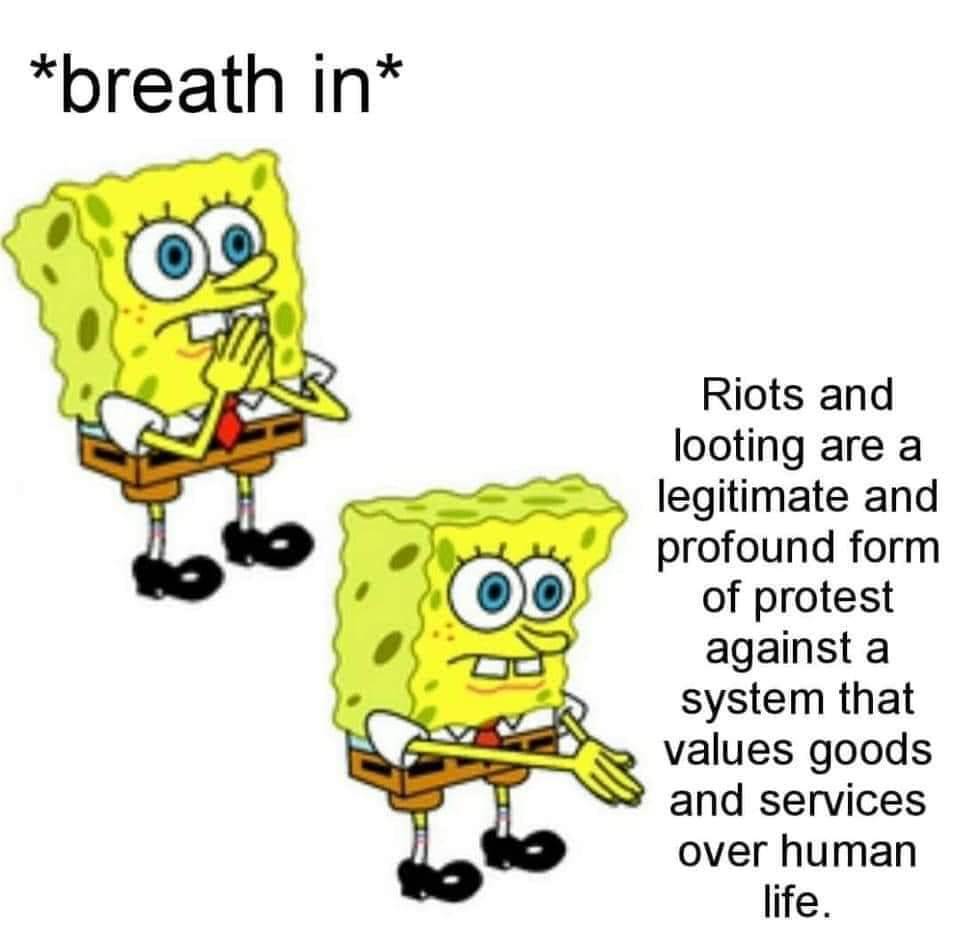
Listen to Sponge Bob…All of that said… peaceful protest is not all it’s cracked up to be. In the last few week, small bands of white people armed to the teeth stormed state capitals, governor’s mansions, and the like. Cops didn’t arrest anyone. Cops didn’t even show up in riot gear. Despite the clear threat the guns implied (along with more than one incident of the so-called protestors hanging in effigy one of their perceived opponents or another), far too many pundits and so-called news agencies called those peaceful protests. When the first protest march of George Floyd happened earlier this week, protestors (mostly black) showed up in street clothes and without weapons. Cops rolled out in full riot gear from the get-go. The violence was brought by the police, not the protestors.
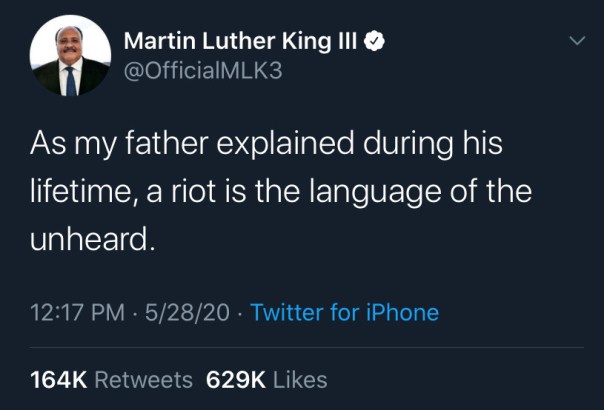
Some people will try to say that I’m simply arguing about who hit first, but it is much more profound than that. At the top of this post I have a picture and link to a tweet from Martin Luthor King III, alluding to a comment his father once made. Here’s Dr. King’s original:
“I think America must see that riots do not develop out of thin air. In the final analysis, the riot is the language of the unheard. What is it that America has failed to hear? In a sense, our nation’s summers of riots are caused by our winter’s delay. And as long as America postpones justice, we stand in the position of having these occurrences of riots and violence over and over again. Social justice and progress are the absolute guarantors of riot prevention.”
—Dr. Martin Luther King, Jr., “The Other America”
Society as a whole hit first. Police like to say that they are here to protect and serve the public, but overwhelming they oppress and control the most vulnerable and marginalized. Oh, they’ll protect the property of white well-to-do people and will serve the interests of the ruling class, but that inherently means keeping everyone else in their place. All of that is important context from the next couple of headlines:
I’m not black. I am a pasty-white blue-eyed guy, and my usual approach to topics regarding racial injustice is to listen to members of those communities and when I can, amplify their voices. But I think it’s also important that I try to find ways to use my white privilege to help them do more than be heard. And I all white people in our society have a certain amount of privilege, regardless of our economic status or other factors. Following up on the George Floyd story reminded me of a very specific example of how that privilege plays out:
Many years ago, when I was in my late twenties, I had stopped at a fast food place to get some food. I handed to guy behind the counter a $10 bill from my wallet. He peered at it, rubbed it with his fingers, and did a few other things. After a moment he handed it back to me and asked if I had another bill. I asked if he thought it was counterfeit. He explained that his employer was requiring them to reject bills if they were suspicious or it would be taken out of their pay. I looked at the bill and said that I didn’t remember where I got it. Then I pulled out my wallet, looked through my bills and pulled out one of the 20s.
While he was looking that bill over, I folded the 10 and stuck it in a different pocket of the wallet. After a minute the guy says, “This is fine,” and handed me my change and my food. Sometime later I took the 10 to my bank, explained what happened, and asked if they could tell me whether it was a counterfeit. The bank teller only took a few moments to examine it. Then she explained that there had been a lot of recent counterfeit 20s in the area, and she figured a lot of businesses had gotten a bit over zealous explaining how to look for them. She also said she that 10-dollar bills weren’t very cost effective to counterfeit. “Let’s just go ahead and deposit this one in your account.”
That was the end of it. The guy at the fast food place didn’t call the cops on me. He didn’t leap to the conclusion that I was intentionally trying to pass the bill.
We don’t know for cure at this point whether the bill Floyd tried to pay with that night was a counterfeit. Even if it was, we have no way to know whether he knew it was counterfeit. It could have been a bad 20 he got from someone else who also didn’t know it was fake, because they’re gotten it from someone else, who had gotten it from someone else, et cetera.
But in Floyd’s case, the moment a clerk saw what he thought was a counterfeit bill, he made the decision to call the cops. And the cops assumed that the bill was counterfeit, that Floyd knew it was counterfeit, and that Floyd was trying to commit a crime. Even if all those things were true, the penalty for passing a single (usually charged as fraud or forgery, depending) is never death.
I also point out that initial official reports on the incident said that Floyd had tried to pass a forged check, which is a different crime. That might just a minor mistatement if in Minnesota the usual practice is to charge a person who intentionally tries to pay with a counterfeit bill with forgery. It might, however, also have been an intentional decision by someone in the department to make it sound like a more serious crime.
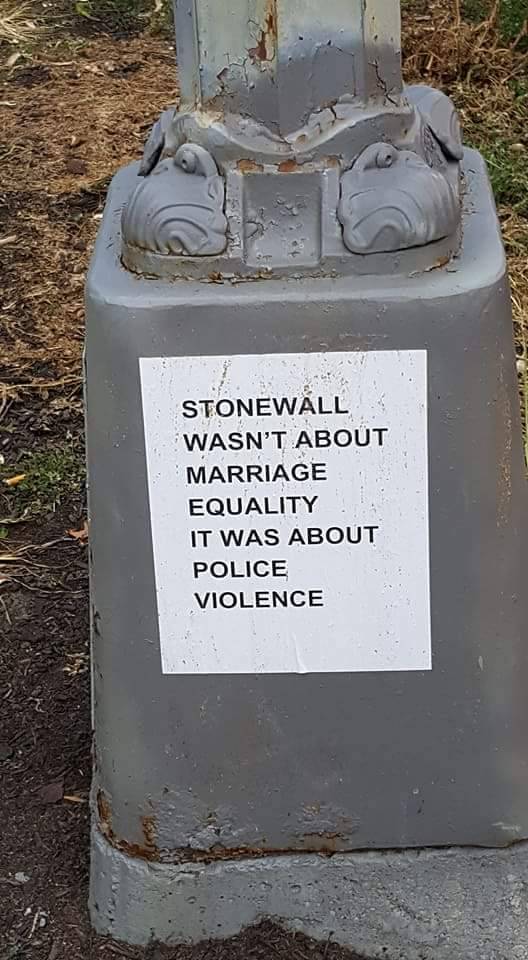
The Stonewall Riots, usually cited as the beginning of the modern gay rights movement, was a reaction to police brutality and harassment.Finally, I’d like to point out that the event which kicked off the modern gay rights movement as series of riots. It started as a violent resistance to yet another police raid (including beatings) on a gay bar. There are conflicting stories about who threw the first brick or shot glass at a cop (that’s right, we can’t even agree whether the first projectile was a brick!), but all of the contenders were either black or lantinx street queens/trans women. Whatever that first projectile was, it was not thrown at some random window (as a certain film showed) and it wasn’t thrown by a clean cut white guy from the midwest. It was thrown at the cops by a queer person of color. And for good reason. I’ve many times repeated the fact that the very first Gay Pride was a riot. In this country we have an LGBTQ+ pride parade in late June because it is the anniversary of those riots. Eventually the movement got around to things like job discrimination and marriage equality, but before we could even broach those topics, we had to get laws, policies, and attitudes changed so that cops were not free to harass us, beat us, arrest us, and sometimes kill us merely because we were queer.
That’s what protests like the ones underway now for George Floyd, Breonna Taylor, Ahmaud Arbery, and so many other recent victims of police brutality.
Now I want to pivot to another story that I don’t want to get lost: Rev. Lou Sheldon, Who Founded ‘Traditional Values Coalition’ in 1980 to Warn Americans of ‘Gay Threat,’ Dead at 85. Sheldon was an evil, lying man who repeatedly tried to make the law even more anti-gay that it was when he founded the so-called Traditional Values Coalition. The Coalition was designated a hated group long ago by the Southern Poverty Law Center for use of “known falsehoods — claims about LGBT people that have been thoroughly discredited by scientific authorities — and repeated, groundless name-calling.”
Sheldon was at the forefront of trying to have AIDS patients rounded up into concentration camps, among many other things. While most people will focus on the Traditional Values Coalition’s anti-LGBTQ+ agenda, it is important to note that the Coalition has long been opposed to immigration reform, and frequently repeats racist and anti-semitic dog whistles in their many, many press releases and calls to action.
Lou Sheldon is dead. Good.
Enough about him. Let’s close with a video.
Jimmy Kimmel on George Floyd, Riots in Minneapolis & Trump’s Violent Stupidity:
Click to embiggen)We have reached the final Friday in May.
Most of the week has been a mix of drizzly evening, cool days, some sun breaks, slowly warming as the week went on. Then Thursday the weather decided to pretend it was summer. So it was sunny, too warm, and the darn pollen count was through the roof… and I had one of four remaining impossible deadlines of the week to try to get out while suffering a major sinus headache and other symptoms of a bad hay fever day.
Meanwhile, welcome to the Friday Five. This week I bring you: the top five stories of the week, five stories about the pandemic, five stories about the criminal pretending to be president, and five videos (plus notable obituaries and some things I wrote).
Stories of the Week:
Activist, Author and Playwright Larry Kramer Has Died at 84. Yes, normally these stories go in the In Memoriam section (and there are more about Larry Kramer there), but Kramer’s role in leading the fight against medical inactivity, societal indifference, and active government hostility to people dying of AIDS during the first two decades of the pandemic is indescribable.
Rep. Brian Sims Delivers Epic, Expletive-Laden Rant Accusing GOP of Covering Up Lawmaker’s COVID-19 Diagnosis – Brian Sims slam Republican colleagues over keeping their COVID-19 exposure secret:
I had a fairly busy weekend, so no time to do a Weekend Update post. So here are some news links to stories that either broke after I made this week’s Friday Five, or are further developments on stories previously commented upon, or didn’t make the cut for the Friday Five but I wanted to make some comments…
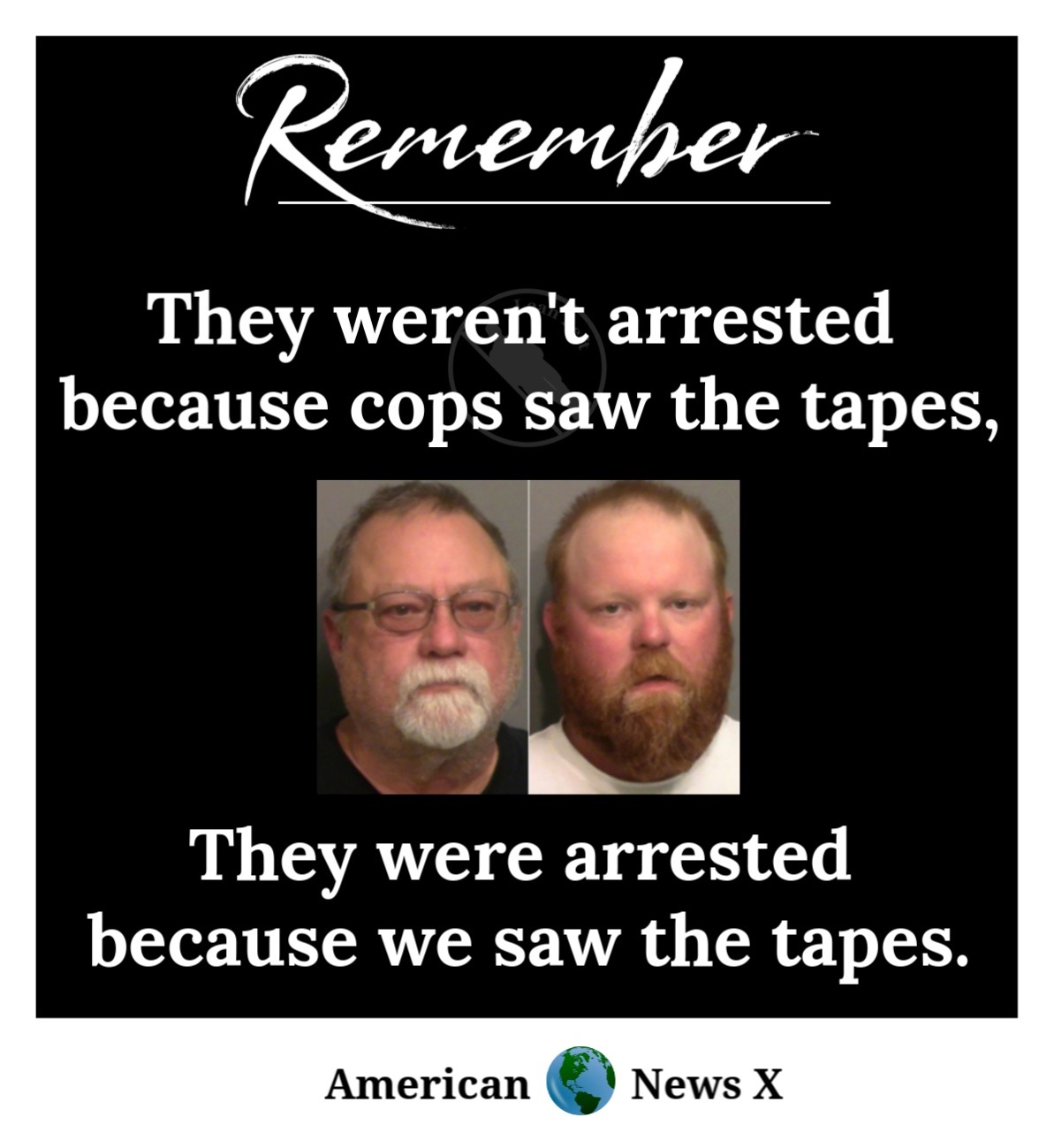
I’m not sure what else to say. That it took the leaked video of one the murderers’ co-conspirator being seen by the public to get a prosecutor to look at the case? Right. Anyone who thinks America is a post-racist society has their head stuck up something…
Threatening to kill people if they don’t do as you say—threatening to kill anyone you perceive has not doing as you say—is the very definition of terrorism. Y’all aren’t heroes. You’re not patriots. You’re certainly not Christian…
How many times do we have to say it: the restrictions aren’t what tanked the economy. It’s the fact that we’ve built the economy on a need for a lot of people to work themselves to the bone to keep things going, and that as soon as a significant fraction of the population cuts back on certain types of spending, everything collapses.
And saying, “People who are afraid of getting infected can just stay home. The rest of us want to be able to go to a restaurant or get our hair cut.” Just proves that you don’t think service industry workers are people. Because if there isn’t a shut down and there isn’t unemployment to cover them, then they have no choice but to risk their lives and the lives of their loved ones just so you can have your dang hot wings.
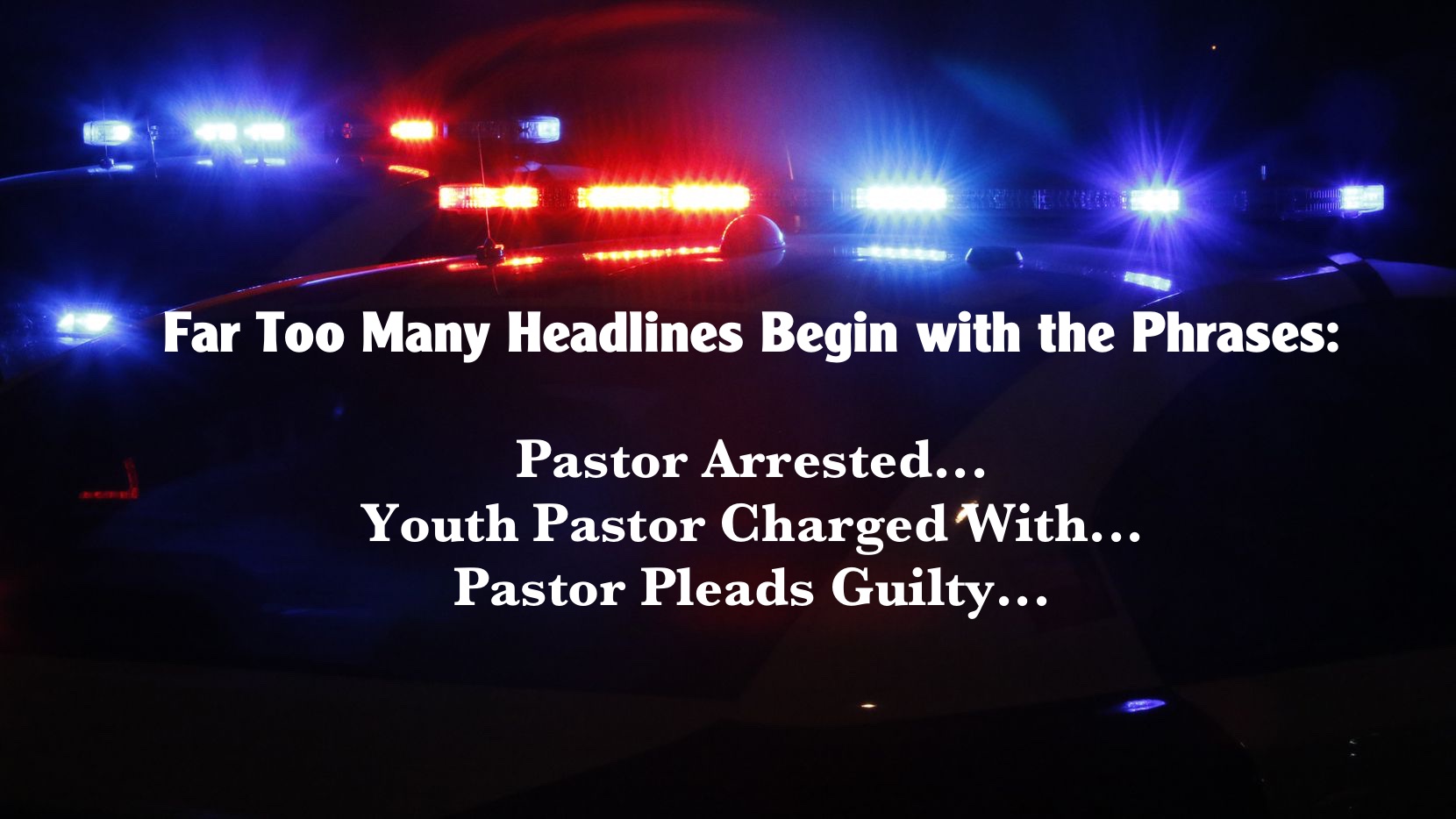
This is an old, old topic I’ve written about many times. Human institutions of all kinds have a terrible habit of protecting people in power and enabling abusing behavior. But there is something particularly insidious about how that manifests in churches. Particularly in how often the pastor or other leader who has abused other people is embraced and offered forgiveness almost before they ask for it, and how their victims are treated as if they are the offenders. And this next story illustrates that:
One Youth Pastor After Another Sexually Abused Kids at This California Church. It’s in the news because civil lawsuits have been filed. But the killer detail is how in 1983, when a 13-year-old boy explained how the youth pastor had sexually assaulted him, it wasn’t just that the church leadership decided not to punish the youth pastor, but they contacted the police and reported the boy for making a false accusation! And the first reaction of the police was to grill the boy about his own sexual desires…
Today isn’t the day to say ‘Thank you for your service.’Once again it’s Memorial Day, and once again I find myself having conflicting feelings. There is, of course, the part of me that gets irritated at how so many people treat every even slightly patriot holiday as another occurrence of Veteran’s Day. And that’s wrong for many reasons. If nothing else, if someone is a military veteran or still serving, this day can be extremely emotional day, because they may be thinking about people they knew who didn’t make it back
The other set of feelings I get revolve around the revisionist history everyone publishes about the history of Memorial Day. Memorial Day didn’t become an official holiday until the passage of the Uniform Monday Holiday Act of 1968. You’ll find scores of articles and web pages telling how the Memorial Day used to be called Decoration Day (true), which was first celebrated at Arlington National Cemetery in 1868 (false). Decoration Day was celebrated in several parts of the country, mostly in the South, long before the Civil War.
Leading up to Decoration Day, volunteers from the community would cut the grass in the cemetery and pull up weeds and generally do maintenance. In modern times, city and county governments take care of cemeteries that are not maintained by a company or a religious organization, so we don’t think about things like the grass and weeds around grave. Then come Sunday was the day to bring flowers to put on the graves, have family reunions, and celebrate the lives of all of our deceased family members. My Grandmother observed that version faithfully her whole life. ‘Decoration Day’: The South Honors Its Dead.
“…on that day, everybody who’s connected to each other and to the people underground convene and have in effect a religious service in the cemetery.”
—Alan Jabbour, the author of the book Decoration Day in the Mountains
As I said, Grandma celebrated the old version her whole life, and she was literally in the process of placing a silk flower arrangement on the grave of Great-aunt Maude (and pulling up some crab grass that was obscuring the marker) when she died. So you may understand while I have strong feelings about the missing history of Decoration Day.
Anyway, for Grandma (originally posted on Memorial Day 2014):
Memorial, part 2
Flowers for Grandma’s grave.Grandma always called it by the older name, Decoration Day. As I’ve written before, the original holiday was celebrated in many states as a day to gather at the grave sites of your parents, grandparents, et cetera, to honor the memory of their lives. It was often a time of picnics and family reunions. At least as much a celebration of their lives as a time of mourning. The connection to military deaths didn’t happen until 1868, and particularly in the south, was often seen as a pro-Union, pro-war, anti-southern celebration.
I didn’t understand most of those nuances when I was a kid. The modern version of the holiday, celebrated on the last Monday in May, didn’t even exist until I was a fifth-grader, when the Uniform Monday Holiday Act went into effect.
Grandma observed it faithfully. Every year, as May rolled around, she would begin calling distant relatives and old family friends. Grandma knew where just about every person descended from her own grandparents was buried, and she made certain that someone who lived nearby was putting flowers on the graves of those relatives by Memorial Day. She took care of all the family members buried within a couple hours drive of her home in southwest Washington.
She was putting flowers on the grave of my Great-aunt Maud (Grandma’s sister-in-law) on the Friday before Memorial Day, 2007 when she died. My step-grandfather said he was getting in position to take a picture of her beside the grave and the flowers (there are hundreds and hundreds of photos of Grandma beside graves with flowers on them in her photo albums) when she suddenly looked up, said, “I don’t feel good!” and pitched over.
One weekend she had blown out the candles on the cake celebrating her 84th birthday. The following Friday, while putting flowers on Great-aunt Maud’s grave, she died. And one week after that a bunch of us were standing at her graveside. It was just down to a few family members, and we were at that stage where you’re commenting on how pretty the flowers that so-and-so that no one had heard from in years were, when someone asked, “Isn’t grandpa’s grave nearby?”
Grandpa had died 23 years earlier, and was buried in one of a pair of plots he and Grandma had bought many years before. And after Grandma re-married, she and our step-grandfather had bought two more plots close by.
Anyway, as soon as someone asked that, my step-grandfather’s eyes bugged out, he went white as a sheet, and said, “Oh, no!” He was obviously very distressed as he hurried toward his car. Several of us followed, worried that he was having some sort of medical issue.
Nope. He and Grandma had been driving to various cemeteries all week long before her death, putting silk-bouquets that Grandma had made on each relative’s grave. Aunt Maud’s was meant to be the next-to-the-last stop on their journey. Grandpa’s silk flower bouquet was still in the trunk of the car. My step-grandfather was beside himself. He’d cried so much that week, you wouldn’t have thought he could cry any more, but there he was, apologizing to Grandma’s spirit for forgetting about the last batch of flowers, and not finishing her chore—for not getting flowers on Grandpa George’s grave by Memorial Day.
The next year, several of us had the realization that without Grandma around, none of us knew who to call to get flowers put on Great-grandma and Great-grandpa’s graves back in Colorado. None of us were sure in which Missouri town Great-great-aunt Pearl was buried, let alone who Grandma called every year to arrange for the flowers. Just as we weren’t certain whether Great-great-aunt Lou was buried in Kansas or was it Missouri? And so on, and so on. One of my cousins had to track down the incident report filed by the paramedics who responded to our step-grandfather’s 9-1-1 call just to find out which cemetery Great-aunt Maud was in.
Flowers from us, Mom, and my Aunt Silly on Grandpa’s grave.Mom and her sister have been putting flowers on Grandma’s and Grandpa’s graves since. Our step-grandfather passed away three years after Grandma, and he was buried beside her.
Some years before her death, Grandma had transferred the ownership of the plot next to Grandpa to Mom. So Mom’s going to be buried beside her dad. Mom mentions it whenever we visit the graves, and I don’t know if she realizes how much it chokes me up to think about it.
We had put the flowers in place. We had both taken pictures. Mom always worries that she won’t remember where Grandpa’s grave is (it’s seared in my head: two rows down from Grandma, four stones to the south). Michael helped Mom take a wide shot picture that has both Grandma’s and Grandpa’s spots in it.
I thought we were going to get away with both of us only getting a little teary-eyeed a few times, but as we were getting back into the car, Mom started crying. Which meant that I lost it.
Grandma’s been gone for more than 10 years, now. But every time we drive down to visit Mom, there is a moment on the drive when my mind is wandering, and I’ll wonder what Grandma will be doing when we get there. And then I remember I won’t be seeing her. It took me about a dozen years to stop having those lapses about Grandpa. I suspect it will be longer for Grandma. After all, she’s the one who taught me the importance of Those Who Matter
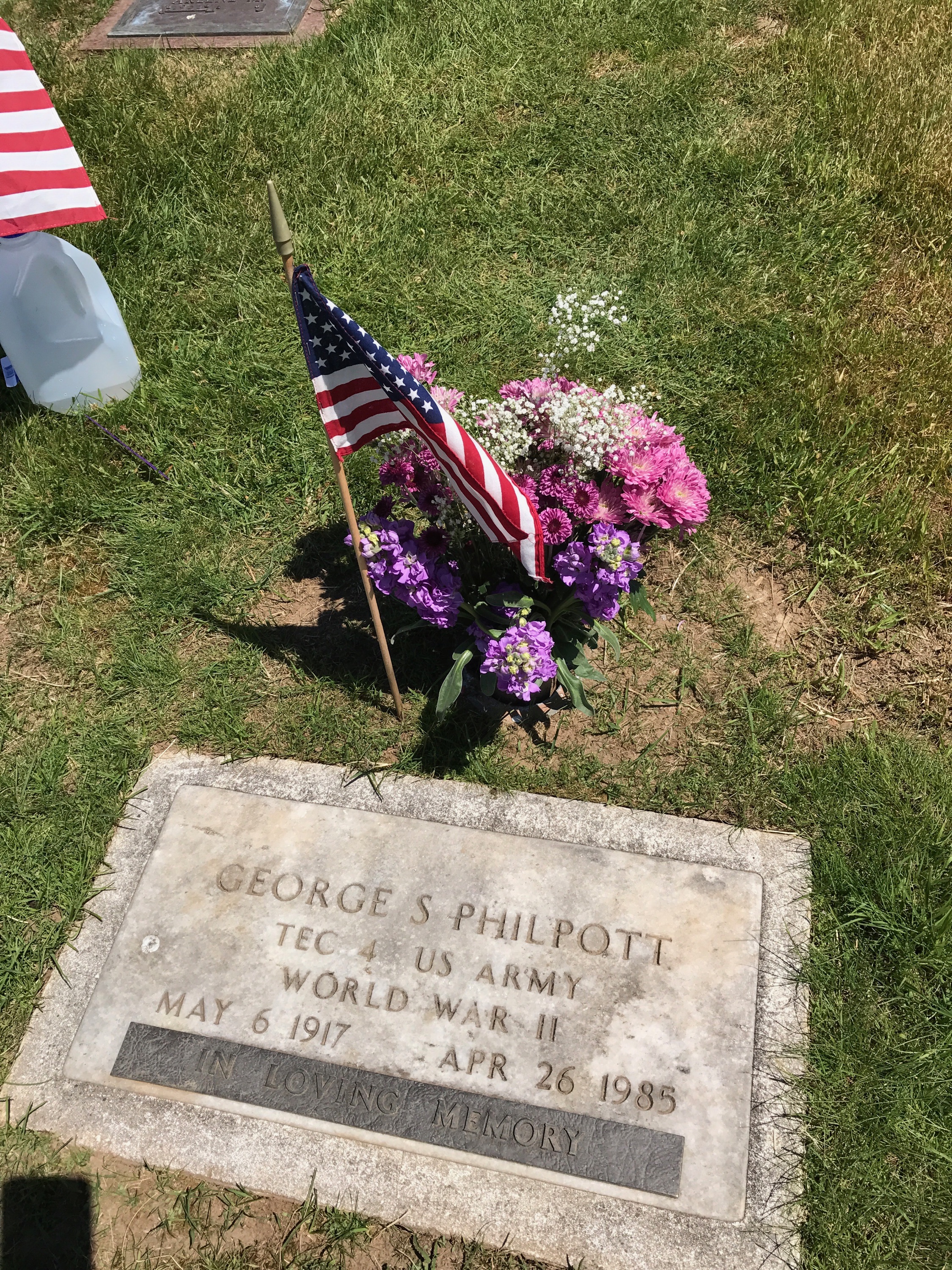
Flowers from Mom and I on Grandpa’s grave this year.And if you are one of those people offended if I don’t mention people who served our country in the armed forces on this day, please note that we also put flowers on my Grandpa’s grave. Grandpa served in WWII in Italy. He didn’t drive a tank, he drove the vehicle that towed tanks that couldn’t be repaired in the field, and one of the two medals he was awarded in the war was for doing a repair of a tank while under fire. After the war, he came back to the U.S., met Grandma (who was at that point working as a nurse and trying to support her two daughters), and eventually married Grandma and adopted my mom and my aunt. Many years later, he was the person who taught me how to rebuild a carburetor (among other things). He was a hero many times over. And this post is also dedicated to his memory.
(Click to embiggen)It’s Friday! Nearly the end of May. In the U.S., we’re on the brink of Memorial Day weekend… which snuck up on me because time feels like a fog.
It’s been drizzly and cool this week. Most of my flowers are wildly blooming, and there have been lots of bees flitting from flower to flower. I just wish work wasn’t so freakishly busy that I could take a few more breaks during the day to enjoy it. On the other hand, I’m really glad I still have a job. So…
Meanwhile, welcome to the Friday Five. This week I bring you: the top five stories of the week, five stories of interest to queers and our allies, five stories about the pandemic, five stories about deplorable people, and five videos (plus notable obituaries and some things I wrote).




 Font Folly