Click to embiggenIt’s Friday! It is the first Friday in April. It’s already April. APRIL! How did that happen?
Pollen counts have been high all week, and so my hay fever has been bad all week. We got a little drizzle Thursday evening, and supposed to get more Friday morning, so I hope that will clear out the air a bit and maybe bring some relief to my sinuses.
Anyway, welcome to the Friday Five. This week I bring you: the top five (IMHO) stories of the week and five videos (plus notable obituaries and things I wrote).
Freedom to read! (click to embiggen)”I saw this great, short post on Tumblr some time back that I thought I would expand into a series of posts about writing. I thought that I recorded the name of the Tumblr blog that I lifted it from, but when I went into my note a while later, it wasn’t there. I didn’t really want to steal it without attributing it, and for some reason it hadn’t Googled the quote until today.
People should probably learn the difference between “plot holes” and “things I didn’t like” or “things the franchise plans to explain in the future” or “things film makers didn’t think they needed to explicitly explain because they thought you had critical thinking skills”
—Gina at ahandsomestark.tumblr.com
I was reminded of this quote while reading some gripes about the recent Captain Marvel movie—complaints that echo criticisms of other films, books, and shows that all happen to have one thing in common: the protagonist isn’t a cishet white male.
To stick to Captain Marvel for a minute, the particular complaint is that it is supposedly a bad movie because Carol’s final battle with the bad guy doesn’t involve her defeating said bad guy without using her superpowers. Now read that again: guys who claim to be superhero fans are angry that the superhero used her superpowers to defeat the bad guy. Not only that, they claim this failure of the superhero to not use her super powers is bad plotting.
Of course, they didn’t phrase it that way. And when someone called them on it, asking them why they expect a superhero in a superhero movie to not use super powers, they twisted themselves in a knot trying to say that wasn’t what they were saying.
And you know what, they are sort of correct on that. I mean, it is exactly what they’re saying, but it isn’t what they mean. What they mean is that the moral victory that Carol achieves at the end of the film isn’t the moral victory they think she should achieve. They can’t even see what the victory is, because they are so deeply immersed in societal expectations of gender roles that they can’t perceive it.
Several times in the movie the audience is shown, as she gets fragments of her memories back, Carol climbing back to her feet after getting knocked down. That is a fairly standard part of any hero’s story, right? No matter how many times you get knocked down, you stand back up and keep fighting. The part these guys don’t understand is it isn’t just about being physically knocked down—it’s also about the guys yelling at her to stay down, telling her that she doesn’t belong there, telling her she isn’t good enough, telling her that the only worth she has is what they have given her.
Overcoming that constant message is the point.
Members of marginalized groups understand that. We’ve spent our whole lives being told that who and what we are isn’t good enough. We’ve been told that our worth comes from what they have given us. We’ve been told that only if we become like them will we amount to anything in the world. We are told to be quiet, do as we’re told, act more like them, et cetera, et cetera, et cetera.
The whole point of Carol’s arc is that she has been lied to, manipulated, and put in a position where her power is limited by the liars. She was always good enough. She was always strong enough. But she believed the liars. And her triumphant moment at the climatic battle is first the moment when she throws off the shackles and embraces the power that was always there.
An even more important moment is when the man who has been lying to her day in and day out for years, who falsely told her that the only reason she had anything was because he gave her his blood, who kept telling her she was too emotional, and that she would never be good enough if she couldn’t come down to his level and win under his rules (rules that are very specifically designed to ensure her loss). Her triumph was when she realized that her worth had nothing to do with his approval.
When she refuses to stoop to his level and blasts him in the face, that was an incredibly big deal. Because the enemy she was always facing was the abusive, manipulative, toxic system that he represented.
I understood how important that moment was because for me it reasonated with the moment in my teens when I finally realized that every time my dad had been telling me that I was broken, worthless, not man enough, et cetera, had been a lie. The moment I stood up to him, and then walked away from him was an important victory.
Millions of women who watch Captain Marvel recognize that moment because they all have had a time where they realized they don’t have to please and prove their worth to the awful, lying people and the system that has been holding them down. Their value does not derive from pleasing a man or serving the needs of men—their worth comes from within.
Her character arc is not going from powerless to powerful—her arc is about going from oppressed to free. Just because it wasn’t the arc you were expecting, that doesn’t mean it isn’t a character arc, nor a worthwhile one.
Finally, if you really think that somehow you were robbed because at the end she didn’t engage in a meaningless fist fight with the lying dude at the end, tell me why everyone in the theatre back in Raiders of the Lost Ark burst into shouts and applause when Indy was confronted by the unknown sword-wielding man and he merely pulled out his gun and shot him.
Life is short… (click to embiggen)So, I started Camp NaNoWriMo yesterday. I and a few friends have a cabin (which is basically a private chat group for up to 12 people who have set up projects). Camp NaNoWriMo is similar to the full fledged National Novel Writing Month, but it’s meant to be a bit more low-key and flexible. You get to set your own word count goal, for one. Lots of people use Camp NaNo to edit or revise a large project (such as whatever they wrote during a previous NaNoWriMo). It’s fun. I like having the private chat and having a structure for posting progress, getting and giving encouragement to friends, and so on.
Our cabin isn’t full, so if something like this appeals to you, set up a project and send me a message with your user name so I can send you an invitation to our cabin.
My particular project is an editing one, and I’m counting words as I go through scenes in the larger project. When I finish the edits on a scene, I copy it into a seperate Scrivener document to keep track of my word count. I was a little suprised at how much I got done on the first day, since it was a day at work where I don’t really get a chance to take a full lunch to spend writing, and I was feeling more than a bit out of it when I got home from work.
In other news, the 2019 Hugo and Campbell Awards Finalists have been announced. I was quite pleased to see that in every category at least one thing I nominated made it to the final ballot. The flip side of that is that there are also a lot of things with which I’m not familiar that made it onto the ballot, so I get to read a lot of new stuff soon!
I was really happy to see that Archive of Our Own—a massive fan fiction repository—is nominated in the Related Works category. It’s a little weird, because there are thousands of contributors (including me, though I have such a teeny tiny bit of stuff posted I don’t really count). Clearly if it wins, thy won’t be handing one of the big rocket trophies to every contributor. There are a couple of things in that category that I haven’t read, so I don’t yet know if AO3 is going to be my first choice for Related Work, yet.
As I said, I’m once again looking forward to reading stuff that has been nominated for the Hugos. As happy as I am to see things I nominated make the list, I also love seeing new things that I haven’t read, yet. Because, as I mentioned as part of another point last week, no one’s favorites list can encompass all of science fiction/fantasy. And that isn’t just because a whole lot of it is being published today (although with self-publishing being so much easier, and the internet making things more discoverable, there is an incredibly wide variety to choose from).
But a lot of people operate under the illusion that in times past a single fan could, indeed, read everything in the genre that had been published that year. It only seems that way if you assume that only the authors and stories you have heard of years later are who and what were being published at that time. A great example of this misapprehension is one of the flaws in a recent blog post by whacko Brian Niemeier (that I won’t link to directly, but since Camestros Felapton does a nice analysis of some of the flaws, I’ll link to his post: Did fandom cause the collapse of civilisation or vice versa? Let’s Assume Neither 🙂).
Niemeier makes the claim that “back in the day” everyone read Edgar Rice Burroughs and everyone listened to The Shadow radio show. Now, it’s true that Burroughs’ Tarzan books sold so well that he was able to form a film company and produce his own adaptations of his books, something that would be unthinkable for an author to do today. But it’s simply not true that everyone read the Tarzan books, if for no other reason that regular readers of novels and the like have always been a minority of the population. James Branch Cabell, a contemporary of Burroughs, sold more copies of his books during the nineteen-teens and -twenties than Burroughs did, yet he is largely forgotten today. There were scores of magazines publishing sci fi, fantasy, horror, and related fantastical fiction, publishing thousands of stories during that time most of which written by hundreds of authors many of whom we’ve never heard of.
While there is a huge amount of fantastic fiction to love now, there was a huge amount then, too. And I think that’s great! Because not everyone likes the same things, and the more variety there is, the more likely that there is something wonderful to discover and read for the first time, right? Similarly, the fact that many people like many things, mean that something you or I create is likely to find a receptive audience.
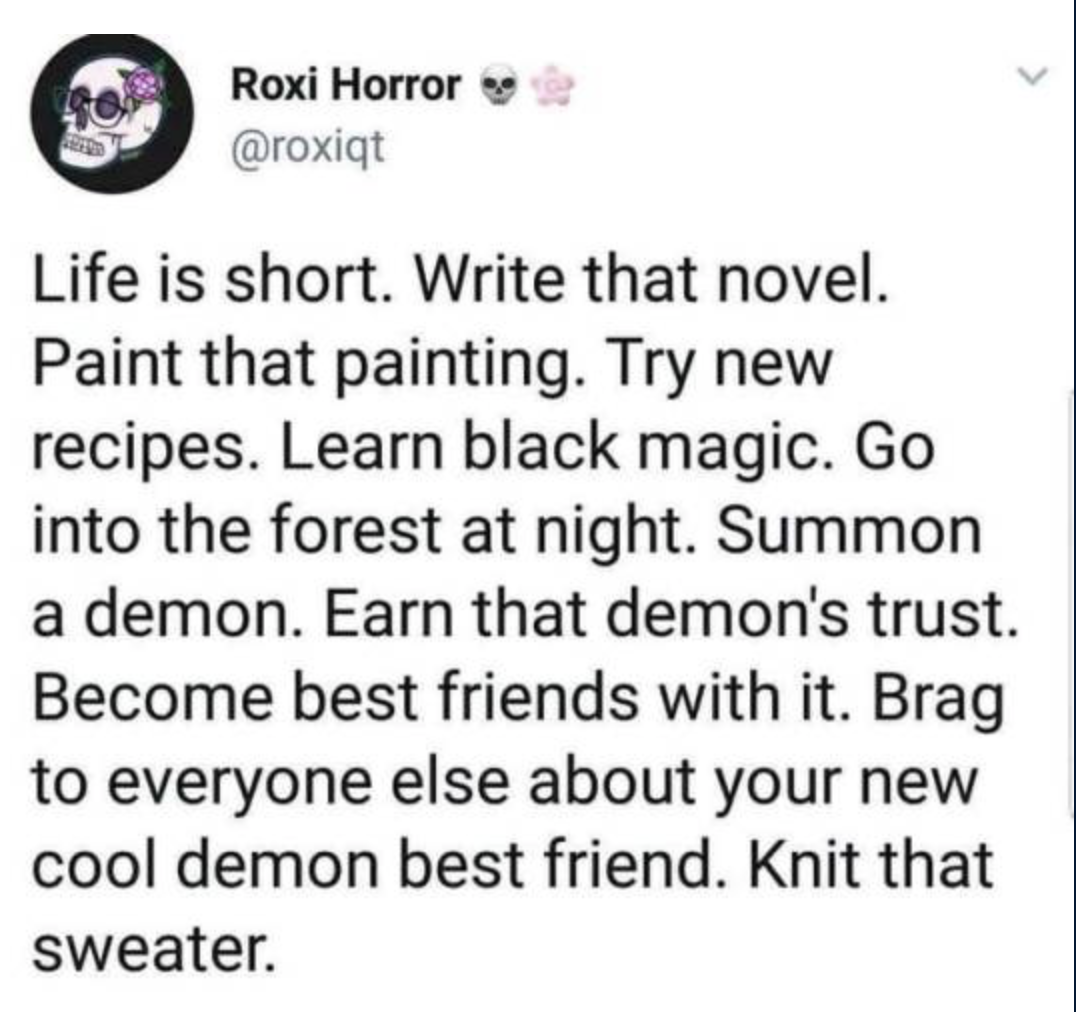
I am quite certain that if someone wrote a story about a conjurer who becomes best pals with a demon and they take up knitting together, someone out there will want to read it.
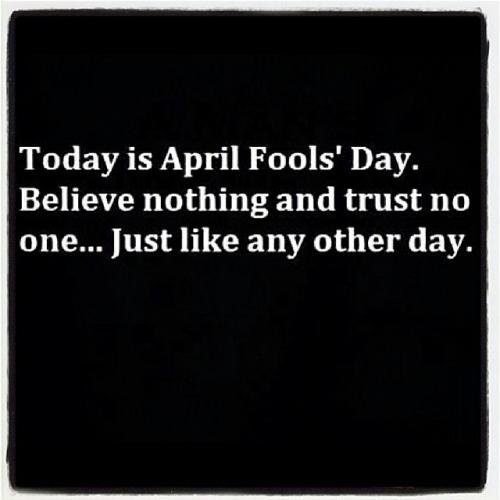
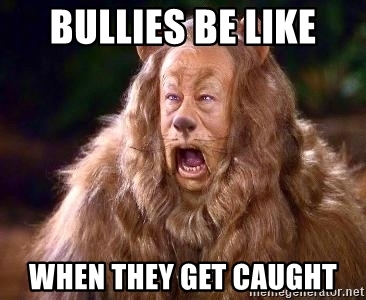
There were two stories that I watched unfolding on Twitter. It’s not often that a conversation crosses my social media and then turns up as headlines the next couple of days. I thought about just saving the links for next Friday Five, but as I was reading one of the articles about one story, I realized that the two sets of events illustrate an aspect of bullying and hate that I’ve written about more than a few times. I also decided that I wanted to publish this before April 1st, so no one will think any of this is a joke.
I’m going to start with the most disturbing one: San Francisco Police Search For Sword-Wielding Man in MAGA Hat Who Cut Victim. Now this is a reported hate crime, and mindful that people will try to claim this is fake, I want to point out that there were multiple witnesses to the guy being in the stupid red hat, yelling homophobic slurs at the people going into the roller rink, and at least once he followed a group up to the door while yelling, but stopped without going inside.
One of the first stories posted on a San Francisco news site tried to make the guy who attacked someone with a sword out to be the victim, because at least one witness said that the guy who got stabbed first knocked the red hat off. Other witnesses were unclear as to what how the guy’s hat came off his head. At least one person described what happened before the sword came out as a scuffle. I’m not as familiar with California law as Washington state, so I don’t know if knocking the hat off (if that’s what happened) counts as assault. And if police find the asshole I’m sure he’s going to claim the other guy attacked him first.
But I’m confident the hat wearing guy was an asshole, because of the multiple witnesses to his hanging outside a skating rink that was hosting a gay-friendly event shouting homophobic slurs. And he brought a damn sword with him. That seems pre-meditated. He meant, at the least, to be a threatening presence. I hope they find him and throw the book at him.
The second story is a little different. I think most of the headlines have the story slightly wrong, but let’s start with the ending: Conservative commentator fired for attacking gay journalist online. So Denise McAllister, who has written for The Federalist and the Daily Wire and a few other of the conservative hate sites that pretend to be news has not had a great week. A few days ago she posted a link to an article from “ILoveMyFreedom.Org” that was critical of Meghan McCain (daughter of the late Senator John McCain and current member of the cast of The View). McAllister’s accompanying derogatory comments generated a lot of backlash, but things really took off when McCain replied with the statement, “You were at my wedding, Denise.”
The phrase quickly became a meme, as hundred of people started attaching it to various unrelated pictures. McCain apparently thought that all of these memes were people taking her side, apparently not quite getting the jokes of the meme.
Anyway, on Friday night McAllister overshared on twitter, saying that she had tried to talk to her husband while he was watching a basketball game, and he replied “Woman you know better than this, the game is on” and she agreed that he was right, she was wrong. And then the oversharing part was how at the commercial she brought him a beer to apologize and she described the kiss and, well, the whole thing was very Stepford Wives. And all in a single tweet.
This is, by the way, a good example of why I wish tweets were still only 140, because you wouldn’t quite be able to encapsulate thousands of years of toxic masculinity/misogyny and the willingness of some women to defend their own abuse in a single message.
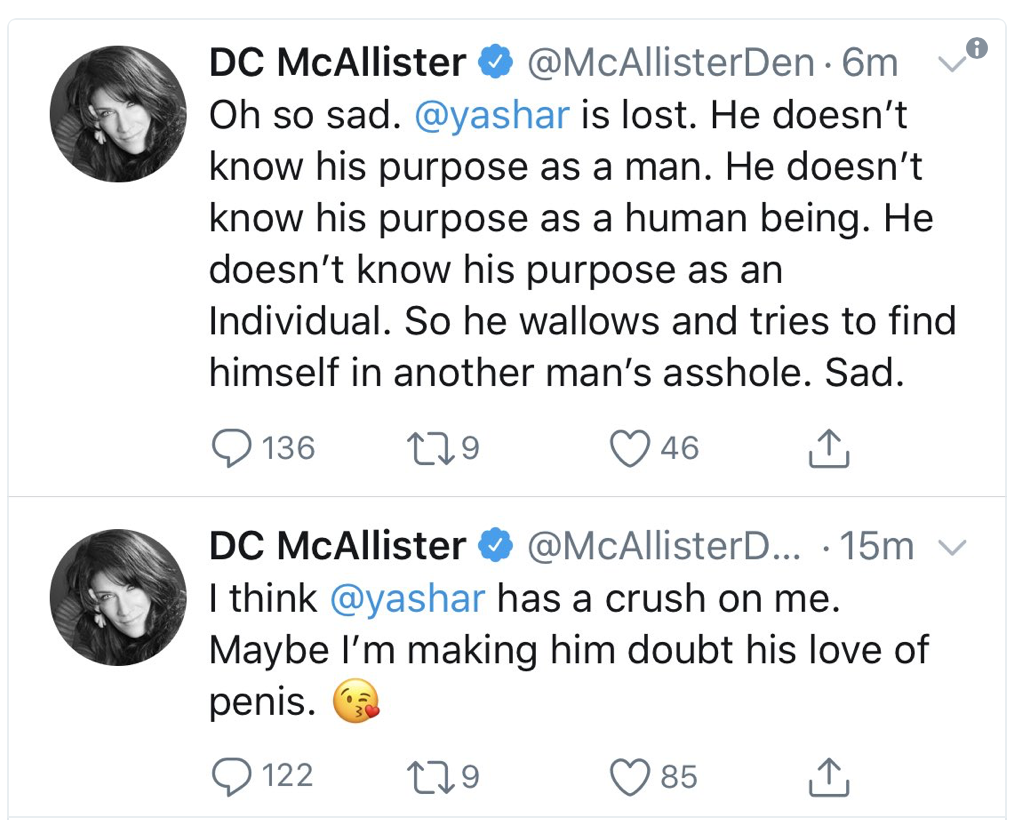
Anyway, an out gay journalist named Yashar Ali quoted McAllister’s tweet with the comment, “Oh, Denise.” And this sent McAllister into a raging tweetstorm.
Those two words, “Oh, Denise” were, in her opinion, a vicious attack—not just on McAllister, but on masculinity and men’s freedom and I don’t know what all. There was a lot. The tamest comment she made was an assertion that gay men have no right to comment on heterosexual relationships, before she got to the kicker:
“Oh so sad. @yasher is lost. He doesn’t know his purpose as a man. He doesn’t know his purpose as a human being. He doesn’t know his purpose as an individual. So he wallows and tried to find himself in another man’s asshole. Sad.” and “I think @yashar has a crush on me. Maybe I’m making him doubt his love of penis.”The only thing that Ali had said after “Oh, Denise” was to observe, “I guess Denise is not happy that I’m worried about how her husband treats her.” Now, I realize that other people were commenting on her first tweet, pointing out that maybe she shouldn’t be so happy about how her husband was treating. But Yashar’s two comments were pretty mild. Once McAllister had gone to both an anal sex and penis reference, a bunch of other people—including other journalists and conservatives—took a screenshot of the two tweets and started contacting the official twitter accounts of the websites/magazines that she listed in her twitter bio as being places where she writes. And yes, two of those sites later issued statements that she no longer works for them, and specifically referenced the homophobic nature of the tweets in the screenshot.
She has deleted most of the rest of her tweetstorm—where she characterized people’s reactions as trying to burn her at the stake, and other crazy things. But by then the damage was done.
There is so much to unpack in all of this. Ali’s initial response was not an attack, it was pity. Pity for a person who is not only perpetuates the disrespect she gets from her husband, but actually rewards it and feels the need to go brag about it to the world. When you broadcast stuff like that, it is perfectly legitimate for other people to comment. The response that a gay man can’t comment on heterosexual relationships is pretty rich, given how many times McAllister has written about homosexual relationships. If a heterosexual homophobe can write homophobic editorials critiquing queer people and how they live their lives, then all us queers can state opinions about things the homophobe brags about in their own relationship.
While we’re on the topic of homophobic editorials: the publications that have fired McAllister have published dozens, nay, hundreds of articles, opinion pieces, and so forth that were just as homophobic as those two tweets that they now claim are unacceptable. If being homophobic and stating so publicly disqualifies someone for working at The Federalist, then they all need to fire each other right now. McAllister’s tweets were slightly (and only slightly) more crudely stated than the usual lying hatred toward gays that The Federalist and The Daily Wire publish all the time. Several other conservative pundits and journalists had weighed in on the sheer disproportionality of McAllister’s response to “Oh, Denise,” but given the sorts of things they have all written about queer people, what they are really upset about his how blunt she was.
I don’t believe that those tweets are the reason she was fired. That fact that Meaghan McCain’s husband is the founder and editor of The Federalist almost certainly has more to do with her firing than a couple of homophobic tweets. The weird dust-up with McCain had almost certainly already put her on the shitlist at several places.
And one is tempted to say, “Oh, Denise” in a rather pitying voice. But she doesn’t deserve our pity any more than the MAGA-hat wearing guy who attacked someone with a sword. Because they are both doing the same thing. You don’t go to a gay-friendly public event, wearing one of those stupid red hats, and yelling slurs at people unless you want attention. You want people to know you hate the gays. Similarly, you don’t post stories about how your husband yelled at you and sent you to fetch him a beer to earn forgiveness for the offense of talking to him while he’s watching a basketball game unless you want people to know that you hate the libtards who expect men to treat women with respect.
And you comment on a gay man’s sex life in crude terms because you want everyone to know that you hate the gays.
But make no mistake, the conservative pundits and sites that publish things about “the militant homosexual agenda,” and defending so-called gay conversion therapy, and insist that equal rights for queer people is an assault on religion, and repeat lies about the health of queer people also hate the gays. They run those headlines because they want everyone to know that they hate the gays. The only difference between them and people like McAllister of the sword-wielding guy is that the misdirect with code words. Instead of coming at us with a sword, they take away our right to healthcare and employment. Instead of blatant references to anal sex, they talk about health. But it’s still attacking us. They just try to hide their rage and hate with polite words and a smirk.
Ali’s final comment was, in stark contrast to McAllister’s raging, both eloquent and refined: “I was bullied for being Iranian as a kid. But I never felt ashamed of my ethnicity. I came out on 8/17/2001 & while it hasn’t always been easy, I have always been proud of who I am. I’m Iranian, gay, and Catholic. Perhaps an odd combo, but I wouldn’t change who I am for the world.”
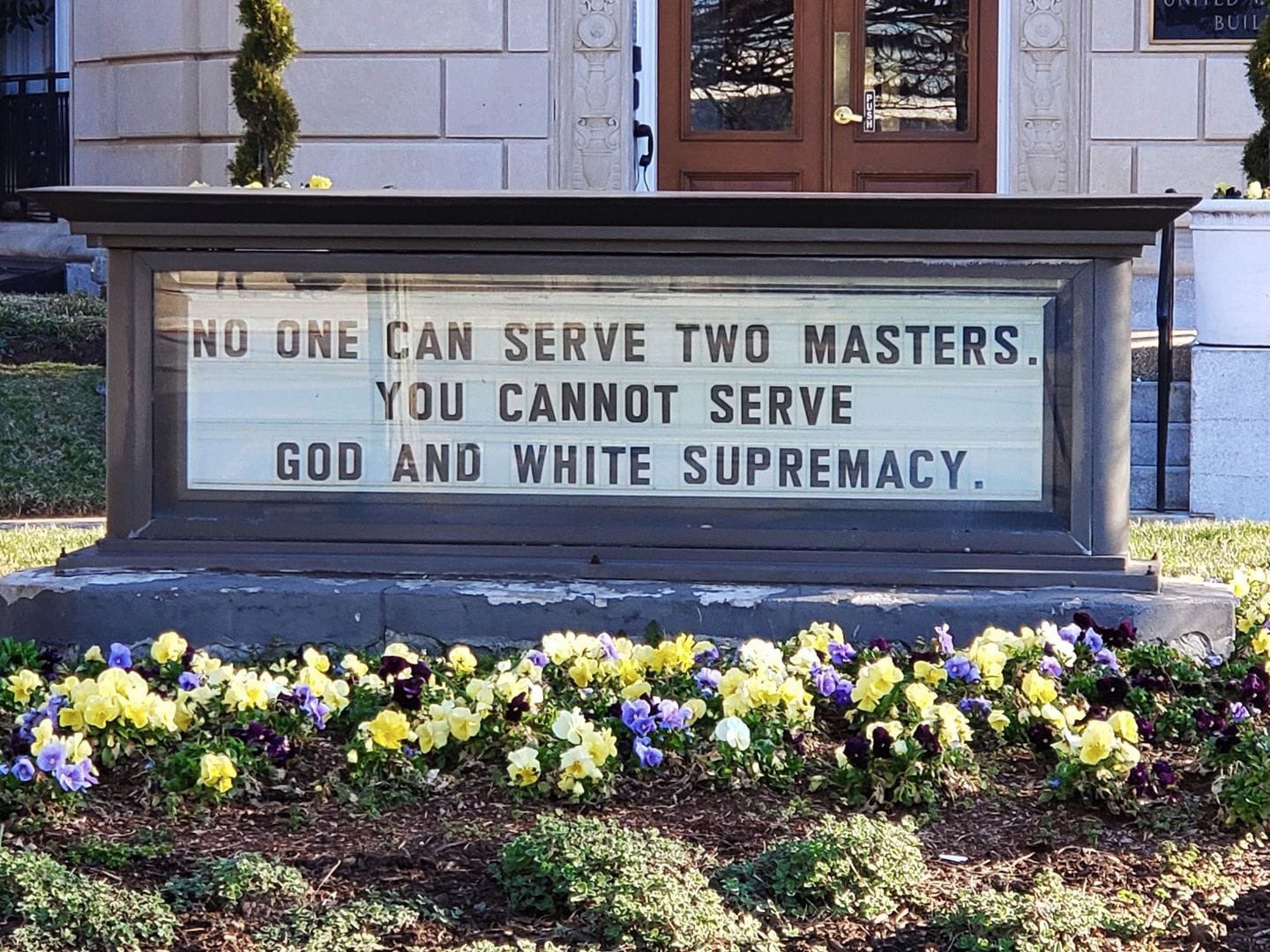
The sign in front of the United Methodist Board of Church and Society building adjacent to the U.S. Capitol in Washington, D.C (click to embiggen)It’s Friday! We’re already up to the fifth Friday in March!
Most of the week has been so normal that it is a bit unsettling. The weather has settled down a bit after a week or so of much warmer than normal temperatures. On the other hand, we are well on our way for it to be one of the driest Marches on record. I wish we would stop breaking all these weather records, but with the climate going the way it is, I think we all know that isn’t going to happen.
Anyway, welcome to the Friday Five. This week I bring you: the top five (IMHO) stories of the week, five stories about technology, five stories about science, five stories about awful people, and five videos (plus things I wrote).
The tired cliche that there are certain “classics” of sf/f that one must have read in order to be a real fan has reared its ugly head. The current iteration is an assertion that writers of sf/f (aspiring or otherwise) who have not read the classics are not able to write good sf/f. And specifically the “classics” one is supposedly required to read and love in order to be a good writer of science fiction and fantasy are the usual suspects: Heinlein, Asimov, Clark, and so on.
Poppycock!
Now, it is true that I read Heinlein, Asimov, and Clark. I have written on this blog about how some of their work helped me in my formative years. I have also written on this blog about problematic aspects of both their writing and some of their personal life choices. I’ve also written before about how some of their writing hasn’t aged very well. Heck, when I was in my teens in the 1970s reading some of their older work, I was finding myself rolling my eyes over things that seemed either embarrassingly wrong or more than a little sexist and/or racist.
Unfortunately a lot of books from the middle of the last century that were important to the development of the genre, and/or were beloved by many fans over a span many years, don’t hold up so well years later.
But that’s not my only problem with this notion. Because people have been bandying around those specific names as “must-reads” for decades. A lot of excellent science fiction was written back then by other people. And a whole lot of good science fiction has been written since the heyday of Heinlein, Asimov, and Clark. A lot has changed in the genre. Sure, Asimov’s short story “The Last Question” was profound and mind-boggling when it was published in 1954 (63 years ago), but when I read it for the first time in 1973, even 13-year-old me saw the ending before it arrived. It was bit disappointing, to be honest. Because the story had been so influential that the once mind-boggling idea had been incorporated, expanded, deconstructed, and re-imagined several times in that 19-year span.
And it’s continued to be re-used in sci fi since. Heck, the entire story was boiled down to a two-sentence (and hilarious) joke in a 1992 episode of BBC’s Red Dwarf!
Which is not me saying that something which has been done before can never be repeated. Looking at old ideas in new ways is an essential part of sf/f. It’s just that the value of revisiting the same “classics” over and over is questionable, at best.
I would feel a little less like this was white guys insisting that everyone has to read their favorite old white guys if some of this “must read” lists included Mary Shelley’s Frankenstein published in 1816, as well as anything by Octavia Butler, Joanna Russ, Ursula LeGuin, or Andre Norton.
The usual argument is that Heinlein, Asimov, and Clark created the genre—and you can’t understand what it is now without reading them. Except, they didn’t create it. If you want to understand the origins you need to go back at least another hundred years to Shelley’s Frankenstein, for one, and stories from Nathaniel Hawthorne (“Dr. Heidegger’s Experiment”, “Rappaccini’s Daughter” for instance) in the 1830s.
Sure, I think a writer needs to have read a lot and broadly to feed their craft. But when I say broadly, I mean really broadly. Read things outside your favorites, absolutely! Not everything you read needs to be a masterpiece, by anyone’s definition. You can learn from bad examples as well as good. Playfulness is an important part of the creative process, so reading light entertaining tales is just as important to feeding your artistic soul as reading deep, meaningful, serious stories.
Science fiction is supposed to be about not just looking at the horizon, but going past it. Not just using your mind, but expanding it.
And you know what doesn’t stretch anyone’s horizon or expand anyone’s mind? Everyone reading the exact same thing.
If the only input anyone has are the same list of books from the same authors, decade after decade, then every creator will just be regurgitating the same stuff that every other creator has.
There is value in studying what has been done before in your chosen field of writing, but it isn’t the only way to learn to create good stories in the genre. Just as one can learn to drive a modern car without first mastering the horse and buggy, you can learn to write without memorizing a specific set of books from a very narrow set of writers who were working 60+ years ago. If you want to study earlier generations of writers, remember that there is a vast volume of science fiction and fantasy works beyond anyone’s chosen list of classics or favorites. Find lists that don’t include the same few “must reads” and sample the less often recommended works, if you’re going to do that.
Similarly, there can be value for some readers in understanding the roots of some of the things being created today, but it isn’t necessary. You don’t have to go back in time to watch traveling vaudeville shows in order to understand and fully appreciate modern movies, right? You can understand and fully appreciate modern stories without reading the old stuff, first.
Look out at that horizon, and take aim for what’s beyond!
I love Earl Grey Tea. Lots of people who really love tea emphatically do not like Earl Grey–and that’s perfectly fine. We all have different tastes. There are foods other people love that make me want to gag, and I am happy to let them enjoy those foods. Which is to say, this post is not meant to convince other people to like the same tea I do, nor to disparage anyone who doesn’t.
I know that I do not have sophisticated taste in tea. I grew up in rural communities where Lipton Flo-Thru® teabags were considered fancy. Most of the grocery stores seemed to carry black tea blends from Tetley, Red Rose, and Lipton. Occasionally they had Twinings teas, and they were more expensive than the others, so I had heard of and seen Earl Grey tea long before I ever tasted it.
Once I had tasted it, it became my favorite tea for many, many years.
There are various stories about how Earl Grey tea came about. The one that seems least far-fetched is that oil of bergamot was added to black tea in order to counteract the high level of lime that came out of the well at Howick Hall in Northumberland, where C Charles Grey, 2nd Earl Grey, and his wife entertained guests. In 1830 Robert Jackson & Company claimed to be the first to sell the tea after obtaining the recipe from Lord Grey, though written references to “Grey’s Tea” only date back to the 1850s. And the oldest advertisements using the name “Earl Grey’s Mixture” date from some years later, in the 1880s, and from a different tea company entirely, Charlton & Co (which was founded by a former partner of Robert Jackson).
Jackson’s company was later bought by R. Twinings and Company, Limited, and for decades Twinings maintained they were the only company following the original recipe. Until 2011, when they reformulated it (to much protest).
The bergamot orange comes from a citrus tree that is grown commercially in Italy. Like all commercial citrus fruits, it is a hybrid of wild varieties that are now propagated by grafting–in other words, every bergamot tree in the world is a clone of one particular plant.
As I said, I’m something of a bergamot addict, by which I mean that I like many different blends of Earl Grey. The Numi Tea Company, for instance, sells an Aged Earl Grey, which they make by layering bergamot and the tea leaves to age for several weeks. The aged tea has a subtler almost smoky citrus taste to my tongue than the typical Earl Grey. Stash, on the other hand, sells a Double Bergamot Earl Grey, which despite the name all they say is that it has more bergamot oil than their regular Earl Grey. In any case, the citrus taste of this blend is more prominent.
Then there are lavender Earl Greys teas. My favorite, when I can find it, is Revolution’s Earl Grey Lavender. The lavender taste compliments and mellows the citrus, to my tongue. Stash also has a lavender Earl Grey, though the name they market it under is Breakfast in Paris. For some reason they only mention the lavender in small print on the boxes. Stash’s is good, though not quite as brisk to my tongue as Revolution’s version. Revolution’s tea is a blend of black, oolong, and darjeeling teas, which may also effect the flavor. Stash also includes vanilla extract. Who knows.
Stash also makes and Earl Grey Black & Green tea, which is a blend of green tea and black tea with bergamot oil. I happen to like this tea better than the regular Stash Earl Grey, though not as much as the Double Bergamot.
All of these come in tea bags, and as one former co-worker liked to say, American and European tea bags contain the stuff swept up from the floor of the tea aging house. Loose teas are what true tea connoisseurs swear by. And when I make tea from loose leaves the taste does seem stronger than from bags.
Of course, to make it from loose leaves you need to have an infuser. I have a few that are intended to making a single cup, but the issue then is that I have to clean out the used leaves, wet, clumping leaves after making a cup, and I wind up switching back to tea bags for any cup after the first. Until a few weeks ago, where I gave in an bought a small glass infuser pot, that lets me make about four mugs worth of tea at once. So I don’t have to deal with the used leaves after each cup.
Which is a good thing, because my friend, Mark, bought me this very tasty loose leaf Earl Grey for Christmas before last, and I hadn’t been drinking it very fast. And the leaves start going stale after a while. Since getting the infuser pot I’ve been drinking more tea and less coffee on the weekends, and really going through that tin of tea.
Which gives me an excuse to go shopping for more.
If you happen to have any recommendations for loose leaf teas, particularly Earl Grey blends, let me know!
Then we can (virtually) sit down together for a nice cuppa…
I keep saving various images to possibly use to illustrate a Friday Five post or a political commentary, then wind up using only a fraction of them. So, here are a few of those memes and graphics you may find amusing, enlightening, or thought-provoking:
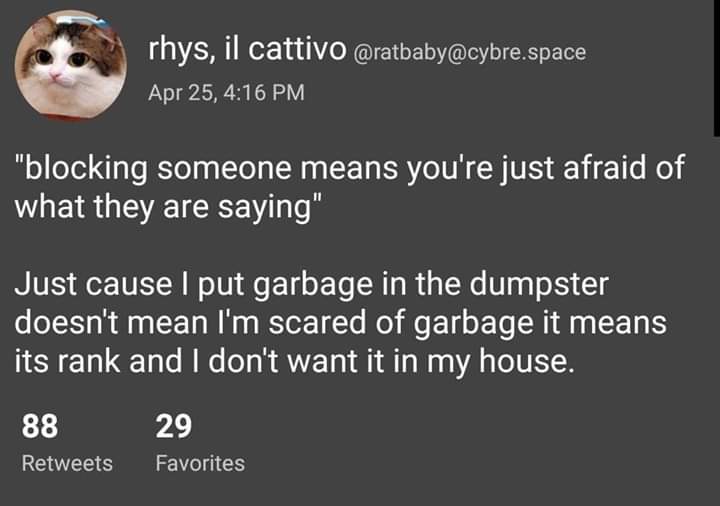
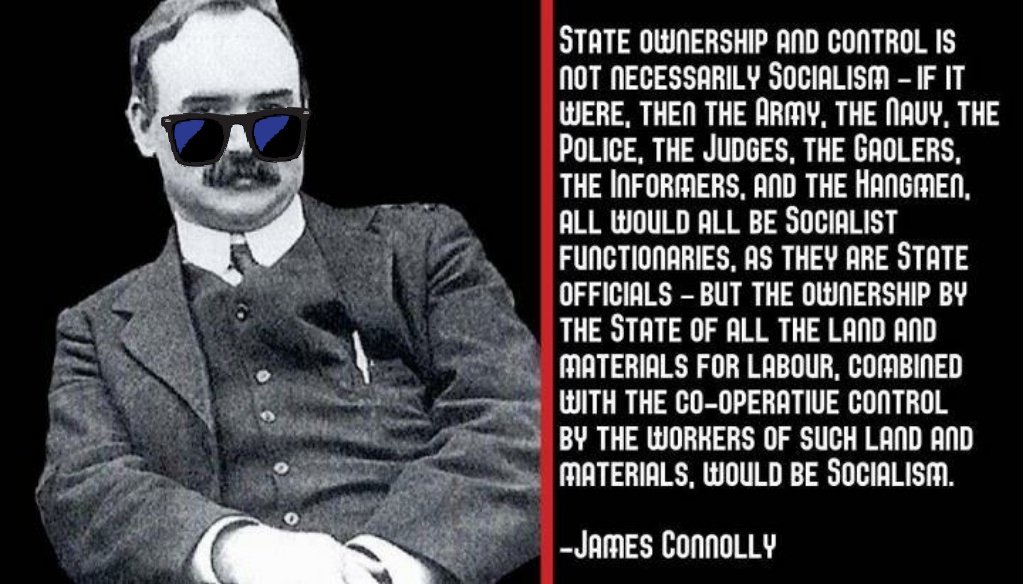
Claim: “Blocking someone means your just afraid of what they are saying.” Truth: “Just because I put garbage in the dumpster doesn’t mean I’m scared of garbage, it means it’s rank and I don’t want it in my house.” Block early and often. (click to embiggen)Have meeting in your workplace? Ever been stuck in a conference room with a bunch of other people for a long time, and feel as if you’ve gone braindead? Turns out science has the answer! Look at the CO2 levels in this chart! (click to embiggen)Click to embiggen,,,“The shooter’s manifest praised Trump as a ‘symbo of renewed white identity and common purpose.’ Let this sink in. A US President is the inspiration of white terrorists around the world. Let that sink in.”“State ownership and control is not necessarily Socialism – if it were, then the Army, the Navy, the Police, the Judges, the Gaolers, the Informers, and the Hangmen, all would all be Socialist functionaries, as they are State officials – but the ownership by the State of all the land and materials for labour, combined with the co-operative control by the workers of such land and materials, would be Socialism.” — James Connolly“The enemy doesn’t arrive by boat, he arrives by limousine.”“In a society where work is necessary for survival, when you refuse to make the workforce accessible or safe for trans/ non-binary people, what you’re saying is you don’t care if we die. It’s a violent as any physical attack.”
(click to embiggen)It’s Friday! We’re already up to the fourth Friday in March!
After the coldest February ever recorded here (and the record-breaking cold lingered for more than a week into March), we then had several days of record-breaking high temperatures! It was like early summer for a while there. At the moment, we’re back to typical temperatures for this time of year, and we may actually see some rain, which would be nice.
Anyway, welcome to the Friday Five. This week I bring you: the top five (IMHO) stories of the week, five stories about science, five stories about criminals, and five videos (plus notable obituaries and the thing I wrote).









 Font Folly