
Go read it.
Go read it.

One of the stories I didn’t link to yesterday was a Buzzfeed piece that only broke on Thursday, but by the time I was working on the Friday Five Thursday night, I had seen so many people link to it or re-reported it that it felt both like old news or at least something that everyone saw, so I didn’t link. Let me remedy that because late Friday a boatload of new developments happened: President Trump Directed His Attorney Michael Cohen To Lie To Congress About The Moscow Tower Project.
I should also admit that, besides seeing so many links to it throughout Thursday, it also just feels like a headline you’ve already read, right? I mean, didn’t we already know this? Except we didn’t know this one, and if a fraction of the details are right, it’s a bigger deal than some of the other well-documented lies and corrupt acts of the Alleged President: BuzzFeed’s Trump-Cohen Story Describes Clearly Impeachable Crimes- The tale of a presidential coverup is familiar — and troubling. This is different than most of the other things we’ve heard about this case because, if the story is correct, it is talking about things Trump did after taking office. If true, it also is a serious crime (and criminal conspiracy) regardless of whether the interactions of the Trump’s campaign organization with Russian officials rise to the legal definition of collusion.
Lying to Congress is a crime. Lying to Congress under oath is a serious crime. A government official (including by not limited to the President) instructing someone else to lie to Congress under oath is a crime. Doing so for the explicit purpose of obstructing one or more criminal investigations (and remember, Mueller’s office is not the only one investigating various possible criminal activities surrounding these events) is a serious crime.
Of course, supporters of the Alleged President got what they think is vindication Friday night (and even he thinks it is, because of course he’s tweeted about it already): Special counsel office: Parts of Buzzfeed article tying Trump to Cohen’s lies to Congress are not accurate. Oh, well, in that case, never mind, right?
Well, no, because you need to both read the actual statement from the Special Counsel’s Office, and you need to think like a prosecutor when you do:
“BuzzFeed’s description of specific statements to the Special Counsel’s Office, and characterization of documents and testimony obtained by this office, regarding Michael Cohen’s Congressional testimony are not accurate.”
Parse that like a lawyer and you realize that all the Special Counsel’s Office is saying is that 1) the don’t have all the details right, and 2) there are nuances or details which the article omits or misinterprets.
It is not a repudiation of the core of the story: Here’s What Legal Experts and Former Gov’t. Officials Say Mueller’s Statement on the Buzzfeed Story Means. In other words, what the Special Counsel’s Office is saying is that parts of the story are right, parts are wrong, but they can’t tell us which parts are without revealing information that would compromise the current investigation.
Buzzfeed has since responded that they stand by their story. The speculation is that someone in one of the other prosecuting offices has leaked this information. I mentioned above that Mueller’s office isn’t the only one, right? We know that the U.S. Attorney for the Southern District of New York is also investigating many of these things, because they have been filing joint motions to federal judges regarding sentencing and so forth of a bunch of the conspirators who have already either pled guilty or been indicted. We know that prosecutors in Germany are investigating some aspects because of raids they have conducted on bank offices and such over there, and the public warrants filed in conjunction with those raids. There is a strong suspicion (but less public proof) that state prosecutors in New York are also conducting a parallel investigation. There are hints in some of the other activities that numerous other state prosecutors have been given information relevant to state crimes that the Special Counsel’s Office as uncovered—this is not unusual for federal investigators, when finding evidence of crimes that they can’t pursue in federal courts to refer that information to the jurisdictions that can prosecute the crimes.
So it is very possible that someone in one of these other offices, for whatever reason, decided to leak the information to the press. One possibility is that several of the statements made this week by the Attorney General nominee have made it seem likely that he will let Mueller complete his investigation, but then not pass the report on to Congress, instead writing his own summary report. This could make law enforcement officials believe that the information is never going to reach Congress or the public unless someone leaks some of it and gets enough people looking into it that it becomes impossible for a corrupt Attorney General to suppress.
This, by the way, was the motivation that led an FBI official named Mark Felt to start passing information about crimes committed on Nixon’s behalf to two reporters for the Washington Post. Those leaks eventually led to the Watergate investigation and created enough public furor that Nixon resigned from office before Congress could impeach him. For many years, the two reporters refused to reveal the name of their source of secret information, referring to him only as Deep Throat.
This raises the question, why would Mueller say anything at all about it, if it wasn’t his office that leaked it? My guess is two reasons. First, he probably believes that he has already set up enough contingencies against interference from a new Attorney General that the investigation’s results will reach the public. Second, he is very angry at whoever did leak it, even though he isn’t sure who did the leaking. He isn’t worried that the information he gathers won’t eventually become public (because of his contingencies) but he is worried that a spooked Alleged President will find another way to shut down the investigation before he finishes.
So, issuing this statement calms Cadet Bonespur down, giving him reason to tweet about how even Mueller agrees with him the Buzzfeed is wrong. And buys Mueller a bit more time.
Which makes me suspect that he is really, really close to nailing down irrefutable evidence on something. He’s got a lot of people who have been found or had pled guilty to all sorts of things already, which means he’s got a lot of thumbscrews being twisted to flush out more evidence.
It might be time to break out the popcorn soon!

I freaked out just a little bit this week when I saw the Betty White was trending. Then I saw the actual tweets and posts and remembered it’s her birthday. Yay! She’s still with us!
Anyway, welcome to the Friday Five. This week I bring you: five stories about people celebrating birthdays this week, the top five (IMHO) stories of the week, five stories of interest to queers and our allies, five stories about deplorable people, and five videos (plus notable obituaries and things I’ve written).
Betty White looks sprightly as ever on stroll ahead of 97th birthday.
Betty White says the secret to her living long is vodka and hot dogs
Barack Obama Posts an Adorable Throwback Photo for Michelle’s Birthday.
Michelle Obama’s Birthday: See Her Most Gorgeous Looks Ever.
Public transportation is 10 times safer, analysis shows.
No, Evolution Did Not Make Us Into Selfish Capitalists.
One month after controversial adult-content purge, far-right pages are thriving on Tumblr .
Violent crime in the U.S. has fallen sharply over the past quarter century
LGBTQ-inclusive bullying laws associated with fewer teen suicide attempts, study says.
A pastor posted an anti-LGBTQ church sign so his congregation kicked him to the curb.
Colorado courthouse honored for issuing gay marriage licenses — in 1975.
Producers say ‘Family Guy’ to Phase Out Homophobic Jokes. Phase out? PHASE OUT? Why not just quit doing it? Is this a tacit admission that they are addicted to bigotry and so have to slowly wean themselves of it?
Leaked Emails Reveal Jesse Singal’s (Bigoted) Thoughts on Trans Issues
Referees Still Targeting Andrew Johnson.
Border Patrol agent who confessed to killing four women last year pleads not guilty.
No notes from Trump-Putin meetings: not just unusual, unprecedented.
Mitch McConnell could end the shutdown. But he’s sitting this one out.
Marriage Equality activist Diane Olson dies at 65.
Carol Channing, Iconic Broadway Star of Hello, Dolly!, Dies at 97.
Carol Channing’s Colorful Life, In 47 Stunning Photos.
Weekend Update 1/12/2019: The wheels of justice may grind slowly, but Alex Jones, they grind on you!
Sunday Update 1/13/2019: This is not a sci fi movie.
This isn’t a political post, but this image was too funny not to share.
Confessions of an information junkie.
Sometimes someone needs an explanation
Misleading notions my teachers taught, Part 1: Democracy’s Not What You Think.
Grimace Puts Trump On The Hot Seat:
(If embedding doesn’t work, click here.)
Trump Is Losing the Shutdown Fight: A Closer Look:
(If embedding doesn’t work, click here.)
Now Apocalypse | Official Trailer:
(If embedding doesn’t work, click here.)
Steve Carell To Star in Netflix Comedy ‘Space Force’:
(If embedding doesn’t work, click here.)
Cub Sport – Party Pill (Official Video):
(If embedding doesn’t work, click here.)
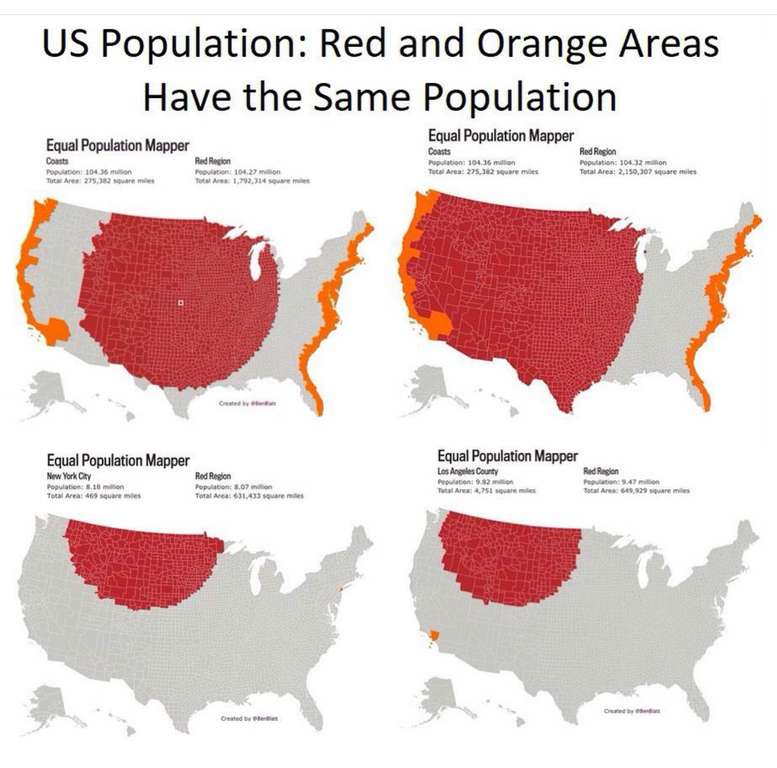
There were problems with the teacher’s analogy, of course. The first is that Virginia was a “big state” for purposes of the actual Constitutional question, not because it was physically larger, per se, but because it had a much higher population. The second is that, while a state is a governmental entity that in theory represents the people inhabiting it’s territory, that entity doesn’t always represent the needs and wishes of all of its citizens equally.
Now, at the time the Continental Congress was drafting the Constitution, state population densities were not as lopsided as they are now, so there happened to be a rough correlation between the physical size of most states and their populations, so it is easy to understand how the geographic size became conflated with size of population.
There was a fear among the states with lower populations that the higher population states would, if given power in the new government proportionate to population, overrule concerns raised by those states. That is one reason why the original Continental Congress had consisted of an equal number of delegates from each state, and why each state only got one vote (despite having multiple delegates). It is also why under the Articles of Confederation, the Congress (which consisted of only one house, and was the entirety of the Federal government for the first ten years of independence—there was no executive branch nor a judiciary) had also consisted of an equal number of delegates from each state, regardless of population.
It wasn’t a fear of a few big hulking bullies, it was a fear of the tyranny of the majority.
So, when the states all agreed in 1787 that the Articles of Confederation weren’t giving them an actual working government, they called a Continental Congress (separate from the federal Congress) to draft a solution.
That process created a Congress of two houses, one had members (in theory) proportionate to the population of each state, the other gave equal representation to each state regardless of population. At the time, this seemed like a brilliant compromise. Another portion of the Constitution laid out the election of the President in a similar way: each state would get a number of votes equal to the total number of representatives and senators it had in the Congress. This gave high population states more votes than low population states, but also gave the low population states more votes than they would be entitled to due to population alone.
I mention above that the representation in the lower house is only proportionate in theory, and here’s why: every state, regardless of population, gets at least one representative. There are currently three states whose populations are fewer than the average population of a congressional district in more populous states. And, because the size of the lower house hasn’t been increased in 90 years, these disparities get weird even when comparing only states that have more than two Representatives in the House: some districts are nearly twice the population of others.
Because the Electoral College is skewed by both the two-senators-no-matter-population rule and the mathematical disparities of the apportionment of the House, that means that voters in the less densely populated states have, for all intents and purposes, four times as much say in selecting the President as voters in some of the more densely populated states.

The fact that 82 of the 100 members in the Senate represent only half the population of the country, is also one reason why we frequently have Congressional gridlock. And it is certainly playing out in the current government shutdown.

When I’ve written about these issues before, some folks have pointed out that fixing it would require amending the Constitution—which requires supermajority votes in both houses of Congress and then a supermajority of states have to ratify. Plus, fixing the Senate is a particularly difficult issue. And no one likes the solution I suggested (half-jokingly), which is a Constitutional amendment that requires any state whose population isn’t large enough to justify three Representatives must cease to be a state and merge with a neighboring state.
But there are things that can be done to alleviate the problem which don’t require amending the Constitution. The first is to simply increase the number of Representatives in the House so that the district disparities are alleviated. There have been a number of bills proposed (and some with bipartisan sponsors) toward this end. One popular solution is called the “Wyoming Rule.” Not because it was proposed by Wyoming, but because Wyoming is the lowest population state. The Wyoming Rule would set up a system where each time when Congress does reapportionment after each Census, part of the process is to increase the total number of Representatives so that the average size of a Congressional District equals the population of the least populous state. Many nations of parliaments/assemblies/what-have-you that are much larger than our House of Representatives and they manage to conduct business just fine.
Increasing the number of Representatives alleviates at least two of the problems: it decreases the odds that a Presidential candidate who lost the popular vote will win the electoral college, and it makes gerrymandering much more difficult.
Another couple of things that could help: Statehood for the District of Columbia and Puerto Rico. D.C. has a population larger than two of the states of the union, and they have no vote in either house of Congress. D.C. statehood has been opposed by National Republicans for several years because the demographics of the district make it likely that it was most often elect Democrats to the Senate. Puerto Rico has a population that exceeds the three least populous states added together! In fact, it has a higher population that 21 of the states. Again, National Republicans have opposed statehood for the territory because it is assumed it would likely add two more reliably Democratic seats to the Senate. And that is precisely why statehood for each would alleviate some of the problems of partisan imbalance in the Senate.
Then, of course, there is the movement to change the way the states appoint their electors: National Popular Vote Interstate Compact.

We’re all scarred for life. Scarred, I tell you.”
I had several answers—all of them true:
However, K. Tempest Bradford recently shared a link to a post she wrote on this topic a few years ago, Pearls Before Swine – Or, Why I Bother and she makes some good points. I’d read the post before, but had forgotten. In the post she’s referring specifically to a long article that astronomer Phil Plait wrote, attempting to answer questions from people who don’t believe in evolution and so forth:
“I’m fairly sure that the reason the creationists in the Buzzfeed article asked such ragingly stupid questions is because no one has ever bothered to answer them seriously before. I know why that might be. Like I said, the questions are really stupid.
“So stupid they can inspire rage. Or stupid enough that it makes people shake their heads and think This Person is Not Even Worth It. Not everyone has the spoons to deal with crap like that.
“If one does have the patience to answer and explain in a real way it helps both the person asking the stupid question and it helps people who have to deal with the kind of people who ask those stupid questions. They can either offer up the knowledge as they understand it thanks to the helpful answers and info behind those links or they can say: “This post over here answers all of that and more, go read it and stop talking to me.” Drop that link and mambo, people!”
And it reminded me of a recent exchange with a friend who shared something with me that was chockful of misconceptions and concealed bigoted assumptions. And I decided that his friendship was probably strong enough to deal with the discussion, so I wrote about a thousand word email explaining the misconceptions, false equivalencies, and so forth. Even though he is a good friend and generally a nice guy, I have to admit I was a little worried he would be upset. Instead, he replied thoughtfully and realized, having read my explanation, that there were some things that he had been taking in and just accepting in various videos and articles and such that were similarly full of false equivalencies, straw man arguments, and so forth.
So, I’m reminded that not everyone gets defensive. Also, as Bradford observes: “Other people have come to me over the years, usually at conventions, and told me how they, at first, thought I was SO WRONG about race and the community and so angry… But then their anger and defensiveness went away and they pondered and listened and read other people saying the same things and finally came to a better understanding.”
I’m not going to go back and unblock any of the people I blocked this week and attempt to re-engage. I am going to think about whether I could keep a list of handy links to certain blog posts or articles on topics that come up again and again and share those links when it might help.

I have always considered this just a variant on an older technology behavior: I would have piles of books on my desk or stacked beside my bed with bookmarks in them. Sometime a small book with a bookmark would be acting as a bookmark inside a larger book. Yes, a lot of the books in those piles were books that I was reading, and just hadn’t finished. But a lot of them were part of one of my research projects, and the bookmarks were things that I wanted to be able to look at again as I moved forward with the project. Some of the projects were for school, so the books would be returned to their shelves once the essay or whatever I had to turn in was finished. Other projects were personal. I might be researching something for a story I was trying to write. Or I might be researching something for a scenario I was running for one of my gaming groups, and so on.
I do try to do a better job of limiting how many tabs are open on my computer, though improvements in browsers (sandboxing among them) has made it less likely that having all those tabs open is going to slow the computer down or cause crashes. And there are some websites (certain news sites, for instance) that I learned long ago that I need to close down as soon as I finish reading an article.
One problem with this habit is that it also means I always have a whole bunch of projects in progress at any time. Which means things don’t get finished as quickly as I like.
Which sometimes plays out here, as I will have dozens of draft blog posts ranging from a dozen or so words to hundreds that I just haven’t finished, yet.
Even when I give myself a totally arbitrary goal to post something every day for thirty days in a row, I find myself staring at a bunch of draft posts, opening one after the other, maybe adding a few words, yet somehow unable to commit and just finish one.
And it’s more than a bit frustrating. It’s also a little confusing, because finishing, and putting things away once a project is done, are things that I really enjoy. So you would think that would motivate me.
And yet…

but the including the kitchen sink” post. You’ve been warned.
First, Birds: So, the saga of the bird feeder continues. Quick refresher: over a year ago I put up a bird feeder on our veranda in a spot where I could watch birds that visited it from my living room window. We got so many birds coming to the feeder that my husband decided we needed a web cam so I could get pictures more easily and/or check on it from the office. Much to my delight the number of birds kept increasing, we had cool species like Stellar Jays showing up, it was very cool. Until just before Halloween, when the amount of birdseed consumed each day suddenly dropped for, then a few days later I learned why as an immature Cooper’s Hawk landed on my railing. Over the course of the next many weeks I witnessed the hawk snatching chickadees and juncos and sparrows out of midair in the vicinity of the feeder and then all the little birds stopped coming.
The level of birdseed in the feeder didn’t go down between the last time I topped it off just before Thanksgiving up to New Year’s Day. I cleaned out the feeder and tried scattering some feed on the deck and different locations, because I still very occasionally saw little birds on the deck. I cleaned out the feeder and put a very teeny amount of seeds in it.
Since then, I have seen pairs of small birds (usually pairs of juncos, but occasionally a pair of chickadees) show up on the veranda together and they have all adopted a similar strategy: one bird perches in one of my larger lavender plants, or on the branch of a nearby tree, the other hops around on the deck for a couple of minutes picking up seeds. Then the one that has eaten will flit to the spot where the buddy bird as been keeping watch, and the buddy bird flits down to the deck to peck at seeds. They trade off like that, one standing lookout the other eating, a few times before flying away.
Very, very occasionally a pair will take turns at the actual feeder, but it is clear that they all feel safer down on the deck where they have the planters and other things as cover.
I haven’t seen the hawk since late November.
I’ll keep scattering birdseed on the deck for now.
Dining: When we moved from Ballard to Shoreline, we decided to try to make some changes in the way we did things around the house. One of those changes was that I wanted us to sit down and eat one meal together at the table every day. The old place had not had adequate counter space or cabinets, and the way the kitchen was arranged, our table wound up being supplemental counter and storage space. So we almost never could clear it off enough to have a meal at the table. We instead would use the TV trays (or folding tray tables, as some people call them), or just each of us eat separately at our computers.
I admit that one reason that I wanted to make this change was the incredible guilt I felt at the dozens and dozens of tablecloths I found squirreled away in a couple of the closets. Tablecloths that had never been removed from their packaging. At least two of which I recognized as ones that were bought before my late husband, Ray, died. In 1997.
Michael had one change to my original proposal that we start using the tablecloths and eating at the table: he wanted to haul all the vinyl tablecloths to Value Village, and only use actual fabric cloths. Mostly because he just preferred fabric ones. Anyway, we got rid of all the vinyl ones, which left us with only a couple of fabric ones. We have since acquired a number more, some of them I think of as seasonal, some aren’t.
But we have eaten at least one meal at least six days out of every week at the table since moving. And the fact that on weekends we often eat two or three at the table in a single day, I think lets us off the hook for the nights that we go out instead of eating at home.
One of the things that means is that we have to keep at least half the table clear most of the time. That is a bit of a challenge, given that the table is really the only horizontal surface of any size near the front door, but we’ve been doing it.
So far, whenever we are cleaning for company, it never takes more than a few minutes to clear the table, pull off the tablecloth, wipe down the table, and pick out and deploy a clean cloth. And I can’t tell you what kind of happy goosebumps I get every time.
Haunted by Expectations: We have a certain number of habits about how we clean and keep the house that cause the voices of my grandmothers to occasionally admonish me. Both my nice Grandma and evil Grandma had very strong feelings along the lines of “a place for everything and everything in its place” and it’s amazing how much of that stuff got engraved in my neurons.
So, for example, t-shirts and laundry. A few years ago, thanks to a care label that came on some t-shirts we bought on Red Bubble (each with artwork that had be created by friends), when I did laundry I would pull those t-shirts out of the wash while transferring laundry from washer to dryer. Those t-shirts were put on broad hangers and hung on the shower curtain rod to dry.
About six months after I started doing that, I noticed that some other cute graphic t-shirts which we had purchased as a sci fi con around the same time as the bunch from Red Bubble were noticeably much more faded. As in, they looked years older in comparison. So I stopped running any graphic t-shirts in the dryer. They all get pulled out and hung up on the shower curtain.
When I started doing this, Sunday was our laundry day, and the t-shirts were often still damp when we needed to shower Monday morning, so Michael would move all the hangers to the end of the towel rod & take his shower (since he went in to work much earlier than I). And then I would, after finishing my shower, move them all back up to the shower curtain rod and spread them out to finish drying.
At our new place, for various reasons, Friday evening is when I do laundry, and the t-shirts wind up hanging in the bathroom all weekend. If one of us decides we need a shower, me move them, then put them back. Until Monday morning.
Neither of us puts the t-shirts away Monday morning, mind you. We just leave them hanging in a bundle on the towel rod. Michael often chooses one of the shirts hanging there to wear to work that day. While I don’t wear t-shirts to the office, on Monday night, when I come home and peel off the office drag, I’ll pick a t-shirt, sometimes from the ones hanging up, somethings from my drawer, to wear while kicking around the house.
The upshot is that the t-shirts that were washed last laundry day often hang in a bundle on one of the towel rods all week long. Unless one of us is suddenly inspired to put them away, the pile slowly dwindles as we wear some from it, but there are usually still about three hanging on the towel rack by the next Friday evening when I carry up a new pile of damp t-shirts from the laundry room.
Both my Grandmothers would be appalled. My Nice Grandma, if she saw it, would give me that look and ask, “You know, it only takes a couple of minutes to put things away, right?” Whereas my Evil Grandma would say something like, “Well, I guess I shouldn’t expect you to understand how important cleaning is, since your mother was atrociously bad at housekeeping. I remember one time…” and a story implying that my mother was not only insane but also morally corrupt on a Lovecraftian level would follow.
And some mornings while I’m rushing to get ready to work, I hear one of the other of those voices in my head, wanting to know why I don’t just put the t-shirts away.
And while my Nice Grandma’s version of the question does sound perfectly reasonable, we often forget that the inverse of the question is just as reasonable: “What is the harm in leaving them hanging there, clean, dry, and within easy reach, for a few days?”
Yeah, putting them away (folding and separating them into my chest of drawers of Michael’s, putting the empty hangers into the hall closer) is probably only a two-spell-slot task… most mornings I don’t know how many slots I’m going to need that day. And getting myself dressed and out the door with my lunch packed and everything else I need for the day are tasks that much be done. Putting away the t-shirts? Not an imperative.
Some times I realize I have the slots and the time and let’s get this done now. And that’s great. But I have to remember that it is okay to prioritize.
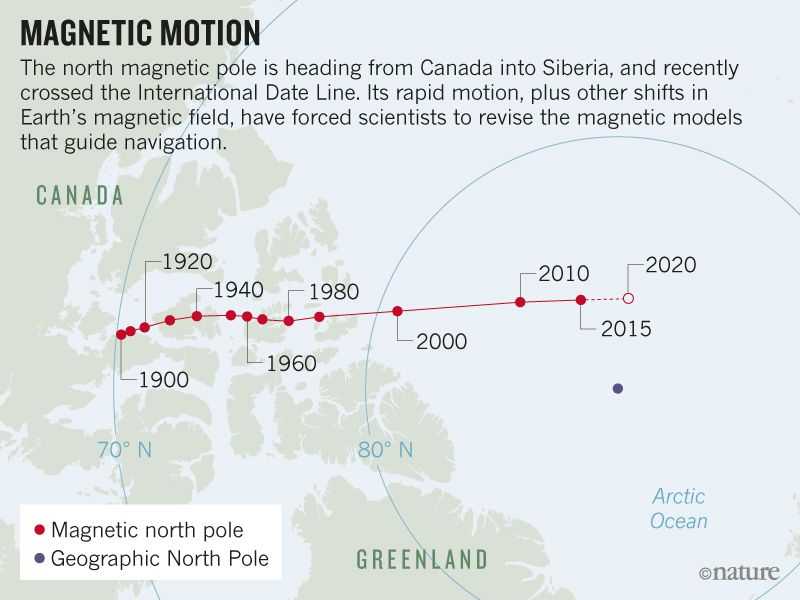
This would have gone in the science links on Friday if I had been able to find an article whose headline didn’t have misleading things in it. I know, I should have just written my own. Anyway, so the magnetic field of the planet always fluctuates and wiggles around a bit, and back in the day when a compass was always an object at least big enough to fill the palm of your hand, the amount of drift didn’t matter. But modern navigation devices (and the way we use them) require a bit more precision, so scientists map the field changes and try to build mathematical models that allow the computerized navigation aids to take the changes in the field into account. Well, things have been a bit more dicey than usual the last few years: Erratic motion of north magnetic pole forces experts to update model that aids global navigation.
So we desperately need to start updating the models more often, and also, we really need to update now because the drift has exceeded the previous model’s margin of error. Simple, right? Well: Scientists Can’t Fix Map of Earth’s Magnetic Field Thanks to the Government Shutdown –
The federal government was set to update the World Magnetic Model but had to delay it because of the shutdown.
That’s right. Cadet Bonespur’s temper tantrum is messing with global navigation systems, too.
Families of Sandy Hook shooting victims win legal victory against InfoWars, Alex Jones. The families haven’t won their lawsuits, yet, but this is an important step in the trials: ALEX JONES MUST REVEAL INFOWARS DATA TO SANDY HOOK FAMILIES AS THEY WIN LEGAL VICTORY.
In case you don’t remember: the Sandy Hook Elementary School shooting occurred back in 2012 were 20 six- and seven-year-old children (along with six teachers) were murdered by an angry 20-year-old. Alex Jones used to be a radio host (his show is carried only on the internet now) of a thing called Info Wars where he spouts all sorts of ridiculous conspiracy theories, while peddling gross survivalist food and other shit to his gullible (and fearful) listeners. And one of the conspiracy theories he pushed hard on his show for years was that Sandy Hook never happened, that no children actually died, and that the grieving parents people saw on the news were all actors.
And the issue is, that a bunch of people who are just as dangerous as the original shooter, believed him. They began harassing the parents, threatening them and their surviving children. They staked out the graves of the buried children and harassed anyone that visited those graves. The families have had to move and try to rebuild their lives several times because of the evil, deplorable followers of this greedy, evil, deplorable man.
And so the fact that some of the families have finally found a court that will hear their case is pretty awesome. I hope he winds up penniless and on the street.
I also wish more of the idiots who have harassed the families were sitting in jail, but I’ll settle for Jones being ruined.
 It’s Friday! It’s the first Friday in 2019. I am typing the year correctly most of the time, now, so that’s an improvement.
I have reached the end of the anti-biotics and most of the related medications, and while I feel less sick, I don’t yet feel well. But no one is feeling great right now, so I’m in good company.
Anyway, welcome to the Friday Five. This week I bring you: the top five (IMHO) stories of the week, five stories about things that should need proving or explaining, five stories of interest to queers and our allies, five stories about science, five stories about the government shutdown and five videos (plus notable obituaries and things I’ve written).
Cyntoia Brown Is Granted Clemency After 15 Years in Prison.
Black farmers were deliberately sold ‘fake seeds’ in scheme to steal their land.
Four Best Friends Were Buried Under ‘FRIENDS’ Tombstone.
The Daily Caller Bewildered to Learn Obama Has Secret Service Protection.
Gavin McInnes, Hate Group Founder, Writes Letters to Neighbors to Take Down Anti-Hate Signs.
Fake news on Facebook is more likely to be spread by people over 65.
Millennials Didn’t Kill the Economy. The Economy Killed Millennials. “The American system has thrown them into debt, depressed their wages, kept them from buying homes—and then blamed them for everything.”
American Psychological Association links ‘masculinity ideology’ to homophobia, misogyny. Yes, we’ve been calling this phenomenon toxic masculinity for years.
There Is No Crisis At The Border – And DHS Stats Prove It.
Queer Films Won Big at the Globes — But Queer Representation Did Not.
This Transgender Woman Says a Message From Her Doctor’s Office Turned Into a Transphobic Tirade.
Evangelicals Think LGBT People Shouldn’t Be Protected From Lynching and just hours later: Liberty Counsel Tries To Backpedal On Lynching LGBTs.
“Death To Gays” Pastor Apologizes For Fucking Hookers But Wants You To Know He Still Hates Gays.
Zero is just 1,500 years old. Before it, there was nothing.
This Professor Teaches Advance Mathematics Through Knitting.
Milky Way to face a one-two punch of galaxy collisions.
Edinburgh scientists discover mammoth secret in ivory DNA.
Trump Walks Out of ‘Waste of Time’ Meeting with Democrats: Shutdown Update.
TSA union says airport screeners are quitting as government shutdown continues.
FBI Agents Warn Shutdown Hampers Anti-Terror Work.
Common Saw Easily Cuts Through Wall Prototype.
Weekend Update 1/5/2019: It’s ugly, oh, so ugly….
On the Twelfth Day of Christmas, or Undecorating on Three Kings’ Day.
Public Service Announcement: How to Delete Online Accounts You No Longer Need.
Fighting toward the light at the end of the tunnel—or why hope is important in sf/f.
Sometimes Extinction Arrives on Wheels — more of why I love sf/f.
Marvel Studios’ Captain Marvel | Special Look:
(If embedding doesn’t work, click here.)
Stephen Colbert Trump Just Wants To Be On Primetime TV:
(If embedding doesn’t work, click here.)
The Late Show with Stephen Colbert – Trump: It’s My Right ‘To Do National Emergency’:
(If embedding doesn’t work, click here.)
Trump’s Wall Has Changed a Lot: A Closer Look:
(If embedding doesn’t work, click here.)
Troye Sivan – Lucky Strike:
(If embedding doesn’t work, click here.)
 Font Folly