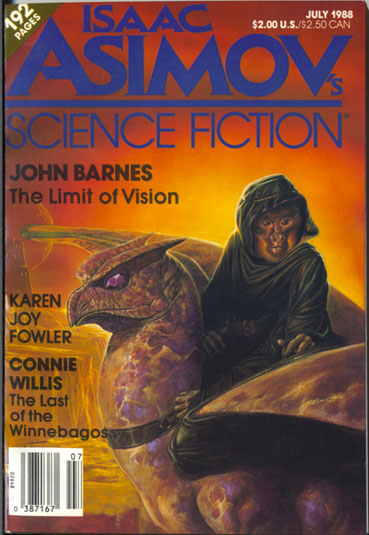
Asimov’s Science Fiction Magazine, July 1988. Cover art by Bob Eggleton.Some months back I wrote about the first story written by Connie Willis that I remember reading. And while that story is awesome and I still find new insights every time I read it decades later, the first of her stories that made me go, “Dang! This author is GREAT!” Was from a few months later that same year: “The Last of the Winnebagos.”
The story is about a photojournalist who is supposed to be on his way to cover a political event, but he stops to take pictures of the so-called Last of the Winnebagos. The tale is set in a dystopia near-future where, among other changes, the entire species of dog was wiped out by a plague. During the death spiral of the dogs extinction, laws against animal cruelty and the like have ratcheted up, and the Society of the Prevention of Cruelty to Animals has become not just a major political force, but for all intents and purposes a national secret police force. Even accidentally killing an animal can result in serious prison time and other steep penalties.
There are other changes that have taken place unrelated to the dog plague. Energy sources are rationed, for instance. At the time of the story there are only three states left in the country that have not banned RVs and similar gas-guzzlers. Even in those states where they are still allowed, just vehicles are banned from federal freeways. So the elderly couple who drive around in one of the last RVs, regularly park somewhere public, put up a sign, and for a small fee give people a tour of this relic of a bygone era.
While taking pictures and interviewing the couple, the photojournalist takes particular interest in the photos they have of their last pet, who succumbed to the plague, like so many others. During this portion of the story, we learn of that the journalist has an ongoing side project to take photos of people talking about their beloved dogs, trying to catch the moment when, as he says, “their face reveals the beloved pet.”
I don’t want to give away any more of the plot. Suffice it to say that there are secrets revealed—such as why the photojournalist is more interested in the elderly couple and their photos of like on the road with their beloved, long-lost pet than the paid gig. And we learn a few more interesting twists about the dystopic America the characters inhabit.
That’s a big part of why this story hooked me. The dystopia that Willis imagines in this story is quite different than any I had seen before. Yet utterly believable. People will vote for very strange things and get behind politicians proposing quite ridiculous things if they get riled up enough. A truth that has been demonstrated very painfully the last few years.
Even though the story involves the journalist driving over great distances a few times, interacting with the “secret police” as well as ordinary citizens, the tale always feels intimate. We’re exploring something very personal and painful in this story. In addition to seeing some novel ideas (for the time) of how certain technologies would change.
It was a good story. A thought-provoking story. A story that explored both personal grief, and communal regret. As well as looking of multiple (and very plausible) types of extinction.
What’s wrong with hope? (click to embiggen)One of the things I loved about tumblr (before the SESTA/FOSTA madness), was the wide variety of cool things that would come across my dashboard because someone had reblogged something reblogged by someone who had reblogged from someone else. At some point in the last year, this blog post by Alexandra Rowland crossed my timeline. I thought it was cool, and I liked it and reblogged it myself, and I didn’t think about it again until last week when everyone was posting links to an article on the same subject on Vox (and in many cases arguing against the premise). The original post was simple:
The opposite of grimdark is hopepunk. Pass it on.
Rowland goes on to describe hopepunk in more detail. In later posts, when lots of people argued about the term she chose (often suggesting noblebright as the preferred term), she explained how a hopepunk world is different than a noblebright one. Noblebright is where every hero is noble and pure and they conquer evil because they are noble and pure and once evil is conquered everything goes back to being noble and pure. A hopepunk world isn’t a rose-colored fairytale place, instead:
The world is the world. It’s really good sometimes and it’s really bad sometimes, and it’s sort of humdrum a lot of the time. People are petty and mean and, y’know, PEOPLE. There are things that need to be fixed, and battles to be fought, and people to be protected, and we’ve gotta do all those things ourselves because we can’t sit around waiting for some knight in shining armor to ride past and deal with it for us. We’re just ordinary people trying to do our best because we give a shit about the world. Why? Because we’re some of the assholes that live there.
I’m not completely sure when the term grimdark was first coined, but I know the attitude was around (and works of fiction based on it were getting praised and winning awards) in the late 1980s. Grimdark is sometimes described as a reaction to idealistic heroic fiction, meant to portray how nasty, brutish, violent, and dark the real world is. It has also been defined somewhat more accurately as a type of fiction that prefers darkness for darkness sake, replacing aspiration with nihilism and the assertion that true ethical behavior is either futile or impossible.
I think a much more accurate description of the majority of grimdark is torture porn and rape porn pretending to be a deconstruction of unrealistic tropes. Damien Walter noted in an article for the Guardian a few years ago that it is driven by a “commercial imperative to win adolescent male readers.”
Usually in grimdark stories the driving narrative force is to do the most brutal, shocking, nasty thing the author can to characters that they have made likable—with a lot of misogynist skewing. Rape of women and children is particularly prevalent in these stories, usually justified by the claim that that is realistic for pre-industrial societies, ignoring the fact that in war zones throughout history men were almost as likely to be the victims of rape by the enemy as women. I also have trouble with the “realistic” defense particularly in the epic fantasy settings because those authors never show people dying of cholera or dysentery—which in the real historical settings were at least a thousand times more likely to be the cause of a person’s death than torture or rape.
Grimdark appeals most strongly to white (usually straight) young men from middle class backgrounds—the sort of people who are least likely to have experienced much in the way of grimness in the real world. They are the kinds of guys who will insist that they are oppressed now because women, people of color, and queer folks have some civil rights protections. In short, they are the kind of people that:
They’re nice white middle class boys and the closest they’ve ever come to the ghetto is when they accidentally got off at the tube in Brixton once, took one look around and ran crying back into the tube.
I’ll tell you where that quote came from in a minute. First, I want to finish explaining why I believe it is mostly white, straight, middle class young men who find this appealing. It’s precisely because their exposure to grim realities is almost always secondhand. The notion that the person held up as a hero isn’t really a paragon of virtue is something they didn’t experience firsthand as a child. They didn’t routinely have someone they admired and loved call them an abomination, for instance. Queer kids, on the other hand, experienced that again and again growing up. Women learn early in life that the best they can expect from society and family if they get sexually harassed or assaulted is that they will be blamed for not somehow avoiding the situation. People of color learn that their lives are considered disposable by much of society, and so on.
Brutality, nastiness, and cruelty aren’t surprising revelations, to us. They are things we learn to expect (and endure with a smile if we don’t want to get grief from those around us). So we don’t get the same puerile thrill from its portrayal as others do.
I started working on this post last weekend after reading some of the follow-ups to the Vox story that I included in the Friday Five. And then I discovered that Cora Buhlert had already said much of what I thought about the issue (and had a lot more references than I to quote) in a blog post that I failed to read last week while I was being sick and not reading much of anything: The Hopepunk Debate. The block quote above came from there, where she was quoting a much older posting she had done elsewhere. You should go read her post, because it’s full of all sorts of interesting citations and observations.
When grimdark first started popping up, it seemed to many like an interesting and novel way to look at our perceptions of culture. It was the scrappy newcomer to the pop culture landscape—in 1987. In the 30-some years since, it has become one of the dominant paradigms of storytelling. The most popular fantasy series on television anywhere right now, Game of Thrones, is grimdark. It’s no longer surprising when likable characters are maimed and tortured and murdered in brutal ways in popular shows and books. It’s become boringly predictable.
Except that’s not quite true. Brutality has always been banal.
This gets to why I think Rowland is right to use the suffix -punk in her description of this reaction to grimdark. Grimdark has become the norm in too much of speculative fiction. Believing that hope is a thing worth kindling is, in such an environment, an act of rebellion.
We can argue about what kind of works qualify as hopepunk. For instance, I think that The Empire Strikes Back could be considered hopepunk. Luke’s insecurities and imperfections drive his part of the plot. Lando isn’t a nice guy (charming, yes, but not nice). Han is imperfect in different ways than Lando or Luke. Lots of things don’t go right for the heroes, but they don’t give up.
I’ve said many times that science fiction is the literature of hope. Even in most dystopian fiction, I have said, there is a glimmer of hope. I fully understand that that is something I believe, and isn’t necessarily an empirical fact. I believe the best sf/f can be realistic, it can be dark, it can portray the imperfect and even nasty nature of the world, while still offering that glimmer of hope.
And the truth is that that world is more realistic. That is an empirical fact. If the worst possible outcome was always more likely than others, our planet would be a barren, lifeless rock. Yes, we all die eventually, as far as we know all living creatures do. But the world is full of life because more often than not, living things survive, they endure, and they pass the gift of life along. Not understanding that requires turning an awfully big blind eye on the world. It’s a boring and inaccurate assessment of the world around us.
“The trouble is that we have a bad habit, encouraged by pedants and sophisticates, of considering happiness as something rather stupid. Only pain is intellectual, only evil interesting. This is the treason of the artist: a refusal to admit the banality of evil and the terrible boredom of pain.”
— Ursula K. Le Guin, “The Ones Who Walk Away From Omelas”
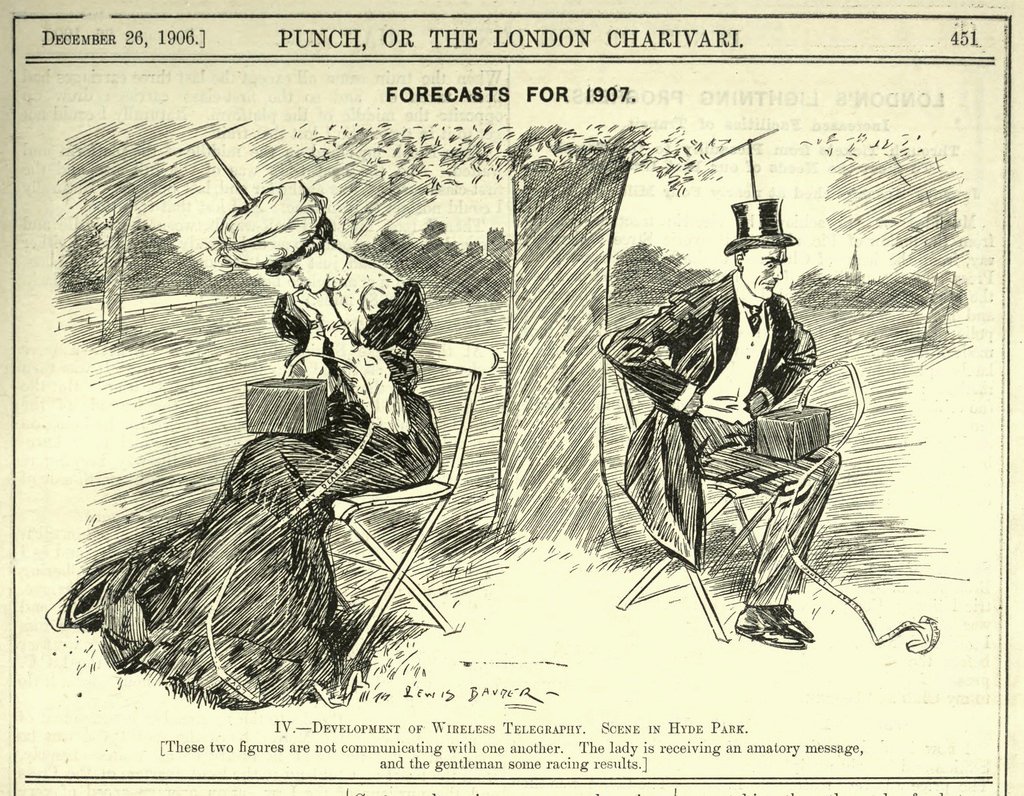
Wireless communications as predicted 113 years ago! (click to embiggen)People are sharing this article that Consumer Reports printed last week, and I think it’s worth sharing. The upside is that of the services they list, the link does indeed take you right to the Delete Account page. The downside is if you don’t remember your old login credentials you may not be able to delete the account. Especially if you no longer have access to the email account (if any) associated with the social media account.
Old accounts like this are a long term security risk for a few reasons. If you’re like millions of others, there has been a time when you were using the same (or substantially similar) passwords for lots of services, so a data breach at a service like that gives hackers database with thousands of people’s username and password pairs that will work at other sites. The bigger issue as that these accounts often have information that can be used to confirm your identity somewhere.
Those “recover your password” security questions, like first car or mother’s maiden name or name of first elementary school teacher. I had one friend once dismiss a big data breach someone by saying, “I don’t give true answers to those question. I have a set of fake answers that I use everywhere instead.” It took me explaining to him a few minutes before he realized that having the same answers to those questions everywhere meant that learning the fake answers from one site gave other people access to his accounts elsewhere. It doesn’t matter if the answers to the personal security questions are true, just whether they match the answers you’ve give before.
In theory, deleting old accounts should remove all of that kinds of information at the service in question. So, this article may be useful to more than a few of you:
For many Christians, the holiday season doesn’t officially end until the 12th day of Christmas (remember the lengthy carol about a partridge in a pear tree ?) known as the Feast of the Epiphany or Three Kings Day . https://www.youtube.com/watch?v=uS3q2iOMljY.The holidays are now officially over. Yes, I took down the tree last weekend and removed the wreath from the door. But Christmas lights remained up on the veranda, and Pendleton the Solstice Otter has been lighting up with them. But now it’s time to take them down…
I’m sure it seems weird to some people that a queer man who describes himself as an ex-Christian would observe the Feast of Epiphany. But I’m not really observing it so much as using it as a cultural milestone. Many years I take down all the decorations on New Year’s Day. Some years, some of them stay up longer (usually because I’m busy or sick or otherwise swamped). I just always try to draw the absolute last line at Three Kings’ Day.
This is also the last day I let myself listen to Christmas music.
Once again some news stories either broke after I had finished this week’s Friday Five or new developments related to stories I’ve posted about before. And these are stories I want to make a bit more commentary on than I usually do with the Friday Fives. So, let’s jump into these things…
This isn’t just bad for them, it is bad for the economy. What makes the economy work isn’t the giant billion-dollar companies or wealthy investors: it is ordinary people spending money day to day.
And the really insane part is contained in this article: Millions face delayed tax refunds, cuts to food stamps as White House scrambles to deal with shutdown’s consequences. Go read some of those quotes! There are a number of Republican congresspeople quoted who were cheering the shutdown a week ago, who are only now learning that government shutdown means that people who voted for them aren’t getting their foodstamps, or the social security checks, and won’t get tax refunds. There are Trump cabinet officials quoted in there who didn’t understand it.
They didn’t understand that ‘government shutdown’ means that the government shuts down!?!?
It isn’t just Trump who is ignorant and doesn’t know how things work. It’s like half the goddamn Republican party!
The thing is, they can end this. The first deal, the one Trump vetoed a couple of weeks ago, passed the Senate unanimously. The Republican-controlled Senate passed the deal with no wall funding already. Congress can override the President’s veto. Now, since new Congresspeople were sworn in and this is technically a new Congress, I believe that means that they have to first pass the deal again, let him veto it, and then if all the Senators who voted for it before, and a bunch of these Republican Reps in the House who are finally realizing what this means joins the Democrats on the reconsideration, BOOM, veto overridden and government is running again.
I’m going to repeat something that I say from time to time: the Founding Fathers wrote the Constitution with the assumption that it is Congress that runs the country. Article I of the Constitution describes the Congress, its powers, its responsibilities, and its limitations. Everything that follows in the Constitution (the Presidency, the Judiciary, the Amendment process, the Bill of Rights) are in relationship to the Congress. The President isn’t supposed to run the country, Congress is. And they can. I realize it means some Republicans (not even half of them—just enough to with the Democrats—reach two-thirds) growing at least a teensy bit of a spine.
“In this struggle, many evangelicals believe they have found a champion in Trump. He is the enemy of their enemies. He is willing to use the hardball tactics of the secular world to defend their sacred interests. In their battle with the Philistines, evangelicals have essentially hired their own Goliath — brutal, pagan, but on their side… A hypocrisy becomes unsustainable. A seed gets planted. And a greater power emerges, revealing new leaders and shaming those who reduce Christianity to a sad and sordid game of thrones.”
I think another point he makes is the most important:
“The employment of an unethical, racist, anti-immigrant, misogynist Giant is not likely to play well with women, minorities and young people, who are likely to equate conservative religion with prejudice for decades to come.”
Honestly, polling information indicates that’s already happened. Which actually gives me a lot of hope.
I know it muddles the point, but it’s both: they are angry and afraid and ignorant and hateful and racist and all the rest… (click to embiggen)
Since my cough was getting worse, I went to see the doctor and next thing I know I was at the pharmacy picking up five prescriptions: antibiotic, steroid, prescription cough tablets for daytime, codeine cough syrup for nighttime, and a new kind of inhaler. Apparently the doctor was not happy with what he heard through the stethoscope when he asked to to take a deep breath and I had another coughing fit.
Anyway, welcome to the Friday Five. This week I bring you: the top five (IMHO) stories of the week, five stories about writing and reading, five stories about deplorable people, and five videos (plus notable obituaries and things I’ve written).
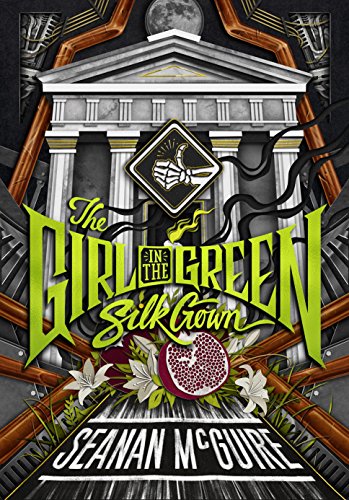
Cover art for The Girl in the Green Silk Gown.Before I get into this book review, I feel the need to disclose a few things. Seanan McGuire, the author of the books I’ll be discussing below, is a personal friend of some of my friends. Other than sitting in some panels that she has been on at conventions, and a short conversation (which consisted of me gushing like a fanboy) at an autograph session where she signed some of her books for me, I am not myself meaningfully acquainted with her. However, because we have these mutual friends in addition to me being a fan of her work and following her on social media, some might say that my opinions of her work are biased. On the other hand, any of the writers or artists who are my friends can tell numerous stories of me giving harsh critiques of their work to them, which I hope will provide some indication that I am able to judge the work of fiction as a work of fiction regardless of who created it.
But that isn’t quite full disclosure. Because I am also quite a nerd/fan of anything to do with Urban Legends. And I have a particular fondness for any sort of work of fiction that attempts to explore and more fully explain folklore. For example, see any of the blog posts where I talk about Mary Stewart’s Arthurian novels: The Crystal Cave, The Hollow Hills, The Last Enchantment, and The Wicked Day.
Because of my love for urban legends and fiction based on folklores, I was aware of the existence of the McGuire’s earlier book, Sparrow Hill Road and had it on my list of books I intended to buy and read some day. Sparrow Hill Road is a fix-up; which means that a number of stories which had originally been published elsewhere are assembled (and sometimes altered or expanded) into a single story. This is different than an anthology, which is merely a collection of the previously printed stories. In a fix-up, the author transforms the series of pre-existing stories into a more coherent, novel-like structure.
I had not gotten around to buying and reading this book, when I became aware that a sequel—which was not a fix-up but was a new story conceived and written as an entire book from the get-go—was about to be published. As in, within a few days of me finding out it was in the pipeline, it would be available to purchase. So I went ahead and pre-ordered the second book, while buying and downloading the first, which I started reading right away.
The urban legend McGuire explores here is a subset of the Phantom Hitchhiker. There are many versions of the Phantom Hitchhiker, but McGuire focuses on is “the girl who asks for a ride home; the one who turns out to have been dead all along.” So the first book, Sparrow Hill Road, introduces us to Rose Marshall, who was 16 in 1952. When her boyfriend failed to pick her up for the prom, Rose got in her car and started down Sparrow Hill Road and wound up in a fight for her life against, well, that’s a detail that is revealed slowly over the course of the individual episodes in this first book. Suffice it to say that Rose is killed and she becomes the Phantom Prom Date.
Over the course of the stories we watch as Rose interacts with the living and certain supernatural forces. From the child separated from her parents at a rest stop who Rose leads to safety, to an angry ghost that doesn’t even remember why it wants to kill, to a retired banshee who still likes to lend a helping hand, we see a wide variety of people and other beings whose destinies are tied up in the highways and byways of America. McGuire builds a rich and multilayered mythology here, weaving in elements of folklore and other urban legends to create a fascinating twilight world.
Rose’s primary function is to help those who are fated to die on a roadway get through the transition and head on to the afterlife (one that is denied to her for various reasons) without becoming one of those vengeful spirits or other dangerous creatures. Sometimes she’s called to a scene where the mortal can be saved, and if Rose can, she does.
The Girl in the Green Silk Gown is where things start hopping. Rose’s first full-length novel opens up 60 years after her initial accident. She’s been 16 years old for all that time, and has become an expert at navigating several layers of reality—dipping into the mortal realm when needed—and familiar with a lot of supernatural threats. Throughout the 60 years she has been pursued off and on by the immortal Bobby Cross, who was responsible for her death. Killing her wasn’t enough. He is out to end her, because consumer her soul (or essence or whatever) being necessary to preserving his immortality. She has eluded him many times over the years, so he launches a more complicated scheme to strip of her powers and trap her in the mortal realm where he’ll be able to finish her off. With a very unlikely ally, she embarks on a quest the included going to the depths of the underworld in an attempt to not just survive, but get back what she’s lost.
The novel builds on and expands a lot of the secrets of the ghost roads and related phenomenon introduced in the first collection. There are some great new characters, as well as the return of several favorites. It’s fun. It is tense when necessary. McGuire kept me turning the pages, anxious to know what would happen next.
I think that The Girl in the Green Silk Gown can be read and enjoyed by someone who hasn’t read the first book. I recommend them both. I’ve seen some overall positive reviews that are less happy with the episodic nature of the first book, particularly the fact that the stories aren’t entirely arranged chronologically. So if you think that might bother you, maybe try the second book first.
James Davis Nicoll writes book reviews and related articles that are published (among other places) at Tor.com. He recently posted “100 SF/F Books You Should Consider Reading in the New Year” where he gives brief (and fun) descriptions of each of the books. They include both fantasy and science fiction, and range over a rather long publishing time. He says in bold print in the introduction, and repeats in all caps at the end, that this list is not meant to imply that these are the only books one should consider reading this year.
Shortly after it went up, he found out other book bloggers were making a meme out of it, where they would list all 100 and mark them in some way to indicate which ones you have read. So on his personal blog he listed only the titles, authors, and year of publication with the suggestion: italics = you’re read it already, underscore = you would recommend a different book by this author, and strikethrough = you recommend no one read the book. And since I keep meaning to write more about books on this blog, I figure this is an easy way to start.
The Goblin Emperor by Katherine Addison (2014)
The Stolen Lake by Joan Aiken (1981) Fullmetal Alchemist by Hiromu Arakawa (2001-2010)
Yokohama Kaidashi Kikō by Hitoshi Ashinano (1994-2006) [partial] The Handmaid’s Tale by Margaret Atwood (1985) Stinz: Charger: The War Stories by Donna Barr (1987)
The Sword and the Satchel by Elizabeth Boyer (1980)
Galactic Sibyl Sue Blue by Rosel George Brown (1968) The Mountains of Mourning by Lois McMaster Bujold (1989)
War for the Oaks by Emma Bull (1987)
Wild Seed by Octavia E. Butler (1980)
Naamah’s Curse by Jacqueline Carey (2010)
The Fortunate Fall by Raphael Carter (1996)
The Long Way to a Small, Angry Planet by Becky Chambers (2015)
Red Moon and Black Mountain by Joy Chant (1970)
The Vampire Tapestry by Suzy McKee Charnas (1980)
Gate of Ivrel by C.J. Cherryh (1976)
Sorcerer to the Crown by Zen Cho (2015)
Diadem from the Stars by Jo Clayton (1977)
The Dark is Rising by Susan Cooper (1973)
Genpei by Kara Dalkey (2000)
Servant of the Underworld by Aliette de Bodard (2010)
The Secret Country by Pamela Dean (1985) Dhalgren by Samuel R. Delany (1975)
The Door into Fire by Diane Duane (1979)
On the Edge of Gone by Corinne Duyvis (2016)
Spirit Gate by Kate Elliott (2006)
Enchantress From the Stars by Sylvia Louise Engdahl (1970)
Golden Witchbreed by Mary Gentle (1983)
The Dazzle of Day by Molly Gloss (1997)
A Mask for the General by Lisa Goldstein (1987)
Slow River by Nicola Griffith (1995) Those Who Hunt the Night by Barbara Hambly (1988)
Winterlong by Elizabeth Hand (1990) Ingathering by Zenna Henderson (1995) — (this is actually a collection of a series of stories, about half of which I have read separately)
The Interior Life by Dorothy Heydt (writing as Katherine Blake, 1990)
God Stalk by P. C. Hodgell (1982) Brown Girl in the Ring by Nalo Hopkinson (1998)
Zero Sum Game by S.L. Huang (2014)
Blood Price by Tanya Huff (1991)
The Keeper of the Isis Light by Monica Hughes (1980)
God’s War by Kameron Hurley (2011)
Memory of Water by Emmi Itäranta (2014) The Fifth Season by N. K. Jemisin (2015)
Cart and Cwidder by Diane Wynne Jones (1975)
Daughter of Mystery by Heather Rose Jones (2014)
Hellspark by Janet Kagan (1988)
A Voice Out of Ramah by Lee Killough (1979)
St Ailbe’s Hall by Naomi Kritzer (2004)
Deryni Rising by Katherine Kurtz (1970)
Swordspoint by Ellen Kushner (1987) A Wrinkle in Time by Madeleine L’Engle (1962)
Magic or Madness by Justine Larbalestier (2005) The Dispossessed by Ursula K. Le Guin (1974) Ancillary Justice by Ann Leckie (2013)
Biting the Sun by Tanith Lee (Also titled Drinking Sapphire Wine, 1979) Ninefox Gambit by Yoon Ha Lee (2016)
Wizard of the Pigeons by Megan Lindholm (1986)
Adaptation by Malinda Lo (2012)
Watchtower by Elizabeth A. Lynn (1979) Tea with the Black Dragon by R. A. MacAvoy (1983)
The Outback Stars by Sandra McDonald (2007)
China Mountain Zhang by Maureen McHugh (1992) Dreamsnake by Vonda N. McIntyre (1978) The Riddle-Master of Hed by Patricia A. McKillip (1976)
Lud-in-the-Mist by Hope Mirrlees (1926)
Pennterra by Judith Moffett (1987)
The ArchAndroid by Janelle Monáe (2010) Jirel of Joiry by C. L. Moore (1969) Certain Dark Things by Silvia Moreno-Garcia (2016)
The City, Not Long After by Pat Murphy (1989)
Vast by Linda Nagata (1998)
Galactic Derelict by Andre Norton (1959)
His Majesty’s Dragon by Naomi Novik (2006)
Dragon Sword and Wind Child by Noriko Ogiwara (1993)
Outlaw School by Rebecca Ore (2000)
Lagoon by Nnedi Okorafor (2014)
Alanna: The First Adventure by Tamora Pierce (1983)
Woman on the Edge of Time by Marge Piercy (1976)
Godmother Night by Rachel Pollack (1996)
Goblin Market by Christina Rossetti (1859)
My Life as a White Trash Zombie by Diana Rowland (2011)
The Female Man by Joanna Russ (1975)
Stay Crazy by Erika L. Satifka (2016)
The Healer’s War by Elizabeth Ann Scarborough (1988)
Five-Twelfths of Heaven by Melissa Scott (1985) Everfair by Nisi Shawl (2016) Frankenstein by Mary Shelley (1818)
A Door Into Ocean by Joan Slonczewski (1986) The Crystal Cave by Mary Stewart (1970)
Up the Walls of the World by James Tiptree, Jr. (1978)
The Thief by Megan Whalen Turner (1996)
The Snow Queen by Joan D. Vinge (1980)
All Systems Red by Martha Wells (2017)
The Well-Favored Man by Elizabeth Willey (1993)
Banner of Souls by Liz Williams (2004)
Alif the Unseen by G. Willow Wilson (2012)
Ariosto by Chelsea Quinn Yarbro (1980)
Ooku by Fumi Yoshinaga (2005-present)
Nicoll tends to review books that don’t get reviewed elsewhere, and he reads a prodigious amount, it shouldn’t shock anyone that this list includes a lot of authors who don’t fall into the cishet white male category. I was pleased at how many of the books on the list were ones I had already read and liked. There were a few that were already in my to-read pile, and a good number that I’ve seen before and been interested in, but just hadn’t gotten around to.
And a bunch of these have been added to my wishlist, now.
I should try to put together some recommendation lists of my own. Or maybe just find a few more lists others have posted to link to.
“Life is short. So do the things that make you happy. Be with those that make you happy. Look for the good in every day—even if some days you have to look a little harder!”There is a lot of baggage on the notion of New Year’s Resolutions. I don’t want to rehash all the arguments. And I really don’t want to get into a pedantic semantics argument about the arbitrariness of the calendar and so forth. Trust me, I know. But I also know from personal experience that when I set goals and also set up some sort of mechanism for reporting on them, I actually make major progress toward them. So, I’m going to set some goals for the year. I’m publishing them on my personal blog and on my Patreon. I am currently planning to post monthly updates about my progress on my Patreon, rather than at the blog. But I also may do some sort of cross-post.
Some years ago a friend suggested the analogy of how one trains a dog: you can’t get rid of a bad behavior without replacing it with something else that fulfills the same need for the pup. In other words, replace a habit you don’t like with a new one that you do. This has helped me make a number of changes in my own behavior over the years since.
For various reasons, when I started setting my annual goals using this method, I kept setting four goals. And other than 2017, when two of those goals were related to external forces (specifically, our involuntary relocation from our home of 20+ years and a surgery my husband required) I have never managed to make progress on all four. So this year, I’m going to cut the goals back to three, and see if that works a little bit better.
My goals for 2019:
Don’t get mad, keep focused. It has always been the case that I find it easy to rant and get outraged about injustices and the like in the world. And this outrage burns up a lot of energy. That’s why for several years I’ve had a goal related to reducing or controlling my outrage. The last two years we’ve all had a lot of anxiety and outrage fatigue. I think I’ve done a reasonably good job of paying enough attention to try to protect myself and my family, while not getting overwhelmed. So I’m going to get try this year to keep (and in some areas increase) my focus on things I can control. My tasks are: write about about things I love, including more book reviews and the like on my blog; continuing listening to music and audiobooks more than news podcasts and the like; carve out some time to paint of make music each month.
Take care of business. There are a number of things that I’ve procrastinated on. It’s been easy to let my insane work schedule derail plans. I’ve made a list of 10 tasks that I just need to finish. The plan is to knock off a minimum of one a month. Some of the tasks have confidentiality issues, so I’m going to remain vague on this..
Revise and finish. I’ve been in an unending iterative loop of proofing/editing one novel for an embarrassingly long time. I tried to balance that by looking at calls for submissions and writing to those. That has not worked out. I don’t seem to ever meet the expectations of those calls. And the time spent writing those stories should have gone to finishing the books I have and just self-publishing them So, that’s what I’m doing this year. My task is: set specific monthly writing/editing goals each month.
Wish me luck!
And I hope everyone (well, everyone except the alleged president of the United States and any of his enablers) has a joyous and blessed 2019.




 Font Folly