Ill humours and untangled threads – more adventures in dictionaries

I’ve been listening to the NPR show, “Wait, Wait, Don’t Tell Me” since, I think, the very first broadcast. And it was while walking home from work one day many years ago, that I first heard a particular use of a word when a listener contestant described herself as a “gruntled postal worker.” She was a mail delivery person, driving a small mail truck around a rural community, and she said he loved her work. That self-description elicted laugher from the panel for a couple of reasons. First, a series of unfortunate workplace violence incidents beginning in the mid-80s in which angry post office employees violently attacked supervisors, co-workers and so forth, the phrase “disgruntled postal worker” and “going postal” had become colloquialisms used in describing workplace violence issues. Second, it sounded like a back-formation of an existing word. Disgruntled describes a state of ill-humor, moody dissatisfaction, or sulky discontent. And since the prefix dis– usually indicates a negation, then removing the syllable ought to reverse the meaning of the word, right?

Just look at that definition of disgruntled: dissatisfaction is the opposite of satisfaction and discontent is the opposite of content. It seems obvious.

But it’s not that simple.

Because discontent and dissatisfaction come to us from Latin and Latin-derived languages. In Latin dis- is, indeed a synonym for “not” or “bad” or “separate.” But disgruntled does not come to English by way of Latin. Disgruntled is based on an Old English word which in turn came from the Old Saxon word grunt meaning literally a low, short, gutteral sound. And the dis- in disgruntled also comes from Old Saxon, where it means “very or a large amount.” The Old English word that I alluded to above is gruntle, which was a verb meaning to make those gutteral sounds–literally to moan and groan. To be gruntled, then, meant to be in a mood or state that causes you to moan and groan with dissatisfaction, while to be disgruntled meant not just a little bit unhappy and cranky, but to be extremely unhappy.

It’s not surprising that modern English speakers aren’t familiar with the Old Saxon prefix, dis– , because digruntled is the only common English word in which that prefix still appears. Nearly every other English word beginning with the letters d i and s Derive from Latin. There are a few rare words we’ve swiped from Dutch and Turkish and the like which begin with those three letters and don’t mean “not-” something.

Disgruntled, then, can be thought of as an orphaned Saxon word—a sort of living fossil in the language, if you will. And there is one other such fossil word hiding in modern English among the dis-es. Distaff, meaning the female branch or side of a family, has also survived intact from Old English. However, the dis– in distaff has almost no relationship to the dis– in disgruntled. Because the Old English distaff didn’t come from Old Saxon, but rather from Middle Low German. In Middle Low German dise meant a bundle of flax. And the disestaff was a specially shaped stick that was used to wind lengths of flax or wool or similar fibers to keep them from tangling until they could be woven or knitted into a cloth or garment.

The rather sexist reason that the English word distaff now refers to the female side of a family or to the female realm is because winding thread or yarn and turning it into garments was considered women’s work. The word isn’t considered completely archaic at this point, but fortunately it isn’t a terrbbly common word, any longer. We could do with a bit less of the dominance of the patriarchy in our language.

Despite my explanation above about the original meaning of gruntle, you will not find me angrily lecturing people for misusing the word. Gruntled is a perfectly servicable colloquialism to refer to a feeling of happiness. And I strongly suspect that the humorous way people tend to use it means that it’s going to stick around for a while. And that’s a good thing. Because if gruntled continues to catch on, that increases the likelihood that the fossil disgruntled will avoid linguistic extinction for a while longer.

And I’ve always had a soft spot for fossils.
Weekend Update 2/24/2018: Mutually Assured Massacre

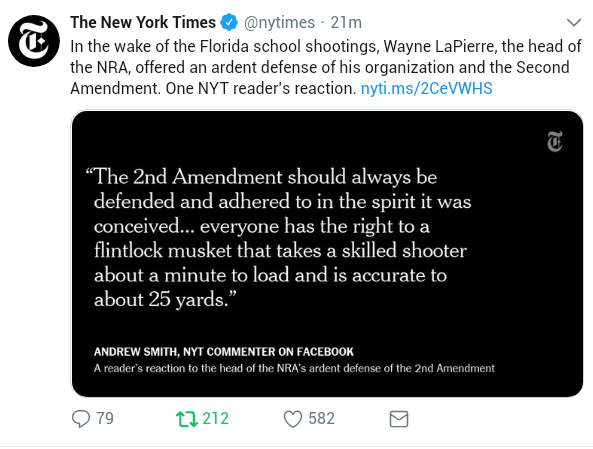
“The 2nd Amendment should always be defended and adhered to in the spirit in which it was conceived... everyone has a right to a flintlock musket that takes a skilled shooter about a minute to load and is accurate to about 25 yards.”
Click to embiggen.
Once again stories that didn’t make it into the Friday Five, or new developments in stories that did, have come to my attention. So I’m going to share them with you, along with some commentary and context.

Many new developments related to the Parkland shooting: Sources: Coral Springs police upset at some Broward deputies for not entering school. Turns out, not only didn’t the armed deputy who was on school grounds specifically to guard the students just hunker down and hide for the entire shooting, the other deputies from the same county office all did the same thing when they arrived. Only the city police actually entered the building to confront the shooter.

Just one more reason why arming more people doesn’t lead to children being safe.

In case you’re curious about how the myth that more guns somehow make us safer came to be, read this: Gun Rights, ‘Positive Good’ and the Evolution of Mutually Assured Massacre.

A lot of idiots out there are sharing the conspiracy theory posts that these high school kids who are confronting lawmakers are fake. Given that all the tech companies have pledged to try to root out fake news, we need to ask, Why Can Everyone Spot Fake News But The Tech Companies? After multiple tragedies and national security disasters made worse by hoaxes and misinformation, why is this even a question? The article explains.

And while we’re on the subject: The collective outrage over Facebook and its actions might result in a lot of talk, but it won’t really change Facebook, its ethos, and its ethics.

And let’s not forget all the people who are trying to pedantically argue that the AR-15 the shooter used to kill 17 people isn’t an assault weapon: What I Saw Treating the Victims From Parkland Should Change the Debate on Guns. I’ll let the surgeon explain it himself:

In a typical handgun injury that I diagnose almost daily, a bullet leaves a laceration through an organ like the liver. To a radiologist, it appears as a linear, thin, grey bullet track through the organ. There may be bleeding and some bullet fragments.

I was looking at a CT scan of one of the victims of the shooting at Marjory Stoneman Douglas High School, who had been brought to the trauma center during my call shift. The organ looked like an overripe melon smashed by a sledgehammer, with extensive bleeding. How could a gunshot wound have caused this much damage?

The reaction in the emergency room was the same. One of the trauma surgeons opened a young victim in the operating room, and found only shreds of the organ that had been hit by a bullet from an AR-15, a semi-automatic rifle which delivers a devastatingly lethal, high-velocity bullet to the victim. There was nothing left to repair, and utterly, devastatingly, nothing that could be done to fix the problem. The injury was fatal.

It’s also important to note that contrary to popular belief, the issue isn’t the Constitution: Why the Second Amendment does not stymie gun control.

And if you’re one of those people trying to tell me that guns don’t kill, it’s people who kill remember first that yeah, there are a lot of evil people out there plotting: Report: Washington state home to one of the largest cells of notorious white supremacist group. So maybe we should make it less easy for them to get weapons.

Finally, I want to end on some good news: Oregon legislature passes bill strengthening state’s gun laws. In Oregon and many other states it is already illegal for someone with certain types of domestic abuse convictions and such to own guns. The problem in those states that have them is the “boyfriend” loophole. Most people convicted of domestic abuse wind up pleading down to a misdemeanor charge, which doesn’t kick in the federal ban against felons, right? And statistics have shown that the number one predictor of whether someone will go out and attempt (or commit) a mass shooting is past domestic abuse, so many states amended laws over the last few years to include the misdemeanor abuse charges in the gun ban. Except that the misdemeanor only counts if the person who committed the abuse either had shared living quarters for a certain number of months with the victim, or if they are married to the victim. So boyfriends who beat their girlfriends before tricking her into moving in with him or marrying him can still buy guns. No matter how many different girlfriends they abuse over the years.

That is now no longer the case in Oregon. Only 49 states to go…

Friday Five (heeding the call edition)

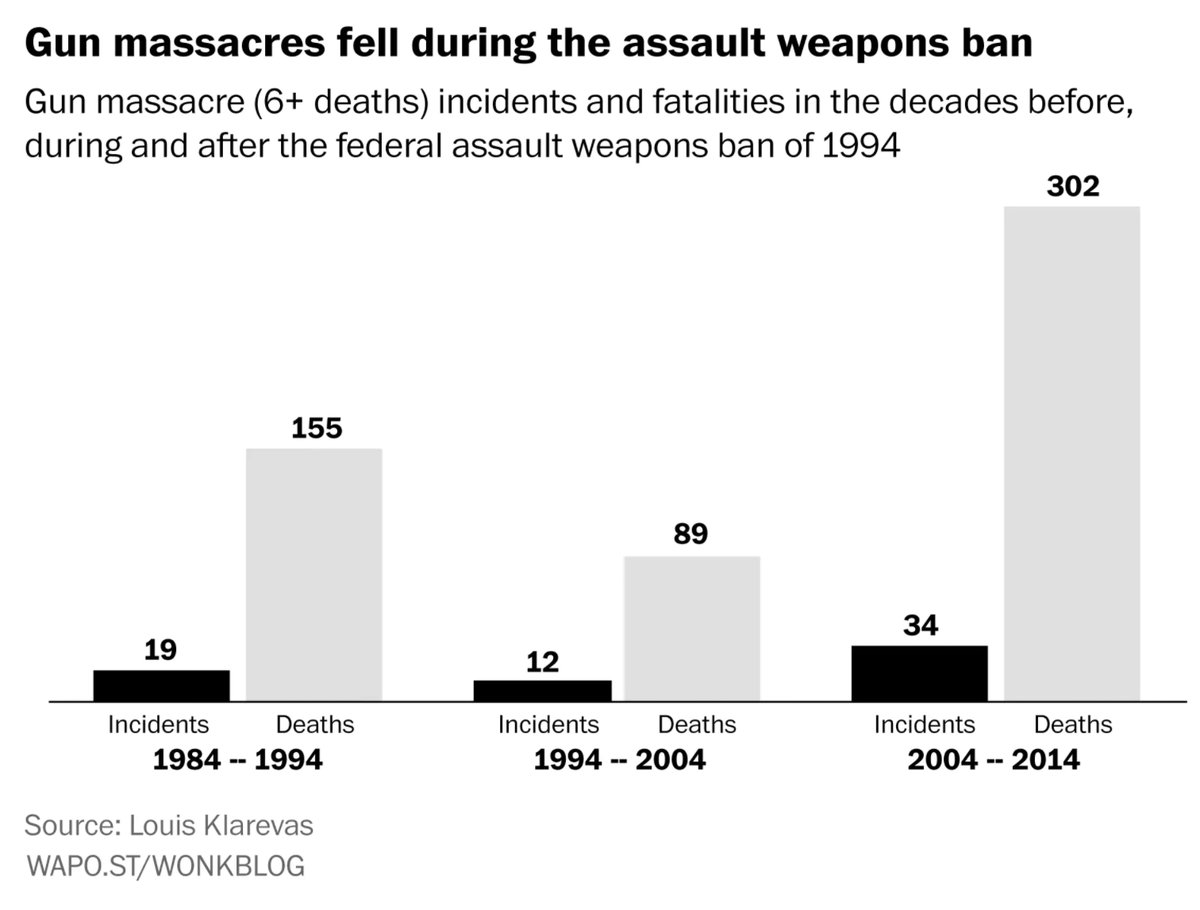
Gun massacres fell during the assault weapons ban (click to embiggen)
It’s the fourth Friday of February!

Seattle is in the middle of a record breaking cold snap, even while other parts of the country are experiencing record breaking heat. We seldom get snow in Seattle at all, and this winter we’ve had it several times. They’re saying it’s going to be this cold for several more days, at least. And the same large atmospheric phenomenon giving us all this icy weather it also what’s making it so warm elsewhere.

Once again I bring you the Friday Five: The top five (IMHO) stories of the week and videos (plus notable obituaries and a recap of my blog posts).

Stories of the Week:

More Than Twice As Many Women Are Running For Congress In 2018 Compared With 2016.

The Pro-Trump Media Has Its Match In The Parkland Students.

Democrats Should Run on Gun Control All Over the Country.

Gov. Greitens indicted for felony invasion of privacy stemming from affair. He is also accused of attempted blackmail. So much for family values…

What Ever Happened To Brendan Fraser? This article is not about what you probably think it’s about.

Death:

Billy Graham: Neither prophet nor theologian. I so seldom agree with George Will, but maybe only a curmudgeonly old ultra conservative can get away from saying (among other thing) in an obituary: “Graham frequently vowed to abstain from partisan politics, and almost as frequently slipped this self-imposed leash, almost always on behalf of Republicans… On Feb. 1, 1972, unaware of Nixon’s Oval Office taping system, when Nixon ranted about how Jews “totally dominated” the media, Graham said “this stranglehold has got to be broken or this country is going down the drain.” He also told Nixon that Jews are “the ones putting out the pornographic stuff.” One can reasonably acquit Graham of anti-Semitism only by convicting him of toadying.”

Even a Graham can’t save Trump. (This is more about Franklin Graham and his ilk and Trump, but the opening paragraphs nicely sum up the way Billy fit into the lives of many, many evangelicals in the 50s through at least the 80s)

Anti-gay evangelical Billy Graham has died, aged 99.

What the Obits Aren’t Saying: Evangelist Billy Graham Was a Homophobe.

Far from being ‘an exemplar to generation upon generation’, Graham is an example of how religion is so often successfully leveraged as a means of making bigotry appear somehow acceptable, even something to aspire to.

Things I wrote:

It can’t be too late for common sense about guns, right?

No, today’s official holiday name isn’t what you think.

When the roll is called up yonder, or queer confessions of an ex-evangelical.

Videos!

Trump vs. The World: Last Week Tonight with John Oliver (HBO):

(If embedding doesn’t work, click here.)

The Kids From Florida Aren’t Acting:

(If embedding doesn’t work, click here.)

Fox News retracts story mocking Olympic diversity:

(If embedding doesn’t work, click here.)

Legion Season 2 “No Secrets” International Promo (HD):

(If embedding doesn’t work, click here.)

Matt Gresham – Home (Official Video):

(If embedding doesn’t work, click here.)

When the roll is called up yonder, or queer confessions of an ex-evangelical

Me wearing part of the uniform for the interdenominational youth touring choir I was a member of for many years.
Just a few months ago I was trying to explain to a friend who lives in the U.K. the weird hypocritical dogma of the typical American fundamentalist Christian, and wound up mentioning that although I disagreed vehemently with many things that Billy Graham preached, I always felt his basic faith was sincere. This is in contrast to my opinion of Graham’s son who has taken over running the ministry, who both on air and in-person came across as an especially unethical used car salesman.

Even so, I was a bit surprised at my reaction to the news that the 99-year-old Billy Graham, oft described as “America’s Pastor,” died yesterday. Let’s make no mistake: while Graham was unusual among Southern Baptist ministers in the 1950s to embrace desegregation (“there is no segregation at the foot of the cross”) and at least gave lip service to decrying racism, he was an unrepentant homophobe. Statements he made over the years included: “Let me say this loud and clear, we traffic in homosexuality at the peril of our spiritual welfare.” Or: “Is AIDS a judgment of God? I could not be sure, but I think so.” Graham claimed to be non-partisan, but often came down on the Republican side of many issues. “At 93, I never thought we would have to debate the definition of marriage. The Bible is clear — God’s definition of marriage is between a man and a woman.” And it’s really hard to justify some of the comments he made while discussing Jews and the media with President Nixon in the 1960s.

But Billy could preach! Oh, how he could preach! It’s difficult to explain to someone who didn’t grow up in an evangelical community in the 50s, 60s, or 70s the cherished place Graham inhabited in the hearts of the faithful, semi-faithful, and faithful-adjacent. Graham wasn’t just held up as an example of a good man and great preacher, people were so certain he was inspired by god, that quoting him sometimes had a stronger effect than quoting from the scripture.

As a teenaged Southern Baptist (very closeted) queer boy in the 70s, I was perhaps more acutely aware of how much Graham was revered than most. While many saw my flare for the dramatic as a troubling hint of queerness, others saw it as a calling from god to become a preacher. The combination of that theatricality with my ability to memorize and recall huge sections of the Bible, as well as a facility with language, and being quick-thinking on my feet had people talking about what a great preacher I would make when I was still in grade school. Once I was older, and had more experience thanks to musical groups, drama club, and the debate team, well, it surprised no one when elders of the church started trying to convince me to get ordained in my late teens.

At the same time, completely unbeknownst to me, Mom and several women in our church were meeting once a week to pray that god would “rescue” me from the temptation of homosexuality. I hadn’t come out to anyone, at all, at the time. And while there are been some very furtive sexual relationships with a few boys my age during middle school, by the time people’s suspicions had risen to that point I was celibate, secretly praying even more fervently than they were, and doing everything I possibly could to be straight.

Which is precisely why, when I was approached about ordination, I started meeting with one of the associate pastors and studying to become a minister. Like millions of religious queers before me, for some time I thought that embracing “full-time Christian service” might be the only way to make my feelings for other guys go away.

I should mention that in Southern Baptist churches at the time, ordination was something that happened usually at your local church before you went off to Bible college. Which is the reverse of the way most other denominations do it. So I was still a teen in my first year attending community college while meeting with the pastors and deacons of our church several times a week to study and pray about my future.

I wish I could say that what caused me to back out was an epiphany about my sexual orientation resulting in self-acceptance replacing the self-loathing I had been taught all my life. That tipping point wouldn’t come for a few more years, yet. I also wish I could say that it was learning that the origins of the Southern Baptist denomination were much more racist and pro-slavery than I had been taught. That shocked me a little bit, but I was already quite familiar with the fact that only a few years before this the Southern Baptist Convention had finally denounced segregation of the races.

What did bring me to my senses were two conversations that happened close together, each with a different deacon in our church.

In the first, the elder in question took issue with my continued interest in science, particularly my interest in astronomy and evolution. He was quite unimpressed by my argument that a god who could plan and carry out a plan involved 15 billions years of stellar evolution eventually leading to humans was a far more impressive feat then simply waving a magic wand and making everything at once. While he referenced the Baptist principle that interpreting the scripture was something each person must do on their own, he also made it clear that my adherence to scientific fact was not an asset for a pastor.

In the conversation with another deacon, I mentioned an article I had read recently in which I learned that Fred Rogers, famous as Mister Rogers on PBS stations, was an ordained Presbyterian minister, who considered his work producing the children’s show his ministry. I thought it was a great example of how doing god’s work could take many forms The deacon had a very different view. First, he pointed out that (in the opinion of typical Southern Baptists), Presbyterians were “soft” on Biblical inerrancy. Further, if Rogers was actually doing god’s work, he would use that daily television show to tell children directly the story of Jesus. Since he didn’t do that, he wasn’t doing god’s work, according to this deacon. Finally, he said, “You know that Billy Graham was raised Presbyterian? He joined the Baptists because we’re actually doing god’s work.”

And those two conversations were the final nails in the coffin of me becoming a Baptist minister. The epiphany I had after those conversations was that all of the church leaders who had been urging me to become a minister didn’t really see the makings of a pastor in me. Instead, they thought that anyone who had Talent, whether it be intelligence, a gift for language, or whatever, who didn’t use that to evangelize wasn’t doing god’s work. That simply being a good person and doing what you can to make the corner of the world you were in a better place and to love your neighbors wasn’t enough.

I didn’t call things off until the end of the Sunday evening Church service where, as part of the process, I delivered a sermon and otherwise conducted the service. I still think that my John 16:33 sermon is an incredible work of art. But even as I was giving it, I knew the whole thing was a mistake. I suspect if I hadn’t called it off, that the deacon who was so concerned about my love of science would have done what he could to derail things. Regardless, there were a few more times over the next couple of years that leaders in that church and related churches came to me and asked me to prayerfully reconsider become a preacher.

I had learned my lesson: if the evangelical faith couldn’t accommodate both scientific fact and Mister Rogers, well, it didn’t have a place for me, either. I didn’t find my real place until several years later, but that’s a story for another day.


Note: The title comes from the hymn “When the Roll Is Called Up Yonder” by James M. Black, hymn #482 in the 1956 Baptist Hymnal.

No, today’s official holiday name isn’t what you think

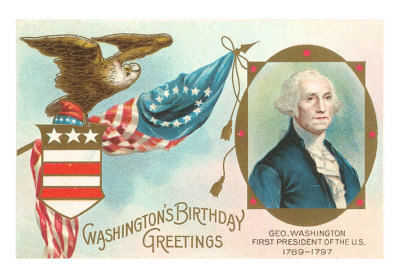
Several years ago my employer did a weird re-arrangement of the holiday calendar that results in the office being closed for almost a full week at Christmas, but we no longer observer MLK, Jr Day, Washington’s Birthday, or get a floating holiday. So I had literally forgotten today was even a holiday until after getting on my bus which was far emptier than usual and never filled up, riding on roads that were very empty, finally walking through downtown front the bus to my office through a downtown that is nearly deserted.

If I had remembered, I might have scheduled the post that published this morning for later in the week and written a new post about Washington’s Birthday and the myth of President’s Day. Instead, I’ll repost something I wrote on this line originally three years ago. Enjoy:

That’s not the name of the holiday

usafederalholidays.com
I’ve written before about the fact that President’s Day is a myth, the official name of the holiday is Washington’s Birthday Observance. Click the link to read about the history of the holiday, the few states that do observe a holiday called President’s Day (though some observe it in completely different months), and so on. Today, I want to talk a little bit about why there has never been a Federal holiday honoring Lincoln’s birthday, and how that contributes to people thinking that today’s holiday is about anyone other than Washington… Continue reading No, today’s official holiday name isn’t what you think

It can’t be too late for common sense about guns, right?

I’ve written about the most recent incident last week, and laid out how all the usual arguments for why we can’t do anything about mass shootings have been trotted out by other industries and proved incorrect a while ago: They used to insist that drunk driving couldn’t be reduced either. I had some more stuff I was going to follow up with, but almost everything I wanted to say is summed up by Emma Gonzalez, one of the survivors of last week’s school shooting in Parkland, Florida: Teen who survived massacre rips Trump to pieces in emotional takedown. I’m just going to quote a bunch of that article:

[S]he responded directly to Trump’s tweet, which blamed students at the school for not reporting on the shooter’s behavior before the event.

“We did,” Gonzalez said, “time and time again, since he was in middle school.”

“We need to pay attention to the fact that this isn’t just a mental health issue,” she continued. “He wouldn’t have harmed that many students with a knife.”

“How about we stop blaming the victims for something that was the shooter’s fault?” she demanded, and called out those who do deserve to shoulder that blame.

“[The people] who let him buy the guns in the first place. Those at the gun shows. The people who encouraged him to buy accessories for his guns to make them fully automatic. The people who didn’t take them away from him when they knew that he expressed homicidal tendencies. And I am not talking about the FBI. I am talking about the people that he lived with, I’m talking about the neighbors who saw him outside holding guns.”

The NRA gave $30,000,000 dollars to the Trump Presidential campaign alone, not to mention the tens of millions to various senators and congresspeople. Last year, when Congress passed a law making it easier for mentally ill people to buy guns (and Cadet Bonespur signed it), the NRA sent out a bulletin to all of its members bragging about it.

The NRA routinely pours millions into defeating laws that NRA members themselves claim to support. When gun sales plummeted last year after Cadet Bonespur was inaugurated, they spent a bunch of money producing advertisements that portrayed Black Lives Matters protesters and such as dangerous violent people. The ads were blatant calls for white supremacists to buy more guns and prepare for a race war.

The NRA as an organization is demonstrably not promoting responsible gun ownership and hasn’t been for decades. It’s only goals are to protect and increase gun manufacturer profit; and if any of its leaders aren’t racist (a highly difficult proposition to prove), they are all absolutely fine fanning the flames of racial fear to keep the money rolling in.

So, anyone still supporting them is supporting an organization that sees mass murders of children and racial tension as marketing tools. You aren’t nobly defending a moral principle if you support them.

It’s time to end this bloody charade.

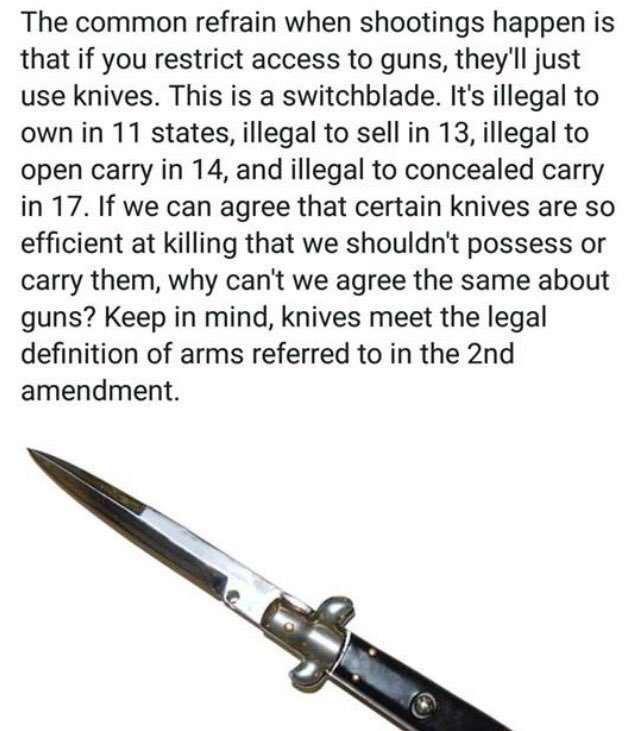
“The common refrain when shootings happen in that if you restrict access to guns, they'll just use knives. This is a switchblade. It's illegal to own in 11 states, illegal to sell in 13, illegal to open carry in 14, and illegal to concealed carry in 17. Itf we can agree that certain knives are so efficient at killing that we shouldn't possess or carry them, why can't we agree the same about guns? Keep in mind, knives meet the legal definition of arms referred to in the 2nd amendment.”
“The common refrain when shootings happen in that if you restrict access to guns, they’ll just use knives. This is a switchblade. It’s illegal to own in 11 states, illegal to sell in 13, illegal to open carry in 14, and illegal to concealed carry in 17. Itf we can agree that certain knives are so efficient at killing that we shouldn’t possess or carry them, why can’t we agree the same about guns? Keep in mind, knives meet the legal definition of arms referred to in the 2nd amendment.”

Friday Five (delighted devil edition)

The Republican Party has a HUGE PROBLEM and BLOOD on their HANDS!
It’s the third Friday of February!

It’s been a weird week for us. My hubby caught another cold. Work has been a weird mix of “Rush! Rush! OMG Please hurry!” and “let’s not get ahead of ourselves.” This weekend we’re host Writers’ Night, meeting a friend for a birthday celebration, and will try to see Black Panther.

Once again I bring you the Friday Five: The top five (IMHO) stories of the week and videos (plus notable obituaries and a recap of my blog posts). This week I’m also including for links related to the 19th mass shooting of the year, because awful news sometimes needs a separate category.

Stories of the Week:

Christian Writer: ‘The devil is delighted’ to see evangelicals defending Trump and the GOP at all costs.

The Follower Factory – Everyone wants to be popular online. Some even pay for it. Inside social media’s black market. The interactive graphics on this story alone are with the click!

Jeff Sessions Celebrates “Anglo-American Heritage of Law Enforcement”. A lot of people keep defending this on the grounds that Anglo-American is a technical legal term used sometimes used to refer to the U.S. interpretation of common law. But it wasn’t in the prepared speech, it is something he added over the advice of others, and every racist dog whistle that ever existed is technically a term of something that exist. Doesn’t make it not racist.

‘Skating was always there’: Eric Radford’s road to becoming the first openly gay man to win gold at the Winter Olympics.

Inside Apple’s HomePod Audio Lab.

Horrible News:

Our Moloch.

Leader Of White Nationalist Militia Says Shooter Was Member, Took Part In Paramilitary Drills.

New assault weapons ban will prevent mass shootings, experts say.

How Donald Trump’s Defense of White Supremacists Puts National Security at Risk.

After the Parkland shooting, let’s call GOP hypocrisy on guns what it really is: complicity.

In Memoriam:

These are the innocent victims of the Florida school shooting.

Florida shooting victims: Tributes pour in for students and teachers killed in Parkland school massacre.

Florida school shooting victims identified by authorities, remembered by friends, family.

Things I wrote:

Offended offenders — the joke is on who, exactly?

A Writer Writes: Where do I find my subplots?

“But he wasn’t a very good illusionist” — or, all is fair in camp, love, and war.

Great-grandma’s Gun.

Videos!

P!nk Belts Out the National Anthem! | Super Bowl LII NFL Pregame:

(If embedding doesn’t work, click here.)

Adam Rippon skates clean team event free skate:

NBC won’t allow embedding, so click here.)

Former GOP House Rep. David Jolly: If You Want Any Action On Guns, Democrats Must Flip The House:

https://platform.twitter.com/widgets.js

(If embedding doesn’t work, click here.)

STAND BY YOUR MAN (Donald Trump) – A Randy Rainbow Song Parody:

(If embedding doesn’t work, click here.)

Otter Snow Day at Shedd – 2018:

(If embedding doesn’t work, click here.)

Great-grandma’s Gun

My sister and I with Great Grandma St, John. I'm 9, my sis is 4, and Great-grandma is 74 in this picture.
My sister and I with Great Grandma St, John. I’m 9, my sis is 4, and Great-grandma is 74 in this picture.

I have often found myself in weird discussions/arguments with people who assume that because I favor many extremely liberal policies, I must be one of those evil anti-gun people. So before I get into this tale, let me begin by saying that I used to be a card-carrying member of the NRA. I have owned guns. I have fired guns. I have almost never fired guns on a gun range, because we didn’t have many in the Rocky Mountain towns where I grew up. I was taught how to shoot a gun by being taken out into the wilderness by my father and grandfather and firing it for a couple of hours at various things we set up as targets. Then after the third of fourth weekend of doing that being told I needed to go shoot a rabbit or two if I wanted to eat that night.

Long before we got to that point there had been many, many gun safety lectures, because there were lots of guns (mostly hunting rifles) in the homes of most of my extended family. I knew how to take apart, clean, and put back together a bolt-action rifle and how to re-load bullet cases (by which I mean, measure out gunpowder, put it into a spent casing, align a new bullet and insert it with a hand operated press, and install a primer cap) years before I was allowed to hold a loaded gun and shoot it.

There were winters when the only reason there was enough food on the table for the whole family was because some of us had gotten a deer or elk during the appropriate season (not to mention rabbits, pheasants, and grouse). I should also mention that I was raised to look down my nose in disdain at people who hunted pheasant and other birds with a shotgun. As my Grandpa said, “If you can’t hit a flying grouse or dove or pheasant with a rifle, you have no business pointing a gun at anything.”

I should also mention, in case it isn’t obvious from the part about learning how to turn spent cartridges back into bullets, missing was considered wasteful. We couldn’t afford to waste a lot of bullets getting the food.

But as the title of this post suggests, today I need to tell you the story of Great-grandma’s Gun… Continue reading Great-grandma’s Gun

“But he wasn’t a very good illusionist” — or, all is fair in camp, love, and war

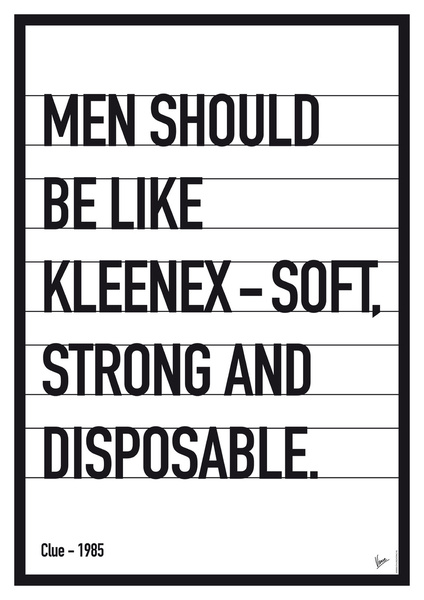
“Men should be like Kleenex — soft, strong, and disposable.”
One of many awesome quotable lines from the movie Clue. (click to embiggen)
Despite the fact that some people have accused me of being a hopeless romantic, one of my favorite fictional characters of all time is Mrs. White as portrayed by Madeline Kahn in the 1985’s Clue the Movie. Mrs White is a multiply-widowed woman who is assumed to have murdered several of her husbands. And those aren’t the only relationships she seems to have carried out in less than exemplary fashion. At one point in the movie she is asked how many husbands she has had, and immediately rejoins, “Mine or other women’s?” Afterward, she admits to five of her own, and then observes, “Just the five. Husbands should be like Kleenex: soft, strong and disposable.” And in more than one way she’s right. At least, what I mean is, when you realize that a relationship has reached its end, you should feel no guilt moving on, so long as you’re both able to be civil and neither of you behave abominably or do anything unethical to the other.

The truth is that the course of love and romance seldom runs true, as the old saying tells us. Mostly people misunderstand that saying, however. A lot of people operate under the mistaken notion that a relationship ending is the same thing as a relationship failing. Which is crazy. Living in a relationship is a whole series of tasks requiring multiple skills. And the only way to learn how to do a skill well is to try, fail, and try again.

Depending on your viewpoint, I can think of many reasons one could argue I’m a terrible spokesperson for Valentine’s Day or the topic of romance. I’m an out queer man, and there are a lot of people (including the man currently sitting in the office of Vice President of the U.S. not to mention a number of my relatives) who would insist that I don’t understand love because queers can’t love. A related group of people would say that because my first marriage ended in divorce (ignoring the whole orientation thing), that means I obviously suck at relationships. Others might quote Mrs. White from Clue and argue that “Life after death is as improbable as sex after marriage!” and therefore since I and my husband have been together for 20 years now that I have long forgotten what real romance is. And so on.

I feel compelled to point out that in college I was active in Debate and Speech competitions and in 1980 I won a number of awards in the After Dinner Speaking category, including eventually winning the Western Region Championship (beating out every other competitor west of the Mississippi) with a speech entitled, “How To Pick Up Girls.” So, this queer guy may know a thing or two about romance?

Of course, there is that divorce. But it may not mean what you think. You may be surprised to learn that some years after my divorce from Julie, that she asked me to be the Maid of Honor at her second wedding. Just as you may be surprised that we remain friends to this day. There are many reasons for that, not least being that Julie is an incredibly warm, loving person who is able to empathize with others and truly see things from multiple perspectives. I consider myself lucky to know her, and remain endlessly grateful that once we realized that I wasn’t bisexual we were able to stick the dismount.

Now, before she married her second husband (who is an awesome man who is perfect for her in thousands of ways that I was not), she had another relationship. This one with a man that, well, as soon as I met him I realized that he was NOT in her league intellectually and otherwise. But I was the ex-husband, and the queer ex-husband, at that, so at the time my opinion belonged tightly clamped behind my lips. But when that relationship fell apart, as a good friend, I was ready to offer sympathy, support, and to openly hate the ex (which was really easy because he was an idiot who didn’t deserve her).

So one evening she, I, and a bunch of our friends from the (now defunct) Seattle Lesbian & Gay Chorus, were standing around smoking (yes, I used to smoke, it has been 23 years since I quit, if you’re curious), and offering our condolences and so forth. She told a story of a particularly douche-y thing that he did to her during the break up, flaunting one of the women he had been cheating with. We all expressed our low opinion of him, and she equivocated, thinking maybe we were being too hard on him. I jumped in to say, “All men are pigs!”

One of the other friends, an extremely butch bisexual woman, laughed and said, “Oh, honey! He knows! Listen to him!” Several others chimed in all agreeing that I was right, all men are pigs.

And I was sincere. I’m a man who has dated a lot of men, and I can testify to the universal truth that men are pigs. As Mrs. White observed. “Flies are where men are most vulnerable.” She’s right. Sometimes we’re ruled by the wrong head. And when we let that head get us into trouble, we seldom manage to get out of such situations without hurting some of the people around us.

All men are pigs. Really and truly. It’s something I’ve known for many years.

However…

I’m addicted to pork. And I ain’t the only one!


Because some years ago a humorous post misled at least one of our friends to think that my husband and I was breaking up, I feel compelled to add this clarification: I love my husband with all my heart and we are still happy and together and I continue to remain astonished that he stays with me, because I don’t deserve him.

A Writer Writes: Where do I find my subplots?

“Adds diabolical subplot to torment protagonist.”
(Click to embiggen)
While working on last week’s post about subplots, I had several digressions that didn’t quite fit in the final version. That happens on most any topic I write about here. I wound up taking those sentences, fragments, and so on, dropped them in a new post with a temporary title “The next time I write about subplots.” This post is not made from those fragements. I started trying to expand them into a full-fledged post this weekend, but it wound up being just a few short paragraphs. So I thought maybe I could use those small points as an anchor for a post where I would include links to advice other people have given about subplots.

So while I was gathering some links, I hit on this one post entitled “How to Add Subplots to Your Novel.” When I saw the title, I thought, “Someone has some advice for people who can’t think up subplots. Brilliant!”

Except that wasn’t what the article was about at all. It’s a good article, don’t get me wrong. It explains what subplots are and the purpose they serve in a novel–basically the same info I wrote about last week. There is some additional advice about mistakes to avoid when weaving the subplot around your main plot and so forth, but nothing for the person who realizes their story needs the extra depth of subplots, but can’t figure out what the subplots should be. As I said, it’s a great article, just with a misleading title. The title should have been something like, “How to Properly Use Subplots in Your Novel Once You Think Them Up.”

Clearly, I need to write about this! First, though, I should admit that I’m having to do some reverse-engineering to write this. My problem has never been thinking up subplots, it has always been restraining myself form using all of them that pop into my head. My subconscious just churns them out by the gross, but I have a good idea of how it does this. Because of that overabundance, I have often been asked by members of Writers’ groups and other people reading drafts questions such as, “Why did you add this sequence in?”

My flip first answer was, “I didn’t add it! It’s just there.” What I meant by that is, when I think about all the characters in my story, I always think about things they are doing throughout their day and who are the imporant people in their lives. For instance: one supporting character runs a deli that she and her husband own. Her husband works as a handyman with a number of clients mostly in their neighborhood, including helping with the business, but she’s the one who runs it. She hires and supervises the staff, makes decisions about where to buy ingredients, designs the menu, and so forth. She also has a sister who she doesn’t always see eye-to-eye with, especially when it comes to religious matters. Her husband, unbeknownst to most of the family, is secretly one of the Elders of the Brotherhood of Chaos. She refers to these activities as her husband “taking care of some lodge nonsense again.”

I could keep going on and on about this supporting character who isn’t even directly involved in the main plot of the novel where she was introduced. All of those details I mentioned about the other people in her life, the business, et cetera, each has potential for subplots. Her deli is where one of the important conversations one of the protagonists has early in the book takes place. Her son is another of the protagonists (this novel has three protagonists).

Even though her first involvement in the novel is that conversation I mentioned, that isn’t why I created her. I was figuring out who my main characters were, and when I was looking at the third protagonist, I asked myself who was important in his life, and started jotting down ideas. Once I had a few sentences about her and her husband, I moved on. I was doing a similar exercise for another protagonist who runs an antique shop, and was wondering what other businesses share the same road, and I immediately thought of the deli-running character. Which gave me a connection between two of the protagonists.

So, if you are stuck for subplots:

  • For every character in your story, jot down the names of a few people important to them (this doesn’t have to be loved ones), a few facts about their life that have nothing to do with the main plot, and at least one ongoing activitiy (it can be as simple as “goes to work every day”)
  • For the characters who have significant roles in the main plot, think about times that they are not on center stage, and ask yourself what were they doing when they were gone. And don’t settle for, “Well, she has to retrieve the holy relic from the monastery then meet back up with the others.” Right. So who does she meet on the way? How does she get there? Where does she eat? What could happen that might delay her?
  • Think like an actor in a stage play: when the character is on stage but not the center of attention, what is the character doing? If two of your supporting characters are having lunch while the protagonist consults an oracle, what do those supporting characters talk about?

Not all of these things will be subplots. If you tried to make all of them subplots, it will look like one of my first drafts. But that’s where most subplots come from: answering the questions about what else is going on in the lives of your characters and their neighbors and friends and enemies outside of the main plot.