Offended offenders — the joke is on who, exactly?

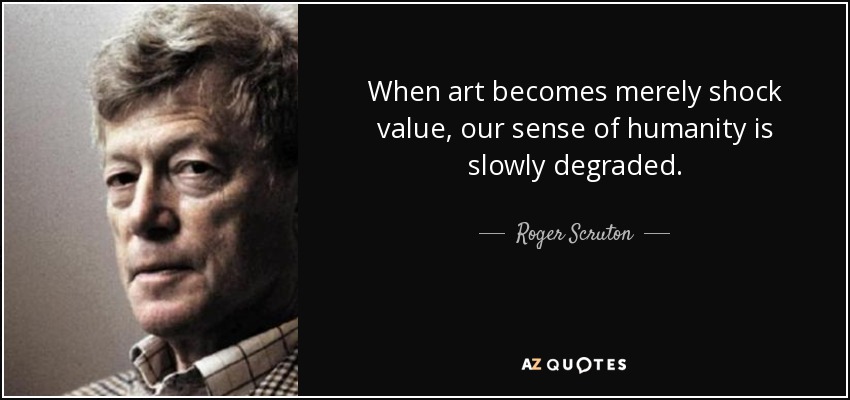
“When art becomes merely shock value, our sense of humanity is slowly degraded.” — Roger Scruton

We hear it all the time: “How dare you call me racist! I don’t hate anyone! I was just making an observation.” And there’s: “It is so rude of you to call me a homophobe! I’m just advocating for my beliefs {that queer people don’t deserve legal rights/to exist openly in public spaces if at all}. You’re the real haters!” Let’s not forget: “Can’t you take a joke? You’re trying to silence me!”

People behave like jerks, make threatening remarks, harass people, advocate for policies and propositions that will cause actual harm to others, and then get angry if other people take offense. They try to hide behind the idea of free speech—they’re just expressing themselves, and everyone has a right to do that, right? But the defense is built on one or more false equivalencies. The most basic is equating disagreement with censorship. If you say that all Freedonians are criminals, and I point out that isn’t true, and show the statistics to prove it, you haven’t been silenced. If other people decide the don’t want to listen to your rants about the evils of the Freedonians anymore, they stop inviting you to their social events and if you show up uninvited they ask you to leave, that also isn’t silencing you. The right to express an opinion doesn’t obligate other people to listen. Then there’s the false equivalence that accurately describing some of their statements as bigoted is just as bad as the bigotry we’re decrying. And so on.

But the defense that really annoys me is the, “But I’m only joking!”

I have several responses to that. The first is: every bully and abuser who ever lived has tried to claim that they were only joking, or they were just playing around. They didn’t meant to cause those bruises or broken bones or to break that laptop or whatever. It’s a lie. Maybe the bully and the bully’s audience were laughing, but real harm is being done.

The second response is: the fact that you think a particular topic is suitable for joking demonstrates the ignobility of your intentions. They only way that one can think the sexual assault is a joking matter is if they either don’t think the sexual assault is a bad thing, or if they think the victims of sexual assault are worth less than other people. There are topics that go beyond the pale, understanding that requires moral fiber and empathy. Not knowing that tells us you possess neither.

The third response is that doing something like “ironically” pretending to believe neo-Nazi ideology is indistinguishable from actually doing it. In other words, if you’re pretending to be an asshole, it doesn’t sound or feel any different to your targets than when a “real” asshole behaves that way. It also has a very scary normalizing effect. The more people feel it is acceptable to express racial bias, for instance, the more likely some of them are to act on the racial bias.

And my fourth response is that jokes are supposed to be funny. Calling entire classes of people inferior, saying they are a waste of space and so on isn’t funny. The objection that is usually raised around this point is that they are just trying to make people think, and they have to shock people out of their complacency to do that. I’ll agree that good political humor pokes at us to get us to think outside the box, but these guys aren’t quite getting it.

“Have you ever noticed that anyone driving slower than you is an idiot and anyone driving faster than you is a maniac?” “Electricity is really just organized lightning.” “Fighting for peace is like screwing for virginity.” “At a formal dinner party, the person nearest death should always be seated closest to the bathroom.” “'I am' is reportedly the shortest sentence in English. Could it be that 'I Do' is the longest sentence?”
Several classic George Carlin one liners. (Click to embiggen)

Let’s look for a moment at the work of a comedian who was often characterized as offensive. The Late George Carlin said things that shocked some people’s sensibilities. Go listen (many recordings abound) to his notorious “Seven words you can’t say on TV or the radio” routine and tell me that wouldn’t give people in the Religious Right conniptions. And sure, you can pull out individual lines from his routines and make him sound almost like some of this current generation of jerks with their racist or homophobic or misogynist rants on their Youtube channel. But that’s taking him out of context. Look over the classic Carlin corpus (excluding the last few years where he seemed to turn into a prophet of doom and things got a little weird) and you’ll find the most prevalent underlying theme is summed up in one of his best one-liners:

“Have you ever noticed that anyone driving slower than you is an idiot and anyone driving faster than you is a maniac?”

While the line works great on its own, it was actually the introduction to a longer bit, where he went on to make humorous observations about foolish and dangerous and weird things that people do while driving. It ranged around for a bit, and the audience laughed. You could certainly characterize the routine as making fun of bad drivers. And that doesn’t seem all that different from someone else having a comedy routine where they make fun of women, or immigrants, or queer people, right? But that’s not what the routine does. Every version of it I ever heard him perform varied a bit, but all stuck to one underlying theme. And it’s in that line I quote. That line isn’t just a joke, it’s a thesis statement.

Read it again: “Have you ever noticed that anyone driving slower than you is an idiot and anyone driving faster than you is a maniac?” Explicitly it says that we classify and judge people in categories like stupid and maniac by extremely subjective criteria. But implicitly it is also saying that sometimes all of us are idiots, and sometimes all of us are maniacs. Because implicitly everyone that we observe is an idiot for driving too slow, knows they we are maniacs. And every person that we can see is a maniac for driving too fast, can observe that we’re driving slow and therefore we are idiots.

Yes, the point of his routines is that some people do very foolish things and isn’t it ridiculous that such people exist? But by the time he has covered the subject, there is a point where he says something that hits close to home. We, the listeners, see ourselves in some part of that routine. In that way, his routines adhere to the classic definition of political humor: to hold a mirror up to society.

That is humor with a purpose. That is how you jostle people out of their complacency. You hold up a mirror, so that we look into it and see our own foibles and flaws. But what these other guys are doing? They aren’t working with mirrors. No, they are putting targets on other people, aiming their fans at those targets, and encouraging the fans to pull their triggers.

That is why the rest of us don’t listen to their rants. We disinvite them from our events. We tell them that their behavior is not welcome at our conventions or on our forums and so forth. That isn’t censorship, that is making a choice of who we will associate with. It’s deciding that we don’t need jerks and abusers in our lives.

Friday Five (emerging awareness edition)

When class consciousness emerges...
When class consciousness emerges…
It’s the second Friday of February!

Work was less tense this week as we scrambled to make the crazy deadline and now we’re picking up loose ends and planning for the next crazy deadlines.

Welcome to my Friday Five: The top five (IMHO) stories of the week and videos (plus notable obituaries and a recap of my blog posts). Also this week I’m including five stories from my local news sources.

Stories of the Week:

Russians penetrated U.S. voter systems, top U.S. official says.

Thomas The Bisexual Goose Will Be Buried Beside His Male Partner Of 30 Years.

Meet a Briton From 10,000 Years Ago.

Why Are Murders Of Gay And Bi Men Up A Staggering 400 Percent?

Tillerson Warns Russia Is Meddling In 2018 Midterms, Methods Evolving.

Local Developments:

Mayor Jenny Durkan: Why Seattle Is Erasing Misdemeanor Marijuana Convictions from People’s Records.

As the oceans change, can oysters adapt?

The Mystery Tree Fall Near Lake Quinault: Why Did It Happen? Part I and Part II.

‘We thought we’d pulled a dead person out of the water’: Extracorporeal Membrane Oxygenation machine saved her life.

Seattle, Tacoma among worst traffic congestion in U.S.

In Memoriam:

John Mahoney, who played cranky dad on “Frasier,” dies at 77.

The Late, Great John Mahoney Was Frasier’s Father, and Yours Too.

Why John Mahoney is an inspiration to late bloomers everywhere.

Things I wrote:

Coffee, coffee, everywhere — and why half of what you know about it is wrong.

Self-loathing self deceivers—they are never just hurting themselves.

A Writer Writes: Subplots and subtexts are not the same thing.

That doesn’t mean what it used to — more adventures in dictionaries.

Videos!

VENOM – Official Teaser Trailer (HD):

(If embedding doesn’t work, click here.)

AVENGERS: INFINITY WAR Official Super Bowl Trailer (2018) Marvel:

(If embedding doesn’t work, click here.)

Deadpool, Meet Cable:

(If embedding doesn’t work, click here.)

Of Course Trump Wants to Throw Himself a Military Parade: The Daily Show:

(If embedding doesn’t work, click here.)

Matt Palmer – Solo Act (Official Music Video):

(If embedding doesn’t work, click here.)

That doesn’t mean what it used to — more adventures in dictionaries

“terrific, a [L. terrificus, from terrere, to frightenm and facere, to make.] Dreadful; causing terror; adapted to excite great fear or dread; as a terrific form; a terrific sight.”
Using my self-lighting magnifier with my latest dictionary acquisition, (Click to embiggen)
If you’ve ever known a collector of anything one thing you learn is the collector seldom has a concept of the word “enough.” No matter how many trading cards or figurines or fossils or whatever it is the collector fancies they already own, if they find one that they don’t already have in good condition at a reasonable price, they’re all over it. And my penchant for collecting dictionaries is no exception. While other people were watching the Super Bowl last Sunday, my husband and I were hitting a few thrift stores. And guess what I found?

Now the sad part is that we were doing this specifically because we’re both working on hall costumes for NorWesCon (at the end of March). My husband actually found things for one of his costumes, but what did I find? Well, I found a copy of the 1951 edition of the World Publishing Company’s New Twentieth Century Webster’s Dictionary of the English Language Unabridged. Yes, that whole thing was the official title. This was one of the dictionaries produced after the legal ruling that found the Merriam-Webster Company could not prevent other companies from using Noah Webster’s name on their dictionaries even though they weren’t actually using Webster’s original dictionaries nor operating under the auspices of the agreement made between Mr. Webster’s estate and George and Charles Merriam back in 1843.

Click to embiggen

The World Publishing Company only produced this edition, a two-volume version, and a slightly revised 1953 edition before selling out to Macmillan Publishing USA. This dictionary, while being labeled “unabridged” and spanning approximately 2300 pages isn’t exactly one of the most highly regarded, given that a third of that page count is actually a desk encyclopedia, and the editorial staff hadn’t been working on it for as long as some of the more storied dictionaries. Which isn’t to say that it’s a poorly made dictionary.

But its primary claim to fame is that the editorial staff for this edition was headed up by Professor Harold Whitehall, of the University of Indiana. Whitehall was an interesting choice to edit an American dictionary because Whitehall was British. Whitehall was born in 1905 in Ramsbottom, Lancashire, England. He got his first degree at Nottingham University, studied for a while after at London University, before coming to the U.S. where he obtained is Ph.D. from the University of Iowa. He taught at the University of Iowa, at the University of Wisconsin, and Queen’s College New York, before settling at the University of Indiana where he spent the rest of his academic career. While he was at Michigan, he served as assistant editor of a Dictionary of Middle English (the English spoken during the 12th, 13th, and 14th Centuries), which was probably why he was recruited by the World Publishing Company.

And why it’s important that Whitehall worked on this dictionary is, that while the number of words and depth of the definitions weren’t on a par with other unabridged dictionaries of the time, the New Twentieth Century Webster’s Dictionary had the most thorough etymologies of any America-published dictionaries published up to that date. Because linguistics—specifically the history and derivation of our language—was Whitehall’s passion.

When Macmillan acquired most of the World Publishing Company, they already had a staff of dictionary editors, but they asked Whitehall to stay on, created the post of Linguistics Editor for him, and they released several more editions of this dictionary for subsequent years, before the company was acquired by another publisher in 1998, who sold off the reference division to yet another company in 1999 and so on. Whitehall stopped working for them some time before 1960, though he continued to teach English and Linguistics at the University of Indiana until his death in 1986.

In honor of my finally acquiring my own copy of this dictionary famous for bringing a new level of etymological rigor to American dictionaries, this is a perfect time to talk about why understanding when your dictionary was created and how it is being maintained is important. Don’t assume that just because there are lots of free dictionaries available on the internet that anyone started with a high quality source or experts are keeping it up to date. And this is important because the language is a living thing that changes over time.

For instance, terrific used to mean terrifying (terrific is to terror as horrific is to horror, as a friend so eloquently put it). As the 1951 edition puts it (shown in the picture above I took the other night):

ter-rif’ic, a [L. terrificus, from terrere, to frighten and facere, to make.] Dreadful; causing terror; adapted to excite great fear or dread; as a terrific form; a terrific sight.”

How did the word come to mean the opposite? Simple, the sarcastic or ironic use became far more common than the original meaning. People used it sarcastically to refer to something that wasn’t horrifying at all—quite the opposite—and people hearing that usage while not being familiar with the word themselves inferred its meaning from context. And soon everyone was using terrific as a synonym for “wonderful” instead of “horrible.”

Notice from the image above, there is no other definition given. If we jump ahead to one of my 1987 dictionaries, for instance, we find the primary definition being “causing great fear or terror”, the second as “remarkable or severe” and only the third definition, marked informal is “very good or wonderful.” Whereas my 2001 Oxford New American Dictionary lists the “causing terror” definition as archaic, but even then, the primary definition is “of great size, amount or intensity,” and the second sense of “extremely good or excellent” is still listed as informal. Although that may be because the editorial board of the Oxfords include a lot of British people. Most of my American published dictionaries from the late 90s on list something along the lines of “extraordinarily good” as the primary definition.

But this is part of the reason I am obsessed with dictionaries and how they are made. I have watched the meanings of some words change in my lifetime. It’s important to know this happens, particularly if you ever read books or stories written many years ago.

Some words don’t mean what they used to. That’s not a bad thing, but it can cause some confusion and consternation from time to time. Did I mention, that while consternation now means “feelings of anxiety or dismay” that is once used to mean “terrified”?

A Writer Writes: Subplots and subtexts are not the same thing

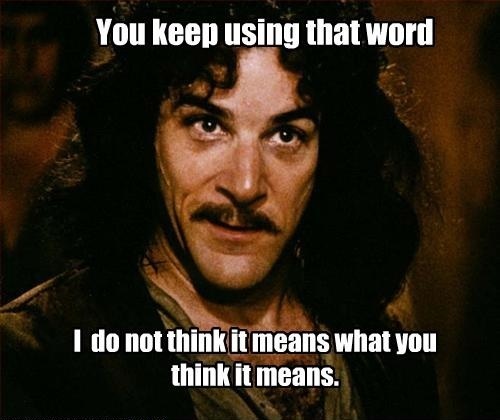
“You keep using that word. I do not think it means what you think it means.”

I was reading a discussion between several fans of a book that I have read, and was finding myself very confused. They kept talking about a subplot that I didn’t remember, and the conversation went in a weird direction where several people in the discussion were arguing about what the subplot actually was. And I finally realized that none of the people in the discussion knew what the word “subplot” means. They seemed to have confused “subplot” with “subtext” and were actually arguing about the underlying metaphors that they thought the author was portraying.

So first, let’s get some definitions.

subplot – a part of the story of a book or play that develops separately from the main story; a secondary strand of the plot that is a supporting side story for any story or the main plot; a subordinate part of a story distinguished from the main plot by taking up less of the action, having fewer significant events occur, with less impact on the “world” of the work, and occurring to less important characters.

Subtext, on the other hand, is an underlying, implied theme in a creative work. It is never announced explicitly by the characters or author, but is implicit or becomes something understood by the observer of the work as the production unfolds.

So a subplot consists of explicit actions that occur in the story: the characters of Merry and Pippin getting separated from the rest of the Fellowship of the Ring and having separate adventures before eventually rejoining the other characters is a subplot. The events actually happen on screen/page. On the other hand, postulating that the entire story is ultimately a commentary about death and obsession, those are discussions of subtext. If you are talking about the meaning of the story, you’re talking about subtext.

If you’re still not sure what a subplot is, it might be helpful to think about a typical television show. The primary plot (often called the A plot) of an episode of a workplace comedy might be about the annual staff review. The subplot (usually called the B plot) might be exploring a relationship between two of the characters. Another subplot (usually called the C plot) might be that one of the characters has started shaving at his desk and it is really annoying two other characters. Quite often in television shows the C plot is a running gag that resurfaces again and again. In my example, the character who shaves at his desk in that episode may have a lot of weird annoying habits, for instance.

Subplots serve various purposes in a story:

  • Add depth to your characters
  • Foreshadow things in later stories when you’re doing a series
  • Provides a sense of reality by showing other things happening in parallel to the main plot
  • Control the rising and falling sense of urgency as the main plot progresses
  • Reinforce the theme or show contrasts to the theme

Please note that I didn’t say anything about increasing the word count of your story. A lot of people think that’s the purpose of subplots in a novel, and I realize that I’ve perpetuated that misapprehension myself when I’ve said that “subplots help fill out a novel.” But what I was actually referring to was that subplots buttress your plot by doing each of the things listed above. Specifically:

Add depth to your characters. The main plot might be about preventing a supernatural disaster that could kill millions, while the subplot about one character not wanting to be betrothed to the person his parents have chosen gives insight into that character’s life and priorities. This gives the reader a stronger sense of the character and more ways to care about how the main plot affects him.

Foreshadow things in later stories. If you already know you want to write sequels to this tale, whether it is a short story, novella, or a novel, a subplot in this story can lead to the primary plot of the next.

Provides a sense of reality. Real life is messy. People have multiple things going on in their lives at the same time. Showing some of the other things happening at the same time as the main plot adds depth and breadth to your fictional world, solidifying your setting. The subplots still need to tie into or support the main plot, which can take many forms. The subplot may explain why a crucial supporting character is unavailable at a crisis point, for instance.

Control the rising and falling sense of urgency. This is one of the most common reasons subplots are employed in TV shows, movies, and the like: it gives the director something to cut to when they want to leave the main plot of a minor cliffhanger or to give the viewer a breather from a particularly intense scene. The same thing happens in prose stories. You can have a scene that shows your main character(s) attempting to sneak into the dark overlord’s stronghold, for instance, and bring them right up to the point where they are surprised by a guard. Then you end the scene on the cliffhanger, and jump to another location where two of the supporting characters who have become lost in the woods then follow them until a moment where they meet a stranger. Then you leave that scene and jump to another location where one of the minions of the dark lord is preparing an ambush of yet another group of supporting characters, and so forth. If first two scene were particularly intense, instead of having the minion setting up an ambush, you might show them failing to accomplish something in a humorous way, to provide a bit of comic relief.

Reinforce or contrast the theme. Suppose the theme of your story is how people react to the possibility of death. You might have one subplot involve a set of supporting characters dealing with another type of loss—perhaps their business is failing or their marriage is on the rocks. You can then have this subplot progress along with the main plot. It might not be resolved until the end when the main plot is resolved. Or you might decide to have it resolve at about the same time that the main plot takes a particularly emotional turn. And/or you may have a subplot that, instead of dealing with the loss or ending of something, is about the beginning of something in the life of another supporting character.

Please note that a single sub-plot can do several or all of these things for your story. The subplot about the supporting characters’ failing business will surely give depth to those particular characters as the reader sees how they react to the fear of the loss to begin with, and how they deal with each stage. Such a subplot also shows that there is more to the life of the characters than just the events of your main plot, providing a sense of reality.

I began this post by talking about people who had confused a subplot with subtext. While a subplot is a different thing than subtext, a subplot can contain subtext. Just as the main plot can have subtext. To sum up: the plot is the explicit primary problem that the protagonist struggles with from the beginning of the story all the way until the end. A subplot is a smaller or less important problem that one or more characters struggle with explicitly for some portion of the story, but not necessarily the entire tale. Subtext is an implicit (or inferred) theme or meaning which the reader understands without the author ever explicitly mentioning it.

Another important different is that plots and subplots are always things that author put in the story intentionally. Subtext can exist completely divorced from the author’s intent. But that’s a topic for another day.

Self-loathing self deceivers—they are never just hurting themselves

“Conversion therapy is harmful to both the individuals who are subjected to it, and society more broadly, as it perpetuates the erroneous belief that homosexuality is a disorder which requires a cure.”
(Click to embiggen)
I know this story broke a couple of weeks ago. If I was still doing the really long weekly round up of links, it would have been included that week, and I might have typed a sentence or two of strongly worded commentary. But it didn’t make it into the top five stories for Friday Five. And besides, if I’m going to comment on the whole Josh Weed situation, I ought to make it a full-fledged post.

Let’s begin with the headline: This Gay Mormon Man Who Got Famous For Marrying A Straight Woman Is Getting Divorced. Quick sum-up, back in 2012 Josh Weed and his wife went public about the fact that he was gay, but that as devout Mormons they were choosing to be married. He claimed to be happy and fulfilled in this loving marriage with a woman, and by the way, he mentioned he was a therapist who was always happy to take on new patients.

He was quick to deny that he was pushing so-called ex-gay or conversion therapy. He was simply “helping those with sexual identity issues, unwanted sexual attractions and behaviors.” In interviews he insisted again and again that this wasn’t conversion therapy because he knew that no one could stop being homosexual. No, he was just helping people (“particularly young people”) struggling with this problem by “meeting them where they are and helping them find a solution that meets their needs.”

And specifically, he was holding himself up as an example of a gay man who could enter into a heterosexual marriage, never act on his same-sex attractions, while living a happy, fulfilled life that was congruent with his church’s belief that being gay was an abomination. Except, of course, he didn’t mention that abomination part.

To claim this wasn’t conversion therapy was to draw a distinction without a difference, at best. To do it while advertising one’s therapy services moves it squarely into the lying category.

“The couple is now apologizing to the LGBT community for how the “publicity of our supposedly successful marriage” has been “used to bully others.””

As part of the process of the downfall of the explicitly ex-gay conversion business (and it was always a business), there were a number of court cases (often parents of children sent off to this quack therapy now suing over the wrongful deaths of their children) where the practicioners were forced to admit under oath that at least 99.9 percent of the time no one was ever cured of being gay. Their previous claims about cure percentages was to count anyone who was able for a period of time to resist their feelings and put on a good front pretending to be happy while the refrained from acting on those feelings as a “cure.”

In other words, all the people doing it knew that it never worked.

Part of Josh’s and his soon-to-be-ex-wife’s apology now is to claim they are deeply saddened and ashamed that their story was used to bully other people. They write a supposedly heartfelt account of a person in his twenties coming home for Thanksgiving not long after the Weeds’ story first came about and being physically assaulted by his father because, “If Josh Weed can stop being gay, so can you!” And many many other horrible tales.

Here’s one of my problems taking this apology as sincere. This assault? Happened back in 2012. The young man who endured it wrote to them about in shortly after it happened. And he wasn’t the only queer person from a conservatively religious family who during the time the Weeds were in the headlines previously experienced something like this, went to Josh Weed’s website, and posted a comment years ago.

If Josh Weed was sincerely sorry about people supposedly misconstruing his allegedly not-homophobic story, he would have began issuing apologies and clarifications when the comments first turned up on the website. What he did instead, was to continue to insist in interview after interview in various publications throughout the years since that 1) he wasn’t providing conversion therapy himself, and 2) he didn’t think that him choosing to live in an opposite sex relationship implied that other people ought to do it.

That’s not my only problem with this. As part of their announcement and apology, they recount the epiphany that Josh had that his sexual orientation isn’t a “biological aberration” after all. Back in 2012 and in all those subsequent interviews, he constantly insisted that he didn’t think there was inherently anything wrong with being gay, he was just offering help to those who didn’t want to act on their desires. But now we clearly know that he and his wife (because while talking about the epiphany he also talks about all the conversations he had with his wife about it) believed all along that being queer was a biological aberration.

So in his apology he is tacitly admitting he was lying for all those years.

Listen, I used to be a self-loathing closet case. I spent most of my teens and twenties scared to death that people would find proof that I was the faggot that many of them called me all the time. I prayed and cried and pleaded with god during those teen years to make it go away. The Southern Baptist churches I was raised in are no more welcoming to queers than the Morman churches Weed grew up in. I understand how he got in that situation. I understand how the fear of being rejected by your family, your church, and everyone you know drives a closeted queer person to terrible rationalizations. I understand that when you’re in that situation, you are lying to yourself and trying to convince yourself to believe the lie even more than you are lying and selling the lie to everyone else.

And, yeah, I’m happy for him now that he’s finally realized that forcing himself to pretend to be happy and fulfilled in a marriage to someone with whom he wasn’t in love—a marriage in which his sexual and emotional needs weren’t being met—was actually harmful. And I’m happy that, unlike a lot of other ex-gays out there who came to their senses he’s actually gone public about it. And sure, it’s nice that he’s apologized for some of what he did.

But it isn’t enough. The current apology is just a variant on the old “if someone was offended” non-apology. He’s apologized that other people used his story to hurt queer family and friends, as if it’s just a completely unexpected side effect that he has only recently learned about. We know that he was contacted by a lot of the victims years ago. He knew. He knew and yet he used the impression people had that if he could pretend to be heterosexual than anyone can to advertise his own counseling services. And in those therapy sessions he told many patients all the things that he says now he’s realized weren’t true.

When people like Josh Weed tell their story of choosing not to act on their sexual orientation—when they actively seek out interviews and coverage in the religious press for their story—that lie he’s telling himself is weaponized by other people. It is used as an excuse by those people to bully their own queer children or any other queer people in their families and communities. It is used in far too many cases to bully those queer people to death. It is used as an excuse to throw queer and gender nonconforming children out on the street.

I’ve written before about my personal experience of having family members use the stories of people like Josh Weed as the justification to reject me, threaten me, and say I and my husband aren’t welcome. I don’t know a single queer person who hasn’t had someone browbeat them with stories like Josh Weed and other ex-gays.

I’m going to keep insisting that Josh was an ex-gay. It doesn’t matter that he rejected that label. The hair-splitting he was doing to justify the rejection was ludicrous. And I’m not going to accept this apology because it is incomplete. He wasn’t just deluding himself for those years, he was literally selling that lie to other people. And until he admits that he was doing that; until he admits that the weaponizing of his story wasn’t happening without his knowledge; until he admits that his denials about the nature of his counseling was wrong; until he admits his silence until very recently in the face of that weaponization was also wrong; he doesn’t have an ethical right to ask for forgiveness.

Coffee, coffee, everywhere — and why half of what you know about it is wrong

“There is no such thing as strong coffee, only weak people...”
“There is no such thing as strong coffee, only weak people…”

I have been drinking coffee since I was 12 or 13 years old—in other words, for 45 years! During that time the amount and types of coffee I drink has varied. Growing up in a working class family in the central Rockies, meant that for many years the kind of coffee I drank would be sneered at by a lot of coffee afictionadoes. Cheap, canned ground coffee for the percolator, instant coffee for when you don’t have the time to make a full pot. My father and both grandfathers had the kinds of jobs where they took a lunch box and a big thermos full of coffee with them each day they went to work.

So for more than 45 years I’ve been around coffee and coffee lovers, as well as consuming a lot of coffee myself. And I have spent a good portion of those 45 years having to debunk commonly held beliefs about coffee’s affect on one’s body. I thought I had heard everything, but a couple of years ago when the topic of coffee came up in an online discussion, someone made a joke about coffee making you poop. Or, I should say, I thought they were making a joke. But I encountered it a few times again over the next few months, and then it seemed that everyone on the planet knew as an absolute certainty that coffee is a natural laxative of such power that if forces you to run to the bathroom a few minutes after finishing the cup.

This puzzled me in part because 1) I had never experienced this effect, and 2) while some of the men who drank a lot of coffee around me when I was a kid would occasionally make crude comments about how many times they had to take a piss because of the coffee (and that they didn’t want a third cup because they didn’t want to take another piss soon), no one had ever mentioned needing to take a dump. And I guarantee you that a couple of my uncles would have had some very colorful jokes based on it if they had ever observed a correlation between drinking coffee and needing to poop.

So, I did some research, and while it is easy to find a lot of web pages that promote the idea, if you restrict your reading to pages that cite medical studies, you find out that, yeah, it’s a myth. There was one study in the 1990 that seemed to show an increase in the muscle movements of the colon a few minutes after drinking coffee—but only in about 28% of the subjects. And, most medical people who commented on the study were quick to point out that the study didn’t demonstrate that this increase in activity was enough to create a laxative effect. Another study a few years later couldn’t reproduce the results with coffee alone—they only measured the increase if the person drank the coffee (either regular or decaf) along with a meal of at least 1000 calories. That would seem to indicate that maybe it isn’t the coffee that’s the issue, it’s filling up the stomach and kicking the digestive system into full gear that causes the movement further down.

Lots of people insist that drinking coffee makes them need to go. Among the many critiques raised by other researchers concerning these studies and the anecdotal evidence is people are overlooking the possibilities of both a pavlovian effect and habits. If you generally drink coffee shortly after waking up most days (because you set up the automatic coffee maker on a timer each night, for instance), and you usually eat dinner at roughly the same time each night, your body may just be ready to go by morning. The coffee is a coincidence.

As the article I linked to above also mentions, the oft repeated notion that drinking coffee, tea, and other beverages containing caffeine actually dehydrates you is also a myth. Coffee, it turns out, is not a diuretic.

I want to pause here and point out that I’ve heard the admonition against drinking coffee because it supposedly dehydrates you from nurses and other medical personnel ten times more often I hear it from anyone else. This is the reason that anytime someone starts telling me that one should eat or do this, or refrain from eating or doing that because their doctor told them that I have to fight not to roll my eyes before urging them to do some of their own research.

My favorite is that people still cite studies from the 1950s that showed a correlation between coffee drinking and heart disease (among other things). Because those original studies made two errors that created a false correlation: they didn’t control for tobacco use, and they didn’t separate data by the gender of the subject.

Turns out that back when smoking was much more prevalent than it is today, there was a high correlation between coffee use and smoking. In other words, people who drank a lot of coffee were more likely to also be heavy smokers. Once you think about the neurological properties of caffeine and nicotine, that makes sense, both substances are mood regulators. Anyway, turns out that most of the statistic correlation vanished once you accounted for the smoking.

A tiny bit of statistical correlation remained, but if you then separated the data and compared only coffee drinking men to non-coffee drinking men, and similarly only comparing coffee drinking women to non-coffee drinking women, the correlation completely vanished. Why? Well, coffee drinking men on average drink between 10-20 percent more coffee today than the average woman. Given that on average men outweigh women by a bit more than 10 percent, and the amount of caffeine one must consume to produce a given result varies by body mass, it makes sense that coffee drinking men will consume at least 10% more coffee than women. Completely separate from any lifestyle questions, it is a biological fact that merely being male increases one’s chances of developing heart disease or high blood pressure.

This is a great reminder that correlation doesn’t necessarily mean causation.

There have been many more recent studies that have shown there is no link between coffee consumption and coronary artery disease or stroke. That is, no link between regular coffee and those diseases. Oddly enough, people who drink a lot of decaf seem to have a slightly increased risk of certain types of coronary disease, though at this time no one knows why.

Anything that people indulge in—if it isn’t perceived as a necessity for survival—comes under a lot of scrutiny from others. There are always people who thinking you shouldn’t indulge in the activity at all, or that you shouldn’t do it more than they do, and so on. So that’s one reason coffee accumulates these misperceptions and why people repeat them indefinitely. More generally, people place a lot more weight on their own perceptions and anecdotal evidence of people who agree with them than they do to logic, statistics, and reproducability.

The science indicates that coffee doesn’t have most of the negative effects most people associate with it. So you can enjoy it guilt free. And if you’re one of those people who don’t enjoy or use it or all, that’s absolutely fine. Just stop ragging on other people for doing it. None of us are giving you grief for your oxygen habit, are we?

“Coffee: a warm, delicious alternative to hating everybody every morning forever.”

The Return of the Fumble Fingers, part gazillion

I clicked publish instead of save by mistake, again. Come back later for the finished post.

Friday Five (how could you realize edition)

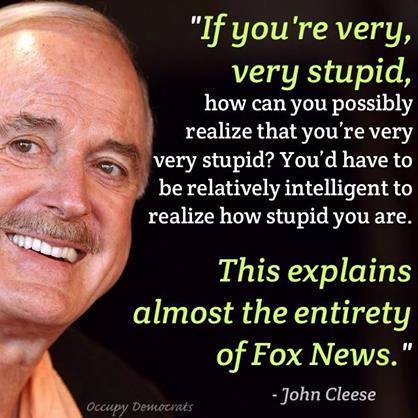
“If you are very, very stupid, how can you possibly realize that you are very stupid? You'd have to be relatively intelligent to realize that you're very,  very stupid? You'd have to be relatively intelligent to realize how stupid you are. This explains almost the entirety of Fox News.”
“If you are very, very stupid… ” (click to embiggen)
It’s Friday! The first Friday of February.

This has been a weird week. Except it isn’t that weird, because in the thirty (30) years that I’ve worked in the software industry, this has been something that occurred several times each year. We had an impossible deadline. Everyone worked extremely long hours (for which we aren’t paid overtime because the suits figured out years ago that you could demand impossible results that require enormous amounts of extra time from people while implicitly threatening their employment and we would allow ourselves to be classified as “exempt” employees and give up many protections).

The upshot is, I was surprised that I had more than five stories bookmarked and actually had to spend some time tonight deciding which five to include in this post, because I worked such long days this week that I had very little time to pay attention to the news. Yet, I did have to spend some time winnowing it down. And therefore…

Welcome to my Friday Five: Only the top five (IMHO) stories of the week and videos (plus notable obituaries and a recap of my blog posts).

Stories of the Week:

Fitness tracking app Strava gives away location of secret US army bases.

Why do evangelicals love Trump? Dumb question: Why wouldn’t they? “Trump is doing the bidding of right-wing Christians — and movement conservatism has become a form of religion”

The Book That Colored Charles Darwin’s World.

‘The Shed at Dulwich’ was London’s top-rated restaurant. Just one problem: It didn’t exist.

Staffing the Accused: Inside the Six-Month-Long Downfall of Seattle Mayor Ed Murray – Their boss allegedly committed sexual assault and abuse. He denied everything. They had to decide: Who do I believe? What do I do? Fascinating story by our local Pulitzer-winning reporter who accepted a 71-day gig as a speech writer for the second of two temporary Mayors we had after the disgraced Murray resigned.

In Memoriam:

Bob Smith, Groundbreaking Gay Comedian, Is Dead at 59.

Things I wrote:

Singular They Isn’t New — more adventures in dictionaries.

Videos!

Samantha Bee on Full Frontal on TBS The Actual State of Our Union:

(If embedding doesn’t work, click here.)

ALL ABOUT HIS BASE – Randy Rainbow Song Parody:

(If embedding doesn’t work, click here.)

Stunning video captures meteorological phenomenon known as cloud iridescence, which painted the sky:

(If embedding doesn’t work, click here.)

Ant-Man and the Wasp Trailer #1:

(If embedding doesn’t work, click here.)

Kylie Minogue – Dancing (Official Video):

(If embedding doesn’t work, click here.)

Singular They Isn’t New — more adventures in dictionaries

“Fake Rule: The generic pronoun in English is he.
Violation: “Each one in turn reads their piece aloud.”

This is wrong, say the grammar bullies, because each one, each person is a singular noun and their is a plural pronoun. But Shakespeare used their with words such as everybody, anybody, a person, and so we all do when we’re talking. (“It’s enough to drive anyone out of their senses,” said George Bernard Shaw.) The grammarians started telling us it was incorrect along in the sixteenth or seventeenth century. That was when they also declared that the pronoun he includes both sexes, as in “If a person needs an abortion, he should be required to tell his parents.” My use of their is socially motivated and, if you like, politically correct: a deliberate response to the socially and politically significant banning of our genderless pronoun by language legislators enforcing the notion that the male sex is the only one that counts. I consistently break a rule I consider to be not only fake but pernicious. I know what I’m doing and why.”
Ursula K. Le Guin, Steering the Craft: A Twenty-First-Century Guide to Sailing the Sea of Story

I included the above quote from Ursula K. Le Guin’s excellent book on writing in my tribute to Le Guin last week. It’s a quote I’ve been meaning to use in a blog post about fake grammar rules for a while, and now seems like a good time.

There are rules of grammar and learning them is important. However, it is also important to recognize that not everything someone tells you is a rule actually is. There are a number of so-called grammar rules that people have been passing down from generation to generation in schools, writers’ groups, and so on that simply are wrong. Some of them are due to a misunderstanding that has become common enough that people adopt it as a rule. Others have been the result of a small group of Latin scholars attempting to force a convention from the Latin language on to English out of a belief that Latin is somehow a purer language.

Others are a bit more complicated.

English pronouns are such a case. It wasn’t that many centuries ago that people had to keep track of more pronouns. The King James Version of the Bible was translated during a time when English speakers used thee, thou, you, ye, they, thine, their, and so forth. There were circumstances where it was incorrect to address someone as you rather than thou, and it generally came down to your social relationship. You use thou when addressing someone who was socially inferior, and you the other way around. This wasn’t just about class. Parents would use thou when talking to their children, for example, and children would use you when addressing parents and so forth. One also used thou for people with whom you were intimate—and I’m not talking about sex, this would be with close friends and so forth (though also one’s fiance or spouse would be appropriate, obviously).

Thee was the objective form of thou—this is parallel to the distinction between me and I which still exists in the language today. Ye was the plural form of you.

So what happened to all of those extra pronouns? We slowly stopped using them. Thou starting going away in the 17th and 18th Century in London as changing socio-economical norms started making it harder to tell which social class people were in. You didn’t want to offend someone who ought to be addressed as you by saying thou! I mention London specifically because etymologists have tracked where and when thou fell out of usage. There are regional dialects in England today where thou is still used, and they all occur in corners of the nation furthest from London.

Now let’s look at they. Lots of people object to using the singular they. It comes up frequently now because as transgender, genderfluid, and nonbinary people embrace their identities some ask us to use different pronouns. A transgender person who was assigned male at birth may ask their friends, family, and acquaintances to stop using he/him/his and start using she/her/hers, for instance. And some people aren’t comfortable with either of those and ask us to they/them/their. This makes some other people uncomfortable.

It makes some people so uncomfortable that they post rants about it on their academic blogs, railing against the singular they in one paragraph, and hilariously using a singular they in another.

The truth is, they has been both singular and plural for at least 675 years. That’s how long ago dictionaries have found samples of they being used in both the singular and the plural. Merriam-Webster cites examples from Chaucer (14th Century), Shakespeare (17th Century), Jane Austen (18th Century), Lord Byron (18th and 19th Century), and the King James Bible (17th Century) of the singular they.

So the first answer to people citing this rule is to inform them it isn’t a rule of English grammar and never has been.

The second is to point to that history of the decline of thou in favor of you. An entire language shifted because people didn’t want to accidentally offend each other. In other words, there is a precedent for adapting English usage to accommodate our mutual sensibilities.

And finally, the third answer is that after being informed of the above two facts, anyone who continues to raise a fuss about using the singular they to refer to someone after being asked to use it is doing so out of a feeling of discomfort due to bigotry. And none of the rest of us are under any obligation to put up with bigoted jerks.

Or, as someone else put it:

This modern world is full of quandaries and conundra, isn’t it? On the one hand, you have human people with human feelings, and on the other hand, you have an entirely insentient entity, the English language, which is wholly incapable of being hurt or offended in any way. Obviously you don’t want to upset either camp, but which do you prioritize? Living, breathing people — members of a systemically and institutionally marginalized minority — who have specifically identified the pronouns that people like you are to use for them so as to avoid causing the exact kind of offense that you profess to be concerned about committing? Or a theoretical concept that not only has no way of knowing whether you’ve used it incorrectly but in fact changes so rapidly that the notion of “correct” is functionally moot anyway, not to mention that being preoccupied with particular grammatical usages signals not a deep concern for linguistic propriety but is instead a probably classist and very likely racist and almost certainly ableist approach to human communication? You’re in a mighty fucking pickle, here!
—Bad Advice On Grammar-Policing Gender-Neutral Pronouns via The Establishment

Friday Five (extreme vetting edition)

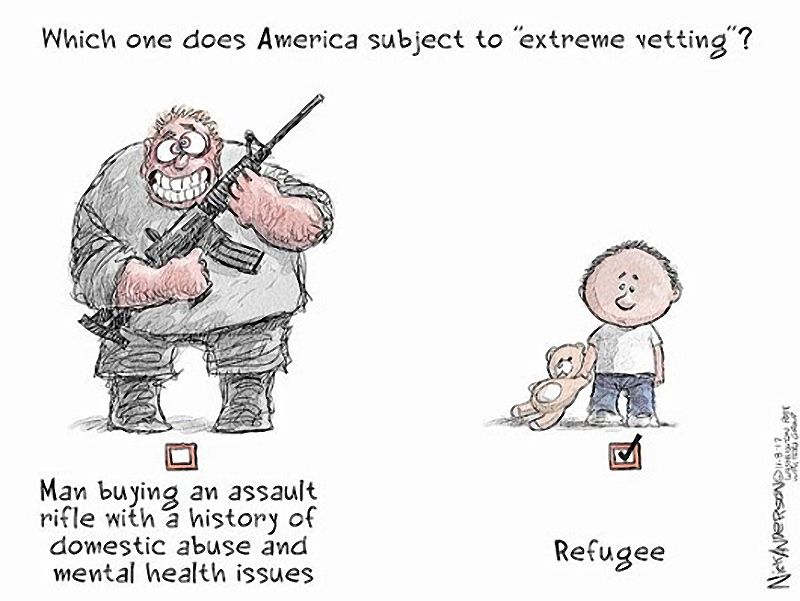
(click to embiggen) © 2017 Nick Anderson gocomics.com/nickanderson
It’s Friday! The final Friday in January, already!

I continue to feel better every day, so the cold/flu seems to be licked. Work has gotten very busy as some impossible deadlines bear down on us. Which means I haven’t gotten much of my own writing done lately.

But that’s enough about me!

Welcome to my Friday Five: Only the top five (IMHO) stories of the week and videos (plus notable obituaries and a recap of my blog posts).

Stories of the Week:

Sessions’ DOJ Charged A White Supremacist With Terrorism. They Just Didn’t Tell Anyone. Because he’s a born-in-the-USA white “christian” white supremacist man, so of course they aren’t making a big deal out of it.

Analyzing the Gender Representation of 34,476 Comic Book Characters.

Are White Evangelicals Sacrificing The Future In Search Of The Past? “While it is difficult to draw a direct connection between the numerical decline of white evangelical Protestants and their increasing isolation on sexual morality, the views of former evangelical Protestants provide some important clues. Analysis of a 2014 Pew study finds that former white evangelicals are far more likely than current white evangelicals to favor same-sex marriage (60 percent vs. 24 percent) and believe that society should accept homosexuality (67 percent vs. 32 percent). They are also substantially younger.”

In an Israeli Cave, Scientists Discover Jawbone of Earliest Modern Human Out of Africa.

The Crazy Story Of How “Clue” Went From Forgotten Flop To Cult Triumph. I love this movie so, so much!

In Memoriam:

Beloved, Visionary Fantasy Writer Ursula K. Le Guin Dies at 88.

The Fantastic Ursula K. Le Guin – The literary mainstream once relegated her work to the margins. Then she transformed the mainstream.

Ursula K. Le Guin, award-winning science fiction writer, has died at 88v.

We Will Remember Freedom : Why It Matters that Ursula K. Le Guin Was an Anarchist.

Things I wrote:

She Knew What She Was Doing and Why – Ursula K. Le Guin.

Women’s March 2018.

Weekend Update 1/20/2018: One year later….

Videos!

Ursula K. Le Guin accepts the National Book Foundation’s Medal for Distinguished Contribution to American Letters at the 65th National Book Awards on November 19, 2014:

(If embedding doesn’t work, click here.)

We Need to Talk About Stephen Miller:

(If embedding doesn’t work, click here.)

Korea’s First Openly Gay K-Pop Star Debuts His First Video, ‘Neverland’:

(If embedding doesn’t work, click here.)

The Killers – Rut:

(If embedding doesn’t work, click here.)

Fischerspooner – TopBrazil (Official Video) [Ultra Music]:

(If embedding doesn’t work, click here.)