Tag Archives: comics

It’s not your decision

I lot of people were sharing a blog post last week by Gavin Aung Than called “BILL WATTERSON: A cartoonist’s advice.” Watterson is the creator of Calvin and Hobbes, and Than being a web cartoonist, has long admired him. I read someone else’s re-blog of the text and tweeted it out to my followers. I didn’t realize that the text was only part of the post. He also drew a comic in Bill Watterson’s style, using excerpts for a commencement speech Watterson gave way back in 1990.

It’s an awesome cartoon and you should go look at it.

In the accompanying post, Than quotes some things Watterson wrote by way of introduction to The Complete Calvin and Hobbes.

As the blog was linked and re-linked, I saw a few people, some of them Big-ish Name types, who seemed to be angry about Watterson’s decision, made years ago, never to license Calvin and Hobbes for any merchandising. There were never any Hobbes dolls on store shelves, never any Calvin and Hobbes lunch boxes or action figures. Just the comic strips, and various books collecting those strips together.

Watterson stopped writing and drawing the strip years ago, and because he refused to license either the characters or the strip, that means that Calvin and Hobbes came to an end.

The angry people take issue with Watterson’s decision (made many years ago) to eschew merchandising deals. If I follow their logic, they think it is hypocritical of Watterson not to license his property because the book collections are a form of merchandising. If he was willing to publish books, then why object to anything else?

I have several responses to that, but I’ll try to keep it to three:

1. Reprinting is not merchandising. The original strip was visual art and text published in newspapers. The books were collections of the exact same visual art and text. Republishing your original art exactly as it was is not the same thing as letting someone else make action figures which may include things you would have never had the characters use, for instance.

When this was pointed out, I saw at least one commentary complain bitterly about the fact that a certain number of unlicensed window clings are out there, showing Calvin pissing on a corporate logo, or praying in front of a cross. “And that’s all we’ve got!” Unlicensed things will happen whether Watterson licensed the characters or not. That is happening outside of his control, and it seems more than a bit illogical to blame him for that.

But the heart of the objection is revealed in that “that’s all we’ve got!” In other words, they’re angry because they can’t buy those hypothetical lunchboxes or dolls. This gets me to the second point, in which I will paraphrase Neil Gaiman:

2. Bill Watterson is not our bitch. Neil Gaiman famously explained to a fan who was complaining about George R.R. Martin not writing the next Game of Thrones novel as soon as the fan wanted that he isn’t entitled to complain. To translate Neil’s argument here: the people are complaining about Watterson’s decision as if their reading of the strip and/or buying the books constituted a contract: they bought the books, and now Watterson is obligated to do everything in his power to create (or allow to be created) things that they want.

Bill Watterson doesn’t owe us anything. While he was still creating the script, he did his best to tell us an engaging story. That is the only obligation any artist has to their audience: to do their best. He created characters that millions of people loved, and he told stories about them that millions of people enjoyed. How can you complain about that?

3. Bill Watterson’s life is his to live as he chooses. We don’t get to dictate what project he undertakes or what goals he pursues. He chose to end the story of Calvin and Hobbes while it was still doing well, because he didn’t want the quality of the stories to degrade, as has happened with other series which continued too long. In doing that, he was still fulfilling the only obligation he had: he was doing his best. He knew that continuing the story would not be his best. So he stopped.

We can disagree with his choice. We can be disappointed that there isn’t another Calvin and Hobbes strip, or a Calvin and Hobbes movie, or whatever. But we aren’t entitled to begrudge his choice.

You liked his work? You are free to re-read it. You want something new? There are artists out there creating new stuff. Go find something you like, and support a new artist or writer or singer or dancer or something.

I would usually at this point proceed to advise, “if you can’t find something you like, maybe you need to try creating something of your own, not fan art or fan fiction, but something that’s yours.”

Except the sorts of people who feel as entitled as these complainers do, they need to work out their overblown entitlement issues before they can create anything worth our time and attention.

Terribly mysterious

As a writer, sometimes you want a character to be mysterious. In good writing this mysteriousness should either further the plot, or speed along one or more of your main character’s emotional arcs. Sometimes, the character just is mysterious because that’s how she or he first came to you, the writer. Whatever the case, once introduced, a mysterious character must be handled with care.

A comic book cover featuring Wolverine and the Hulk
Hulk #181, Nov 1974, first appearance of The Wolverine. (Click to embiggen)
Back in 1974 I stopped at the only drugstore in town and looked through the comic rack. This was my only means of buying comics, and while I was a fan, I wasn’t able to follow anything very faithfully because which comics came into the store from month to month seemed to be completely random. That I was a middle school student, with limited funds and easily distracted didn’t help.

Anyway, there hadn’t been an issue of Hulk in the rack in several months, so I had missed the previous few issues, and I didn’t know how the story line had gotten to this point, but there the Hulk was, and some strange guy in a yellow and blue costume seemed to be fighting him. Of course, I bought the issue. We didn’t learn much about this Wolverine guy in this issue. He apparently worked with the Canadian government and had been parachuted into the wilderness to try to stop the Hulk from rampaging, or something like that. Note the text in the black arrow on the cover: the world’s first and greatest Canadian super-hero!

Note that this is not an X-men comic. In 1974 the X-men were on hiatus. Their magazine was being printed, but it was reprinting stories from the 1960s, for reasons that must have made sense to an accountant, somewhere. The team had never been terribly successful before that. It would be a couple more years before the team was Re-booted (though we didn’t use that term back them), with a lot of new members and only a few of the old, and Wolverine began his off-again, on-again relationship with the X-teams.

For a long time he was a cool character precisely because he was mysterious and always seemed very reluctant to get involved with other people. It’s not exactly an original character type, but generally it worked pretty well. He’d come to help with a specific problem for reasons that weren’t always entirely clear, be gruff and business-like and morally ambiguous, betray a glimmer of affection or respect for one or two characters, then disappear for awhile, only to turn up again and repeat the process.

The problem with mysterious characters is that, if they catch the reader’s attention, the reader wants to know what’s behind the mystery. A writer may keep tantalizing and teasing readers for a while, dropping hints here and there, but you have to be careful, because there’s an extremely thin line between tantalizing and annoying to the point of wanting to take the writer by the throat and squeeze the life out of them.

An image of the masked man called the Sphinx.
The Sphinx – so annoying, you want him to die.
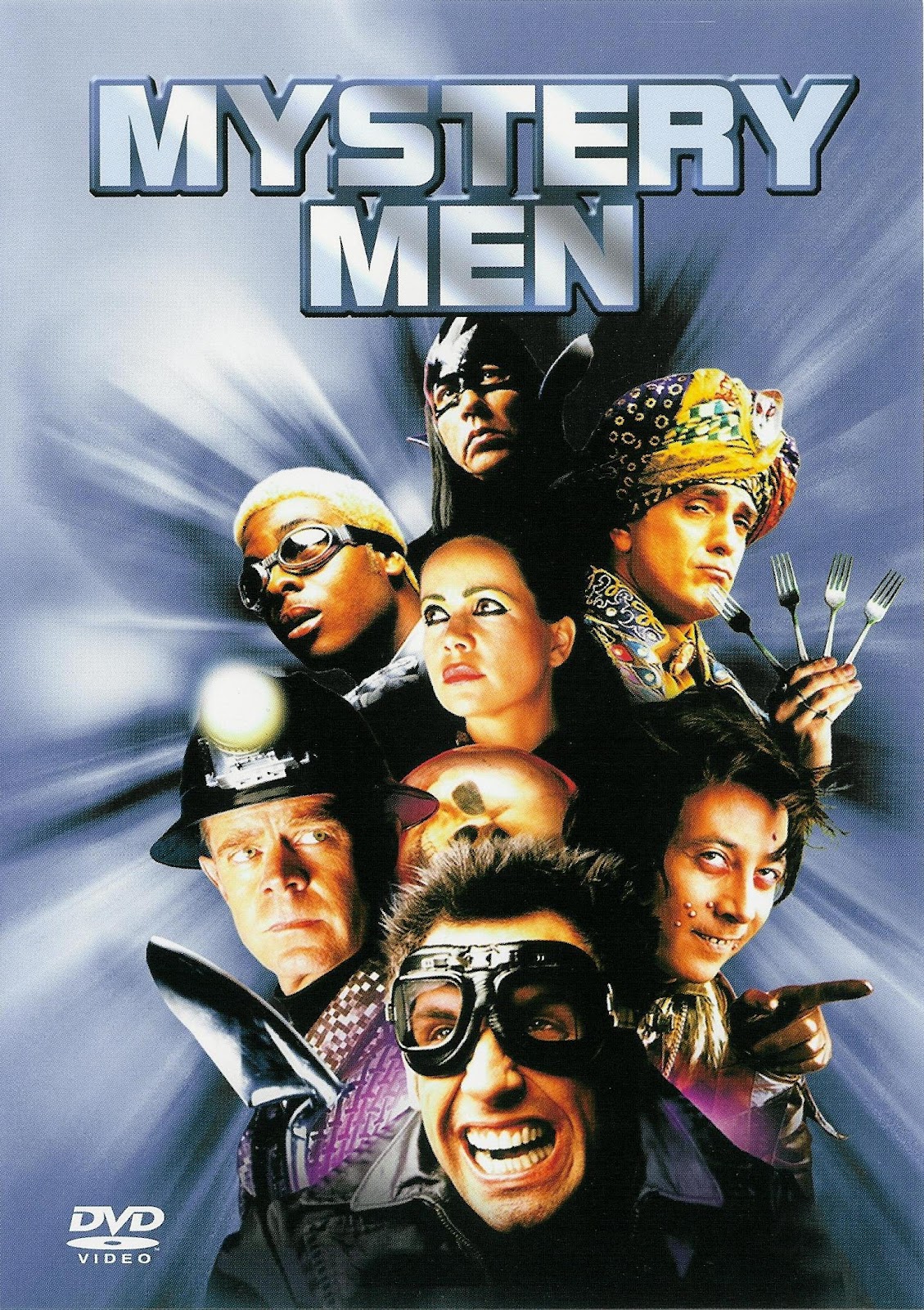
The latter type of annoying character was rather nicely parodied in the moveie, Mystery Men, in the person of the Sphinx. He tries so hard to be cryptic that he’s transparently shallow. His wisdom doesn’t even come up to the level of bad fortune cookies. He’s not just mysterious, he’s “well, terribly mysterious,” as the Blue Raja is at pains to tell his colleagues more than once.

You don’t want your mysterious character to turn into the Sphinx.

Cover image of the DVD of the movie Mystery Men
Mystery Men – one of the greatest movies of all time. (Click to embiggen)
There comes a point where a writer decides to show the reader the truth, to whisk off the shroud of mystery and intrigue, and reveal all. This can go badly. And in the case of the Wolverine, in both comics and movies, has gone, not just badly, not just very badly, but terribly badly.

One problem is that the revelations have been contradictory. Subsequent attempts to make the revelations less contradictory pushed his backstory into pure ludicrousness. And his characterization has consequently become worse and worse. He’s a loner, except that he’s joined pretty much every team Marvel has ever published. And has picked and consistently abandoned a disturbing number of adolescent female protegés/sidekicks. He’s supposed to be a highly skilled assassin, except he’s a chaotic brawler. He’s supposed to be an honorable Samurai (with all the training in the ritualized combat/politics of same), except he’s also a savage killing machine. He’s amoral, except he’s noble and self-sacrificial.

Now, when a character is appearing in a series, and written over a number of years by different writers, this sort of thing might appear to be unavoidable. Except that it doesn’t have to be. Batman, for instance, has a much longer publishing and movie history (first appearance in comics in 1939, first movie in 1943 {a delightfully cheesy serial that I happen to have a copy of, if you want to watch the WWII era special effects and dumb cliffhangers}), but despite all those reboots, retellings, et cetera, the central core of the character has been kept intact: witnessing the murder of his parents as a child, he obsessively trains and studies, eventually becoming a dark detective and vigilante who prowls Gotham at night, foiling criminals and bringing the worst to justice. At various points they’ve wandered into the quite campy, to the darkly romantic, and other odd places, but all of the writers have managed to bring the character back to that core.

I’m working with a mysterious character in my current novel in progress. The previous novel, to which this is a sequel, also had a mysterious character—one of my two protagonists. But she wasn’t a dark, brooding person with hints of a tragic past. She’s one of the most cheerful and optimistic characters in the whole book. There were simply mysteries about her from the beginning, hints were dropped here and there, until during the big battle at the end (it’s a light fantasy with epic fantasy tropes, so there has to be a big battle!) a chunk of the mystery was revealed. It was not revealed in a big bunch of exposition. A crisis was reached, and in an act that resolved her internal conflict at the same time as saving one of her comrades (and temporarily thwarting the big bad), her true nature was revealed. I think it worked. It is currently in copy edit, and does not yet have a publication date, so I will have to wait for the readers’ verdict.

I’m a bit more nervous about the mysterious character in this one. He’s specifically hiding his identity for reasons that are both in character and important to the plot. He’s not a protagonist, he is helping one of the protagonists. Because he is specifically hiding his identity, and because his sub-plot is built around trying to protect a young woman who various people want dead, a lot of his scenes tend to be dark, grim affairs. I hope, when his identity is revealed, that the reader goes, “Oh! Oh! Why didn’t I realize that? Of course it’s ______!” rather than, “Yeah, yeah, we saw that coming a mile away…”

Wish me luck.

The co-opting of the Nerds

The Great Nerd Summit (also known as San Diego Comic-Con International, or SDCC) of 2013 has just happened.

I have only attended once, back in the mid-80s when attendance was a mere 6000 people. Yes, I said “mere.” Last year’s attendance was more than 130,000 people. I don’t believe that official figures are out, yet, for this year. While the convention (called the Golden State Comic Book Convention when it was founded in 1970) originally was about Comics, and the word “comic” is still in its name, it had expanded far beyond that realm to embrace sci fi/fantasy books, movies with any sci fi or superhero connection what-so-ever, and gaming back when I was there.

Of course, comics is a style or medium of storytelling. I grew up reading both Donald Duck/Uncle Scrooge comics and X-men and the like, so even I knew that as a child. Yes, I said grew up. My mom was an X-men fan in the mid-sixties. I have mentioned before that I’m a second generation fan, right? My point being that you can conceivably tell any kind of story in comic form. And there have been the extremely interesting and well done examples of memoirs, biographies, and other kinds of story that don’t fit the comic book stereotype.

That said, SDCC has gotten to the point where it is the trade show for just about the entire entertainment industry. I understand why there are events highlighting upcoming movies such as sequels to The Avengers, Captain America, and Thor, as they’re all based on comics. And I understand why there are events rolling out teasers for My Little Pony: Friendship is Magic. It’s a cartoon, not a graphic story (there are comics, but those are spin-offs, and the official MLP events were all about the cartoon), but animated cartoons are an allied artform of comics. I even understand all the video game stuff that happens at the con.

But, much as I love Benedict Cumberbatch and the current BBC Sherlock series, I think that Sherlock events at SDCC is stretching the definition a bit. Whereas the fact that there were events for How I Met Your Mother, Veronica Mars, and Community is just insane.

The official SDCC award (as opposed to Awards sponsored by other organization which are simply presented at SDCC), the Inkpot, is given out for “outstanding achievement in the Popular Arts industry.” Which makes me think the event should more properly be called the San Diego Popular Arts Con.

I’ve gotten into arguments with fellow nerds about why Sherlock Holmes, as in the original character and stories by Arthur Conan Doyle, has often been included in science fiction events. I have defended the inclusion because Holmes could be argued to be an archetype of a particular kind of nerd: hyper observant, possessed of encyclopedic knowledge of a vast range of topics, an uncanny ability to find relationships between the most minute details, and infamously incapable of relating to people empathically. Serious articles have been published in psychological journals debating (pro and con) whether the fictional Holmes had Aspergers syndrome, for goodness sake! The Holmes stories may not be sci fi, but both the character and the methodology by which he solves his mysteries are highly identifiable to a significant portion of the fan community.

While I have made that argument, and will continue to do so, I’m also the first to admit that all it provides is a reasonable rationale for stretching the envelope to include Holmes as an allied creation. It’s a stretch, and I admit it.

A sort of similar argument can be made for the specific television show, Community, because its ensemble includes some nerds. But it’s a much more tenuous connection to make based on a couple of supporting characters, as opposed to the main character and his primary activity.

I can think of even more tenuous (and ludicrous) arguments that might be made for shows such as How I Met Your Mother, but all of them would be a smoke screen. The truth is that, as I mentioned, SDCC is a trade show, not a fan convention. Its purpose is to advertise, generate buzz, and fan the flames of enthusiasm for any popular art property that can shoehorn itself into the convention. That isn’t a bad thing, per se. Certainly no one is forcing fans to get online at a particular time on the final day of the convention so that the entirety of the next year’s memberships can be sold out in less than two hours. No one is forcing people such as myself to track down stories and videos of the events to get some ideas of what movies and shows I should be looking for in the future.

If you want to fan the flames of enthusiasm, there is no better place than the heart or mind of a nerd or geek. We’re more politely called fans, which is short for fanatic. The one trait that most distinguishes us from the mundanes is how incredibly, obsessively enthusiastic we get about the things we like. So even though some of us are primarily enthusiastic about science and science fiction, if you can get us interested in your show— even one that doesn’t have any discernible science-y aspects—we’ll talk about it. We’ll set our DVRs to catch your premiere. We’ll mention that it’s coming out to our less nerdy friends. We’ll make and post fan art or create and share silly memes based on photos from your show.

We will be your viral marketing campaign. And because tens of thousands of us are willing to buy memberships at SDCC each year, that means some of us are paying for the privilege.

Apart from other branding considerations, I think that’s why for the foreseeable future they won’t be replacing the “Comic” part of the name.

Abyss gazing

It was 1986 and I was twenty-six years old, attending a regional science fiction convention with a bunch of my friends. One of the guests of honor was an author (we’ll call him Mr. C) that two of my friends were very fond of. I had read a couple of his short stories and thought they were good, but he hadn’t really wowed me.

But hearing Mr. C talk about the writing process, his influences, and so forth, made me much more intrigued. It didn’t hurt that when another panelist made a disparaging joke about my favorite science fiction author (who was not in attendance), Mr. C rather emphatically jumped to the defense of my favorite author.

After that panel, one of my friends commented that Mr. C’s takedown of the other panelist had been mean. It was true. Mr. C had ended the rebuttal with something along the lines, “…and it infuriates me when writers who don’t have a fraction of his understanding of how to write or a sliver of his talent make thoughtless critiques.” But, she had called my favorite author a fossil, I pointed out. Once one makes an ad hominem attack, you invite something similar in return. Since it was my favorite author being defended, I was more than a bit prejudiced.

So I wound up standing in line with one of my friends, clutching a pair of just-purchased books of Mr. C’s work, waiting for his autograph. That is the one and only time I have met Mr. C in person. He was pleasant enough, despite having had to smile, listen, and sign however hundreds of times.

After the convention, I tried to read one of the books. It was a collection of his short stories, which included the couple I had read before. They weren’t bad by any means, but after reading a few in a row, an unsatisfying feeling was developing. I sat the book down, not quite sure why I wasn’t enjoying the reading.

A few weeks later, I picked it up again and started on the next story. Again, the story itself was well written and interesting. I read another, then started on the next after that and, well, a few paragraphs in I realized that same feeling of wrongness was building up.

I did eventually finish the collection, but it took a few months, reading only a few stories at a time. And by the end I couldn’t really say that I’d enjoyed them all, but I also couldn’t put my finger on their shortcomings.

The other book was a novel. A novel for which he had won a lot of awards. It was based on one of the short stories in the previous collection. And the short story in question had been one of those I had enjoyed more than the others. Plus, I had friends who swore this book was a masterpiece. And it had garnered all those awards, so it had to be good, right?

I couldn’t finish it. I don’t think I’d even gotten a quarter of the way through before I found myself intensely disliking it.

I tried explaining what I didn’t like about it to one of my friends who loved it. As we were talking, I kept finding myself talking about abstract concepts, rather than actual events in the story. My friend said it sounded more like my baggage than the story. So I started explaining how a similar philosophical assumption underpinned one of the short stories. And that’s when I finally managed to connect the dots and say what was bothering me about all of the stories.

There was a fundamental notion forming the foundation of all the tales: if you don’t know your place and stay in it, horrible things will happen to you. A corrollary was that if you prevented someone else from achieving what was “rightfully” theirs, even more horrible things would happen to you.

When I articulated that, my friend began to argue. That wasn’t what was going on at all, he said. So then I made a guess at how the book I hadn’t finished would end. Specifically what would happen to certain characters.

My friend blinked. “How did you know?”

“Because, if you don’t know your place and stay there, forces, whether they be social, cultural, or fate, will strike you down. And if you stand in the way of someone else’s destiny—”

My friend grinned and interrupted. “Oh, wow! You’re right! That’s so messed up, because it’s like the opposite of what the main character says, but it’s really what happens!”

“Mr. C believes in hierarchical, patriarchic societies in which you behave according to societal expectations, and people who have the temerity to want to choose their own way of living are evil,” I said.

My friend shrugged and said, “You’re probably right. But I still love the stories.”

“Whoever fights monsters should see to it that in the process he does not become a monster. And when you gaze long into an abyss the abyss also gazes into you” — Friedrich Nietzsche

Just a few years later, a controversy erupted in a forum dedicated to Mr C on the (now long defunct) Prodigy network. The controversy was about a protagonist in another of Mr. C’s novels who experimented with gay sex midway through the book. Some people were angry Mr. C had included an “abomination” as a sympathetic character. Others thought people who thought gay people were abominations were bigots.

As the arguments raged, Mr. C waded in with a rather long discussion about the sin of homosexuality, why he felt he had to include it in the book (his reasoning, as I recall, was that in any community where people amass power there will be people who must dominate, possess, and destroy others, and of course homosexuality is all about dominating and destroying each other), and then had the gall to claim that anyone who called him homophobic were themselves bigots. Because he didn’t hate any gay people. They were just sinners, and if they refused to repent and stop being gay, well, they would face consequences.

His comments were quoted far and wide. And he got angrier and angrier as people “mischaracterized” his comments. He repeated, again and again, that he didn’t hate gay people. He wound up writing (in 1990) a long essay and getting it published in a magazine that catered to the members of the church Mr. C had been raised in, in order to explain his side in context.

While the essay repeatedly said that he did not condone violence against sinful people, it talked about how just as children must be punished in order to learn right from wrong, then adults will face greater penalties when they continue to act outside the bounds of propriety. He talked abstractly about the “day of grief” that each homosexual would eventually experience if they did not repent. He talked about the horrible consequences homosexuals face if they refuse to adhere to propriety. But he was not advocating violence even then, he said. If the faithful, such as himself, had been compassionate but firm in condemning the sin, they would “keep ourselves unspotted by the blood of this generation.”

It’s an old lie that bigots of a religious persuasion tell themselves all the time. They don’t advocate or condone violence, it’s just that god’s law causes these things. And when it happens, they pretend that the people who did resort to violence never took all the words of condemnation as permission to commit violence.

Think about it: if it’s god’s will that homosexuals should experience a “day of grief”; if god’s law demands that “blood of this generation” must be shed, then the person who inflicts the violence is doing god’s will. They are a special tool of god!

Heck, it isn’t just permission to commit violence: it’s encouragement!

I had already guessed most of this about Mr. C before he began writing publicly about his reasons for opposing the decriminalization of gay sex and other topics back in 1990. And so I had already made my decision not to buy any more of his books. I didn’t post rants about him, nor try to organize boycotts of his work. If I was asked, I would say that I disagreed with what I perceived to be the underlying philosophy espoused by his work.

Once he did make his very public statements, I felt it was appropriate to go a step further and point out that Mr. C was a hypocrite and a bigot who advocated against the rights of myself and others. I would suggest that perhaps there were other writers whose works were more deserving of people’s money, but wouldn’t go further.

In the years since, he has continued to write and speak out against gay rights of all sorts, eventually becoming an officer for a large organization that says it is out to protect “traditional marriage.” They try to portray themselves as narrowly focused on marriage, but anyone paying attention to their rhetoric and some of the other causes they support, can see that they want to roll back the few rights gay people have won. He donates his own money to the cause, he has organized efforts that have raised millions of dollars for the cause. He has claimed victory for every anti-gay amendment, law, proposition, or initiative that has been passed in the last ten years.

He has, now, gone far beyond the point of simply stating his opinion and trying to persuade others to it. He has gone beyond that disingenuous tactic of saying he was opposed to violence while providing double-speak that actually encouraged it. He has helped spread distortions and outright lies about all gay, lesbian, bisexual, and transgender persons. His organization has refused to obey public disclosure laws regarding their election activities in several states. He continues to fight to prevent gays, lesbians, trans people, and bisexuals full equality before the law. He continues to put forward arguments to take away what rights have been extended.

So, for that reason, yes, I agree with the people who have been disappointed that DC Comics hired him to write a prominent new Superman series. Yes, I support the comic book shop owners who have said they will not sell comics written by him. I support the artist who decided not to illustrate his stories after learning of Mr C’s views and activities. I urge everyone I know not to buy things he writes, not to go see the movie that is being made of his most famous novel.

I re-iterate: this isn’t just about a difference of opinion regarding marriage equality. For over 20 years he has advocated for restoring laws that made it a crime for consenting adults to have gay sex in the privacy of their own homes, and against laws that protect people from being fired, evicted, or denied medical care just because they are gay. And he has done more than just advocate those things, he has taken action to make them happen. It is not hypocritical of us to advocate a voluntary boycott of his work, it is hypocritical of him and his apologists to decry a voluntary boycott while they are campaigning for laws that will take away jobs, housing, health care, and more from entire classes of people.

Orson Scott Card is a hypocrite and a bigot who uses distortions and outright lies to hurt innocent people. Those are the facts.

Flying my nerd flag high

On one of the news blogs I follow, the resident comics nerd felt compelled to post a correction/explanation to a post by another contributor reporting that DC Comics’ character, Green Lantern, who was revealed as gay this week. The correction noted that the Green Lantern in question (Alan Scott) is not the same DC Comics Green Lantern character (Hal Jordan) portrayed in the awful movie last year starring Ryan Reynolds. At the end of the explanation, he lamented that the fact that such an explanation was needed proved comics will never be accessible to casual readers.

I think he was being too generous. As a comics nerd of many decades standing—a comics nerd who marked corrections in my copy of the excellent Facts on File Encyclopedia of Super Heroes shortly after I bought mine in 1985—let me say that superhero comics are fast becoming inaccessible to the devoted reader, as well.

Continue reading Flying my nerd flag high

Avengers Assemble!

Friday night my husband and I saw The Avengers. It was awesome. It was fun. It was entertaining. It had great dialogue. Every character had great moments. There were plenty of nods to the comic book history of the characters as well as the recent movie incarnations.

And Chris Evans looks awesome in sweat pants. Just sayin’.

(and for those of you who don’t drool over men, there was plenty for you, too. And not just Scarlet Johansen’s Black Widow– Cobie Smulders was a**-kicking in both the action and beauty departments)

Continue reading Avengers Assemble!