Yesterday I wrote about queer invisibility in movies, television, books, and other forms of cultural expression—specifically why being annoyed at us for trying to find hints of our existence in such things contributes to the culture of oppression. Comprehending that requires understanding decades of discrimination, the consequences of straight male privilege, and finding a way to empathize with people who have lived with the alienation, rejection, and oppression that results from the aforementioned discrimination.
Which can make the whole thing seem overwhelming.
But each of us who creates art and stories can contribute to the solution. Queers aren’t the only ones who are marginalized—or excluded completely—from most stories. And no writer is immune. For example, many years back at my monthly writer’s meeting I was receiving feedback on a chapter of a book I was writing. Another member of the group asked me why there were no women in the book. I’d read a number of chapters by that point, and it just seemed odd to her in a story where my protagonist was a middle school student that there had been no female characters, at all.
Ah, love!I was having a discussion about a movie with some friends on line, and two of us were commenting upon the possible romantic relationships between some of the characters. Because one of the pairs under consideration were two male characters who had not explicitly been portrayed as non-heterosexual, another friend in the conversation commented that he never understood why people do that.
At the time, I decided to keep the conversation light, and simply said that we saw it because it was obvious. The real answer is a lot more complicated and serious than that. I didn’t feel up to explaining the unconscious homophobia underlyng the very question, and sometimes, frankly, I’m just tired of being disappointed in people.
But the problem persists, far beyond the people involved in that conversation. And yes, it is a problem, a very real and serious problem. What is the problem, you ask? Some people say the problem is invisibility or cluelessness, but…
In this way the writer can present his cowardice, laziness, and lack of imagination, as artistic integrity. “I couldn’t write gay characters; I didn’t have any.” Hand-to-forehead; the tortured auteur.
—Andrew Wheeler, writing for Comics Alliance
It’s actually about erasure and willful blindness. As I’ll explain further…
Sometimes it feels as if my whole life consists of defending why I like something. When I was a kid, I was frequently called up to justify why I preferred reading books to playing with other kids my age. Even the notion that reading was educational wasn’t enough to satisfy some people (many of them teachers). And heaven forfend that I should mention how many times “playing” with kids my age actually meant being bullied, harassed, and ridiculed non-stop! As I got older, the kind of books I liked became the issue. “Reading too much make-believe is unhealthy!1” or “Aren’t you a little old to believe in all the space hooey?2”
My copy of Bleak House looked a lot like this one.Of course, it wasn’t just the science fiction and fantasy that set people off. If I was caught reading a book about science fact, or the hardcover of Charles Dickens’ Bleak House my grandma bought me at a library sale, or my well-worn paperback of Homer’s The Iliad, it was more proof that I was an “over-educated freak4.”
When I finally escaped to college and met people who valued reading over sports, I thought that I had left all of that behind. Oh, how naive I was! According to these literati wannabes, my tastes were quite low brow. How could I possible understand the meaning of serious art and literature if I actually enjoyed Hitchhiker’s Guide to the Galaxy or The White Dragon or Harpist in the Wind or Midnight at the Well of Souls? Or even worse, I watched television!?
It’s easy to dismiss those latter examples as either snobbery or hipster-ism. Except I can be just as guilty of judging other people for liking things that I don’t.
Who am I kidding? I have been incredibly worse about this. When I think a particular book or series or movie or what-have-you is not just unlikeable, but very badly made, it will completely boggle my mind when someone I know actually likes it. And I seem to be absolutely incapable of hiding my incredulity. I frequently have to remind myself that sometimes what I think of as one of a particular work’s mediocre-but-not-awful parts might be someone else’s fiction kink. And by fiction kink I mean, it’s something they like or identify with so much that it can be a redeeming quality. Such a redeeming quality makes the parts some of us see as glaring shortcomings, merely a small price to pay to get the other thing.
Goodness knows I have my own favorite books, series, and movies that I know are flawed, but I enjoy them anyway because they contain a particular character dynamic, or a type of plot line, or use a particular combination of mythic tropes which appeal to me. I try to make the distinction between something that I don’t like for reasons of taste as opposed to something I don’t like for reasons of actual quality. It is a subjective judgement, but not an impossible one.
I got tired of finding myself having to defend my preferred reading material. Eventually, I was saved by Leo Tolstoy. Tolstoy, the Russian author of such great classic novels as War and Peace and Anna Karenina. I have to confess that I tried to read War and Peace at least a couple of times, and just failed to plough all the way through it. And failing to get through it was one of the things that made me wonder if those people who said my tastes were too low brow to understand great works of art were correct. But then, when a similar sort of discussion happened in one of my college literature classes, the instructor5 quoted a bit from Tolstoy’s nonfiction book, What is Art? I think it was this passage:
The assertion that art may be good art and at the same time incomprehensible to a great number of people is extremely unjust, and its consequences are ruinous to art itself…it is the same as saying some kind of food is good but most people can’t eat it.
—Leo Tolstoy
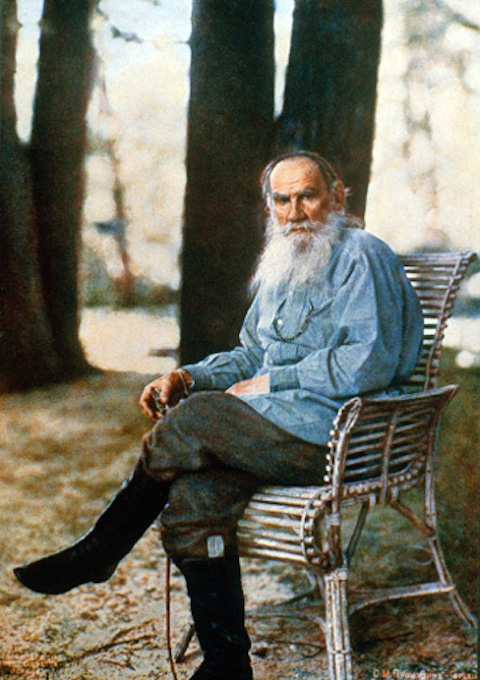
A portrait photograph of Tolstoy taken in 1908 by Sergei Prokudin-Gorsky, who had invented one of the early methods of color photography.Not long after that, I found a copy of the book in the library, which I wound up checking out and reading. There are a lot of Tolstoy’s arguments in the book which I don’t agree with. He had adopted, by the time he wrote it, a rather radical form of Christian anarchy. So he critiqued a lot of specific examples of art as being immoral in content—more often because he thought it promoted capitalism and classism than the sorts of things that get the modern religious right up in arms. He dissed Shakespeare and Dickens, for instance (though with a lot of caveats in Dickens’ case, since much of Dickens’ later work was critical of the dehumanizing effects of the industrial revolution).
Despite those parts of his thesis with which I still disagree, his arguments in favor of accessibility and sincerity in art helped me figure out that those literati wannabes had mistaken obscurity for superiority. They’ve fallen victim to the notion that if “ordinary” people enjoy something, it cannot possibly be high quality. If you define art by its difficulty to be comprehended, you’ve completely misunderstood what art is. That doesn’t mean that art can’t be challenging, but there is a difference between a piece that requires thought, afterthought, and re-visiting to tease out all the layers of meaning and something which hides its meaninglessness under layers of pretension.
Art is a human activity consisting in this, that one man consciously, by means of certain external signs, hands on to others feelings he has lived through, and that other people are infected by these feelings and also experience them.
—Leo Tolstoy
The way I usually try to sum up Tolstoy’s notion is: Art happens when the heart of the artist touches the heart of the audience, and the audience responds. The audience doesn’t have to like it; a piece of art that evokes intense dislike must be doing something right, or you wouldn’t feel so strongly about it. But art should never leave you unmoved.
Footnotes
1. The exact words said both to me (and later to my parents at a parent-teacher conference) by my seventh grade social studies teacher. He was not that only one who said things to that general effect.
2. The exact words said to me by a minister3 of another church who caught me reading during afternoon free time on a rainy day at Bible camp. Again, he was not the only person by any means to make similar comments about my penchant for both science fiction and science fact, particularly NASA.
3. Of course, this was the same preacher who thought it was funny, when teasing or disagreeing with a boy (he never would do such a thing to a girl, oh no!), to grab your pinkie, twist it into a stress position, and keep you there not only until you agreed with whatever he was trying to make you say, but that you cried sufficiently that he thought you had learned your lesson.
4. The favorite phrase one of my uncles like to use to describe me.
5. Several instructors quoted Tolstoy at me around this time. Another literature profession quoted the famous line, “All happy families are alike; each unhappy family is unhappy in its own way” but he completely misunderstood it. On the other hand, one of my mathematics professors quoted the exact same line, and then explained how the line was the perfect example of an important statistics concept. The concept is sometimes referred to as the Anna Karenina principle in honor of the Tolstoy novel from which the line comes. One way to think of the principle is this: in any system, there are a large number of ways that a given process can fail, and the only way to achieve success is to avoid every single possible failure. A successful outcome depends on every single requirement being met, whereas a single shortcoming in only one requirement can cause failure of the entire endeavor.
I hear or read it at least once each year as Pride weekend approaches (or shortly afterward when people post pictures of their local Pride parade): what’s there to be proud of? Usually followed up with comments to the effect that if we are born this way, then there isn’t anything we’ve done to be gay, so why be proud? Why can’t we just be ourselves and go about our day?
The answer is quite simple: because every moment of our lives—from before we were old enough to understand—society at large (including very nearly every single person who raised us, took care of us, taught us, lived beside us, et cetera) has told us again and again that “just being ourselves” is shameful. We have been told that our very beings were wrong. Our selves are a sickness to be cured, or a sin to be despised, or a shameful secret to be hidden. We’ve been bullied, harassed, tormented, shunned, and beaten because of who we are. We have been told (and often shown violently) that our lives don’t matter. We’ve been told we can’t love. We’ve been told that those of us who do fine love deserve what happens to us when the bashers and haters decide to make an example of us.
In a world that insidiously and relentlessly drums that message into us—driving many to attempt suicide as children (and sadly for many to succeed), browbeating us into hating ourselves—just openly being our selves is no small feat.
Merely surviving all of that and managing to piece together lives of authenticity is a monumental victory over incredible odds.
That’s what we have to be proud of.
I used to react to this question by just thinking that the person was clueless. And certainly cluelessness is a factor. But I’ve also realized that it’s just another manifestation of that most basic form of homophobia. “Can’t you just be who you are and not make a big deal about it” is exactly the same as “why do you have to shove it in our faces all the time” which is the equivalent of “go back into hiding where you belong.”
The saddest part of this is that those people don’t think they are being homophobic at all. And they never think about that fact that straight people “shove their sexuality” in everyone else’s face all the time. Have pictures of your spouse, significant other, or children on your desk, wall, or phone’s home screen? Mention your wife or husband in casual conversation? Comment on how hot a particular actor or actress is? Routinely ask about family discounts? Expect that, of course, your spouse will be included in the company health insurance plan? Invite us to your wedding or your kid’s straight wedding? Show us pictures of yours or your kid’s straight wedding? Ever use the phrase “no homo”?
Since we get accused of shoving our sexuality in your face if we merely casually mention the existence of our significant other, we get to count all of those things as you shoving your sexuality in our faces. Straight pride happens 24 hours a day, seven days a week, 365 days a year, yet you begrudge queer people (trans, lesbian, bisexual, gay, genderqueer, polyamorous, asexual, pansexual, gender fluid, intersexed, gender neutral, and those who love and support us) a parade once a year?
Why am I proud?
I’m proud because they tried to drown us in lies, and we’ve risen above to reveal our truth. I’m proud because they have beaten and tortured us in the name of faith, and we’ve found the strength to show the world our love. I’m proud because they tried to smother us with fear, but we found hope in the most unlikely of places. I’m proud because we have endured hate, which has taught us how to love better. I’m proud because we have fled the shadows, and showed the world our light. I’m proud because no matter how many times we’ve been knocked down, we have gotten back up.
I’m proud because we’re all still here, we’re unstoppable, and we’re beautiful!
Mat Staver is the head of the anti-gay Liberty Counsel, featured speaker at several Values Voter Summits over the years, a man who has gone to court many times defending laws that discriminate against gay people, and someone who as recently as June has testified to congress about why gay, lesbian, bisexual, or transgendered people shouldn’t be included in anti-discrimination law, and has many times on his radio show praised laws in places like Russia and Uganda that criminalize gay people and even talking about gay people. For example, last year he was on another radio show, ranting about those Christians who have said that gay rights and marriage equality are losing battles. “To assume that you can go against the created order is hubris, it’s arrogance, it’s dangerous and it is not something in which we can simply say, ‘the battle’s over, we need to figure out how to coexist.’ There is no coexistence.”
“There is no coexistence.” If he insists that his side can’t co-exist with us, that’s another way of saying either we have to cease to exist or he does, right? And I’m pretty sure he isn’t suggesting that all true believers (his side) should commit mass suicide.
When Staver says “there is no coexistence” that means he’s ultimately willing to kill. The reason Staver’s organization encourages things like Uganda’s kill-the-gays laws, and talks up the rhetoric of how dangerous we are to society is because he believes we should not be allowed to exist. Which means killing us. Or at least, scaring us with a credible enough threat of death that we all go back into the closet.
It’s the same tactics used by the hate leaders who radicalized Dylann Roof into shooting nine innocent people in a church in Charleston: making members of the majority believe that a historically oppressed minority somehow has all the power. Roof told the lone adult survivor of his shooting, “I have to do it. You’re raping our women and overrunning our country.” In a country where white police officers gun down unarmed black children in the street without facing murder charges, he believes that black people are the ones threatening the existence of white people.
Similarly, in a country where:
1500 queer children are bullied into committing suicide every year,
where thousands of queer children are thrown out onto the streets by so-called Christian parents whose religious leaders have told them they have to show tough love,
where the authorities don’t investigate those parents for child neglect,
where the numbers of homicides of LGBT people have climbed to record highs,
where more than half of hate-motivated murder victims are trans people of color,
where state legislators are rushing to enact religious-belief based “right to discriminate” laws,
where in most states it is perfectly legal for employers to fire someone simply because they think the person might be gay (and where landlords can evict gay tenants or refuse to rent to them, et cetera),
where queer people are 2.4 times more likely to be victims of hate crimes than jews, and 2.6 times more likely to be victims of hate crimes than muslims,
where the number of hate crimes against all groups except lesbian, gays, trans, and bi people is going down while all categories of anti-queer hate crimes remain the some or are rising,
where the overwhelming majority of elected officials at the federal, state, and local level are Christian (far out of proportion to their percentage of the population),
where state and federal tax dollars are funneled into “faith-based” charity organizations that are often allowed to discriminate in how they administer those tax-funded activities,
where religious schools are often supported by tax dollars diverted from public schools,
where high school kids are threatened with expulsion for wearing “Gay OK” t-shirts to school after a bunch of Christian bullies beat a gay classmate (but the bullies weren’t punished),
where a public school teacher responding to an incident of anti-gay bullying read a book about acceptance to his class, then was forced to resign for “promoting homosexuality,”
where Christian organizations rally and raise money to combat anti-bullying policies unless said policies include exemptions that allow their kids to bully gay kids in the name of their faith,
…Christians are claiming that queers are persecuting them.
Seriously? Not being able to bully, discriminate against, and torment their gay neighbors is oppression?
Indiana RFRA protest rally earlier this year. (WISH-TV/Howard Monroe)I stared at my iPad, flabbergasted. A writer whose work I admire, and who has always come across as thoughtful in his personal blog, stated that after carefully reviewing the blog posts and comments of another writer who has been spearheading a particular bigoted movement concluded, “I can find no solid evidence to support the frequently repeated charge of homophobia.” It took me three minutes with Google to come up with five rather blatant homophobic statements. One of which was in a post that the writer who now says he can find no evidence of homophobia had commented on. A few sentences later I found the answer: “While it’s clear he opposes marriage equality for religious reasons, there’s no evidence of blatant animosity.”
Oh, dear, not that old fallacy again!
It comes up all the time. People who consider themselves progressive and pro-gay rights, but who are themselves not queer, will turn a blind eye to homophobic statements and actions so long as the perpetrator refrains from employing obviously offensive language too frequently and claims they are doing it for religious reasons. As if, somehow, only when an oppressor is openly vicious are the actions actually oppressive…Continue reading Sincerely (up) yours,→
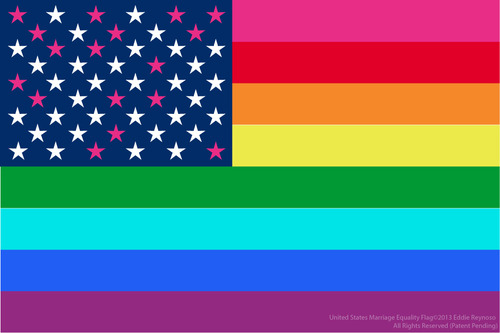
Just a year ago, many conservative pundits were pointing out that the number of states that had adopted marriage equality, and where a majority of the citizens of said states supported it, meant that there weren’t enough states left to ratify a constitutional amendment. Then we have polls released just this week that not only show that a majority of americans support marriage equality, but that a whopping 63% believe that marriage equality is a constitutional right and that the court should rule it so!
I have to point out that back in 1971, four years after a unanimous Supreme Court had struck down bans on interracial marriage, that a majority of americans disagreed with that decision. But no one even tried to pass a federal constitutional amendment to allow states to begin banning interracial marriage again. I don’t believe that anyone could make a credible run at an amendment to ban gay marriage now when a majority of americans support gay marriage.
I should point out, that while 63 percent said they thought the constitution protects the right, a “mere” 57% said they fully support it. Which means that about 6% are personally opposed to queers marrying each other, but also believe it should be legal. That isn’t a contradiction. Lots of us disapprove of things that we also don’t think should be illegal for other people to do if they really want.
The most interesting statistic on that, as always, is the demographic number. We’re used to, in these polls, seeing that young people are more supportive of gay rights than older people. So it is no surprise that roughly 73% of those under the age of 50 are in favor of marriage equality. But the surprise is that just over 52% of people aged 50 and older are also in favor. It’s almost evenly split, but for a long time it was a clear majority of older people who disapproved. Of course, some of that shift has been a simple matter of aging. People who were in their late 40s when polls were taken a few years ago, and were therefore at least slight more likely to be in favor of marriage equality, are now in the older cohort, and they’re brought their beliefs with them. But aging alone doesn’t account for the change. So in the last few years, some of those older people who previously opposed it or answered that they weren’t sure have changed their minds.
It’s that last piece, I know, that some of the haters hang onto. They remain convinced that somehow, if they just keep screaming about how horrible and icky gay people are, that they can start getting people to change their minds the other way.
I don’t think so. I continue to believe that our two best weapon are visibility and familiarity. The more people who know actual gay people—and specifically, the more they see their own relatives and the relatives of their friends not just be out, but stand in line for marriage licenses and have their weddings and so forth without the world coming crashing down—the more supportive they become.
The cliché is that you can’t put the genie back in the bottle. I agree that the marriage equality genie is out and isn’t going back. More importantly, none of us queers are going to allow ourselves to be chased back into the closet.
No one’s coming out goes exactly the same as any other. The fear that the guy talks about in the first video (and the anxiety you can see on the young woman’s face in the first part of the second) is very real. Even in 2015, 40% of homeless teen-agers are homeless because they have been kicked out of their homes by parents because they are gay.
I tried to come out to my best friend—a guy I loved like a brother—dozens or more times. Because we were both attending fundamentalist evangelical churches, I tried to ease us into the conversation. But every single time that even a hint of the topic of non-heterosexuality came up, he would instantly go into “Gross! Sinful! All homos go to hell!” mode with such vehemence, it’s amazing I wasn’t physically hurled from the room by the strength of his condemnation.
Ironically, when I finally did come out years later, he insisted that the reason he was ending our friendship was not because I was “an unrepentant homosexual” (his words), but rather because I told someone else before I told him. He was also one of the people who insisted emphatically that he had never, ever, ever suspected at all that I was gay before I came out.
I don’t believe that statement, either.
Several relatives and close friends from back then made equally insistent denials of ever suspecting. Of course, one of those people was my Mom. And when one of my aunts found out Mom was claiming she had never suspected, that’s when the aunt informed me that beginning when I was about 14 years old, she and my mom and several ladies from church had begun meeting once a week to pray my gay away. I also was informed by one of the former board members of the evangelical touring teen choir I had been involved with as a teen-ager that it had been explicitly known that one reason I wasn’t given solos or put into one of the small ensembles for the first many years I was active in the group was because the leadership was certain I was “struggling with the sin of homosexuality.”
They were correct in that I was struggling mightily to stop feeling attracted to other guys. But unlike a lot of the guys who they did put into leadership positions and gave solos to, I wasn’t acting on my feelings. I wrote about one of those cases, but he wasn’t the only queer boy in the group fooling around with other guys back then.
I’m glad that more people are getting reactions like the second video: “I always knew. Were you afraid to tell me?” But far too many queer people have plenty of reasons to fear rejection (and worse) from their own families and friends if they admit who they are. And that’s just wrong.
The original Pride flag designed by Gilbert Baker in 1978 has 8-stripes. Colors were removed and changed originally due to fabric availability.I don’t remember when I first learned that the Rainbow flag was a symbol for LGBTQ pride. I do remember in high school finding out that a particular representation of a labrys (double-headed symmetric ax associated with several goddesses from Greek mythology) had been adopted by some lesbians. However, since the information came first from the same sorts of church people who saw Satanic symbols everywhere, I wasn’t completely certain it was true.
The next symbol I learned about was the pink triangle. Since it was an emblem used by the Nazis to mark prisoners sent to the concentration camps with the excuse that they were sexual deviants, and since the Allies had then re-imprisoned all of the gay men who managed to survive the camps, the emblem was more of an assertion of “never again!” than a pure statement of pride.
Quote from Whitney Phillips’ excellent essay, “Don’t Feed the Trolls? It’s Not That Simple.”I was in High School the first time that something I wrote prompted threats of bodily harm. I was a regular contributor to the editorial page of the student newspaper and wrote on a variety of topics—usually political—but the one that pushed my fellow students over the edge was a critique of stagecraft of the music department’s regular concerts. And I was critiquing it as an insider. I played bassoon in the orchestra and symphonic band (and occasionally other instruments as needed), trombone in the jazz band, and sang baritone in the men’s a cappella group (marching band and the pep band never participated in the formal concerts, but I was in those groups, too).
I was tired of playing concerts to a nearly empty theatre. I had recently seen the fall concert of the music department of the other high school across town, and their auditorium was not only packed, they actually charged an admission fee! And their shows were fun.
Anyway, my opinion column did not go over well with some of my fellow music students. But at least none of them felt the need to be anonymous with the threats of maiming and murder.
The first anonymous threats happened when I wrote about abortion and sex education—in the same high school newspaper in the late 70s. And again at community college (and later at university).
But the most vicious, virulent, and disturbing threats came when I started reviewing exhibits in the small free art gallery at the community college. Express an opinion about art, and people completely lose all sense of proportion. Remember that the next time someone tells you that art (or music, or literature, or movies, television, et cetera) doesn’t matter.So, by the time I was active on QueerNet and such in the early 90s, getting homophobic death threats and the like on the internet seemed like old hat.
Anyway, since the whole Sad Puppies thing has happened, I’ve been getting a few more comments here than usual. Okay, sometimes more than a few. Though it isn’t a deluge. Besides having comments set to moderate (a comment doesn’t appear until approved, unless I’ve added the commenter to the whitelist), anonymous commenting is disabled. And the comment system records IP addresses (and alerts you that it will). So the number is high for my blog (since my average is less than one comment per post), but low by typical internet forum standards.
Although many of the comments have been angry, so far none have risen to a vitriolic level. Not being able to post wholly anonymously contributes to that (just the fact that one has to type into multiple fields is probably too much of a hurdle for many troll), I’m sure. I suspect that because there is simply so much being written about this particular topic, and my little blog isn’t exactly drowning in traffic, that there are too many other places for the trolls to go.
Anyone who has ever met me and talked with me for more than a millisecond knows that I do not shy away from debate. And I don’t believe that simply ignoring all trolls is an effective way to deal with the problem of vicious harassment. I’m not ignoring them. I’ve read the comments, and made a determination based on the contents of the comment of whether the person is here to discuss the issue or just wants to yell. I see no reason to approve the latter type of comments and subject any of my readers to an angry tirade that adds nothing to the discussion. I certainly don’t have the time to try to reason with someone who seems bent on nothing more than trying to shout down and insult dissenters.
Make an actual logical or reasonable argument. Indicate that you understand there is more than one side to the issue. Then we can talk.
 Yesterday I wrote about queer invisibility in movies, television, books, and other forms of cultural expression—specifically why being annoyed at us for trying to find hints of our existence in such things contributes to the culture of oppression. Comprehending that requires understanding decades of discrimination, the consequences of straight male privilege, and finding a way to empathize with people who have lived with the alienation, rejection, and oppression that results from the aforementioned discrimination.






 Font Folly