Tag Archives: culture

The stories we have to tell

"Don't forget, no one else sees the world they way you do, so no one else can tell the stories that you have to tell." - Charles de Lint“Researcher Dale Spender in Australia used audio and video tape to independently evaluate who talked the most in mixed-gender university classroom discussions. Regardless of the gender ratio of the students, whether the instructor was deliberately trying to encourage female participation or not, men always talked more—whether the metric was minutes of talking or number of words spoken.

“Moreover, men literally have no clue how much they talk. When Spencer asked students to evaluate their perception of who talked more in a given discussion, women were pretty accurate; but men perceived the discussion as being “equal” when women talked only 15% of the time, and the discussion as being dominated by women if they talked only 30% of the time.”

My conclusion: men think women talk too much because they think women should be silent.

This perception problem isn’t limited to gender issues. Any person in a position of power or privilege thinks that any time someone outside their group talks or is recognized more than a tiny fraction of the time that the others are dominating the situation.

  • It is part of the reason that someone like Senator Cotton of Arizona can go on a national news program and say, with a straight face, that lesbians and gay men should stop demanding full equality and simply be grateful that we aren’t being publicly executed by the government.
  • It’s part of the reason the GamerGate goons start screaming that women are taking away their fun simply by suggesting that maybe a few games might be made that don’t treat woman as objects to be destroyed and avenged or taken as a prize.
  • It’s the reason that rightwing politicians and the like can claim that Christians are being oppressed despite the fact that: Christian holy days are observed as both state and federal holidays; two-thirds of the justices on the Supreme Court are Catholic; the President, Vice-President, Speaker of the House, Senate Majority Leader, Senate Minority Leader, House Minority Leader (heck, 92 percent of the members of Congress) are Christian; where many states have laws that explicitly exempt Christians from anti-bullying laws and policies at schools (in other words, Christians can bully anyone they want, as long as they claim it is due to their sincerely held belief); and where not one single state has enacted laws banning Christians from getting married, or adopting children, or being teachers.
  • And yes, it’s part of the reason that someone like Larry Correia and his cohorts—Brad Torgerson, Theodore Beale (aka Vox Day), and John C. Wright—can see more than one or two women or people of color nominated in a single category for the Hugo Awards and start screaming that science fiction is being taken away from people like them.

A bit over a year ago, Laurie Penny wrote Whose wankfest is this anyway? The BBC’s Sherlock doesn’t just engage with fan fiction – it is fan fiction for The New Statesmen which included this brilliant observation:

“What is significant about fan fiction is that it often spins the kind of stories that showrunners wouldn’t think to tell, because fanficcers often come from a different demographic. The discomfort seems to be not that the shows are being reinterpreted by fans, but that they are being reinterpreted by the wrong sorts of fans – women, people of colour, queer kids, horny teenagers, people who are not professional writers, people who actually care about continuity (sorry). The proper way for cultural mythmaking to progress, it is implied, is for privileged men to recreate the works of privileged men from previous generations whilst everyone else listens quietly.”

Laurie Penny is talking about the BBC series, Sherlock, and quite rightly pointing out that the series itself is fan fiction. It is being produced and broadcast on a prestigious network, and very few people would say that it isn’t real story telling, but the series is a re-imagining of stories written more than a hundred years ago by Arthur Conan Doyle. It isn’t sneered upon the same way that Buffy fanfic or ElfQuest fanfic or Teen Wolf fanfic or Supernatural fanfic is in part because the source material for Sherlock is in the public domain, but also in no small part because the people writing it are a pair of middle-aged University-educated white male British citizens.

Her insight doesn’t apply only to fan fiction.

Stories—whether they be fiction or the narrative of our existence or history—shouldn’t come from only privileged voices. They need to come from all voices, including women, people of color, queers, young people, old people, prudes, libertines, people who aren’t (yet) professional, and most definitely people who actually care about continuity. That’s why those of us who aren’t part of the dominant demographic need to tell our stories. And we need to make room for others to tell theirs.
About disliking a ‘classic’ novel

When we don’t like something that a friend likes a great deal, they may be surprised—even shocked. I know I’m often surprised when I share a book or movie or series that I think is the coolest thing I’ve experienced in years with a friend and they can’t stand it. How can they not see how amazing it is? I ask. And sometimes I ask far too emphatically and make them feel defensive.

It’s one thing when a single friend is disappointed that we don’t like something they’ve shared with us. It’s quite another when it seems the entire world thinks some book is one of the greatest novels ever written, but you think it’s mediocre at best. You wind up feeling more than just defensive. Especially when the people going on about how good it is are writers whose work you love, or teachers that you admire. You wonder if something is wrong with you. Did you miss something when you read it? Are you not quite discerning enough to recognize its nuances? Are you simply not smart enough to understand it?

Sure, we all understand that people have differing tastes. But when a specific book evokes labels like “great” and “a classic” from the sorts of people who should be good at spotting greatness, we expect to at least be able to recognize why the other people liked it more than we did. Part of the problem is, of course, that significant doesn’t always also mean engaging.

For instance, I was in middle school and high school in the 1970s, when The Catcher in the Rye was one of the most-banned books in the U.S. I read and listened to a lot of arguments about why it should or shouldn’t be banned, including descriptions of the subject matter of the novel, with debates about what it meant. When it first came to my attention, I remember trying to find a copy in both the school’s library and my local library, and coming up empty handed. The book had been described so vehemently as immoral by a teacher who happened to be the husband of one of the librarians at the public library, I decided not to put in an inter-library loan request. I didn’t want to deal with awkward questions. Being anti-censorship from a young age, this left me with the feeling that someday, when I was no longer trapped in the boonies, I would read the book for myself.

I didn’t actually get around to reading it until my mid-twenties. I was a bit underwhelmed. It isn’t a badly written book, by any means, but I’d been led to expect something mind-blowingly good and life-changing. I found it fell far short in both respects. Maybe the subject matter and style, which had been innovative and edgy when it was published in 1951 was simply too quaint by the mid-80s. Or maybe I had read too many books and stories and seen too many movies and plays that had been influenced by it.

The “Tales of Passing Time” blog posted a great description of the phenomenon:

A classic novel isn’t good because it’s a classic, rather it is a classic because it was important to the development of the art. And that certainly doesn’t mean that any given person, on any given day, will enjoy reading it. It means that, as a writer, I should be aware of what the classic novel changed in the historical progression of novel story telling. Some classics are pretty terrible, even unreadable, but they are still important.

I would rephrase that just slightly: sometimes a classic novel isn’t called a classic because it was good, but rather because it had a significant influence on the development of the art.

Sometimes a novel was the first one to introduce a particular idea, and that idea was mind-blowing and life-changing. It was so life-changing, that hundreds of novels since have taken the idea and developed it in different ways; each author putting their own spin on it. The idea becomes part of the fabric of literature after that, so that a reader born decades later will have encountered that once mind-blowing notion hundreds or even thousands of times. By which point, if we read the original, which might have contained no redeeming qualities other than this one idea, it feels derivative of all this other stuff we’ve experienced. We may intellectually know that the “classic” inspired all the other instances or variants of the idea we encountered. Emotionally, however, it strikes us the other way around, because we have already internalized the once mind-blowing idea.

The fact that the idea has become ubiquitous is a testament to the significance of the classic in question to literature and the culture in general. It doesn’t mean that everyone is going to love it’s original package.

Visions and Ventures: why I love sf/f

tumblr_nkryuujLIC1sndzdgo2_540I don’t remember a time when I wasn’t a fan of fantasy and science fiction. Which is not surprising, since my mother accidentally taught me how to read at an early age by reading to me from her favorite authors (Agathe Christie and Robert Heinlein) and making me repeat back entire sentences. Tales of the fantastic by Heinlein, Andre Norton, J. R. R. Tolkien, Edgar Eager, Edith Nesbit, Isaac Asimov, Ursula K. Le Guin, Leigh Brackett, Gordon R. Dickson, Lin Carter, and so many others fed my imagination, encouraged my curiosity, fueled my thirst for science and math, and provided a refuge from the cruelties and contradictions of life.

One might wonder how cruel an existence growing up as a white boy in mid-twentieth century America could be. When you have a physically abusive alcoholic father heading up your working class rural evangelical fundamentalist family, real life can be quite unpleasant—especially for a gay, nerdy kid who talked to himself and was more comfortable with books than kids his own age. Science fiction and fantasy promised worlds where all you needed to defeat evil was a bit of courage, a lot of cleverness, and people you could count on. Every time my dad’s job transferred us to a new town, I would quickly ingratiate myself with the local librarians and proceed to devour every science fiction and fantasy book I could find on the shelves. Not to mention mysteries and science non-fiction books.

It wasn’t just the imaginary worlds of the various stories I read that provided a refuge, but from the introductions and interstitial texts of anthologies such as The Hugo Winners, Volume n, Best Science Fiction of the Year XXXX, and so forth, I also learned of conventions, where the creators and fans of these fantastic worlds gathered to talk about their favorite books and stories, encourage each other to write more stories, collaborate in various ways, and maybe even have a fun party or banquet where awards were handed out. And that sounded so amazing. Before middle school I knew about the Nebula Awards and the Hugo Awards. I knew that the Nebulas were voted on by members of the Science Fiction Writers of America, and that you had to be a professionally published SF writer to get in. But the Hugos were voted on by the attendees of WorldCon—by fans and professionals alike. So in theory, at least, I didn’t have to wait until I’d been published to participate in those.

I’d decided to become a writer sometime around the age of five or six. I’d been making my own books out of whatever notebooks or paper I could get my hands on since before I could write. I started writing my own stories as soon as I could assemble my sloppily-drawn letters into words. I was determined to be a writer. And I hoped that someday I might be a member of that community of writers vying for a Hugo.

As an adult, I’ve been attending sci fi conventions for decades. I’ve even been a staff member at a few. I’ve had some of my own tales of the fantastic published, even though most of my published stories have been in fanzines and other small semi-pro publications. I’ve had the good fortune to be the editor of a fanzine with a not insignificant subscriber base. I count among my friends and friendly acquaintances people who have been published in more professional venues, people who have run those conventions, people who have won awards for their sf/f stories and art, even people who have designed some of the trophies. Not to mention many, many fans. I have even occasionally referred to that conglomeration of fans, writers, artists, editors, and so forth as my tribe.

All of that only begins to scratch the surface of why I find the entire Sad Puppies/Rabid Puppies mess so heart-wrenching. Yes, part of the reason the situation infuriates me is because the perpetrators are all so unabashedly anti-queer. For this queer kid, sf/f and its promise of better worlds and a better future was how I survived the bullying, bashing, hatred, and rejection of my childhood. To find out that there are fans and writers who so despise people like me that they have orchestrated a scheme whose ultimate goal is to erase us goes beyond infuriating.

But it’s worse and so much more than a bloc-voting scheme.

This is hardly the first time I’ve encountered homophobia, misogyny, and racism in the fandom. It’s certainly not the first time I’ve encountered it among the professionals! While it’s disheartening to have people sneer and make denigrating comments; and it’s chilling to be told people like me deserve extermination. The worst part is to be told that even putting characters that are like me into stories about space battles or post-apocalyptic worlds or bio-engineered futures makes those stores cease to be “real science fiction.”

If your imagination is so small that you can’t conceive of a future where gay people and women and non-white people actually exist and do interesting things—that those people can sometimes be the heroes of the tale—then I just don’t see how your speculative fiction can be very creative. If you can’t conceive of a world with gays and straights, women and men (trans* or cis), and people of all races, living and working together, you’re hardly a visionary. If you’re so afraid to share imaginary worlds with such people, you’re the exact opposite of an intrepid adventurer.


Update: Some of the Sad Puppy supporters have decided to send me messages, accusing me of blindly believing propaganda. The implication seems to be that the various organizers of the Sad Puppies have never said the things alluded to here.

Let me be clear: I’ve been reading the blogs and other postings of John C. Wright, Brad R. Torgersen, Larry Correia, and Vox Day/Theodore Beale for years, because they’ve been on their anti-SJW and anti-gay kick for a while. Everything I’ve mentioned in this post and previously I have seen myself, from their own words. That they have deleted and revised many of their old posts to obfuscate that doesn’t change anything. They can claim they didn’t say what they said, but we have screen captures and Google caches and Wayback Machine caches that say otherwise.

And even the revised posts are still clearly anti-gay: [The unraveling of an unreliable field | Brad R. Torgersen]

The stories I have to tell

"Don't forget, no one else sees the world the way you do, so no one else can tell the stories that you have to tell." - Charles de LintThere are lots of topics boiling away in the real world that I keep wanting to comment on. Some of them are about drama in sci fi fandom, some are about controversies in the community of writers, some are arguments about civil rights, some are arguments about police use of force, and so on. Each of varying importance in the scheme of things, to be sure, but all involving real people and real harm in one way or another; therefore all worthy of some consideration.

But I’m supposed to be working on some hefty writing goals for the month. And I’m supposed to be trying to spend less of my time and energy getting outraged and ranting about things. So I keep stopping myself from writing about them, and try to turn my attention back to my fiction writing.

But even then, I am confronted with some of those same issues. What are the stories I’m trying to tell, and why am I telling them this way?… Continue reading The stories I have to tell

The stages of truth

TheEqualityProject.Net
German philosopher Arthur Schopenhauer is very often quoted as saying, “All truth passes through three stages. First, it is ridiculed. Second, it is violently opposed. Third, it is accepted as being self-evident.” I have usually personally preferred Mahatma Ghandi’s take on this from the point of view of a person struggling for freedom and equality: “First they ignore you, then they laugh at you, then they fight you, then you win.” Although I have also read that Ghandi probably never said that, or if he did he was quoting a speech by labor activist Nicholas Klein.

And I’ve been quite fond of the way that blogger Driftglass merged the two and customized it to refer to a particular gay conservative columnist: “First they ignored you. Then they laughed at you. Then they fought you. Then they got gigs in national magazines repeating as breathless epiphany things you had been saying for thirty years.”

Personally, I’ve always felt as if it was more, “They erase you through ridicule, harassment, hate crimes, and criminalizing your nature; then they ridicule and violently oppose you; then they claim you’re hurting them and try passing laws that claim to be about something else but whose effect is to essentially to re-criminalize you; then they pretend that they agreed with you the whole time (while privately still ridiculing you and cheering every time a “lone psycho” commits a hate crime against you).”

Now, you may think I’m talking about gay rights, but it’s a much bigger thing than that. My topic includes:

  • GamerGate trying to drive women out of gaming;
  • the Sad Puppies trying to “take back” sci fi fandom from women, people of color, and queers;
  • the Teabaggers trying to “reclaim our country” from women, people of color, people who aren’t fundamentalist christians, and queers;
  • the Reagan revolution trying to bring back “traditional family values”;

All of those things are part of the same reactionary movement trying to shut out the other and keep the old guard in power. And while I like the beautiful simplicity of Schopenhauer’s origin, “ridicule, violently oppose, accept,” I can’t quite embrace it as the truth. Violent opposition is evident in every stage. The only thing that is different in each stage is how the violence is talked about in polite society.

The truth is that humans are a diverse bunch. But that isn’t the entire truth. We’re weird, and we disagree, and we don’t all like the same things, and we don’t all thrive in the same way, and we have different skill sets (and strengths and weaknesses), and we are hardwired to be social animals. We can’t survive without communities. Whether we call those communities families, churches, social circles, or like-minded people, we need them to survive. But we also need the bigger communities, because surviving the thriving in this world requires sharing the world.

And it’s the sharing part that irks the people fighting us even more than the fact that we’re different.

Bullied Bullies: Indiana law worse than ‘similar’ bans

I mentioned that the Indiana license to discriminate law is different from and worse than others that have been passed before. The person who explains this best is, of all people, a Fox News anchor:

Indiana’s RFRA is categorically different from other “religious freedom” laws, because it includes for-profit businesses under its definition of “persons” capable of religious expression. The Indiana law also allows private individuals and businesses to claim a religious exemption in court “regardless of whether the state or any other governmental entity is a party to the proceeding.” Those differences — which the ACLU has called “virtually without precedent” — expand the scope of Indiana’s RFRA and provide a legal defense for businesses and individuals who refuse service to LGBT residents.

Watch the video for more details:

http://mediamatters.org/embed/static/clips/2015/03/30/39299/fnc-hn-20150330-rfra

In mostly unrelated news, It’s Trans Day of Visibility! Here’s 15 Ways To Let Trans People Know You See Them and Care!

Bullied bullies: Indiana’s license to discriminate hurts more than queers

Image posted to Twitter by @seamonkey237. Click to embiggen. Links to corroborating information in the post.
Image posted to Twitter by @seamonkey237. Click to embiggen. Links to corroborating information in the picture itself.
Indiana is the latest state to pass a so-called Religious Freedom Act, and they’re getting a lot of heat for it. Large conventions which bring a huge amount of money into the state have stated they’re considering pulling out. Corporations are canceling some activities and investments. Some corporate leaders have pointed out that bigotry like this law leads to an economic death spiral.

At the moment, Indiana’s governor is feeling heat because the law was clearly intended to give legal permission to people to discriminate against LGBT people, which he keeps denying. Because the fact that the bill was written by a notorious anti-gay activist, and is based on similar bills that have been promoted by the equally anti-gay Ethics and Public Policy Center, no one is believing the governor’s denial. It doesn’t help that he invited a bunch of notorious anti-gay activists to the private signing ceremony. (I’m kind of disappointed that it is even legal for a governor to have a private ceremony when he or she signs a public law into effect, you know?) But it’s worse than that… Continue reading Bullied bullies: Indiana’s license to discriminate hurts more than queers

Talent doesn’t mean what you think it means

My uncle Joe was a metal-smoothing wizard. Most of the men on Mom’s side of the family were car mechanics of one sort or another, and Joe was good at troubleshooting engines and fast at replacing various engine components, but where he really shined was body work. He took it as a personal affront if someone suggested filling in mangled, crumpled fender with Bond-o. Joe didn’t just believe in pounding a metal fender out, he wanted to take the time to smooth the metal back into the shape it had been. He rolled and tapped it until you couldn’t tell there had ever been anything amiss, before saying it was ready for primer and painting. Watching him work on a car’s quarter panel was like watching true magic.

Joe is my mom’s baby brother and only four years older than me. As a teen-ager working in a body shop, he did a better job coaxing the crumpled car body parts back into shape than men who had been doing the job for decades. But people outside the body shop didn’t seem to value it as a talent. It was something he had a knack for, they might say. Or it was a skill you could make a decent living at. But it wasn’t really talent.

A lot of those same people insisted that I had Talent, with a capital-t. Because I was clever with words. I could think quickly on my feet, recalls enormous amount of data, construct compelling arguments, and paint vivid pictures with words. They were certain that god had given me these gifts and intended me for great things.

I wasn’t so sure… Continue reading Talent doesn’t mean what you think it means

Being religious is a choice, being gay isn’t

Late last week, Ben Carson, one of the many people who are hoping to snag the Republican nomination for President, when asked about whether gay people deserve the same civil rights protections of other minority groups, gave a weird answer involving prison rape. He didn’t explicitly say prison rape (or any other rape in forcibly homosocial environments), what he said was that some people go into prison straight, and when they come out they’re gay. Therefore, this “proves” that being gay is a matter of choice, and therefore gay people don’t deserve civil rights protections.

I think he was more than a little surprised at how many people on his side of the political spectrum thought that was a ridiculous thing to say. There’s lots I could say about this, but I think the following clip from CNN in which a reporter talks to Dan Savage about this, sums up things fairly well. Please watch it, then I’ll continue on a related topic after:

.

To be fair, before the day was over Ben Carson had back-pedaled and offered a so-called apology. Keeping in mind that Ben Carson is, literally, a brain surgeon, and had just the day before his interview had officially announced that he had formed a Presidential Campaign committee, his answer is that he doesn’t really know whether there is any medical or scientific studies about whether being gay is a choice, and because he isn’t a politician, he wasn’t ready to speak about this issue. He also tried to blame the media for taking his remarks out of context.

There is an overwhelming medical consensus that being homosexual is not a matter of choice, nor is one’s sexual orientation mutable. Every medical association, including all of those Ben Carson has been certified by, reached that conclusion quite some time ago. So as a doctor, he should already know whether or not that have been any medical studies. Second, the moment he formed a Presidential Campaign committee, he became a politician. It could be argued that he’s been a politician since he started taking speaking fees to go to conservative political events and talk about what a bad president Obama is, and how he would be better at the job. In any case, he’s a politician now, and he can’t claim not to be. Besides, his whole schtick up to now has been that the reason he’s qualified to be president precisely because he isn’t a career politician, because career politicians don’t speak truthfully.

And, of course, if you go watch the original interview, you can see that throughout Carson’s entire painfully stupid answer to the question, there is not a single pause or jump-cut. His comments were not taken out of context.

And, as Dan points out, if something being a choice disqualifies it, philosophically, morally, of ethically, from equal protection under the law, then a lot of people are going to lose their rights.

But that isn’t my biggest gripe in this whole case. I’m more irritated at how everyone, even reporters like the guy in the clip, keep saying that it was Dan Savage who took this into “vile” territory. That Dan shouldn’t have mentioned a specific sex act in his reply.

That’s a load of hypocritical hooey.

Carson’s dumb comments about prison turning someone gay were not about homosexuality as a sexual orientation, they were about the reality that in the closed environment of prison, straight men with no other means of getting sex will rape (even if sometimes the coercion isn’t a physical assault, it is still rape) weaker men, most of whom are also straight. Many of those less physically strong or mentally vicious men find that the only way to survive is to allow themselves to be used by the other men. That doesn’t make them gay. Being coerced into performing same sex acts is not the same thing as falling in love with, being attracted to, and feeling physical desire for members of the same sex. It’s different.

And that culture of prison rape was exactly what Carson was talking about. So, it wasn’t the gay activist who first made reference to a “vile” sex act.

In a bigger sense, conservative politicians and their anti-gay supporters, are always talking about gay sex when they make their arguments against gay rights. Some of them are like that crazy Harlem pastor I’ve written about and linked to stories about before, who can’t seem to stop talking about anal sex and gay semen. I could link to those stories again, but none of us need to go there. Or like the politician who sneered that marriage equality advocates were trying to equate “the violent invasion of a colon by a penis” with the love between a man and woman.

Other opponents of gay rights are more subtle, using the code phrase “gay lifestyle.” The religious right is especially fond of claiming that they love their gay and lesbian brothers and sisters, but they can’t support the “lifestyle.” But when someone like me points out that my lifestyle is sleep, go to work, discuss with my spouse what we’re having for dinner, wrangle over who’s doing the dishes, sometimes watch TV, try to get some writing in each day before going back to sleep, and somewhere in their paying our bills and taxes—and then ask them which part of that lifestyle is wrong or harmful, then start stuttering. They will allude to the answer euphemistically: that two men are living together as husband and wife. And then I say, “Yes, paying bills, cleaning the house, sometimes disagreeing about whose turn it is to empty the garbage. What’s wrong with that?”

You keep pushing hard enough, and they’ll finally admit that it’s the sex. And usually they refer to specific sex acts which they incorrectly believe all gay men engage in all the time. Which is why some of us point out that hundreds of thousands more straight people engage regularly in anal sex than gay people do. That lots of gay men don’t do anal sex at all.

They may try to wiggle out of it by saying that most gay people are promiscuous, living a life of meaningless one-night stands and drug and alcohol abuse. When we point out that statistically lesbians are better at monogamy than either straight couples or gay couples, and that there are again hundreds of thousands more straight people trolling bars, consuming mind-altering substances, and looking for hook-ups with members of the opposite sex every weekend than gay people doing the same, they get flustered.

Seriously, the last time I was in a bar, it wasn’t a gay bar. We were celebrating the birthday of a straight friend. The last time I was in a gay bar was, um, I think 1999 or 2000, and we were having breakfast before the Pride Parade. The last time I was in a gay bar at night with the intention of drinking and dancing and so forth, was 1998. And I’ve written before about that fact that not only have I never been stoned, but I was in my mid-30s when my husband, a former bartender, had to explain to me that the annoying smell I was complaining about in a convention hotel hallway was pot smoke.

There are lots of single straight men out there living a “gayer” lifestyle than a lot of gay and lesbian couples.

When people from Focus on the Family, or the National Organization for Marriage, or the religious right wing of the Republican party talk about the gay lifestyle or claim we’re assaulting the sanctity of marriage, et cetera, they thing they are angry about is the kind of sex they think we’re having. We need to stop pretending that that isn’t what they’re talking about. We need to confront them about it, and remind them again and again that they are the ones obsessed with our sex lives. We’re not the one’s making “vile statements.”

We’re the victims of their vile implications.

Logic is the beginning of wisdom, not the end

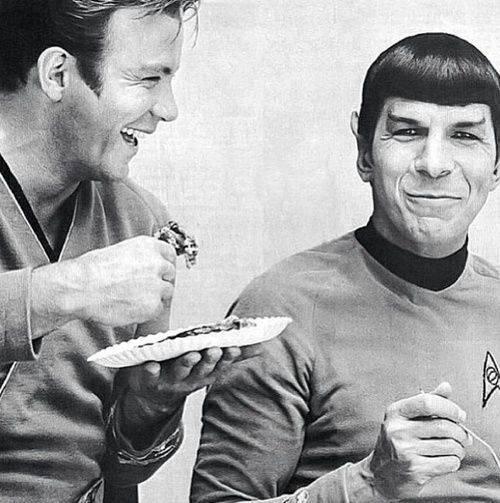
Publicity photo of William Shatner and Leonard Nimoy on the set of the original Star Trek series.
There are a lot of thoughts and emotions bouncing around in my head since learning that Leonard Nimoy—who portrayed the logical yet humane Spock on the original Star Trek series, the enigmatic and sometimes villainous William Bell on Fringe, and many, many roles in between—passed away on Friday. Before I was able to compose something that made sense of my feelings to post, my beloved husband wrote on twitter:

RIP @TheRealNimoy you showed us how to become whole people even when we felt like we were a mix of random parts.

Or, as writer and Manga Editor Stacy King put it:

Spock was the “it gets better” symbol for 70s nerd kids: a brilliant alien caught between cultures who still managed to find home & friends.

Some people say that we’re conflating a character with the actor that played him. Yes, Gene Roddenberry should get the credit for creating Spock—and when the network executives wanting to dump the “guy with the ears” after seeing the first pilot, for fighting fiercely to keep the half-alien/half-human character on the show. Similarly, credit is due to all of the writers who wrote him (especially Dorothy Fontana). But while characters in movies, television shows, and plays are the product of the creative work of writers, directors, costume designers, or so on, you can’t completely dismiss the contribution of the person who spoke those lines, wore the costume, and actually played the part.

Nimoy could communicate volumes in a cocked eyebrow or the tilt of his head. He’s the one who made us believe that this character that was a hybrid of a cold, emotionless alien and a much less logical human was a real person.

It doesn’t hurt that the man himself seemed quite likable. Whether he was playing Sherlock Holmes on stage, recording some truly awful music, directing movies, voicing parodies of himself in various animated (and not) shows, or being interviewed about any of his work, he always seemed to be having a good time. He took his craft quite seriously, but didn’t seem to take himself too seriously.

If George Takei is everyone’s favorite gay uncle, Nimoy became every nerd’s favorite grandpa. One of my friends retweeted one of Nimoy’s tweets from 2013 where he said that anyone who wanted him to be their honorary grandfather, should consider it done.

When he was diagnosed with chronic obstructive pulmonary disease, which may have been the result of his smoking in his younger days, he started campaigning against smoking, by posting statements like: “I quit smoking 30 yrs ago. Not soon enough. I have COPD. Grandpa says, quit now!! Live Long and Prosper.”

Given his age and the illness, I thought I was prepared for this news. But I wasn’t. By the time I heard the news last week that he was hospitalized, he had already been released and gone home. I heaved a sigh of relief. He even posted to twitter afterward, so everything must be okay, right?

In retrospect, when you read the tweet, it’s obvious he knew. I guess I just wanted to be in denial. I know I cry easily, but I didn’t expect it to hit me quite like this.

I just posted the text of his final tweet yesterday, but it’s a good thought, and worth re-reading:

“A life is like a garden. Perfect moments can be had, but not preserved, except in memory. [Live Long And Prosper]”

Leonard Nimoy, 1931-2015