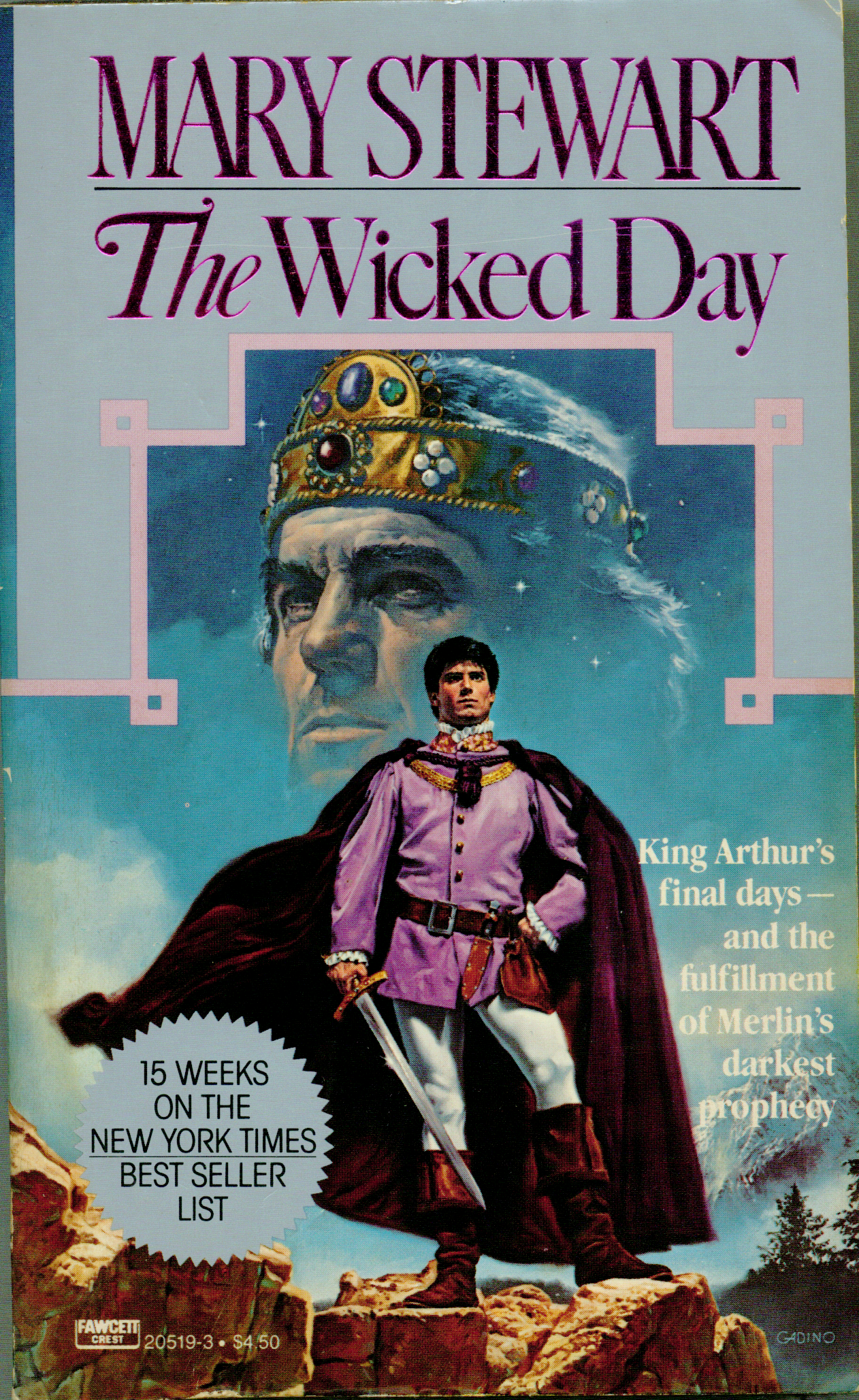
A scan of my own copy of The Wicked Day, by Mary Stewart, purchased back in 1983. (Click to embiggen)In the last two weeks I have written about the first three books in Mary Stewart’s Merlin series. The first three books are first-person narratives told from Merlin’s point of view, while the fourth book is told in third-person, mostly from both Mordred and Arthur’s points of view. Part this choice was necessitate by the fact that the crucial parts of Mordred’s story happen after the death of Merlin, so Merlin can’t narrate it. And if you’re familiar with the classic Arthurian legend, you know that both Mordred and Arthur die at the same time, so neither of them could be the narrator.
Even within the third-person narrative, Stewart shifts perspective. The opening of the book is told in an omniscient viewpoint, the narrator revealing the thoughts and feelings of all the characters. While the bulk of the book is subjective, in some chapters the reader is privy to Mordred thoughts but sees all the other characters through his eyes only. In other chapter’s we are in Arthur’s perspective. Then at the end, she moves t a more objective viewpoint, though not fully omniscient. Anyway, I’m spending so much time talking about this viewpoint stuff, which you might be inclined to think of as the mere mechanics of writing, because in a completely different sense, The Wicked Day is all about viewpoints. Several important plot points turn on the fact that one or more characters is operating on incomplete or completely mistaken understanding. And the theme is about perspectives…Continue reading Dark Prophecies and Evil Half-brothers – more of why I love sf/f→
I couldn’t find a nice large image of the same cover art as my copy on line, so spent a while trying to scan the gold paperback. The best image I got was this one, even though you can see my hands and iPhone reflected in the cover. (Click to embiggen)Last week I wrote about the first two books in Mary Stewart’s Merlin trilogy and how they became the standard against which I measure all Arthurian stories. The third and fourth books in the series came along some time later, and consequently influenced me in very different ways.
Before I get into that, I want to remind you that voting for the Hugo Awards ends tomorrow. If you are a Sasquan (WorldCon 2015) member and haven’t completed your ballot online, do it now before the servers get bogged down with the rush. The ballot is here. If you aren’t a member, you can still buy a supporting membership to become a voter, but since processing a membership might take a while as more traffic hits the servers, time is running out!
I’ve mentioned before that it’s my Mom’s fault that I am a fan of both science fiction and mysteries. From the time I was a baby, she would read aloud to me from whatever book she was reading (and when I got to the point I was trying to talk, she would cajole me into repeating back words and phrases and eventually whole sentences, which is how I learned to read at least a year before I was sent off to school). Since her favorite authors were Agathe Christie and Robert Heinlein, they made up a large proportion of what she read. But that’s a slight oversimplification. Because she read other books, too. The Christies and the Heinleins resonated with me in a way that the gothic romances she was also fond of did not. With one exception.
Mary Stewart wrote romances that weren’t always classified as romance. They were mysteries as well, and she integrated the two elements in a way where the solving of the mystery illuminated the character development as the characters fell for each other. So you’ll find some places classify her old books as thrillers, or mysteries, or romances, depending on the whims of the reviewer. Paperbacks my parents each bought tended to get taken back to used book stores to be traded in for store credit unless they were deemed worthy of multiple rereads. So there were only a couple of Stewart’s romances (most originally written in the 50s) that stayed on our bookshelves for years. One particular that I remember reading myself after pulling it off Mom’s shelf several times to look at the cover, was Stewart’s romance/thriller The Moon-Spinners.
The Hugo trophy handed out at the 67th World Science Fiction Convention in Montréal in 2009. Designed by Dave Howell. This is the only Hugo trophy that I have personally touched. (Click to embiggen)This was going to be merely the next in my own journey of reviewing the Hugo nominees before casting my ballot. I have attempted to read all the nominees with an open mind, rather than cast a No Award vote for anything that had made it onto the ballot due to the bloc-voting scheme of the Sad Puppies and Rabid Puppies. Links to my previous reviews are included below…Continue reading Hugo Ballot: My final take before voting closes→
Winners and nominees of the John W. Campbell Award for Best New Writer each receive this pin, which is a star made of fountain pin nubs.This is another post in my journey of reading the Hugo nominated stories before casting my ballot. By this point I’ve gotten through most of the story categories. I’ve probably gone on a bit too long about some of them. I’m not going to do full reviews of everything in the two Dramatic Presentation categories. You won’t have to wade through a lot to get to the Campbell Award, where I spend most of the post.
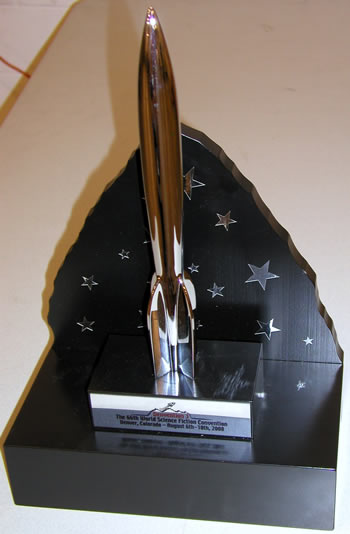
The 2008 Hugo trophy handed out at Denvention 3, the 66th annual World Science Fiction convention held that year in Denver, Colorado, USA. Trophy designed by Lee Kuruganti. Photo by Cheryl Morgan. (Click to embiggen)This is another post in my journey of reading the Hugo nominated stories before casting my ballot. I have attempted to read all the nominees with an open mind, rather than cast a No Award vote for anything that had made it onto the ballot due to the bloc-voting scheme of the Sad Puppies and Rabid Puppies. The Short Story and Novella categories were extremely disappointing, while Novelette category contained one great story, one good, and the rest dreck. Fortunately the Graphic Story category was full of great stuff, but my renewed sense of hope was dashed by the bad stuff that made up the Related Work.
Today I’m reviewing nominees for Best Fan Writer. This is awarded to a person for work(s) published in fanzines, semiprozines, mailing lists, blogs, BBSs, and similar electronic fora. Work the person may have published in professional publications should not be considered when judging for this award.
The 2003 Hugo Trophies, presented at TorCon 3, the 61st annual World Science Fiction Convention held that year in Toronto, Canada. Trophy designed by Franklyn Johnson (Click to embiggen).This is another post in my journey of reading the Hugo nominated stories before casting my ballot. I have attempted to read all the nominees with an open mind, rather than cast a No Award vote for anything that had made it onto the ballot due to the bloc-voting scheme of the Sad Puppies and Rabid Puppies. The Short Story and Novella categories were extremely disappointing, while Novelette category contained one great story, one good, and the rest dreck. Fortunately the Graphic Story category was full of great stuff that renewed my sense of hope for this endeavor.
This time I’m reviewing the Best Related Work nominees. These are awarded to a work related to the field of science fiction, fantasy, or fandom, appearing for the first time during the previous calendar year or which has been substantially modified during the previous calendar year.
This is a sort of catch-all category, that frequently includes things like biographies of writers, artists, editors or others important to the field, or books about the making of a particular movie or TV series. It usually does not include anthologies, even though there is no Best Anthology category. Non-fiction collections (such as a collection of essays about a sci fi/fantasy related topic, or collections of literary criticism, et cetera) are eligible.
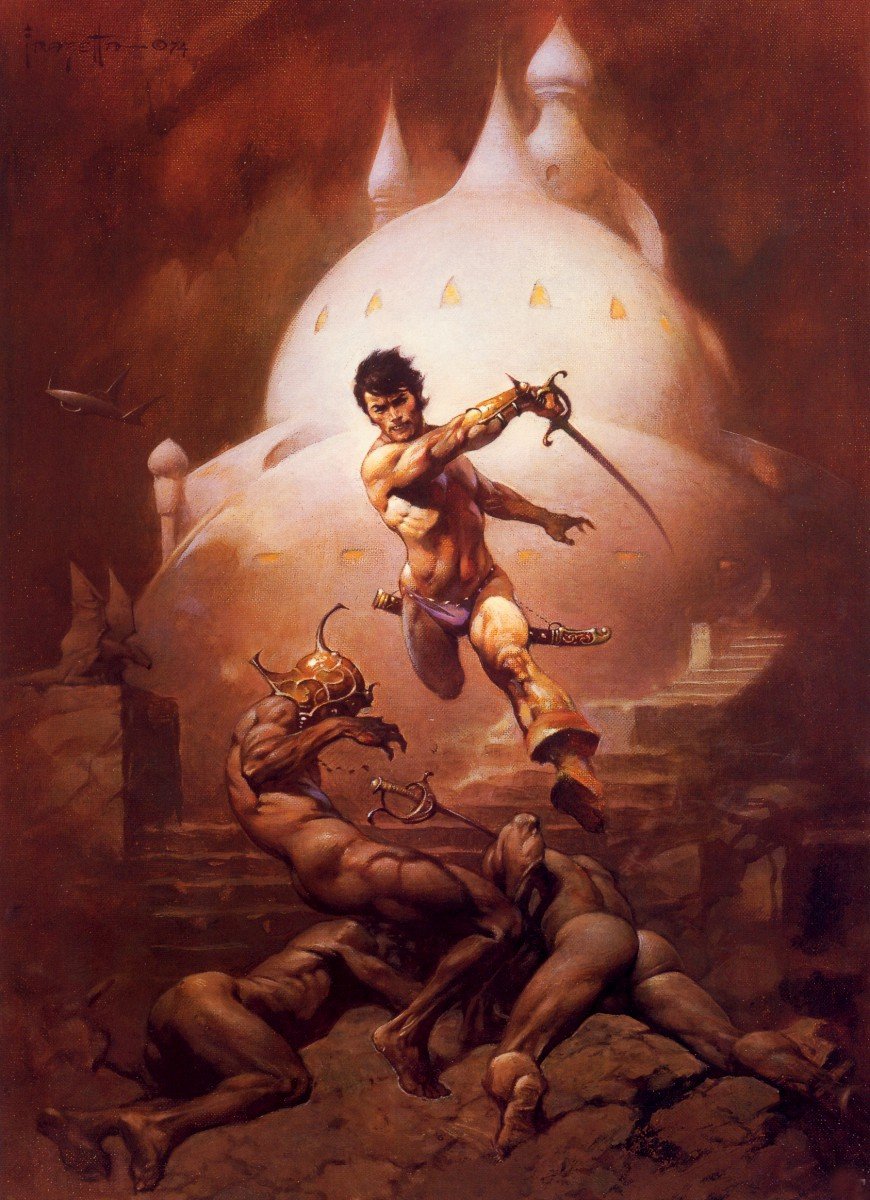
This Frank Frazetta painting, a cover for a John Carter of Mars paperback, hung on my bedroom wall throughout high school and college.(Click to embiggen)
I don’t know when I first saw a painting by Frank Frazetta adorning a book. He had worked for many years in the comics industry, then began doing movie posters in the early 60s, and by the mid 60s he was painting cover art for paperback editions of Conan the Barbarian, John Carter of Mars, and numerous other similar sorts of fantasy book series. He became the go-to guy for that sort of book. And soon rock bands were licensing images for album covers or sometimes commissioning him to do an original work for an album.
His fantasy art style was described as primal and potent. He liked to call his work rough. He also freely admitted he didn’t read the books he created covers for—even when he was also paid to create pen and ink illustrations for the interior. He insisted that most of the people who bought the books didn’t really read them, either. I’m not sure if that was supposed to be an egotistical claim that the book covers were so great that people who didn’t read would buy them, or if he thought that only illiterate people were interested in the types of stories in the books (but if they were literally illiterate, what were they doing even looking at books?), or what.
I know that most of the books I owned that featured his artwork were picked up at used book stores. And they were almost always very worn, having had their pages turned a lot. Lots of people buy books to read only once then pass on. My experience with the other fantasy fans I hung out with during my teen years was that the folks who bought these books read them, re-read them, and re-read them again. We became obsessed, and would go back again and again.
I was reading them for the sense of adventure. For a chance to imagine a different world, where the bad guys were obvious, and the good guys would get back up no matter how often they were knocked down.
But I also spent a lot of time staring at cover art. Thinking about the world and the story, yes, but also wondering why the artist made this choice, or that. What was that thing in the bad guy’s hand supposed to be? That sort of thing.
I also had other, much less noble reasons for staring at the artwork. And for buying posters of some of the artwork to hang on my bedroom wall. Though I didn’t admit it. The artwork, particularly Frazetta’s wasn’t merely primal, potent, barbaric, and rough—it was also erotic.
Frazetta’s cover painting for The Book of Paradox by Louise Cooper, published in 1973. (Click to embiggen)
My first week at university, the parents of my roommate showed up to visit. My roommate’s mother freaked out at this poster on my side of the room. I thought she was upset because of the naked man’s butt, or maybe she guessed that it was a “supernatural” picture (this was a Free Methodist university, and most folks there were quite rightwing conservative). The novel, The Book of Paradox was a sort of tarot-based fantasy, which I’m sure his mother would have labeled Satanic if she realized a battered paperback copy of it was sitting on the shelf above my bed in that same dorm room.
No, what she was angry about were the bare breasts on the winged creatures. I think I actually said out loud, “I forgot those were even there.” Because I literally had. They were obviously not the part of the painting that interested me.
“Atlantis” my very favorite Frazetta painting. I hung onto the poster long after all the others. (Click to embiggen)
My favorite Frazetta was “Atlantis,” which depicts a statue of some long forgotten warrior among flooded ruins. I know that part of my fascination was the presence of a near-nude male figure, as in so many others. But there was also something about the melancholy sense of determination in the face of great loss that spoke to me. The evocation of a great disaster that reduced the heroic exploits of generations of champions to a few vague remembrances alluded to in the stories of more recent adventurers. I wrote more than one story attempting to evoke the feelings that the picture gave me of a once mighty and noble people who had been stuck down by overwhelming, perhaps uncaring forces. I also used variants of this scene in a large number of roleplaying games I ran.
At the time I was doing everything I could to deny my attraction to other guys. Reading some of those hyper-masculine, pulpy adventures of barbarians and warriors seemed like the opposite of anything gay. Because, frankly, the only women who ever appeared in those stories were there as a prize to be won or a damsel to be rescued (or both). But I remember one friend commenting on just how often Edgar Rice Burroughs, for instance, mentioned that his various heroes were “half-naked.” At the time, I suggested that a lot of those stories had originally be written to be serialized in magazines. The writer had to re-introduce each character in each installment, for the benefit of readers just joining the tale, or to refresh the memories for those for whom it had been a month since reading the previous chapter.
Many years later, I’m not so sure. There were a lot of guys I knew back then who were all about my age that were really into these kinds of books. We lent each other copies of books we couldn’t afford or hadn’t found our own copy of. We talked about our favorite parts. Some of us bought posters of the book covers. We speculated about which ones would make good movies. We drew pictures of scenes from the stories. We tried to write similar stories of our own. In the years since, more than half of those guys have come out as gay or bisexual.
So maybe I wasn’t the only one who spent a lot of time staring at those cover paintings.
The cover of Half Magic, by by Edward Eager with illustrations by N. M. Bodecker.I think it was in the third grade that I found the copy of Half Magic by Edward Eager in the school library. It was a tale about four siblings who are having a less than wonderful summer—even though during the summer they are allowed to check out more books at a time from the public library, and keep them longer. One of the children finds an unusual coin on the sidewalk, and because she is very bored she makes a wish. The wish is granted… sort of. After some experimentation they determine that the coin grants half a wish. Wish to go home, and you will find yourself magically transported to a spot exactly halfway there, for instance. Wish for a suit of armor, and you can half a suit (the right half, if I recall). So they start making wishes for double of what they want, but that seldom works out (what is half of two talking cats, you might wonder).
They have various misadventures with their wishes. Most of the misadventures are funny, though a few are a bit intense. It was a fun book. I read it several times before I had to take it back to the library. And I was extremely pleased to learn, when I took it back, that the library had a few more books by the author (Edward Eager), some of which starred the same set of siblings. In fairly short order I had devoured Magic by the Lake, Magic or Not?, and Seven-Day Magic. Which was the extent of what that library had. It wouldn’t be until six grade that I found copies of The Time Garden and The Well Wishers. I was getting to be a bit old for them by that point, but I recall enjoying them…Continue reading The Best Kind of Books Are Magic Books – more of why I love sf/f→
Hugo trophy designed by Kathy Sanders for the 42nd World Science Fiction Convention, aka LA Con II, held in 1984.This is another post in my journey of reading the Hugo nominated stories before casting my ballot. I have attempted to read all the nominees with an open mind, rather than cast a No Award vote for anything that had made it onto the ballot due to the bloc-voting scheme of the Sad Puppies and Rabid Puppies. The Short Story and Novella categories were extremely disappointing, while Novelette category contained one great story, one good, and the rest dreck. However! I want to point out that this set of reviews is much more upbeat. This was a fantastic and fun category to review!
This time I’m reviewing Best Graphic Story. This category is awarded to a science fiction or fantasy story told in graphic form, such as a comic book, graphic novel, or webcomic. So, what did I think of the Hugo-nominated comics? Continue reading Hugo Ballot Reviews: Graphic Story→





 Font Folly