
This time I’m looking at the nominees for Best Novella. This category is awarded for a science fiction or fantasy story of between 17,500 and 40,000 words. Click to see what I thought… Continue reading Hugo Ballot Reviews: Novella
This time I’m looking at the nominees for Best Novella. This category is awarded for a science fiction or fantasy story of between 17,500 and 40,000 words. Click to see what I thought… Continue reading Hugo Ballot Reviews: Novella

I don’t want to give anything away, but one reason it’s been a few weeks since I posted any more reviews was because the next categories were at least as difficult to slough through…
Continue reading Hugo Ballot Reviews: Novelette

The awards are supposed to be about the artistic merits of the nominated pieces, right?
The WorldCon committee hosting each year’s awards traditionally assembles packets of either electronic copies of the nominated works, or excerpts (whichever the publisher will allow) to send to all voters. The Hugo Packets have not been sent out yet (but may show up any moment) so I’ve been locating the short stories that are available on-line to read (Much thanks to the Adventures in Reading blog for gathering all the links in one place; I wish I’d found this list much earlier). Other folks have been posting reviews as they read the stories.
So in this post, I write a short review of each of the short stories available on-line… Continue reading Hugo Ballot Reviews: Short Stories

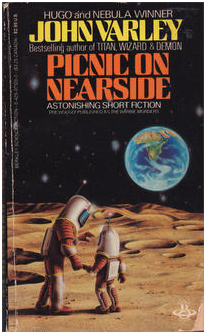
It was summer, just months before my 14th birthday, when I got hold of the new copy of the Magazine of Fantasy & Science Fiction and found inside it a story called “Picnic on the Nearside” written by John Varley. In it, the narrator, Fox, who was 12 years old and lived on a colony of the moon sometime in the future, had been in an epic argument with his mother, because he wanted a Change. He didn’t explain right away what the change was, but before that reveal, we learned that people in his society could easily alter their bodies (his mother exchanged her feet for peds/hands before going out to a party; and Fox mentioned a time he had assembled an eight-legged cat). Then Fox’s best friend, Halo, shows up as a nude woman, which finally explained what the change was. Fox and Halo had been best buds for years, and Fox worried that now that Halo was a woman, it would ruin their friendship.
I have to make a couple of digressions here. The first is that not all queer people are transgender, transsexual, nor transvestite. Gay boys don’t want to become women, we’re guys who are attracted to and fall in love with other guys. The proper answer to the clueless question, “Which one is the woman” is “Neither, that’s the point!” But one of the reasons young gay boys often idolize female characters in their favorite movies, books, and so forth is because the female characters are the objects of desire of the male characters. Similarly, young lesbian girls often idolize male characters in works of fiction. Young bisexuals may find themselves idolizing both, and so on.
Because there were no openly gay characters in any of movies, TV shows, books, short stories, et cetera which made up our cultural landscape growing up, one of the only ways to imagine ourselves in the worlds we longed to live in was to identify with the female characters. So on one level, “Picnic on the Nearside” offered me a more explicit way of projecting myself into that world. It was as if one of my subconscious coping mechanisms had been made manifest in the plot! Therefore, this story so intrigued me not because its imagined future would afford me an opportunity to change genders (which wasn’t what I wanted), but because it offered an escape from the expectations that boys were only allowed to do boy things, and only allowed to be friends with other boys, and only allowed to be boyfriends with girls.
The other digression is about the difference between a gender fluid milieu and a gay/lesbian culture. Varley has written a lot of stories set in the same world as “Picnic on the Nearside,” including several with the same character, Fox, as the protagonist (though the stories starring Detective Anna-Louise Bach {for example, “The Barbie Murders”} may be a bit more famous). Many of his characters change genders and have love affairs with people who have also swapped genders, but many times his imaginary gender fluid society is still very heterosexual. Fox never thinks of Halo as a potential sexual partner until they are opposite gender, for instance. Some of the couples who appear in the various stories seem to be just friends when they happen to be the same gender, then become lovers only when they happen to be opposite.
Many psychologists and sociologists now theorize that men who like to dress up as women and have sex with other men while thus dressed up are actually exploring an exaggerated heterosexuality. Having, in the online world, been sometimes emphatically propositioned by guys like that, and found myself turned off by their “flirting” that consists of trying to get me to say I will treat them the way an extremely selfish chauvinist man might treat a “slut,” I see their point. The men pursuing those scenarios are so into their fantasy of what heterosex could be that sometimes they want to experience it from the girls’ side. They aren’t turned on by the other man as a man, they are turned on by the situation of a woman submitting to a man in very specific ways.
Looking back on some of Varley’s stories, they can feel more like a mostly hetero exploration of gender roles, rather than a pan-gender exploration of sexual orientations.
There’s nothing wrong with that, and there’s a lot right with it.
A lot of the pain, fear, and bigotry directed toward LGBTQ people is grounded in very narrow and strict views of gender. It’s why homophobic men are almost always also misogynist (or at least very chauvinist). So anything that makes us question those assumptions about intrinsic differences between men and women, what roles men and women are each allowed to take in society, and the morality of those gender binaries is a good thing. And there’s no question that Varley’s tales exposed many of hypocrisies at the heart of all those assumptions.
I became a Varley fan that summer. Even more so, I became a fan of the protagonist, Fox, who went on to appear in the short story “The Phantom of Kansas” and the novel Steel Beach. Questions of gender and sexuality are at most a minor consideration in most of his stories, and I’ve come to appreciate his ability to take seemingly any speculative notion (no matter how weird) to its logical conclusion, and still tell a cracking good yarn along the way. What grabbed me that summer, while re-reading Fox and Halo’s misadventure again and again, was that there was at least one writer willing to tell stories that didn’t exclude a queer viewpoint. And there were editors who would print it, and by implication, readers other than me who wanted to read it.
And that was an amazing epiphany for a 13-year-old gay boy in the rural and very redneck Rocky Mountains.
 I don’t remember a time when I wasn’t a fan of fantasy and science fiction. Which is not surprising, since my mother accidentally taught me how to read at an early age by reading to me from her favorite authors (Agathe Christie and Robert Heinlein) and making me repeat back entire sentences. Tales of the fantastic by Heinlein, Andre Norton, J. R. R. Tolkien, Edgar Eager, Edith Nesbit, Isaac Asimov, Ursula K. Le Guin, Leigh Brackett, Gordon R. Dickson, Lin Carter, and so many others fed my imagination, encouraged my curiosity, fueled my thirst for science and math, and provided a refuge from the cruelties and contradictions of life.
One might wonder how cruel an existence growing up as a white boy in mid-twentieth century America could be. When you have a physically abusive alcoholic father heading up your working class rural evangelical fundamentalist family, real life can be quite unpleasant—especially for a gay, nerdy kid who talked to himself and was more comfortable with books than kids his own age. Science fiction and fantasy promised worlds where all you needed to defeat evil was a bit of courage, a lot of cleverness, and people you could count on. Every time my dad’s job transferred us to a new town, I would quickly ingratiate myself with the local librarians and proceed to devour every science fiction and fantasy book I could find on the shelves. Not to mention mysteries and science non-fiction books.
It wasn’t just the imaginary worlds of the various stories I read that provided a refuge, but from the introductions and interstitial texts of anthologies such as The Hugo Winners, Volume n, Best Science Fiction of the Year XXXX, and so forth, I also learned of conventions, where the creators and fans of these fantastic worlds gathered to talk about their favorite books and stories, encourage each other to write more stories, collaborate in various ways, and maybe even have a fun party or banquet where awards were handed out. And that sounded so amazing. Before middle school I knew about the Nebula Awards and the Hugo Awards. I knew that the Nebulas were voted on by members of the Science Fiction Writers of America, and that you had to be a professionally published SF writer to get in. But the Hugos were voted on by the attendees of WorldCon—by fans and professionals alike. So in theory, at least, I didn’t have to wait until I’d been published to participate in those.
I’d decided to become a writer sometime around the age of five or six. I’d been making my own books out of whatever notebooks or paper I could get my hands on since before I could write. I started writing my own stories as soon as I could assemble my sloppily-drawn letters into words. I was determined to be a writer. And I hoped that someday I might be a member of that community of writers vying for a Hugo.
As an adult, I’ve been attending sci fi conventions for decades. I’ve even been a staff member at a few. I’ve had some of my own tales of the fantastic published, even though most of my published stories have been in fanzines and other small semi-pro publications. I’ve had the good fortune to be the editor of a fanzine with a not insignificant subscriber base. I count among my friends and friendly acquaintances people who have been published in more professional venues, people who have run those conventions, people who have won awards for their sf/f stories and art, even people who have designed some of the trophies. Not to mention many, many fans. I have even occasionally referred to that conglomeration of fans, writers, artists, editors, and so forth as my tribe.
All of that only begins to scratch the surface of why I find the entire Sad Puppies/Rabid Puppies mess so heart-wrenching. Yes, part of the reason the situation infuriates me is because the perpetrators are all so unabashedly anti-queer. For this queer kid, sf/f and its promise of better worlds and a better future was how I survived the bullying, bashing, hatred, and rejection of my childhood. To find out that there are fans and writers who so despise people like me that they have orchestrated a scheme whose ultimate goal is to erase us goes beyond infuriating.
But it’s worse and so much more than a bloc-voting scheme.
This is hardly the first time I’ve encountered homophobia, misogyny, and racism in the fandom. It’s certainly not the first time I’ve encountered it among the professionals! While it’s disheartening to have people sneer and make denigrating comments; and it’s chilling to be told people like me deserve extermination. The worst part is to be told that even putting characters that are like me into stories about space battles or post-apocalyptic worlds or bio-engineered futures makes those stores cease to be “real science fiction.”
If your imagination is so small that you can’t conceive of a future where gay people and women and non-white people actually exist and do interesting things—that those people can sometimes be the heroes of the tale—then I just don’t see how your speculative fiction can be very creative. If you can’t conceive of a world with gays and straights, women and men (trans* or cis), and people of all races, living and working together, you’re hardly a visionary. If you’re so afraid to share imaginary worlds with such people, you’re the exact opposite of an intrepid adventurer.
Update: Some of the Sad Puppy supporters have decided to send me messages, accusing me of blindly believing propaganda. The implication seems to be that the various organizers of the Sad Puppies have never said the things alluded to here.
Let me be clear: I’ve been reading the blogs and other postings of John C. Wright, Brad R. Torgersen, Larry Correia, and Vox Day/Theodore Beale for years, because they’ve been on their anti-SJW and anti-gay kick for a while. Everything I’ve mentioned in this post and previously I have seen myself, from their own words. That they have deleted and revised many of their old posts to obfuscate that doesn’t change anything. They can claim they didn’t say what they said, but we have screen captures and Google caches and Wayback Machine caches that say otherwise.
And even the revised posts are still clearly anti-gay: [The unraveling of an unreliable field | Brad R. Torgersen]
I wrote yesterday about why I believe storytelling shouldn’t be preaching. I’ve also written about how author’s values inform stories, usually not in the ways you think.
Sometimes stories come about because the author is trying to figure something out. We write the tale hoping to find that answer. I wrote a story set in my Trickster universe that was one of those. I’d had the bare bones of the conflict in my head for a long time, a kind of just-so story to answer a question about how one of the characters got into a particular vocation. But while I had an opening problem, I didn’t know how it ended, so it sat in my big list of story ideas on the hard disk for a couple of years.
Completely unrelated, I had been struggling for a long time to understand a particular zen koan. And it occurred to me, one day, that this character’s struggle might be something like the koan.
The next thing I knew, I was writing a story… And what came out was something called “The Luminous Pearl, or the Second Tail of Sora.”
Go give it a read, and tell me what you think.
I know a lot of people I follow on Tumblr have already reblogged this post Seanan McGuire put up this morning, but it hits on topics I have talked about, so:
Responding to this question: kerrykhat asked: What do you do when there’s an author you absolutely adore in a short story anthology, but there’s also an author that you don’t want to give money to under any circumstances?
Well, first, I remind myself that all the authors in that anthology have already been paid, and that the majority of anthologies never earn out or make any additional revenue for the authors inside. It’s a small thing, but it salves my conscience. Beyond that…
Let’s say there are three authors whose careers I monitor. Jan, who is an absolute favorite, whom I would follow to the ends of the earth. Pat, who stepped on my foot once at a con and didn’t say sorry, and who I consequentially avoid whenever it doesn’t inconvenience me. And Robin, who actively lobbies for causes I find repugnant, and flat-out says that my friends and family are perverts and freaks of nature for loving the people that we love. Now let’s say that there’s a new anthology containing all three people.
This is a problem for me, obviously. I want to read Jan’s story. More, I know Jan makes a lot of money from anthologies, and since I want Jan to keep getting those invitations, I don’t want to pirate the story. I’m okay with giving a little money to Pat; there’s no hatred there, just mild annoyance. But what about Robin? Robin’s an asshole and a bigot and I am really uncomfortable with the idea of forking over a penny.
This is my solution, which obviously is not perfect:
I buy the anthology. And then I take an exacto knife, and excise as much of Robin’s story as I can, slicing carefully one page at a time to prevent damaging the spine. If I’m lucky, Robin’s story doesn’t share any pages with the stories around it, and I can get the damn thing completely out. And then I mail that story to the publisher of the anthology, with a letter explaining that they almost lost my money because of Robin’s presence.
I am not advocating censorship. Authors are people too, and they’re going to live their lives as they see fit. But I am saying that you have a right to live your life as you see fit, too, and that if people are going to put an author who says your life is wrong in an anthology, you have a right to comment on it.
Also: please don’t yell at authors who share an anthology with Robin, because odds are they had no input at all on who got invited. We’re all just trying to put food on the table however we can.
I think this is a great idea. I may have to go find some anthologies to buy paper copies of just for this purpose, now…
Note: I can’t take credit for the above idea. Neither should anyone conclude from my re-blogging this that she agrees or endorses anything I may have previously blogged about authors who I refuse to give money to and that I discourage other people from giving money to because of their decades of advocacy against gay rights.
My endorsement of her suggestion is simple that, an endorsement of her idea of one way to support writers you like, while still commenting on those who contribute to oppression.
(I endorse her other writing, too. You can follow Seanan McGuire’s blog here, learn about her books here and buy them here.)

Then I found out my friend, Mark, was going to participate in Camp NaNoWriMo. I had heard of the Camp, but I hadn’t really known what it was. I thought it might actually me a physical meet-up. The organization that runs NaNoWriMo has sponsored such activities, like the Night of Writing Dangerously, so a weekend retreat or something similar didn’t seem unreasonable.
My impression was wrong. Continue reading Deadlines motivate me
Our friend, Jared, had agreed to give the manuscript of the first novel in the Trickster series a copy edit pass. He handed back the pile of pages, and we discussed topics other than mechanical copy edits. One of the questions he had for me was whether I planned to create a map of the fictitious world to include in the book.
One reason was that there are some places where it is a bit confusing where some of the groups of traveling people are in the story.
I have a very rough map sketched out in my notes, along with description that would just be long exposition in the book. There is description of the setting, but generally I keep it short and focused on the immediate vicinity of the characters. I really don’t want to write a scene where one character says to another, “As you know, Philippe, the empire is bordered on the south by four independent lands: the Duchy of Molalla, the Duchy of Falatin, the Tlatskan Marches, and the Duchy of Matilla. The river Klitwatchee defines the border, and it’s many tributaries define the major trade routes between the larger cities of each…”
When one of the characters is actually at the river, I mention that the opposite bank is another country, but no one really wants a detailed geography lesson plopped into the middle of the adventure tale, right?
I feel a little reluctance to put in a map because of a number of reviews I recall reading some years ago (as in, when I was in my teens) disparaging such maps in fantasy novels. I don’t really recall all of the reasons that were given for treating the maps with such derision. I remember a suggestion it denoted either laziness or a case of copying all the more successful epic fantasy novels. Or something.
Which I realized is weird. I have somehow internalized these opinions that I only vaguely recall reading, and it’s made me ambivalent about the idea of including a map.
While I was talking about this, a couple of our other friends scoffed at the derisive commentaries. One said, “Some of my favorite books have maps!”
The consensus seemed to be that a map wouldn’t hurt. Since the plot of the novel does involve several characters traveling, not to mention a battle with multiple armies, a map would probably be quite useful for at least some readers.
So I guess I need to draw a better map.
 Font Folly