Tag Archives: gay

Actions speak louder than words

Credit: Associated Press)
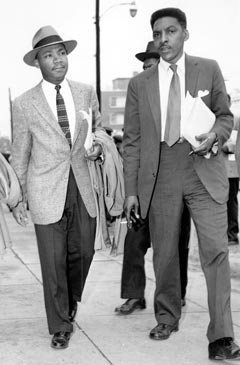
Dr. Martin Luther King, Jr. and Bayard Rustin in a file photo from 1956.
Not wanting to co-opt another community’s struggle, I don’t usually write anything about Martin Luther King, Jr. Day. But since certain other people with far less right than I do have, and have done so as a way to shore up their own anti-gay agenda, I feel an obligation to make a couple of observations.

Bayard Rustin is probably most famous as the man who handled all the organizational details of Dr. King’s 1963 March On Washington. Rustin took care of everything from the transportation, to making sure there were enough porta potties for the crowd, to insuring that no one brought weapons and the march stayed nonviolent, to convincing Dr. King that King’s speech should the be at the very end of the program. Rustin was convinced that the “I Have a Dream” message that King had been writing and rehearsing would work best as the dramatic crescendo at the end of the day, rather than as an opening whose sentiment might be overshadowed and diluted by other speakers and performances afterward.

And Bayard Rustin was gay. He was not closeted and secretly gay—Bayard Rustin was openly gay in an era far more homophobic than today. Despite having been arrested, beaten, and several times fired for being homosexual, Rustin remained open and candid about his sexuality. Throughout the years of their association, Dr. King was frequently urged (and begged and ordered) to push Rustin out of the Southern Christian Leadership Conference, to distance himself from Rustin and denounce him as a “pervert” and “immoral influence.” Again and again, Dr. King refused to do that, and continued to rely on both Rustin’s organizational and debate skills.

Dr. King was assassinated before the Stonewall Riots, therefore before the modern gay rights movement began to be noticed by the press and the public at large. We don’t know what he might have said or done at that time. We do know that he fought as much against factionalism within his own movement as the enemies without, trying to keep everyone focused on the cause of racial equality and economic equality. As more than one historian or political scientists have pointed out, if he had been anti-gay, there would surely have been a sermon delivered on the topic, or some negative comments about Rustin or other homosexuals he met among the hours and hours of FBI wiretap tapes.

And there isn’t.

Nor is there any indication he ever asked Rustin to try to hide his sexuality.

Rustin had deep religious convictions about the importance of nonviolently fighting against racial and economic equality. While he was open about his sexuality, he didn’t start publicly fighting for gay rights until the 1970s, when he referred to the treatment of gays and lesbians as the new barometer for measuring social justice.

And he wasn’t the only one.

“If you are gay, lesbian, bisexual or transgender, you do not have the same rights as other Americans, you cannot marry, …you still face discrimination in the workplace, and in our armed forces. For a nation that prides itself on liberty, justice and equality for all, this is totally unacceptable.” — Yolanda Denise King, Dr. King’s eldest daughter.

Today, several white leaders of anti-gay organizations have tried to wrap their hatred in King’s legacy. They do this by quoting King’s niece, Dr. Alveda King, a rabid anti-abortion and anti-gay rights activist. I suppose it is petty of me to point out that the supposedly pro-traditional marriage, pro-life Alveda King has been divorced three times, had two abortions, and the only reason she didn’t have a third abortion is that she could not convince her father or grandfather to pay for it, and that she didn’t appear to become anti-abortion until she started being a paid speaker for various archconservative groups.

But I think Dr. King’s widow might have more accurate insight into Dr. King’s beliefs:

“I still hear people say that I should not be talking about the rights of lesbian and gay people. … But I hasten to remind them that Martin Luther King Jr. said, ‘Injustice anywhere is a threat to justice everywhere.’ I appeal to everyone who believes in Martin Luther King Jr.’s dream, to make room at the table of brotherhood and sisterhood for lesbian and gay people.” — Coretta Scott King, Dr. King’s widow.

Bayard Rustin and his long time partner, Walter Naegle.
To me, the real answer comes back to Bayard Rustin. Dr. King was pressured to distance himself from Rustin, to disavow him, to remove him from leadership positions within King’s organizations. When, before the March On Washington, a U.S. Senator read the full police report about Rustin’s arrest in 1953 into the Congressional Record, including Rustin’s guilty plea to the sodomy charge, along with statements from Rustin’s FBI file in admitting several times to being a homosexual, virtually no one would have faulted Dr. King if he had removed Rustin from his position. In fact, the then-president of the NAACP begged Dr. King to, at the very least, not publicly acknowledge Rustin’s role in organizing the march.

Dr. King did none of those things. When Life magazine interviewed King about the March, Dr. King credited Rustin and A. Philip Randolph as the organizers, which led to Ruston and Randolph appearing on the cover photograph of the magazine.

I could include many more quotes from members of Dr. King’s family and other leaders of the movement, but I think Dr. King’s actions toward Rustin tell the story.


Arguing with numbers

freedomtomarry.org
Things change. (Click to embiggen)
Just a couple of weeks ago, a spokesperson for another one of the anti-gay hate groups out there (I don’t remember whether it was the National Association for Research and Therapy of Homosexuality, or National Organization for Marriage, or American Family Association, or Coalition of Conscience, or Focus on the Family, or Public Advocate of the United States, or Abiding Truth Ministries… I just can’t keep up with them all!) was on someone’s program repeating the claim that the vast majority of Americans oppose Marriage Equality. Just as only a few months ago a different guy was on another program insisting that “every time this question has been put to the voters, they have rejected it!” Both of them are apparently in deep denial of the fact that polls in the middle of last year showed that now a clear majority of Americans support extended full legal marriage to same sex couples, and more than two-thirds approve of civil unions or marriage. And they seem to be in deep denial of the four states that did not reject marriage equality when put to a vote of the people in 2012.

Now, only three of those four states approved ballot measures enacting marriage equality, while the fourth state rejected a constitutional ban on such marriage by a good margin. But a healthy majority of votes refusing to ban same sex marriage certainly falls into the category of “not rejecting” marriage equality.

So why do they keep arguing…? Continue reading Arguing with numbers

Too close to home

SuperStock.com
Not all natural habitats are equal.
My current “pocket book” is a memoir by a gay man who, like me, was raised in a very evangelical fundamentalist family. I’d read reviews of the book when it first came out, and they all emphasized his humorous recollection of often painful situations. Then just before Christmas, the author was a guest on a podcast I listen to, and the host mentioned the book again, repeating the hilarity of his approach to the topic.

And I was just wrapping up another book and thinking I would need to download a new e-book to my phone to be the next “pocket” book. So guess what book I bought?

I didn’t start reading it right way. Once I finished my previous book, I started listening to audiobooks of various holiday favorites during my usual read on the bus time. So I just started reading it this week.

So far, it’s been too painful to be funny.

Continue reading Too close to home

The jerk in the closet

A lynx in the snowy woods, barely visible.
Can you spot the lynx?
I spent a huge amount of time in elementary school, middle school, and high school trying to blend in. Sometimes I just wished I could be invisible, and that no one would notice me at all. Other times I tried to act like the people that the other kids seemed to like.

It was always worst right after we moved. My father’s job in the oil fields resulted in me attending ten different elementary schools in four different states. And at each new school it was never long before some of the kids (and occasionally some of the teachers) were teasing, harassing, or outright bullying me for being a sissy, pussy, or fag. Most of the times those words were hurled around in the lower grades, no one was literally accusing me of homosexuality. All they meant was I didn’t act like a “normal” boy.

In middle school it was a bit different. For one thing, everyone’s hormones were going crazy. In elementary school most of the normal boys had thought girls were icky (and one of the ways I kept being abnormal was I always got along better with the girls than most of the boys), but suddenly those same boys were trying to find a girlfriend. And the insults changed. Now “pussy” was the nicest thing any of the other boys or male teachers called me.

It’s not that they ever caught me in flagrante delicto. Well, except one bully. Though “caught” isn’t the right word. But I’ll get back to him…

Continue reading The jerk in the closet

In the place where you are

They said...
They said…
A friend shared this article on Facebook: Same-sex Couples Shatter Marriage Records In Utah. It is incredible, when you think about it: in just a few days of marriage equality, Utah has had almost as many same-sex weddings as the state of Maine did in the entire year since voters there approved marriage equality. Another friend commented on the irony that there seemed to be more gay couples in the states where they are least respected. This kicked off some pondering as to whether there are more LGBT people there than other places, or does it just seem that way.

Of course, I have a few theories about this… Continue reading In the place where you are

“The decision to marry is a fundamental right”

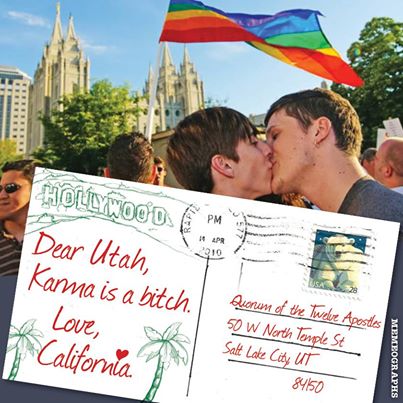
Marriage equality comes to Utah.
After pouring tens of millions into the Prop 8 campaign in California, organizing phone banks, and so on…
The decision in federal court declaring the Utah state constitution’s ban on same sex marriage a violation of the U.S. Constitution set off a cacophony of hysteria in conservative circles. Numerous op-ed pieces in conservative blogs and publications made the outraged assertion that the “activist judge” had “fabricated a constitutional right to marry.”

The problem is that it isn’t fabricated. Since as far back as the year 1888, the U.S. Supreme Court has repeatedly declared that the right to marry is a fundamental human right. In the 1888 case the court declared it “the most important relation in life.” In 1923 they declared it one of the fundamental rights protected by the Due Process Clause. In 1942 they declared marriage one of the most basic and fundamental civil rights covered under the Equal Protection Clause. In 1965 they declared the right to marry and make decisions about having a family as part of a fundamental right of privacy that was older than the constitution, that the right to privacy was implied by several parts of the Bill of Rights, most strongly in the Ninth and Fourteenth amendments.

Most famously in 1967, in the case that struck down the few remaining laws against interracial marriage, the court unanimously ruled that “The freedom to marry has long been recognized as one of the vital personal rights essential to the orderly pursuit of happiness by free men.”

In 1974 the court declared “This Court has long recognized that freedom of personal choice in matters of marriage and family life is one of the liberties protected by the Due Process Clause” when it struck down laws that prohibited pregnant women from working as teachers.

In 1977 in a couple of cases involving laws about who was allowed to live together, the court declared that the choice of who to live with, who to marry, and who to raise children with were fundamental rights which the government could not interfere in without justification that would pass careful judicial review.

In 1978 the court found that “the right to marry is of fundamental importance for all individuals” in the course of declaring that a state must show that any law restricting the right furthers an important government interest in a way that is substantially related to that interest.

In 1987 the court reaffirmed that “the decision to marry is a fundamental right” and that it was so fundamental that even the most violent and dangerous of convicted criminals must be allowed to marry even while they were in prison regardless of whether they would ever be allowed to consumate such marriages.

In 1992 the court included marriage and the choice of whether and who to raise children with as “central to personal dignity and autonomy” and “central to the liberty protected by the Fourteenth Amendment.”

In 1996 the court held that “choices about marriage, family life, and the upbringing of children are among associational rights this Court has ranked as ‘of basic importance in our society,’ rights sheltered by the Fourteenth Amendment against the State’s unwarranted usurpation, disregard, or disrespect.”

Most tellingly, in 2003 when striking down state sodomy laws, the court held that “our laws and tradition afford constitutional protection to personal decisions relating to marriage, procreation, contraception, family relationships, and education. … Persons in a homosexual relationship may seek autonomy for these purposes, just as heterosexual persons do.”

That last one certainly seems to imply that gay couples ought to be able to get married, if they wish. And it was the ruling that set off the flurry of state ballot measures in 2004 to place gay marriage bans into several state constitutions, including Utah’s. These bans were not spontaneous statements from the people about individual rights. They were, in fact, a carefully orchestrated strategy by extremely cynical persons in the Republican party. The primary goal was to drive conservative leaning voters to the polls in order to re-elect George W. Bush.

And calling it “extremely cynical” is putting it mildly. The guy whose idea it was, then-chairman of the Republican National Committee, was a closeted gay man, who has since tried to rehabilitate his image by becoming a pro-marriage equality advocate (personally, I believe he needs to apologize to the parents of every single gay kid who committed suicide or attempted suicide during the years he was active as a Republican politician, and then he should go be a religious hermit somewhere).

But I digress…

The bottom line is, it is settled law, going back 125 years, that the Constitution protects the right to marry and to choose who to marry. It isn’t a new idea, or a radical fabrication. Just as some of the people who agreed the marriage was a basic right used to also think that the word “marriage” only applied when people belonged to the same church, and some who agreed it was a basic right thought the word only applied when both people were members of the same ethnic group, there are people who believe that you should have to right to marry, but only if the two people involved are opposite gender.

Despite the sincerely held beliefs of a minority of people (and it is now a minority of U.S. citizens) that people of the same sex should not be allowed to marry, those people have failed, again and again and again, to show a single logical or verifiable reason that that should be the case. Even Supreme Court Justice Antonin Scalia, who opposes same sex marriage with a passion that borders on the disturbing, has admitted that the only reason to bar it is because some folks believe it is wrong.

And just because some people think some other people are icky is not a compelling or even substantial reason to deny them basic rights.

I now pronounce you…

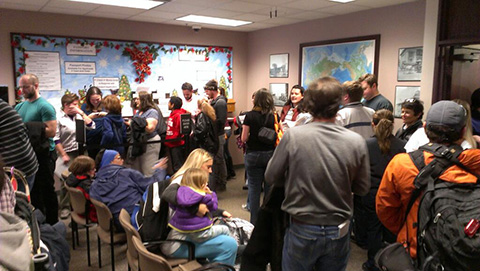
Same-sex couples wait in long lines to wed in Salt Lake City.
I’ve been expecting the New Mexico ruling. They already had a number of individual counties issuing licenses to same sex couples, and the state didn’t have a specific same-sex ban (unlike other states). There were a number of different laws related to marriage that included gender-specific clauses, but it seemed fairly obvious the state supreme court would rule in favor of equality. So, when the court issued its unanimous ruling on Thursday, it was worth cheering, but it wasn’t a shocker.

Utah on Friday was a big shock. Especially to me, since part of my childhood was spent in one of the most religiously conservative counties in that state… Continue reading I now pronounce you…

That isn’t what artistic expression means

A fancy wedding cake.
Can you tell from the artistic expression in this cake what the baker’s religious beliefs are?
I have a lot of friends who are artists. And several of them have, at one time or another, sold sketches at sci fi/fantasy/comic/furry/et cetera conventions. And I’ve heard horror stories from them of people asking them to draw disturbing or offensive things. Usually they’ll say, “No, I won’t do that” or “I can’t draw that,” and then offer to draw something else instead. And I support their right to do that.

But the people who are trying to claim that a bakery refusing to make a cake for a gay couple’s wedding or a reception is the same sort of refusal are being more than a bit disingenuous. The judge in the Colorado case does a great job of explaining why this argument (and others) don’t hold up. I’ll quote the most salient part:

The undisputed evidence is that Phillips categorically refused to prepare a cake for Complainants’ same-sex wedding before there was any discussion about what the cake would look like. Phillips was not asked to apply any message or symbol to the cake, or to construct the cake in any fashion that could be reasonably understood as advocating same-sex marriage. After being refused, Complainants immediately left the shop. For all Phillips knew at the time, Complainants might have wanted a nondescript cake that would have been suitable for consumption at any wedding. Therefore, Respondents’ claim that they refused to provide a cake because it would convey a message supporting same-sex marriage is specious. —Administrative Law Judge Robert Spencer

Continue reading That isn’t what artistic expression means

Bullied bullies, part 2

Religious person beats atheist with cross, is angry when atheist breaks cross.
They never think it’s fair when you stand up for yourself.
Week before last, a Catholic Bishop in Hawaii spoke out against the Marriage Equality law, and while doing so claimed that children raised by same sex couples were at very high risk for becoming suicidal. Dan Savage, a Seattle-based nationally-syndicated sex advice columnist and gay activist, appeared on Bill Maher’s show, and Maher mentioned this Bishop’s statement. One reason to mention it, besides the fact that Savage is always good for some commentary on a gay rights issue, is because Savage was raised Catholic (and has written eloquently about how his Mom’s Catholic faith is where she gained the determination to became a fierce pro-gay activist). So Dan has written and talked a lot about the Catholic church’s stand on gay rights as opposed to its more supportive members.

Anyway, Dan replied that the Bishop was confusing kids raised by same sex parents with the actual statistics about kids raped by pedophile priests.

This set many conservatives and Catholic pundits into an uproar, accusing Dan’s comments of being hate speech, or even a hate crime, or at the very least disrespectful.

The problem is that it was none of those things.

Continue reading Bullied bullies, part 2

Bullied bullies, part 1

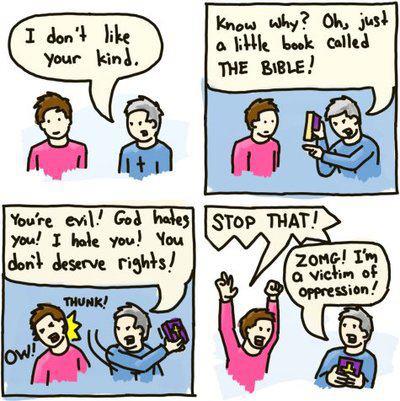
Cartoon about abusers claiming to be abused.
A literal bible thumper!
Anti-gay activists have been claiming to be the victim of bullying and oppression for a long time. The go-to response when anyone points out their intolerant attitude has always been to accuse that person of being intolerant. So in one sense this isn’t new. But the attempts to paint themselves as victims have escalated lately, including being invoked as a “justification” for the political action branches of these anti-gay organizations to ignore, violate, or only half-heartedly comply with campaign finance disclosure laws and tax filings.

Last week a new claim began making the rounds: that anti-Christian hate crimes were now happening as often as anti-gay hate crimes. A claim that the numbers just don’t support…

Continue reading Bullied bullies, part 1