Tag Archives: gay

Skewed polls and secret money

A few days after election night, when the leader of one of the local anti-gay groups conceded that voters had approved marriage equality, he groused about how the pro-gay groups had outspent them three-to-one. Just a week earlier he had been insisting that the polls which were all predicting passage of the referendum were skewed. “People are reluctant to say what they really feel to a pollster, because the pro-sodomy side has tricked the media into calling support of traditional marriage as bigotry. But when those voters are in the privacy of the voting booth, they will vote their true feelings.”

They did vote their true feelings. Fortunately for those of us who believe in equality, they had also been telling their true feelings to the pollsters. Surprise, surprise!

Sadly, I believe it was a complete surprise to the opposers. It shouldn’t have been. They had other evidence, and it was right there in that hypocritical comment he made about spending. It was hypocritical because it had only been four years before, during the Proposition 8 campaign in California that the anti-gay side had been doing the outspending. And for years before that, each ballot measure that came up in any state related to marriage equality or civil unions, it was the anti-gay side that always seemed to have the money advantage.

This time around, in Washington, Maine, Maryland, and Minnesota, the forces of hate came up short both in the ballot box and fundraising. And it wasn’t simply a matter that suddenly our side was better at raising money. No, the big story is that they have, in just the last few years, experienced a serious drop in donations.

It isn’t just the amount of money. What’s more significant is the number of donors. The national organizations have been very secretive about their funding. They have refused, again and again, to reveal their donor lists, even when they appealed all the way to the U.S. Supreme Court and lost, they have tried to keep that secret. Eventually, some details are beginning to emerge:

Each year, according to [the National Organization for Marriage]’s tax filings, two or three donors give NOM between $1 million and $3.5 million apiece; another two or three give between $100,000 and $750,000; and 10 or so others give between $5,000 and $95,000. In 2009 the top five donors made up three fourths of NOM’s budget; in 2010 the top two donors gave two thirds of the year’s total donations; and in 2011 the top two donors gave three fourths of NOM’s total income. But those funders’ identities are a mystery. Their names are redacted on NOM’s federal tax returns.

My emphasis added. Whoever those mysterious top two donors are, their donations have became a larger and larger proportion of the pot, as the thousands who gave less than $5000 dollars a year have dwindled to hundreds.

Statistics tell us the the most vehement opposition comes from the oldest voters, so a percentage of that drop off represents to reality of demographics. As elderly opposers die off, without a compensating proportion of supporters coming up in younger generations, some of that is just inevitable. But the drop off in support to the anti-gay cause in the last three or four years is far in excess of what could be accounted for by mere demographics.

People are changing their minds.

There will always be a hardcore group opposed to equal rights for gay, lesbian, bi, and trans people. Just a couple weeks ago at the big conservative conference a guy stood up and argued in favor of slavery because he believed it was a self-evident truth that whites were superior to blacks. He wasn’t an invited speaker, and to their credit, panelists and audience members challenged him on it, but during the ensuing back and forth he also made a comment to the effect the women shouldn’t have the right to speak up in public, either. So, just like that unrepentant racist and misogynist, there will always be homophobes among us.

But as more of the moderates and non-hateful conservatives come around, that view will be limited to the lunatic fringe where it belongs.

In the months since the vote in Washington, Maine, Maryland, and Minnesota went our way, the opposers’ spokespeople have gone from saying that they were outspent 3-to-1 (which turned out to be a small exaggeration in our state) to claiming they were outspent 4-to-1, then 5-to-1… the last quote I read was “more than 7-to-1.” I believe their exaggerations get worse due to desperation. They hope that skewing their claim of victimhood will prompt more people to donate more money, which they think can turn the tide.

What they don’t understand is that the only skewed “polls” were their own. They fell into the common trap of thinking that because most of the people they know and like agree with them, that it absolutely must be the case the most people, period, do so. They think that since they still manage to raise a lot of money that there is still a lot of support, ignoring the fact that it’s a smaller and smaller number of people sending in the money. Because they are convinced of the truth of their cause, they believe that the only reasons polls and voting can be going against them is some kind of chicanery. They think that calling us pedophiles, comparing our relationships to bestiality or incest is “civil discourse,” but if we call them bigots we’re being bullies.

Most of all, many of them believe all the lies and distortions that they tell about us. Lies that other people can no longer believe once they get to know us:

A real pink-neck sensibility

It happens to the best of us: trying to write is a complete bust, and when you try to read your brain just can’t seem to hold the thought from the beginning of a paragraph to the end. You can’t concentrate, but you’re not sleepy, and so you wind up either surfing the internet or surfing channels.

A few years ago I was doing that one late weekend night and I came across a comedian doing standup. He was a big guy with a shaved head and wearing a football jersey telling a joke about why he loves the series, Cops. Cops happens to be one of my least favorite shows, for exactly the reasons he was joking about it, but he made me laugh, so I kept watching.

A few minutes later he mentions that he’s gay, and then makes a bunch of self-depracating jokes about how difficult it is for a gay guy who looks like him to get a date. Which made me laugh a bit more—and not just because my equally non-stereotypical look had made dating unpleasant back in the day. He made some more jokes about growing up in Texas in a Baptist family, then summed up the routine with a comment, “Folks look at me and think I’m a real redneck, but I’m really a pinkneck, which isn’t all that different.”

I had to do a little on-line sleuthing to find out who he was, since I had missed his introduction, and the show went to a commercial break and moved on to the next comedian without repeating his name. Scott Kennedy, it was a name I hoped I would remember.

Sometime after that I read a story online somewhere about how Scott had formed a group to entertain troops. He had worked with the USO a few times, being the son of a veteran and a military school graduate himself, he felt strongly about supporting the men and women serving their country. He called it, “Giving them a piece of home.”

But the USO organizers didn’t like to take the entertainers into dangerous places. Scott thought those were the troops that needed it most, so working with some officers he’d met during his USO tours and some comedians back home, he formed Comics Ready to Entertain (CR2E) in 2007, and started doing tours.

The last time I’d heard anything about CR2E was a short video interview after his (I think it was) 47th tour, talking about how he’d gotten his father to go along with him on the tour, which included some comments from his 70-some-year-old dad talking about what it was like to see his son entertaining troops from the same unit he had served in (back in the 50s), now somewhere deep in Afghanistan.

I’ve caught Scott’s act a few times since on cable. It wasn’t that he made me laugh so hard my sides hurt—maybe I watch too many comedians, because that seldom happens any more—but his act reassured me that it was okay that I was a gay man who occasionally watches football, likes some country music (in between the glam pop, dance, musicals, and all my other weird music tastes), doesn’t like RuPaul’s Drag Race, and will never, ever look like a gym bunny.

Scott Kennedy died a bit over a week ago. I’d seen no mention of it on any of the many gay-related news blogs I read before one blog post today. I would have rather been reading tributes to him than some of the news I did read (and amplified and ranted about on my own blog).

Scott was a funny man who did what he could to make people laugh. We need more laughter. And we need to spend more time recognizing heroes such as Scott:

I’ve known…

On the subject of coming out to one’s parents, I’ve always remembered the story one acquaintance told: “When I finally came out to my mom, she said, ‘I’ve known you were gay since you were two.’ And I thought, ‘Gee, thanks, Mom, why didn’t you tell me? It would have made my teens a lot less confusing!'”

Growing up gay, particularly before the 90s, the best you could hope for if your parents learned you were gay was a reaction like his mother’s. Truth be told, since we had no positive role models, and what little we knew about the family members of gay people were that they were all ashamed or hostile to their gay child, we didn’t even hope for that.

In my early teens I recall whispers about someone’s cousins being kicked out by his parents, for instance. In my later teens I knew one classmate who was accused of being gay whose parents sent him to “reform school.” Another who was actually caught having sex with another guy was kicked out by his parents and wound up living with relatives in another city (how the quarterback of the football team who he was having sex with was able, somehow, to convince everyone in authority that the much smaller, skinnier kid had somehow forced him into the situation is a tale for another post).

When I did come out to my own parents in the early nineties (I was a gainfully employed adult living in my own place in another city, by then), their reaction could best be characterized as, “I never had any clue, I don’t accept it, and someone must have done something to you to make you think this way.”

Even today, we are surprised to hear of anything as loving and accepting from a parent as this letter that a teen-ager in Michigan received this week from his Dad:

 Michigan dad put his son's fears about coming out to rest with this loving letter.
Michigan dad put his son’s fears about coming out to rest with this loving letter.

You can read the story of a teen named Nate, from Michigan, and the note from his Dad in this story.

Note: since apparently I wasn’t being clear: I am not Nate. That isn’t my letter. My father’s reaction was, as noted above, pretty much the opposite of this in every way.

Abyss gazing

It was 1986 and I was twenty-six years old, attending a regional science fiction convention with a bunch of my friends. One of the guests of honor was an author (we’ll call him Mr. C) that two of my friends were very fond of. I had read a couple of his short stories and thought they were good, but he hadn’t really wowed me.

But hearing Mr. C talk about the writing process, his influences, and so forth, made me much more intrigued. It didn’t hurt that when another panelist made a disparaging joke about my favorite science fiction author (who was not in attendance), Mr. C rather emphatically jumped to the defense of my favorite author.

After that panel, one of my friends commented that Mr. C’s takedown of the other panelist had been mean. It was true. Mr. C had ended the rebuttal with something along the lines, “…and it infuriates me when writers who don’t have a fraction of his understanding of how to write or a sliver of his talent make thoughtless critiques.” But, she had called my favorite author a fossil, I pointed out. Once one makes an ad hominem attack, you invite something similar in return. Since it was my favorite author being defended, I was more than a bit prejudiced.

So I wound up standing in line with one of my friends, clutching a pair of just-purchased books of Mr. C’s work, waiting for his autograph. That is the one and only time I have met Mr. C in person. He was pleasant enough, despite having had to smile, listen, and sign however hundreds of times.

After the convention, I tried to read one of the books. It was a collection of his short stories, which included the couple I had read before. They weren’t bad by any means, but after reading a few in a row, an unsatisfying feeling was developing. I sat the book down, not quite sure why I wasn’t enjoying the reading.

A few weeks later, I picked it up again and started on the next story. Again, the story itself was well written and interesting. I read another, then started on the next after that and, well, a few paragraphs in I realized that same feeling of wrongness was building up.

I did eventually finish the collection, but it took a few months, reading only a few stories at a time. And by the end I couldn’t really say that I’d enjoyed them all, but I also couldn’t put my finger on their shortcomings.

The other book was a novel. A novel for which he had won a lot of awards. It was based on one of the short stories in the previous collection. And the short story in question had been one of those I had enjoyed more than the others. Plus, I had friends who swore this book was a masterpiece. And it had garnered all those awards, so it had to be good, right?

I couldn’t finish it. I don’t think I’d even gotten a quarter of the way through before I found myself intensely disliking it.

I tried explaining what I didn’t like about it to one of my friends who loved it. As we were talking, I kept finding myself talking about abstract concepts, rather than actual events in the story. My friend said it sounded more like my baggage than the story. So I started explaining how a similar philosophical assumption underpinned one of the short stories. And that’s when I finally managed to connect the dots and say what was bothering me about all of the stories.

There was a fundamental notion forming the foundation of all the tales: if you don’t know your place and stay in it, horrible things will happen to you. A corrollary was that if you prevented someone else from achieving what was “rightfully” theirs, even more horrible things would happen to you.

When I articulated that, my friend began to argue. That wasn’t what was going on at all, he said. So then I made a guess at how the book I hadn’t finished would end. Specifically what would happen to certain characters.

My friend blinked. “How did you know?”

“Because, if you don’t know your place and stay there, forces, whether they be social, cultural, or fate, will strike you down. And if you stand in the way of someone else’s destiny—”

My friend grinned and interrupted. “Oh, wow! You’re right! That’s so messed up, because it’s like the opposite of what the main character says, but it’s really what happens!”

“Mr. C believes in hierarchical, patriarchic societies in which you behave according to societal expectations, and people who have the temerity to want to choose their own way of living are evil,” I said.

My friend shrugged and said, “You’re probably right. But I still love the stories.”

“Whoever fights monsters should see to it that in the process he does not become a monster. And when you gaze long into an abyss the abyss also gazes into you” — Friedrich Nietzsche

Just a few years later, a controversy erupted in a forum dedicated to Mr C on the (now long defunct) Prodigy network. The controversy was about a protagonist in another of Mr. C’s novels who experimented with gay sex midway through the book. Some people were angry Mr. C had included an “abomination” as a sympathetic character. Others thought people who thought gay people were abominations were bigots.

As the arguments raged, Mr. C waded in with a rather long discussion about the sin of homosexuality, why he felt he had to include it in the book (his reasoning, as I recall, was that in any community where people amass power there will be people who must dominate, possess, and destroy others, and of course homosexuality is all about dominating and destroying each other), and then had the gall to claim that anyone who called him homophobic were themselves bigots. Because he didn’t hate any gay people. They were just sinners, and if they refused to repent and stop being gay, well, they would face consequences.

His comments were quoted far and wide. And he got angrier and angrier as people “mischaracterized” his comments. He repeated, again and again, that he didn’t hate gay people. He wound up writing (in 1990) a long essay and getting it published in a magazine that catered to the members of the church Mr. C had been raised in, in order to explain his side in context.

While the essay repeatedly said that he did not condone violence against sinful people, it talked about how just as children must be punished in order to learn right from wrong, then adults will face greater penalties when they continue to act outside the bounds of propriety. He talked abstractly about the “day of grief” that each homosexual would eventually experience if they did not repent. He talked about the horrible consequences homosexuals face if they refuse to adhere to propriety. But he was not advocating violence even then, he said. If the faithful, such as himself, had been compassionate but firm in condemning the sin, they would “keep ourselves unspotted by the blood of this generation.”

It’s an old lie that bigots of a religious persuasion tell themselves all the time. They don’t advocate or condone violence, it’s just that god’s law causes these things. And when it happens, they pretend that the people who did resort to violence never took all the words of condemnation as permission to commit violence.

Think about it: if it’s god’s will that homosexuals should experience a “day of grief”; if god’s law demands that “blood of this generation” must be shed, then the person who inflicts the violence is doing god’s will. They are a special tool of god!

Heck, it isn’t just permission to commit violence: it’s encouragement!

I had already guessed most of this about Mr. C before he began writing publicly about his reasons for opposing the decriminalization of gay sex and other topics back in 1990. And so I had already made my decision not to buy any more of his books. I didn’t post rants about him, nor try to organize boycotts of his work. If I was asked, I would say that I disagreed with what I perceived to be the underlying philosophy espoused by his work.

Once he did make his very public statements, I felt it was appropriate to go a step further and point out that Mr. C was a hypocrite and a bigot who advocated against the rights of myself and others. I would suggest that perhaps there were other writers whose works were more deserving of people’s money, but wouldn’t go further.

In the years since, he has continued to write and speak out against gay rights of all sorts, eventually becoming an officer for a large organization that says it is out to protect “traditional marriage.” They try to portray themselves as narrowly focused on marriage, but anyone paying attention to their rhetoric and some of the other causes they support, can see that they want to roll back the few rights gay people have won. He donates his own money to the cause, he has organized efforts that have raised millions of dollars for the cause. He has claimed victory for every anti-gay amendment, law, proposition, or initiative that has been passed in the last ten years.

He has, now, gone far beyond the point of simply stating his opinion and trying to persuade others to it. He has gone beyond that disingenuous tactic of saying he was opposed to violence while providing double-speak that actually encouraged it. He has helped spread distortions and outright lies about all gay, lesbian, bisexual, and transgender persons. His organization has refused to obey public disclosure laws regarding their election activities in several states. He continues to fight to prevent gays, lesbians, trans people, and bisexuals full equality before the law. He continues to put forward arguments to take away what rights have been extended.

So, for that reason, yes, I agree with the people who have been disappointed that DC Comics hired him to write a prominent new Superman series. Yes, I support the comic book shop owners who have said they will not sell comics written by him. I support the artist who decided not to illustrate his stories after learning of Mr C’s views and activities. I urge everyone I know not to buy things he writes, not to go see the movie that is being made of his most famous novel.

I re-iterate: this isn’t just about a difference of opinion regarding marriage equality. For over 20 years he has advocated for restoring laws that made it a crime for consenting adults to have gay sex in the privacy of their own homes, and against laws that protect people from being fired, evicted, or denied medical care just because they are gay. And he has done more than just advocate those things, he has taken action to make them happen. It is not hypocritical of us to advocate a voluntary boycott of his work, it is hypocritical of him and his apologists to decry a voluntary boycott while they are campaigning for laws that will take away jobs, housing, health care, and more from entire classes of people.

Orson Scott Card is a hypocrite and a bigot who uses distortions and outright lies to hurt innocent people. Those are the facts.

Not all like that

It happens any time I write (or link to someone else’s post or article) about certain groups of people opposing gay rights, or those people doing really awful things in the name of opposing gay rights, et cetera: a direct message, private email, or (rarely) a public comment from someone explaining that “not all of us are like that.”

Sometimes it’s nothing more than that simple statement: we’re not all like that. More often it is a bit defensive. “You really shouldn’t generalize, because you make those of us who aren’t like that look bad.” The phenomenon happens so often, that advice columnist & gay rights advocate Dan Savage has started referring to those people as NALTs, for “Not All Like That.”

The thing is, that “you make those of us who aren’t like that look bad” is utterly false.

I’m not the one making them look bad. If I post a link to a story about a study that shows that nearly 75% of those who describe themselves as Evangelical Christians oppose gay rights, it isn’t me who is making those Christians who don’t oppose gay rights look bad, it’s the other Christians who are making Christians look bad.

If someone posts a piece showing how an organization is cherry-picking facts from a study which actually proves that the denial of equal rights harms the health of gays and lesbians to support their lies that being gay is unhealthy, it isn’t us who is making Christians look like liars. It’s the liar who claims to be speaking for Christ who is making Christians look like liars. It’s also the Christians who disagree with him but who are too timid to confront him about his lies who are making Christians look like liars and bigots. And it is especially those Christians who are too timid to confront their co-religionists but never hesitate to scold someone like me because they’re “not all like that” who are making Christians look like liars and bigots.

And that means, instead of scolding me for posting it, or “correcting” anyone who posts these news tidbits, you need to go scold or correct your co-religionists. Tell them you disagree. Tell them that they are lying. Speak out in public forums when they lie, and tell them they don’t speak for you.

I mean, really, my major in college was Mathematics and I posted the article which said nearly 75% of Evangelical Christians oppose gay rights. I don’t need you to tell me that nearly 75% is less than 100%. I already know that not all are like that.

I understand why people may be reluctant to confront the liars and bigots in their group. Those bigots and liars are mean, and they don’t fight fair. I get it. Really, I do. But if you’re too timid to go take them on, then keep your mouth shut. Whispering to people like me that “we aren’t all like that” doesn’t help me, it doesn’t prevent any of the meanness, nor does it further the causes of truth or justice. The only thing it does is make you feel better about being too cowardly to actually do anything about the lies and the bigotry.

And I have exactly zero desire to enable that!

If you happen to be one of those who are not like that, and are looking for something more concrete to do than whisper to people like me that you exist, may I suggest you get involved in one of these fine organizations:

The Reconciling Ministries Network

Evangelicals Concerned

Integrity USA

Dignity USA

The Welcoming Congregation Program

The United Church of Christ LGBT Ministries

Queer Dharma

Things I never believed I would see

A lot of gay news blogs are sharing the video below this week. And to most people it probably just seems like a kind of silly video with these two guys talking.

But to folks like me? Gay men who no longer can be described as “young” by any definition? It’s amazing. I literally never believed I would see the day when someone would so casually create a show about them self that included the phrase “Your Favorite Gay Marine.”

The fact that Russ and Matt are just two adorable young guys in love, who just happen to both be in the Marines, and happen to be in love with each other, and how matter-of-fact they can be in this very public way is just mind-boggling for an old fart like me:

The cooing of turtledoves fills the air

Reporter Marissa Bodnar took this video of the first same-sex couple to be married in Maine stepping out of city hall a bit after midnight:

Crowds greet first same-sex married couple

That was a big crowd to be standing outside at midnight on a snowy night, waiting for a few hours to congratulate some of their fellow citizens. News reports indicated two protestors standing some distance away, singing religious songs. Apparently they kept fleeing the reporters and cameras. One talked briefly to a print reporter and said, “This is a wicked thing,” but wouldn’t say anything more.

I would be the first to defend the right of the protestors to make their beliefs known in a public space. But if you are going to do that, have enough strength of your convictions to stand up for those beliefs. If you don’t have the courage to be photographed protesting in public, why bother? It must be a very, very fragile world you live in if the thought of two women being in love will utterly destroy it. If two middle-aged men (who have been building such a life together for nine years) showing up at city hall (with their four grown children to cheer them on) to get a marriage certificate threatens your whole belief system, it can’t be a very robust faith. No wonder they’re so afraid of everything!

When people find love and build a life together, living and working within their community, that’s a good thing. Accepting your neighbors for who they are strengthens society, it doesn’t weaken it.

Shared fear erodes all that is good in us. Shared joy uplifts and strengthens.

So, share the joy.

Drumming

I loved those Johnny Weismuller Tarzan movies, when I was a kid. I’m pretty sure it was in one of those silly black and white films that I first saw the jungle drums as communication trope. Supposedly all the tribes of the jungle, no matter their culture or language, participated in this form of long distance communication where the pounding of drums could warn the neighboring villages of some disaster, perhaps, or to call the tribes to war.

So when I later first heard a pundit or read an editorial that referred to people advocating an escalation in our military actions in Vietnam as “the drum-beat of war,” I thought of those jungle drums. And it seemed to fit the context of the editorials.

In the movies the drumming was always a bad portent. The drums always signaled something that would menace our heroes. Something savage, unpredictable, and utterly merciless (there was, of course, more than a little racism in this trope).

Since drums had been used in various European armies centuries before any of those Hollywood depictions of Africa came to exist, I’m certain that particular turn of phrase also predates the jungle drum trope. Still, whenever I hear the phrase “the drum-beat of” my imagination conjures up black and white images of people dressed in khaki and pith helmets, fearfully looking this way and that, but only able to see impenetrable leaves and vines.

So, when the leader of one of the groups trying to hide their homophobia and religious supremacism behind an innocuous sounding pro-marriage name starting referring to the shift public opinion has been undergoing regarding gay rights in general as “the drumbeat of gay entitlement” I started laughing. Many of the other haters have picked up the phrase, and when they say it on one of those news show, they get such a serious, worried look on their face. Often exactly the same expression from those old jungle movies that the one person who knew what the drums meant would have while he explained to the rest of the party.

They describe gay people and gay-friendly straight people as being on a crusade to destroy all that is right and good in this world. When they do, they have that wide-eyed look of someone who knows the menace is near, but can’t figure out from where the menace will strike.

There isn’t an evil, menacing army beating those drums and preparing to ambush them. The forces for tolerance and equality are not savage, unpredictable, nor merciless. There is a battle going on, but not that kind. And the people beating the drums aren’t at all like that.

A great example was a police raid on a gay bar in Atlanta three years ago. A SWAT-type team of cops from multiple agencies stormed into the bar without a warrant, made everyone lay face down on the floor, and proceeded to harass, threaten, search, and occasionally assault the customers for about 90 minutes. When the news first broke, city officials said the officers were following a lead in a perfectly legitimate investigation. Some veiled comments about “those kinds of people” were made, and they expected it to go away, just as tens of thousands of such raids have in cities everywhere for years.

They didn’t expect a protest march made up primarily of church ladies. For years people like those cops could count on at least two things to protect their bigotted actions from a serious investigation: virtually none of the men they harassed or assaulted would press charges (for fear of being outed), and families of the men harassed would be so ashamed of their gay children that they would never pressure any politician to look into the matter.

Neither of those things are universally true, any longer. A bunch of those men had parents who were not ashamed of their sons. Some of those parents stood up in their churches to describe the warrantless, unjustified police action. And a bunch of those church members—surprise, surprise—thought that “love your neighbor as you love yourself” didn’t include handcuffing innocent people, shouting at them, and kicking them in the head.

The church lady march was only the beginning. With the unexpected pressure from the community, the city had to conduct a real investigation. No evidence of any crime was ever found. No explanation of a legitimate case in progress was ever given. The review board ruled that two of the officers and some supervisors were provably guilty of misconduct, though the punishments at the time were minor, and to this day the city claims that other than those few “mistakes” nothing was wrong with the raid. Eventually, six of the officers involved in the raid were fired for lying about events in the raid, but the city tried to do it very quietly. A report was reluctantly released under a freedom of information request detailing how a total of 16 officers had lied or destroyed evidence to try to cover up the misconduct.

The drummers aren’t just bleeding hearts from liberal churches. Last year, while marriage equality was being debated in my state’s legislature, one legislator who was known not to be in favor of the bill hosted a townhall-style meeting in her district to let people from the community give her their thoughts. After a couple hours of person after person passionately speaking in favor of same-sex marriage, the surprised legislator said that she knew their had to be voices in the community who felt differently. She looked at a man in a police uniform who had been sitting in the front row, looking angrier and angrier the entire time. “This gentleman, for example, hasn’t said anything.”

The cop reluctantly rose to his feet. He explained that he hadn’t said anything because he hadn’t had time to change out of uniform before coming to the forum, so he didn’t want people to think he was speaking for his department. But if she insisted, well, he just wanted to say that as a father of four sons, he wanted all of his boys, including his gay son, to be able to marry the person they fell in love with.

She never found anyone at the meeting willing to speak against the bill. She eventually voted in favor of it.

Or the pair of grandparents I saw, speaking at a legislative hearing in another state, who said, “We want to dance at the weddings of all of our grandchildren, including our lesbian granddaughter.”

There is a drumbeat out there. But it isn’t calling us to march to war. It isn’t warning you of a slaughter or some other danger.

It’s inviting you to come dance at some weddings.

As long as you hold me tight

I’ve been grinning like a loon much of the day.

I have also been crying a lot—tears of joy (and astonishment).

Today the law allowing same sex couples to marry went into effect in our state (having been passed by the legislature, signed by the governor, and finally approved by a 54% majority of voters {in a year where the state at 81% voter turnout, I might add}).

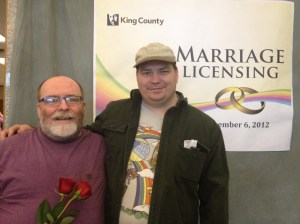
Picture taken by Chelsea Kellogg, reporter for the Stranger.
Michael and I.

For various reasons, we didn’t go to wait in line for the office opening at one minute after midnight. We each took the day off from work and headed downtown after the sun was up and we’d had some breakfast. Since one of the reasons we didn’t want to be standing around outside on a nearly-winter night with rain in the forecast was that Michael still has the cough from our recent bouts with the flu, I let him sleep in. So we got to the county admin building at nearly noon.

I spent the morning reading news blogs and looking at the pictures of couples who had been the first in line at our county and a few others that opened early. They selected some couples to go first in line, such as a sweet pair of ladies who are in their late 70s-early 80s and had been together for over 35 years. Or the two men that age who have been together more than 40. Seeing the picture of one guy pushing his husband-to-be in his wheelchair up to the counter made me cry. There were a lot of pictures like that being posted by the various news outlets.

When we arrived, there wasn’t a big line. We were pointed in the right direction by people at several points, and getting congratulated by all these people. While there wasn’t a line, every workstation was busy with couples getting their licenses. And just as we and another couple were leaving… two more couples came in. So it was at the steady stream point by then.

A reporter from The Stranger asked if she could take our picture and ask a few questions. Since I read their blog every day, of course I was willing to answer questions. The first picture in this post is the one she took.

Us again. Why do I always stand on his right?

In addition to the regular paperwork, we were given a copy of the proclamation signed by the county executive, and various other commemorative items. We were directed out a different door than the way we’d come in, and some more volunteers were there, handing out roses and taking pictures in front of a sign commemorating the first day that marriage equality was the law. They took a few of these with my camera, then one of the others asked if we wanted one of us kissing.

For whatever reason, that was when I started crying for us. All of my tearing up, getting misty-eyed, and full-fledged crying earlier in the day had been for other people. This was the one where it finally hit me in the gut: the most wonderful man in the world has not only been living with me and putting up with me for nearly 15 years, but finally we’re going to be married. Not civilly united, or domestically partnered, or any of those other names, but married. Part of my astonishment is the simple fact that this wonderful guy actually wants to be saddled with me. I mean, yes, we’ve been together nearly 15 years (it will be 15 in February), and he’s had ample opportunity to run for the hills and hasn’t. But you have to understand, I don’t completely get why he puts up with me. Seriously, there are times I can’t stand to be around me, so I know for a fact I am not easy to live with!

Fortunately, Micheal's hat is hiding my tears.
Fortunately, Micheal’s hat is hiding my tears.

And there were more people waiting outside. We were offered donuts. There were also people handing out business cards and promotional fliers for wedding-related services. That’s to be expected, obviously. And I’m not complaining. Thanks to the fliers I’ve found several possible places to rent for our reception that I didn’t even know existed.

There were no protestors, though. I had kind of expected some. There are always a few of those people with the old testament signs and such at events like the Pride parade, so I just figured they’d turn out for this. Then when we saw that the line was shrunk to the trickle, I thought that protestors had left. I didn’t find out until we were back home that the reporter was there taking more pictures, after the big lines were through, because there had been a rumor that a group was coming to protest. Apparently they never showed up.

While we were walking back to the bus stop, a random woman on the sidewalk saw the roses, looked at us, grinned, and said, “Congratulations!”

I’ve violated one of my rules and dived into the comments sections of some of those news sites posting the pictures. And the amazing thing is how very few haters are commenting there. In the ones I looked at, if there were negative comments at all, for every 1 negative comment there were easily 20 comments from people saying how happy the pictures make them feel, with lots of mentions of people needing to grab a tissue. And a number of people going out of their way to say things like, “I want to say for the record, that I don’t believe any of these couples has in any way diminished my heterosexual marriage.”

I thought I was emotionally overwhelmed when the Referendum passed, and when I thought about all those straight people who voted for it. But it feels more overwhelming now. I guess going in and getting the license finally is making it feel real.

We have a three-day waiting period. We’re going to have a simple ceremony with friends this Sunday. We’re calling this the Elopement. I want to get the legal stuff handled as quickly as possible, if for no other reason than that I can finally add Michael to the much better medical and dental at my work. So this is the legal thing. And I know some of our friends will be there, and it will be fun and happy.

But the real purpose of a wedding is to allow your extended community of friends and family in on it. I don’t just mean the celebration. I believe that what makes marriage sacred is not that two people have made a pledge before some deity, it is because a group of people have committed to support two people in their love. When I attend someone’s wedding, I’m entering into a covenant with them and the other attendees, affirming a particular loving relationship, but also affirming the power of love itself. It’s a commitment to the extended ties that bind all of us together in circles of mutual affection and respect.

Which is why, yes, we’re planning something bigger and a bit more formal later next year.

And there will most definitely be a party.