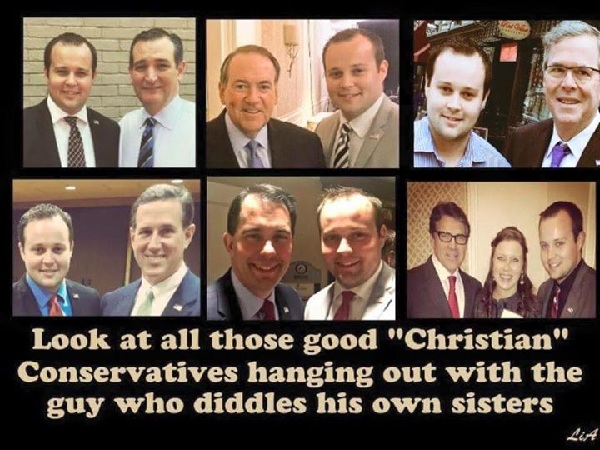
http://www.inquistr.com (click to embiggen)I wrote (and linked to others who wrote) about why we shouldn’t give in to the schadenfreude urge in relation to the child sex abuse scandal swamping the cultish Duggar family of TLC’s 19 Kids and Counting fame, and Brooke Arnold makes a powerful argument coinciding with that: I could’ve been a Duggar wife: I grew up in the same church, and the abuse scandal doesn’t shock me. The children of the cultish perversion of Christianity the Duggars practice, particularly the girl children, are raised in an environment guaranteed to create these tragedies. And should we be surprised that the man credited with founding this movement is guilty of both a sexual harassment and sexual assault?
And now there’s the indictment of former Republican speaker of the house, Dennis Hastert for paying out millions of dollars in hush money to a man who Hastert had some sort of sexual relationship (sexual misconduct) with back when Hastert was a high school wrestling coach? As I asked earlier, and the author of that story asks now, “When do we get to acknowledge that sexual hypocrisy is in fact a constant theme of conservative politics — that every single time a Republican or ‘family values’ representative speaks to the bigoted mythology of homophobia or transphobia, they are closeting skeletons like a Duggar?” (In case we’ve forgotten how often this happens, Queerty has rounded up a subset of 16 Antigay Leaders Exposed as Gay or Bi.)
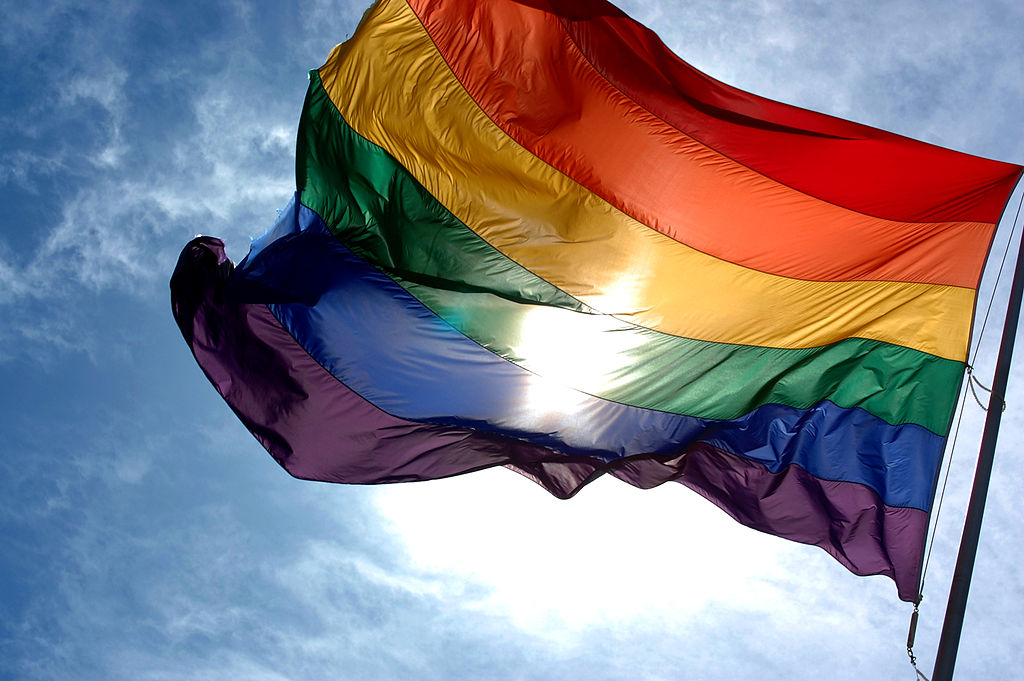
Bisexual FlagOn the other hand, June is almost here, and the President has issued a proclamation for Pride Month. People are reacting as if it isn’t a big deal, but as Gabe Ortiz (an immigration rights and gay rights activist) pointed out: George W. Bush refused to issue any such proclamations for 8 years even though they had been issued annually almost pro forma for many years before.
Polyamory SymbolA few points stick out for me: “For countless young people, it is not enough to simply say it gets better; we must take action too.” and “All people deserve to live with dignity and respect, free from fear and violence, and protected against discrimination, regardless of their gender identity or sexual orientation. During Lesbian, Gay, Bisexual, and Transgender Pride Month, we celebrate the proud legacy LGBT individuals have woven into the fabric of our Nation, we honor those who have fought to perfect our Union, and we continue our work to build a society where every child grows up knowing that their country supports them, is proud of them, and has a place for them exactly as they are.” Obama reflects on progress in Pride proclamation
Genderqueer flagAlthough some people think the acronym is already long, I wish the President had used the LGBTQ version, because I like to think that the Q (for queer) includes our polyamorous, agender, genderfluid, asexual, genderqueer, pansexual, genderqueer, and allied siblings. Because we’re all part of that crazy, happy, wonderfully fabulous tribe!
Ludovic Bertron from New York City, USA (Creative Commons Attribution 2.0 Generic license)The world would have a lot fewer tragedies like Hastert’s inappropriate touching problem, Foley’s congressional page scandal, and the Duggar child molestation disaster if society as a whole accepted and affirmed all queer people.
Click to embiggen.Earlier this week I posted about how much I love fantasy and science fiction and one of the reasons why. Specifically that sf/f had been a refuge from some of the cruelties a homophobic society heaps upon queer kids while they’re growing up. Much of sf/f is about escaping oppression of one sort or another. Science fiction in particular is often about the triumph of the light of reason over the darkness of ignorance. That gave me hope, as a kid. Sometimes it was the only hope I had. Which is why it feels like a double betrayal when I encounter homophobia in sf/f circles. One phrase I used to describe the homophobes in question was, “whose ultimate goal is to erase us.”
Which led one commenter to tsk at me and insist that, while the people in question are decidedly anti-gay, there was no evidence they want to erase us.
Oh, goodie! Straightsplaining! Homophobia isn’t what I think it is, at all! How foolish of me to think that my 50+ years of surviving the slings and arrows of homophobia gave me any expertise in the meaning or aims of homophobia!
It’s possible the commenter has a reading comprehension problem and thinks that erasure must always literally imply extermination and is trying to claim that the people in question don’t want all queers dead. So, on the slight possibility that that’s the case, let me just explain that when I say “erase us” I mean “wish that we were invisible and that all or nearly all evidence of our existence was removed from stories, books, movies, television series, and society in general.”
And you know what? Every single homophobe in existence wishes that we were, in the least, invisible. It is part of the definition of being a homophobe! It’s a common lie they tell themselves and us all the time: “I don’t hate gay people, just why do they have to shove it in my face all the time?” Or “I wish they wouldn’t flaunt it all the time!” Or “I don’t want my children seeing that!”
And in the cases of the Sad Puppies, making us invisible is exactly what they’ve been talking about:
When they lament the fact that they can’t always be sure when they pick up a “book with a rocket on it” that they aren’t going to encounter gay characters inside? That’s wishing we were invisible.
When they insist (in the comments thread of the post linked in the first bullet) that it is deceptive that another book’s back cover blurb didn’t mention prominently enough that the protagonist is gay? That’s wishing we were invisible.
When they insist that in a novel about a young person’s quest for self-discovery the fact that the young person is gay isn’t revealed until nearly midway through the book (when the character finally admits it to himself) is some form of malicious deception? That’s wishing we were invisible.
And while we’re on the subject of John C. Wright: when he says that the “instinctive reaction of men” to “fags” is “beating them to death with axhandles and tire-irons,” that’s beyond wishing we were invisible, it’s an explicit statement that they wish we were exterminated.
To the commenter who kicked this off: I don’t know how you could have been paying close enough attention to the Bad Puppies to notice that they were anti-gay, yet missed the many times they have alluded to the bashing (and worse) of queers. Just as I don’t know how you could have been paying close enough attention to these guys to describe Vox Day/Theodore Beale as “vile” and have missed all the times he’s said that homosexuality is an existential threat to civilization that must be either cured or eradicated. Because all of that is also evidence that even more than wishing we were invisible, they wish we didn’t exist.
So please, don’t tell me or any other queer person that we don’t understand our own oppression. To paraphrase bunnika : when you were watching our lifestyles and checking out the homophobes’ web sites, we have been living our lives and experiencing actual homophobia that you have no right to ‘splain.
Thanks for your comment, though. And bless your heart.
Note: Comments on this entire blog have always been moderated. Specific commenters have been whitelisted, but everyone else’s comments sit in a queue until I approve them. And I don’t see any point in approving comments that are insulting, or obviously coming from sock puppets (there have been a lot of those this week) or—such as the comment alluded to here—indicate the person isn’t interested in listening.
We’re queer, we’re nerds, get used to it!I was 13 years old and had been a semi-faithful reader of the Magazine of Fantasy and Science Fiction for a few years. I think I found my first copy in a magazine rack in a drug store sometime during fourth grade. I had pleaded and begged for a subscription of my own, and one of my grandparents had bought me a subscription for my twelfth birthday—except they got me a subscription to Galaxy Science Fiction instead. Which wasn’t bad, it meant I got a magazine about the size of a paperbook every month filled with short stories, novelletes, and sometimes serialized novels. But my adventures in the pages of Galaxy magazine is a story for another blog post.
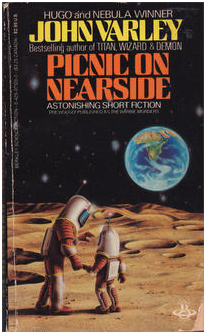
It was summer, just months before my 14th birthday, when I got hold of the new copy of the Magazine of Fantasy & Science Fiction and found inside it a story called “Picnic on the Nearside” written by John Varley. In it, the narrator, Fox, who was 12 years old and lived on a colony of the moon sometime in the future, had been in an epic argument with his mother, because he wanted a Change. He didn’t explain right away what the change was, but before that reveal, we learned that people in his society could easily alter their bodies (his mother exchanged her feet for peds/hands before going out to a party; and Fox mentioned a time he had assembled an eight-legged cat). Then Fox’s best friend, Halo, shows up as a nude woman, which finally explained what the change was. Fox and Halo had been best buds for years, and Fox worried that now that Halo was a woman, it would ruin their friendship.
Cover of the paperback edition of one of Varley’s anthologies which included the story in question.There are many other interesting things that happen in the story: Fox and Halo take Fox’s parents’ vehicle out on the surface without permission and get into a misadventure. But the really mind-bending part of the tale was the setting: a society where changing genders was only slightly more complicated than changing one’s clothes, and where everyone was okay with it. That was just mind-boggling!
I have to make a couple of digressions here. The first is that not all queer people are transgender, transsexual, nor transvestite. Gay boys don’t want to become women, we’re guys who are attracted to and fall in love with other guys. The proper answer to the clueless question, “Which one is the woman” is “Neither, that’s the point!” But one of the reasons young gay boys often idolize female characters in their favorite movies, books, and so forth is because the female characters are the objects of desire of the male characters. Similarly, young lesbian girls often idolize male characters in works of fiction. Young bisexuals may find themselves idolizing both, and so on.
Because there were no openly gay characters in any of movies, TV shows, books, short stories, et cetera which made up our cultural landscape growing up, one of the only ways to imagine ourselves in the worlds we longed to live in was to identify with the female characters. So on one level, “Picnic on the Nearside” offered me a more explicit way of projecting myself into that world. It was as if one of my subconscious coping mechanisms had been made manifest in the plot! Therefore, this story so intrigued me not because its imagined future would afford me an opportunity to change genders (which wasn’t what I wanted), but because it offered an escape from the expectations that boys were only allowed to do boy things, and only allowed to be friends with other boys, and only allowed to be boyfriends with girls.
The other digression is about the difference between a gender fluid milieu and a gay/lesbian culture. Varley has written a lot of stories set in the same world as “Picnic on the Nearside,” including several with the same character, Fox, as the protagonist (though the stories starring Detective Anna-Louise Bach {for example, “The Barbie Murders”} may be a bit more famous). Many of his characters change genders and have love affairs with people who have also swapped genders, but many times his imaginary gender fluid society is still very heterosexual. Fox never thinks of Halo as a potential sexual partner until they are opposite gender, for instance. Some of the couples who appear in the various stories seem to be just friends when they happen to be the same gender, then become lovers only when they happen to be opposite.
Many psychologists and sociologists now theorize that men who like to dress up as women and have sex with other men while thus dressed up are actually exploring an exaggerated heterosexuality. Having, in the online world, been sometimes emphatically propositioned by guys like that, and found myself turned off by their “flirting” that consists of trying to get me to say I will treat them the way an extremely selfish chauvinist man might treat a “slut,” I see their point. The men pursuing those scenarios are so into their fantasy of what heterosex could be that sometimes they want to experience it from the girls’ side. They aren’t turned on by the other man as a man, they are turned on by the situation of a woman submitting to a man in very specific ways.
Looking back on some of Varley’s stories, they can feel more like a mostly hetero exploration of gender roles, rather than a pan-gender exploration of sexual orientations.
There’s nothing wrong with that, and there’s a lot right with it.
A lot of the pain, fear, and bigotry directed toward LGBTQ people is grounded in very narrow and strict views of gender. It’s why homophobic men are almost always also misogynist (or at least very chauvinist). So anything that makes us question those assumptions about intrinsic differences between men and women, what roles men and women are each allowed to take in society, and the morality of those gender binaries is a good thing. And there’s no question that Varley’s tales exposed many of hypocrisies at the heart of all those assumptions.
I became a Varley fan that summer. Even more so, I became a fan of the protagonist, Fox, who went on to appear in the short story “The Phantom of Kansas” and the novel Steel Beach. Questions of gender and sexuality are at most a minor consideration in most of his stories, and I’ve come to appreciate his ability to take seemingly any speculative notion (no matter how weird) to its logical conclusion, and still tell a cracking good yarn along the way. What grabbed me that summer, while re-reading Fox and Halo’s misadventure again and again, was that there was at least one writer willing to tell stories that didn’t exclude a queer viewpoint. And there were editors who would print it, and by implication, readers other than me who wanted to read it.
And that was an amazing epiphany for a 13-year-old gay boy in the rural and very redneck Rocky Mountains.
I don’t remember a time when I wasn’t a fan of fantasy and science fiction. Which is not surprising, since my mother accidentally taught me how to read at an early age by reading to me from her favorite authors (Agathe Christie and Robert Heinlein) and making me repeat back entire sentences. Tales of the fantastic by Heinlein, Andre Norton, J. R. R. Tolkien, Edgar Eager, Edith Nesbit, Isaac Asimov, Ursula K. Le Guin, Leigh Brackett, Gordon R. Dickson, Lin Carter, and so many others fed my imagination, encouraged my curiosity, fueled my thirst for science and math, and provided a refuge from the cruelties and contradictions of life.
One might wonder how cruel an existence growing up as a white boy in mid-twentieth century America could be. When you have a physically abusive alcoholic father heading up your working class rural evangelical fundamentalist family, real life can be quite unpleasant—especially for a gay, nerdy kid who talked to himself and was more comfortable with books than kids his own age. Science fiction and fantasy promised worlds where all you needed to defeat evil was a bit of courage, a lot of cleverness, and people you could count on. Every time my dad’s job transferred us to a new town, I would quickly ingratiate myself with the local librarians and proceed to devour every science fiction and fantasy book I could find on the shelves. Not to mention mysteries and science non-fiction books.
It wasn’t just the imaginary worlds of the various stories I read that provided a refuge, but from the introductions and interstitial texts of anthologies such as The Hugo Winners, Volume n, Best Science Fiction of the Year XXXX, and so forth, I also learned of conventions, where the creators and fans of these fantastic worlds gathered to talk about their favorite books and stories, encourage each other to write more stories, collaborate in various ways, and maybe even have a fun party or banquet where awards were handed out. And that sounded so amazing. Before middle school I knew about the Nebula Awards and the Hugo Awards. I knew that the Nebulas were voted on by members of the Science Fiction Writers of America, and that you had to be a professionally published SF writer to get in. But the Hugos were voted on by the attendees of WorldCon—by fans and professionals alike. So in theory, at least, I didn’t have to wait until I’d been published to participate in those.
I’d decided to become a writer sometime around the age of five or six. I’d been making my own books out of whatever notebooks or paper I could get my hands on since before I could write. I started writing my own stories as soon as I could assemble my sloppily-drawn letters into words. I was determined to be a writer. And I hoped that someday I might be a member of that community of writers vying for a Hugo.
As an adult, I’ve been attending sci fi conventions for decades. I’ve even been a staff member at a few. I’ve had some of my own tales of the fantastic published, even though most of my published stories have been in fanzines and other small semi-pro publications. I’ve had the good fortune to be the editor of a fanzine with a not insignificant subscriber base. I count among my friends and friendly acquaintances people who have been published in more professional venues, people who have run those conventions, people who have won awards for their sf/f stories and art, even people who have designed some of the trophies. Not to mention many, many fans. I have even occasionally referred to that conglomeration of fans, writers, artists, editors, and so forth as my tribe.
All of that only begins to scratch the surface of why I find the entire Sad Puppies/Rabid Puppies mess so heart-wrenching. Yes, part of the reason the situation infuriates me is because the perpetrators are all so unabashedly anti-queer. For this queer kid, sf/f and its promise of better worlds and a better future was how I survived the bullying, bashing, hatred, and rejection of my childhood. To find out that there are fans and writers who so despise people like me that they have orchestrated a scheme whose ultimate goal is to erase us goes beyond infuriating.
But it’s worse and so much more than a bloc-voting scheme.
This is hardly the first time I’ve encountered homophobia, misogyny, and racism in the fandom. It’s certainly not the first time I’ve encountered it among the professionals! While it’s disheartening to have people sneer and make denigrating comments; and it’s chilling to be told people like me deserve extermination. The worst part is to be told that even putting characters that are like me into stories about space battles or post-apocalyptic worlds or bio-engineered futures makes those stores cease to be “real science fiction.”
If your imagination is so small that you can’t conceive of a future where gay people and women and non-white people actually exist and do interesting things—that those people can sometimes be the heroes of the tale—then I just don’t see how your speculative fiction can be very creative. If you can’t conceive of a world with gays and straights, women and men (trans* or cis), and people of all races, living and working together, you’re hardly a visionary. If you’re so afraid to share imaginary worlds with such people, you’re the exact opposite of an intrepid adventurer.
Update: Some of the Sad Puppy supporters have decided to send me messages, accusing me of blindly believing propaganda. The implication seems to be that the various organizers of the Sad Puppies have never said the things alluded to here.
Let me be clear: I’ve been reading the blogs and other postings of John C. Wright, Brad R. Torgersen, Larry Correia, and Vox Day/Theodore Beale for years, because they’ve been on their anti-SJW and anti-gay kick for a while. Everything I’ve mentioned in this post and previously I have seen myself, from their own words. That they have deleted and revised many of their old posts to obfuscate that doesn’t change anything. They can claim they didn’t say what they said, but we have screen captures and Google caches and Wayback Machine caches that say otherwise.
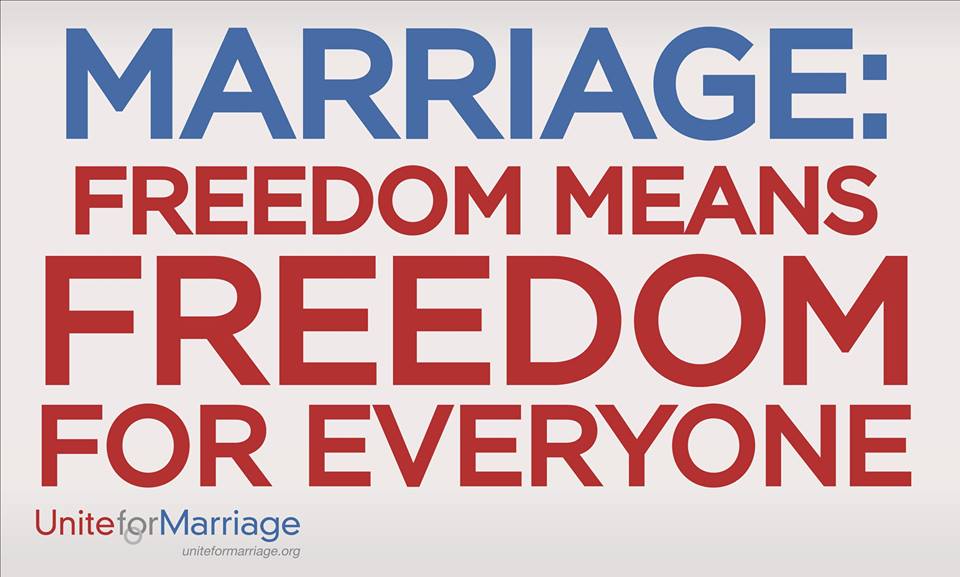
The Supreme Court is hearing arguments today on four cases involving Marriage Equality. Over the last year, the Court has declined to hear appeals of cases where a federal court struck down a ban on same-sex marriage. These four cases are ones in which the lower courts have struck down some aspect of a state ban, and an appellate court has stayed or overruled the lower court ruling. It’s not a done deal by any means, but it seems clear that a majority of the court is at least willing to let marriage equality become the law of the land. My own worry is not that the court won’t rule that gays have a right to marry, but rather that the less enthusiastic justices will force a very narrow ruling that would ultimately allow people to get fired from their jobs if they marry, businesses to refuse to sell to gay people, and so on.
Anyway, they will hear arguments today, but the ruling is not likely to be announced until nearly the end of the term, in June. Still, people are rallying in Washington, D.C., and there are local rallies happening around the country today.
But here are two nice videos that sum up our side of things:
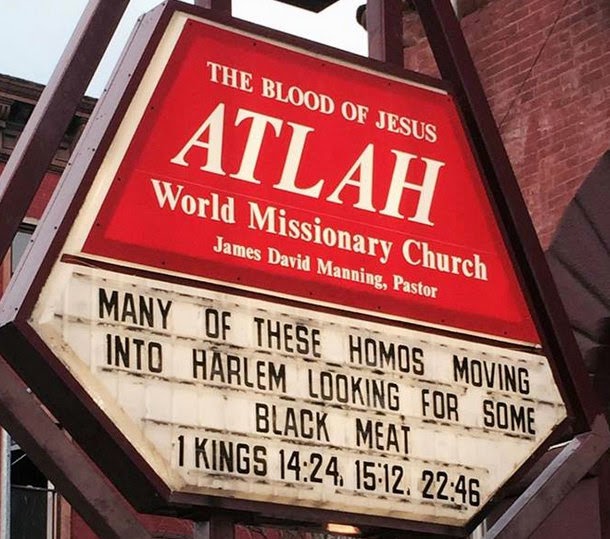
Pastor Manning and his church are at it again with weird anti-gay messages on their church sign. (Click to embiggen)There have been further developments of some of the stories I posted about in yesterday’s Friday Links (Hugos and movies edition), as well as some things I would have included if I had seen them earlier.
Eric Flint delivers Some comments on the Hugos and other SF awards. Specifically explaining why any system of awards drifts into a subset of any large set of works. It’s a really good read if just for the information about some of the giants in the field who never won awards.
The Family Research Council is once again calling for weeks of fasting and praying to save America from the evil of homosexuality (they say it’s about other things, but just take a look at the list of prayer topics in the article). As part of this they have been publishing a suggested prayer each day. After they published one earlier this week that seemed to be suggesting that gay people raising children should be forcibly drowned, news sites started publishing stories about the other awful anti-gay things said in all of the published prayers. Suddenly, FRC has decided that the prayers needed “editing” and removed them. Fortunately, someone took screen captures each day as they were published: WHOA: FRC ‘reediting’ all those heinous fasting-for-marriage prayers I’ve been showing you!
It’s not just national anti-gay rights activists who are suddenly deleting things they were saying quite opening just a few weeks ago. The Sad Puppies (a.k.a. the anti-gay, racist, misogynist GamerGate allies who are trying to screw up science fiction awards) are suddenly trying to erase hateful things they posted, sometimes just weeks ago. Fortunately there’s Google Cache, Wayback Machine, and screen captures: since some puppies are deleting things.
The National Organization of Marriage’s (NOM) email money begs have started claiming they may have to cancel some of the buses to bring people to D.C. for this year’s anti-gay “march for marriage.” Jeremy Hooper as Good As You thinks that NOM pre-spins its likely low #March4Marriage attendance. Given how they tried to explain away the low turn-out last year, I bet he’s right.
DailyKos.comI admit, it’s heartening to see the outpouring of outrage over the latest so-called Religious Liberty laws and that clueless politicians are paying a price for pandering to the bigots. And it’s nice to see that some of the other bigots are starting to realize that pandering no longer works to their advantage.
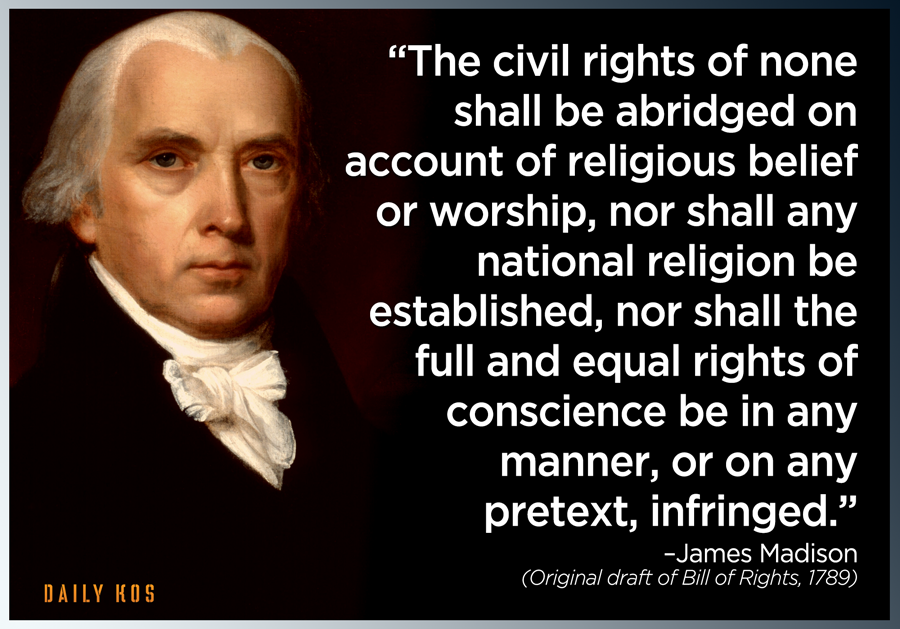
The religious liberty bills are toxic. They address a non-existent problem. Freedom of conscience is already protected thanks to the Constitutions’s first amendment and loads of Supreme Court rulings. And the religious liberty bills can be used to discriminate against a whole lot of people, including trans* kids who just want to got to school and while at school sometimes they need to pee just like everyone else.
But these bathroom bully bills are just as toxic. They are also addressing an imaginary problem. It really is imaginary, and we can prove it:
None of those bathroom or locker room horror stories have a basis in fact. (Click to embiggen)Media Matters has a nice compilation of statements from law enforcement officials and other experts from the 12 states that have had laws protecting transgender people on the books for a while (some going back to 1993!) about whether or not all those predictioned sexual assaults in bathrooms and locker rooms have occurred. Shockingly, no such assault has occurred in any of those twelve states. Who would have thought?
Please look at that chart, and repeat this to any people who start repeating those claims about bathroom assaults: some states have by law allowed trans* people to use whichever bathroom matches their own gender identity since 1993, and not once, ever, has anyone used that law as a means to sneak into a bathroom and assault someone. Not once.
The problem is that while it’s pretty easy to get people worked up about a really broad-based license to discriminate law, it’s a little more difficult to get those same people to rally against these bathroom bully bills. Because a lot of people who think of themselves as liberal and open-minded, who label themselves “gay allies” still have problems with transgender people. And they still get irrational about anything having to do with “children.”
They wring their hands and say vague (but very emotionally laden) things like, “I don’t want my kids seeing… um…”
Here’s part of how you respond to that. “I get it. But think about it, none of us want to actually watch what people go into bathrooms for, right? You want to go in, do your business, wash your hands, and get out, right? Well, so do they.”
I mentioned that the Indiana license to discriminate law is different from and worse than others that have been passed before. The person who explains this best is, of all people, a Fox News anchor:
Indiana’s RFRA is categorically different from other “religious freedom” laws, because it includes for-profit businesses under its definition of “persons” capable of religious expression. The Indiana law also allows private individuals and businesses to claim a religious exemption in court “regardless of whether the state or any other governmental entity is a party to the proceeding.” Those differences — which the ACLU has called “virtually without precedent” — expand the scope of Indiana’s RFRA and provide a legal defense for businesses and individuals who refuse service to LGBT residents.
Image posted to Twitter by @seamonkey237. Click to embiggen. Links to corroborating information in the picture itself.Indiana is the latest state to pass a so-called Religious Freedom Act, and they’re getting a lot of heat for it. Large conventions which bring a huge amount of money into the state have stated they’re considering pulling out. Corporations are canceling some activities and investments. Some corporate leaders have pointed out that bigotry like this law leads to an economic death spiral.
At the moment, Indiana’s governor is feeling heat because the law was clearly intended to give legal permission to people to discriminate against LGBT people, which he keeps denying. Because the fact that the bill was written by a notorious anti-gay activist, and is based on similar bills that have been promoted by the equally anti-gay Ethics and Public Policy Center, no one is believing the governor’s denial. It doesn’t help that he invited a bunch of notorious anti-gay activists to the private signing ceremony. (I’m kind of disappointed that it is even legal for a governor to have a private ceremony when he or she signs a public law into effect, you know?) But it’s worse than that…Continue reading Bullied bullies: Indiana’s license to discriminate hurts more than queers→
Late last week, Ben Carson, one of the many people who are hoping to snag the Republican nomination for President, when asked about whether gay people deserve the same civil rights protections of other minority groups, gave a weird answer involving prison rape. He didn’t explicitly say prison rape (or any other rape in forcibly homosocial environments), what he said was that some people go into prison straight, and when they come out they’re gay. Therefore, this “proves” that being gay is a matter of choice, and therefore gay people don’t deserve civil rights protections.
I think he was more than a little surprised at how many people on his side of the political spectrum thought that was a ridiculous thing to say. There’s lots I could say about this, but I think the following clip from CNN in which a reporter talks to Dan Savage about this, sums up things fairly well. Please watch it, then I’ll continue on a related topic after:
.
To be fair, before the day was over Ben Carson had back-pedaled and offered a so-called apology. Keeping in mind that Ben Carson is, literally, a brain surgeon, and had just the day before his interview had officially announced that he had formed a Presidential Campaign committee, his answer is that he doesn’t really know whether there is any medical or scientific studies about whether being gay is a choice, and because he isn’t a politician, he wasn’t ready to speak about this issue. He also tried to blame the media for taking his remarks out of context.
There is an overwhelming medical consensus that being homosexual is not a matter of choice, nor is one’s sexual orientation mutable. Every medical association, including all of those Ben Carson has been certified by, reached that conclusion quite some time ago. So as a doctor, he should already know whether or not that have been any medical studies. Second, the moment he formed a Presidential Campaign committee, he became a politician. It could be argued that he’s been a politician since he started taking speaking fees to go to conservative political events and talk about what a bad president Obama is, and how he would be better at the job. In any case, he’s a politician now, and he can’t claim not to be. Besides, his whole schtick up to now has been that the reason he’s qualified to be president precisely because he isn’t a career politician, because career politicians don’t speak truthfully.
And, of course, if you go watch the original interview, you can see that throughout Carson’s entire painfully stupid answer to the question, there is not a single pause or jump-cut. His comments were not taken out of context.
And, as Dan points out, if something being a choice disqualifies it, philosophically, morally, of ethically, from equal protection under the law, then a lot of people are going to lose their rights.
But that isn’t my biggest gripe in this whole case. I’m more irritated at how everyone, even reporters like the guy in the clip, keep saying that it was Dan Savage who took this into “vile” territory. That Dan shouldn’t have mentioned a specific sex act in his reply.
That’s a load of hypocritical hooey.
Carson’s dumb comments about prison turning someone gay were not about homosexuality as a sexual orientation, they were about the reality that in the closed environment of prison, straight men with no other means of getting sex will rape (even if sometimes the coercion isn’t a physical assault, it is still rape) weaker men, most of whom are also straight. Many of those less physically strong or mentally vicious men find that the only way to survive is to allow themselves to be used by the other men. That doesn’t make them gay. Being coerced into performing same sex acts is not the same thing as falling in love with, being attracted to, and feeling physical desire for members of the same sex. It’s different.
And that culture of prison rape was exactly what Carson was talking about. So, it wasn’t the gay activist who first made reference to a “vile” sex act.
In a bigger sense, conservative politicians and their anti-gay supporters, are always talking about gay sex when they make their arguments against gay rights. Some of them are like that crazy Harlem pastor I’ve written about and linked to stories about before, who can’t seem to stop talking about anal sex and gay semen. I could link to those stories again, but none of us need to go there. Or like the politician who sneered that marriage equality advocates were trying to equate “the violent invasion of a colon by a penis” with the love between a man and woman.
Other opponents of gay rights are more subtle, using the code phrase “gay lifestyle.” The religious right is especially fond of claiming that they love their gay and lesbian brothers and sisters, but they can’t support the “lifestyle.” But when someone like me points out that my lifestyle is sleep, go to work, discuss with my spouse what we’re having for dinner, wrangle over who’s doing the dishes, sometimes watch TV, try to get some writing in each day before going back to sleep, and somewhere in their paying our bills and taxes—and then ask them which part of that lifestyle is wrong or harmful, then start stuttering. They will allude to the answer euphemistically: that two men are living together as husband and wife. And then I say, “Yes, paying bills, cleaning the house, sometimes disagreeing about whose turn it is to empty the garbage. What’s wrong with that?”
You keep pushing hard enough, and they’ll finally admit that it’s the sex. And usually they refer to specific sex acts which they incorrectly believe all gay men engage in all the time. Which is why some of us point out that hundreds of thousands more straight people engage regularly in anal sex than gay people do. That lots of gay men don’t do anal sex at all.
They may try to wiggle out of it by saying that most gay people are promiscuous, living a life of meaningless one-night stands and drug and alcohol abuse. When we point out that statistically lesbians are better at monogamy than either straight couples or gay couples, and that there are again hundreds of thousands more straight people trolling bars, consuming mind-altering substances, and looking for hook-ups with members of the opposite sex every weekend than gay people doing the same, they get flustered.
Seriously, the last time I was in a bar, it wasn’t a gay bar. We were celebrating the birthday of a straight friend. The last time I was in a gay bar was, um, I think 1999 or 2000, and we were having breakfast before the Pride Parade. The last time I was in a gay bar at night with the intention of drinking and dancing and so forth, was 1998. And I’ve written before about that fact that not only have I never been stoned, but I was in my mid-30s when my husband, a former bartender, had to explain to me that the annoying smell I was complaining about in a convention hotel hallway was pot smoke.
There are lots of single straight men out there living a “gayer” lifestyle than a lot of gay and lesbian couples.
When people from Focus on the Family, or the National Organization for Marriage, or the religious right wing of the Republican party talk about the gay lifestyle or claim we’re assaulting the sanctity of marriage, et cetera, they thing they are angry about is the kind of sex they think we’re having. We need to stop pretending that that isn’t what they’re talking about. We need to confront them about it, and remind them again and again that they are the ones obsessed with our sex lives. We’re not the one’s making “vile statements.”







 Font Folly
