


John Lewis, ‘conscience of Congress,’ to lie in state at the Capitol
.
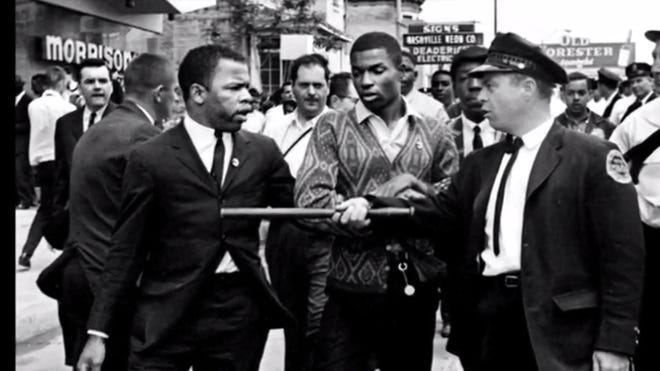 Lots of other people have written about U.S. Representative John Lewis. He was one of many fighting in the civil rights movement from the Nashville Student Movement in 1960, through the Freedom Rides and beyond. He was one of the “Big Six” organizers of the 1963 March On Washington (and until his death last week, he was the last survivor of the Big Six). He was beaten by police, arrested, had dog set on him, received countless death threats, but he never backed down. And eventually, he became not just an activist, but a member of Congress.
He was an American Hero from early on.
But he became one of my personal heroes in 1996. Bill Clinton had run for President on a promise to bring equal rights to the LGBT community, but instead he caved to pressure from the Republicans, conservative Democrats, and (even more problematic) timid Democrats. Instead of equality, he created the Don’t Ask, Don’t Tell policy for the armed services, which instead of making it easier for queer people to serve, significantly increased the number of discharges for being gay. And he also ultimately signed the so-called Defense of Marriage Act, which made it illegal for the federal government to recognized marriages of same-sex couples if states decided to extend those rights, and also exempted states from recognizing those marriages from other states (a clear violation of the Full Faith and Credit clause of the U.S. Constitution).
John Lewis was not one of the timid Democrats. He rose in opposition to the act. He spoke passionately about why he would vote against it.
“This bill is a slap in the face of the Declaration of Independence. It denies gay men and women the right to liberty and the pursuit of happiness. Marriage is a basic human right.”
—Rep. John Lewis, explaining why he was voting against the so-called Defense of Marriage Act in 1996
Unfortunately, the law passed. And we would have to wait for the Supreme Court to finally rule it unconstitutional in 2012.
That wasn’t the only time that John Lewis—a straight Black man, raised in the south, and an ordained Southern Baptist preacher—fought for LGBT rights.
“I have fought too hard and too long against discrimination based on race and color not to stand up against discrimination based on sexual orientation. I’ve heard the reasons for opposing civil marriage for same-sex couples. Cut through the distractions, and they stink of the same fear, hatred, and intolerance I have known in racism and in bigotry.”
—Rep. John Lewis, in an op-ed he wrote for the Boston Globe in 2003
“As a nation, we cannot say we are committed to equality, if we do not mandate equality for every citizen. You cannot have equality for some in America and not equality for all. This is another major step down a very long road toward the realization of a fair and just society. We should embrace the decision of the United States Supreme Court. It is now the law of the land.”
—Rep. John Lewis, commenting after the Supreme Court legalized Marriage Equality in 2015
I had really hoped that Rep. Lewis would live long enough to see us oust the fascist from the White House. I guess we’ll have to do in on our own.
Every time I see another headline about Lewis’s death, tears come to my eyes. We have lost a giant.
Rise in glory, John Lewis.
Rest in power, sir.
I think, but am not entirely certain, that the first inkling I had that any sort of Gay Rights movement existed at all was probably sometime in middle school… so sometime between 1973 and 1975. I remember a film shown in one of my sociology classes that included a very short clip about the extremists in California calling for legal rights for gay men–and it was extremely disparaging.
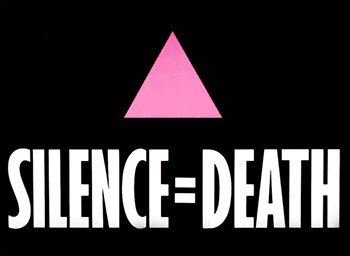
In the Nazi camps, the Pink Triangle was not ever attached to women, because Lesbianism was not perceived as being the same category of crime by the Nazis. I could write many blog posts about that, but most of the lesbians who were thrown into the camps were charged not specifically with being lesbian, but with the (rather bizarre to modern readers) crime of not being willing to marry a proper Aryan Man and produce beautiful blond-blue-eyed children for him. Or other things.
The point is, that even though Gilbert Baker created the original Rainbow Pride Flag in 1978 for the San Francisco Pride commemoration, in 1987 when I attended my first Pride Parade in Seattle, the Rainbow was not considered a universal symbol of the LGBTQ+ community. There were one or two rainbows visible in that first parade I attended, but they were lost in the see of thousands of Pink Triangles and scores of Purple Labryses (a symbol many Lesbians adopted at the time). The Rainbow was still mostly thought of as a San Francisco thing at that time.
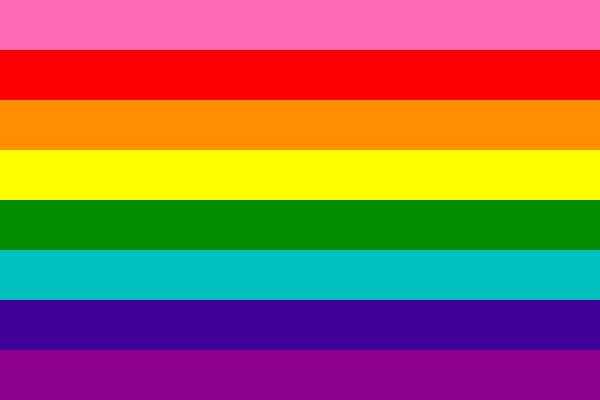
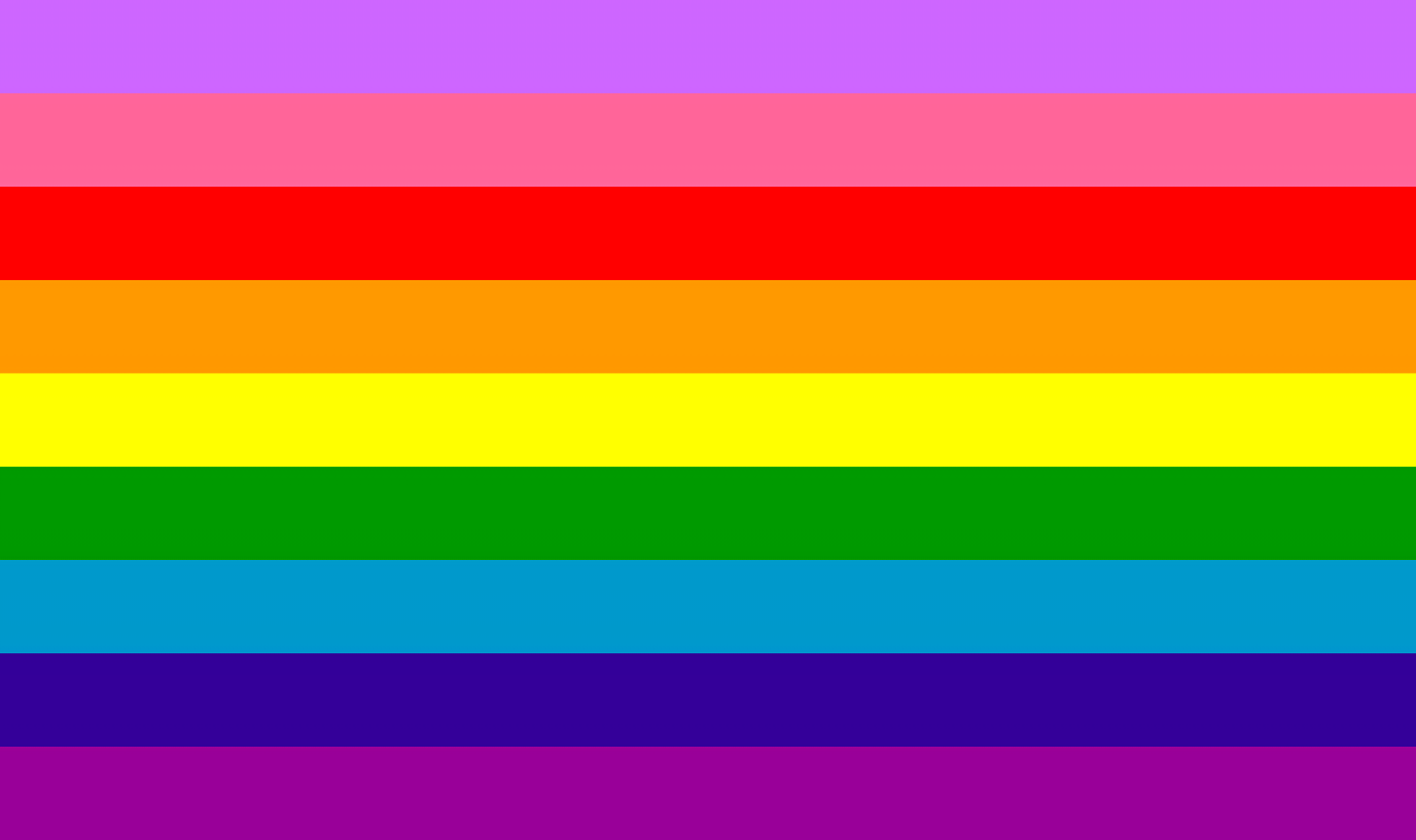
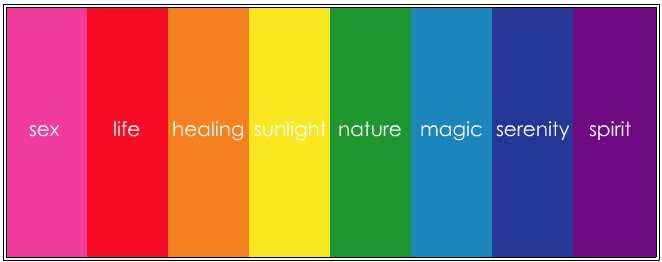 Before I go on with my perception of the history of pride symbols, I should list Gilbert Baker’s original explanation of the meaning of the flag he created. The colors Gilbert chose represented what he saw as pillars of the non-heterosexual community. Hot pink represented Sex; red represented Life; orange represented Healing; yellow represented Sunlight; green represented Nature; turquoise represented Magic; indigo represented Serenity; and finally violet represented Spirit. All of which makes a lot of sense to those of us who spent part of the 1990s as members of the Radical Fairies but might not resonate with a lot of other members of the non-heterosexual community.
Within a year or two of me coming completely out (by which I mean not only that close friends knew I wasn’t straight, but also extended family members and co-workers), I witnessed the backlash against the Rainbow Flag as a symbol for the community. I remember specifically a comedy routine by one specific performer that was circulated a lot called “I Am So Over the Rainbow.” And the first time someone played a recording of it to me (by chance, the man who was my supervisor at my place of employment at the time), the entire thing came across to me very much as a variation of “You kids get off my lawn!” I mean, I know the people in the audience were laughing, and the show was billed as a comedy act, but to me it was One Thousand Percent Bitter Old Queen Whining, and not much humor to speak of.
I should also mention that 32-ish year old me listening to that is where I made a solemn promise to myself that if I ever turned into that kind of bitter queen I would put myself out of everyone else’s misery. I hope that as I am now approached 60 that I have succeeded in not going down that bitter road.
But I should back up a bit…
During the 1980s, as the AIDS Crisis killed thousands of gay people and representatives of the president of the United States and the so-called liberal press laughed at anyone who suggested that people should be concerned with tens of thousands of (mostly gay) people dying, several radical homosexual rights groups rose up, and a lot of them embraced the word “Queer” precisely because it had been a term used to attack us, and also because it was quickly becoming clear that thousands of people dying upset fewer of the bigots than the word “Queer” did.
So in addition to ACT-UP, other radical organizations such as Queer Nation and Q Patrol came into being to fight against the complacency of society about the deaths (whether due to the new disease or from homophobic gay bashers) that most of us experienced during the 1980s and 1990s.
Two more digressions worth noting: during the mid-1990s I was personally involved in arguments within the Seattle Lesbian/Gay Community about whether to add the term “Bisexual” to the official name of the Pride Parade… and then a year or two later whether we should add “Transgender” to the name. I found myself in very heated arguments over both, which really pissed me off. I was well aware that most of the leader of the original Pride Riot (or Uprising or Rebellion) were trans/nonbinary women of color. How could anyone think that trans people weren’t part of the community? And yet a lot of people made that exact argument. And very similar ones for bi people… which are equally absurd.
There have been many variants on the basic Rainbow Flag. The Victory Over AIDS version, for instance, consisted of the Six-color Rainbow plus a black stripe on the bottom. The black stripe represented two things: first, our sense of mourning over all the people who have died of the diseases; but second, it was at the bottom of the flag to represent our hope that one day a cure or a vaccine would be available and end the deaths from the disease.
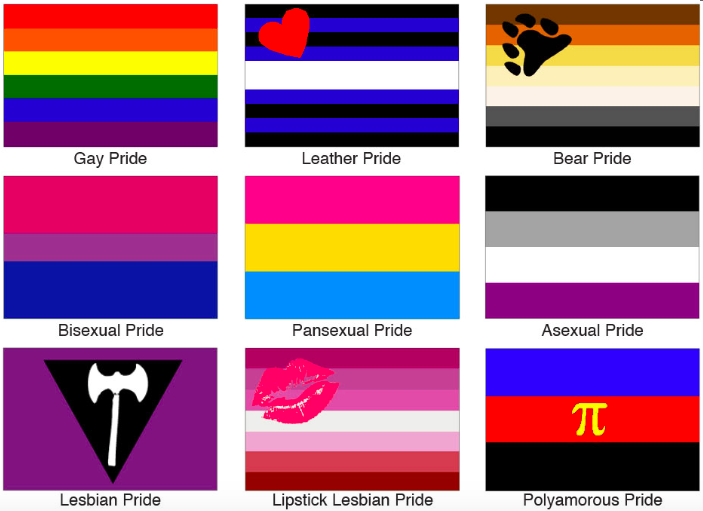
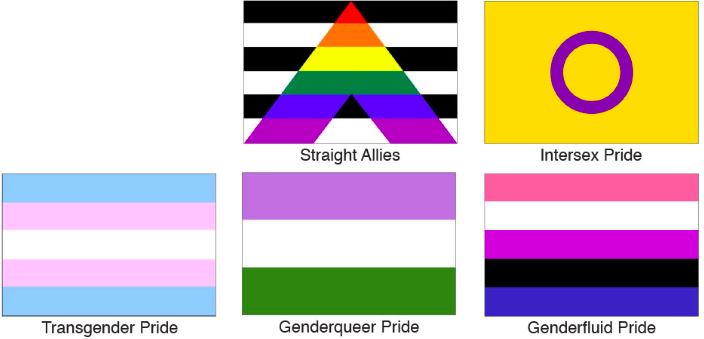
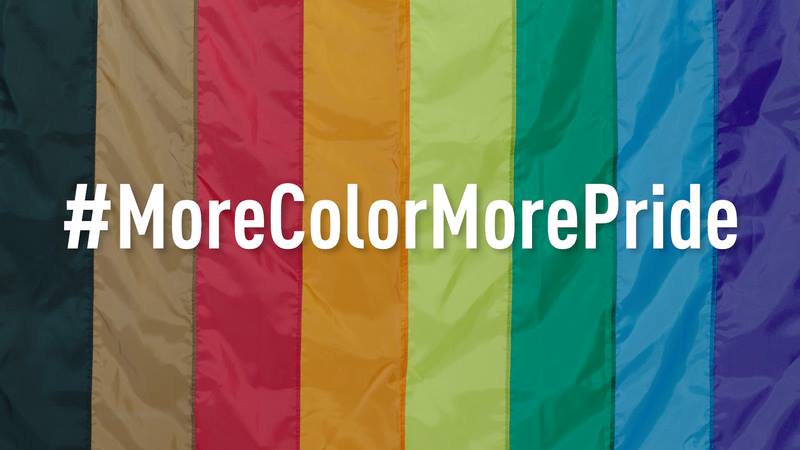
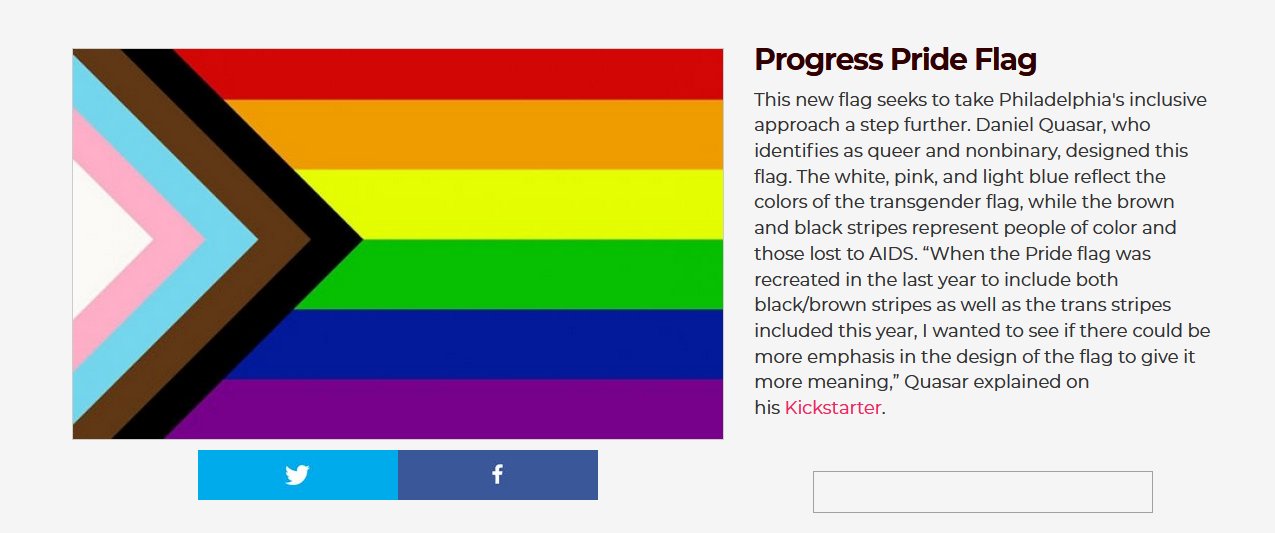
Others have tried to design variants of the flag which incorporated symbols for more communities who were not specifically represented in the “standard” six-stripe flag. That’s where we get flags such at the Progress Pride Flag pictured at the very beginning of this post. I’m not sure any of those variants will catch on. But then, in the early 80s most queer folks outside of the Bay Area didn’t think the Rainbow would catch on.
Outside my window this year I have three Pride Flags: a recreation of the original 8-stripe flag, the “standard” 6-stripe flag, and the More Colors More Pride/aka the Philadelphia Rainbow Flag. They are all recognizable as the Pride Flag. I suspect that the Rainbow Flag, possibly in many forms, is going to be with us for a long, long time.
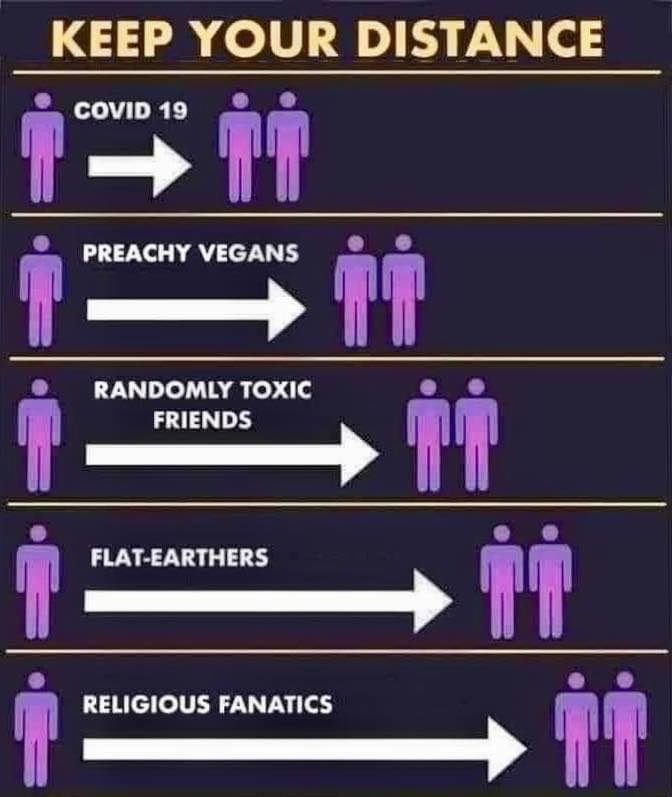
Jesus Christ, Just Wear a Face Mask!
“Libertarians” (in brackets) are resisting mask wearing on grounds that it constrains their freedom. Yet the entire concept of liberty lies in the Non-Aggression Principle, the equivalent of the Silver Rule: do not harm others; they in turn should not harm you. Even more insulting is the demand by pseudolibertarians that Costco should banned from forcing customers to wear mask — but libertarianism allows you to set the rules on your own property. Costco should be able to force visitors to wear pink shirts and purple glasses if they wished.
Note that by infecting another person you are not infecting just another person. You are infecting many many more and causing systemic risk.
Surgeon general says wearing masks will give Americans ‘more freedom’.
To No One’s Surprise, More Coronavirus Outbreaks Are Traced Back to Churches.


The NRA Has Spent Decades Warning About Police Crackdowns. Now It’s Utterly Silent. …because their definition of tyranny only applies to white people. Because they aren’t just cowards, they are also racists.
Gun-toting Trump supporters attack George Floyd protesters in rural Ohio town.
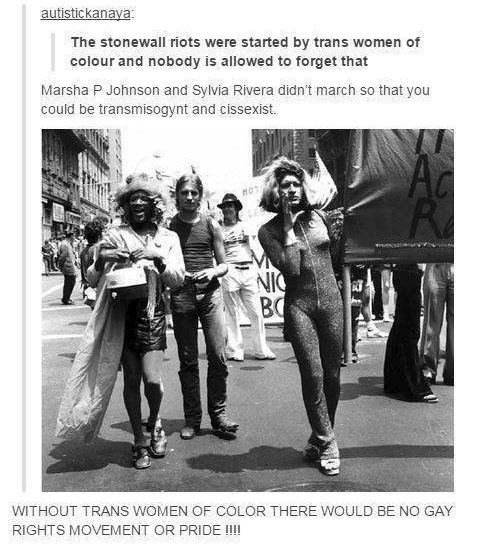
I’ve written more than once before about how who owe a huge debt to the people who stood up and fought back that night, 51 years ago, at the Stonewall Inn in New York City. Most of the legal rights that LGBTQ+ people have in the U.S. today is thanks to those Black and Puerto Rican queens who fought back, threw bricks, and so forth when the cops raided that bar.
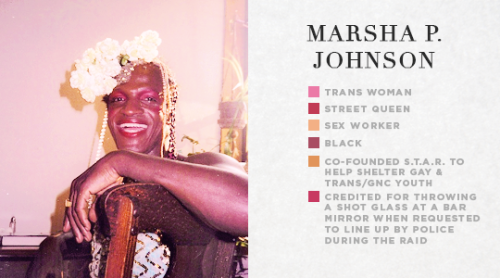
Miss Marsha P. Johnson (which is how she identified herself whenever asked), was impossible to ignore—always appearing in public wearing a flowered hat and flamboyant dresses. Once when appearing in court on a disorderly conduct charge, after the judge asked her what the middle initial P stood for replied airily, “Pay it no mind!” Some early accounts of the Stonewall Riots said she was the one who threw the first brick or the first shot glass at a cop. In interviews she would admit that she threw several things at cops that night, but wasn’t certain she was the first person to throw anything. After the riots, she was one of the founding members of the Gay Liberation Front, and also co-founded the gay and transvestite advocacy organization S.T.A.R. (Street Transvestite Action Revolutionaries), alongside close friend Sylvia Rivera. A note here about terminology: at the time several terms that would he considered slurs by transgender and gender nonconforming people today were commonly used within those self same communities. At different times Marsha identified herself as a street queen, a drag queen, and a transvestite. But she also always insisted on female pronouns and consistently introduced herself as Miss Marsha. Which is why most of us refer to her as trans.
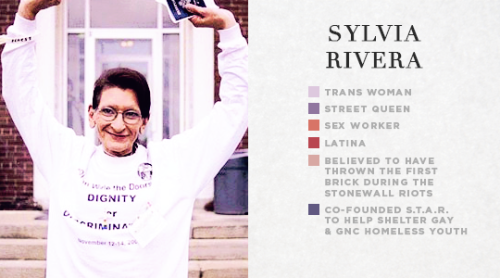
Silvia Rivera was only 17 and living as a self-described drag queen at the time of the Stonewall Riots. Most historians (and her friend Miss Marsha P. Johnson) agree that she wasn’t at the Stonewall Inn the night of the raid, being at a party at another location that night. Her whole life she asserted that she had been there. And there were others who agreed and said she was the person who threw the first brick at a cop car. She certainly joined the protests and rioting that continued the following nights, and later founded the Street Transvestite Action Revolutionaries (S.T.A.R.) along with Johnson. She was also a member of the Gay Activists Alliance. In a speech she gave at the 1973 Christopher Street Liberation Day Rally (what they called the annual event commemorating the riots for the first several years), she espoused a definition a belief that people such as herself belonged to a third gender.
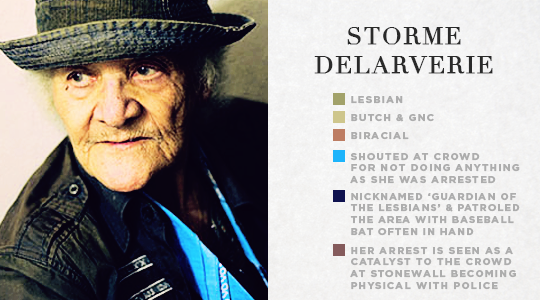
Stormé DeLarverie was often described as a butch lesbian. Before Stonewall, she had been part of a touring theatre troupe which, among other things, performed a number called, “Who is the one girl?” and audience members seldom guessed correctly that the tall latino “guy” in a tailored suit wearing a false mustache was the one woman in the dance number. She was one of several who resisted arrest the night of the Stonewall police raid. Many witnesses claimed she was the woman who broke loose from the cops before being loaded into one of the waiting paddy wagons several times, to run, get caught, and dragged back through the crowd, each time making the crowd more angry at the cops. Of the events at Stonewall that night, DeLarverie always argued that it should not have been called a riot: “It was a rebellion, it was an uprising, it was a civil rights disobedience – it wasn’t no damn riot.” She remained active in many gay rights groups and activities in the years after Stonewall, but was most often remembered as the self-appointed guardian of lesbians who patrolled the neighborhood at night with her baseball bat to drive off bashers.
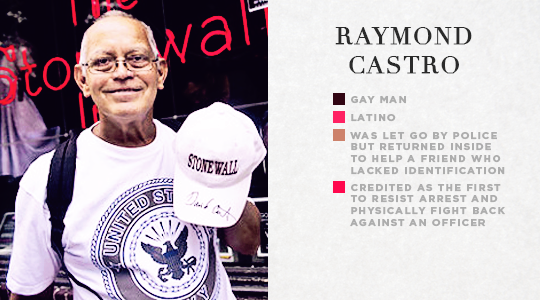
Raymond Castro was another Veteran of Stonewall. Because we was not dressed in gender nonconforming clothes, he was not arrested, and was told he could leave. When he realized a friend was being arrested, he went back inside to try to help the friend. This got him arrested and put in handcuffs. He struggled with the cops, managing to knock a couple of them down. This seemed to encourage several other people nearby to start struggling. One of the officers that eventually wrestled him into the truck commented that he was “some kind of animal.” Castro was active in several gay rights organizations in the years after Stonewall.
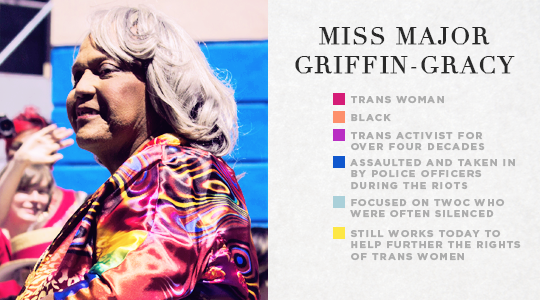
Miss Major Griffin-Gracy was at the Stonewall Inn with her girlfriend the night of the police raid. She was one of several to fight back. Unfortunately she was struck unconscious during the fight and was taken into custody. Miss Major has been active in a lot of transgender right organizations, civil rights organizations, and in the 80s became active in multiple HIV/AIDS organizations. She was the original Executive Director of the Transgender Gender Variant Intersex Justice Project, which advocates for the rights of incarcerated trans and nonbinary people. And Miss Major is still alive today, still fighting! Her Instragram account shows her at a Black Lives Matter protest earlier this week. She suffered a stroke last year and has a lot of medical expenses, which you can help with by donating here Miss Major’s Monthly Fundraising Circle.
 Font Folly