And now that November is here, this is a good time to post a link like this: Stop donating canned goods to food drives: Your corned mutton castoffs are only making things worse. Here’s the short version: boxes or barrels full of random groceries actually take more time and resources from the food banks and similar charities than groceries cost, because they have to be sorted, inventoried, checked for expiration date, and put into inventory. The amount of money you or I might spend buying a single can of stew or tuna or the like to donate could be used by the charity to buy much, much, much food at bulk discount. Which they get in already sorted cases that are a lot easier to store.
My particular local food charity, Northwest Harvest, says they can “feed a family of three a nutritious meal for just 67 cents.”
Hunger is a serious problem, and lots of people who work multiple jobs trying to keep a roof over their kids’ heads, often don’t know where the next meal those kids will get is coming from. So, find a local food bank or a blanket food charity, and give them money. Even a little bit can go a long, long way!
If you don’t want to go read the above article, watch “Adam Ruins Everything – Why You Shouldn’t Donate Canned Food to Charities:”
It works better if I stay back from the window and have the camera zoom.After putting up the new bird feeder over a week ago and being really happy when birds actually started using it, a new part of my morning routine has become peeking between the blinds to check on the feeder (since opening the blinds sends the birds scattering, and I’d only just have to close them again before I left). I only caught birds actually at the feeder when I peeked once, but I could notice from day to day the level of seed in the feeder decreasing at a noticeable rate. Which was good news, since the other style of feeder we had up all summer never had the seed level decrease the whole time.
On Friday, a work-from-home day, I had the blinds open all day. The birds flew away when I opened, of course, but soon came back. There were several points in the day Friday when there were between three and four small birds arrayed around the perch of the feeder, and three or four more on the deck under the feeder pecking up seeds. A couple of times a crow would fly up and intentionally chase the other birds away, then it would land on the deck and eat a bunch of the spilled seeds. At one point there were two crows on the deck both amicably eating, put when a third crow landed on the rail, the other two leapt at it, cawing and flapping noisily. Earlier in the summer I had deduced that there was a mated pair of crows with a nest in one of the big evergreens behind us, so I suspect the two that were happy to share the deck are that pair.
The feeder’s package had said it held up to two pounds of seeds. I’d filled it completely full Saturday before last, and by this last Saturday, the feeder was a bit less than half full. So Saturday afternoon I took the big bag of seed out to top off the feeder. There were a couple of birds on the feeder and at least one on the deck when I opened the sliding glass door. They scattered immediately, but landed on the branches nearby and chirped at me rather insistently. I interpreted it as them trying to get me to leave so they could get back to eating.
Anyway, while I was getting the feeder down and such, I managed to spill maybe half to three-quarters of a cup worth of the seeds from the bag in a spot right next to where I was working. I filled up the feeder, hung it back up, resealed the bag and put it away, then came back out with the broom and dustpan. I had already planned to sweep the whole deck. The birds scatter a lot of seeds in the course of eating. And they get everywhere. It’s the only thing worse than pine needles. I swept up everything except the little pile where I had spilled, and once it was altogether I only had one dustpan full. And about half of the volume of what I had was the aforementioned pine needles. So while they knock a lot of the seeds out of the feeder while they’re eating, they also eat a lot of the spilled seeds.
So, they appear to go through about a pound of seed a week.
I took this one during lunch on Friday. On work for home days I like to eat lunch out on the veranda. This little guy was the only one brave enough to come back to the deck and hop around eating while I was there. Several times he was no more then three feet from me.Once I had finished sweeping and put the deck furniture and such back to their usual positions, I then scattered my spilt pile under the feeder. My reasoning being that the seeds on the deck will rot once they get damp, but a lot of the birds like to feed from the deck rather than the feeder (some times I look out and there are none on the feeder, but several on the deck pecking away). I probably won’t intentionally scatter any seeds on the deck in the future (unless I have another spill). But I do have to note that on Sunday afternoon when I went out, it was clear that the birds had eaten most of what I spilled. There were seeds on the deck, but it looked like their initial scatter had after a day last week.
I need to try to get more good pictures and see if I can identify them better. The black-headed chickadees were easy to identify, but none of the others are an exact match of the pictures of any other birds in my Audubon book. I think most of them are sparrows, but I also hear the distinct “chick-a-dee” style trilling when I don’t see any black-headed chickadees out there, so maybe we’ve got some other species of chick-a-dees, too.
“Hello Darkness, my old friend.”I’ve seen the opinion expressed more than once that there is nothing more boring than reading about other people’s dreams. But I have also noticed that the people who say that frequently are the sorts whose blogging consists of long cynical (and boring) discourses on how horrible every single person they have ever known is and/or how every book/game/movie/TV series episode they watch is horrible. So, I’m going to ignore them.
Recently I had a weird series of dreams. My husband leaves for work about two hours before I need to get up to get ready for my job. So most weekday mornings I wake up at least partially while he’s getting ready. So I may mumble something to him and roll back over in bed, then wake up a couple of times again before my alarm goes off, each time squinting at the clock and being relieved that I have time to get a little more sleep in. This was one of those mornings. Right after Michael left, I fell back to sleep and seemed to immediately begin dreaming that our friend, Keith, was trying to help me reach an important destination and was driving me in a car belonging to another friend, Mark. We kept getting interrupted by weird things, like a golden box full of Magic: The Gathering Cards being left on the side of the road, or a couple of people who desperately needed directions somewhere, and I was getting increasingly worried we weren’t going to make it to whatever we were trying to get to.
Then someone outside was revving their car motor, and I woke up enough to squint at the clock, note that I had only been asleep, at most, 25 minutes, and fell back again. And I began dreaming not about the weird road trip, but instead about trying to finish laundry. Except the laundry room was inexplicably located inside a hollow tree in a park that was perhaps across the street from my home. It was a little unclear. I kept running back home to work on errands, then back to the park to move the laundry from one machine to another. And there was this guy who kept stopping me in the park to ask questions. I kept thinking he was trying to steal my wallet, and then being relieved that I still had it each time I got away from him.
Something woke me up again, I peered at the clock to see that I still have nearly an hour to go before the alarm went off, and rolled back over to start dreaming about helping a bunch of people I didn’t know restore a six-color web press because we needed to get news out to the world because there had been some horrible disaster, the city was half destroyed, and so forth. I had been drafted to help because I had some familiarity with the process. Some moments the group I was working with included soldiers or government agents of some sort, and other moments we were all just ordinary civilians.
Then I heard another noise outside, pried my eyes open, and saw that my alarm clock was going to go off in less than twenty minutes. And I needed to go to the bathroom, but even though I only had a few minutes left before the alarm went off, I laid back down afterward and closed my eyes. And seemed to immediately dream that I was awakened by a noise outside and I looked to see what time it was and the clock clearly said it was 6:20pm, and I had somehow slept through the entire day or possibly several days and I need to get up right now and start getting ready…
…and I did leap out of bed, because I was convinced I was very late for work, and I grabbed my watch off the charger, strapped it on my wrist, was trying to get my thoughts together… and the watch on my wrist started vibrating because it was exactly 7:30 in the morning and time to wake up. And I stood there, after tapping the snooze button, for a good 40 seconds trying to figure out what was dream and what was reality, because I swear that the watch was flashing in weird colors both a time and a date later in the week just milliseconds before it started vibrating on my wrist, and I was standing there wearing the watch and its face was just changing to 7:31, so the jumping up and grabbing the watch had been real while also being part of the dream.
And while my watch has a lot of customizable faces, none of them look anything like the flashing “OMG, you’re late!” watch face which I could still close my mind and see in memory as if I had just been looking at it.
I don’t understand my brain. I mean, sometimes I am able to tell that a particular dream is just anxiety manifesting because of things going on in real life. And occasionally I recognize individual elements in a dream as probably being inspired by this specific thing that happened to us recently. But mostly they are just weird mishmashes of things that make no sense outside of a dream. So sometimes I think it is a pretty amazing that we manage to communicate and have conversations and such where we seem to understand each other.
Even more amazing that we can read some fiction that someone else has written and get caught up with it to the point that we imagine the events of the story, become invested deeply enough to care about what happens to the imaginary people, and even get into long arguments with other people about whether these imaginary people in an imaginary setting having imaginary adventures were portrayed realistically. Like the time back in high school where one friend angrily asserted, “Come on! A real dragon would never behave that way!” and another starting laughing so hard, he fell off his chair.
This is not a photo of me with my very first iPhone… it isn’t, really, but…I fully admit to being addicted to gadgets. I spend a lot of my time at home writing, reading, and researching on a Macbook Pro, but I also own one of the big Mac Pro Towers with an Apple Cinema Display for a monitor, and I own an Asuratek Ultrabook that runs Windows 7. Plus I have an iPad Pro with the Apple Smart Keyboard, upon which I do a surprising number of tasks that previously required a laptop, plus my iPhone and Apple Watch, and did I mention my Kindle? And that doesn’t even get into the more than half-dozen iPods of various models that I load up with music and rotate through the car. Plus there is a dizzying array of accessories for all of the above. The number of different types of headphones I own (even after purging a whole bunch during the move) is enough to make most people’s heads spin.
Sometimes I try to rationalize this by pointing out the my husband has more computers than I do… and more iPads, and… and… but that’s really deflecting.
Now one thing that I will say in my defense is that many of these things were not paid for at full retail. Most of the iPods, for instance, were picked up used, some of them with more than one previous owner before I got them. And, as I explained in Confessions of a penny pinching packrat, my childhood and early adulthood spent living (barely) paycheck to paycheck taught me to hang on to things. When I buy a new appliance or gadget or whatever the old one is seldom disposed of. Instead it is held onto as a backup in case the new thing breaks. Often older computers and such are passed on to friends and family who need them, and when that isn’t the case, I can frequently find away to sell them or trade them in to get a discount on something else we need.
But, I also love tools that work well, and I especially love tools that work well for particular tasks. The headphones I use for commuting, for instance, need to meet several requirements: they need to be wireless and feel comfortable and not awkward when worn with various hats and scarves and such that I need in various types of weather. They also need to be able to hold up to rain. Because of some issues with my inner ears, they can’t be in-ear. The models that meet those requirements don’t usually have fantastic sound fidelity. But I don’t necessarily want that, because I don’t want headphones to block out traffic noise, and so forth, because since I take a bus, a part of my commute involves walking on sidewalks along busy city streets. So I need to be able to hear what’s going on around me.
That means that the commute headphones aren’t ideal for other listening situations. So I have a pair of wired noise-cancelling headphones that live in my desk drawer at my office, so on those days that I need to block out conversations going on in the cubes and halls around me, I can. And also, if I’m going to listen to music while working, I’d like the quality of the sound to be a bit better than what I’m willing to settle for during my bus ride and walking, right?
Then I have a nice pair of wireless headphones to use at home for listening to music or podcasts while I’m writing or editing. And again, I prefer them to have better music quality than the commute headphones. Unfortunately, it is often the case the wireless headphone with great sound, have inferior microphones. So if I’m trying to have conversations or gaming sessions with friends online, I need a headset that has good sound and a good microphone, which winds up being a wired headset.
And then… well… so the nice bluetooth and wired headsets I mentioned in the above paragraph basically live with my laptop. So there is another set of headphones, wired, that some years ago used to be the primary for listening to music on the laptop, that have been handed-down to the desktop Mac Pro, so that when I use that machine, I can listen to my music without disturbing my husband on the other side of the computer room. And there is a pair of really nice wired noise-cancelling headphones that permanently live in the On The Go computer bag, so that when we’re at cons or whatever, I’ll have a good set on those occasions I need them…
…and then there is a small stash of some older ones that still work well enough in a pinch, and usually one or two pairs of still in box backups for the commute headphones, because when they die, they tend to completely die, and I need a backup right away, right?
It’s a little harder to explain how the primary laptop, iPad, desktop, and Windows-based laptop all fit some of my use cases but aren’t the best tool for some of my other tasks. I mean, I have the Windows laptop because occasionally I need to process a file in software that is only available on Windows. And some of my old backups were done on Windows, since I used that operating system for many years. My new laptop is, in theory, pretty water resistant, but I’m still a bit reluctant to take it outside when rain is likely. And now that we have such a nice veranda, I spend a little bit of pretty much every day out there either writing, reading, or chatting with friends. So the iPad is a better tool for that location, since it is much much much more water resistant than the laptop, right?
I also, whenever possible, I spend my lunch break at the office writing or editing my own fiction, and that happens on the iPad. Which is much tinier and easier to transport along with my lunch and stuff than the laptop.
This is a long way of saying: what works for me, works for me, but may not meet the your needs. Likewise, what works for you may not meet my specific needs at all. And it’s okay if some of us spend more of our time and resources on different things than other people.
“If Harry Potter taught us anything, it’s that no one deserved to live in a closet.”
It’s National Coming Out Day! And just for the record, in case it isn’t clear: I’m queer! Specifically I am a gay man married to a bisexual man. For many years I lived in the closet, and am ever so happy that those days are far, far behind me. So, if you’re a person living in the closet, I urge you to consider coming out. Being in the closet is scary—you live in a constant state of high anxiety about people finding out and what they might do when it happens. Studies show that this affects us the same as extended trauma, inducing the same sorts of stress changes to the central nervous system as PTSD.
The problem is that coming out is also scary. 40% of homeless teen-agers are living on the streets because their parents either kicked them out because the teens were gay (or suspected of being gay), or drove them away through the constant abuse intended to beat the gay out of their kids. This statistic is the main reason I advise kids not to come out until they are no longer financially dependent on their parents. Yeah, there are many stories of kids who came out to their parents and those parents became supportive allies. But not all, by any means.
“My only regret about being gay is that I repressed it for so long. I surrendered my youth to the people I feared when I could have been out there loving someone. Don’t make that mistake yourself. Life’s too damn short.” —Armistead MaupinEven if you are a self-supporting adult, coming out is often accompanied by drama. Some of your family and friends will not take it well. You will be surprised at some of the ones who you thought would be okay with it being exactly the opposite. On the other hand, some people will surprise you with how fiercely supportive they become.
In the long run, being out is better than living in the closet. You will finally know who loves you for who you are, rather than those who love the idea of who they think you ought to be. You will also find out that you were expending far more energy than you realized constantly being on the look out for signs your secret is discovered. There will be a moment when you feel the burden lifted. But you will also discover the coming out isn’t a one-and-done deal.
But the freedom of no longer living a lie is incredible. So when you’re ready, come out, come out, where ever you are!
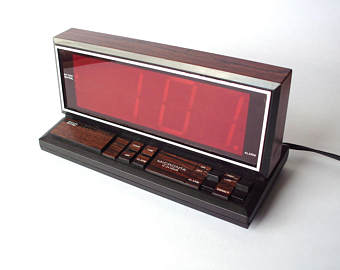
This picture of a “vintage alarm clock” was as close as I could find to the old clock on line, but this looks a bit more modern than that one.There are many little aspects of our move that I haven’t written about. Not that every little anecdote is worth a blog post, but we had a few discoveries/epiphanies during the course of the packing and sorting and reducing and hauling and unpacking and replacing that are at least a little amusing. For example, there’s the matter of our alarm clocks. Way, way, way back when Ray and I first moved in together, we had two alarm clocks. Since Ray’s job at the time sometimes required him to get up earlier on some days than others, while I generally tried to catch the bus at the same time every day to get to the office by 9-ish. So we each had an alarm clock on each side of the bed.
Both were digital alarm clocks with that formerly ubiquitous red LED display, though Ray’s was a large print display, because without his glasses, even if he picked up a regular alarm clock and held it so close that his nose was almost touching the display, he still couldn’t read the numbers. My alarm clock was a clock radio, and I always set it to start playing NPR about a half hour before I needed to wake up, then the alarm when I had to get out of bed. Because I was less likely to be a Grouch Monster™ when the alarm went off if I’d been eased into waking up by the radio. After Ray died, I kept both alarm clocks. For one thing, while my eyesight had never been quite as bad as Ray’s, I liked the fact that I could read the large print clock from the far side of the bedroom when I didn’t have my glasses on.
When Michael moved in with me the year after Ray died, he already owned an alarm clock. And since he also had a job where he needed to get up at different times each day for work, it made sense to have a separate clock. But we didn’t get rid of my second clock. Instead we moved the clock radio to the far side of the bedroom, which I found made it less likely that I would hit the snooze alarm a bunch of times and oversleep. Over the years, the clock radio had to be replaced a couple of times. And Michael’s clock’s display went wonky and had to be replaced, but the large print clock which had been Ray’s just kept chugging along.
Or at least, that’s what I told myself.
I don’t know how old the clock was, because Ray already owned in when we started dating in 1990. But that means it was at a minimum 27 years old this spring when Michael and I were packing. Not surprisingly, after 27+ years of use, some things didn’t work as well any longer.
One of the features the large print clock had which was innovative and unusual in 1990 was a battery compartment in the bottom of the clock so that if you kept fresh batteries in there, the clock wouldn’t lose time during a power outage. The clock wouldn’t actually stay lit up or sound its alarm when it was on battery back up, but you didn’t have to reset it once the power came back on. Now it is pretty standard for electronics to have a in-built mini rechargeable battery for this purpose, but back then it was unusual. The battery backup stopped working years ago. You don’t want to know how many times I changed the batteries and cleaned the contacts in the battery compartment, or shone a flashlight into it while I peered through a magnifying glass trying to fix it before I admitted to myself that the memory chip or whatever it was that the batteries powered must have failed.
A couple years after the battery backup stopped working, the alarm became inconsistent. You could set the alarm, and when it came time for the alarm to go off, the clock would try to sound an alarm. But sometimes all you got was a click and a single weird little chirping noise. other times the buzzer would sound, but it wasn’t very loud. Other times it chirped and chirped and chirped until you turned the alarm off. Very rarely did the buzzer just buzz loudly. But since by this time I had a clock radio that had two alarms in addition to the radio, I didn’t really need the alarm on this clock any longer. But the large print display I still had a use for.
More recently, the power cord had gotten twitchy. By which I mean, if you bumped the power cord, it would temporarily lose power. And because the battery backup wasn’t working any longer, that meant that basically if you sneezed in the vicinity of the clock, the display would go dark until you jiggled the cord again, and then you had this enormous blinking 12:00 on the screen. Now, I’m not saying the cord was frayed or otherwise showed any sign of the sort of wear that would make it a fire hazard, I think the iffy connection was actually inside the body of the clock on one side or the other of the rectifier (this is the part inside most electronic devices that converts the household 110-volt alternating current into the much lower voltage direct current that circuit board and chips and such use). So this didn’t represent a fire hazard, just an annoyance.
Cosmetically, the faux-gold coating on some parts of the plastic bezel around the display had been wearing off. The labels on some of the switches and buttons necessary to setting the time had faded to the point of being difficult to read, and there was a half-inch-long crack in one corner of the display.
When I actually type these things up, it seems really ludicrous that I hung onto the clock as long as I did, right? And it is ridiculous. But it’s not that unusual for people to let small annoyances like this build up to a ridiculous point and try to keep muddling along. How many times have you known someone in a relationship which had obviously soured or become awful over time who didn’t notice the thousands of little ways they were walking on eggshells to keep the peace?
Yeah, part of the reason I was more willing than was reasonable to overlook the growing list of problems with this clock is because it had belonged to Ray. And I am a sentimental fool, so of course I don’t want to get rid of something that had any fond memories attached. And yes, the alarm clock did have fond memories associated with it. Not to get too graphic, but it was the only light on in the room the first time we made love, after all. But the other part was the human tendency to make-do with something because it seems easier to keep the thing we’re familiar with than to replace it.
As it was, the clock radio, though many years newer than the large print clock, was also beginning to develop some issues, and the alarm clock on Michael’s side of the bed had a crack in the display that made it difficult to read from some angles. And so Michael bought a brand new bedroom clock for the new house within a day or two of the move. And he found a single clock that replaced the functions we had actually been using on the three old ones. The main display shows time, day, date, and the temperature in the room. It has a radio, multiple alarms, alarms you can specify for different days of the week, and it has an adjustable, focusable laser display that projects the time on the ceiling or a wall in very large print so I can read it in the dark (and it doesn’t have to be that dark, just dim in the room) from across the room without my glasses.
It’s a very big improvement, it wasn’t expensive, and one little clock takes up a lot less space than the three old things we had before.
“People with goals succeed because they know where they’re going.”When I set my goals for this year, I pledged to do monthly updates, since the years I’ve done that has resulted in better results than years I haven’t. This year has been complicated by the move, my husband’s surgery, and more craziness in my work schedule than usual. So there was a month that I didn’t post an update because we were swamped in the actual move. Then I declared June a reset month as we still had a lot of unpacking to do and were still trying to settle into new routines. By the end of June I’d realized that I really needed to reassess and reframe some of the goals, which is why in July’s update I only talked in really general terms.
The big goals now are mostly the same, but I’ve tweaked them a bit and decided to rearrange their priority:
Take care of us: reduce and prioritize. The move has changed a lot of things, and left us with a bunch of new tasks. People kept warning me before the move that it always takes longer to unpack than you think, for instance. And so far they’ve been right. It’s important to remember to take rests, not to let ourselves stress about things, and so on. However, not having the house quite as organized as we would like and so forth contributes to our stress level. So I’m going to count everything we do to further the unpacking and organizing of the house in this category, too. Which means this is no longer a separate main goal.
Don’t get mad, stay busy. My tasks are: write about things I love; listen to music and audiobooks more and podcasts less; spend at least half of my lunch break writing; set specific monthly writing/editing goals in each check-in.
Write, submit, and publish. More than half the year is gone and I’ve only submitted to two places. I have consolidated all of my notes for the revisions to the first novel. I spent much of July trying to get the editing/revision pass finished. While I need to work on finding other places to submit shorter work, I also need to get the big stuff done.
My specific tasks for June and July were:
Get back into the rhythm of editing the novel. Only so-so. I got work done, but I haven’t got new habits. Considering eight weeks of unplanned overtime as a mitigating factor, I’m going to consider this a mixed success.
Write at least two blog posts each month about things I like, rather than rants or commentaries. Done. Two one month and three the other!
Get the iris bulbs, monitors, and other things that we want to give away handed off to people who said they wanted them. We got a lot of stuff handed off, but there are still several people who wanted iris bulbs that I haven’t hooked up with since digging up the irises. So, half done.
Go through the rest of the Christmas decoration bins and finish that purge. Done! Finished! Completed! They are out of here, and the small number of boxes we had room for in the walk-in closet contain all the Christmas ornaments we kept.
Write something that isn’t in one of the novels. Sort of. I’ve written several things that I’m calling “prose skits.” They are stand alone vignettes that don’t have a traditional plot an resolution. But all of them are at least related to my fantasy novel series thus far.
Make significant progress on revising the first novel. Another sort of. I got through several more chapters, but a lot less than I hoped for.
It’s a mixed bag, but there was at least some progress on every task.
So, for August my tasks are:
Revise, revise, revise the novel.
Write at least two blog posts about things I like, rather than rants or commentaries.
Write at least two blog posts about the writing process.
Complete my action items from the last Corporate Board meeting.
Get more stuff handed off and finish cleaning out the veranda.
Get gaming sessions scheduled.
Review calls for submissions and figure out something to write for one of them.
Fair Warning: This post falls into the “what I had for breakfast” category for some people. If you don’t want to read me rambling about things I like about our new home, things I’m getting used to about our new home town, how the move motivated us to take care of overdue tasks, and related topics, you’ll want to skip this. I’ll get back to the craft of writing, my love of all things sf/f, and various culture war issues soon.
So, in case you haven’t been following: we had to move from the place in Ballard that I had lived in since 1996 (and that Michael had shared with me since 1998) this year. On the one hand, it wasn’t our decision to move; on the other, the process by which the new owners of our old building went about it, we had many months notice to prepare and plan. On the gripping hand, we had to also fit in my husband’s surgery and recovery time, plus my work was even crazier with long hours than usual.
“Guilt: the gift that keeps giving.” —Erma BombeckI’ve written more than once about being a packrat, especially recently, as the process of packing, purging, moving, unpacking, purging some more has really driven home just how much stuff we had squirreled and stashed away all over the place. One aspect of the packrat I’ve only touched on briefly is the guilt over gifts. Anxiety comes in many forms for packrats. We worry that if something we need breaks, or is stolen, or stops working or whatever that we won’t be able to afford to replace it. We feel guilt at the thought of spending money to replace something that we could have avoiding spending if we had simply kept a backup. We worry that someone we care about will be left in the lurch if something they need breaks and they can’t afford to replace it. We grow up being taught that people who waste money, or who don’t plan for an equipment or other failure, or who aren’t in a position to help a loved if/when something breaks down are bad people. And so on.
It’s a really complex web of guilt trips that we’re programmed with. And while most of those guilt trips are about necessities, not all of them are. We also have been taught to feel guilt over a lot of useless stuff. Specifically: anything that has ever been a gift. Don’t get me wrong: I love gifts. I love finding gifts for people I love. I love giving them. I love when someone gives something to me. Most people do. But we’ve all gotten those gifts that leave us scratching our heads. Why did this person think I would love this strange, ugly thing whose only purpose is to hang on a wall or sit on a shelf and isn’t like anything else I own at all?
The truth is, we know that we’ve made similar mistakes in gifting to other people. We found something we thought was cool, or thought they would like, but it’s really not. So when we get gifts like that ourselves, we smile and say “thank you.” And we are grateful that they thought of us and went to the trouble and expense of getting this thing for us, even if we have no clue what we’re going to do with it.
But no matter how useless or inappropriate the gift is, we packrats have a very hard time getting rid of it. Years later it will still be on a shelf or in a closet somewhere, next to a bunch of other things I never use. Even if I’ve decided that it’s time for a purge and I’m specifically going through a part of the house looking for things to take to the thrift store, I’ll pick up the thing I never use that was a gift and immediately hear my grandma’s voice in the back of my head: “You can’t get rid of that! So-and-so gave it to you, and what sort of ungrateful person would get rid of a heartfelt gift?” Getting rid of the gift would be the same thing as saying I don’t love that person as much as I think I do. Getting rid of the gift would mean I don’t appreciate how lucky I am that people think of me fondly enough to get a gift. Getting rid of the gift means that I’m a very bad person.
All of that runs through my head at the thought of getting rid of any gift. Even a silly old knick knack that I don’t merely don’t like, but actually think is repulsive. Even gifts given by people who are no longer a part of my life.
When my parents, grandparents, great-grandparents, and various aunts and uncles were inducing all this guilt, they weren’t meaning to turn me into a borderline hoarder—they were trying to teach me not to be ungrateful. They wanted me to treasure friends and value friendship and be thankful for the love that came into my life. Just as they had been taught. The fact that they were all packrats because of it didn’t even cross their minds.
Every single weird little kickknack and odd odject d’art that was crammed into the homes of each of my great-grandparents had a story. If I pointed at something and asked about it they would tell a story about the dear friend or long-deceased relative or whoever that had given them the thing. The story they told didn’t always involve the gift itself. But it was about the person and how wonderful or funny or dear they had been. Each dusty item was a memorial to someone they cared about.
And it isn’t just gifts that do that. My late husband, Ray, was even more into plushies than I am. Some of the plush tigers and bunnies and such he owned for a very long time before we met. Many of them had spent years in storage while he was living in a series of rented rooms in other people’s houses. But some went with him to each of those rooms. Some were later kept near his favorite chair in the apartments he and I shared.
The problem is that Ray was a heavy smoker—like his mom and sister and brothers who liked to visit a lot. And many of those plushies became badly nicotine stained. I’ve spent years periodically taking the stained ones out and trying various cleaning solutions on them. Some cleaned up easily, but other have just resisted.
But every time I thought it was time to throw in the towel and admit they couldn’t be cleaned, I would immediate think, “But Ray adored it! What kind of heartless widower would throw away something your husband loved!?” So they would go back into the closet or the back of a shelf until the next time I tried to clean them.
The process happened again during the move. For the first time in a long while I had all of the stained ones in a single place and I went through trying to clean all of them yet again. As before, they resist the commercial soap and various homemade concoctions I’ve put together from recipes on the web and so forth. They just won’t come clean. And since they are so badly stained, they shouldn’t be donated to a thrift store. When I mentioned this to Michael, he very delicately suggested it was time to “retire” them. I probably should have made a Bladerunner joke, but instead I just said, “I know. I just may have to hold a funeral for them.”
When Grandma died, we found literally hundreds and hundreds of teddy bears, easter bunnies, and assorted other plushies, each packed in plastic bags and crammed impossibly densely into a couple of closets. A lot of them had little notes attached in Grandma’s handwritting with some person’s name and a date. The vast majority of the names were people none of the family recognized. Grandma did lots of volunteer work at church, and over the years she helped and came to know a dizzying array of people who were there for a while and moved on with their life when they got through whatever calamity had brought them to the charity program. And Grandma seemed to remember them all.
For a few years after her death, everytime I saw either my mother or my aunt, they would try to foist some of those plushies off on me. “It belonged to your grandmother!” they would protest if I suggested donating it to a thrift store. It didn’t matter that many of them looked like they had come from a thrift store before Grandma got them. It didn’t matter that they had been hidden away somewhere in some cases for many decades. It didn’t matter that none of us had any knowledge of their existence before Grandma’s death; not one of us had a fond memory of Grandma telling the story of how this one was given to her. To my mom and my aunt, suggestions that we didn’t want them amounted to saying we didn’t want to remember Grandma, or something.
I don’t want to be that person. I recognize that hanging onto these things that I don’t and can’t enjoy simply because they were his is as irrational as my Mom being upset when I suggested a hunk of junk that had clearly once been a dime store window display that one of Grandma’s charity cases had picked up as salvage somewhere and given to her wasn’t a family heirloom.
There’s a difference between hanging on to something that you love or reminds you of someone you love (and that you have room for and you can enjoy and/or it serves a purpose), and hanging on because you feel guilt toward someone who is not going to be harmed in any way if you don’t keep it.
But I’m still probably going to hold a little funeral for the plushies…
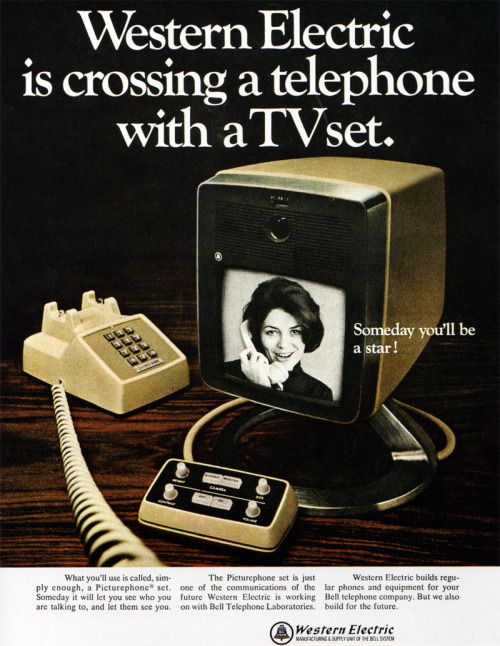
An magazine ad from 1968: Western Electric is crossing a telephone with a TV set. “What you’ll use is called, simply enough, a Picturephone set. Someday it will let you see who you are talking to, and let them see you.”Some years ago I was attending a meeting of the committee that ran one of the local science fiction conventions. I had just joined the staff, and it was my first full meeting. One of the topics debated that day was a proposal that the committee obtain an email address that several committee members could check, because people kept asking why they didn’t have an email address. The only means that were available to the public (and thus people who might want to attend the convention) for contacting the organization was to either mail a physical letter to the club’s post office box, or to leave a voice mail message via a phone number that didn’t actually ring a phone. A system that was troublesome because if you didn’t check the voice mail box often enough, it would fill up with messages and no one could leave a new message.
During the debate, one person admitted that he had voted “no” each previous time the question had come up, but he had recently realized that it was as inconvenient for him and his friends that he didn’t have an email address of his own, as it had been inconvenient for he and his family that his elderly great-aunt refused to get a telephone. He wasn’t the only member of the committee to admit that they had been resisting adopting that “new technology.”
And this was a bunch of sci fi nerds.
Admittedly, it was sci fi nerds in the 1980s. Personal computers were still complicated gadgets that cost more than a car (the first IBM PC/XT had 128kilobytes of RAM and cost $5000, that’s the equivalent of $12,000 in 2017) and often had parts you had to solder together yourself. But my point is that even people who think they are forward thinking and tech savvy often have big blind spots about technology.
Such as the current dismay I keep seeing expressed online because so many politicians on both sides of the aisle have been talking about rural broadband. “Is this really a pressing need?” As a matter of fact, yes. It is nearly impossible in the modern era to apply for a job if you don’t have access not just to email, but a robust enough internet connection to fill out the often very-poorly scripted online applications. When my husband and I were recently looking for a new place to live, not only were the only reliable places to find available properties online, but often the only way to inquire about a property was to fill out a web form. Even after that point, we had to each fill out applications for background checks via a different website and system than we’d used to contact the property manager.
(click to embiggen)The primary means to access services such as unemployment insurance, disability benefits, and so forth, is over the web. And that means needing more than a basic internet connection, you have to have a decent amount of bandwidth, or things time out. When new medical equipment is handed out, they doctor’s offices don’t have the time to show you how to use it, they give you a web address to access videos online. That’s how I learned to properly inject myself with insulin (including how to troubleshoot the injection pin and so on): they sent me to a webpage to watch the videos and read the warnings and disclaimers myself.
Internet access, particularly high speed/high bandwidth access, is no longer a luxury. Society, both businesses and institutions, have embraced the new technologies. Just as phones ceased being a luxury decades ago, then cellphones ceased being a luxury about a decade ago, and now smart phones have also crossed that line. For a number of people, particularly poor people, their smartphone is their only reliable way of accessing the services they need to get and keep their jobs, to take care of their kids’ needs, and so on.
Douglas Adams observed in an article in 1999:
“I’ve come up with a set of rules that describe our reactions to technologies:
1. Anything that is in the world when you’re born is normal and ordinary and is just a natural part of the way the world works.
2. Anything that’s invented between when you’re fifteen and thirty-five is new and exciting and revolutionary and you can probably get a career in it.
3. Anything invented after you’re thirty-five is against the natural order of things.”
Which is accurate, but also just a bit dated. Technology doesn’t just move forward, but the rate at which things change accelerates. Adams’s rules could use a couple of additions. For instance, we might add “Any new and exciting thing creating jobs when you’re in your 20s is a dying, obsolete industry by the time you turn 40.”
And there are the people who don’t understand how mass production and the commodification of products makes things that once were terribly expensive available for a fraction of the cost. This comes up a lot in relation to iPhones, in particular. In certain circles it is popular to hold up the ownership of an iPhone by someone who is struggling financially as proof that the person is only struggling because of bad priorities. This doesn’t take into account the many, many ways that someone can obtain slightly older versions of currently expensive gadgets extremely cheaply. We’ve already established that have a phone, specifically a mobile phone, has become a necessity in our modern society. Getting a refurbished unit of some previous year’s model or a non-refurbished unit of a model from a couple of years ago for free or close to it as part of a cell phone contract is quite common. And then there are various sales and special offers one can find.
That doesn’t even get into the hand-me-down process. Lots of people, when they upgrade a device such as a phone or tablet or laptop, rather than try to sell it somewhere, wipe their data and give the device to a friend or relative who can’t afford a new device themselves.
Luxuries aren’t what some people think they are. Sadly, the people least likely to understand this also don’t realize that being able to look with condescension on others for having or wanting nice things is a form of luxury on its own.





 Font Folly