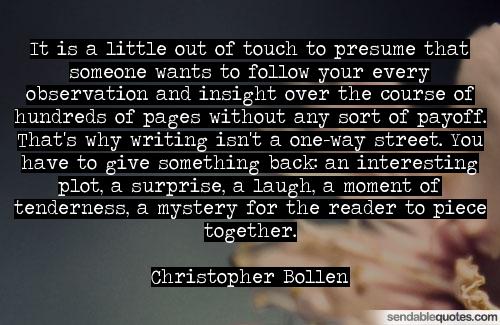
Christopher Bollen explains that writing isn’t a one-way street (click to embiggen)There was a lot of talk on social media this week because a group of jerks harassed the writer of an episode of a television show about said episode until the writer deleted their social media accounts. And it was harassment, not critique. You can be unhappy with a story, you can dislike it, you can even tell other people you don’t like it; but that doesn’t mean you can make ad hominem attacks on the writer, threaten the writer and their family, hurl bigoted slurs, and so forth.
Similarly, you can be unhappy with a story because you feel the story is reinforcing sexist, or homophobic, or racist, or ableist myths. You can call out the problem when a story pushes that agenda. You can express your disappointment. You can organize a boycott. But again, pointing out problems in a narrative should not turn into harassment of the people involved.
In this case it was actually two hordes of idiots harassing the writer. One group were angry because they thought the writer was pushing a relationship between two characters they didn’t want together. The other group were angry because the relationship wasn’t going where it had “clearly” been implied it was going.
Readers aren’t the only ones who can be jerks. Writers can disrespect their audience; they can make mistakes, abuse the reader’s trust, they can cheat and exploit their audience. Which isn’t to say that the writer owes any reader or group of readers a specific outcome, or a particular plot resolution. But as writers we must always remember Niven’s Law for Writers: It is a sin to waste the reader’s time.
In the simplest sense that means that as writers we owe the reader our best professional effort. We tell the story as best we can. No story and no draft will ever be perfect, so we can’t get hung up on revising until it is, but we don’t turn in a half-assed effort.
I want to make a brief digression here. Most of my fiction writing and publishing has been in small press and amateur publications. Occasionally, when as an editor I have given writers aspiring to those publications feedback and requests for re-writes, a writer has pushed back. “You can’t hold me to professional standards, I’m not getting paid!” I didn’t quibble over the fact that technically, because we were giving them free copies of the publication if we used their story it meant they were getting paid, instead I said, “I’m publishing to professional readers. They pay for the privilege of reading my zine. And even though what they pay barely covers the costs of printing, and doesn’t provide any monetary compensation to you, or me, or the copy editors, or the layout specialist, the reader is still paying.” Of course they didn’t have to make re-writes if they didn’t want to. But if they didn’t, I wasn’t going to publish the story, because I wasn’t going to ask my readers to spend their time or money on a story I didn’t think was ready.
To get back to what we mean when we say it is a sin to waste the reader’s time, in a deeper sense that means playing fair. If there are mysteries for the reader to try to solve, you can’t withhold information. Obscure it amongst a bunch of other description? Sure. Distract the reader by dangling a red herring in the same scene? Also perfectly reasonable, but you can’t simply not show the reader vital information.
Also, don’t spring surprises on the reader merely for the sake of shock. It’s easy to think that surprises and shocks and twists are the only way to create suspense, but that’s wrong. Suspense happens when the reader cares about your character. If you create characters the reader identifies with and cares about, you can create suspense out of anything that the character cares about. You create that caring by treating the reader with respect and showing the reader the hearts of your characters.
Don’t lead the reader down a painful emotional path without giving them a pay-off. If you make the reader care about the protagonist and then allow the reader to see a horrible thing happen to the protagonist, don’t skip past the messy emotional fallout. You don’t have to show blood and gore—often graphic descriptions of violence are more boring than engaging—but show us how the bad thing affected the characters. Let the reader experience their sorrow or anger or triumph. Don’t skip that to get to the next plot twist.
When you tell a story, you are asking the reader to give you their time and attention. Make sure that the journey your tale takes them on is worth it.
“It is a little out of touch to presume that someone wants to follow your every observation and insight over the course of hundreds of pages without any sort of payoff. That’s why writing isn’t a one-way street. You have to give something back: an interesting plot, a surprise, a laugh, a moment of tenderness, a mystery for the reader to put together.” — Christopher Bollen
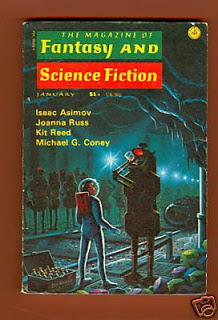
“My Boat” by Joanna Russ was published in Fantasy And Science Fiction Magazine, January 1976, cover by David Hardy. (click to embiggen)By January of 1976, I was midway through my freshman year in high school, living in a tiny town in northwestern Colorado. My parents had been separated for a few months and their divorce was underway. My physically and verbally abusive father wasn’t living with us any more, which was a plus, but everything from our finances to our daily routines were far less certain and predictable. I had had a big break-up of my own that no one knew about—because we were both extremely closeted boys in a very redneck town so of course we had been keeping it a secret. And another boy who had been one of my most consistent bullies throughout middle-school had recently coerced me into an even more covert non-consensual relationship. So to say my life at the time was a bit of a nightmare would not be inaccurate.
I still had a subscription to The Magazine of Fantasy and Science Fiction, thanks to my grandparents, and each time a new issue arrived in the mail, I would retreat to my room with it and stay up way past my bedtime devouring every page. These were the circumstances under which I first read the short story, “My Boat” by Joanna Russ…Continue reading Lost Friends in the Dreamlands – more of why I love sf/f→
I’ve had several partially drafted blog posts about protagonists and heroes and characters I love reading/watching and characters I love to hate and characters that disappoint and how my feelings as a writer are sometimes different than my reactions as a reader. Which I never seem to be able to finish.
One reason I have trouble finishing any of them is that in many ways it’s one great big nuanced topic in my head, which is impossible to condense into a thousands words, but is just as difficult to break up into meaningful sub-parts without wanting to cross-reference all the other sub-parts. And while the crazy info architect inside me thinks it would be awesome to compose a dozen blog posts each with a dozen footnotes and cross-references to the other, the practical side of me knows that way lies madness.
And then Watts Martin quoted Glen Weldon from NPR’s Pop Culture Happy Hour podcast, and this quote covers one of the big concepts in my nuanced ball in far less than a thousand words:
“We tell ourselves we embrace the antihero because we think it’s more sophisticated. We recognize that the world isn’t black and white, and that moral ambiguity and ambivalence is ‘more real.’ We tell ourselves that, and we’re awfully smug about it, but the real reason we’re doing that—that we embrace the antihero—is because we just don’t have the guts to embrace the hero. We’re too cowardly, we’re too cynical to believe in heroes. We distrust ideals because they’re too hopeful and sincere. If we believed in the heroes that embodied them, it means we’d actually have to risk something, put ourselves out there, be hopeful and sincere and look hokey and uncool. The default reflexive cynicism risks nothing.”
—Glen Weldon
Weldon is talking about anti-heroes, which is a protagonist with the opposite of the usual attributes of a hero (idealism, courage, selflessness), but that doesn’t mean that there are only two types of protagonist possible: hero and anti-hero. An anti-hero is different than an imperfect person being heroic. People rationalize the reflexive cynicism Weldon describes by pointing out that no one is perfect, therefore heroes don’t exist. While it is true that no one is perfect, a person doesn’t have to be absolutely perfect in order to be good.
As a reader, I love rooting for a character who isn’t perfect but is trying to do the right thing, any way. Dan Savage likes to say that a successful relationship is a myth two people build together. You each pretend that the other person is their best self—that best-foot-forward version of yourself you presented on your first date. As time goes on, you each try to do a better job of being that better self. It’s not simply a matter of overlooking imperfections, there is also a process of real change, of transforming yourself into someone who deserves the love of the person you love.
That isn’t just true of romantic relationship. A successful friendship is a similar jointly-created myth. And yes, a good relationship between a reader and a beloved character has some elements of that as well.
As a writer, I want readers to identify with my characters. I want them to root for the characters when the characters struggle. I want them to be disappointed when a character makes a mistake. But just as in real life when a good friend disappoints us, I want my reader to still cheer the character on when the character struggles to make amends. I want my character to be that kind of a hero: an imperfect person striving to be their better self.
It’s sincere and it’s hokey and it’s uncool, yes. But that doesn’t make it unrealistic.
Some times, you just have to quote one of the masters:
“Critics who treat ‘adult’ as a term of approval, instead of as a merely descriptive term, cannot be adult themselves. To be concerned about being grown up, to admire the grown up because it is grown up, to blush at the suspicion of being childish; these things are the marks of childhood and adolescence. And in childhood and adolescence they are, in moderation, healthy symptoms. Young things ought to want to grow. But to carry on into middle life or even into early manhood this concern about being adult is a mark of really arrested development. When I was ten, I read fairy tales in secret and would have been ashamed if I had been found doing so. Now that I am fifty I read them openly. When I became a man I put away childish things, including the fear of childishness and the desire to be very grown up.”
—C.S. Lewis
The cover of the very first appearance in any comic of Captain America (March 1941) shows him punching out Adolf Hitler, in case there was any doubt whose side he was on. (click to embiggen)So, in the latest edition of the official comic book adventures of the original Captain America, Steve Rogers, the writers (and editors and surely a few other powers that be at the comic book subsidiary of the massive Marvel/Disney conglomerate) decided to publish the shocking plot twist that Steve Rogers has been an evil double agent all along! And by the initial reactions they have had to the less-than-happy reaction of at least some of the public, they seem to be taking great glee in this “amazing” and “clever” twist which they had to take in order to keep the story “fresh” and “relevant.”
This twist is neither fresh, clever, nor amazing. The most polite way to describe it would be as click-bait. And as Jessica Plummer pointed out in a post on Panels.Net (ON STEVE ROGERS #1, ANTISEMITISM, AND PUBLICITY STUNTS), it’s not just ordinary click-bait, it’s using the deaths of the 11 million victims of the Nazi Holocaust as click-bait, which means that it is a bigoted publicity stunt, at that.
I’m not saying that the writers intentionally set out the make an anti-semitic (not to mention homophobic and white supremacist) statement. What I’m talking about is the thoughtless bigotry of people who don’t recognize their own privilege nor the inherent unconscious bigotry that permeates our culture at large. The only people who think that someone who is admired as a hero being revealed to actually be a villain is a surprise are people who have never personally experience systemic prejudice. As Sashayed pointed out in a blog post a few days ago:
There is a particular kind of shock that comes with discovering that someone you care about holds a belief or set of beliefs that is dehumanizing to you personally, if not actually – LOL!! – inimical to your existence. Many if not most women have suffered and weathered this shock. Many people of color have. Many LGBT people have. Relevantly to this specific discussion, MANY Jewish people have. It is not Shocking to anyone in an unprivileged cultural position that someone you like, someone you care about, someone who is a “hero,” even someone you thought cared about YOU, can be revealed to have been metaphorically Working Against You All Along. Nobody thinks it’s fucking SURPRISING that you CAN’T TRUST ANYBODY to be on your side! Of course you can’t! You just adjust to that and try to get through your life in spite of it. No shit, white dudes.
From my own personal experience, I would amend “Many LGBT people have” to “nearly every single LGBT person ever.” As Solarbird commented, elaborating on Sashayed’s observations:
I’ve had three people – three people – that I thought were various degrees of friend start posting things from anti-queer groups just this spring. This “ha ha really evil” thing is fucking routine. One of them was even one of the tiny, tiny number of Christians I’ve always brought up to myself whenever I’ve tried to tell myself, “they’re not all like this, they’re not all like this, remember, there’s X and Y and Z” and SURPRISE! X IS TOTALLY WILLING TO POST ANTI-QUEER MEMES AND DEFEND THAT! so I’ve just been through this again recently.
Hell, I’ve been through this so many times it almost – almost – doesn’t even faze me anymore. (Well, okay, X did, and I have now learned that lesson.) It’s more a matter of, “okay, move this one to “Surprise Explicit Enemy” category, and two more to add to the absolutely do not trust list.“
If you’re queer in this society, you have to keep lists like that, you see. It sucks.
So yeah, this is not new to my life, and more of it is the opposite of shocking. It’s more just…
…one more goddamned disappointment. Of which I have had enough.
In case the message wasn’t clear in issue #1, the creators of Captain America, Joe Simon and Jack Kirby, had Cap attacking Hitler on the cover of the second issue of the comic, as well. (Click to embiggen)One of my experiences along this line was a friend who had been arguing emphatically on a particular public forum for a law that would “quarantine” all gay men in “medical camps” (this was back in the late 90s or early 00s); when other people pointed out she was being homophobic, she actually named me as one of her gay friends whose existence proved that she wasn’t a bigot! She didn’t hate me, she just firmly believed that every single gay, lesbian, and bisexual person was deeply and incurably mentally ill, and that we needed to be locked up for our own good. But she wasn’t a bigot.
Or the many times my aunt who regularly posts articles and memes and so forth saying that god is going to destroy america because of marriage equality or queer rights or trans people using public bathrooms, and then sends disappointed messages wondering why I and my husband don’t visit more often. And how can I say she’s bigoted? She loves me and all of her gay and lesbian friends, and has said so many times.
So, yes, don’t color me surprised by this shocking and tone-deaf development.
And there’s more. I reblogged some observations on Tumblr that it is very telling that the producers of Captain America are quite willing to make him a Nazi or Hydra double agent, but remain adamant that the character couldn’t possibly be bisexual. Equally telling is that the same fanboys who come out in angry droves when someone posts fan art or fic that depicts Cap as bisexual, have remained completely silent at this revelation that Cap has been secretly a Nazi all along. Someone felt the need to admonish me about that, because “making this about queer representation is dismissive of the persecution of Jewish people.”
No. No it is not. First of all, we can be upset about more than one aspect of an egregiously bad storytelling decision. We can point out that it is both anti-semitic and racist towards various people of color. We can point out that a situation is anti-semitic, racist, homophobic, and sexist all at the same time. Mentioning one or more of the problematic aspects doesn’t erase or diminish any of the others.
Furthermore, reducing a comment about homophobia (and the linkage between it and other bigotry) to the phrase “representation” is a form of erasure. It’s playing oppression olympics, saying that one group is more oppressed than another. It’s saying we can’t talk about homophobia until all other “more important” issues have been utterly solved.
And that’s pure B.S.
Besides, I hate to have to be the one to point this out, dear anonymous Tumblr commenter, but those 11 million victims of the Nazis you mentioned? That included between 5,000 and 15,000 gay men. In fact, homosexuals were among the very first groups targeted for internment in the camps by the Nazis in 1933. Even worse, when the allies liberated the camps, while prisoners who had been locked up because they were Jewish or Roma or biracial and so forth were set free? The homos were transferred to regular prisons.
The death toll of the Nazi camps also included nearly a quarter million Roma (who were targeted as an ethnic group), tens of thousands of Jehovah’s Witnesses (the denomination was identified as an enemy of the Aryan race relatively early because of its public resistance to the racist policies of the Nazis), biracial people, and pretty much every ethnic group the Nazis didn’t consider Aryan. They also locked up a lot of white folks for the horrific crime of being married to someone that wasn’t Aryan, having had children with someone who wasn’t Aryan, and so on. This gets to the real reason I made the link between the refusal to consider that Steve Rogers might be bi and anti-semitism:
The bigotries tend to go hand in hand. If someone is homophobic, that’s a very good indicator they are also sympathetic to misogynist ideas, racist notions, and yes, anti-semitic assumptions, too. If supposedly heroic people being bigots comes of no surprise to many of us, the fact that people who are homophobic are bigoted toward a lot of other groups should come as even less of a surprise.
I understand this is a comic book, and that comics have a long tradition of rescinding storylines or retroactively changing continuity whether it be telling us in a few issues it was all a clever plot to trick some of the bad guys, or that it is really a Skrull shapeshifter pretending to be Captain America, or some other hand-waving. If that’s what they had in mind all along, that makes it even more of a cheap trick. It’s a publicity stunt that tramples on the history of a character that was created by two Jewish men: Joe Simon (born Hymie Simon) and Jack Kirby (birth name Jacob Kurtzberg) explicitly as not merely an anti-Nazi symbol, but as the embodiment of what they thought were some of the most noble aspirations of the human heart.
I’m not saying the writers don’t have a right to tell this story. I’m not arguing for censorship. I’m simply pointing out what it was a bad choice. I’ve tried to explain why it isn’t a clever or creative plot twist, but rather a dickish stunt. It’s disrespectful of the audience. It is using the horrible murders of 11,000,000 humans as clickbait. And it is a bad choice artistically. As Pablo Picasso said:
The purpose of art is washing the dust of daily life off our souls.
This is trampling the hopes of some people in the dust of mockery in order to try to make yourself look clever. That isn’t art at all.
Cover for the first edition hardback of The Bicentennial Man and Other Stories by Isaac Asimov. (Click to embiggen)I first heard of “The Bicentennial Man” by Isaac Asimov when I saw the anthology, The Bicentennial Man and Other Stories offered as a selection in the Science Fiction Book Club. I was 16, and still technically a member of the club, but most months I checked off the “Send nothing at this time” box on the card, because even the cheaper prices of the book club were a bit much for my budget. It a bit over a year later when I found a paperback copy of The 1977 Annual World’s Best SF edited by Donald Wolheim in the local used book store when I finally got a chance to read the story.
Asimov wrote a lot of short stories about robots. Most of the stories collected in his anthologies I, Robot and The Rest of the Robots dealt with various logical contradictions that robots would be placed in by various circumstances, and how the robots (and the humans working with them) would work out those conflicts between the Three Laws of Robotics, their other programming, and the situation at hand. Even in his longer novels where robots figured prominently, such as the two sci fi murder mysteries, The Caves of Steel and The Naked Sun, the robots were always motivated by pure logic. The fact that the world is not a purely logical place, and that humans are seldom covered by rationality alone, formed the framework for the conflict in the stories.
“The Bicentennial Man” centered on a single robot, dubbed Andrew by the daughter of its first owner (a Mr. Martin, identified in the story which is told from Andrew’s point of view as simply Sir). Andrew demonstrates an unusual talent with wood carving—his works of art fetching high prices when offered for sale—and develops a desire to became human. Andrew is part of a new series of robots with what Asimov describes “more open-ended architecture” in his positronic brain, which the experts believe is where his apparent artistic talent comes from. Andrew’s stubborn insistence that he can become a human worries the scientists at the world’s largest robotics company, causing them to try to buy Andrew back.
In part because of the pleading of the owner’s daughter (whom Andrew calls Little Miss), Sir refuses to sell Andrew back to the company. Later, Sir helps Andrew gain some form of legal independence as a “free robot” with the legal name of Andrew Martin.
From there the story follows Andrew’s physical and legal journey through several generations of the original family, as Little Miss grows up, grows old, and dies, and her son and grandson found a legal firm which, among other things, fights to secure Andrew’s legal rights. Andrew designs new kinds of prosthetics, which are almost indistinguishable from natural body parts. Andrew’s body is slowly ungraded to first being a more human-looking android body, to an organic one. The proceeds from the patents on the various processes to create the prosthetics (which are used medically to improve the lives of disabled, maimed, and diseased people) providing Andrew’s income and funding the legal fight.
One of his important legal victories happens when he is 150 years old, where at a dinner in his honor (celebrating his medical inventions), he is toasted as the Sesquicentennial Robot.
Eventually, as Andrew realizes that he will never persuade a human legislature to pass a law declaring him, or any robot, a human because the key difference will always be his positronic brain. Which leads Andrew to compel a robotic surgeon to perform an operation on his brain that will cause the brain to slowly decay and die. Andrew’s reasoning is that it’s the immortality that forms the final barrier between him being accepted as a human.
The story really resonated with me. And it was interesting to see Asimov explore the nature of emotions and creativity from the point of view of artificial intelligence. But more interesting was the series of legal barriers that Andrew has to go through. Laws have to be changed to allow a robot to own property, for instance. Laws must be changed to make harming a robot a crime, at another point.
The legal progression to personhood that Asimov takes us through is based on the historical legal fights for woman’s rights and racial equality. For millenia, the legal system treated women as property. Assaulting a woman was a crime, yes, but the penalties imposed always included paying a fine to the woman’s father (if she were unmarried) or her husband, because the man in her life was deemed to have been harmed by the degradation of his property.
Similarly, Andrew discovers, once he is a free robot, that since there is no owner to whom damages would be owed, the legal system doesn’t consider anyone assaulting and damaging him a crime as assault. Vandalism, perhaps, but then, who is the owner who should be compensated for the damage?
It seems ridiculous to us now that some people, simply because of their gender or the color of their skin, had once been in a similar situation: harming them wasn’t inherently a crime, it was only a crime if it caused their “owner” to suffer a loss. And especially frightening to realize that in the matter of sexual assault laws in the U.S., for instance, that as recently as the 1970s the law was still structured this way. A woman couldn’t file rape charges against her husband or sometimes even her ex-husband, because once married her consent was no longer hers to give or withold, in that regard.
Andrew’s struggle for human rights parallels, thus, every oppressed groups struggle for equality. Something that I came to appreciate more some years later, when I finally bought my own hardcover copy of The Bicentennial Man and Other Stories and re-read this particular short story again. There is even a point, during the discussion about the assault laws, where another character makes the same argument at homophobes current make against hate crime laws: they aren’t needed, because the action is already a (minor) crime under existing laws.
Asimov’s story about a robot who wants to be a human might seem, on the surface, to be little more than a retelling of Pinocchio, but we see here one of the Grandmasters of Science Fiction—a sci fi writer who first reached prominence during the “golden age” of sci fi—turning a civil rights argument into a rattling good tale of old-fashioned science fiction. Who would have thought an old, white (okay, jewish, but still) male sci fi writer who made his first professional sale in 1939 would be a social justice warrior? Don’t tell the melancholy canines!
When I read “The Bicentennial Man” I was a very closeted high school student, terrified that people would find out I was queer because I knew that strangers, friends, and even family members would see me as an abomination if they knew. So the story of Andrew, who wanted to be seen and accepted as a person certainly struck a chord. Even if his ultimate solution, dying, seemed like a terrible way to achieve his goal.
Cover of the paperback edition of the 1977 Annual World’s Best Science Fiction, edited by Donald Wolheim (click to embiggen)When I was a junior in high school there was one comic book shop in the town I lived in. It was also a used book store, so I visited there a lot. I didn’t have much money, and I was still reading several comics regularly which took up most of my discretionary spending, so I spent a lot more time there browsing—trying to find the cheapest books—than actually buying.
One day at the store I happened upon a paperback copy of The 1977 Annual World’s Best SF edited by Donald Wolheim. I owned several of his earlier annual anthologies, having gotten several of them as part of my introductory new member shipment from the Science Fiction Book Club a few years previously. The paperback was in pretty good shape, having only been published about six months previous, so it was probably marked at half cover price, which meant it wasn’t in my usual price range, but I had enjoyed the earlier collections, and there was more than one author in the table of contents whose work I really loved, so I bought it.
One of the stories in this particular collection was a novella, “Houston, Houston, Do You Read?” by James Tiptree, Jr. I didn’t know, at the time, that Tiptree was a pseudonym of Alice Sheldon (I think the year I read this was the year that her true identity was revealed, after ten years of being published under the name).
I believe I had read a few of Tiptree’s earlier short stories in the various SF magazines that I followed semi-regularly. I recognized the name, at least, but didn’t have a strong recollection of what kind of stories Tiptree had written before or whether I liked them. So I wasn’t prepared for just how good this story was.
The tale concerns the three-man crew of a NASA mission sent on a polar circuit of the sun. The ship is hit by an unexpectedly strong solar flare and is severely damaged. The crew survives and eventually gets their radio repaired, but are unable to reach Earth. At first it’s because Earth isn’t where they expect it to be in relationship to their position. They eventually figure out that they are further off course than they thought, and start transmitting their distress signal in the correct direction. No answer comes.
Eventually, as they scan more frequencies, they start picking up signals, many of them conversations in English with Australian accents. This is confusing, particularly since many of the signals are coming from various parts of the solar system, indicating a rather large number of space ships. Plus Australia, as far as they knew, didn’t have much of a space program. Also, almost all of the voices on the radio sound like women.
They establish contact with one ship which detected them and has diverted from its course to rescue them. During the radio exchanges before the rescue ship reaches them, they learn that it has been hundreds of years since their mission went up. The world is anxious to meet them, they are told, because they had long been assumed to be dead.
They also learn that there has been some sort of catastrophe on Earth in the intervening years which greatly reduced the population. When the rescue ship finally arrives, the men are surprised that there is only one man in the crew of the ship. Lots of other things surprise them, too. Two of the crewmembers seem to be twins, and both named Judy, but one seems to be several years older than the other. There are several other anomalies and slips of the tongue during the weeks that the ship is returning them to Earth that make the astronauts more suspicious.
Eventually they learn that the catastrophe was even worse than they imagined: it was a plague which only 11,000 women survived; not one single man survived it. The remaining people have been reproducing for several generations by cloning. Children are raised in a communal setting. Some are chosen to receive hormone treatments to give them the musculature and size of men. The story seems to imply that the only reason this is done is for the physical benefits of the muscles and such, and it is unclear if these children choose to became essentially transmen, or if it is imposed by some sort of societal system.
The three astronauts react in very different ways to the discovery. One becomes convinced that god threw them through a wormhole so that they can “rescue” this society and bring men back in charge. Another assumes that since there’s a whole planet of women who have never had sex with a “real man” that he will become sort of a sex god to them all. The last simply hopes that they will be allowed to rejoin society and help repopulate the species (since there are some health problems due to the of lack of genetic diversity).
It turns out, of course, that none of that is to be. The actions of the three men have been being recorded and sent back home. The men were slipped drugs which supposedly made them act out their true natures. The leaders of the world agree that men are simply too dangerous to introduce back into the species. There’s a particularly moving conversation between the captain of the rescue ship and the one man who has remained rational where she points out that most of the heroic behavior the man has tried to cite as proof that men can be good was simply men protecting their own women and children from other men.
The men’s genes are going to be used. Before the three are euthanized, sperm is collected, to diversify the gene pool, but only female babies will be taken to term. Since the entire story is told from the point of view of the one man, the reader never finds out what happens after he and his companions are put to sleep.
I wasn’t the only one who thought the story was good. It won both the Nebula and Hugo award for best novella the year it was published. The story did not kick off much in the way of controversy at the time, in part because people believed Tiptree was simply a feminist-minded man. A man could write a science fiction story decrying generations of misogyny and patriarchal violence and be thought of as open-minded, and a forward thinker. A woman, on the other hand, would (and still often is) branded as a radical man-hater.
I simply thought it was an intriguing story. I was still struggling to accept my own sexual orientation at the time, and I was intimately familiar with how the cruelty of boys toward boys who weren’t manly enough was overlooked, approved, and often encouraged by a sexist society. So the notion that culture might be a better place without all that hypermasculinity was appealing, even if I felt sorry for the reasonable male viewpoint character who was going to be exterminated along with his more brutish companions.
I want to emphasize that Tiptree made the male character sympathetic. She laid out the case for both sides convincingly, and seemed to be inviting the reader to consider (and maybe fight for) solutions to the problems of toxic chauvinism other than simply wiping the men out.
It was another mind-blowing story. Another time that sci fi helped me (as a very closeted queer teen living in a small town among Christian fundamentalists) imagine a better life, particularly the notion of romantic relationships other than opposite-sex pairings. After that story, whenever I saw Tiptree’s name on an anthology or magazine cover, I knew I wanted to read it.
My husband and I had a disagreement the other day on a topic that surprised me. He made the comment that a particular story which won some awards a few years ago shouldn’t have, because it was, as far as he was concerned, a piece of fan fiction, rather than an original tale. I thought it was going to turn into a much more spirited debate, because I have rather strong feelings on the subject. But I barely got a few sentences of my first point out, when he smiled, shrugged, and said, “Okay, I see your point. But I still don’t think the story deserved an award.” And I laughed and replied, “Maybe it didn’t, but that’s a different point than saying it should never have been considered for one.” And he said, “Yeah, I guess.”
And that was it.
Which wasn’t much of a debate. And I have to admit, I was a little disappointed that we wrapped that topic up so quickly, because I think it’s one that deserves more consideration. Which means I’m going to blog about it. Lucky you!
Fan fiction, according to Professor Rebecca Black, “is writing in which fans use media narratives and pop cultural icons as inspiration for creating their own texts.” A lot of people look down on fan fiction, characterizing it as not real writing, often arguing that it is just retelling existing stories, rather than someone telling their own. My first disagreement on that is that all human story telling can be characterized as retelling of existing narratives. Humans have been telling each other stories for tens of thousands of years, and there is no such thing as a wholly original story idea, any longer…Continue reading Confessions of a fan fiction fan→
I knew both authors for one beloved book each. For Harper Lee it was because she never wrote another book after To Kill a Mockingbird. For Umberto Eco I don’t have that excuse. I loved The Name of the Rose, and usually when I love a book, I actively seek out others by the author. I distinctly remember reading the back cover synopsis of Foucault’s Pendulum in a bookstore once and not being terribly interested. I have no idea why I never looked for anything else he wrote.
It’s very sad to lose them both.
If you’ve never read either To Kill a Mockingbird or The Name of the Rose, there’s no better time than now!
Speaking of beloved books: How One Mashup Artist Got Legal Permission to Pair Calvin & Hobbes with Dune. It’s pretty awesome. With the permission of Bill Watterson, the artist takes Calvin & Hobbes comic strips and replaces the dialog with extensive quotes from various Dune books creating some really interesting results.
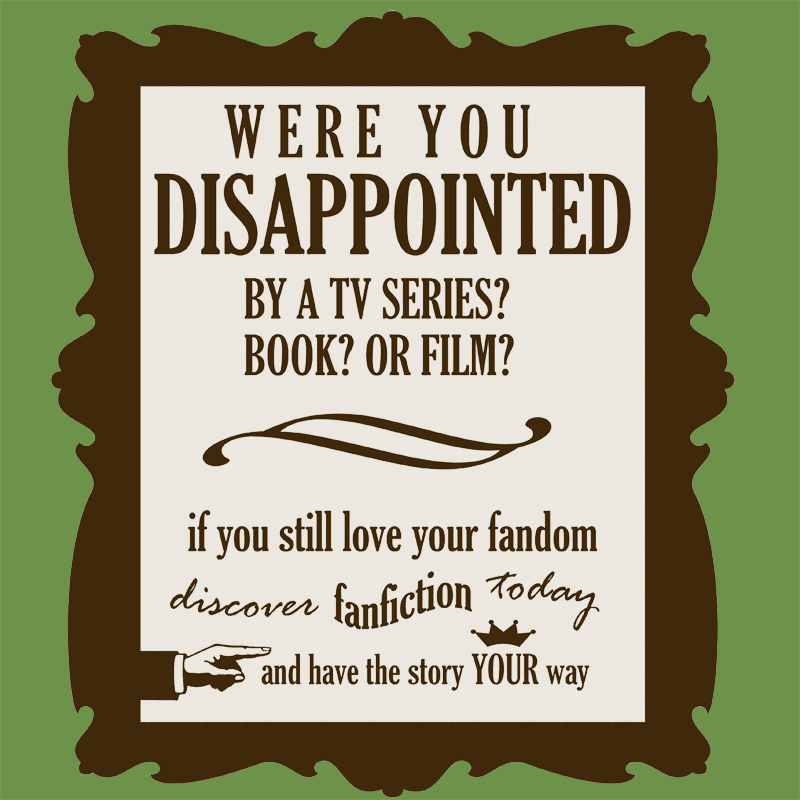
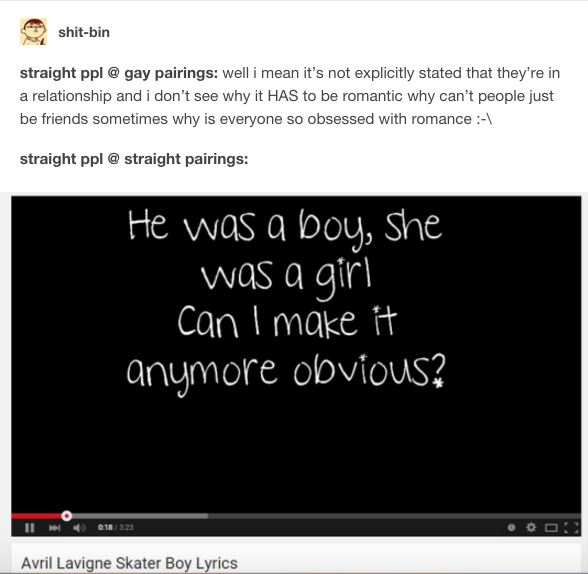
A blog post that appeared on my Tumblr dashboard. Click to embiggen.
A lot of Tumblr is about reblogging and liking stuff other people have posted. Or more realistically, reblogging stuff someone you follow reblogged from someone the follow who reblogged it from someone else, ad nauseum, that someone else posted.
A certain amount of commentary happens, though the tools aren’t really designed to foster conversation. But that’s another topic for another day.


 Font Folly