Tag Archives: literature

Meta-labels and Sub-genres – loving sf/f in all its forms

https://thehopefulheroine.wordpress.com/2014/01/02/dont-judge-a-book-by-its-genre-an-intro/ (Click to embiggen)
I had two different ideas for this week’s “Why I love sf/f” post. Unfortunately, the one I had gotten furthest along in was turning into a mash-up of last week’s and the one before. The other one showed a bit more promise, and then I saw this post on the Over The Effing Rainbow blog: [Sci-Fi Month] Guest post: Aliette de Bodard – Science-fiction, fantasy, and all the things in between.

Go read it, because she says what I wanted to say, only better!

I went through a long phase where I preferred science fiction over fantasy with a bit of self-delusion along the lines that somehow fantasy was “just making any old thing up” while science fiction required an understanding of science! Likewise, I often expounded the notion that hard sci fi was superior to all others because you were constructing your what-if scenarios inside even more demanding parameters. Somehow I was able to express those beliefs at the same time that I would read and re-read any Andre Norton book I could get my hands on because I always loved them. I’m not sure why it took so long for me to recognize the cognitive dissonance between the kinds of stories that moved me most, and the sorts of stories which didn’t but which I claimed were superior.

Some of it is pure stubbornness: you express an opinion at one point, and then you feel obligated to keep justifying your original statement. But when I finally started to recognize this particular contradiction, that didn’t seem a sufficient explanation. Until I had an epiphany.

The epiphany came from an unusual source. I was watching a recording of a question-and-answer session that sex advice columnist and gay rights activist Dan Savage was having after giving a talk at a university. A young woman had a question about why guys her age would be friendly and sometimes flirty with her and other woman she knew who weren’t “model thin,” but always distancing themselves before things got beyond friendship. Yet she found older men pursuing her. She feared that the older men were desperate because of some other flaw she hadn’t uncovered, and that younger guys were merely shallow.

Dan pointed out a couple of things. One was that every week since he’d become an advice columnist he received at least a couple of letters from straight guys who confessed that they were really attracted to bigger women, but terrified to admit it because they thought it meant something was wrong with them. In an aside, he said that he got similar messages from some gay guys about their attraction to big guys. He said the thing nearly all the letters had in common was that the letter writer was either in their teens or their twenties. At that age, Dan said, guys are still very focused on winning the approval of other guys. So they are much more concerned with appearing to be interested in the things they think others expect them to be interested in.

His conclusion was that a lot of the guys she thought were sending mixed signals were doing just that. They were genuinely attracted to her, but when they recognized what was happening, they bailed because they thought they weren’t supposed to be attracted to that kind of body. So his advice was to go ahead and take men who did express interest at their word, and if they didn’t otherwise set of alarm bells, there was nothing wrong with dating them. But also, she would find when she got a bit older, that there were plenty of guys who always had found her attractive, they just had to grow up enough to stop worrying about the approval of their friends.

I realized that I had started espousing those opinions about sci fi vs fantasty, and hard sci fi vs so-called soft science sci fi, and very cerebral sci fi vs action/adventure sci fi when I was in my teens, and I hardened those opinions in my early twenties. At the time it seemed that the fans I most admired all held that opinion. And the way that libraries often classified various books seemed to reinforce that. All of the “soft” sci fi and fantasy was filed in the young adult section or the children’s section of libraries that divided things up that way. Only the hard sci fi and certain kinds of action/adventure sci fi was over in the adult sections. Clearly fantasy and so forth was for less mature, and therefore less sophisticated, readers.

Bull.

“If you’re going to break a rule, break it good and hard. My personal motto!”
—Aliette de Bodard

Especially since science fiction is supposed to be not just exploring limits, but pushing beyond frontiers into the unknown, we shouldn’t look down on things that vary from the familiar. That’s the whole point, right? It’s timid to worry about whether a story is supposed to go this way, or whether we’re supposed to like a particular kind of story, et cetera.

Isn’t science fiction and fantasy supposed to be about boldly going where no one has gone before?

Ancient Tomes and Living Fossils – how I love sf/f isn’t the only way

“Kids these days will never know the joys of oil lamps and chamber pots”Jason Sanford set off small internet firestorm with a series of Twitter comments that he then collected on his blog as: The fossilization of science fiction and fantasy literature. Some people were upset because they thought he was implying that the classics of sci fi were garbage, when all he actually said was that younger people are reading, watching, and playing newer works and there’s nothing wrong with that. He’s since added a follow-up to clarify his point which included this important bit of context:

A few years ago I was on a SF/F panel about bringing new readers into the genre. I mentioned that SF needed more gateway novels, at which point the other author on the panel snorted and said we don’t need new gateway novels … the Heinlein juveniles are still perfect.

That is the type of attitude which people should fear because it will kill our genre. But new readers not discovering SF/F through the classic authors you grew up on — that’s nothing to worry about.

His critique was not aimed at the classics themselves, but rather at older fans and pros who belittle younger people who first learned to love science fiction and fantasy by encountering newer works, or who lecture people who aren’t familiar with many works published 70 or more years ago, or gripe that “real” fandom is greying and dying off.

Reading the original post and some of the fallout left me feeling a bit guilty for ways that I have no doubt come across that way myself. I do react with great incredulity when a friend, regardless of age, isn’t familiar with a book, series of books, or movie that I consider a classic, for instance. I try to get people to watch some of the old movies or read the old books that I loved.

It also made me wonder about the series of posts I’ve been doing for Throwback Thursday the last 6+ months, the “more of why I love sf/f” posts. I started those posts as a personal antidote to the sturm und drang over the affair of the melancholy canines. Because I read a lot of sci fi blogs, and because I was determined to read all the Hugo-nominated works before filling out my ballot, I knew I was likely to spend a lot of time being outraged and otherwise upset about things people were saying about some types of sci fi. So I decided it would be a good idea to write a weekly post in which I would only talk about something I loved from the genre. Since I like having a regular deadline, I needed to pick a day, and it occurred to me that if I focused on works that were influential in my formative years, then I could post them on Thursdays and tag them as Throwback Thursdays.

So I gave myself that assignment.

These posts have been about things I loved in science fiction and fantasy. I’ve written about works that spoke to me in important ways when I was a kid. Many times I’ve mentioned how a particular story or movie or series gave me hints that someday, when I wasn’t a closeted queer kid living among anti-science and anti-gay evangelicals, life would get better. None of which is meant to imply that people who aren’t familiar with or don’t like any of the things I’ve written about are any less real fans than I am, nor that there is anything wrong with treasuring different authors or works.

Not that anyone probably has, but I think it’s important to acknowledge that I’m an old white guy, and what I experienced growing up is going to be very different for fans who aren’t guys, or white… or whose teen-age years are much more recent than mine.

It’s also important to realize that a lot of things that we loved when we were younger don’t always hold up when we’re older. Before I started the “more of why I love sf/f” posts, I’d written about reading some books by a favorite author from my teens and early twenties, and how difficult some of her books were for me to read, now. Some are fine, but some of them have definitely not aged well. And I felt really bad for not liking some of them as much as I did when I was younger.

Because I’m doing National Novel Writing Month (my project is to finish the revision on two of my fantasy novels) there will be a lot fewer blog posts of any kind from me. And those “more of why I love sf/f” posts take more time than others of similar length, because I research the work and author in question. Yes, I’m writing about things I loved, but in some of the cases they are books or shows I encountered before my teens, so I want to make certain I’m remembering them correctly.

I will resume the posts after November. And I will probably continue to focus on books and stories from my younger days. I mean, I averaged reading more than seven novels a week through most of middle school, for goodness sake! There is a lot of potential material to write about!

Learning how to write what you want to write

UrsulaKLeGuinLearningQuoteIt’s nearly time for National Novel Writing Month (NaNoWriMo), which I’m participating in again. That means that I am encouraging (read: recruiting, nagging, pleading, conniving…) anyone that I can to take a shot at it. Last week I riffed on a quotation from Ray Bradbury, Overthinking is the enemy of creativity to talk about some of the most common ways we can self-sabotage creative efforts.

I dismissed one of the usual excuses, that what you write isn’t good enough, by pointing out that no first draft is perfect. Which is true, but incomplete. The only way that anyone can learn to be a better writer is to write. That means writing badly. A lot. Just like the only way a baby can learn to walk is to try, and fall down, then try again. It is a slow process of slowly getting less bad until we reach a point where we literally don’t remember what it was like not knowing how to walk.

When I said last time that humans are natural storytellers, that was also true and also incomplete. Yes, humans tell stories to ourselves and each other in order to make sense of the world, to communicate, to persuade, and to commiserate. You have years of experience doing that. But if you are a typical person, most of your experience is storytelling through the spoken word—usually face-to-face. Your narrative depends on a lot of nonverbal supplementary material. You sit down with friends and explain about your day, for instance. You may imitate the voice of one of the other people involved in your tale. You might gesture with your hands. Your facial expression changes to convey emotional context. Your tone of voice varies. You slow down at some points and speed up at others in order to draw out suspense of convey a sense of urgency. You will pause dramatically.

And you have none of those tricks available when you write.

What many people never fully grasp is that, while written language is based upon spoken language, they aren’t actually the same language. It’s because spoken language has all that non-verbal stuff going along with it. It has all those non-verbal communication tricks that we learned the same way a baby learns to walk: by observation followed by trial and error. Which means we do it without thinking. But we don’t know how to convey all that with words on screen or on paper.

That’s one of the things we have to learn in order to become a writer. How do we tell our story compellingly without those non-verbal bits? How does sentence length correspond to verbal pacing? Are compound-complex sentences the equivalent of a long aside, building up dramatic tension while providing hints of what is to come so that the listener anticipates where it it going, yet does not become impatient? And what of fragments?

All of that is hardly scratching the surface. It isn’t just about technique. It isn’t just about vocabulary. It isn’t just about structure, or theme, or scene setting, or characterization. It is all of those things, yes, but the whole is also more than merely the sum of the parts.

The only way to learn how to do that is the same as any other skill: observation followed by trial and error. That’s why you need to read as well as write. You can’t simply think about your story ideas. Or talk about them with other people. You have to sit down, just you and the blank page (and it doesn’t matter whether the page is paper or pixels), and write it. Then later, read what you wrote. And let someone else read what you wrote to see how they react to it. And read other stuff by other people. Then sit down again and write again. Revise, rewrite from scratch, write something else for a while to take your mind off of it. All of those things are part of the learning process.

What isn’t part of the learning process is explaining to other people why you don’t have time. What isn’t part of the learning process is playing video games because you aren’t feeling it just now (except when it is, but that’s another post for another time). What isn’t part of the learning process is whining to your friends that you don’t have any ideas.

It’s tough. I know. Though, full disclosure, I don’t really remember just how tough it is. I literally tried to write my first book when I was six years old. Which was 49 years ago. By the time I was ten I was in the habit, every month, of reading the new issue of The Writer magazine at the public library from cover to cover. I checked out books about writing. I copied out whole sections of the books and articles that made the most sense to me so I could re-read the bits later after I turned the books back in to the library. From the fourth grade on I spent so much time in my bedroom banging away on the typewriter writing short stories, attempting novels, and so on, that sometimes my father threatened to burn all my books and take the typewriter and all writing implements away so I would be forced to go be a “normal boy.”

Now I routinely sit down at the keyboard with only a vague notion of what I’d like to write about, and an hour or so later I have over 1,000 words of a relatively decent essay on learning to write by trial and error (that includes the time it took to find the Le Guin quote, open Affinity Designer, and create the graphic to go with this post). Or I sit down at the keyboard looking at a big hole in my plot, click the plus icon in Scrivener, and a few hours later I’ve written a new scene or three which have at least pushed the story forward. Yet, I still can’t write quite as well as I’d like. But I know I write better today than I did last week. And better last week than I did a year ago. A better last year than I did five years ago, and so on.

I got here the same way every writer does: I wrote, it wasn’t as good as I wanted it to be, so I wrote again.

You can do it, too. Don’t give in to the excuses or self-doubt. Don’t compare yourself to other writers. Just sit down, look at that blank page, and then fill it up!

All I can say is, it took me about ten years to learn how to write a story I knew was something like what I wanted to write. In the sixty years since then I’ve learned how to do some more of what I’d like to do. But never all.
—Ursula K. Le Guin

Applause from the wrong side

images (1)I was listening to the recent episode of the Cabbages and Kings podcast, Seeing Yourself In The Narrative and found myself nodding emphatically in agreement when the guest, Cecily Kane, observed that “when dudes write fanfic, it isn’t called fanfic.” In the podcast she was referring to a certain Hugo-winning novel from a couple of years ago. I’ve previously linked to an article Laurie Penny wrote, Whose wankfest is this anyway? The BBC’s Sherlock doesn’t just engage with fan fiction – it is fan fiction that makes a similar point.

Everyone claims that they evaluate a book, or movie, or other work of art based on the quality of the work, and not the identity of who made it. But that isn’t true. A woman writes a Star Trek-inspired story in which characters who were not involved romantically on screen are, or the characters cross-over with the characters of another fictional series, and it’s relegated to fanfic archives and looked down upon by serious people. A guy who has had several science fiction novels published writes a Star Trek-inspired story in which the fictional characters cross-over into the real world and discover a strange relationship between the real and fictional world, and it’s awarded a Hugo.

Knowing who did it changes our perception of the quality and importance of the work. Even though we don’t like to admit it.

For example, I have justified my enthusiasm for a movie or television series that everyone else I know thinks is terrible—and that I agree is badly written and/or poorly directed—simply because a particular actor or actress was in it. Similarly, there is an author (who I have written about before) whose activities promoting anti-gay laws and fundraising for anti-gay organizations caused me to pledge long ago that I will never again buy anything that he has written; and when asked my opinion of his stuff, I mention the reasons why I boycott him.

That’s a bit different than the blanket sort of de-valuation that either Kane or Penny were discussing in the above linked items.

And it isn’t just who produces it that matters in the way the powers that be evaluate a work of fiction. Even more important then who is writing it is who we (which is to say, the collective consciousness) believe is the intended audience. Red Shirts wasn’t dismissed out of hand as fan fiction not merely because it was written by a guy, but even more because it was perceived as being aimed at the dude-bros of geekdom. Many things in the story were crafted to appeal specifically to the guys who love space battles and love arguing about whether Han Solo or Captain Kirk would come out triumphant in various arenas of competition.

I want to pause for a moment and point out that I liked Red Shirts, just as I like BBC’s Sherlock. I’m a guy who grew up watching the original Trek series (during it’s original primetime run 1966-69) as well as reading Sherlock Holmes stories. Because I’m also a queer guy, I don’t entirely match the target audience, but I’m close enough for it to resonate. My point isn’t that those sorts of work are inherently bad. It’s that other work which is at least as good (if not better) gets relegated to various ghettos of the arts not because those works are inherently less worthy, but because they are perceived as being intended for the “wrong” audience.

If you have a girl or a woman as your lead character, your story won’t be marketed as serious science fiction or fantasy or mainstream fiction. Instead it will be channeled into Young Adult, or Romance, or some other “specialized” category. Heaven forfend that you have a queer protagonist! That is going to be perceived as a niche work at best.

How do we fix this? The first step is, if you really love science fiction or fantasy, make an effort to find works that don’t fall into that so-called mainstream audience. When you find something that you think is good, buy it, recommend it, look for other things by the same author and buy those as well. If you’re active on Goodreads, post positive reviews of these discoveries. If you bought the book from an online source that lets you rate and review works, write a review. All of those places have algorithms for recommending works to other people, and most of the algorithms are more likely to recommend a work if it has a lot of reviews.

If the work is published in a magazine, whether it be a paper publication or online, write in to say how much you liked the particular story. Let the people who published it and the person who wrote it know that you liked it! If they know there is an audience for that sort of story and that sort of protagonist, you’ll see more of that kind of thing.

If you find yourself wishing there was more work that has a particular kind of protagonist or is set in a particular kind of world, consider writing it yourself. Sometimes the only way to get more good art that includes us is to do it ourselves. And that’s okay. Because no matter how unusual you may think it is, I guarantee you that someone else out there is looking for it, too.

Storytelling should not be preaching, part 2

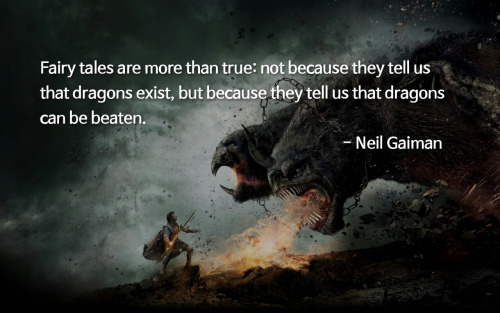
Fairy tales are more than true: not because they tell us that dragons exist, but because they tell us dragons can be beaten. - Neal Gaiman.
Fairy tales are more than true: not because they tell us that dragons exist, but because they tell us dragons can be beaten. – Neal Gaiman. (click to embiggen)
A couple months ago I had to read a bunch of “stories” which were actually just sermons. Which was extremely ironic since the author of most of those stories (and the people who put those and similar stories onto a ballot we’ve already discussed to death) all claimed that they had taken the actions they had because they were tired of reading stories with messages1.

Over dinner last night, my husband pointed out2 that C.S. Lewis, even when writing stories that were meant to be Biblical allegory, remembered that the stories had to be stories first: fully-rounded characters that you care about facing obstacles that seem insurmountable which they overcome through their own actions. And that made me realize that even Lewis’s Christian apologetic novel, The Screwtape Letters was less preachy than some of the other stories we were discussing—because even while discoursing on the nature of human imperfection in the form of letters from a senior demon to his nephew (who is a Junior Tempter), Lewis created a demon who was, as a character, sympathetic and relatable.

I’ve written about this before, during which I quoted (and disagreed with) a Christian filmmaker’s argument that all fiction has a message. The same argument has been being repeated by a lot of people in the discussions specifically about sci fi/fantasy writing, with a new variant: maybe none of us (of any political opinion) notice the messages we agree with because we are so passionate about the things we believe.

I think this is just as wrong as the earlier version. All fiction tells stories, yes, and those stories will embody the values of the author in many ways. I’ve given the example that part of my fundamental temperament is a refusal to accept a no-win situation4, and therefore even when I write grim stories with unhappy endings5, there winds up being at least some hint of a glimmer of hope somewhere in the tone of the story.

But the C.S. Lewis example belies that notion that all fiction is message fic. Yes, some people find the allegory of the Narnia books not to their liking, but I haven’t met anyone who’s read them who can’t explain the plot. Yet, I read scores of reviews of “Parliament of Beast and Birds” earlier this summer (by some very smart people) who couldn’t find a plot6.

So I remain firm in believing that if your story is a message, you’re dong it wrong. That isn’t how you make good art.

I agree that messages are to be found in stories. But they ought to be more like that one alluded to in the Neal Gaiman quote, “Fairy tales are more than true: not because they tell us that dragons exist, but because they tell us dragons can be beaten.” They are meanings that can be inferred by the reader. They are meanings that different readers will interpret in different ways. The interpretations of some readers can contradict the interpretations of other readers and can contradict the interpretation of the author.

Some readers will come away from the story knowing that dragons can be beaten. Others will come away convinced that wizards always find loopholes. Others will say that kings always find ways to take credit for other people’s work. Others may say the message is never to underestimate the damsel. And some, of course, will say the message is humans would rather kill an endangered species than learn how to live with them.

If the story is art, if the storyteller has done their job, the world of the story should be vivid enough and rich enough for readers to find and see all of those sorts of things in the tale. Which is what you want. You want the reader to be transported into a world that they will experience and interpret themselves. You want the reader to share your vision, yes, but you want that vision to take on a life of its own and for the reader to find visions of their own.

That is the opposite of a sermon, whose goal is to bring a person around to thinking the “right” way. To adhere to the truth as defined by the speaker.

I want my readers to run through the imaginary world and find new things that I never dreamed of.


Footnotes:

1. Which is why many of us reviewing those stories commented along these lines: “Oh, Puppies, just because you agree with the message, it does not make the work any less message fiction.”

2. We were on the subject because he had been reading one of his favorite sci fi zine sites and had gotten pulled into the comments section of a book review, if I recall correctly3.

3. I was into my second glass of my favorite wine at my favorite restaurant, so I am probably getting the details wrong.

4. Intellectually, I know that lots of situations are no-win, but there’s always that one voice in the back of my head arguing that we should just spend a little more time and try something else…

5. And despite the fact that more than one reader has accused me of being a hopeless optimist who writes everything through rose-colored glasses, I actually have written more than a few tragedies.

6. Or figure out what the story was supposed to be about7.

7. Quick sum-up: imagine an idiot savant has read some Aesop’s Fables and then binge-read the entire Christian apocalyptic snuff-porn series, Left Behind8, and then attempts to write fanfic of it.

8. To be fair, much of the New Testament’s Book of Revelations is treated as snuff-porn by a lot of Xtians I knew growing up. One of them was me. It was my grandfather who pointed out to me that I was spending all my time and energy focusing on the end of the word, when god put us here to build each other up and make the world a better place.

So many books, so little time…

CI6ah4DW8AA49iBIt used to be that I had a rough measure of how busy I’d been by looking at the pile of books beside the bed. For most of my life, going back well into childhood, there has always been a pile of books beside my bed. These are books that I intend to read soon. Sometimes the ones on top are books I am in the middle of reading. I am almost always in the middle of reading several books at the same time, which complicates things. The pile shrinks as I finish books (or, occasionally, as I get far enough into a book to realize that no, I don’t want to finish this one). And it grows whenever I go to a bookstore, or a convention, or browse piles of free books, or… well, you get the picture.

Certain things about the pile have changed over the years, of course. When I was middle school aged, for instance, much of the pile was made up of library books. The pile changed out a lot quicker, back then, as well. I went through a period of a couple of years where I read at least one entire novel nearly every day. So I would take books back to the library every few days and bring home more. In high school my pace slowed down a little bit, and a much larger proportion of the pile was paperback books, usually picked up at one of the used book stores. I did a lot of trading books back in to buy more back then. I also borrowed a lot of books from friends (and loaned a bunch).

I’d also been a member of the science fiction book club for a long time. I got suckered into it when I was about 13 years old. I say suckered mostly because I didn’t really have a concept of just how difficult it was to remember to mail back in the little card that said, “No, I don’t want the automatic selection this month.” Which I had to do most of the time if for no other reason that, as a kid, I didn’t have the money to pay for the book and the shipping. I did acquire about a shelf worth of books that way, though.

But most recently the pile by the bed has become a lot more static than it used to be. Mainly because I don’t read hardcopy books nearly as much. Most of my reading is ebooks, switching between reading on my phone or iPad. The apps do a decent job of keeping track of where I left off on the other device when I switch. It’s just so much easier, when I find myself stuck in line at the bank, let’s say, to pull out the phone and open either iBooks or the Kindle app.

It didn’t happen all at once. My gateway drug, as it were, to non-paper books was the audio book—for which I usually blame my husband. He loves to listen to audiobooks, mostly sci fi and fantasy, while he plays video games. Usually listening over the stereo in the computer room. Except in the summer, because the fans make it a little hard to hear clearly, so then he switches to headphones.

I don’t know how many times I went into the computer room to do something that should have taken 5 minutes or less, only to wind up sitting in there for a half hour or more listening to the book he was listening to. Of course, often if it was a book that we also owned in hardcopy, I’d head into the other room, find the paper book, and sit down to finish it off; because of course I can read it myself much faster than the reader can read it aloud.

Though I have to admit that the real culprits are a pair of Jims. James Marsters and Jim Butcher, to be exact. But they had some accomplices.

I was in my late thirties when, somehow, I deluded myself into the idea that signing up for a book club would be a good idea, again, so I was a member of the science fiction book club, again. At least by then you could do your ordering and/or declining to order on-line, so the number of times I got books I didn’t mean to was a lot lower. I’d been mostly declining, only buying a few books a year for quite some time. I bought my first Dresden Files books because I’d had a few friends recommend the books, (generally by expressing shock when we were discussing the short-lived TV series when they found out I’d never read the books). In early late 2007 or early 2008 the book club had a deal on a four-volume set that contained the first eight books in the series. So I bought them, and then they sat in the pile by the bed for a few months. After being laid-off from the place I’d worked at for more than 20 years, one night when I was between contract jobs, I picked up the first volume and started reading. I stayed up all night reading through the first two books. Over the course of the next week or so I read through the rest of the series.

While chatting about the series with another friend, she expressed surprise, given what a big fan I was of the character of Spike from Buffy the Vampire Slayer and Angel the Series, that I’d never gotten the Dresden audio books. “I can have Spike read bedtime stories to me?” I asked, in disbelief. The original distributor of the audiobooks even offered a free download of the first four or five chapters of the first book!

One of the first purchases I made once I landed a job as a “regular employee,” was the audio version of the first Dresden book. Which began my pattern of reading the paper copy of the book first, then buying the audiobook and listening to it again and again…

I have noticed lately that my book buying habits have made another change. There are books I still buy in hardcopy. I am easily lured into used book booths at conventions, for instance, and almost always buy something. But generally speaking, I get annoyed for new books if I can’t find an e-book version. In the last year or so, there are books that I’ve just decided not to get because they are only available in hardcopy. If I really like a book once I’ve read it digitally, I may well buy a paper copy to cuddle up with for re-reads, but the e-book has become my preferred format.

I don’t think that’s necessarily a good or bad thing. Though given how much energy we’ve spent, over the years, trying to keep the book shelves in order, occasionally going through the lot and pulling out books we know we’ll never look at again to give away or attempt to sell, I have to admit that letting books pile up on the computer is a whole lot less work.

But it’s also the convenience of always having a whole bunch of books in my pocket that wins the day. So the pile by the bed changes much more slowly, now. I don’t think it will ever go away entirely, but it is no longer an indicator of how much reading I’ve been doing.

Invisible? Refusing to see what’s already there…

Kissing otters
Ah, love!
I was having a discussion about a movie with some friends on line, and two of us were commenting upon the possible romantic relationships between some of the characters. Because one of the pairs under consideration were two male characters who had not explicitly been portrayed as non-heterosexual, another friend in the conversation commented that he never understood why people do that.

At the time, I decided to keep the conversation light, and simply said that we saw it because it was obvious. The real answer is a lot more complicated and serious than that. I didn’t feel up to explaining the unconscious homophobia underlyng the very question, and sometimes, frankly, I’m just tired of being disappointed in people.

But the problem persists, far beyond the people involved in that conversation. And yes, it is a problem, a very real and serious problem. What is the problem, you ask? Some people say the problem is invisibility or cluelessness, but…

In this way the writer can present his cowardice, laziness, and lack of imagination, as artistic integrity. “I couldn’t write gay characters; I didn’t have any.” Hand-to-forehead; the tortured auteur.
—Andrew Wheeler, writing for Comics Alliance

It’s actually about erasure and willful blindness. As I’ll explain further…

Continue reading Invisible? Refusing to see what’s already there…

What is art? I know what I like…

Sometimes it feels as if my whole life consists of defending why I like something. When I was a kid, I was frequently called up to justify why I preferred reading books to playing with other kids my age. Even the notion that reading was educational wasn’t enough to satisfy some people (many of them teachers). And heaven forfend that I should mention how many times “playing” with kids my age actually meant being bullied, harassed, and ridiculed non-stop! As I got older, the kind of books I liked became the issue. “Reading too much make-believe is unhealthy!1” or “Aren’t you a little old to believe in all the space hooey?2

My copy looked a lot like this one.
My copy of Bleak House looked a lot like this one.
Of course, it wasn’t just the science fiction and fantasy that set people off. If I was caught reading a book about science fact, or the hardcover of Charles Dickens’ Bleak House my grandma bought me at a library sale, or my well-worn paperback of Homer’s The Iliad, it was more proof that I was an “over-educated freak4.”

When I finally escaped to college and met people who valued reading over sports, I thought that I had left all of that behind. Oh, how naive I was! According to these literati wannabes, my tastes were quite low brow. How could I possible understand the meaning of serious art and literature if I actually enjoyed Hitchhiker’s Guide to the Galaxy or The White Dragon or Harpist in the Wind or Midnight at the Well of Souls? Or even worse, I watched television!?

It’s easy to dismiss those latter examples as either snobbery or hipster-ism. Except I can be just as guilty of judging other people for liking things that I don’t.

Who am I kidding? I have been incredibly worse about this. When I think a particular book or series or movie or what-have-you is not just unlikeable, but very badly made, it will completely boggle my mind when someone I know actually likes it. And I seem to be absolutely incapable of hiding my incredulity. I frequently have to remind myself that sometimes what I think of as one of a particular work’s mediocre-but-not-awful parts might be someone else’s fiction kink. And by fiction kink I mean, it’s something they like or identify with so much that it can be a redeeming quality. Such a redeeming quality makes the parts some of us see as glaring shortcomings, merely a small price to pay to get the other thing.

Goodness knows I have my own favorite books, series, and movies that I know are flawed, but I enjoy them anyway because they contain a particular character dynamic, or a type of plot line, or use a particular combination of mythic tropes which appeal to me. I try to make the distinction between something that I don’t like for reasons of taste as opposed to something I don’t like for reasons of actual quality. It is a subjective judgement, but not an impossible one.

I got tired of finding myself having to defend my preferred reading material. Eventually, I was saved by Leo Tolstoy. Tolstoy, the Russian author of such great classic novels as War and Peace and Anna Karenina. I have to confess that I tried to read War and Peace at least a couple of times, and just failed to plough all the way through it. And failing to get through it was one of the things that made me wonder if those people who said my tastes were too low brow to understand great works of art were correct. But then, when a similar sort of discussion happened in one of my college literature classes, the instructor5 quoted a bit from Tolstoy’s nonfiction book, What is Art? I think it was this passage:

The assertion that art may be good art and at the same time incomprehensible to a great number of people is extremely unjust, and its consequences are ruinous to art itself…it is the same as saying some kind of food is good but most people can’t eat it.
—Leo Tolstoy

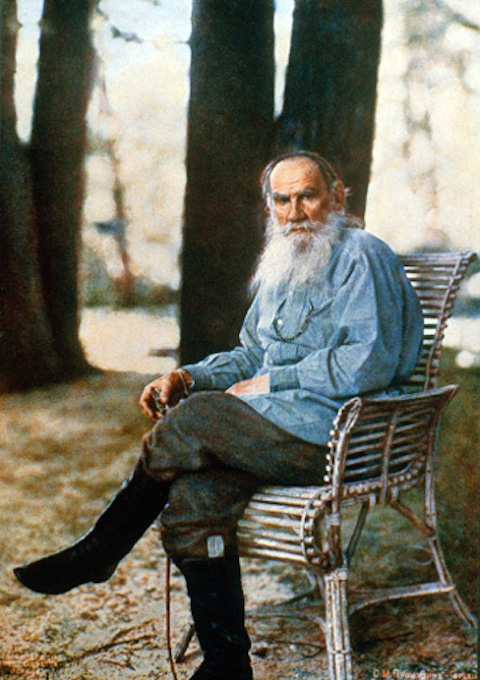
A portrait photograph of Tolstoy taken in 1908 by  Sergei Prokudin-Gorsky, who had invented one of the early methods of color photography.
A portrait photograph of Tolstoy taken in 1908 by Sergei Prokudin-Gorsky, who had invented one of the early methods of color photography.
Not long after that, I found a copy of the book in the library, which I wound up checking out and reading. There are a lot of Tolstoy’s arguments in the book which I don’t agree with. He had adopted, by the time he wrote it, a rather radical form of Christian anarchy. So he critiqued a lot of specific examples of art as being immoral in content—more often because he thought it promoted capitalism and classism than the sorts of things that get the modern religious right up in arms. He dissed Shakespeare and Dickens, for instance (though with a lot of caveats in Dickens’ case, since much of Dickens’ later work was critical of the dehumanizing effects of the industrial revolution).

Despite those parts of his thesis with which I still disagree, his arguments in favor of accessibility and sincerity in art helped me figure out that those literati wannabes had mistaken obscurity for superiority. They’ve fallen victim to the notion that if “ordinary” people enjoy something, it cannot possibly be high quality. If you define art by its difficulty to be comprehended, you’ve completely misunderstood what art is. That doesn’t mean that art can’t be challenging, but there is a difference between a piece that requires thought, afterthought, and re-visiting to tease out all the layers of meaning and something which hides its meaninglessness under layers of pretension.

Art is a human activity consisting in this, that one man consciously, by means of certain external signs, hands on to others feelings he has lived through, and that other people are infected by these feelings and also experience them.
—Leo Tolstoy

The way I usually try to sum up Tolstoy’s notion is: Art happens when the heart of the artist touches the heart of the audience, and the audience responds. The audience doesn’t have to like it; a piece of art that evokes intense dislike must be doing something right, or you wouldn’t feel so strongly about it. But art should never leave you unmoved.


Footnotes

1. The exact words said both to me (and later to my parents at a parent-teacher conference) by my seventh grade social studies teacher. He was not that only one who said things to that general effect.

2. The exact words said to me by a minister3 of another church who caught me reading during afternoon free time on a rainy day at Bible camp. Again, he was not the only person by any means to make similar comments about my penchant for both science fiction and science fact, particularly NASA.

3. Of course, this was the same preacher who thought it was funny, when teasing or disagreeing with a boy (he never would do such a thing to a girl, oh no!), to grab your pinkie, twist it into a stress position, and keep you there not only until you agreed with whatever he was trying to make you say, but that you cried sufficiently that he thought you had learned your lesson.

4. The favorite phrase one of my uncles like to use to describe me.

5. Several instructors quoted Tolstoy at me around this time. Another literature profession quoted the famous line, “All happy families are alike; each unhappy family is unhappy in its own way” but he completely misunderstood it. On the other hand, one of my mathematics professors quoted the exact same line, and then explained how the line was the perfect example of an important statistics concept. The concept is sometimes referred to as the Anna Karenina principle in honor of the Tolstoy novel from which the line comes. One way to think of the principle is this: in any system, there are a large number of ways that a given process can fail, and the only way to achieve success is to avoid every single possible failure. A successful outcome depends on every single requirement being met, whereas a single shortcoming in only one requirement can cause failure of the entire endeavor.

Authorial i/n/t/e/n/t/ consent

consent1I find myself reading about consent a lot. Having grown up in a culture which socializes guys not to take “no” for an answer, while socializing girls not to make trouble and always put other people’s wants and comforts first, it’s no wonder a lot of people don’t seem to understand consent in that context. Then there’s the whole Harper Lee and her “new” book situation. Is she healthy and aware enough to give informed consent? Does she actually know what’s going on, or is she a victim of the younger lawyers from who sister’s old firm who have taken over her estate now that her sister has died?

When I had read that her home state had initiated an investigation because of the reports of coercion, and that the state had determined that she had given her consent freely, I was mollified. I also rationalized it by comparing it to volumes I own of posthumously published material from Arthur Conan Doyle and from J.R.R. Tolkien. Those early drafts (heavily annotated by experts) and small one-offs originally created for a limited audience are fascinating and very educational, particularly from a writers’ point of view. If I can own those and enjoy them, do I have a right to condemn anyone who purchases this “new” book?

Of course, there is a difference. Tolkien and Conan Doyle have been dead for decades, these things have the notes and commentary making it clear that they are drafts or incomplete works. They aren’t being represented as something the author thought was a finished product. They’re clearly an exercise is the academic study of the work of those writers, and intended to illuminate the other works of the author.

But now I read that the investigation that looked into Harper Lee’s case did not include any medical personnel. No part of the investigation seemed to focus on whether she still possesses the capacity to give informed consent. That changes things a lot.

I do like one local book reviewers’ take on it: he read the new book, says the first chapter is amazing and you can understand why instead of outright rejecting it, the editor asked her to write a different story without the flashbacks to the narrator’s childhood, but rather to tell a story about the protagonist as a child. And then as you get into the rest of the book, the fact that this is a first draft of a first novel by a novice author is clear. And, he says, you can see why, with the help of an agent and the editor, it took her about a dozen rewrites of that second version of the book to arrive at To Kill A Mockingbird.

His conclusion: don’t buy the new book, “it’s a trap!” Instead, he advises you to read (or re-read) To Kill A Mockingbird. You can read all of his reasons why here: When Was the Last Time You Read To Kill a Mockingbird? Do You Remember How Funny It Is?

One other reason: there is absolutely no doubt that at the time Lee wrote To Kill A Mockingbird that she thought it was complete, that she was ready for it to publish, and that she knew what she was doing.

It’s also, if my very vague memories of reading it in my early teens, a very good book. Which I intend to re-read soon!

Hugo Ballot Reviews: Novelette

The 2004 Hugo Award Trophy (given out at Noreascon 4, the fourth Worldcon held in Boston), base designed by Scott Lefton.
When I started on this journey of reading the Hugo nominated stories before casting my ballot, I had a rather noble notion that I would read everything with an open mind, and not necessarily make a blanket No Award vote for anything that had made it onto the ballot due to the bloc-voting scheme of the Sad Puppies and Rabid Puppies. The short story category was disappointing, to say the least, but I remained determined to soldier on, in hopes of posting maybe a category a week.

I don’t want to give anything away, but one reason it’s been a few weeks since I posted any more reviews was because the next categories were at least as difficult to slough through…
Continue reading Hugo Ballot Reviews: Novelette