Tag Archives: marriage equality

Anniversaries, or, what we remember

I mentioned earlier that Michael used to say that he considered NorWesCon our anniversary, because he was even worse about forgetting the date of our first date (which is one of the dates I tried to remember as an anniversary) than I am, and neither of us could ever remember the date of our commitment ceremony without digging out the paperwork for our domestic partnership registration.

To be fair, we made it a very small thing we tacked onto another get-together with friends. So it wasn’t like an event planned for months ahead or anything. We needed to file domestic partnership paperwork to get us both on the same health insurance, so we did it and that was that. Just a few months afterward I had already started forgetting what the date was. It just never stuck.

I have not had the issue at all with remembering our wedding day…

Continue reading Anniversaries, or, what we remember

Connections, rainbow or otherwise

I’ve spent some time this morning crying at weddings more than a thousand miles away. I’ll likely spend a lot of time this weekend doing that. A federal judge ruled yesterday that Michigan’s ban on same-sex marriage is unconstitutional (given all the other rulings that isn’t much of a surprise).

Detroit Free Press and WoodTV.com
Couples getting married in Michigan today.
He refused to issue a stay on the ruling, pointing to the evidence presented in the trial that denying the marriages causes harm to the thousands of Michigan children already being raised by same sex couples. This is different than other such rulings, or the situation in Utah where the state simply didn’t think to ask for a stay until the weddings had started.

The Court finds Sankaran’s testimony to be fully credible and gives it great weight. He testified convincingly that children being raised by same-sex couples have only one legal parent and are at risk of being placed in “legal limbo” if that parent dies or is incapacitated. Denying same-sex couples the ability to marry therefore has a manifestly harmful and destabilizing effecton such couples’ children.

The clerks in four counties, so far, have opened their offices on the weekend, to give out “no waiting period” marriage licenses. State and county officials have come in to work on their own time to facilitate the weddings. Judges, ministers, and other people legally authorized to perform the ceremonies have also come in to perform them. Ordinary citizens, some of them friends and families of the couples, but others just people who believe in equality, have come in to help, to congratulate, to cheer.

Couples who have been together over 50 years have been among the people married this morning.

My favorite part of this judge’s ruling (in his findings of fact—that will be very important during the appeals process), is his total evisceration of the notorious Regnerus study:

“The Court finds Regnerus’s testimony entirely unbelievable and not worthy of serious consideration. The evidence adduced at trial demonstrated that his 2012 ‘study’ was hastily concocted at the behest of a third-party funder, which found it ‘essential that the necessary data be gathered to settle the question in the forum of public debate about what kinds of family arrangement are best for society’ and which ‘was confident that the traditional understanding of marriage will be vindicated by this study.’ While Regnerus maintained that the funding source did not affect his impartiality as a researcher, the Court finds this testimony unbelievable. The funder clearly wanted a certain result, and Regnerus obliged. Whatever Regnerus may have found in this ‘study,’ he certainly cannot purport to have undertaken a scholarly research effort to compare the outcomes of children raised by same-sex couples with those of children raised by heterosexual couples. It is no wonder that the NFSS has been widely and severely criticized by other scholars, and that Regnerus’s own sociology department at the University of Texas has distanced itself from the NFSS in particular and Dr. Regnerus’s views in general.”

(You can read Judge Bernard Friedman’s entire ruling here.)

@SteveFriess
A little girl with rainbow star stickers at a courthouse in Michigan with morning. (Photo by Steve Friess)
In case you are unfamiliar, Regenerus compared a few hundred children whose parents had divorced, and in which the non-custodial parent later came out as gay or lesbian, to a control group of children raised by parents who never divorced. Not surprisingly, the children whose early childhoods were disrupted by a divorce tended to have trouble in school and show the other typical problems that have been documented many time before when families experience “household instability and parental relationship fluctuation.” Regenerus then claimed that this proved that children raised by same-sex parents have worse outcomes than children raised by opposite-sex parents.

Except that this doesn’t show that, because none of the children in that group were actually raised by a pair of same-sex parents. None.

It is true that his study also included two children whose parents divorced and the custodial parent came out as lesbian. Those two children did spend part of their childhood being raised by their mother and her same sex partner. Regenerus was forced to admit under oath that these two children did better than average in school, and otherwise had “better outcomes” in all the areas he measured than the others.

So, the only children in his ‘study’ who actually were raised by a same sex couple were success stories, rather than the horror story he has claimed.

So far, every state that is defending bans against marriage equality has cited the Regenerus study, despite its having been debunked many times before this. As far as I can tell, this is the first time that a court has specifically gone into the reasons that they have not been persuaded by the study.

@SteveFriess
“The Washtenaw county clerk @kestenbaum hands out xeroxes of the 14th amendment, equal protection.”
Freelance journalist (and former POLITICO writer, and now an instructor at Michigan State University) Steve Friess has been at a courthouse in Ann Arbor covering the story all day. He posted a link to his dropbox folder containing photos he’s been taking all day, which he is offering free with attribution. But I think my favorite is one he tweeted earlier: a print-out of the 14th Amendment one of the county clerks is handing out, reminding us that this has nothing to do the activist judges, and everything to do with enforcing the constitution.

I’m going to go look at more wedding pictures. Pass me another box of kleenex.


Update: Alas, the Sixth Circuit Appeals Court has issue a stay at least until Wednesday, when they will hear arguments as to whether the stay should be permanent until the Appeals Court rules on the original case. It’s disappointing, though not entirely unexpected. I do have to re-ask the question of just what the attorney general requesting this stay hopes to accomplish? He can’t be so delusional as to think the the whole country is going to reverse course on this sometime soon, can he?

In the place where you are

They said...
They said…
A friend shared this article on Facebook: Same-sex Couples Shatter Marriage Records In Utah. It is incredible, when you think about it: in just a few days of marriage equality, Utah has had almost as many same-sex weddings as the state of Maine did in the entire year since voters there approved marriage equality. Another friend commented on the irony that there seemed to be more gay couples in the states where they are least respected. This kicked off some pondering as to whether there are more LGBT people there than other places, or does it just seem that way.

Of course, I have a few theories about this… Continue reading In the place where you are

“The decision to marry is a fundamental right”

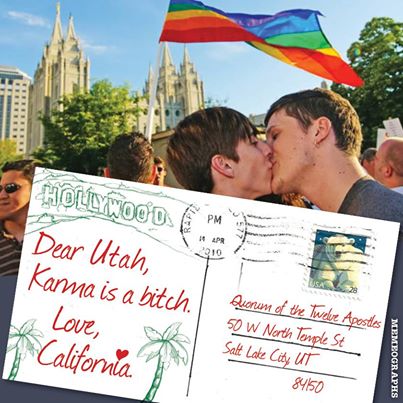
Marriage equality comes to Utah.
After pouring tens of millions into the Prop 8 campaign in California, organizing phone banks, and so on…
The decision in federal court declaring the Utah state constitution’s ban on same sex marriage a violation of the U.S. Constitution set off a cacophony of hysteria in conservative circles. Numerous op-ed pieces in conservative blogs and publications made the outraged assertion that the “activist judge” had “fabricated a constitutional right to marry.”

The problem is that it isn’t fabricated. Since as far back as the year 1888, the U.S. Supreme Court has repeatedly declared that the right to marry is a fundamental human right. In the 1888 case the court declared it “the most important relation in life.” In 1923 they declared it one of the fundamental rights protected by the Due Process Clause. In 1942 they declared marriage one of the most basic and fundamental civil rights covered under the Equal Protection Clause. In 1965 they declared the right to marry and make decisions about having a family as part of a fundamental right of privacy that was older than the constitution, that the right to privacy was implied by several parts of the Bill of Rights, most strongly in the Ninth and Fourteenth amendments.

Most famously in 1967, in the case that struck down the few remaining laws against interracial marriage, the court unanimously ruled that “The freedom to marry has long been recognized as one of the vital personal rights essential to the orderly pursuit of happiness by free men.”

In 1974 the court declared “This Court has long recognized that freedom of personal choice in matters of marriage and family life is one of the liberties protected by the Due Process Clause” when it struck down laws that prohibited pregnant women from working as teachers.

In 1977 in a couple of cases involving laws about who was allowed to live together, the court declared that the choice of who to live with, who to marry, and who to raise children with were fundamental rights which the government could not interfere in without justification that would pass careful judicial review.

In 1978 the court found that “the right to marry is of fundamental importance for all individuals” in the course of declaring that a state must show that any law restricting the right furthers an important government interest in a way that is substantially related to that interest.

In 1987 the court reaffirmed that “the decision to marry is a fundamental right” and that it was so fundamental that even the most violent and dangerous of convicted criminals must be allowed to marry even while they were in prison regardless of whether they would ever be allowed to consumate such marriages.

In 1992 the court included marriage and the choice of whether and who to raise children with as “central to personal dignity and autonomy” and “central to the liberty protected by the Fourteenth Amendment.”

In 1996 the court held that “choices about marriage, family life, and the upbringing of children are among associational rights this Court has ranked as ‘of basic importance in our society,’ rights sheltered by the Fourteenth Amendment against the State’s unwarranted usurpation, disregard, or disrespect.”

Most tellingly, in 2003 when striking down state sodomy laws, the court held that “our laws and tradition afford constitutional protection to personal decisions relating to marriage, procreation, contraception, family relationships, and education. … Persons in a homosexual relationship may seek autonomy for these purposes, just as heterosexual persons do.”

That last one certainly seems to imply that gay couples ought to be able to get married, if they wish. And it was the ruling that set off the flurry of state ballot measures in 2004 to place gay marriage bans into several state constitutions, including Utah’s. These bans were not spontaneous statements from the people about individual rights. They were, in fact, a carefully orchestrated strategy by extremely cynical persons in the Republican party. The primary goal was to drive conservative leaning voters to the polls in order to re-elect George W. Bush.

And calling it “extremely cynical” is putting it mildly. The guy whose idea it was, then-chairman of the Republican National Committee, was a closeted gay man, who has since tried to rehabilitate his image by becoming a pro-marriage equality advocate (personally, I believe he needs to apologize to the parents of every single gay kid who committed suicide or attempted suicide during the years he was active as a Republican politician, and then he should go be a religious hermit somewhere).

But I digress…

The bottom line is, it is settled law, going back 125 years, that the Constitution protects the right to marry and to choose who to marry. It isn’t a new idea, or a radical fabrication. Just as some of the people who agreed the marriage was a basic right used to also think that the word “marriage” only applied when people belonged to the same church, and some who agreed it was a basic right thought the word only applied when both people were members of the same ethnic group, there are people who believe that you should have to right to marry, but only if the two people involved are opposite gender.

Despite the sincerely held beliefs of a minority of people (and it is now a minority of U.S. citizens) that people of the same sex should not be allowed to marry, those people have failed, again and again and again, to show a single logical or verifiable reason that that should be the case. Even Supreme Court Justice Antonin Scalia, who opposes same sex marriage with a passion that borders on the disturbing, has admitted that the only reason to bar it is because some folks believe it is wrong.

And just because some people think some other people are icky is not a compelling or even substantial reason to deny them basic rights.

I now pronounce you…

Same-sex couples wait in long lines to wed in Salt Lake City.
I’ve been expecting the New Mexico ruling. They already had a number of individual counties issuing licenses to same sex couples, and the state didn’t have a specific same-sex ban (unlike other states). There were a number of different laws related to marriage that included gender-specific clauses, but it seemed fairly obvious the state supreme court would rule in favor of equality. So, when the court issued its unanimous ruling on Thursday, it was worth cheering, but it wasn’t a shocker.

Utah on Friday was a big shock. Especially to me, since part of my childhood was spent in one of the most religiously conservative counties in that state… Continue reading I now pronounce you…

Anniversary

Michael is the handsome devil on the right.
So, 365 days ago the sweetest, most capable, most patient, and most astonishingly funny man married me.

I really don’t quite understand what he sees in me. Whenever I ask him why he puts up with me, he just counters with asking why I put up with him. Which makes no sense at all, because I can be annoying and exasperating.

Continue reading Anniversary

16 and counting…

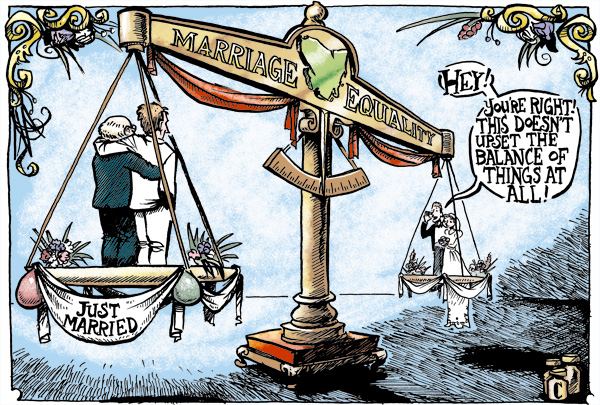
Cartoon showing the equality doesn't unbalance anything.
Freedom to marry doesn’t hurt anyone.
So, the Hawaii legislature has passed marriage equality, setting the Aloha state to be the 16th that will allow all citizens, gay and straight, say “I do” to love and commitment.

It has been an extraordinary year. Think about it, just 18 months ago, the citizens of North Carolina, a state that already had a law banning marriage between same-sex couple, approved an amendment to their state constitution prohibiting the state from performing or recognizing either same-sex marriages or civil unions. Then, 12 months ago, on election night, the voters in Maine, Maryland, and Washington state all approved measures in favor of same-sex marriage (and the voters of Minnesota rejected an attempt to amend their constitution to prevent the marriages). That brought the number of states recognizing marriage equality to ten. And it was as if the floodgates had opened…

Continue reading 16 and counting…

Try to stop me!

Lynx running across snow.
Running lynx by Daniel J. Cox (www.wildthingsultd.org)
When I got the first email responding to my post earlier in the week about a weird search term that had been used to find my site, I figured I had just phrased something weird.

The person specifically referenced the post and said they hoped I would keep writing. I hadn’t intended to say anything that indicated I was considering not posting, but I know that sometimes when I’m writing a post in a hurry that I phrase things weird. Even when I’m not in a rush, I make odd typos (the words I type are correctly spelled, but they are the wrong word, usually a related word, but wrong), which can also lead to misunderstanding.

So I re-read the post, and read it again, and couldn’t find anything weird.

Then I got a second email from a different person, with the same sentiment…

Continue reading Try to stop me!

Rejoice, spouse and spouse

I had a post about other things scheduled for today, but then I got caught up watching the live feed from city hall in Minneapolis, where same sex marriage became legal today. And I think it would be better if we all just rejoiced with these couples:

Photo gallery: Gays marry in Minnesota

Photo gallery: Weddings at Como Conservatory in St. Paul

Gay couples rush to wed as Minnesota, Rhode Island legalize same-sex marriage

I think my favorite from the live blogs is the tweet from sometime in the early morning from a person watching at City Hall: “I’ve got this down: cheer, clap, cry, repeat.”

Why marriage matters

Bill was a medical laboratory technician. Scott was an architect.

Bill said he was walking with friends one night on their way to have drinks when he saw a really sexy guy on a motorcycle waiting for the light to change. A bit later they saw the motorcycle parked in front of a bar. It wasn’t the one they were heading toward, but Bill wanted to meet the guy on the ‘cycle, so he convinced his friends to go in. Bill found Scott inside, tried to strike up a conversation. Scott didn’t seem interested, but wasn’t completely unfriendly, either. Eventually another guy that Scott had been waiting for arrived, and it seemed obvious that they were together. Bill’s friends didn’t want to stick around, so he and his friends went to the place they had originally been headed to.

Hours later, Bill was still with the friends at the other bar when suddenly a voice asked if he could buy Bill a drink.

Scott had heard Bill’s friends say where they were going, and once he had concluded some unfinished business with his ex, had come looking for him.

Less than a year later they were living together. They bought a house together. Scott’s family all lived in or near the city, and over time came to accept Bill into the family. Years later, Bill’s still got teary-eyed telling about the first time Scott’s brother’s daughter called him Uncle Bill. “This was the 70s,” he explained. “It was far more common for families to refuse to even meet your brother’s gay lover.”

The house they’d bought was something of a fixer-upper. They worked on it together for years. Even with Scott’s connections in the real estate industry, they hadn’t been able to get a bank to give them a mortgage in both their names. Scott had insisted, then, on drawing up a contract so that the money Bill put into a special account they had set up for house expenses would be recorded as equity in the house. Scott had also insisted on drawing up wills. “He didn’t like to leave things to chance,” Bill told me.

One day at work, Bill got a phone call from one of Scott’s co-workers. Scott had been in some kind of highway accident. Bill hurried to the emergency room. Arriving at about the same time as Scott’s mother.

It was too late. Scott had been pronounced dead on arrival.

Over the next few days, Bill was busy with funeral arrangements. It was all a bit of a blur, of course. All those tedious details seem unimportant in the face of the enormous sense of loss.

“I should have known something was up from the way Scott’s father and brother were acting,” Bill said. “I didn’t really notice until the wake, when I noticed they were both absent.”

When Bill arrived home after the funeral and wake, he found the father and brother along with a lawyer. They had a court order, barring Bill from removing any property from the house until an inventory had been completed by a court appointed agent. Scott’s father was contesting the will, on the grounds that Bill had coerced him into signing it.

Bill couldn’t afford to put up much of a legal fight. The will was thrown out, though the equity contract was not. I don’t know all the the legal details, but the upshot was that Bill had to move out, and was only allowed to take items that he could prove he had paid for himself. The family did have to pay him the equity, thanks to one of the precautions that Scott had set up, but they seized nearly every piece of furniture and nearly every personal item in the house.

Bill wasn’t allowed to take even any book, photograph, or paper that he could not show was his personal property. Because the mortgage was in Scott’s name, the presumption was that the house and all property within was Scott’s. Bill, as far as the law was concerned, was just a roommate. “At one point,” Bill said, “I thought I was going to have to produce receipts for my own underwear. As it was, more than half of my own family photos went to them, because I got tired of arguing over every page in every photo album.”

As part of the equity settlement, he was also forced to sign an agreement he would never try to contact any of Scott’s family members again. Even though at that point Bill really needed the money, he balked at that, until Scott’s brother informed him that if he didn’t, the brother was going to say to the police that he overheard Bill making lewd comments to one of the nepews. It was a lie, but as the brother said, “Who do you think they’ll believe?”

Some time after the last legal document had been filed, Bill received an unmarked envelope in the mail. Inside were some polaroid photographs. Someone had piled all of Scott’s sketchbooks from his years of art classes and beyond, made a bonfire, the took pictures of the fire. “Of course they took all his sketchbooks, and of course they burned them. Half of Scott’s sketches were of men.”

Even when there is a will that specifically names one’s unmarried partner, the law stil considers said partner a stranger, for legal purposes. Blood relatives can contest wills on all sorts of grounds, and any non-relative has a disadvantage in regards to burden of proof.

Marriage, as opposed to civil unions or any other arrangement, changes that. In both formal law and common law principles, a spouse is not just counted as a blood relative, but is automatically the nearest relative. If other family members contest a will, it is considered an intra-familial dispute, and the burden of proof switches.

Yes, Scott died in the early 80s. This may lead you to think that in our more enlightened times this sort of thing can’t happen.

You’d be wrong. There’s the case of the two young men who had been together for several years, until one died in an accident just last year. His family were able to legally prevent his surviving partner from even getting a look at the full police report about how the young man died. The surviving partner was told not to try to attend the funeral, or else.

Or two older men, both retired, had been living together for decades. They’d had a ceremony together years ago and exchanged rings, but their state doesn’t even recognize civil unions. One of the men, as his health has deteriorated with age, began to exhibit dementia. His sister had herself appointed guardian and kicked the other partner out. When the story broke just a few months ago, the partner who had been kicked out had had to sell his wedding ring to get enough money to travel to relatives of his own who would let him live with them.

There will always be people who disapprove of the people their grown children or siblings choose to share their life with. But if the law recognizes our marriages the same as it does any heterosexual couple’s, there are thousands of legal protections and safeguards available to protect us and the ones we love from such people.

Marriage is how we say, both socially, culturally, and legally, “this person is family.”

It’s a right that every adult should be able to exercise.