Tag Archives: marriage

16 and counting…

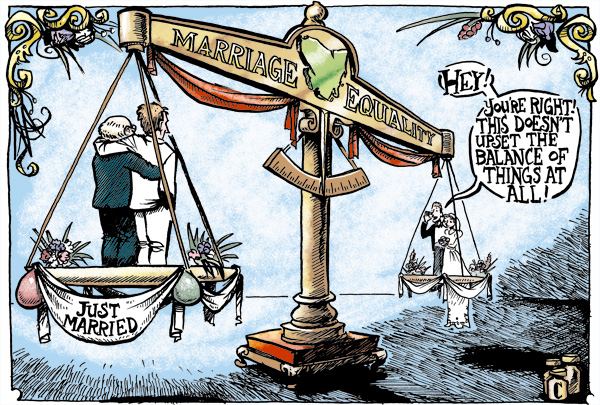
Cartoon showing the equality doesn't unbalance anything.
Freedom to marry doesn’t hurt anyone.
So, the Hawaii legislature has passed marriage equality, setting the Aloha state to be the 16th that will allow all citizens, gay and straight, say “I do” to love and commitment.

It has been an extraordinary year. Think about it, just 18 months ago, the citizens of North Carolina, a state that already had a law banning marriage between same-sex couple, approved an amendment to their state constitution prohibiting the state from performing or recognizing either same-sex marriages or civil unions. Then, 12 months ago, on election night, the voters in Maine, Maryland, and Washington state all approved measures in favor of same-sex marriage (and the voters of Minnesota rejected an attempt to amend their constitution to prevent the marriages). That brought the number of states recognizing marriage equality to ten. And it was as if the floodgates had opened…

Continue reading 16 and counting…

Try to stop me!

Lynx running across snow.
Running lynx by Daniel J. Cox (www.wildthingsultd.org)
When I got the first email responding to my post earlier in the week about a weird search term that had been used to find my site, I figured I had just phrased something weird.

The person specifically referenced the post and said they hoped I would keep writing. I hadn’t intended to say anything that indicated I was considering not posting, but I know that sometimes when I’m writing a post in a hurry that I phrase things weird. Even when I’m not in a rush, I make odd typos (the words I type are correctly spelled, but they are the wrong word, usually a related word, but wrong), which can also lead to misunderstanding.

So I re-read the post, and read it again, and couldn’t find anything weird.

Then I got a second email from a different person, with the same sentiment…

Continue reading Try to stop me!

Rejoice, spouse and spouse

I had a post about other things scheduled for today, but then I got caught up watching the live feed from city hall in Minneapolis, where same sex marriage became legal today. And I think it would be better if we all just rejoiced with these couples:

Photo gallery: Gays marry in Minnesota

Photo gallery: Weddings at Como Conservatory in St. Paul

Gay couples rush to wed as Minnesota, Rhode Island legalize same-sex marriage

I think my favorite from the live blogs is the tweet from sometime in the early morning from a person watching at City Hall: “I’ve got this down: cheer, clap, cry, repeat.”

Why marriage matters

Bill was a medical laboratory technician. Scott was an architect.

Bill said he was walking with friends one night on their way to have drinks when he saw a really sexy guy on a motorcycle waiting for the light to change. A bit later they saw the motorcycle parked in front of a bar. It wasn’t the one they were heading toward, but Bill wanted to meet the guy on the ‘cycle, so he convinced his friends to go in. Bill found Scott inside, tried to strike up a conversation. Scott didn’t seem interested, but wasn’t completely unfriendly, either. Eventually another guy that Scott had been waiting for arrived, and it seemed obvious that they were together. Bill’s friends didn’t want to stick around, so he and his friends went to the place they had originally been headed to.

Hours later, Bill was still with the friends at the other bar when suddenly a voice asked if he could buy Bill a drink.

Scott had heard Bill’s friends say where they were going, and once he had concluded some unfinished business with his ex, had come looking for him.

Less than a year later they were living together. They bought a house together. Scott’s family all lived in or near the city, and over time came to accept Bill into the family. Years later, Bill’s still got teary-eyed telling about the first time Scott’s brother’s daughter called him Uncle Bill. “This was the 70s,” he explained. “It was far more common for families to refuse to even meet your brother’s gay lover.”

The house they’d bought was something of a fixer-upper. They worked on it together for years. Even with Scott’s connections in the real estate industry, they hadn’t been able to get a bank to give them a mortgage in both their names. Scott had insisted, then, on drawing up a contract so that the money Bill put into a special account they had set up for house expenses would be recorded as equity in the house. Scott had also insisted on drawing up wills. “He didn’t like to leave things to chance,” Bill told me.

One day at work, Bill got a phone call from one of Scott’s co-workers. Scott had been in some kind of highway accident. Bill hurried to the emergency room. Arriving at about the same time as Scott’s mother.

It was too late. Scott had been pronounced dead on arrival.

Over the next few days, Bill was busy with funeral arrangements. It was all a bit of a blur, of course. All those tedious details seem unimportant in the face of the enormous sense of loss.

“I should have known something was up from the way Scott’s father and brother were acting,” Bill said. “I didn’t really notice until the wake, when I noticed they were both absent.”

When Bill arrived home after the funeral and wake, he found the father and brother along with a lawyer. They had a court order, barring Bill from removing any property from the house until an inventory had been completed by a court appointed agent. Scott’s father was contesting the will, on the grounds that Bill had coerced him into signing it.

Bill couldn’t afford to put up much of a legal fight. The will was thrown out, though the equity contract was not. I don’t know all the the legal details, but the upshot was that Bill had to move out, and was only allowed to take items that he could prove he had paid for himself. The family did have to pay him the equity, thanks to one of the precautions that Scott had set up, but they seized nearly every piece of furniture and nearly every personal item in the house.

Bill wasn’t allowed to take even any book, photograph, or paper that he could not show was his personal property. Because the mortgage was in Scott’s name, the presumption was that the house and all property within was Scott’s. Bill, as far as the law was concerned, was just a roommate. “At one point,” Bill said, “I thought I was going to have to produce receipts for my own underwear. As it was, more than half of my own family photos went to them, because I got tired of arguing over every page in every photo album.”

As part of the equity settlement, he was also forced to sign an agreement he would never try to contact any of Scott’s family members again. Even though at that point Bill really needed the money, he balked at that, until Scott’s brother informed him that if he didn’t, the brother was going to say to the police that he overheard Bill making lewd comments to one of the nepews. It was a lie, but as the brother said, “Who do you think they’ll believe?”

Some time after the last legal document had been filed, Bill received an unmarked envelope in the mail. Inside were some polaroid photographs. Someone had piled all of Scott’s sketchbooks from his years of art classes and beyond, made a bonfire, the took pictures of the fire. “Of course they took all his sketchbooks, and of course they burned them. Half of Scott’s sketches were of men.”

Even when there is a will that specifically names one’s unmarried partner, the law stil considers said partner a stranger, for legal purposes. Blood relatives can contest wills on all sorts of grounds, and any non-relative has a disadvantage in regards to burden of proof.

Marriage, as opposed to civil unions or any other arrangement, changes that. In both formal law and common law principles, a spouse is not just counted as a blood relative, but is automatically the nearest relative. If other family members contest a will, it is considered an intra-familial dispute, and the burden of proof switches.

Yes, Scott died in the early 80s. This may lead you to think that in our more enlightened times this sort of thing can’t happen.

You’d be wrong. There’s the case of the two young men who had been together for several years, until one died in an accident just last year. His family were able to legally prevent his surviving partner from even getting a look at the full police report about how the young man died. The surviving partner was told not to try to attend the funeral, or else.

Or two older men, both retired, had been living together for decades. They’d had a ceremony together years ago and exchanged rings, but their state doesn’t even recognize civil unions. One of the men, as his health has deteriorated with age, began to exhibit dementia. His sister had herself appointed guardian and kicked the other partner out. When the story broke just a few months ago, the partner who had been kicked out had had to sell his wedding ring to get enough money to travel to relatives of his own who would let him live with them.

There will always be people who disapprove of the people their grown children or siblings choose to share their life with. But if the law recognizes our marriages the same as it does any heterosexual couple’s, there are thousands of legal protections and safeguards available to protect us and the ones we love from such people.

Marriage is how we say, both socially, culturally, and legally, “this person is family.”

It’s a right that every adult should be able to exercise.
Why I love him

I love Michael because:

  • His first reaction when he hears someone is having a problem is, “How can I help?”
  • He loves to re-read his favorite books again and again.
  • He reads an astounding number of new books every year.
  • He will spend hours letting me babble about a book, a TV show, or a movie that he isn’t really interested in without complaining.
  • His smile always makes me feel happy, no matter how bad a day/week/month/year I’m having.
  • When I’m ranting and raging about something that isn’t working, or that I’ve broken, or that’s just really bothering me, he says, “Okay, honey” without any sarcasm or flippancy in his voice at all.
  • He can fix unfixable equipment.
  • He’s got the prettiest eyes.
  • He acts as if my extremely nerdy mathematics rants are interesting and important.
  • He tells me when I’ve screwed up, but always in private.
  • He doesn’t say, “I told you so” even though he has the right to dozens of times every week.
  • He kisses really well.
  • He can always find things I lose, often right away.
  • He just laughs when I point at something he can’t find that’s right in front of him.
  • He makes the most yummy chicken soup from scratch on the entire planet.
  • He finds ways to anonymously help people.
  • He doesn’t complain about my weird music.
  • When I’m going overboard with the Christmas music, which he can’t stand, he either puts on his own earphones without saying anything, or asks if I can skip to another song.
  • Even though he absolutely hates tomatoes, he helps me grow my own.
  • He has great legs.
  • He has, on way more than one occasion, when learning that someone is limping along on a dying computer, assembled a better system, installed software (sometimes going to interesting lengths to find out what sorts of software the person uses without telling why), tested everything several times, then shipped it off to the person as a surprise.
  • He looks good in a worn work shirt and heavy duty Carhartts.
  • He rocks a Victorian frock coat and top hat.
  • He’s comfortable with us both quietly working on our projects at home all night.
  • He can chop vegetables faster than the human eye can follow.
  • He laughs at my lame jokes.
  • He finds humor in nearly every situation.
  • He believes in people.
  • Even me when I am convinced I don’t deserve it.
  • When I asked, “Will you marry me?” he grinned brighter than the sun and said, “Yes.”

Six months ago today…

…the sweetest man on the planet said, “I do” when asked if he would take me as his husband.

Michael is the handsome devil on the right.
I really don’t quite understand how I got lucky enough to have him in my life. The fact that he’s stuck with me for more than 15 years now is a daily wonder.

Making a big fuss about a six month “anniversary” is a bit silly. For one thing, one of the Latin roots of anniversary means “year”—the literal definition is “returning yearly,” so the phrase “six month anniversary” is nonsensical. If you were to insist on a Latinate word for it you could call it the semi-anniversary, but then someone is going to say, “Don’t you mean semi-annular” at which point you have to explain that semi-annular refers to the shape or form of a half-ring rather than a unit of time and once you’re down that pedantic rabbit hole you might as well give up.

Marking the lesser milestones seems premature when you’re talking about a brand-new relationship, because you’re presumed to still be in the giddy state of having not really gotten to know each other, and where hormones and the novelty of newness makes one more prone to overlook any signs of incompatibility. There is also a fear of jinxing things.

Neither of those would seem to apply to us, having been together for more than 15 years. But that immediately raises the question, shouldn’t we observe the anniversary of the day we met, or our first date, or the day we moved in together, et cetera, rather than the date of this more recent formalization of the existing relationship?

I have several responses to that one.

The less obvious response is that neither of us had the foresight to make a note of the precise date of those other events. We don’t even agree on when we first met. Michael remembers meeting me at an early morning panel on a Friday at NorWesCon (NorthWest Science Fiction Convention). I don’t recall that meeting, but rather remember meeting him at a Saturday room party at the same NorWesCon. Which is why for years Michael said we should just think of NorWesCon as our anniversary. Our first go-out-for-dinner date was in February ’98, a few months after Ray died. I think it was the 7th, but I’m not completely sure. We made plans to move in together, but we were going to wait until after the anniversary of Ray’s death, because it seemed unseemly to do so before that. But a series of bizarre incidents with two of Michael’s roommates made me feel he wasn’t safe there, so we accelerated plans and what with the flurry of events that ensued, we don’t quite agree on which month the actual moving in happened, let alone which day. Our various registrations of domestic partnerships (in different jurisdictions, et al) were dictated by external legal and insurance-requirement reasons, without much planning or fanfare.

My next argument is that the vast majority of married couples have all of those significant dates, too, but the one everyone focuses is on is the date you stand up in front of witnesses and an officiant to say “I do,” even though the emotional commitment happened before that point.

And my biggest argument is that the date for which the even vaster majority of friends, family, and acquaintances of all those married couples consider “real” is the date that one became legally married. That’s when you made things official. That’s when society gave the stamp of approval (or at least recognition). If you’re required to produce proof, that’s the date which will be on the certification you can request from an appropriate agency.

For us, that date didn’t become possible until we had already been together for many years. We did it on the first day it was legal in the state we reside in for several reasons. Yes, one was because we’d been waiting for a long time, goddammit! Another was that it was a date where it was easy to get several of the people we wanted to be there, there (though given how many of them volunteered to stand in line with us at midnight when licenses were first available, if that’s when we wanted to get ours, I realize that easy wasn’t one of their requirements).

But it was also because that day, December 9, 2012, was the first day in America that same-sex couples were allowed to marry as a result of a vote of the people. Yes, three states passed marriage equality on Election Day, 2012, but by pure chance, Michael and I lived in the state of those three whose constitution gave the earliest date such a law became effective. We beat out Maine by 20 days, and Maryland by 22.

If I’d really wanted to be historical, we should have tried to be one of the couples married after midnight by the county judge who came in to do those. Admittedly, it would have been very cool to have our official marriage certificate signed by Judge Mary Yu—isn’t that the coolest name for a judge? Regardless, I’m proud that a majority of our state citizens were willing to recognize the basic humanity and fairness issues involved. Do I think it should have happened years ago? Of course we wish the culture had been less intolerant long ago. But that doesn’t mean we can’t celebrate the fact that a lot of people have reached that conclusion—so having our anniversary on the historic day lets us commemorate that event, too.

And I can’t help being a product of my culture. I grew up with everything from fairy tales, television, family, and the community at large saying that the milestone worth marking is the wedding day. Not the day you signed civil union papers. Not the day you realized that his smile was something you would go out of your way to make reappear. Not the day you first signed a lease together. Not the day you caught yourself changing a favorite recipe because he doesn’t like tomatoes. Not the night you bought a major kitchen appliance together. Not the day that you first realized that you never wanted a morning to dawn without him at your side. Not even the day you picked up your marriage license.

No, the date you’re supposed to remember, the date that matters, is the day you got married.

So, yeah, even though I’m a bit of an old man, and we’ve been together for as long as we have, I’m going to keep being a bit of a silly, giddy newlywed. I’m probably going to keep saying “Happy Anniversary” on the 9th of every month for the rest of the year. I’m going to keep getting a silly grin on my face and a tear in my eye when I realize it’s been another month since I stood there, holding flowers and trying not to cry too hard to repeat my vows.

Because six months ago today, the sweetest man in the world married me. And don’t you forget it!

Oppression Olympics

As a gay person, I am aware of (and have experienced) a certain amount of discrimination. In many situations I have been in a category that could be described as “second class citizen.”

As a white male, I am aware of the privilege that society confers on some people just because of outward appearances and how easy it is for us to not even notice it is happening. I have no doubt that I have found doors open to me that weren’t to others because I happen to be pale and male.

It is very easy, while discussing any issue involving rights, discrimination, and related topics to fall into an unproductive cycle of arguing with each other about who does and doesn’t benefit from various areas of privilege and which among them is “truly able” to understand the oppression of others. This form of circular firing squad is sometimes referred to as the “Oppression Olympics.” Arguing over who is the most oppressed, or just trying to explain that one is properly aware of the oppression of others, wastes an incredible amount of time and energy.

Because two cases involving one aspect of non-heterosexual rights were before the Supreme Court this week, and because people determined to deny certain rights to those non-heterosexuals have staged marches and rallies in the nation’s capital in response to those cases, every news outlet has been covering the cases, the rallies, and so on. Every organization involved in the battle for or against non-heterosexual rights is posting videos, news releases, and so on. Everyone of us who follows this thing are linking to those stories, videos, and other postings—including me.

I understand it can get a bit tiring for people who are not invested in the story du jour. I do.

So a bunch of people were linking to a particular tumblr post this week whose purpose was to make sure the debate about equality doesn’t just devolve to marriage equality. This is a noble goal that I support, but one of the points made on the post epitomizes a major flaw in this ongoing internal debate:

examine what marriage as an institution has historically looked like. marriage isn’t even good for most white folks if they don’t fit into a heteronormative, able-bodied supremacist, upper-ruling-class, nuclear family frame

This is a nod to the argument that some people make that marriage is bad because it’s only useful to people who what to mimic or pass as straights, or only useful to people who are not racial minorities, et cetera.

There is more than one argument going on in this, some of them contradictory. Let’s tackle a couple of them:

One of the implicit points in this boils down to: “your proposal [marriage equality] does not solve this host of other problems, so we should not pursue it.” This is the equivalent of the FDA saying, “Your new antibiotic doesn’t cure cancer, Parkinson’s disease, or celiac disease—it only treats infections by some bacteria that have grown resistant to other antibiotics—therefore we cannot approve your drug.” Marriage equality removes only one barrier to a host of legal rights in our system, and it’s true that there are a lot of rights that aren’t effected, and it’s true that there are a lot of people who still can’t get at those rights or have no interest in those rights, but that doesn’t mean that that particular barrier should remain in place.

The more obvious part of the argument, “what marriage as an institution has historically looked like” is even more ridiculous. This argument is virtually the same false argument the anti-gay people make: cherry-picking some aspects of the historical and religious meanings of marriage, and insisting that any discussion of civil marriage is exactly the same thing. The anti-gay people argue that allowing same-sex partners to access the legal rights associated with civil marriage will somehow magically destroy the sacred power of the religious meaning of marriage. These non-anti-gay folks argue that allowing same-sex partners to access the legal rights associated with civil marriage will somehow magically force all the nasty bad aspects of the historical meaning of marriage onto people who don’t want it. Neither is true. Because we are not talking about going back in time, and we are not talking about any religion’s sacred vision of marriage. We’re talking about civil marriage, which is the legal recognition of a decision citizens make as to who counts as their legal next-of-kin, and a collection of legal rights and responsibilities that go along with that designation.

The entire “it’s not even good for” argument is based upon this historical aspect, rather than on the actual practice or laws of marriage today. To return to my FDA analogy, claiming that marriage is only of interest to “able-bodied supremacist, upper-ruling-class” people is the same as someone saying, “I oppose the use and development of antibiotics because the medieval practice of bleeding proves that all medicine is harmful.” The folks who spout this argument about marriage are the anti-vaxxers of the civil rights movement.

Another argument implied in there is the notion that too much energy is going to the marriage equality fight when there are other, more important problems we could be solving. The “more important” argument has been used forever to thwart civil rights progress. It has probably been the most common argument thrown in the face of feminists for decades. There will always be something someone thinks is more important, but that’s not sufficient reason to halt all pursuit of this. Besides, many of those more important, more complicated issues will be slightly easier to tackle after achieving victory here. After each incremental improvement, society at large has to get used to the new normal. Once used to one change without the collapse of society, it is easier to see the ridiculousness of other forms of discrimination. It’s like each improvement lowers all the other hurdles a fraction of an inch.

I’ve ranted plenty about the frustrations of an incremental approach. But I also recognize that every now and then, when enough of the little improvements have accumulated, a kind of tipping point is reached, and society is ready to take a much bigger leap. I’d love to have the leaps happen more rapidly. That isn’t going to happen if we don’t take the baby steps when we can get them.

There are reasons that the first couple in line to get a marriage certificate when Washington, D.C. recognized marriage equality was a pair of working class African-american women. They were not trying to transform into white heterosexual elitists. They want the legal protections (hospital visitation rights, medical decisions on behalf of partner, housing lease transfer, all the rights with joint parenting, sick leave for care of partner, bereavement leave, wrongful death benefits, et cetera) that come with marriage. Yes, it’s about choosing who to share your life with, but it’s also about the law respecting that decision.

Occasionally someone does the math to calculate what it would cost a gay couple to have drawn up and properly registered the legal documents—power of attorney, durable power of attorney (which is not the same thing), property deed with right of survivorship, wills, and so on—to grant the fraction of those rights that the law allows for someone other than the spouse. The last one I saw was $15,000. And that is for only some of the rights that come with marriage! Compare that to the $64 Michael and I paid for our marriage license, and it becomes crystal clear that marriage equality is not an upper-ruling class supremacy issue. In fact, it is the opposite. Not fighting for marriage equality is pro upper-ruling class supremacy.

So while, yes, there are people in the lgbt community who aren’t in favor of marriage equality, they are no less wrong to do so than the screaming Bible-thumpers.

But enough of this serious talk! I’d much rather listen to Stephen Colbert and Jon Stewart break the marriage equality debate down, wouldn’t you?

Skewed polls and secret money

A few days after election night, when the leader of one of the local anti-gay groups conceded that voters had approved marriage equality, he groused about how the pro-gay groups had outspent them three-to-one. Just a week earlier he had been insisting that the polls which were all predicting passage of the referendum were skewed. “People are reluctant to say what they really feel to a pollster, because the pro-sodomy side has tricked the media into calling support of traditional marriage as bigotry. But when those voters are in the privacy of the voting booth, they will vote their true feelings.”

They did vote their true feelings. Fortunately for those of us who believe in equality, they had also been telling their true feelings to the pollsters. Surprise, surprise!

Sadly, I believe it was a complete surprise to the opposers. It shouldn’t have been. They had other evidence, and it was right there in that hypocritical comment he made about spending. It was hypocritical because it had only been four years before, during the Proposition 8 campaign in California that the anti-gay side had been doing the outspending. And for years before that, each ballot measure that came up in any state related to marriage equality or civil unions, it was the anti-gay side that always seemed to have the money advantage.

This time around, in Washington, Maine, Maryland, and Minnesota, the forces of hate came up short both in the ballot box and fundraising. And it wasn’t simply a matter that suddenly our side was better at raising money. No, the big story is that they have, in just the last few years, experienced a serious drop in donations.

It isn’t just the amount of money. What’s more significant is the number of donors. The national organizations have been very secretive about their funding. They have refused, again and again, to reveal their donor lists, even when they appealed all the way to the U.S. Supreme Court and lost, they have tried to keep that secret. Eventually, some details are beginning to emerge:

Each year, according to [the National Organization for Marriage]’s tax filings, two or three donors give NOM between $1 million and $3.5 million apiece; another two or three give between $100,000 and $750,000; and 10 or so others give between $5,000 and $95,000. In 2009 the top five donors made up three fourths of NOM’s budget; in 2010 the top two donors gave two thirds of the year’s total donations; and in 2011 the top two donors gave three fourths of NOM’s total income. But those funders’ identities are a mystery. Their names are redacted on NOM’s federal tax returns.

My emphasis added. Whoever those mysterious top two donors are, their donations have became a larger and larger proportion of the pot, as the thousands who gave less than $5000 dollars a year have dwindled to hundreds.

Statistics tell us the the most vehement opposition comes from the oldest voters, so a percentage of that drop off represents to reality of demographics. As elderly opposers die off, without a compensating proportion of supporters coming up in younger generations, some of that is just inevitable. But the drop off in support to the anti-gay cause in the last three or four years is far in excess of what could be accounted for by mere demographics.

People are changing their minds.

There will always be a hardcore group opposed to equal rights for gay, lesbian, bi, and trans people. Just a couple weeks ago at the big conservative conference a guy stood up and argued in favor of slavery because he believed it was a self-evident truth that whites were superior to blacks. He wasn’t an invited speaker, and to their credit, panelists and audience members challenged him on it, but during the ensuing back and forth he also made a comment to the effect the women shouldn’t have the right to speak up in public, either. So, just like that unrepentant racist and misogynist, there will always be homophobes among us.

But as more of the moderates and non-hateful conservatives come around, that view will be limited to the lunatic fringe where it belongs.

In the months since the vote in Washington, Maine, Maryland, and Minnesota went our way, the opposers’ spokespeople have gone from saying that they were outspent 3-to-1 (which turned out to be a small exaggeration in our state) to claiming they were outspent 4-to-1, then 5-to-1… the last quote I read was “more than 7-to-1.” I believe their exaggerations get worse due to desperation. They hope that skewing their claim of victimhood will prompt more people to donate more money, which they think can turn the tide.

What they don’t understand is that the only skewed “polls” were their own. They fell into the common trap of thinking that because most of the people they know and like agree with them, that it absolutely must be the case the most people, period, do so. They think that since they still manage to raise a lot of money that there is still a lot of support, ignoring the fact that it’s a smaller and smaller number of people sending in the money. Because they are convinced of the truth of their cause, they believe that the only reasons polls and voting can be going against them is some kind of chicanery. They think that calling us pedophiles, comparing our relationships to bestiality or incest is “civil discourse,” but if we call them bigots we’re being bullies.

Most of all, many of them believe all the lies and distortions that they tell about us. Lies that other people can no longer believe once they get to know us:

Gold rings (ba-dum-bum-bum)

About a week after we eloped a friend said, “I’m going to ask you a question that may seem weird, but I’m asking because so many people asked me the same question after I got married: do you feel different?”

My answer was, “Actually, yes, I do. It’s a little weird. Great, but weird.”

There are several reasons I didn’t expect to feel different. Michael and I have been together for nearly fifteen years, living together for 14½ of them. We already know each other’s quirks, bad habits, good habits, who is most likely to misplace his keys/wallet/watch/phone (me), or who is most likely to not check to see if his keys are in his pocket until he’s out of the house but know exactly where they are inside the house (Michael). We’ve registered as domestic partners, first with the city, and then when the state offered it, the state. We even had a small party with friends the first time. We’ve been through medical emergencies together. We’ve bought two cars together. We’ve been calling each other (and thinking of each other as) “husband” for many years.

When voters in our state approved the referendum three years ago affirming the legislature’s vote that extended all the state-given rights and responsibilities of marriage to domestic partnerships (but not to call it marriage), one of the changes was that the process of dissolving a partnership became the same as getting a divorce. When we received the official notice from the state that we had a certain number of days to dissolve the partnership under the old (much quicker and simpler) process before the new law went into effect, I remember we had a few moments of joking that if either of us wanted out, this was our last chance. It was a sobering thought, and one which I don’t think most couples entering into marriage think about as much as they ought.

So while I think the latest vote that got rid of domestic partnerships and extended marriage to same-sex couples was important, I didn’t expect to feel different. Having been through so much with Michael already—having covered all that emotional ground together—I figured the actual being married part would feel like the same old same old. I knew I would get emotional during the actual ceremony. I cry at tearful scenes in movies that I’ve seen millions of times, for goodness sake. Of course I was going to tear up a bit.

Okay, so I didn’t just cry a little bit. I cried while reading news stories of couples who had been together for many decades getting their licenses. I cried seeing the pictures and watching the videos of crowds of people congratulating strangers. I cried when they took our picture after we picked up our license. I cried when relatives and friends sent their congratulations. And I cried at our elopement. I cried a lot.

And I still get teary-eyed. While I was tidying the house on the afternoon of Christmas Eve it struck me that this is our first Christmas as a married couple. And I teared up and had to go give Michael a hug.

I know part of that is because it is new. I know another part of it is because I’ve had to fight for legal equality my whole life, and it’s still just a bit of a shock that a majority of voters in my state agreed this institution should be open to gay people, too. Related, over the last few decades I have become painfully familiar with just how many legal rights and responsibilities are utterly unavailable to couples who don’t have the flimsy piece of paper from the state saying you’re married.

A few years ago I read an editorial about how important marriage is to society. In building her argument, the author pointed to several gay rights web sites that had lists of legal rights available only through marriage and heart-wrenching stories of long-term partners being kept out of hospitals or funerals by bigoted relatives as the best source of information about how deeply entrenched the concept of marriage is in many of our customs and laws. “No one understands the value of a social or legal institution more than the people who are not allowed in,” she said.

Which brings me to the people who feel such a burning desire to keep the institution an exclusive club that only allows people of whom they approve. People don’t raise millions of dollars, compose disingenuous television commercials, and pass laws to exclude people from a mere piece of paper. They don’t amend state constitutions, try to oust judges, or fire teachers to prevent the mere public acknowledgement of the “true commitment that happened in private.” To do that sort of thing you must believe that this institution is something more important than a simple piece of paper or public declaration.

So one shouldn’t be surprised if one does feel something once you’ve managed to join that very institution.

I’ve been failing to complete this posting for several days because I can’t quite put into words the difference that I’m feeling. Searching the web, I see that in other blogs and articles it’s split about 50-50 between people who insist that nothing feels different, and those who admit that it does feel different, but they can’t quite explain what it is.

One thing I know it isn’t: the ceremony was not the culmination of our relationship. It isn’t a pinnacle. It was a high point, but it isn’t the highest we will ever reach together.

It was a wonderful and very moving day. It was and is fabulous to feel the genuine excitement from our friends. The love and support and well wishes that we’ve received have been palpable and have made me grateful to have so many wonderful people in our life. It’s the beginning of a new phase in our journey through life together. Not radically different on a day-to-day basis, but very subtly different.

I can’t fully describe all the ways I feel different. And I certainly don’t claim that the way I feel is the same way any other married person ought to feel. But I do know that I feel very, very, very lucky to have this wonderful man as my husband.

And maybe that’s all that matters.

Get me to the church on time, part 2

We got hitched.

C.D. administering the vows.

I’ve been calling it “the Elopement,” in part because we were doing this quickly for legal purposes, and planning a more traditional ceremony and reception in the late spring/early summer when more of the people who wanted to attend could. And so we could do it properly.

Which is why, when we were thinking of a cake for the elopement, and Michael said that the ones we were looking at looked too much like birthday cakes, I had said that wasn’t a problem. In fact, I opined that for the proper elopement vibe the cake ought to say something like, “Happy Bar Mitzvah, Kevin.”

Then Michael said it was the wrong time of year, because if that was the aesthetic I wanted, then the bouquet needed to be flowers stolen from someone’s garden. And maybe looking a little bedraggled. Which made me say something about how I hadn’t decided if I should be holding flowers, to which he replied, “Are you saying I can’t hold flowers?”

“We can both hold flowers!”

I knew, because of some of the friends involved, that there would be more than a slight festive look to the house when we arrived. and there had been hints that the super simple ceremony we had told C.D. we would be happy with might not cut it with one of our witnesses. There had also been whispered conversations I almost overheard, where some friends immediately denied they had been talking about anything, so I knew people were planning some additions. I just didn’t correctly anticipate how many.

A kiss after the toast/

When we arrived at the home of the friends hosting, and walked in the door with the hat boxes and such, a cello and violin began playing “Here Comes the Bride.” My godson was playing the violin, and our friend Jeri Lynn was on the cello. I should have realized there would be a surprise string section. It is entirely in character for our friends. But it did surprise me, and I started crying.

Then, of course, I saw the flowers. Lots and lots of flowers. Red roses. Big lilies. White mums. White poinsettias. And more. A big altar of flowers.

Two rows of chairs were set up facing the flowers. Four very pretty wedding-cake-shaped candies were under a beautiful glass dome. Gorgeous cut crystal champaign flutes were lined up. I could go on. But even typing this is making me get misty-eyed.

I cried a lot.

So after hugging, expressing astonishment, setting up the cakes, and getting our bouquets in water, we went off to get dressed. More friends arrived. More decorations appeared. The musicians kept playing incidental music until we were all ready to begin.

I cried more. I couldn’t actually look at Michael while I was repeating my vows, because when I did, I would cry harder and wasn’t able to talk.

I must say, a small wedding like this is especially fun because instead of a receiving line, we just turned into a hugging mob. Which was perfect.

We fed each other the wedding cake candies. We cut the cakes. There was a toast (with amendments). There was a lot more hugging.

And then we changed, rearranged the room, and sat down to play a game.

Thank you to Ieva, Kristin, Jeri Lynne, David, C.D., Valentine, Sky, Judy, Matt, Jeff, and Darrell, for being there for the happiest day of the year–and quite possibly my whole life.

Most of all, thank you, Michael, for becoming my husband.

I love you all!

The service made me cry a lot.
Indulged in the felicity,
Of unbounded domesticity.
Quickly parsonified,
Conjugally matrimonified,
A first-rate opportunity,
To get married with impunity!

(Apologies to Gilbert and Sullivan for re-arranging their lyrics!)