Tag Archives: Memory

Why queer clubs and gay bars are more than just places to dance and drink

Rainbow flag saying, “Is it Queer in here, or is it just me?”
“Is it Queer in here, or is it just me?” (click to embiggen)

In the immediate aftermath of the Orlando shooting, President Obama’s remarks were met with criticism from many corners, as they do, but there was a particular comment that seemed to really upset a lot of straight people on social media. This bit really got some folks’ panties in a bunch:

The shooter targeted a nightclub where people came together to be with friends, to dance and to sing, and to live. The place where they were attacked was more than a nightclub—it is a place of solidarity and empowerment…
—Barack Obama

Some people had a real difficult time understanding why anyone would refer to a gay bar as a place of empowerment. It’s really hard for most straight people to understand just how isolated and alienated queer kids feel their entire lives. We take a lot of flack, particularly white male queer people, from people of color whenever we draw parallels between our struggle for acceptance and equality with the struggles that racial minorities face. There are more similarities than some people want to admit, but they are correct that there are differences. And one of those differences is that isolation.

A member of a racial or ethnic minority growing up in a racist society is never told that other people like him or her do not exist. At all. Usually a person of color is aware of the existence of other people of color if for no other reason than the rest of their family is also a member of that racial or ethnic minority. They may live in a neighborhood where other members of the minority are neighbors, classmates, and so on.

Not queer kids. Until very recently, queer kids were pretty much guaranteed to grow up being told and shown again and again that every human is straight. Little boys are teased about having a crush on any girl or woman other than a close relative that they get along with. Little girls get told they will be a mommy some day. Every book, movie, television show, family anecdote, et cetera shows us again and again that every boy grows up to have a girlfriend, eventually a wife, and will become a daddy. And they tell every girl that she will grow up to be some boy’s girlfriend, then some man’s wife, and eventually will have that man’s babies.

And anyone who doesn’t do those things? Well, there’s something wrong with them! Unattached characters of either gender appearing in stories and shows are usually treated as the comic relief or as tragically alone. Lonely spinsters that everyone feels sorry for or eccentric bachelors that no one takes seriously are the least horrible futures that society tells us await us if we don’t fall in love with a person of the opposite gender and settle down.

That’s the initial indoctrination. The first level of lying, if you will.

As we get older, we start noticing other fates for men and women who don’t fit into the coupled hetero ideal. They aren’t just taken seriously and pitied, it’s worse than that. Some of those oddballs may indeed have special friendships with another person of the same gender, but that always ends in death for at least one of them. If one survives, it is as a broken creature, forever haunted by guilt and despair because of it.

The lies that we are told is that queer people don’t exist, or at least they don’t exist naturally, and those few queer people that do come about however that happens, will live lives that are filled with loneliness, despair, pain, suffering, and death. But it is a pain, suffering and death that they deserve because they are monsters.

When you are told those lies again and again; when you are made to feel like a freak any time you behave or feel anything other than what is expected; when you are not allowed to see any examples of queer people who aren’t object lessons who deserve pain and suffering—you believe it. Your parents, your teachers, your church, your neighbors, your classmates, and your siblings have all told you the same thing again and again your entire life. It must be true! There must be something deeply wrong with you, and that wrongness means that you can never be happy, never be loved, never know joy, never be accepted.

And you’ve been made to feel miserable any time that any hint of your difference has manifested. You have probably developed crushes on members of your own gender, but realized that the other person didn’t feel the same way. Or if the affection was returned, you both lived in terror of what would happen if anyone found out. If anyone has found out, there were some sort of bad consequences. One or both of your were beaten. You were forbidden to see each other. One or both of you might have been sent away or simply kicked out of your home by your parents.

So, the first time that we walk into a gay bar is usually a revelation. There are other people like you there! More importantly, you find people like you there who seem to be happy. The first visit may be a short one because you’re nervous and not sure what to expect. Or it might be that the atmosphere or theme of the place is catering to a different subset of the community than you identify with. But when you find a place that you can feel comfortable in, you see that there are people there who are living lives other than lonely and tragic. There aren’t just sexual or romantic relationships, there are friendships. People share drinks and a laugh when their life is going well, they share drinks and hugs and commiserations in times of sorrow.

And while you may not be a person who particularly fits in at the bar scene, there is still a sense of community and belonging that you can find there. One that many queer people never experienced before that.

My first few experiences in gay bars didn’t go terribly well. The first place I went to was more of a leather bar and I felt as if I’d stepped into a foreign country. My bright colored nerdy t-shirt didn’t help me fit in, but more importantly, I didn’t understand any of the non-verbal signals that were going on all around me. My second gay bar was filled with loud music that I had never heard before, and everyone was dressed in far more fashionable clothes than I could pull off. I felt like a very ugly duckling surrounded by a sea fashion models and body builders.

For me, the bar that clicked was the old Timberline. It was a mix of lesbians and queer men—a lot of people wearing cowboy boots and blue jeans. Country music was played there, and twice a week there were classes in line-dancing and two-stepping. Same-sex couples danced arm in arm, circling around the dance floor to the kind of music that I had grown up with. It wasn’t every queer person’s dream, but to those of us who are came to Seattle from the south or from rural communities just about anywhere, there were enough cultural touchstones to our childhood to make being an openly queer man dancing with another man feel like a magic transformation where the impossible suddenly seemed within reach.

That’s another reason the shooting hurts so much. Even though I haven’t been inside a gay bar in something like 14 years, the images of wounded people being carried out of the club not by paramedics, but by other people who were clearly part of the bar crowd was worse than a punch in the gut. One of our places was no longer ours.

I’ve rambled enough about this. We grew up being told we were monsters who should either not exist or be invisible. We grew up believing we would never have friends who would accept us for who we really were. We grew up believing that not only would we never find love, but that we didn’t deserve any form of happiness at all. For many of us, a queer club was one of the first places that we learned that all of those things were lies.

And it wasn’t just me who experienced that:
I Found A Home In Clubs Like Pulse In Cities Like Orlando: As a gay Latino man I know there are few safe spaces for me, but Latin night always felt like a solace

How Queer Spaces Gave Me Superpowers

What We Find in Gay Bars and Queer Clubs

Why do you think god hates anyone?

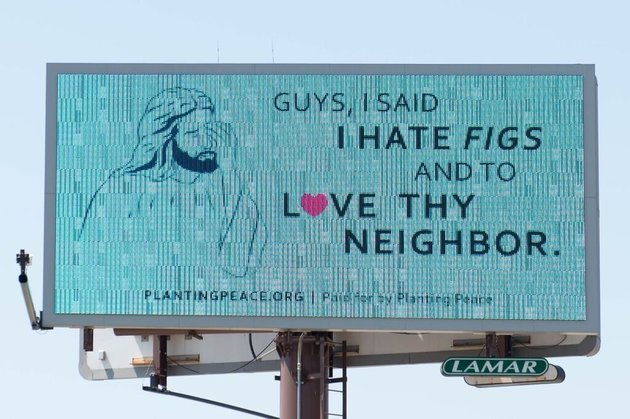
Billboard that went up in Jacksonville, Mississippi this week after the new anti-LGBT law was signed. “Guys, I said I hate figs and to love thy neighbor.”
Billboard that went up in Jacksonville, Mississippi in April after the new anti-LGBT law was signed. “Guys, I said I hate figs and to love thy neighbor.” (click to embiggen)
I was twenty-three years old, sitting in a pew in a church with my head bowed and my eyes closed when the pastor leading the prayer thanked god for sending the plague of AIDS to the world to eliminate the scourge of homosexuality. He went on at some length during his prayer about how the devil has deceived many and led them into a life of sin. And he went further, talking about how the devil also deceives people who think they are righteous, making some people believe that homosexuality is just a choice, like buying a different brand of car than your neighbor, and that we can be friends with depraved sinners such as homosexuals, and still be good Christians. But that notion, he said, was a lie from the depths of hell itself.

It was hardly the first time I had heard condemnation of homosexuality coming from the pulpit, but the hostility of these pronouncements was much worse than usual. It was also a bit unusual for a prayer to have such a long expository lump. Not completely unheard of, but enough to make several people in the congregation shift nervously. The prayer was going on and on for quite some time.

The subject of the prayer was also at odds with the sermon we had just heard. The sermon had been delivered by a visiting preacher. The church was having a revival week, which meant that a pastor from out of town presiding of the services, and the church was having a service every night of the week, rather than just the usual Sunday morning and evening worship service and Wednesday prayer meeting. And the visiting preacher had just delivered a sermon about the unity of the church. Nothing about sexual immorality or the like.

The preacher leading the prayer was not the same man who had delivered the sermon. He was the lead pastor of the church. And the tone of his prayer sounded more like an argument than a supplication for divine favor.

I was trying not to have a panic attack. If the church had been my home church I would have been in even more distress. But this wasn’t my church. I was at this service because I was the assistant director of an interdenominational teen touring choir, and we had been asked to have our smaller ensembles take a turn each night providing special music for the service. The ensemble I led within the choir had sang two songs earlier in the service, and we were scheduled to sing one more for the altar call at the end.

Anyway, among the reasons that I was upset at this unusually aggressive prayer was that I had been, to use the evangelical terminology of the time, “struggling with homosexual temptation” for years. Not that I had ever told anyone. I was too afraid of what would happen if I actually admitted to anyone in my church or family that I even thought about homosexuality.

And I had done more than dipped my toe into the waters of temptation. There had been a several occasions during the previous ten years during which I had taken the plunge right into the deep end.

At the time of this prayer, it had been at least two years since my last plunge. And that had been with a stranger not just in another town, but an entire different country. No one I knew knew the guy—and truth be told, I couldn’t even remember his name. So I didn’t think anyone knew. But still, it seemed that the pastor was aiming all this anti-gay contempt at someone, and as far as I knew at the time, I was the only homosexual in the room.

It was not the first time (nor would it be the last) that, while sitting in a house of worship I would hear people like me described as depraved sinners and tools of the devil. But this time was the most vehement had yet heard.

Looking back on it, years later, I realize that there probably was an argument going on. The visiting pastor’s sermon about unity could be interpreted as a call for factions of the Christian faith to set aside their differences, while the local pastor clearly thought that some of those factions weren’t really faithful. But I couldn’t be objective enough at the time to work that out. I half expected someone to take me aside to stage an intervention.

Except the intervention would have involved people laying hands on me and praying fervently for god to cast the demons out of me. Which had been something I had been fearing since at least the age of eleven. And that didn’t preclude the possibility that other members of the community might waylay me and just beat me up. That very thing had happened to one of my classmates several years earlier. There had also been classmates kicked out of their homes by their families and sent “away” to stay with some distant relatives or other vague described living arrangements.

CkxNItoUYAADQocThe fear of being kicked out of your home, rejected by your parents, siblings, classmates, and neighbors is something that every queer kid growing up in conservative Christian churches live with. A lot of other queer kids know that fear, as well, don’t get me wrong. But when you’re raised to believe that you are among god’s chosen, that anyone who is not a part of this community of faith means that you are destined to drown in hatred and sin, without ever knowing love and eventually spending an eternity in agony, well, it’s traumatic.

It is a bit astonishing that any of us survive it, to be honest. We’ve known for a long time that queer teens are much more likely to attempt suicide than their straight peers, and we know that teens who come from queer-rejecting families are eight times more likely to attempt suicide queer peers who reported no or low levels of family rejection.

It’s not just that the haters are trying to take away the rights of adults, such as myself, who have the means to fight back. They spend years telling some of their own children that god hates them. So there was one bit of that prayer that was correct. This isn’t just a difference of opinion. This isn’t about them saying they want to drive gas-guzzling SUVs, while some of us prefer more fuel efficient cars. They are literally bullying children, sometimes bullying those children to death. And they want the rest of us dead, too: GOP Congressman Who Prayed Gays ‘Worthy of Death’ Weeks Before Orlando Still Has No Apologies.

This is why queer people need to be out of the closet. This is why we need to have Pride parades and festivals and all the rest. This is why it isn’t enough to say “to each their own.” As long as there are kids growing up being taught that god hates them, we need to call out the bigotry for what it is, and stand up for those who aren’t yet able to stand up for themselves.

Why Does God Hate Me? – Gay Short film (LGBT):

(If embedding doesn’t work, click here.)

Nostalgia for a Time that Never Was – more of why I love sf/f

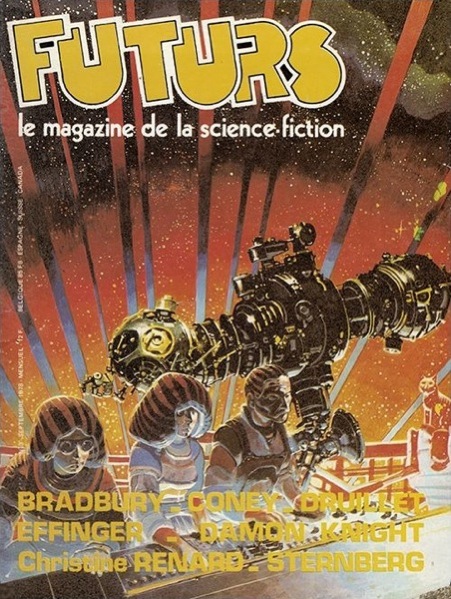
The cover of Futurs No 3, an anthology of translated science fiction published in Paris, September, 1978.
The cover of Futurs No 3, an anthology of translated science fiction published in Paris, September, 1978. (Click to embiggen)
One day, back when I was in high school, I found a paperback copy of The 1977 Annual World’s Best SF edited by Donald Wolheim in the used bookstore I frequented. I already owned several of Wolheim’s earlier annual anthologies, so I knew they usually the contained a lot of good stories. The table of contents of this issue featured several authors I loved, including at least a couple of titles that I remembered reading elsewhere and liking. So, of course, I picked it up.

The third story in that anthology, “Those Good Old Days of Liquid Fuel” by Michael G. Coney did not wow me on the first reading. Honestly, the thing that I found most interesting in the first paragraph was the revelation that it was apparently set in Western Washington state. The story is told by a first person narrator, who is taking a ferry to go to a port to meet a shipment of some sort of alien creature. We never learn much about them, other than that he raises them for their pelts, which he can sell for a profit. Though the way he describes his farm, he is mostly just getting by in this endeavor.

Most of the first two pages of the stories consists of the character describing his ferry trip in such a way that we learn that Earth is part of some kind of Galactic society, that only recently have they replaced rockets with antigrav for vessels that move from ground to orbit, and so on. The hook of the first paragraph is him noticing on his “newspocket” that all the old shuttles at the abandoned Pacific Northwest spaceport are to be scrapped, finally.

He arrives at his destination early, finding himself with five or six hours to kill, and decides to drive up to the old space port. During the drive he rambles some more, dropping hints about what his life was life before, and telling us more about how things have changed since then. It isn’t until halfway through the fifth page that he gets to what appears to be the meat of the story, as he flashes back to junior high school, when he and his best friend used to sneak onto the grounds of the spaceport to watch shuttles land and take off.

The narrator, as a young man, loved everything about the shuttles: the roar of the engines, the sleek shapes of the ships themselves, et cetera. His friends was obsessed with identifying and checking off the shuttles from a book he had of every registers craft that ever landed on Earth. There are a few anecdotes about the mild misadventures the narrator, his friend, and a few other people who liked to sneak onto the grounds of the space port had watching the shuttles land and take off.

Then everything is ruined when his friend gets a crush on a girl. Who just happens to be the same girl that the narrator once got into an altercation with in grade school and of course they hate each other. To say the friendship is strained is an understatement. Then there is a disaster involving the girl’s pet, with is a cat-like animal imported from across the galaxy, which happens to be telepathic, but only with members of its own species.

After the disaster, we flash back to the present, and then the narrator—who has lamented about five dozen times so far in the story how much he misses his old friend, and how astonished his middle-school-aged self would be to know that he doesn’t even know where the friend lives any longer—sees said old friend. The friend, it turns out, owns the wrecking company that is going to tear down the spaceport. But the narrator, of course, doesn’t say hello. He skulks away.

There are a lot of things not to like about this tale. The rambling expository lumps. The lack of characterization. The clichéd use of flashback to tell most of the story. The extremely dated boy vs girl dynamic of the tale. The ludicrous ways that chauvinism pops up and is even defended at one point.

Then in the category of merely cringeworthy, there is the fact that the only female characters who appear in the story all dress and act as if they are characters out of the 1950s. Remember, this was written in 1975—women’s lib had been a thing for many years by then! Even in 1978, when I read this story, that section seemed terribly dated!

I read the story one more time, when I found it in another anthology years later. I didn’t recognize the title, or I might not have read it. The second time I didn’t remember the story until fairly late into it, just about the time of the disaster near the end of the tale. I read it to the end, hoping to have a bit more insight, but still wasn’t impressed.

When I re-read it again last week, I was having the same reaction as before all the way until the end. And then I finally had an epiphany about what the author may have been trying to do. It had never occurred to me during my earlier readings that the narrator was unreliable. The section early on where he defends men’s only clubs and no girls allowed spaces as not being sexist at all should have tipped me off. It was too over the top. And there were several other hints throughout the story where our narrator is being very defensive in describing the events.

That’s when I realized that the ending, where he decides he doesn’t have anything in common with the old friend anymore is supposed to be tragic or ironic (depending). The narrator drives many hours out of his way and spends the entire tale wallowing in a nostalgic lament for the good old days. He goes into inordinate details on fairly minor stuff, is very defensive of himself and goes to pains to describe every other character in the narrative as betraying him or at least not treating him right. He had these great dreams and aspirations, which have all come to naught because the world is just not fair to nice guys like him.

Meanwhile his old friend is now a successful businessman, and is literally in the business of tearing down the obsolete relics of the past so that something new can be built.

Now, finally, the story makes sense when I think of it as a critique of nostalgia and clinging so hard to the past that you can’t move forward. And those expository ramblings sound an awful lot like an old bad way that some sci fi stories in the 30s, 40s, and 50s would do their world building: by having two characters say such unnatural things (while riding a subway or something), “Thank goodness for modern convenience! Can you believe that our ancestors used to have to connect their appliances to receptacles in ways with physical cables to draw power! What a primitive nightmare!”

As an indictment of nostalgia, “Those Good Old Days of Liquid Fuel” isn’t quite so bad. I’m not sure I agree with Wolheim that it was one of the best story published that year, but it did make me think, even before my epiphany. Struggling with a story is good mental exercise.

And I have to admit that the descriptions of the shuttles taking off and landing and the sense of wonder the narrator had as a child was pretty good.

Memorials, reposting

I noticed this morning on the Washington Post web site that Valerie Strauss has republished the article she’s been publishing for a few years now on both Veteran’s Day and Memorial Day: Why Memorial Day is different from Veterans Day. And while I am all for any effort to prevent people from turning every single even moderately patriotic holiday into a variant of Veteran’s Day, I have a quibble.

She leaves out the fact that before the first official federal observation of a Memorial Day, at Arlington National Cemetery back in 1868, there was another holiday observed in many parts of the country—long before the Civil War—called Decoration Day, which was a day to have family reunions and celebrate the lives of all of our deceased family members. And my Grandmother was someone who observed that version faithfully her whole life, long before the official creation of the modern Memorial Day with the Uniform Monday Holiday Act of 1968.

I tried to simply reblog the earlier entry, but apparently because it has been reblogged by myself before, WordPress won’t let me. So I’ll republish the entire thing below. If you don’t want to read about me and my mom crying at Grandma’s grave, you can skip to my post about my absent-minded coffee cup issues from earlier today: A cup, a cup, a cup, a cup, a cup… boy! instead.

Anyway, for Grandma (originally posted on Memorial Day 2014):

Memorial, part 2

copyright 2014 Gene Breshears
Flowers for Grandma’s grave.
Grandma always called it by the older name, Decoration Day. As I’ve written before, the original holiday was celebrated in many states as a day to gather at the grave sites of your parents, grandparents, et cetera, to honor the memory of their lives. It was often a time of picnics and family reunions. At least as much a celebration of their lives as a time of mourning. The connection to military deaths didn’t happen until 1868, and particularly in the south, was often seen as a pro-Union, pro-war, anti-southern celebration.

I didn’t understand most of those nuances when I was a kid. The modern version of the holiday, celebrated on the last Monday in May, didn’t even exist until I was a fifth-grader, when the Uniform Monday Holiday Act went into effect.

Grandma observed it faithfully. Every year, as May rolled around, she would begin calling distant relatives and old family friends. Grandma knew where just about every person descended from her own grandparents was buried, and she made certain that someone who lived nearby was putting flowers on the graves of those relatives by Memorial Day. She took care of all the family members buried within a couple hours drive of her home in southwest Washington.

She was putting flowers on the grave of my Great-aunt Maud (Grandma’s sister-in-law) seven years ago on the Friday before Memorial Day when she died. My step-grandfather said he was getting in position to take a picture of her beside the grave and the flowers (there are hundreds and hundreds of photos of Grandma beside graves with flowers on them in her photo albums) when she suddenly looked up, said, “I don’t feel good!” and pitched over.

One weekend she had blown out the candles on the cake celebrating her 84th birthday. The following Friday, while putting flowers on Great-aunt Maud’s grave, she died. And one week after that a bunch of us were standing at her graveside. It was just down to a few family members, and we were at that stage where you’re commenting on how pretty the flowers that so-and-so that no one had heard from in years were, when someone asked, “Isn’t grandpa’s grave nearby?”

Grandpa had died 23 years earlier, and was buried in one of a pair of plots he and Grandma had bought many years before. And after Grandma re-married, she and our step-grandfather had bought two more plots close by.

Anyway, as soon as someone asked that, my step-grandfather’s eyes bugged out, he went white as a sheet, and said, “Oh, no!” He was obviously very distressed as he hurried toward his car. Several of us followed, worried that he was having some sort of medical issue.

Nope. He and Grandma had been driving to various cemeteries all week long before her death, putting silk-bouquets that Grandma had made on each relative’s grave. Aunt Maud’s was meant to be the next-to-the-last stop on their journey. Grandpa’s silk flower bouquet was still in the trunk of the car. My step-grandfather was beside himself. He’d cried so much that week, you wouldn’t have thought he could cry any more, but there he was, apologizing to Grandma’s spirit for forgetting about the last batch of flowers, and not finishing her chore—for not getting flowers on Grandpa George’s grave by Memorial Day.

The next year, several of us had the realization that without Grandma around, none of us knew who to call to get flowers put on Great-grandma and Great-grandpa’s graves back in Colorado. None of us were sure in which Missouri town Great-great-aunt Pearl was buried, let alone who Grandma called every year to arrange for the flowers. Just as we weren’t certain whether Great-great-aunt Lou was buried in Kansas or was it Missouri? And so on, and so on. One of my cousins had to track down the incident report filed by the paramedics who responded to our step-grandfather’s 9-1-1 call just to find out which cemetery Great-aunt Maud was in.

copyright 2014 Gene Breshears
Flowers from us, Mom, and my Aunt Silly on Grandpa’s grave.
Mom and her sister have been putting flowers on Grandma’s and Grandpa’s graves since. Our step-grandfather passed away three years after Grandma, and he was buried beside her.

Some years before her death, Grandma had transferred the ownership of the plot next to Grandpa to Mom. So Mom’s going to be buried beside her dad. Mom mentions it whenever we visit the graves, and I don’t know if she realizes how much it chokes me up to think about it.

We had put the flowers in place. We had both taken pictures. Mom always worries that she won’t remember where Grandpa’s grave is (it’s seared in my head: two rows down from Grandma, four stones to the south). Michael helped Mom take a wide shot picture that has both Grandma’s and Grandpa’s spots in it.

I thought we were going to get away with both of us only getting a little teary-eyeed a few times, but as we were getting back into the car, Mom started crying. Which meant that I lost it.

Grandma’s been gone for seven years, now. But every time we drive down to visit Mom, there is a moment on the drive when my mind is wandering, and I’ll wonder what Grandma will be doing when we get there. And then I remember I won’t be seeing her. It took me about a dozen years to stop having those lapses about Grandpa. I suspect it will be longer for Grandma. After all, she’s the one who taught me the importance of Those Who Matter

Adventure awaits: more of why I love sf/f

A silver rocket from the classic Flash Gordon serials.
It’s that time of year, again, where I’m waiting for the Hugo Packet to arrive so I can start reading things that have been nominated for the award. And while several categories have again been piddled by the Rabid Puppies, I am still looking forward to the experience. Particularly since I learned an important lesson last time: the point of the awards is to recognize excellence. I’m not obligated to read stories to the end—as I always have as a small-press editor, where part of my mission is to help the writer improve the story if necessary. These stories have been nominated because, allegedly, they are great stories. So, this year I’ll give each story three pages to hook me. If by that point I’m not feeling interested enough to keep reading—regardless of whether the story was on anyone’s slate—then it goes under No Award on my ballot.

If I am enjoying it, I’ll keep reading. The only stories that will go above No Award will be the ones that kept me hooked until the end. Then I’ll rank those and move on to the next category.

It may be a very busy few months, since only one of the novels that were nominated is one I’ve already read. It’s easy enough to read five each of short stories, novellas, and novelletes in the time frame, and graphic novels usually go relatively quickly, but the novels take a bit more time!

With this new rule, I suspect that I’m going to enjoy the process this year a bit more than last year. Because the reason I care about any of the awards is because I love science fiction and fantasy. I don’t just love it, I frikkin’ love it. I have written before about how I can’t remember a time when sf/f was part of my life, because even when I was a small baby my mom read aloud to me from whatever book she was reading at the time, and she is one of the world’s geekiest Agatha Christie and Robert Heinlein fans.

Thanks to her, my childhood was full of a lot of science fiction. For a few years we faithfully watched episodes of Flash Gordon on channel two every morning, for instance. And our regular trips to the library (and used book store, when we lived in towns big enough to have one) usually resulted in several fantasy or science fiction books coming home with us.

It was one of those used bookstore runs when Mom found a copy of Dune in paperback. That book always sticks out in my memory because it was the first time that Mom was reluctant to tell me details about the book while she was reading it. It was also the first book that Mom told me I would have to wait until I was older. I know she really liked it, because it never once went into the pile of books she was thinking of trading in when we were preparing to visit a used book store. The fact that it was forbidden but also apparently really good instilled more than a bit of longing.

But it was rare for her to restrict my access to books. She never seemed to worry that I might not understand most books. If I asked to read one of her books, she’d let me, and she was always willing to discuss the story. There were times when I would try one of her books and I’d call it boring, though sometimes it was probably more because I actually was a bit too young to be tackling that particular book.

I loved browsing in the science fiction sections of the library or bookstores. Looking at the cover art, which was sometimes a bit weird and confusing, but always otherworldly. Each one seemed to beckon, promising strange and wondrous adventures if I would brave those pages.

Science fiction was always about possibilities, to me. I never felt that some sci fi wasn’t for me. I always felt welcome. Science fiction, particularly the way Mom enthused about it, was about making the world a better place. About going to new worlds, or creating new inventions, or learning what it would be like to live with aliens—or elves, or dragons. Do I wish more of the sf/f available in the 60s and early 70s had been more inclusive? Yes. Just as I wish more of present day sf/f was inclusive of people of color, queer people, et cetera. We’re getting better, but still have a ways to go before the representation matches the real world.

Whenever I pick up a new science fiction book, especially if it’s one that’s been recommended by a friend, I get a flash of that feeling of wonder and anticipation; the sense of strange adventures beckoning. For a moment, I’m that little boy in the bookstore, clutching a story, and about to plunge into something wondrous!

A rose, some memories, and a goofy grin

A bud from a branch I had to trim off one of our roses late last week has finally started to bloom (© Gene Breshears)
When Ray and I moved to Ballard 20 years ago, I’m not sure I would have believed you if you’d told me I’d still live here two decades later. We had stayed in our previous two apartments less than three years each, for one thing. And Ray had been given an estimate of two years left to live about 19 months prior to the move. Not that I believed it, mind you. I refused to accept that he wasn’t going to get better, somehow. For one thing, I was older. I was the one who had chronic medical conditions when we met. So I was convinced that it would be him who outlived me.

The previous two places we had lived had not had any sort of yard. They were like the archetypical city apartment, in that regard. So when we’d found a place with a small lawn and a couple of flower beds that would be ours, Ray had been ecstatic. Particularly since there was already a rose bush in one of the beds.

The rose had clearly been there a for many years, with the thickest canes being nearly three inches thick. When we moved in in February, the rose was just leafing out, with no sign of buds, yet. But it wasn’t long before enormous red roses were appearing on it. We took some pictures and shared with friends who knew a bit more about roses. More than one person guessed it was a Mr. Lincoln, a fairly well-known red rose. Later that summer, when I was digging down deep around the roots of the red rose (we were trying to excise wild deadly nightshade, which grows as a weed up here), that I found the original stamped metal tag that had come with the rose whenever it had been planted, which identified it as a Patrician. It’s a red rose that was specifically bred to emulate a Mr. Lincoln, though it is supposed to be a bit hardier.

That same spring Ray came home from a shopping trip one day with a new rose to plant at the other end of the same bed. It was labeled a Maid of Honor, which was not a rose I had heard of. I learned much later that the name Maid of Honor does not represent a recognized cultivar of a rose, but is rather a name that sounds like it ought to be a real rose breed which gets slapped on various pink or yellow roses sold by, shall we say, less than scrupulous distributors.

We didn’t know that, at the time. We planted it, took care of it, and we were both a little shocked at just how quickly it sent canes shooting up for the sky. We would get these enormous pink blooms, often in clusters above the eaves. The next spring I remember quite clearly one Friday finding a new cane that had grown to about 8 inches in length. By the next Friday, that same cane was more than 6 feet tall.

To say that it was an aggressive climbing rose might be an understatement.

So I have learned that I have to be a bit aggressive in trimming our pink rose. Not just in the fall, but throughout the growing season, as side branches soon block off the walkway, and the tall branches hang down into the driveway.

Ray died before our Maid of Honor reached its third spring. Another rose that we found that same year, a pale lavender rose whose labeled breed I have forgotten, lived only a couple more years after Ray did. But the Maid of Honor, and the original Patrician, continued to go strong.

A couple of years ago, I apparently got too aggressive at trimming the Maid of Honor, because the root stock started sending even more rapidly growing canes up. Roses don’t breed true via seed, so when you buy one at a nursery, what you get are several canes grafted off of an original (or more likely, a graft of a graft of a graft… et cetera… of an original) and onto a hardier breed of rose. Usually a wild rose or tea rose. So if you get new shoots from the root ball, they are a different kind of rose, altogether.

The root’s flowers on mine are very tiny white blossoms that almost don’t look like roses once they open all the way. It’s branches grow even fast than the pink ones, but they never get quite as thick as a pencil, so while they are very long, they droop and wind around the thicker, stronger pink branches (and anything else they can reach).

Our building is getting painted right now, and I’ve been having to trim both the white and pink branches multiple times because the rose keeps getting up around the eaves or into the porch railing. Late last week I trimmed a new tall branch, and it had a single bud near the end. So I trimmed it some more and stuck in in the vase where I had some flowers (some that I had bought myself, and some that friends brought over when they heard the news about my dad).

Sometime while I was sleeping last night, the bud began to open. So I took a picture.

Every time I stop and look at any of the buds from the Maid of Honor, I think about of Ray. Who loved to smell those pink blooms, give me a goofy grin, and ask me if I agreed that it was pretty.

Confessions of a bad son

Myths about violence, #3: "Children need their father even if he is abusive. Fact: Children need a safe, non-violent environment in order to feel secure and thrive. They are often relieved when the violent relationship ends."
Myths about violence, #3: “Children need their father even if he is abusive. Fact: Children need a safe, non-violent environment in order to feel secure and thrive. They are often relieved when the violent relationship ends.” (Click to embiggen)
One of my earlier childhood memories is being scolded by my mother and grandmother for not being excited about going with my dad to do some errands. I was 3 or 4 years old. The thrust of both scoldings was that I should be grateful that Dad wanted to spend some time with me at all, and didn’t I realize that being nice to Dad might make him less likely to be mean to me? I hadn’t wanted to go with him because I could never remember a time that I wasn’t afraid to be alone with him. I reluctantly agreed to pretend to be excited to spend time with him, but only because I was afraid of what he might do if I didn’t please him. Nothing terrible happened on that particular trip.

Contrast this with my first memory of a hospital emergency room. It was about a year later and I was 4 or 5 years old. I had lost consciousness after Dad smacked me around because I had cried when one of his friends that were attending a barbecue in our back yard had scared me. Later, after I woke up, one of the other adults (I think it was one of the wives who was refraining from alcohol so my mother, who was very pregnant at the time, wouldn’t be the only one sober) had realized that I wasn’t kidding when I said there was something wrong with my eyes. The others were eventually convinced that I needed to be taken to a hospital. During the ride to the emergency room, Dad drilled me with the story that I had been running around in the dark playing hide and seek and had climbed somewhere I shouldn’t have, I had been surprised when someone shone a bright light in my eyes, so I fell down and landed on my head. It was made very clear that if I did not stick to this story, not only would I get an even more severe beating when I got home, but that my mother would also suffer… Continue reading Confessions of a bad son

I is for Imagination – more of why I love sf/f

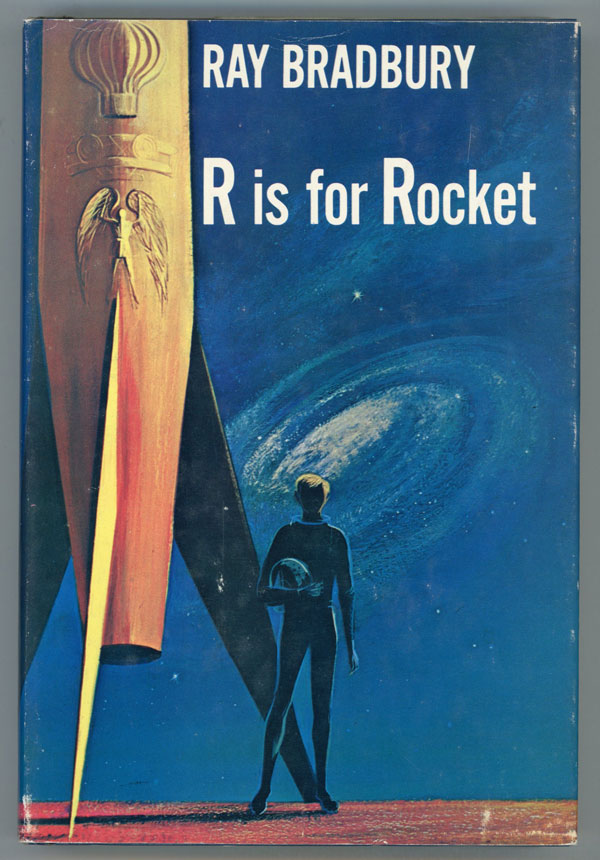
Dust jacker of the first edition of Bradbury's collection, R is for rocket.
Dust jacker of the first edition of Bradbury’s collection, R is for rocket.
I don’t remember when I first read a story by Ray Bradbury.

That’s not quite right. The sentence is true, but it doesn’t convey the full meaning. It’s equally true that I cannot remember a time when I didn’t know about Ray Bradbury’s incredible stories. He isn’t the only author who falls into the category. Since my Mom read to me from her favorite two authors: Agatha Christie and Robert Heinlein, since I was a baby as part of her plan to make sure I learned to talk correctly, I can’t remember a time when I didn’t know about Heinlein or Christie. And it’s more than slightly likely that Mom read some Bradbury in there at one point, so that might account for it… Continue reading I is for Imagination – more of why I love sf/f

The Man Who Fell to Earth

I was watching a recording of a football game Sunday night after a day spent with friends role-playing in 19th Century Scotland when I saw the first “Oh, no! Not Bowie” go by on twitter. So at least I didn’t hear the news of David Bowie’s death while I was laying half-asleep while the clock radio played news before I had to get up for work. Which is, unfortunately, how I heard about Alan Rickman. This hasn’t been a great week, obviously. But I saw one reaction this morning that helped:

https://twitter.com/DelilahSDawson/status/687618388332527617

Yes, let’s all be bold and creative and weird as hell.

It wouldn’t be correct to say the David Bowie was my hero, though in many important ways he was. He was also so much more. I wish that I had been bold enough during the height of his Glam Rock period to have been a Bowie fan. Make no mistake, I liked his work a lot. The first song I remember liking by Bowie was “Starman” which didn’t become much of a hit in the U.S. in 1972, but how could I not like it, since it seemed to have a sci fi theme?

Then I saw him on TV. Back the the 70s there were a lot of musical/comedy variety shows on prime time, and Bowie appeared on one of those. I don’t remember what song he sang. What I do remember was that he was dressed in something that flashed and glittered, and that his hair was in a style I had never seen on any human before, and he had face paint. When I try to visualize it, the colors keep changing, which means this was before we got out first color TV (which happened when I was 15 years old).

I was mesmerized. I had no idea a man could look like that, dress like that, and move like that while singing. I had seen men in movies and TV in weird costumes, and even in certain kinds of drag, but nothing like this. And then my dad growled, “Who is that cocksucking freak? What are you watching?”

Throughout my childhood, any time that my dad was really, really angry at me—angry enough that he’d grab something club-like to beat me with rather than just slap or punch me around—one of the things he called me was “cocksucker.” And for most of those years I had no idea what the word meant. From his tone of voice and actions while calling me that, I knew that it was a horrible, awful, vile thing—but that was it. By the time of this TV incident, I knew what the word meant, and I knew that literally it was true about me. But I also knew that my dad wasn’t the only person who thought it was the most awful thing a boy could be. I knew with absolute certainty that if any family member, or any of the people at church or school found out it was true about me, that my life would be over. Probably literally.

And Dad had just called this singer on TV (that I was finding so fascinating) a cocksucker. I knew, immediately, that I could never, ever let dad know that I thought David Bowie’s music was good—let alone admit to my fascination with how he looked! I don’t know exactly what I said in answer to Dad. I probably said the name of the variety show we were watching, and I know I said something about not liking the freaky guy at all, and hoped they got to someone else, soon.

A couple of years later, I saw a story in a magazine about a new movie coming soon, The Man Who Fell to Earth, based on a sci fi novel by the same name, starring David Bowie. I owned a paperback copy of the book, and had read it and enjoyed it. Immediately, seeing some photos of Bowie in makeup for the film as an alien who comes to Earth, I realized he was perfect for the role. I dug out the book and re-read it, imagining the alien looking and talking like Bowie. I went from simply liking the book to loving it.

The movie wasn’t a big hit, so never made it to the theatre in the small town where we lived. But I kept imagining it, based on the novel and those pictures, for years.

In the 80s, when I was in my twenties, Bowie’s music videos were among my favorites. And then the movie Labyrinth came out, and I and a bunch of my sci fi nerd friends went to see it in the theatre. I bought the soundtrack album. It was around the time, some months later, when I bought my own copy of  Labyrinth on videotape when I realized that I could safely purchase regular Bowie albums. I hadn’t lived with or even near my dad since just before my 16th birthday, but that initial fear of being recognized as queer if I bought any Bowie music lingered. It didn’t help when Bowie described himself as gay in an interview in 1978 (something he later didn’t exactly renounce, but did say wasn’t accurate). Ironically, I owned lots of Queen and Elton John music in my teens, and it never occurred to me that anyone would infer anything about my sexuality from those.

Anyway, I picked of Ziggy Stardust and the Spiders from Mars and listened to it so often, I wore out the cassette tape. I started acquiring some of his other albums on disc, both the older ones and the albums from the 80s.

Eventually I also finally saw The Man Who Fell to Earth. Although by that time, I had been imagining how the movie went so vividly, that I thought I had managed to see it somehow. The actual film didn’t live up to my imagination in many ways. Except Bowie himself. He was magical and ethereal and totally believable as the alien trying to pass as a human.

And by the time I was buying Bowie and admitting I liked him, I was also in the process of coming out. Which is appropriate. Knowing Bowie existed—both the singer who gave me “The Width of a Circle,” “Moonage Daydream,” “Starman,” “Space Oddity,” and “Suffragette City” and the actor who played the Man Who Fell to Earth—kept alive the idea that maybe a freak like me could have a happy and full life during those dark closeted years. He was one of people who saved my life.

Alan Rickman didn’t come into my awareness until my late twenties, when I saw Die Hard for the first time in theatres. He was awesome, of course, as he was in every role I saw him in, afterward. So he didn’t have the same impact on my formative years as Bowie did. But his work touched my adult life in profound ways, as well.

I don’t like thinking of the world without either of them.

Not Yet Christmas

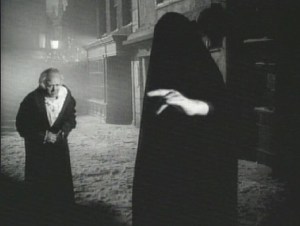
Alistair Sim meets the Ghost of Christmas Yet To Come in the 1951 "Scrooge."
Alistair Sim meets the Ghost of Christmas Yet To Come in the 1951 “Scrooge.”
Today is the first day of my husband’s Christmas vacation, while for me it’s the eighth vacation day. As luck would have it, he woke up with a slight fever and other cold symptoms this morning. If it isn’t the same bug I had a couple of weeks ago, then I’ll probably come down with it right about the time I’m suppose to go back to work. Fun, no?

Other than finishing the Christmas Ghost Story (whose title is currently “Whips for the Wicked”) and copy editing, I haven’t gotten any writing done so far this vacation. Some years I manage to get a lot of writing in during my time off for the holiday, but most years are more like this. There are enough things I need to do (finish shopping, mail last minute things, deliver gifts, visit people, clean, cook, change my mind about what we’re cooking a zillion times, watch Christmas movies, sleep in, and spend time just staring at the tree while listening to Christmas music) that very little writing gets done.

That’s okay. One’s mental and creative batteries can get a recharge from at least some of those holiday activities. Being an introvert who does a really good job of faking extroversion, it’s complicated. I get a lot out of spending time with people I love. And I really enjoy those moments when a loved one is overjoyed with a gift you gave them. Heck, I get a charge when I see someone being really excited by a gift someone else gave them. And my time spent with some of my favorite Christmas movies, particularly the ones that make me cry, is good for both my soul and my creative subconscious.

Just this morning I found myself once again explaining to my Aunt Silly, who is probably the biggest extrovert in the family, why I don’t mind having Christmas Eve and Christmas Day with just Michael and I. Yes, I love my friends and family. I enjoyed the time spent with several on Thanksgiving, and everyone who came to the party, and all the visiting I did with family members on Tuesday. And yes, on past Christmases I’ve loved watching my nieces opening presents on Christmas morning with their Grandma. I just don’t need that all the time.

Grandma with myself and my almost-twin cousin.
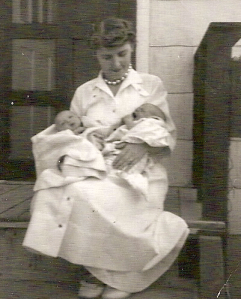
Grandma with myself and my almost-twin cousin as babies.
And I have to admit, Christmas with the extended family hasn’t been the same since Grandma died. I sometimes miss the big boisterous Christmas Eves when you never knew which shirt-tail relatives would pop in next to say “Merry Christmas” and see everyone. Grandma’s biological children, adopted children, step-children, and honorary children and their kids and grandkids would often make an appearance. Not to mention some of the children and grandchildren of Grandpa’s siblings some of whom still lived nearby. And it really was a wildly extended group.

I remember one day in High School not long after Mom, my sister, and I had moved to southwest Washington (after my parents divorce back in Colorado), a classmate whose name I hadn’t learned, yet, walked up to me and said, “I think we’re cousins.” We weren’t actually related by genetics, it turned out. She was the daughter of the step-son of one of my mom’s adopted father’s sisters. (Say that three times fast!) By the usual definitions, we weren’t cousins, but her entire life she had called my grandmother “Aunt Gertie.” And that was to distinguish Grandma from her other Great-aunt Gertrude, because Grandpa George (Mom’s adopted dad) wasn’t just married to a Gertrude, one of his sisters was also named Gertrude. So she had both an Aunt Gertie and and Aunt Gert.

But what made those big get-togethers work was Grandma. She was happy to see whoever showed up, and her laughter and love poured out and infected all the rest of us. So even when the relative was someone that you couldn’t remember precisely how they were related, they loved Grandma and she loved them, and that made everything feel right. Without the glue of Grandma’s love, some of us are just that awkward person who used to spend some holidays together.

Our lives have drifted in different ways. I’m an out queer guy who votes for Democrats and Greens and Socialists, and then complains that my own choices for elected official are too conservative. That makes me the polar opposite of a bunch of my relatives. That’s not the only way I’m an alien to some of them. Even my cousin who’s an engineer and works for Intel has never quite understood what a Technical Writer/Information Architect actually does, for example.

And don’t get me started on the gulfs between me and some folks on Dad’s side of the family!

I’ve digressed a long way from where I meant to go with this post. It’s nearly Christmas, yet not quite. There are lights on the trees and presents beneath it. Stockings are hung. Soon there will be mulled wine steaming in the kitchen. Cookies will be consumed. The NORAD Santa tracker will be consulted a few times. Carols will be sung. If I play my cards right, I might convince my poor, sick, hobbling-on-crutches husband to kiss under a sprig of mistletoe.

A can’t wait to see what Santa brings us!