Tag Archives: Memory

Presents under the tree

My sister and I with our presents Christmas morning at my paternal grandparents; house.
My sister and I with our presents Christmas morning at my paternal grandparents’ house. My guess is I’m about 9 years old in this pic. (Click to embiggen)
I remember lots of Christmases being asked to pose with my presents so one of my grandparents could take a picture. I remember it happening a lot. Some years they would have several of the kids pose together. Some years, particularly when one or more sets of cousins were present, they’d arrange a photo first with one, then the next kid, and the next until we were all done.

I don’t have very many of those pictures. I’m not sure which extended family member ended up with them. The picture above is one of the very few I have in which my sister appears with me. I don’t have any with my cousins. And since I never spent a Christmas with my younger half-siblings, I don’t have any with them, either. In the modern era of digital image sharing, I suspect that if people take that particular kind of picture that it gets shared with all the relatives who sent the kid a toy. I know that part of the reason this particular scan is such low resolution is that for a while one of the standard processing options you could ask for when sending film in to get photos made, was you would receive one image that was about 3 inches tall by 5 inches wide, and then printed on the same chunk of photo paper two smaller images, about one-and-a-quarter inches by one-and-a-quarter. Besides the two duplicate images being a lot smaller, they were also cropped square, so some of the image on the left and right was lost.

The idea was you could take some scissor and cut off the two duplicates from all the pictures and share them around. That’s how this picture, take at my paternal grandparents’ house, maybe by my grandparents, wound up in my other grandma’s photo album. One of the miniature duplicates was mailed to her.

The other reason the picture is a bit hard to make out is that the photo was printed on a faux-linen texture photo paper. The texture introduces some noise into the image. And over time, the parts of the texture that is raised tends to rub of and lose part of the image.

I cropped this down a bit to cut out the boring parts of the room in hopes the picture would look a bit more interesting, but the resolution at which it was scanned, plus the tiny size of the original are conspiring against me.

I remember the robot and kept it for years. It walked back and forth, the chest panel opened up and these sort of laser canon things folded out and made a lot of noise while the robot’s upper body spun around. In my early teens the robot started falling apart, so I disassembled it and tried to figure out if I could rebuild any of it into anything useful or cool. I never quite liked any of the things I transformed it into.

I don’t remember who gave that one to me, though based on the size my guess would be my paternal grandparents. I have a lot more memories of poking and prodding presents under the tree during the days and weeks leading up to Christmas than I do of opening presents Christmas morning. I loved lifting the presents, turning them this way and that, figuring out the relative mass of different parts of the package to get an idea of the shape of whatever was in the box. Guessing what materials the gift is made for by the weight, density, and most importantly the noise it made as it moved in the box.

It’s why my maternal grandma always set up at least one box with extra things inside (buttons, bolts, little bells inside mint tins, et cetera) to make weird rattling noises. And it’s one reason I don’t feel like a Christmas tree is complete until there are wrapped presents under it. It isn’t that I want a lot of gifts. I just want some wrapped boxes to try to guess the contents of. And to have days to check it out and think about it. It’s the puzzle and the potential of things in might be that seems to get the little kid in me most giddy.

There’s also the pretty paper and ribbons and such. Especially back when a lot of the presents would come from relatives who lived far away and would mail them to us. All of the wrapping would be different. One aunt might have wrapped on the presents in cream-colored paper with images of holly leaves and berries, for instance, and another had silver paper with snowflakes. I remember some wrapping paper would have images that weren’t just a few abstract or cartoon characters, but would be a fully illustrated Christmas scene, such as a family decorating a tree, or people going sledding. I like trying to compose stories for those pictures.

I now enjoy giving presents a lot more than getting them. Some years I try to wrap everything in similar paper. I seldom stick to it, though, because there is also certain wrapping paper I find that I think a particular friend or relative will really like it. Or it reminds me of them in some way. I seldom survey anyone afterward, but sometimes someone will comment on the cool wrapping paper, and that makes me feel as if I accomplished the mission.

I probably think about this sort of thing a lot more than other people do. But it’s a pretty harmless obsession. And it adds a bit of bright color to the world, so that can’t be bad.

Grandma’s houses… and other things

Christmas at my Grandma's, age 4. There are a surprising number of pictures of me with that Tonka steam shovel in later years.
Christmas at my Grandma’s, age 4. There are a surprising number of pictures of me with that Tonka steam shovel in later years. (Click to embiggen)
“Over the river and through the woods, to Grandmother’s house we go…” as the song says. My paternal Grandmother lived for most of my life in a five-bedroom house that Grandpa built when I was 2 years old. And for as long as my parents were still married to each other, nearly every Christmas and Thanksgiving (a lot of the Easters) was spent at that house. When I was very young, my maternal Grandmother lived in the same small Colorado town as my paternal Grandparents, so I got to see her (and my Great-grandparents) at least briefly for each of those holidays as well.

Grandma lived in three different houses during that time… Continue reading Grandma’s houses… and other things

Nuclear Dinosaurs and Tragic Heroes – more of why I love sf/f

Image from the 1954 Gojira (click to embiggen)
I don’t remember precisely when I saw my first Godzilla movie. I was probably four or five years old. When we were living in the parts of Colorado where all the TV stations we received came from Denver, one of those channels had a Saturday afternoon movie called Science Fiction Theatre (or something like that) which seemed to almost exclusively show Japanese sci fi films. So there were a lot of Godzilla, Mothra, and other kaiju films that I saw during this time.

Often when there were parts of the plot that didn’t make sense to me, Mom would explain it away as the problems with translation. She had already explained about how the movies were originally filmed in Japanese, then dubbed into English. So anything else that seemed odd or illogical was because of that. It didn’t occur to me until later that part of the process of translating it for an American audience also sometimes involved editing the film, taking out scenes or cutting them short.

Godzilla was, of course, my favorite… Continue reading Nuclear Dinosaurs and Tragic Heroes – more of why I love sf/f

Infinity In Your Mailbox – more of why I love sf/f

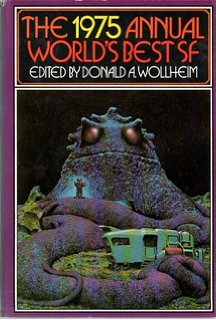
Cover of the Science Fiction Book Club edition of the 1975 edition of the Annual World's Best SF series edited by Donald Wolheim.
Cover of the Science Fiction Book Club edition of the 1975 edition of the Annual World’s Best SF series edited by Donald Wolheim.
I joined the science fiction book club at three different points in my life. The first time was when I was about 13 or 14 years old, and had no idea what I was getting myself into. My mom was not very happy when the first package of books arrived. Fortunately, my paternal grandmother found out about it before my dad did and was able to run some interference for me. So this wasn’t one of the incidents that led to a beating, but it was a close thing.

I wound up doing extra chores at my grandparents’ house to earn the money to cover it. Dad let me remain a member for a year, strictly limiting what I was allowed to order until I’d met the obligation so I could quit the club. I wound up with a bunch of books. And they were hardcover—they were cheap hardcover, but still more sturdy than the paperbacks that most of my collection consisted of before then.

The second time was the summer just before I turned 18, and at least I had a job and was earning my own money.

The book club reeled you in with the introductory packet: for a token payment of two cents, you could choose something like six books from a list. There was a little asterisk statement about paying shipping and handling, which was always more expensive than you thought it would be. But compared to paying full price for the hardcover version when they first came out, it was still a bargain. After that you received a monthly mailing, and if you forgot to return the card that said, “send nothing at this time,” you’d get whatever that month’s book was. You could choose other books out of the mini catalog that came in each month’s mailing. And again, the prices weren’t bad, even with the shipping and handling.

The killer was if you didn’t return the card in time. Because you’d receive books you didn’t want, and usually wound up paying for them because returning them was more of a hassle.

The other downsides were that generally the books were a few years old. They usually didn’t become available to the book club until the original bookstore sales had dropped off for the hard cover, and then the paperback release. The amount of money the authors received was less than for bookstore sales, though most writers who have been willing to talk about it seem to take the attitude that a sale is better than no sale.

When I was living in redneck rural communities, back before the existence of the Internet, a book club was a means to get books that you otherwise might not ever know existed.

The second time I joined, I picked every anthology that was on the list for my initial package. Which included two different years of Donald Wolheim’s Annual World’s Best Science Fiction collections. I loved those kinds of anthologies, because I got a bunch of different stories by different authors. One tale might be a space adventure, another a dark exploration of the nature or identity, another a humorous examination of the future of crime, and the next might have a wizard outwitting a god. Anything could be between those pages!

And I didn’t even have to order one of the books to get a bit of that thrilling sense of wonder. Half the fun of the book club, for me, was reading the catalog each month. Because books and authors I had not heard of—even after I had moved to a slightly larger town that actually had a book store, and not only that more than one!—each received a paragraph or two of description, along with a picture of the cover. So even if I didn’t order the book at the time, later if I saw a copy in a used bookstore, or saw other books by the author, I had a better idea of what the book would be like than I would get just from reading the cover blurbs.

Every month I received a colorful display of dozens of imagined worlds, ranging from high fantasy to gritty near future sci fi thrillers to epic space battles between empires to individual journies of discovery. And all I had to do was, every now and then, buy one of those wondrous books. It was really a small price to pay for infinity.

No wonder 14-year-old me had thought nothing of the consequences when I taped two shiny pennies to a piece of card stock, scribbled my name and address on one side, then swiped an envelope and stamp from Mom’s desk. An infinity of wonder would be mine!

Changelings on Distant Worlds – more of why I love sf/f

Cover of the 1980 paperback re-release of Dread Companion.
I can’t narrow it down more than to say that I found Andre Norton’s Dread Companion on a library shelf during middle school. The cover blurb told me it was a tale of a woman living on another planet far in the future who was hired to take care of two children who had an “imaginary” friend that was something far more sinister.

I didn’t expect that it would be about faeries in space.

The blurb was a fairly accurate description of the set-up: Kilda is a young woman trying to find her place in the world. Her father was a spacer who had no interest in settling down with the woman who got pregnant during their brief political marriage. And her mother didn’t want to be saddled with a child like Kilda who was more interested in exploring and learning science and so forth than she was in being pretty and having babies of her own… Continue reading Changelings on Distant Worlds – more of why I love sf/f

The Original Wizard School – more of why I love sf/f

Original hardback cover of A Wizard of Earthsea by Ursula K. Le Guin art by Ruth Robbins
Original hardback cover of A Wizard of Earthsea by Ursula K. Le Guin, art by Ruth Robbins (click to embiggen).
I think I was 14 years old when I found a copy of A Wizard of Earthsea on a library shelf. The novel tells the story of a boy named Sparrowhawk who lives on the island of Gont which is situated in an archipelago called Earthsea. Sparrowhawk’s aunt is the village witch, and she recognizes his innate magical talents when he is very young, so she teaches him as much as she can. When he is twelve he nearly dies saving his village from marauders using magic. Which attracts the attention of an older mage named Ogion. Ogion heals Sparrowhawk and takes him on as a student. Ogion is the person who gives Sparrowhawk his true name, Ged. Knowing someone’s true name gives one power over them in the magic of Earthsea, so people have to guard their true name. When it becomes obvious that Ged’s talents and impatience are more than the mage can handle, Ogion sends him to the island of Roke to see if he can join the school of mages, there… Continue reading The Original Wizard School – more of why I love sf/f

Homemade Rockets and Invisible Moons: more of why I love sf/f

Cover of the 1958 hardcover edition of Mr. Bass's Planetoid by  Eleanor Cameron,.
Cover of the 1958 hardcover edition of Mr. Bass’s Planetoid by Eleanor Cameron, just like the one I found in the school library (click to embiggen).
In 1970 (I was in the Fourth Grade) the oil company my dad worked for transferred us to a tiny town in eastern Utah. When my sister and I were enrolled in the public school there, we exactly doubled the number of children in the school district who were not members of the Church of Latter Day Saints. Over the next 10 months or so, as many more families (mostly from the south) were transferred to the town by various oil companies, the elementary school’s enrollment went from about 350 children to nearly 500 hundred. I’m not going to talk about the culture shock that occurred during that time, on both sides of the religious divide. But that incredible influx of unexpected kids to the school caused a lot of upheaval, including causing the school to pack up most of the books from the library to convert the library space into four classrooms. For a while, most of the library books were in storage, and a subset was rotated into the tiny old classroom which had been converted into the new library.

It was during one of those rotations that I first found a copy of Eleanor Cameron’s Mr. Bass’s Planetoid. Of course I had to check out right away because it had “planetoid” in the title! It was clear from nearly the first page that this was a sequel. Two best friends, Chuck and David, are friends with an eccentric scientist, Mr. Tyco Bass, who helped them with their homemade rocket previously. Another scientist, Prewytt Brumblydge, has stolen a sample of a mysterious metal Mr. Bass had discovered in a meteorite, and soon he is using this metal to power a machine with which he hopes to solve two of the world’s problems: the lack of safe drinking water in some parts of the world, and the need for electricity. Unfortunately, the machine has dangerous side effects that could destroy the entire planet. The boy’s learn this part from yet another scientist who happens to be Brumblydge’s former teacher, who is convinced the student is looking for the source of Mr. Bass’s mysterious metal.

The problem is that Mr. Bass is nowhere to be found… Continue reading Homemade Rockets and Invisible Moons: more of why I love sf/f

Semi-Precious Stone, Helical or Otherwise: more of why I love sf/f

Cover of the first edition paperback, World's Best Science Fiction 1969 edited by  Donald A. Wollheim and Terry Carr.
Cover of the first edition paperback, World’s Best Science Fiction 1969 edited by Donald A. Wollheim and Terry Carr.
I was either 13 or 14 years old when I acquired my copy of the 1969 edition of the World’s Best Science Fiction. As was so often the case, I picked up my copy at a used bookstore. I recognized several of the authors in the table of contents, though I don’t believe I had read any of the stories. That was the point! One book, a whole bunch of stories! Brilliant!

Once I got the book home, I read through the titles in the table of contents again, and one jumped out at me: “Time Considered as a Helix of Semi-Precious Stones.” It was just an interesting image: a helix of gemstones and the like as some sort of analogy or metaphor for time. And the author’s name, Samuel R. Delaney, seemed familiar, though I couldn’t think of any stories I had read by him.

So I jumped right to that story… Continue reading Semi-Precious Stone, Helical or Otherwise: more of why I love sf/f

Computerized Clods and Squeamish Scoundrels: more of why I love sf/f

Lost in Space, 20th Century Fox Television & CBS Broadcasting
Lost in Space, 20th Century Fox Television & CBS Broadcasting (Click to embiggen)
The first episode of Lost In Space aired on CBS in September of 1965, and I was glued to my set. It debuted less than two weeks before my fifth birthday, so I don’t remember a lot about my feelings about the first episode. If you aren’t familiar, the show follows the adventures of the “space family Robinson” (Professor John Robinson, his wife Dr. Maureen Robinson, their grown daughter Judy, and younger children Penny and Will; their pilot, Major Don West, and their robot called B-9 in the early episodes) who were sent off to be the first colonists of the Alpha Centauri system, except their ship is thrown off course due to the bumbling actions of the stowaway/saboteur Dr. Zachary Smith, who ends up trapped on the ship when it takes off.

Lost In Space is not remembered as being serious science fiction, or even as a serious series. Though this is primarily because of the second and third season. The first season was intended as a serious action adventure series giving a science fictional spin to the early 19th Century novel, The Swiss Family Robinson, which had itself been inspired by the 18th Century novel, Robinson Crusoe. Like those novels, the early episodes focused on the crew as castaways trying to survive in a hostile environment. Some of the sci fi notions of some first season episodes were pretty silly by modern standards, but mostly because they were attempts to adapt the sort of complications that might appear in a western series or a contemporary slice-of-life series and put a spacey spin on it… Continue reading Computerized Clods and Squeamish Scoundrels: more of why I love sf/f

Thinking Machines and Thoughtless People: more of why I love sf/f

Hardcover copy of the original version of David Gerrold's When Harlie Was One.
Hardcover copy of the original version of David Gerrold’s When Harlie Was One.
I was thirteen or fourteen years old when I found the copy of When Harlie Was One in the public library. The book jacket described an intelligent machine that has to prove he is a person or be shut down. It sounded really cool. This was during a period in my life where I was literally reading at least one entire book every day. I visited the library constantly, turning in a pile of books I’d finished every few days and checking out more. I read during every free moment. I even read while I was walking to school or while walking home. Yep, I was that kid, walking down the sidewalk with my nose stuck in a book. Books weren’t my only friends, but they were my best friends.

Thinking back, I’m sort of surprised that particular public library in that tiny town had this book. It had only been published a year or two previously. Most of the science fiction they had was stuff that had been around for much longer. Of course, When Harlie Was One had been nominated in the best novel category for both the Nebula Award and the Hugo Award (it won neither) not long before the library acquired it, so maybe that’s why the librarian who ordered new books picked it. I don’t know… Continue reading Thinking Machines and Thoughtless People: more of why I love sf/f