Tag Archives: nanowrimo

Just because I need to know that, doesn’t mean the reader does — or, adventures in back stories

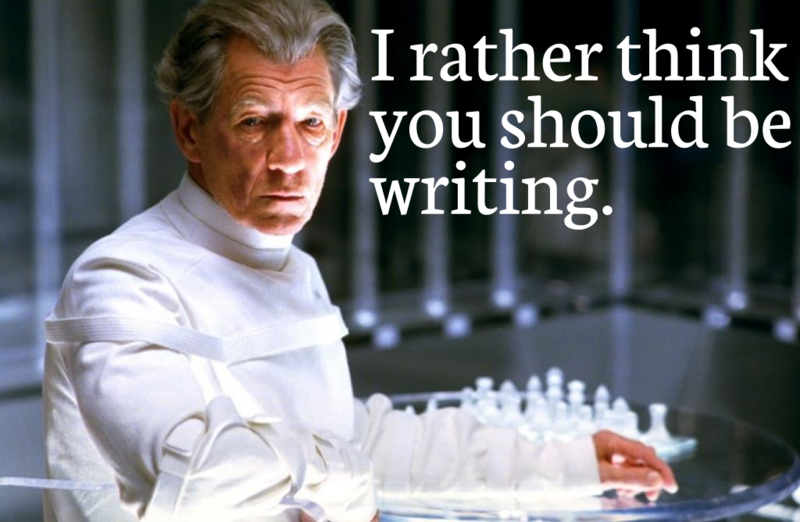
“I rather think you should be writing.”
(click to embiggen)
As mentioned previously, I’m doing NaNoWriMo again, and so have less time for blogging than usual. I was bantering with a couple of friends last night on line while also trying to finish a scene, and something one friend said about her childhood made me think of an interesting detail to add to the history of one of the characters I was writing. The other friend asked why would I complicate the story with that new detail, and I had to explain that just because I add some more information to a character’s biography doesn’t mean it’s going to pop up in the story.

This reminded me of another conversation I was part of online elsewhere in which another NaNoWriMo participant commented that they had gotten bogged down because they reached a part of the tale where some characters needed to explain something that had happened off screen to other characters. Since NaNoWriMo is a first draft, experienced writers go into it knowing that a bunch of what we write isn’t going to remain in the final story. Sometimes we know that we’re just writing a scene to figure something out. Other times we don’t realize that all or most of a scene isn’t needed until much later, while we’re editing revising.

It is true that sometimes you need to give the reader information to understand a character’s motives and relationships. The trick is to do it without a lot of exposition. One of my favorite instances of giving the viewer such back story happened in the pilot episode of Teen Wolf the series. There’s a lot of bad story telling (contradictions, nonsensical villain plots, queer-baiting by the metric tonne, et cetera) that happened in that series, but sometimes they got things right. In that first episode, the two teen best friends, Stiles and Scott, are trying to figure out what bit Scott the night before, and whether it has anything to do with the mysterious body found be authorities the previous day. They are in the woods and are confronted by a slightly older, very gruff man who tells them they are trespassing and to go away. As they leave, Stiles whispers to Scott, “Don’t you remember who that is? It’s Derek Hale, he was a couple years ahead of in school? His entire family died in a fire several years back.”

It’s a whole lot of backstory, packed into a couple of sentences that set up a number of more mysteries and reveals that come up over the rest of the season. And having Stiles be the one who says it helps you learn a bit more about his personality traits that become important later: he notices things, he obsessively researches things, and no matter how many times his father, the Sheriff, tells him not to snoop, his curiosity just can’t be restrained.

Anyway, I’ve written about this topic a few times. But rather than paraphrase, I’m just going to quote one of the shorter posts on that topic from some years ago:

Too much back story

In order to write a character’s dialog correctly, I have to have a good image in my head of who he or she is. That doesn’t mean I need to know eye color and hair length and how they dress, necessarily—I’m using image metaphorically. I mean that part of the process of giving a character a personality is imagining their life and how they got to be who they are now.

This is for everyone, even walk-on characters who may have only one or two lines of dialog out of an entire novel. I’m not one of those authors who has to write all of that down before I can use the character. Walk-ons usually just pop up when I need them. I’ve put my protagonist in jail, let’s say, and I’d planned who his cellmate would be before I got to the scene, but I hadn’t thought much about any other prisoners. As I start writing the scene between the protagonist and his cellmate, the other prisoners just chimed in at appropriate parts. While I don’t know the names of any of them, I have a small sketch in my mind of each one’s personality and a bit of his or her history, too. It just blossomed as soon as I needed someone to make a humorous interjection.

That’s just the walk-ons. Supporting characters that are planned as parts of subplots have quite a bit more than that, while the main characters have even more.

Most of the backstory remains in my head and my notes. My stories tend to be character- and dialog- driven, so usually the only details about a character’s background that come up are the ones that would normally occur in conversation:

“You always have to be smarter than everyone else, don’t you?”

“There was a time when you found that endearing.”

“I grew up!”

Even without any description or names, reading that dialog tells you that these two have known each other a long time, that they used to be close (perhaps even romanticaly involved), and now they are less friendly. I may never reveal more about the past experiences between these two characters, but I know how they met, how long they were close, how they spent their time together, and how they had their falling out.

Usually I’m pretty good about not letting the backstory over shadow the current action. But not always. Especially if I get some characters together in a scene who are very talkative. The dialog can go on and on for a while, if I let them.

During re-write I always find some scenes like this, filled with a lot of interesting banter, but that I need to trim. When reading the scenes aloud, even just by myself, I can tell when they’re going on too long. Fortunately, usually it only takes a little pruning to punch up the scene and get things moving.

But sometimes that backstory includes information the reader needs, and it isn’t always clear until I get a reader’s perspective that some details I thought could be inferred weren’t obivous.

I have a couple of supporting characters I’m working with right now whose scenes I was trimming the last couple of nights. They’re both intresting characters. I’ve gotten feedback indicating readers like them. (Even though in the current novel they don’t have any scenes together, one of them had a short story of his own published a few years ago, and the other happened to be a supporting chracter in it.) But they’re only supporting characters in this tale, and the parts they have to play in the current story aren’t big enough to justify all that information.

Even though I saved the removed dialog elsewhere, it still hurts to trim it.

But when it’s too much, it has to go!

You should be writing — whether you join us in NaNoWriMo or not!

Chris Evans, Chris Hemsworth, Robert Downey Jr, and Mark Ruffalo pointing at the camera and saying "You should be writing."
(click to embiggen)
It’s the first of November, which means that it’s National Novel Writing Month (NaNoWriMo)! NaNoWriMo is a lot of fun. I frequently recommend it precisely because the point is to just keep writing and not worry about being perfect. That worry often paralyzes people, preventing them from writing. Oh, they type out a few words, maybe a few sentences, but then they stare and delete and write something else. It is easy to fall into the trap of rewriting and revising a story (or a single scene) again and again because it isn’t perfect.

I’ve discussed this topic many times both on my various blogs, on convention panels, and in personal conversations. The person thinks they can’t write because the idea they have isn’t perfect, or they aren’t being creative/original enough, and so forth. One very specific form of this issue I’ve heard many times goes something like this: “I’ve read about how plotting and so forth works, and when I’m analyzing a book or show or something I can often see where the tale went wrong, but I’m not able to apply that skill to writing something new.”

At which point I usually launch into my rant about how writing is not the inverse of literary criticism?

What do I mean by inverse? Well, let’s first consult the Oxford Dictionary of the English Language. The relevant definition is: “ Of two operations, relations, etc.: such that the starting point or antecedent of the one is the result or conclusion of the other, and vice versa; (of one such operation, relation, etc.) opposite in nature or effect (to the other).” So, for instance, untying a shoelace is the inverse of tying it, while tying the shoelace is likewise the inverse of untying, right?

So, what do I mean when I say that literary criticism isn’t the inverse of writing? I mean that if one imagined the process of analyzing and deconstructing a story as a series of tasks, performing those tasks in reverse doesn’t produce a story. And when you compare your ability to find flaws in a story as being a necessary skill to creating a story, you are misunderstanding the creative process. Also, knowing how to perform literary deconstruction doesn’t guarantee that one understands stories—it means one understands paradigms that some authorities have proclaimed about stories.

Another way to understand it is to think about music: literary criticism and the like can be looked at as similar to understanding the mathematical equations that describe sound waves. Understanding those equations doesn’t mean you can think up a catchy tune. Which doesn’t mean that studying music theory might not improve your music making, but it doesn’t guarantee you will make compelling, or even mildly interesting music.

So, for instance, when a story teller begins working on a story, they don’t make lists of the metaphors they intend to use. Likewise, we don’t usually think about what the theme of the tale is and so on. I, personally, virtually never know what any of my metaphors are in a story unless someone points them out to me.

Everyone’s process is different. Most of my stories begin as a question, and the process of writing is how I try to find the answer to that question, and to the subsequent questions I uncover while working on the first.

Analysis is very useful during the editing and revising. Studying some of the things we can quantify about how stories work isn’t a waste of time. But don’t focus on that. Certainly not when you’re at the first draft stage.

Or, as Gandalf observed: “He that breaks a thing to find out what it is has left the path of wisdom.”

Once again, time to start your word processing engines!

In just a couple of days November will be here and that means National Novel Writing Month (NaNoWriMo)! In case you aren’t familiar with NaNoWriMo, let me first quote from their website:

National Novel Writing Month (NaNoWriMo) is a fun, seat-of-your-pants approach to creative writing.

On November 1, participants begin working towards the goal of writing a 50,000-word novel by 11:59 PM on November 30.

There are rules, but for years I participated as a Rebel, until a few years ago when they dropped the one rule that kept making me a rebel.

  • Write one 50,000-word (or longer!) novel, between November 1 and November 30.
  • Start from scratch.
  • Write a novel. We define a novel as a lengthy work of fiction.
  • Be the sole author of your novel.
  • Write more than one word repeated 50,000 times.

That second bullet is the rule that they changed. Most years I use NaNoWriMo as a motivation to work on some stalled or otherwise unfinished projects rather than starting from scratch, which is why I was always over in the Rebel category. NaNoWriMo is a lot of fun, and I find that having a few friends participating and mutually cheering each other on (and in a couple of cases to try to race against, word-count wise) helps me get a lot of work done.

NaNoWriMo isn’t for everyone. But I’ve seen people who didn’t think they’d like it come out happy that they’d given it a go.

If you’ve ever wanted to write and have trouble finishing, give it a try. Particularly if the thing that is holding you back is a feeling that whatever you’re writing isn’t good enough, there is something freeing about just focusing on getting the word count up. Leave editing for later. you can revise and correct a horrible draft, but you can’t do that to a blank page.

And it is supposed to be fun, not a chore.

I think I know what I’m going to work on this year. But I’m leaving myself the option to change my mind at the last minute.

Let’s make some fiction!

Getting ready for the coming spooks and books amid the rising dark

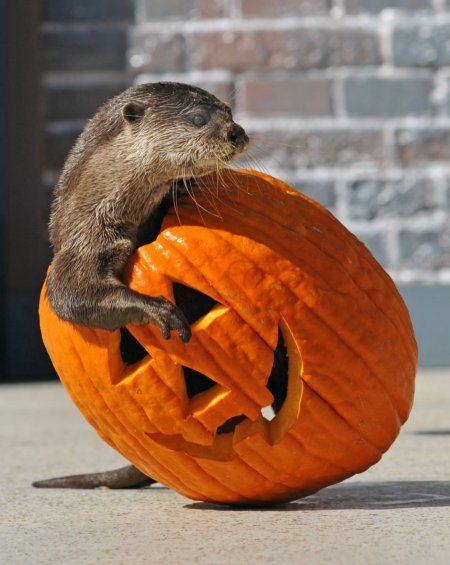
An otter climbs has climbed inside a jack o lantern, head and one forepaw sticking out of the opening on top.
Someone’s getting ready for Halloween!
Last Sunday I needed to run to the grocery store for a couple of things before my football game, which was earlier this week than it usually is. I started the car, flipping on the wipers to clear the heavy layer of dew off the windshield, and lowered and raised the side windows for the same thing. I started to put the car in gear when I realized that my music wasn’t playing. I looked at the stereo in the dash and the main screen said “No Device.” We have a small collection of old iPods loaded with various subsets of my music library that I rotate through the car. So there’s always an iPod plugged into the stereo, and the stereo is set to automatically start playing music from the iPod on shuffle when it starts up.

There was no sign that the car had been broken into (one of the reason we have several iPods salvaged from the junk pile at my husband’s workplace is that we have had about four previous iPods stolen from over the last ten years and two cars), so I knew the most likely cause was that the iPod was too cold. I opened up the console, dug the iPod out while trying not to disconnect its cable and it was definitely ice cold. Electronic devices with internal rechargeable batteries have temperature sensors that deactivate the system if the device is either too cold and too hot, because the chemical processes inside the rechargeable batteries don’t operate as efficiently (and safely) outside certain ranges.

This made me realize that the overnight low temps are cold enough that I probably should sit in the car letting the engine idle for a couple of minutes before driving. And this is yet another sign of the changing of the seasons: sometimes it’s cold enough to disable the iPod. That probably means I should bring swap out the iPod in the car to change out the music a bit.

And that reminded me that while I have been thinking about a new Halloween playlist, all I have actually been doing is listening to all my old ones (I usually make a new one each year). Combine that with a conversation between two friends on social media about playlists for NaNoWriMo, and I spent more than a bit of my free time this week setting up a new Halloween playlist and a possible NaNoWriMo playlist.

I love making playlists. Given that there are literally thousands in my library, I probably love it just a bit much. Writing playlist are assembled in several different ways. Some songs I associate with certain characters. Lots of songs simply evoke moods. A good friend always remarks on how many of the songs in my writing playlists have lyrics. He says he can’t write while listening to people talking or singing words. I get that, and I have a few writing lists that are entirely instrumental. The key, of me, is that the songs that have lyrics can only go into a writing list if I know the song well enough that I don’t have to actively process the words to follow the song.

Many of my writing playlists are intended to help me think about writing while doing other things. Listening to my playlist, “A Dark Lord’s Lady” during my evening walk, or while riding the bus, or walking from the bus to the office, or while working on certain tasks at work make keeps me in the mood to write scenes related to one certain characters and subplots in a couple of the books in my fantasy series, for example. Whereas the playlist, “Devil in the Trickster Details” has me thinking about a completely different set of characters and their subplots across….. many more of the books in the series.

To make a new list for this year’s NaNoWriMo requires me to decide which of many projects to actually work on this November. And that’s a problem, because I’ve been running the Red Queen’s Race in regards to a bunch of writing projects for the last few years, and can’t quite manage to actually finish anything. Which is frustrating, but also entirely my fault.

I think I know what I’m going to do. And I have assembled a new NaNoWriMo playlist (currently titled “A Heart Rattling World Ending”) with 55 songs that focus on characters in a couple of the stalled projects. But I might change me mind by the time November 1 rolls around. If you happen to be doing NaNoWriMo this year, and want a writing buddy, I’m Fontfolly over there, so say “hi.”

Compounding the problem for many of us it the grinding compassion fatigue/outrage fatigue/existential fear fatigue that world events have been inflicting on so many of us. There were literal mobs roving streets of cities this weekend looking for liberals and queers and anyone else the alt-right thinks of as enemies. They beat a bunch of people up, and in at least three cases the cops arrested the victims. It should be no surprise, then, that many of us are having trouble getting into the mood for holidays, no matter how much we may love Halloween. Let alone getting in the mood to write a novel.

But I refuse to give up.

In this kind of social/political atmosphere, creating is an act of rebellion. Having fun that doesn’t come at someone else’s expense is an act of rebellion. I’m trying to remember that. Let’s all try to accomplish some creativity and celebration together, shall we?

NaNoWriMo 2017: there will be sentences, so many sentences…

And so it begins!
I was really bad this year and didn’t even start the new Scrivener project file for NaNoWriMo until nearly 11:30. Yes, once again I am participating in National Novel Writing Month. If you aren’t familiar, I’ve written about it a few times, most recently here. If past NaNo’s are any indication, I will be blogging a bit less all month because of all the writing on the novel. If you’ve never done it, there is still time to jump in and give it a try. And if you’re already doing it, feel free to add me as a writing buddy.

Let’s tell some stories!

Gentlefolk, start your (word processing) engines!

It’s nearly time!
Do you like stories? Have you ever thought about telling stories? Do already know that you like telling stories? Do words make you happy? Do you have a favorite word processor, or a favorite pen, or a favorite writing notebook or the like? Do you like a challenge? Have you ever wondered what it’s like to work on a creative project at the same time a bunch of other people are working on something similar? If any of the above applies to you, then you might want to give NaNoWriMo a try.

I’m participating in National Novel Writing Month (NaNoWriMo) once again this year! If you don’t know what that means, let me quote their website:

National Novel Writing Month (NaNoWriMo) is a fun, seat-of-your-pants approach to creative writing.

On November 1, participants begin working towards the goal of writing a 50,000-word novel by 11:59 PM on November 30.

There are rules, but for years I participated as a Rebel, until a few years ago when they dropped the one rule that kept making me a rebel.

  • Write one 50,000-word (or longer!) novel, between November 1 and November 30.
  • Start from scratch.
  • Write a novel. We define a novel as a lengthy work of fiction.
  • Be the sole author of your novel.
  • Write more than one word repeated 50,000 times.

That second bullet is the rule that they changed. Most years I use NaNoWriMo as a motivation to work on some stalled or otherwise unfinished projects rather than starting from scratch, which is why I was always over in the Rebel category. NaNoWriMo is a lot of fun, and I find that having a few friends participating and mutually cheering each other on (and in a couple of cases to try to race against, word-count wise) helps me get a lot of work done.

NaNoWriMo isn’t for everyone. But I’ve seen people who didn’t think they’d like it come out happy that they’d given it a go.

Usually about this point in this post I would veer into some advice about the virtues of getting a draft down and not worrying about quality. And probably will write something about that in the next few days, but a friend shared an interesting post that goes in a slightly different direction that I think many people might find valuable. I should note a couple of things. The Story Nurse gives out customized writing advice, and this particular letter writer talks about struggling with thoughts of suicide and other types of anxiety, and how trying to force themselves to power through stalled writing projects makes that worse. So, consider yourself warned.

Story Nurse #66: Getting Past the Confidence Sinkhole

Having more than one friend who has found that a lot of their frustrations with writing and similar projects were actually symptoms of untreated mental health issues, I can appreciate how the sorts of advice people like me often give out (“just put one word after the other, whatever it takes”) is not only not helpful, but can actually cause harm. I like the way that the Story Nurse breaks out some things to try that are completely different that just trying to force more words out. I am particularly enamored with this suggestion:

Set the goal of creating works that are explicitly for practice, rather than going directly to big projects that you care passionately about. The less emotionally attached you are to the work you’re doing, the less energy you’re feeding into that self-doubt dynamic.

She also suggests keeping a compliment file. That’s a place where you save kind things people say about your work or just about you.

Anyway, take a look at that column. I think several of her suggestions for this letter writer are good things to try. And check out the Story Hospital website for earlier columns.

And if you’re planning to participate in NaNoWriMo, and would like a writing buddy, you can add me: FontFolly. Let’s tell some stories!

Hit the word count again, but…

nanowrimo_2016_webbadge_winnerMy NaNoWriMo project this year was to fix the gaping plotholes in two novels that I had decided to split apart from a previous NaNoWriMo. I had decided that there were just way too many subplots for one novel, and the fact that for at least three-fourths of the original 105,000 word draft that there were a bunch of the characters who never interacted with the others until the end, led me to try separating it.

But it wasn’t a matter of arbitrarily breaking it in the middle and trying to write something that would feel like climax but still lead into book two. The first two-thirds of book two happens at the same time as the entirety of book one, and then all the characters from book one start coming into the main plot of book two. Also one of the sets of subplots came together in a big battle (it’s a light fantasy in an epic fantasy wrapper, so there are battles) in the second half of the original rough draft made the book feel as if it had two climaxes, so trying to turn it into two books made sense.

Anyway, I had second drafts of two related books that didn’t work and had a some missing connective bits, so I made that this year’s project. Existing scenes that required a major re-write were counted in this year’s word count along with completely new scenes. And I hit the 50,000 mark, and have at least improved things, but I don’t feel as if I’ve actually fixed the plot problems. Which was what I had hoped for.

I don’t really have a conclusion. I know my productivity went way down after the election, and I haven’t really gotten back into a good space where I’m being productive and liking what I write.

It’s NaNoWriMo time again!

nanonovemberbanner

I’m participating in National Novel Writing Month (NaNoWriMo) once more. If you don’t know what that means, let me quote their website:

National Novel Writing Month (NaNoWriMo) is a fun, seat-of-your-pants approach to creative writing.

On November 1, participants begin working towards the goal of writing a 50,000-word novel by 11:59 PM on November 30.

There are rules, but for years I participated as a Rebel, until a few years ago when they dropped the one rule that kept making me a rebel.

  • Write one 50,000-word (or longer!) novel, between November 1 and November 30.
  • Start from scratch.
  • Write a novel. We define a novel as a lengthy work of fiction.
  • Be the sole author of your novel.
  • Write more than one word repeated 50,000 times.

It used to be that you were supposed to begin with a total blank page (or empty word processor file) and not type any words of the actual novel before November 1. Now the new rule is that you only count the words you actually write during November in your total. So since I was usually working on finishing or revising an existing piece, I was a rebel.

This year I’m being a rebel again because I’m working on finishing two novels started previously. I’m writing new scenes in a separate file to handle the word count. If I substantially re-write an existing scene, I’ll copy it over to that file to keep track of the words, but if I’m just tweaking a few things, I won’t.

One of the coolest things about NaNoWriMo the last few years is that the makers of Scrivener, which is in my not-so-humble opinion the best writing software out there (for macOS, Windows, and iOS), make a special trial version available free for the duration of NaNoWriMo plus seven days. So if, at the end of the month, you decide you don’t want to buy the software, you can still export your work to a format that is readable by other (inferior) word processors.

You can download this special trial and a custom NaNoWriMo Novel template here.

The NaNoWriMo template is like the ordinary novel template, except that it contains links to free video tutorials, and it contains a macro that will output your novel in a scrambled plain text form if you are paranoid about uploading your piece to the word-count verifying function later in the month.

Scrivener is not merely a word processor. The folks who make it (and it’s a very tiny company of, last time I checked, five people) describe it as a complete writing studio, or a content generation system. Scrivener has projects rather than single files. you can add scenes or chapters, move them around, view them in a summary mode where they look like index cards, and so on. Each project also has a research binder where you can save all your notes and scribblings and other supporting information. It’s all kept in the project, but won’t appear in the final product when you publish the manuscript in all the supported formats (including epub, of course).

One of my favorite features is that, from within the Research binder, you can select an “Import web page” function. Paste the URL of the page in question, and Scrivener will go out, copy all the text, images, links and so forth, and make it a “page” in the research binder or your project file. It’s not a link, it’s a complete copy. So if the web page goes away, you still have all the information from the page. This is really handy when you’re doing research on the web.

Scrivener is an awesome program that I’ve been using for years, and on top of all this content management and publishing functionality, it only costs US$45. That’s full price. You don’t have to pay full price! If you download the NaNoWriMo trial (either Windows or Mac version) and set up a NaNoWriMo account, at the end of the month you can buy it for a 20% discount, no matter whether you finished your 50,000 words or not.

If, however, you do finish the 50,000 words and upload and get verified, they’ll send you a code that lets you buy Scrivener at half price. When I first started using the older version a few years ago (not as part of NaNoWriMo, I’d simply read a review of the software somewhere), after just a week of the free trial I decided that the full price was a bargain, and I have never regretted it.

I’ve only used the Mac and iOS versiosn. I have a couple of friends who regularly use the Windows version and they like it a lot.

I really love Scrivener, can you tell?

There are some other special offers for NaNoWriMo participants, if you’re participating, you might want to check them out.

The only tools other than Scrivener on the sponsor offers page that I’ve used is Aeon Timeline and Evernote. I have found Aeon Timeline very useful for charting out the events of the world I have created for my series of fantasy novels. Evernote was useful for taking notes in various places and having it available on my other devices, but I don’t find it suitable for serious writing. They also no longer support free access on an unlimited number of devices, you have to pay a subscription to get that.

Anyway, whether you’re doing NaNoWriMo or not, if you’re a writer, I can’t recommend Scrivener enough. You can get the NaNoWriMo trial version at the link I shared above, or if you don’t want to be bothered with NaNoWriMo, but the tool sounds interesting, their ordinary 30-day trial version is here.

gravitarEither way, let’s get writing!

Hi ho! Hi ho! It’s off to Camp I go…

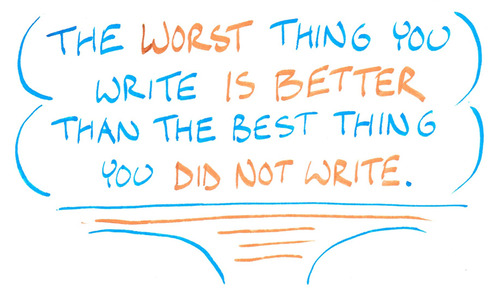
“The worst thing you write is better than the best thing you did not write.”
Camp NaNoWriMo starts on Friday, and once again I’m participating. National Novel Writing Month (NaNoWriMo) is the annual event in November where millions of crazy people attempt to write a novel (or at least a work of fiction 50,000 words long). Camp NaNoWriMo happens twice a year as a month to either finish a story you started in NaNoWriMo, or to practice writing a smaller amount to get in the habit of writing every day, or just to work on any writing or writing-related project that strikes your fancy.

You set your own goal and if you achieve it, hurrah! You win. The Camp website has a couple of different features that aren’t part of the regular NaNoWriMo, chief among these are virtual cabins. You can set your account be randomly assigned to a cabin, or you can form one of your own and invite your friends to join. Or not do it at all. The cabin is simply a small chat forum that only members of the cabin can post to and see. So it’s a place you can check in for encouragement or to ask questions, or simply report on your progress.

I’ve enjoyed myself every time I’ve participated. I haven’t always hit my goal during Camp. But I do a better job of staying on target for the month than I do at other times. It helps having a goal and people encouraging me.

Every time that I try to recruit folks I know, there are always some who are reluctant because either they tried it before and it didn’t work, or they don’t think they’ll hit any goal, or the like. And I get it, I do. But missing a goal isn’t failure, it’s just missing the goal. We’re too focused on never making mistakes, and forget that the way you learn is to try, and when you don’t succeed the first time, try again. The analogy I’ve used before is a toddler learning to walk. We don’t remember how many times as toddlers we fell down attempting to walk. But we didn’t give up, we kept trying. And now we do it without even thinking.

Learning anything works that way. Maybe you won’t hit your word count goal. Or maybe the story’s plot won’t go in quite the direction you planned. But that’s okay. You tried, and if you let yourself learn from it—and most importantly, try again— you’ll get better next time.

So, wanna join me at Camp NaNoWriMo? If you’re still in doubt, may I suggest this video to help you decide?

Shakira – Try Everything (Official Video)

(If embedding doesn’t work, click here.)

Heading off to camp!

CNW_Participant_TwitterOnce again, I’m going to participate in Camp Nanowrimo. Camp is similar to the full-fledged National Novel Writing Month, except they’re much looser on the rules (not that the full rules are that restrictive). Camp Nanowrimo is for doing things such as editing/revising a novel (which you may have written during a previous NaNoWriMo, for instance), or working on a smaller project as perhaps a way to practice for trying to write a full 50,000+ word story in 30 days at a subsequent NaNoWriMo.

I’ve used it in the past to do editing, plotting, and revising. Currently, I’m planning to finish off an editing project, which I have described rather facetiously. Though I’ve been so unproductive working on my novel in progress, that I’ve also been thinking of knocking out a few very short stories I’ve been noodling on for a long time first. We’ll see how I feel after work tomorrow!

Why do this as part of Camp Nanowrimo? It’s helpful to me to have a defined goal, with a clear end date and some mechanism for measuring progress. More importantly, a mechanism for reporting progress so I have motivation not to goof off. In most of my previous Camps and Nanos, I’ve managed to remain focused and accomplish at least most of my goal more quickly than when I’m just trying to meet my own monthly tasks.

I enjoy bantering with my writing buddies, including cheering them on when they make progress, or racing with someone to see who can hit a higher word count on a particular day.

So, I’ve invited a bunch of my past writing buddies to be cabin mates (a cabin is a group of participants who share a private message forum and can easily keep track of each others’ progress on the cabin web page). I think we’ve got a good group.

It’s going to be a fun April!