Tag Archives: nanowrimo

Editing is not about understanding the semi-colon and similar arcana

Write drunk; edit sober. - Ernest Hemingway
Write drunk; edit sober. – Ernest Hemingway (Click to embiggen)
Now that National Novel Writing Month (NaNoWriMo) has come to an end for another year, a lot of people are looking at large piles of words which they have assembled and are contemplating the task of editing. At least I sincerely hope they are1! Editing can be a daunting task. And let’s be honest, it is hard work.

But, getting the rough draft together is no mean feat. And it’s whole lot easier to revise something once you’ve got a rough draft than it is to create the first draft to begin with6.

Now, some people operate under the mistaken notion that by editing we mean going through the story line by line to correct spelling and get the punctuation right. No, that’s copy editing. And you do that at the very end. Which isn’t to say that you oughtn’t fix any spelling errors, typos, and so forth that you notice during the first editing pass, but that isn’t what editing is. It’s not even the most important part of editing.

Storytelling isn’t about creating perfectly structured sentences with perfectly spelled words and having every comma at just the right spot. One reason why that isn’t nearly as important as many people think is because there are a lot fewer rules of grammar than most people believe. There are wrong ways to use a comma, yes, but there are an infinite number of completely different but still right ways to use (or omit) one as well. A lot of the “rules” that people have learned aren’t rules at all. They aren’t even, often, good guidelines. They are preferences in some case—and outright myths in others.

Writing isn’t a simple algorithmic function. A story needs to live and breathe. A story has a mood, sometimes that mood changes as the tale moves along. Some parts of a story move more quickly than others. You may have a rapid fight scene with a lot of angry posturing and taunting between the opponents, followed by a more leisurely description of the aftermath, when the conquering heroine comforts the person she rescued. And you control pacing by varying things like length of sentence, length of paragraphs, choices of punctuation, and so on.

No style guide, no matter how good, can tell you how to structure a sentence to be brassy and defiant. You have to let the context be your guide.

But before you get to copy editing, you need to revise, restructure, and clean up your story. In my day job as a technical writer we have several terms for different types of editing. And the one you need to concern yourself with first is what we call a developmental edit. This is where you look at things such as the structure of the story, the plotting, the pacing, the characterization, the tone, and the overall reading experience. This is something that is very hard to do to your own work if you haven’t been writing for a long time, but it’s something you can learn, and just like writing, you learn it primarily by doing. But you also have to study.

Pick up some good books about structure and narrative7, and read at least one all the way through before you pick up your manuscript at start the edit pass. I admit, at least half of the reason I give this particular piece of advice is to give you some time away from your story. You need some emotional distance in order to look at your work objectively8.

Then you need to look at the story first as a whole. What is your central conflict that drives your main character’s actions? Does this conflict run like a thread from the beginning to the end of the story, or does it get tangled and cut off midway through, and another conflict entirely take over?

What about the emotional arc of each of your characters? This is another way of looking at the theme of the story. Why should the reader care about the things that happen to your leads and supporting characters? What is at stake and how do they feel about it? In what way do they change? Or what prevents them from changing?

Does the order of events make sense? Are you missing connecting scenes? Do you need to have a few characters spell out their motives a bit more?

Is the pacing of the story overall consistent with the plot? Does the pacing of individual scenes match the mood, purpose, and context of that scene?

Do your sub-plots compliment the main plot, or are they distractions? Does each sub-plot line up with the emotional arc of at least one character?

There’s a lot to work on. And at some point you’re going to have to let someone you trust (and by trust, I mean, they will give you their honest opinion) read what you’ve got to see how they react to it. So long as you remember Neil Gaiman’s advice: “Remember: when people tell you something’s wrong or doesn’t work for them, they are almost always right. When they tell you exactly what they think is wrong and how to fix it, they are almost always wrong.”

Before you do that, you should try the trick of reading it aloud in an empty room. You will be amazed when you read a scene aloud to yourself at all of the things that are wrong with it which you never noticed while reading it silently.

Editing is work, but it has rewards. There will be moments during the editing process when you’re just sloughing through, and start wondering if it’s worth it. And there will be other moments that inspiration will strike and you’ll find yourself writing new bits or revising existing bits that feel as exciting as the best moments of the first draft.

Just remember: the goal is to tell the story the best that you can. Never forget that.

“Write drunk; edit sober.”
—Ernest Hemingway


Footnotes:

1. A writer I follow on Twitter re-tweeted another writer who said, “An agent recently told me that every December 1 she receives hundreds of unsolicited, awful, unedited manuscripts. Don’t be that person.” So, obviously, there are people who don’t realize that a rough draft needs edit and re-write passes2.

2. This shouldn’t surprise me. As the editor of a non-profit amateur publishing project for more than 20 years I frequently received unsolicited manuscripts from people who were absolutely aghast when we asked for re-writes. “Can’t you do that?”3.

3. And I’ve written before about people who have never written a thing in their lives and are convinced that their life experiences would make a great book—and then find out that I’m a writer. They are always shocked that I’m not willing let them tell me their anecdotes so that I will write it up for them for a promise of a small percentage of the proceeds?4

4. Though my favorite was still the woman who, after listening to my explanation of the project at our table in a Dealer’s Den of a sci fi convention, asked if we she could dictate her stories to us and we just write it down. I referred her to services that will do that and she was appalled that someone would actually charge to type her stories for her. “I’m doing the hard part! I thought it up!”5

5. See, it isn’t just artists who have to contend with this!

6. Even though there are times while working on the rough draft that you probably despaired of ever finishing, there were also times when the words just seemed to fly from your fingers. You didn’t always know what was coming next, but right that moment, inspiration was driving you, and it was fun.

7. Building Fiction: How to Develop Plot and Structure by Jesse Lee Kercheval is an excellent place to start. The Art of Fiction: Notes on Craft for Young Writers by John Garder is excellent. The 38 Most Common Fiction Writing Mistakes by Jack Bickham is very good. Steering the Craft: Exercises and Discussions on Story Writing for the Lone Navigator or the Mutinous Crew by Ursula K. LeGuin is very good. There are a lot of other excellent choices. Lots of people swear by Stephen King’s On Writing, and it’s an excellent book, but I found it more useful in terms of thinking about the writing process than looking at the structure of a finished story.

8. Or as objectively as anyone can look at anything.

Quality vs quantity is a false dichotomy

"Quantity produces quality. If you only write a few things, you're doomed." --Ray Bradbury
“Quantity produces quality. If you only write a few things, you’re doomed.” –Ray Bradbury
When I was planning this year’s National Novel Writing Month (NaNoWriMo) project, I set myself a goal of writing at least three or four pep talk style posts about the importance of not giving up and/or about some writing tricks and tips that seemed appropriate as I moved along. I did write about three such posts before November began, aimed at convincing people who were considering giving it a try, or who had considered it before but thought they couldn’t do it to take a shot.

But my plan didn’t quite work out. Part of the issue was that about the time when a lot of people might need a little encouragement to keep going, I got bogged down in some of my own issues, and my previous fast pace slowed way down.

Today, shortly after noon, I crossed the 50,000 word finish line. Though I haven’t quite finished the story I set out to write, so I’m going to keep working and see just how high a word count I can rack up before the end of the month. But there is still a week left, and some topics have come up in my conversations with writing buddies on Twitter and similar forums.

The biggest one is the old cliché about quality vs. quantity. It manifests in various ways. One friend said that because he didn’t think a lot of what he wrote this month is moving his original plot along, that the word count is some sort of cheat. This misses the point of a rough draft: it’s all right to have a lot of bad stuff that needs to be revised, rewritten, or deleted later. It’s a lot easier to clean up a mess of words and sharpen it into a good story than it is to write the work from a blank page. Fill up the pages (virtual or otherwise) with all the ideas, and then clean it up later.

We all wish that what we did was sit down at the keyboard, typed the story from the beginning until the end, and then when we re-read it afterward, discovered that it was a complete masterpiece, perfect in every way. That isn’t reality, for anyone, no matter how talented or experienced. Yes, as you practice and improve, a lot more of your rough draft is good stuff that needs little clean up, but the only way you get to that point is to spend a long time writing far-from-perfect stuff. Improvement comes from doing things mostly wrong, trying something slightly different next time, and over time learning how to recognize the good stuff when you produce it, and how to discard the not-good stuff.

You have to produce a whole lot of bad art or writing before you can make good art. No matter how bad your writing is, some of it is going to be better than other bits. Keep practicing, and the ratio of bad-to-good will improve.

So don’t despair. Don’t give up. Don’t get down on yourself. At this stage, you’re not making a final product. The old joke is that making a sculpture of a noble horse is easy, you take a big rock and knock off all he pieces that don’t look like a horse. At this point you’re assembling as much rough draft as you can, so later you can cut away all the pieces that don’t look like a final story.

“Quantity produces quality. If you only write a few things, you’re doomed.”
—Ray Bradbury

It’s that time of year again: NaNoWriMo starts tonight!

I'm participating in NaNoWriMo, again!
I’m participating in NaNoWriMo, again!
As I’ve mentioned several times, I’m participating in National Novel Writing Month (NaNoWriMo) once more. But I realized that in the several posts leading up to this week, I haven’t explained what it is. So, first, from the official website:

National Novel Writing Month (NaNoWriMo) is a fun, seat-of-your-pants approach to creative writing.

On November 1, participants begin working towards the goal of writing a 50,000-word novel by 11:59 PM on November 30.

There are rules, but I’ve always participated as a Rebel. But last year they dropped the one rule that kept making me a rebel.

  • Write one 50,000-word (or longer!) novel, between November 1 and November 30.
  • Start from scratch.
  • Write a novel. We define a novel as a lengthy work of fiction.
  • Be the sole author of your novel.
  • Write more than one word repeated 50,000 times.

It used to be that you were supposed to begin with a total blank page (or empty word processor file) and not type any words of the actual novel before November 1. Now the new rule is that you only count the words you actually write during November in your total. So since I was usually working on finishing or revising an existing piece, I was a rebel.

Now I’m not. Except that I still feel like a rebel, dang it! I’m just a rebel who happens to be following the rules this time.

I meant to post this earlier in the week, but kept getting caught up in other things. One of the coolest things about NaNoWriMo the last few years is that the makers of Scrivener, which is in my not-so-humble opinion the best writing software out there, make a special trial version available free for the duration of NaNoWriMo plus seven days. So if, at the end of the month, you decide you don’t want to buy the software, you can still export your work to a format that is readable by ordinary word processors.

You can download this special trial and a custom NaNoWriMo Novel template here.

The NaNoWriMo template is like the ordinary novel template, except that it contains links to free video tutorials, and it contains a macro that will output you novel in a scramble plain text form if you are paranoid about uploading your piece to the word-count verifying function later in the month.

Scrivener is not merely a word processor. The folks who make it (and it’s a very tiny company of, last time I checked, three people) describe it as a complete writing studio, or a content generation system. Scrivener has projects rather than single files. you can add scenes or chapters, move them around, view them in a summary mode where they look like index cards, and so on. Each project also has a research binder where you can save all your notes and scribblings and other supporting information. It’s all kept in the project, but won’t appear in the final product when you publish the manuscript in all the supported formats (include epub, of course).

One of my favorite features is that, from within the Research binder, you can select an “Import web page” function. Paste the URL of the page in question, and Scrivener will go out, copy all the text, images, links and so forth, and make it a “page” in the research binder or your project file. It’s not a link, it’s a complete copy. So if the web page goes away, you still have all the information from the page. This is really handy when you’re doing research on the web.

Scrivener is an awesome program that I’ve been using for years, and on top of all this content management and publishing functionality, it only costs US$45. That’s full price. If you download the NaNoWriMo trial (either Windows or Mac version) and set up a NaNoWriMo account, at the end of the month you can buy it for a 20% discount, no matter whether you finished your 50,000 words or not.

If, however, you do finish the 50,000 words and upload and get verified, they’ll send you a code that lets you buy Scrivener at half price. When I first started using the older version a few years ago, after just a week of the free trial I decided that the full price was a bargain, and I’ve never regretted it.

I’ve only used the Mac version. I have a couple of friends who regularly use the Windows version and they like it a lot. I should also mention that I have at least two friends who use both, and they both agree that the Windows version isn’t quite as slick as the Mac version. But the company is only a handful of people, so I can understand. Also, I know that the Mac version leverages a lot of functionality which Apple bakes into the operating system which simply isn’t there in the Windows OS (just because the companies have different philosophies on how to do things).

I really love Scrivener. They don’t yet have an iOS version, but I use a function they have to synch a project to an external folder, and I synchronize it to Dropbox (it will also sync to iCloud drive, and Copy and a lot of other cloud services), and then I edit individual scenes on my iPad using a word processor for iOS called Textilus. There are a lot of other word processors for iOS, and if you already have one, if it can read RTF files, you can do this, too.

There are some other special offers for NaNoWriMo participants, including two other writing tools I’ve never used: Ulysses (Mac and iOS) and Storyist (Mac, iPad, iPhone). There are trial versions available of the Mac versions, and discounts offered after completing NaNoWriMo.

The only tool other than Scrivener on the sponsor offers page that I’ve used is Aeon Timeline, which I have found very useful for charting out the events of the world I have created for my series of fantasy novels.

Anyway, whether you’re doing NaNoWriMo or not, if you’re a writer, I can’t recommend Scrivener enough. You can get the NaNoWriMo trial version at the link I shared above, or if you don’t want to be bothered with NaNoWriMo, but the tool sounds interesting, their ordinary 30-day trial version is here.

Either way, let’s get writing!

If you never get started…

Start writing, no matter what . The water does not flow until the faucet is turned on. Louis L'Amour
“Start writing, no matter what…” (Click to embiggen)
I’m getting ready to do National Novel Writing Month (NaNoWriMo) again, which means that I’m also attempting to recruit people to join in the challenge. I was one of those people who for years encouraged other people to do it without doing it myself. I would refer to the time that I wrote a 75,000 word technical manual from scratch, all the actually writing done in only a couple of weeks, and point out that I already knew that I could rack up a big word count. And I’ve had fiction published, lots of short stories, novelettes, novellas, and novel-length pieces.

But word count isn’t what it’s all about. It’s also about setting some goals (maybe very crazy goals) and pushing yourself through it. There’s something kinda magickal about getting to the end of the month after having written so much, commiserating with others trying the same thing.

My last couple of pep talks have been about just making yourself sit down and plow through, learning not to get paralyzed by the need for perfection, or fear that it isn’t good enough, and so on. A big part of writing is, indeed, a matter if putting down the next word, and the next, and the next, until you reach the end. In fact, for a project like NaNoWriMo, that’s what most of the month will be about.

But even though lots of famous writers say the same thing: all that matters is the next word, that isn’t really all that matters.

Before there can be a next word, there has to be a first word, doesn’t there? Getting started is more than just typing a word. If you are doing a novel, or a play, or writing a script for a comic, or writing a memoir, you need to have some definition of the story, and you need to have a starting point.

Novels don’t necessarily need the same sort of quick hook opening sentence that a short story does. Because the reader knows they’re going into a longer story, they will probably give you more than just the opening sentence to grab their attention. But the opening does still need to be a hook. And not just for the reader. It needs to hook you. Before you can hook yourself, you need to have an idea what the story is.

While I have listed myself on the NaNoWriMo web page as a Planner rather than a Pantser (someone who jumps in and writes “by the seat of their pants”), I’m not big on elaborate plans and outlines before I write. My novel, The Trickster Apocalypse started as an opening scene that just came to me when I was supposed to be writing a story I had promised another ‘zine editor. Even when I’d finished writing a 3,000 word beginning that night, I didn’t think it was a novel. It was after I’d written a few more chunks that big that I figured out what it was.

Other times I’ve started with something like this: “Cheating death and the consequences thereof. M and J each seek ancient artifacts and forbidden tomes for very different purposes. L dies.”

Occasionally I put together much more elaborate outlines or charts. My charts have gotten a bit easier to make and edit since I bought Scapple, a program made by the fine folks responsible for Scrivener. But usually I don’t do that until I’ve gotten a few tens of thousands of words into the story.

M. Harold Page has a post up on the Black Gate website linking to a whole bunch of writing advice posts. This one, Find the Conflict: Unblocking (or Actually Planning!) your NaNoWriMo Novel is a nice overview of how to plan without making an elaborate outline. He includes some screenshots of some of his charts. Also, Ryland J.K. Lee has a nice post about some of the same tools and some others: Software and tools for planning a first draft: colored pencils, Scrivener, and more.

If you have a basic conflict: something your protagonist wants but there’s something in her way, you can take the classic reversal of fortune approach. Two steps forward, then one step back. As in: 1) A woman wants to be a concert pianist, 2) then she loses an arm, 3) luckily she meets another aspiring pianist with only one arm, 4) but it’s the same arm… It’s really easy to do, though it can get a little tiresome if you keep it only internal. Which is why it helps if you have supporting characters with their own thwarted desires.

But the important thing is to have a beginning in mind, even if it is a beginning that you know you will have to revise later. Once you are started, there are millions of ways to find the means to put down the next word, and the next.

But you have to start!

Start writing, no matter what . The water does not flow until the faucet is turned on.
—Louis L’Amour

Learning how to write what you want to write

UrsulaKLeGuinLearningQuoteIt’s nearly time for National Novel Writing Month (NaNoWriMo), which I’m participating in again. That means that I am encouraging (read: recruiting, nagging, pleading, conniving…) anyone that I can to take a shot at it. Last week I riffed on a quotation from Ray Bradbury, Overthinking is the enemy of creativity to talk about some of the most common ways we can self-sabotage creative efforts.

I dismissed one of the usual excuses, that what you write isn’t good enough, by pointing out that no first draft is perfect. Which is true, but incomplete. The only way that anyone can learn to be a better writer is to write. That means writing badly. A lot. Just like the only way a baby can learn to walk is to try, and fall down, then try again. It is a slow process of slowly getting less bad until we reach a point where we literally don’t remember what it was like not knowing how to walk.

When I said last time that humans are natural storytellers, that was also true and also incomplete. Yes, humans tell stories to ourselves and each other in order to make sense of the world, to communicate, to persuade, and to commiserate. You have years of experience doing that. But if you are a typical person, most of your experience is storytelling through the spoken word—usually face-to-face. Your narrative depends on a lot of nonverbal supplementary material. You sit down with friends and explain about your day, for instance. You may imitate the voice of one of the other people involved in your tale. You might gesture with your hands. Your facial expression changes to convey emotional context. Your tone of voice varies. You slow down at some points and speed up at others in order to draw out suspense of convey a sense of urgency. You will pause dramatically.

And you have none of those tricks available when you write.

What many people never fully grasp is that, while written language is based upon spoken language, they aren’t actually the same language. It’s because spoken language has all that non-verbal stuff going along with it. It has all those non-verbal communication tricks that we learned the same way a baby learns to walk: by observation followed by trial and error. Which means we do it without thinking. But we don’t know how to convey all that with words on screen or on paper.

That’s one of the things we have to learn in order to become a writer. How do we tell our story compellingly without those non-verbal bits? How does sentence length correspond to verbal pacing? Are compound-complex sentences the equivalent of a long aside, building up dramatic tension while providing hints of what is to come so that the listener anticipates where it it going, yet does not become impatient? And what of fragments?

All of that is hardly scratching the surface. It isn’t just about technique. It isn’t just about vocabulary. It isn’t just about structure, or theme, or scene setting, or characterization. It is all of those things, yes, but the whole is also more than merely the sum of the parts.

The only way to learn how to do that is the same as any other skill: observation followed by trial and error. That’s why you need to read as well as write. You can’t simply think about your story ideas. Or talk about them with other people. You have to sit down, just you and the blank page (and it doesn’t matter whether the page is paper or pixels), and write it. Then later, read what you wrote. And let someone else read what you wrote to see how they react to it. And read other stuff by other people. Then sit down again and write again. Revise, rewrite from scratch, write something else for a while to take your mind off of it. All of those things are part of the learning process.

What isn’t part of the learning process is explaining to other people why you don’t have time. What isn’t part of the learning process is playing video games because you aren’t feeling it just now (except when it is, but that’s another post for another time). What isn’t part of the learning process is whining to your friends that you don’t have any ideas.

It’s tough. I know. Though, full disclosure, I don’t really remember just how tough it is. I literally tried to write my first book when I was six years old. Which was 49 years ago. By the time I was ten I was in the habit, every month, of reading the new issue of The Writer magazine at the public library from cover to cover. I checked out books about writing. I copied out whole sections of the books and articles that made the most sense to me so I could re-read the bits later after I turned the books back in to the library. From the fourth grade on I spent so much time in my bedroom banging away on the typewriter writing short stories, attempting novels, and so on, that sometimes my father threatened to burn all my books and take the typewriter and all writing implements away so I would be forced to go be a “normal boy.”

Now I routinely sit down at the keyboard with only a vague notion of what I’d like to write about, and an hour or so later I have over 1,000 words of a relatively decent essay on learning to write by trial and error (that includes the time it took to find the Le Guin quote, open Affinity Designer, and create the graphic to go with this post). Or I sit down at the keyboard looking at a big hole in my plot, click the plus icon in Scrivener, and a few hours later I’ve written a new scene or three which have at least pushed the story forward. Yet, I still can’t write quite as well as I’d like. But I know I write better today than I did last week. And better last week than I did a year ago. A better last year than I did five years ago, and so on.

I got here the same way every writer does: I wrote, it wasn’t as good as I wanted it to be, so I wrote again.

You can do it, too. Don’t give in to the excuses or self-doubt. Don’t compare yourself to other writers. Just sit down, look at that blank page, and then fill it up!

All I can say is, it took me about ten years to learn how to write a story I knew was something like what I wanted to write. In the sixty years since then I’ve learned how to do some more of what I’d like to do. But never all.
—Ursula K. Le Guin

Overthinking is the enemy of creativity!

"Don't think. Thinking is the enemy of creativity. It's self-conscious, and anything self-conscious is lousy. You can't try to do things. You simply must do things." (Click to embiggen)
(Click to embiggen)
I’m getting ready to do National Novel Writing Month (NaNoWriMo) again, which means that I’m also nagging, wheedling, and otherwise attempting to recruit people to join in the fun. It really can be fun. Usually people respond with worry that they can’t do it, or that they’ve tried it before and didn’t finish, and therefore they don’t want to set themselves up for failure again.

The problem with that is one thing which is certain to set you up for failure is not even giving it a go.

No matter what I say, some of you (and you know who you are) will continue to protest that you’re never able to finish, you never know what to write next, et cetera, et cetera.

To which I say: bull. Pure, unadulterated bull.

You know why that claim is pure bull? Humans are hardwired to tell stories. Over 2 millions years of natural selection has strengthened and perfected the neural machinery of language and more specifically story-telling. Stories are how we constantly make sense of the world. Another driver cuts you off in traffic? When you tell someone about it later, you use narrative tools to do so, attributing possible motives, build in dramatic pauses, and probably use some colorful language.

You’re human? You can read these words? Then you know how to tell a story.

The only reason you haven’t finished before is because you decided not to finish. You might claim that you didn’t know what to say next, or claim you wrote yourself into a corner, or ran out of time. But all of those things are lies to cover up the real problem. You are afraid that what you wanted to say next was not “good enough.” You were afraid that what you wanted to say next was “wrong.”

Don’t worry about whether it is good enough. It’s a first draft. Of course it isn’t perfect, yet. But if it gets you from one paragraph to the next, it’s good enough for a first draft. Keep going.

Don’t worry about being wrong. It isn’t a math quiz or a history exam. It’s a story. Not only that, it’s your story. There aren’t objectively wrong ways to get your characters from point A to point B. If you’ve written your protagonist into a corner, the next words you type can be, “suddenly, a trapdoor opened beneath her feet.” You’re out of the corner. Worry about making a smoother transition during the second draft.

I had started to type in the previous paragraph that there aren’t wrong ways to tell a story, but that isn’t true. There is one definitively wrong way: and that is to give up.

When it comes to the editing and revision stage, there will be all sorts of considerations about continuity, and what works in the particular kind of story you’re telling, and what will work for the kind of audience that wants to read the kind of story you’re telling. Those are all things that can be fixed by rewriting, deleting, tweaking, adding, and so forth. But it is utterly impossible to fix a story that isn’t written.

So stop making excuses. Roll up your sleeves, and write.

And if you won’t listen to me, then take if from Ray Bradbury:

“Don’t think. Thinking is the enemy of creativity. It’s self-conscious, and anything self-conscious is lousy. You can’t try to do things. You simply must do things.”
—Ray Bradbury

Yea, though I write through the valley of the shadow of death

JeanOram.com
JeanOram.com

This bon mot from Jean Oram really captures how I feel right now.

Editing is like killing your story and then very slowly bringing it back to life.

My Camp NaNoWriMo project is to take the rough draft of what I had originally intended to be one book, and turn it into two books. And I don’t want to just chop it in two—not just because I have really disliked several series which have been built that way, but also because one of the problems the first draft has is too many subplots to easily follow. I still think it’s quite doable. I have about half the the characters and their plots pulled out and getting resolved in one book, then the bulk of the next book is the other half of the characters and their plots, with some of the characters from the earlier book joining in for the big battle at the end.

To make the earlier book work as a book on its own, I’m changing one important event in the battle which is its ending, in a way which I believe will later solve an issue which was causing my writer’s group to get bounced out of the story. I hope.

But it has involved a whole lot less new writing than I had expect, so far. I’m still doing more cutting and revising of existing scenes than writing new stuff to fill in gaps. On the plus side, as I’m making this group of subplots work on their own, I’m fixing a bunch of timing issues that had been plaguing the first draft.

So I’m not just killing a book and very slowly bringing it back to life, I’ve killed a set of conjoined twins and am trying to bring them back to life as two self-sufficent beings.

Keep wishing me luck!

I’m the Cheerful Fairy (no joke)!

Camp-Participant-2015-Twitter-ProfileIn Sir Terry Pratchett’s brilliant novel1, Hogfather, one subplot3 is that an excess of belief causes the temporary creation of a bunch of minor godlings/fairies, such as the Oh-God of Hangovers or the Sock-eater. And one of those beings is the Cheerful Fairy. She is said to “look just like your first schoolteacher”9 and wasn’t very good at her job. She kept trying to get the wizards of Unseen University to engage in party games and other activities suitable for Hogswatch Night11.

I am once again embarking on a Camp NaNoWriMo project12. I’ve recruited several friends to join my cabin14. I’ve had most success at NaNoWriMo and Camp NaNoWriMo where I had writing buddies to check in with, and sometimes have word count races with. Camp NaNoWriMo is supposed to be a low-key version of National Novel Writing Month, where you either set a lower word count than the standard 50,000 words in a month, or you work on an editing or revising project. So I’m going to try to be more cheerleader rather than competitor with my buddies17. Thus, Cheerful Fairy!

Also… Continue reading I’m the Cheerful Fairy (no joke)!

Prepping to go camping

Camp-Participant-2015-Twitter-ProfileOnce again, I’m going to participate in Camp Nanowrimo. Camp is similar to the full-fledged National Novel Writing Month, except they’re much looser on the rules (not that the full rules are that restrictive). Camp Nanowrimo is for doing things such as editing/revising a novel (which you may have written during a previous NaNoWriMo, for instance), or working on a smaller project as perhaps a way to practice for trying to write a full 50,000+ word story in 30 days at a subsequent NaNoWriMo.

I’ve used it in the past to do editing, plotting, and revising. Currently, I’m planning to use it to try to finish splitting a big book that has two many subplots and characters into two less-huge books which I hope will be less confusing. I don’t want to merely cut the book in half and just stop in the middle. I’ve been frustrated at book series that did that. I think I’ve found a way to separate the plot lines so that the first book will come to a conclusion that feels like a conclusion to the plots I’m moving into this book.

I may change my mind. And tackle a different project altogether. It’s not as if I have a shortage of them, after all.

Why do this as part of Camp Nanowrimo, you may ask? It’s helpful to me to have a defined goal, with a clear end date and some mechanism for measuring progress. Or importantly, a mechanism for reporting progress so I have motivation not to goof off. In most of my previous Camps and Nanos, I’ve managed to remain focused and accomplish at least most of my goal more quickly than when I’m just trying to meet my own monthly tasks.

I enjoy bantering with my writing buddies, including cheering them on when they make progress, or racing with someone to see who can hit a higher word count on a particular day.

So, I’ve invited a bunch of my past writing buddies to be cabin mates (a cabin is a group of participants who share a private message forum and can easily keep track of each others’ progress on the cabin web page), and we’ve got a good crowd for this time around.

It’s going to be a fun April!

NaNoWriMo achievement unlocked again!

Winner-2014-Web-Banner
I’m not finished with the novel. In fact, I figured that 50,000 words would be about half of the total novel. But I have a good, solid start on it. I will need to shift much of my attention over to the final edits to the first novel so I can publish it, not to mention a Christmas Ghost story that must be ready to read in just three weeks (eeek!).

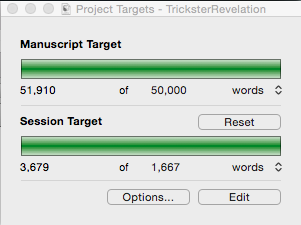
I love this little project targets widget in Scrivener!
But right now, I’m very happy with how much I’ve written and how far the first draft of the third novel in this series has moved. Yay!

This is the first time I’ve used Scrivener’s Project Targets widget. It’s very cool. You set the word count target for the entire project, and Scrivener keeps track of it in the top bar. When you only have a few words written, the bar is red. As the bar grows, it changes to orange, then yellow, then yellow-green, turning a darker and darker green until you reach the goal. The lower bar is for shorter term goals you set. You can reset that bar any time you like, except that it always resets at midnight. Which works nicely with National Novel Writing Month (NaNoWriMo), since writing every day and trying to average 1667 word a day is the goal.

Screen Shot 2014-11-01 at 6.22.05 PMI tweeted screenshots of my project targets over the course of the month, so here’s one of the earliest ones, when the upper bar representing the whole month was still in the red, and that particular day I was just getting into the orange.

November isn’t quite over, yet, and I haven’t reached the end of the novel, so I plan one continuing to work on this for a another day before I switch to the Christmas ghost story.

I also need to post an update on my yearly goals. I haven’t since early October, because everything was focused on NaNoWriMo this month. But I have not forgotten them!

Right now, I’m feeling very happy about the writing.