Tag Archives: news

Skewed polls and secret money

A few days after election night, when the leader of one of the local anti-gay groups conceded that voters had approved marriage equality, he groused about how the pro-gay groups had outspent them three-to-one. Just a week earlier he had been insisting that the polls which were all predicting passage of the referendum were skewed. “People are reluctant to say what they really feel to a pollster, because the pro-sodomy side has tricked the media into calling support of traditional marriage as bigotry. But when those voters are in the privacy of the voting booth, they will vote their true feelings.”

They did vote their true feelings. Fortunately for those of us who believe in equality, they had also been telling their true feelings to the pollsters. Surprise, surprise!

Sadly, I believe it was a complete surprise to the opposers. It shouldn’t have been. They had other evidence, and it was right there in that hypocritical comment he made about spending. It was hypocritical because it had only been four years before, during the Proposition 8 campaign in California that the anti-gay side had been doing the outspending. And for years before that, each ballot measure that came up in any state related to marriage equality or civil unions, it was the anti-gay side that always seemed to have the money advantage.

This time around, in Washington, Maine, Maryland, and Minnesota, the forces of hate came up short both in the ballot box and fundraising. And it wasn’t simply a matter that suddenly our side was better at raising money. No, the big story is that they have, in just the last few years, experienced a serious drop in donations.

It isn’t just the amount of money. What’s more significant is the number of donors. The national organizations have been very secretive about their funding. They have refused, again and again, to reveal their donor lists, even when they appealed all the way to the U.S. Supreme Court and lost, they have tried to keep that secret. Eventually, some details are beginning to emerge:

Each year, according to [the National Organization for Marriage]’s tax filings, two or three donors give NOM between $1 million and $3.5 million apiece; another two or three give between $100,000 and $750,000; and 10 or so others give between $5,000 and $95,000. In 2009 the top five donors made up three fourths of NOM’s budget; in 2010 the top two donors gave two thirds of the year’s total donations; and in 2011 the top two donors gave three fourths of NOM’s total income. But those funders’ identities are a mystery. Their names are redacted on NOM’s federal tax returns.

My emphasis added. Whoever those mysterious top two donors are, their donations have became a larger and larger proportion of the pot, as the thousands who gave less than $5000 dollars a year have dwindled to hundreds.

Statistics tell us the the most vehement opposition comes from the oldest voters, so a percentage of that drop off represents to reality of demographics. As elderly opposers die off, without a compensating proportion of supporters coming up in younger generations, some of that is just inevitable. But the drop off in support to the anti-gay cause in the last three or four years is far in excess of what could be accounted for by mere demographics.

People are changing their minds.

There will always be a hardcore group opposed to equal rights for gay, lesbian, bi, and trans people. Just a couple weeks ago at the big conservative conference a guy stood up and argued in favor of slavery because he believed it was a self-evident truth that whites were superior to blacks. He wasn’t an invited speaker, and to their credit, panelists and audience members challenged him on it, but during the ensuing back and forth he also made a comment to the effect the women shouldn’t have the right to speak up in public, either. So, just like that unrepentant racist and misogynist, there will always be homophobes among us.

But as more of the moderates and non-hateful conservatives come around, that view will be limited to the lunatic fringe where it belongs.

In the months since the vote in Washington, Maine, Maryland, and Minnesota went our way, the opposers’ spokespeople have gone from saying that they were outspent 3-to-1 (which turned out to be a small exaggeration in our state) to claiming they were outspent 4-to-1, then 5-to-1… the last quote I read was “more than 7-to-1.” I believe their exaggerations get worse due to desperation. They hope that skewing their claim of victimhood will prompt more people to donate more money, which they think can turn the tide.

What they don’t understand is that the only skewed “polls” were their own. They fell into the common trap of thinking that because most of the people they know and like agree with them, that it absolutely must be the case the most people, period, do so. They think that since they still manage to raise a lot of money that there is still a lot of support, ignoring the fact that it’s a smaller and smaller number of people sending in the money. Because they are convinced of the truth of their cause, they believe that the only reasons polls and voting can be going against them is some kind of chicanery. They think that calling us pedophiles, comparing our relationships to bestiality or incest is “civil discourse,” but if we call them bigots we’re being bullies.

Most of all, many of them believe all the lies and distortions that they tell about us. Lies that other people can no longer believe once they get to know us:

Part and parcel

A pop musician or movie star gets arrested for driving under the influence and being in possession of an illegal controlled substance. When he or she is sentenced to nothing more than some hours of community service, there may be a bit of an outcry from the public, but thousands still attend the concerts, buy the music, see the movies.

If questioned, the fans might claim that you have to separate the art from the artist. They’re more likely to simply say, “Yeah, but I love the music/movie.” But it’s the same argument. Things that an artist does in their real life has nothing to do with the quality of product itself. Just as it would be inappropriate to claim that a painting is less than worthy of appreciation because the artist happens to be a member of a race other than the majority, a particular piece of art should stand upon its own merits, alone.

That doesn’t mean that we can’t argue that the celebrity doesn’t deserve special treatment before the law. We can compare the punishment given to the celebrity to those typically given to non-celebrities charged with the same crime. We can point out that this prominent person was given a punishment at the very lowest end of the first-offenders sentencing range, even though this is their fifth or sixth or twentieth run-in with the law over substance abuse issues.

We can demand that the special treatment stop. Yes, maybe that movie we’ve been waiting for will have to be delayed (or more likely, made with a different actor), but crimes and irresponsible actions should have consequences, and sometimes those consequences impact people other than the perpetrator.

The aforementioned situation is pretty clear, and not likely to draw a lot of argument on the principles.

It gets less black and white if the actor, musician, or artist is arrested for assault, or worse. How much that changes our perception of his or her work depends upon the nature of the crimes and the nature of their work. It may become difficult to listen to a singer crooning love songs when you know he has been convicted multiple times of domestic abuse against multiple partners, for instance.

Painting is an infinitely minute part of my personality.—Salvador Dali

So far our hypotheticals have been about what an artist does during aspects of their lives that would otherwise be private. What happens when it happens on the stage? Say, for instance, that you’re a C- or D-list singer-songwriter who, early in your career, made statements indicating you were lesbian, and for a couple of decades your fanbase has been predominately lesbian, and you’ve continued to cater to that fanbase even though in your private life you’ve married a conservation fundamentalist Christian man and joined an evangelical church.

And then one night, on stage in a city that most of the world equates with gay people, in between songs you start going on a long, screaming rant about how gay marriage is going to destroy the world, how decriminalizing abortion is the signal of the collapse of civilization, and screaming at the audience members who start walking out that “God hates fags!

I don’t think anybody would argue that other venues you were scheduled to appear at are within their rights to cancel your shows. Politics aside, no one wants to deal with all those angry customers.

Issuing statements afterward that it was meant to be ironic (yet another assault on that poor, abused, misunderstood word), or taken out of context, afterward isn’t going to undo the damage. Particularly with the full video available on the internet and it is quite clear the the context is only hate, hate, more hate, and crazy.

And you can insist you have freedom of speech all you want. Freedom of speech means that you can say what you want without intrference from the government. It doesn’t mean freedom from people being so offended that they choose to stop listening to and buying your music. It doesn’t mean freedom from being criticized. It doesn’t mean freedom from being seen to be a hateful hypocrit whose career is based almost entirely on milking an ambiguous statement that you might be a member of a group of people you despise. Nor does it mean freedom from being labeled a self-loathing closet case in addition to the hypocrit charge.

Assaulting your audience and essentially admitting that you’ve been scamming them for years is another case where things are pretty black and white. There is no reason to separate the art from the artist, because the art is an inherent part of the crime the artist committed.

While I think that Ms Shocked’s tirade was deplorable and revealed that she is a reprehensible, malicious, vulgar louse deserving of our scorn, that wasn’t her biggest crime.

The most awful thing she has done is to produce all that disingenuous music. It is a sin to be a hateful bigot. It is a bigger sin to intentionally produce crap that you don’t believe and call in art.

I’ve known…

On the subject of coming out to one’s parents, I’ve always remembered the story one acquaintance told: “When I finally came out to my mom, she said, ‘I’ve known you were gay since you were two.’ And I thought, ‘Gee, thanks, Mom, why didn’t you tell me? It would have made my teens a lot less confusing!'”

Growing up gay, particularly before the 90s, the best you could hope for if your parents learned you were gay was a reaction like his mother’s. Truth be told, since we had no positive role models, and what little we knew about the family members of gay people were that they were all ashamed or hostile to their gay child, we didn’t even hope for that.

In my early teens I recall whispers about someone’s cousins being kicked out by his parents, for instance. In my later teens I knew one classmate who was accused of being gay whose parents sent him to “reform school.” Another who was actually caught having sex with another guy was kicked out by his parents and wound up living with relatives in another city (how the quarterback of the football team who he was having sex with was able, somehow, to convince everyone in authority that the much smaller, skinnier kid had somehow forced him into the situation is a tale for another post).

When I did come out to my own parents in the early nineties (I was a gainfully employed adult living in my own place in another city, by then), their reaction could best be characterized as, “I never had any clue, I don’t accept it, and someone must have done something to you to make you think this way.”

Even today, we are surprised to hear of anything as loving and accepting from a parent as this letter that a teen-ager in Michigan received this week from his Dad:

 Michigan dad put his son's fears about coming out to rest with this loving letter.
Michigan dad put his son’s fears about coming out to rest with this loving letter.

You can read the story of a teen named Nate, from Michigan, and the note from his Dad in this story.

Note: since apparently I wasn’t being clear: I am not Nate. That isn’t my letter. My father’s reaction was, as noted above, pretty much the opposite of this in every way.

March Forth!

It was spring of my first year in college. I walked into the Math Lab, where I worked, and the administrative assistant looked at me and declared, “March forth!”

“What?”

“It’s the only date on the calendar that is also a command,” she said. “March forth!”

Puns have never really been my thing. I find some of them cute—occasionally even clever—but I almost never think of them on my own. So the joke had never occurred to me. She was flabbergasted that I’d never heard the pun before.

That “March forth!” is an imperative was moderately amusing. I tried in subsequent years to think of something to do with it. Because just pointing out that the day sounds like a command lacks something. And truth be told, about half the time I don’t remember the joke at all until March fifth, by which time it’s too late.

I don’t remember anyone that I ever told the pun too having ever heard it before I mentioned it.

A few years ago, at my previous employer, I wound up on a committee charged with setting up some parties and other fun activities to prop up morale in the work place. Right after someone suggested some activity involving people wearing the shirts of their favorite football team, another co-worker suggested Combat Boot Day. None of us knew what it was.

“When I was in college there was this other girl in my dorm who got us all to wear boots—like Doc Martins or something that could pass for combat boots—on March the fourth. Because it’s March Forth Day. And you March in groups to classes together. And at the end of the day we had a party back in the dorm.”

I had to tell about the admin assistant at my college job who had first told me the March Forth pun and had acted surprised when I didn’t know about the day. But she also hadn’t told me anything to actually do to observe it.

The co-worker said her dorm-mate said it had been an annual thing at her high school. “It was weird, but kind of fun to march around and have people be confused. But now that I say it, I don’t know how we make that an office activity.”

Then I read this rather heartbreaking article: Trauma Sets Female Veterans Adrift Back Home. And I thought, “Okay, here’s something I can do.”

So, this March Forth, I would like to urge everyone to go donate to The National Coalition for Homeless Veterans.

March forth, and spread the word.

As deep as a raindrop

I’m a news junkie.

Back when every town had at least one newspaper, I used to love sitting in the library reading the daily papers of two or three or even four different cities. I could go on and on about the relative merits of Newsweek vs Time magazine. And then once I became an NPR regular listener, I started to really drive my friends crazy.

As news organizations began opening sites on the web, I thought we might be entering a golden age of information. I was so naive… It’s true that now there are thousands of news portals available on the web, the vast majority of them free. Unfortunately, you get what you pay for.

Gathering news, and putting it into a form that is both informative and interesting takes time. I only free-lanced as a journalist for a while, but because my college career included several years as a part-time student, I had a bit more than four years experience working on college newspapers. My experience taught me a few things:

  • Trying to gather all the relevant information, understand it, condense it into a few hundred words, then re-write it when the editor tells you it’s too long, and by the way, your deadline was an hour ago, is exhausting,
  • No one who has never done that ever believes it is that hard, and
  • No one who has never done it ever believes you did it correctly.

It is hard work. It’s impossible to track down every detail, particularly when writing to deadline. And when trying to keep it within a reasonable size, it’s impossible to include all of the details you have tracked down. If you’re an ethical journalist (or at least trying to be one), the harder you try to be impartial just guarantees that more people will accuse you of bias or inaccuracy.

And because people expect the information to be free, very few sites are able to pay anyone enough to justify the work. Most of them are able to generate a small revenue stream thanks to advertising, but that won’t support enough writers with enough time to write much. So most news sites depend heavily on the ability to link to or crib from other sites. Often what little writing does get done for a site is under an agreement that lets the person sell the same story to other sites.

Superficially, this seems similar to the old print days, when competing publications would carry very similar stories about the “big news” events. But there is a difference.

And don’t get me started on the too-long-didn’t-read people.

This profound lack of depth becomes especially noticeable at certain times of the year, such as during the Christmas and New Year holidays when so many people are on vacation, that even the year-in-review slideshows start looking interesting.

This is one reason that I hope Andrew Sullivan’s experiment with a subscription model can begin to pay off. Pay walls haven’t been terribly successful so far, I know. On the other hand, two of my favorite new “shows” of the last year were crowd-funded web series.

I hope someone figures out something. Because I would love to have some reliable places to get news stories with just a bit of depth in them before I go crazy.

Oh, lord, the leaping!

Within minutes of the news of the horrific shooting at an elementary school, the voices of inaction started spreading across the social networks:

  • “Even if you ban all the guns, people can still be killed with other things!”
  • “Why do people start talking about mental health care whenever there’s a violent event?”
  • “Now is not the time to talk about political action. People are just starting to mourn this senseless tragedy.”
  • “Why does the media put so much attention to these things? It only encourages other people to do this so they’ll become famous!”
  • “If only there were more armed citizens, this could be prevented.”

…and so on.

An internet meme is one of the least nuanced ways to discuss anything, but I have to admit that sometimes they raise a good point. Thanks to one failed clownish attempt to take out a jet with a shoe bomb, millions of us are forced to take off our shoes when we go through security at airports. Meanwhile, over 30,000 people are killed by gun violence every year in the U.S., but we can’t even talk about changing any gun regulations?

The air travel security processes that have been imposed on us are a horrific overreaction, don’t reduce the odds of a disaster by a significant amount, and are therefore a colossal waste of time and money. So we shouldn’t duplicate the thinking over there.

But doing nothing after decades of these mass shootings is an even more colossal waste.

The good news is, there are options between the extremes of overreacting and doing nothing.

Will banning assault weapons end violence? Of course not. But think about this: last week, a man went on a rampage and stabbed 22 school children in China, but no one died. Yes, it was a horribly traumatic event. Yes, it is certainly possible to kill someone with a knife, but it is much harder for a single person to inflict deadly wounds on a whole bunch of people in a short time with knives than with an assault rifle. So regulating the sale of certain types of weapons, offering gun buy-back programs, and so forth might save a few thousand lives a year.

Will better mental health options end all violence? No. And the usual argument people make on this point is that most mass shooters have fallen through the cracks of the mental health system. The problem with that argument is that currently, the mental health care system has cracks the size of the Grand Canyon. Nearly everyone falls through the cracks. Let’s get a functioning system together, first, shall we?

The variant on the mental health argument I was quite amused with recently is that, since so few of these shooters survive to be diagnosed, we can’t assume they are mentally ill. One person making this argument insisted that mentally ill people are no more likely than the non-ill to be violent. And as proof said, “Of the 61 mass shooters of the last five years, only 38 exhibited signs of mental illness before the crime, but none had been diagnosed.” Thirty-eight out of sixty-one is 62%. According to the National Institute of Mental Health, only 26% of the population suffer from a diagnosable mental or mood disorder at any time. So 62% seems at least a bit disproportionate.

The “now is not the time” argument is beyond infuriating. If anything, talking about it after a tragedy is too late, certainly not too soon. And silencing the discussion by saying we’re trying to politicize a tragedy? That is politicizing a tragedy. So, stop being a hippocrit, man up, and debate the issue.

The “media creates these events” argument is very tempting. And in more than a few of the cases there is evidence that the person was trying to make a statement, having left behind videos or notes. But you know who else does that sort of thing? Terrorists. And no sane person believes that the guys who flew those planes into the World Trade Center thinks that if only the news hadn’t revealed their names, that they would have never done it.

The “more guns argument” overlooks a few facts. First, there are already more privately owned guns in this country than there are people. We have no shortage of guns available for citizens to defend themselves. Second, one need look only at incidents such as the Lakewood shoot a couple years ago in my state: four armed cops, all experienced, all having been in shooting situations before hand, were at a cafe when an armed guy walked in and started shooting. He wasn’t even armed with an assault rifle, but none of the officers was able to draw and fire back in time to stop him from killing all four. There are dozens of similar cases, and statistics galore that indicate that just having responsible, trained, armed people there doesn’t put a stop to these crimes. In the majority of the cases, even after a large force of armed police arrive, it’s the shooter killing himself that ends the massacre, not the police killing him.

And all of these leaps to unsupportable conclusions are keeping us from tackling any of the sources of the problems that lead these guys (and they are almost all men, usually young men) to do these things. We aren’t willing to talk about our society’s toxic expectations of what masculinity means. We aren’t willing to discuss the correlations between the economic and romantic frustration that many of these mass murderers express before these things happen, and how many of them form alliances with gun-stockpiling, paranoid communities.

We have to stop leaping to conclusions, stop following our gut reactions, and look at the facts. We have to be willing to start seriously implementing multiple changes. We have to be willing to get past the bumper sticker/internet meme rhetoric and talk about the difficult problems.

Otherwise, the senseless deaths are going to just keep happening.

As long as you hold me tight

I’ve been grinning like a loon much of the day.

I have also been crying a lot—tears of joy (and astonishment).

Today the law allowing same sex couples to marry went into effect in our state (having been passed by the legislature, signed by the governor, and finally approved by a 54% majority of voters {in a year where the state at 81% voter turnout, I might add}).

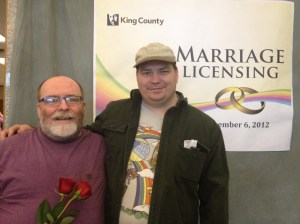
Picture taken by Chelsea Kellogg, reporter for the Stranger.
Michael and I.

For various reasons, we didn’t go to wait in line for the office opening at one minute after midnight. We each took the day off from work and headed downtown after the sun was up and we’d had some breakfast. Since one of the reasons we didn’t want to be standing around outside on a nearly-winter night with rain in the forecast was that Michael still has the cough from our recent bouts with the flu, I let him sleep in. So we got to the county admin building at nearly noon.

I spent the morning reading news blogs and looking at the pictures of couples who had been the first in line at our county and a few others that opened early. They selected some couples to go first in line, such as a sweet pair of ladies who are in their late 70s-early 80s and had been together for over 35 years. Or the two men that age who have been together more than 40. Seeing the picture of one guy pushing his husband-to-be in his wheelchair up to the counter made me cry. There were a lot of pictures like that being posted by the various news outlets.

When we arrived, there wasn’t a big line. We were pointed in the right direction by people at several points, and getting congratulated by all these people. While there wasn’t a line, every workstation was busy with couples getting their licenses. And just as we and another couple were leaving… two more couples came in. So it was at the steady stream point by then.

A reporter from The Stranger asked if she could take our picture and ask a few questions. Since I read their blog every day, of course I was willing to answer questions. The first picture in this post is the one she took.

Us again. Why do I always stand on his right?

In addition to the regular paperwork, we were given a copy of the proclamation signed by the county executive, and various other commemorative items. We were directed out a different door than the way we’d come in, and some more volunteers were there, handing out roses and taking pictures in front of a sign commemorating the first day that marriage equality was the law. They took a few of these with my camera, then one of the others asked if we wanted one of us kissing.

For whatever reason, that was when I started crying for us. All of my tearing up, getting misty-eyed, and full-fledged crying earlier in the day had been for other people. This was the one where it finally hit me in the gut: the most wonderful man in the world has not only been living with me and putting up with me for nearly 15 years, but finally we’re going to be married. Not civilly united, or domestically partnered, or any of those other names, but married. Part of my astonishment is the simple fact that this wonderful guy actually wants to be saddled with me. I mean, yes, we’ve been together nearly 15 years (it will be 15 in February), and he’s had ample opportunity to run for the hills and hasn’t. But you have to understand, I don’t completely get why he puts up with me. Seriously, there are times I can’t stand to be around me, so I know for a fact I am not easy to live with!

Fortunately, Micheal's hat is hiding my tears.
Fortunately, Micheal’s hat is hiding my tears.

And there were more people waiting outside. We were offered donuts. There were also people handing out business cards and promotional fliers for wedding-related services. That’s to be expected, obviously. And I’m not complaining. Thanks to the fliers I’ve found several possible places to rent for our reception that I didn’t even know existed.

There were no protestors, though. I had kind of expected some. There are always a few of those people with the old testament signs and such at events like the Pride parade, so I just figured they’d turn out for this. Then when we saw that the line was shrunk to the trickle, I thought that protestors had left. I didn’t find out until we were back home that the reporter was there taking more pictures, after the big lines were through, because there had been a rumor that a group was coming to protest. Apparently they never showed up.

While we were walking back to the bus stop, a random woman on the sidewalk saw the roses, looked at us, grinned, and said, “Congratulations!”

I’ve violated one of my rules and dived into the comments sections of some of those news sites posting the pictures. And the amazing thing is how very few haters are commenting there. In the ones I looked at, if there were negative comments at all, for every 1 negative comment there were easily 20 comments from people saying how happy the pictures make them feel, with lots of mentions of people needing to grab a tissue. And a number of people going out of their way to say things like, “I want to say for the record, that I don’t believe any of these couples has in any way diminished my heterosexual marriage.”

I thought I was emotionally overwhelmed when the Referendum passed, and when I thought about all those straight people who voted for it. But it feels more overwhelming now. I guess going in and getting the license finally is making it feel real.

We have a three-day waiting period. We’re going to have a simple ceremony with friends this Sunday. We’re calling this the Elopement. I want to get the legal stuff handled as quickly as possible, if for no other reason than that I can finally add Michael to the much better medical and dental at my work. So this is the legal thing. And I know some of our friends will be there, and it will be fun and happy.

But the real purpose of a wedding is to allow your extended community of friends and family in on it. I don’t just mean the celebration. I believe that what makes marriage sacred is not that two people have made a pledge before some deity, it is because a group of people have committed to support two people in their love. When I attend someone’s wedding, I’m entering into a covenant with them and the other attendees, affirming a particular loving relationship, but also affirming the power of love itself. It’s a commitment to the extended ties that bind all of us together in circles of mutual affection and respect.

Which is why, yes, we’re planning something bigger and a bit more formal later next year.

And there will most definitely be a party.

Grateful, not resentful

Many years ago, when I was either still attending university or during that first couple years after, while visiting my mom for one of the holidays, she handed me a manila envelope. “I was cleaning some things out, and I found these papers. I don’t know if they’re important, but it’s old school things I thought you might like.”

My mom is one of the people from whom I inherited my own packrat tendencies (which I have been fighting most of my adult life), so I knew if I looked at them while she was watching and decided they weren’t worth keeping, that she would retrieve them and hang onto them for years. So I always took whatever weird stuff she offered me and waited until I got home to review it.

The envelope contained about 20 sheets of paper. Two were report cards from different grades. Neither was an official end-of-term report card. Both were midterm “advisory” report cards. “Your child’s grade will probably be this if work does not change.” Most of the other papers were even less archive-worthy. Most contained no person information at all: announcements about an upcoming parent-teacher night, for instance.

But there were a couple that were revelations. There was a letter to my parents explaining that our family qualified to have a charity pay for my first pair of eyeglasses back in grade school. There were some papers related to a free lunch program during another part of grade school.

Until I read those papers, I had had no idea. I remembered, during those particular grades, that about once a month Mom would hand me a sealed envelope which I had to take to the school office, where I would be given lunch tickets for myself and my little sister. I thought everyone’s parents had to fill out a couple forms for lunch tickets. And I guess I just assumed there was a cheque in there, somewhere.

I knew that there were things we couldn’t afford. But other kids’ parents were also frequently saying, “We can’t afford that” or “When you get a job and can pay for it yourself, you can have a fill-in-the-blank.” So I didn’t think much about it. It never occurred to me that we were poor.

Of course, we couldn’t be poor! Poor people lived in shacks or in ghettos. We lived in ordinary parts of each of the small towns we moved to as my dad’s work demanded. We owned a car and a pickup truck. Poor people didn’t have jobs, or didn’t have regular jobs, anyway. They were always begging or looking for work. Or if they were “bad, lazy poor people” they were always waiting for their next Welfare cheque. My dad had a job. He’d been working for the same company for as long as I could remember, so we couldn’t be poor. We just weren’t rich, that’s all.

Certainly by the time I was in High School I had a much better idea of the broad spectrum of economic status that families inhabited. I understood that most of my childhood my dad had been “working class” rather than true middle class. But I also knew that the old lower, middle, and upper class division of economic status was a gross oversimplification.

And somehow, I had never figured out that we had taken assistance. I think the shock was mostly because of how hotly my dad frequently ranted about the evils of people who depended on charity. The almost stereotypical way he sneered at programs like welfare and food stamps because they “took money from hard working people.”

That attitude, which was frequently echoed by other adults in my community—especially at church social functions—had always seemed weird to me. During Sunday School lessons or the Sunday sermon, we would be taught that Jesus expected us to feed the hungry, clothe the poor, and take care of the sick. Yet at the church potluck, people who actually took handouts were talked about almost as if they were in league with the devil.

Why the resentment? Everyone needs help some time. There should be no shame in needing a hand of any kind (I hate that cliche about hand-up vs handout) once in a while. The proper response to getting a little help is gratitude. And the proper response when you have been the one helping, is to tell the person, “if you want to pay me back, just promise when you see someone else who needs help, you’ll offer what you can.”

Resentment and condescencion corrupt and destroy the soul, leaving only emptiness behind.

Gratitude and charity do the opposite.

So, go feed your soul.

Get me to the church on time!

One of my favorite scenes in the movie Jeffrey is where a priest, played by Nathan Lane, explains to the protagonist that the protagonist’s ideas about god came from the album cover of the original cast recording of My Fair Lady. He further claims it’s where most gay men got their notions about god.

My Fair Lady Original Cast AlbumHis reasoning is: most parents in the 50s and 60s had a copy of the album*, most gay kids went through at least a phase of listening to musical soundtracks (and even if they didn’t, they all at least saw the cover art), most kids didn’t realize that the man in the clouds on the cover art manipulating the stars like puppets on strings was supposed to be George Bernard Shaw (the man who wrote the play upon which the musical was based), they believed it was god. “It was your parents’ album. You were little. You thought it was god!” Then he goes on to explain that god doesn’t run the world like that.

Part of why that scene cracked me up is because I did go through a phase of listening to the soundtracks of musicals—musicals that in many cases I had never seen. I’m not completely sure why my folks owned several sound track albums, but they did. I do know that my mom had a tendency, if she saw a movie adaptation of a musical, to buy the original broadway cast album instead of the movie album. Anyway, My Fair Lady was one of those albums that I listened to a lot as a kid, but I had never seen the show.

I wound up making up my own version of what happened between the songs. I also imagined my own versions of the choreography and costumes, guided by whatever photographs were part of the album cover, or in some cases, versions of the songs I’d seen on TV. There were a lot of musical variety shows on the air when I was a kid, and stars of movies and broadway shows would often be guests on the variety programs, and might perform a version of (or parody of) a scene from the musical, with regulars from the variety show filling in for various characters.

So in my head, the song “Get Me To the Church On Time” was not primarily about the wild last night of partying that Eliza Doolittle’s long-widowed father wanted to have before he married in the morning. I didn’t know enough of the play to know the context, for one. I think the album only identified the character as “Alfie” so I had no way to know he was supposed to by Eliza’s father. The lyrics talk about having a whopper, and kicking up a rumpus, but somehow I thought it was about celebrating the marriage itself—partying because he was overjoyed to be getting married, rather than a last night of debauchery because he would never be having fun again.

It was also about all the people around him, friends and strangers alike, joining in on the joy and exaltation.

It’s that imagined version of the song and dance that kept popping up in my head last Tuesday night as I saw that Marriage Equality was winning at the ballot box. It was that image of friends, family, neighbors, and complete strangers shouting “hurray!” that came to mind as I thought of the hundreds of straight people who manned those phone banks—calling strangers and patiently explaining that the law explicitly exempted churches and religious institutions from performing same sex marriages (not that the law needed it, it’s already established in other laws and court decisions; churches can choose to turn away opposite sex couples for whatever religious reason they want, too). The thousands of straight people who donated to the campaigns. The thousands of straight people who urged neighbors, co-workers, and family members to give equality a chance. The hundreds of thousands of straight people who voted that way.

Depending on which statistics you believe, gays and lesbians make up somewhere between 3 and 10 percent of the population. There’s no way we could have voted this in for ourselves. There’s no way we could have handled all of the ground game: the canvassing, the pamphleting, the phone banking, and so on.

It was my imaginary version of “Get Me to the Church on Time” that was playing in my head when straight friends told me, “I thought of you and Michael while I was filling out my ballot.” It was the soundtrack to the images I saw on TV of the straight couples joining in the party at the campaign headquarters on the news.

It’s what comes to mind when I re-watch the tearful speech of the straight, Republican state senator explaining why she was voting for the law that kicked this off last spring. Or when I read stories of the way, the last few years, many straight couples have taken a moment in their wedding ceremonies to acknowledge that they have friends and loved ones who are denied the right to choose to enter this important institution, and asking their guests to join the fight for equality.

Yes, part of the reason there were tears in my eyes on Tuesday night when I saw the news that marriage equality had won in Maine, and then in Maryland, and that it was leading in my home state of Washington was because I’m looking forward to finally getting to marry (rather than “domestically partner”???) Michael. But that was only part of it.

The rest of those tears of joy was the realization that a majority of my fellow citizens–not just my fellow homos, or my friends, but a bunch of people who don’t know me–has our back.

Thank you.

And I hope you all get invited to a lot of weddings, because you deserve to celebrate with us.

UPDATE: I started this the morning after Election Night. Because of craziness at work, I didn’t finish it until a day later. And I didn’t see this column by Dan Savage on the same topic until Thursday night. His is definitely worth a read.


* Remember, Jeffery is a comedy, it’s not a real statistic.

It’s not just speech…

When I proposed to Michael, I didn’t ask him to move in with me. He had said “yes” to my proposal, but he lived and worked in a different city, and my late husband had died less than a year before, so we were both a little nervous about rushing into things. Therefore, at the time of the proposal, we agreed we’d wait a year before taking the more drastic step.

But about six months later, one of his housemates started behaving strangely, such as going through Michael’s stuff when he was away (and more creepy things). Suddenly the thought of Michael being there was completely unacceptable. I didn’t care if it seemed like we were rushing, all I could think of was that I needed to get him somewhere safe.

Never mind that he, as one friend recently described him, is “the most capable person I’ve ever known.” Never mind that his job history has included being a bouncer at a bar, or that his past hobbies included bull-riding. No matter how tough, smart, or capable he is, the thought of him being in an unsafe place made me a bit irrational.

Fourteen-and-a-half years later, we’re still together—happily so. I guess we weren’t rushing, eh?

During that time, we’ve registered our domestic partnership—first with the city, because the state didn’t allow it. Then later, once the state did allow it, with the state. Thanks to a voter-approved referendum, in our state that partnership now carries all the legal rights and responsibilities of marriage. So we can jointly own property, we are allowed to make medical decision for each other if one of us in incapacitated (assuming we don’t run into a hospital worker who doesn’t understand what the domestic partnership law means), and if one of us dies, the survivor doesn’t have to produce proof that he paid for half or more of anything or lose it to the other’s blood relatives (because it’s all by default community property).

Unfortunately, even in a state with strong domestic partner laws, there are still a lot of inequalities.

I’m older than Michael, and have some chronic health issues. It is likely he will outlive me. By chance, I also earn more money than he does. If something were to happen to me, he would be put in a financial bind. Yes, I have life insurance, so there will be a bit of a cushion, but because what we have isn’t recognized on the federal level as a marriage, he would not be entitled to survivor benefits from social security. If he remains single after my death, when he decides to retire, his benefits will be calculated solely on his own earnings.

If our relationship was legally recognized, all of that changes. He would be entitled to survivor benefits under some circumstances. When it came time to retire, he would be entitled to benefits based on my years of earning.

Before you make an argument about the sanctity of marriage, consider this: if, on my deathbed, I was to have a quicky marriage with a woman someone selects completely randomly, the ceremony and signing completed literally seconds before my death, she would be entitled to all those benefits. Never mind that we didn’t know each other. Never mind that no defininition of sacred would encompass that random person standing by my hospital bed.

Legal marriage isn’t about sanctity. Legal marriage isn’t about forcing churches to do anything. Right now, two people who have been divorced can legally marry in all fifty states (so long as they are opposite gender). If they ask a Catholic priest to perform the ceremony, he will turn them down, because the church doesn’t believe in divorce. It happens a lot. The fact that the law recognizes re-marriages has not and will not open the church to being sued. Just as a church can choose not to perform a wedding if, for example, one of the members belongs to a completely different faith.

And before you bring up that story about the “church” that got in trouble about a same sex marriage a couple years ago: 1) it wasn’t a church, it was a separate business set up by a ministry as a fundraising activity, 2) when they set up the business, they applied for an exemption from paying property taxes on a small park and pavilion that they intended to rent out for events, 3) the exemption required them to sign an agreement which explicitly said that they would run the business as a public accomodation, and that they would not refuse to rent to any member of the public on the basis of race, religion, political affiliation, creed, ethnicity, gender, or sexual orientation, 4) this agreement that they signed had to be renewed every year, and they had to, every year, re-affirm that they would not refuse to rent the park and pavilion to anyone on the basis of race, religion, political affiliation, creed, gender, or sexual orientation or the park and pavilion would cease to be tax exempt.

And then they told a lesbian couple that the couple could not rent the pavillion because they were opposed to same sex marriage and anything like it.

That’s when the one selected parcel of land lost its tax exemption. The parent ministry was not fined, it did not lose its tax exempt status. The church that many members belonged to did not lose its tax exempt status and did not face any fines or retribution. The only thing that happened was that the side business had to start paying taxes, just like any other business.

It is true that as marriage equality moves forward at the state level, people who don’t approve of it will see neighbors, co-workers, and strangers enter into legal marriages and in legal ways be treated just like the other kinds of marriage. That will include, sometimes, having to do business with these couples and treat them, in terms of publicly transacted business and such, just like any other married couple. Which will make them uncomfortable.

Being comfortable is not a legal right.

Asking the law to allow you to discriminate is not just speech. Preventing someone from renting a home is not just speech. Barring someone from the hospital bedside of their partner is not just speech. Barring some couples from tax benefits is not just speech. Encouraging parents to literally throw their gay, lesbian, or bisexual teen-agers out on the street—telling them that abandoning their own children and making them homeless is the correct, biblical thing to do—is not just speech.