Tag Archives: people

Too close to home

SuperStock.com
Not all natural habitats are equal.
My current “pocket book” is a memoir by a gay man who, like me, was raised in a very evangelical fundamentalist family. I’d read reviews of the book when it first came out, and they all emphasized his humorous recollection of often painful situations. Then just before Christmas, the author was a guest on a podcast I listen to, and the host mentioned the book again, repeating the hilarity of his approach to the topic.

And I was just wrapping up another book and thinking I would need to download a new e-book to my phone to be the next “pocket” book. So guess what book I bought?

I didn’t start reading it right way. Once I finished my previous book, I started listening to audiobooks of various holiday favorites during my usual read on the bus time. So I just started reading it this week.

So far, it’s been too painful to be funny.

Continue reading Too close to home

Bleak midwinter

Cat hissing.
Having a bad day?
It’s been a while since I heard the old myth, so I was a little surprised when a detective show I watch had the medical examiner character refer to Christmas as “Suicide Season.” That myth (based on the notions that the cheerfulness {forced or otherwise} of the holidays the makes depressed people more starkly aware of their situation) and the associated one that the stress of the holidays literal drives people crazy, have both been debunked by numerous studies.

It’s not just that suicide rates don’t go up, nor merely that psychiatric admissions don’t go up. The studies show that suicide rates actually go down at each major holiday, and that psychiatric admissions reach their lowest point in the weeks immediately before Christmas.

Continue reading Bleak midwinter

If you meet them all day…

Cartoon: If you see an asshole in the morning, you've seen an asshole. If you see assholes all day, you're the asshole.In the opening episode of season four of Justified, Deputy U.S. Marshall Raylan Givens tells a criminal he has locked in his trunk, “If you meet an asshole in the morning, you met an asshole. If you meet assholes all day, you’re the asshole.” I had never heard that saying before, but I had become familiar with the principle.

I have seen it again and again. Many times, through the various fandoms and other activities I’m involved with, I meet people who are always saying that most people are awful. Most of their co-workers are incompetent or are constantly undermining them. And this experience is repeated every time they change jobs. Every relationship they get into falls apart. Most of their former friends betrayed them or let them down in some way, and they have almost no long term friends. They like to go on about all the reasons that they would be a good catch, and they don’t understand why no one will date them. They grumble about the fact that no one likes nice guys.

And just about every time when I get a chance to get to know these people who have all these horror stories, they act like jerks.

The problem is that they have confused “being civil in expectation of being rewarded” with being genuinely good. They have confused “what can this person do for me” with being genuinely interested.

Now, don’t get me wrong. I’m not saying that everyone who has bad experiences with friend, dates, or co-workers is a jerk. Everyone has bad things happen to them. We all have had to work with or be around people who are less than wonderful—sometimes even quite awful people.

However, if nearly every person you have ever worked with at every workplace is incapable of completing tasks correctly, or is uncooperative, conspires against you, is unappreciative of your skills, takes credit for your work, or always unfairly assigns blame to you, you need to take a good hard look in the mirror.

If virtually every person who have ever been romantically involved with cheated on you, or was “crazy,” or never appreciated you, or always demanded sacrifice from you without any reciprocation, or caused all the problems in the relationship, you need to learn to take an objective self assessment.

If time after time nearly everyone you befriend turns into a demanding jerk, or never has time for you, or is only available when they want something from you, is always critical, is never supportive, or otherwise betrayed you again and again, you need to re-evaluate your choices.

Experiencing such a string of similar bad situations isn’t proof positive that you’re a world-class jerk. It’s possible that you are a really bad judge of character. It’s possible that you have such low self-esteem that your opinion becomes a self-fulfilling prophecy. It’s possible that you are sabotaging yourself in some other way.

But when everyone is letting you down in every situation, there is no chance that you aren’t contributing to the situation in some way.

Many jerks are sincerely unaware of just how badly they treat others. Being a jerk isn’t just about calling people bad names, or stealing from them, or physically assaulting them. There are so many ways you can disrespect people.

For instance, a friend might hear that you’re looking for a new job, and puts in a good word for you at their workplace when you apply. Then you blow off the interview because something else came up, or you forgot what day it was, or whatever. You think that it didn’t cost your friend anything, but they’ve now lost some credibility with their employer. Now any time they recommend anything, or simply report about an issue at work, there will be a tendency on the part of their supervisor to doubt them, because they were wrong about you. You do something like that to someone, and they are going to be very reluctant do extend any favors to you again.

It was most strongly driven home for me when, after dating a bunch of guys that kept not working out in very similar ways, I finally had to admit that the only thing they all had in common was that I had picked them. I couldn’t control how a guy was going to feel about me, but I did have control over who I asked out or who I said yes to.

Everyone vents. Everyone shares frustrations and disappointments. I am as guilty of that as anyone. But when all you have is frustration and disappointment, when there is never any redeeming friendship, acquaintance, or association, you need to stop complaining, stop blaming, and figure out what thing about yourself needs to change.

Bullied bullies, part 1

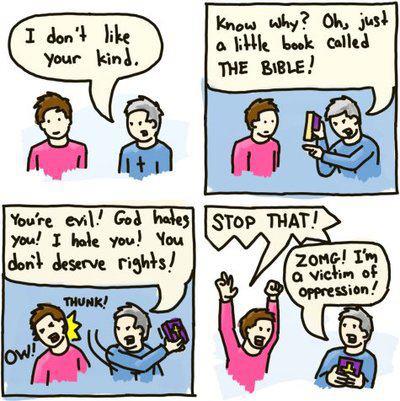
Cartoon about abusers claiming to be abused.
A literal bible thumper!
Anti-gay activists have been claiming to be the victim of bullying and oppression for a long time. The go-to response when anyone points out their intolerant attitude has always been to accuse that person of being intolerant. So in one sense this isn’t new. But the attempts to paint themselves as victims have escalated lately, including being invoked as a “justification” for the political action branches of these anti-gay organizations to ignore, violate, or only half-heartedly comply with campaign finance disclosure laws and tax filings.

Last week a new claim began making the rounds: that anti-Christian hate crimes were now happening as often as anti-gay hate crimes. A claim that the numbers just don’t support…

Continue reading Bullied bullies, part 1

Rough, manly sport, part 4

We’re in the middle of football season, so I am watching games each week. I’ve written before about the complicated relationship I have with football. This week it was impossible to watch the games without having those issues front and center.

Two Miami Dolphins players have been in the news. Jonathan Martin has left the team, is getting treatment for stress-related illness, and is entering counseling. After which Richie Incognito has been suspended for allegedly harassing and bullying Martin to a level that goes beyond what is expected. Each of them has ended up with a lawyer and who knows where this will end. The voice mail messages and texts that Incognito left for Martin which have been seen and leaked do not paint a pretty picture…

Continue reading Rough, manly sport, part 4

“Why’d ya do it?”

Ant colonies in temperate regions will close off all the entrances to the colony at night to prevent the interior temperature from dropping to fatal levels. In order to properly seal the entrances, a small number of ants have to push material into the entrance and pack it down from outside. Trapped outside, they die when the temperature drops. Their sacrifice contributes to the ongoing survival of the colony, so from a genetics and evolutionary viewpoint, the death of a few members of the colony is a good thing.

Not that the ant actually thinks of that. They aren’t nobly volunteering to make this sacrifice for the rest of the colony. The species has evolved a series of behaviors in response to various stimuli, and they just do it when it’s time.

When a person like me—a very analytical guy prone to introspection, and who watches everything amd everyone looking for patterns and drawing conclusions—talks about the behavior of other people, the reasons I ascribe for their behavior are an awful lot like our academic analysis of the ants. We understand the benefit which the colony as a whole gains from the sacrifice of a few ants, but the ant doesn’t.

Most of people don’t spend a lot of time thinking about why we do the things we do. Even someone as notoriously over-analytical as me doesn’t spend much time thinking about why I’m doing something while I’m doing it. A person on the street asks me a question, and I answer. How I answer, from my tone of voice, to my body posture and facial expressions, are the result of a complicated process going on mostly unconsciously.

If I saw the person before they asked the question, likely part of my brain did an assessment of them based on how they looked and acted. I may be in a slightly defensive mode if my brain has seen similarities between them and people who have harassed me on the street in the past, for instance. I will be very defensive if my subconscious assessment has tagged them as a certain kind of prostelytizing jerk (lately more likely to be some sort of teabaggy political sort, but I’ve also been harassed by nuts of a religious variety).

I may feel quite friendly and welcoming if I recognize them—even if it is only as a stranger who has nodded and said, “good morning” when we’ve passed on that street before.

Similarly, how they behave toward me is going to be influenced by their own subconscious assessment of me based on the same sort of superficial features. I’m a short, overweight, grey-bearded white guy. Depending on the other person’s past experiences, that might mean I look harmless, or annoying, or potentially a source of unwanted attention.

So they might frown at me because I seem likely to cause them some annoyance or inconvenience. Or they may only appear to be frowning at me, but they are actually just trying to figure out what is written on the t-shirt of a person walking behind me. Or maybe they’re just squinting because of a blinding reflection from the windows on a building across the street.

So, if when they ask me a question, my tone of voice might sound annoyed or even angry, while inside I’m only aware that I’m worried that this person is going to make me late. And because I sound angry, they may give me a less than enthusiastic thank you after I give them directions to the place they can’t find.

And we both walk away thinking the other person was rude.

I try to remind myself of that when I rant about someone like the guy on the bus last week. I remember the experience from my perspective. Which has its own biases. Maybe I was the one giving off attitude and expecting other people to respect my wish to listen to my music and read my book.

Missed signals and entitlement

Otter with his paw up.
“No, thanks. I’m fine.”
Before overhearing the conversation the other night, where I heard a young man cajoling a woman of his acquaintance for not liking one of their mutual acquaintances enough to date him, I had been thinking of the many ways that we are all socialized to accept, excuse, and even enable a lot of socially aggressive behavior from guys. And also how we, as guys, are socialized to aggressively take what we think is ours.

It started at the end of a previous weekend, but I’m going to save that story for later, because it involves a topic that causes some people to stop listening and start arguing. Instead, I will start nearer the end of the week, and rant about bit about a guy on the bus…

Continue reading Missed signals and entitlement

“Why don’t you like him?”

Creepy smiling guy with "I like your hair, it smells nice"
A creepy guy meme.
I now know who the creeper/proto-rapist in my neighbors’ social group.

I was half asleep late Friday/early Saturday, when a vehicle pulled into the driveway between our building and the next one. I heard the voice of the 20-something guy that lives with his girlfriend in the unit behind us talking with several other people of both genders while they unloaded something from the vehicle with the engine still running.

As the number of voices dwindled down to just a woman I didn’t know and the neighbor (I believe she was driving the vehicle and the other friends were from a separate vehicle out on the street, perhaps?). The neighbor suddenly asks, “So are you going to go out with Adam?”

And she replied, “I don’t like Adam.”

“Why not? He’s a nice guy!”

“He always acts creepy around me.”

“Oh, he doesn’t mean anything by it…”

“I don’t like him.”

“Why don’t you like him?”

Ah! There we have it. The classic attitude guys have been socialized to have when other guys of their acquaintance sexually harass, touch without permission, and otherwise creep on girls of their acquaintance.

Otherwise known as, rape culture…

Continue reading “Why don’t you like him?”

That’s not what persecuted means

I have restrained myself from commenting on the nonsense that one branch of one party put us through with 16 days of what amounted to extortion, but there is at least one incident about the recent craziness in Congress that I have to comment upon: Stenographer in U.S. Congress disrupts debt ceiling vote to rant about Jesus or House Stenographer Seizes Microphone In Bizarre Rant.

So this woman, whose job it is to record the official things said in the House of Representatives, at the end of a 16-day fiasco that cost taxpayers billions of dollars, put hundreds of thousands of people temporarily out of work, cost the economy much more, contributed to some needless deaths, and very nearly put the credit of the entire nation in jeopardy, in the moments before a last minute vote to bring said idiocy to a close, she rushes the microphone and begins ranting about Freemasons and how the country ought to be a Christian nation but isn’t and “praise Jesus!”

When I say “rant,” I mean that it was, vehement, immoderate, and exceeding normal parameters of behavior. Continue reading That’s not what persecuted means

Why is it always an “agenda”?

So, an incident happens in the workplace. One person is late. Another person who is irritated that the other person is late, and is griping about having to wait. A co-worker suggests they just chill out and wait. The grumbler gets a bit angrier and makes a comment to the effect that he is tired of always having to wait for “that faggot.” The co-worker takes offense at the comment, the grumbler gets even angrier and grabs the co-worker by the throat.

Other co-workers break up the scuffle, everyone separates to cool off. The late person arrives and eventually people are back to work.

Would anyone be surprised after such a thing happening in a workplace, that the person who grabbed a co-worker by the throat and referred to another co-worker (in front of witnesses) as a faggot received some kind of discipline?

No, we wouldn’t.

And if the person who had both physically assaulted one co-worker and verbally assaulted another, then goes public and insists it was just a joke, would we be surprised if other people in the industry begin to be a bit wary in the presence of the person?

Then nearly all the rest of the co-workers, including the guy who was assaulted and the guy who was called a faggot try to minimize the incident. “Sometimes tensions get high.” “People say things that they regret.” When that happens, you would expect the first guy to be grateful that people are trying to let him get past it. You wouldn’t expect him to, at a public event, in front of reporters and with TV cameras rolling, to suddenly say, “I’m just glad we’ve all stopped talking about me allegedly calling him a faggot!”

But this is exactly what actor Isaiah Washington did three years ago. It resulted in him losing that job. He dropped out of sight for a few years. And this week he resurfaced and gave an interview in which he says:

“After the incident at the Golden Globes everything just fell apart. It literally stopped. Whatever the agenda, whatever the plan was it worked. I lost everything. I couldn’t afford to have an agent. I couldn’t afford to have a publicist for the crisis management to continue. I couldn’t afford to continue. I went from 2 million dollars a year to residual checks. Zero. I couldn’t get another apartment after I turned in my lease for my $3 million home. I had to put it in my wife’s name. No one wanted to touch the name of Isaiah Washington for three years.”

And everyone is supposed to be sorry, because it was just some silly incident, right? I mean, the poor man lost a 2-million dollar a year job, and had to survive on just $200,000 a year in residuals. All because of one thing he said at the silly awards show. Then the whole thing becomes “an agenda.” Like there was some sort of conspiracy aimed just at him.

There are still people trying to portray this as some sort of “he said, he said” thing. One of the problems is that Mr. Washington’s story has changed several times. At first he said the scuffle on set didn’t happen. Then he tried to make jokes about the scuffle, but insisted the word “faggot” hadn’t been mentioned. Then he admitted he used “an unacceptable slur” when he was tired and angry, but insisted that he wasn’t really like that.

Then he used the slur again, with a big grin on his face, in front of the cameras. Yes, it was at an awards presentation where just about everyone had been drinking. And also he was denying that he had used the slur, but it was a comment completely out of context, and rolled so easily off his tongue that it gave a very different impression.

And here’s the thing about both anger and alcohol: they don’t force you to say things that you have never, ever thought before. They do lower inhibitions and make it more likely that you’ll say things you ordinarily wouldn’t say. But those things will be things that you think all the time.

So it isn’t an agenda. A lot of people would understandably be uncomfortable being around someone like that after a series of incidents like those. Particularly given how poorly he handled the apology, and even re-ignited the issue when it was beginning to look like it might blow over, it shouldn’t surprise him that other production companies are going to be reluctant to hire him. No one wants a similar incident, right?

Now, to be fair, I’ll admit that there used to be a conspiracy around these things. It used to be the case that a straight man could count on getting away with calling a co-worker a faggot without facing any consequences. Plenty of workplaces still overlook that sort of thing all the time.

For a long time there’s been an unspoken agreement that real men can literally push other people around and call them names like “faggot” with impunity. Because that’s the sort of thing “real men” do when they’re stressed and angry. Other “real men” are supposed to just laugh it off and move on as if nothing happened—because nothing out of the ordinary did.

That “real men” conspiracy is starting to break down. And I imagine that when Mr. Washington found himself in a place where everyone didn’t just laugh and move on it did feel as if people were out to get him.

Everyone is difficult to work with at least some of the time. Those of us who weren’t there don’t know what he’s like day-in and day-out. But the series of events which are not in dispute, including the series of unconvincing and changing apologies, indicates a pattern of behaviors. I suspect, therefore, that there are many, many other incidents over the years of his career that we never heard about. So, of course people are reluctant to hire him.

There’s no agenda. There are only consequences.