Tag Archives: people

Getting it right

I sat down to gripe a bit about news coverage, beating dead horses, and about being annoyed at people worrying about the wrong thing. That last one deserves a more thoughtful post than I would write today, seeing as I’m a little cranky—having forgotten to stop at the store to pick up my allergy meds last night, which I ran out of the day before.

I was trying to find a particular old story to link to, and instead happened across another one that I hadn’t read in a while. An acquaintance in one of the fan communities I’m active in was working as a reporter years ago, and had been assigned to do a story about the anniversary of a news event that had happened before she was born. She thought it was going to be a simple assignment, until… well, you need to go read it.

No, really, you do: I Remember Townsend….

The only other thing I have worth saying today: two good friends of mine happen to have fathers whose birthday is today. Lots of people have a birthday or wedding anniversary today, of course. To all of them I just want to say, “I’m sorry that we as a society have stolen your special day, and spend so much energy re-processing and politicizing that one event. Happy birthday/anniversary.”

It’s not your decision

I lot of people were sharing a blog post last week by Gavin Aung Than called “BILL WATTERSON: A cartoonist’s advice.” Watterson is the creator of Calvin and Hobbes, and Than being a web cartoonist, has long admired him. I read someone else’s re-blog of the text and tweeted it out to my followers. I didn’t realize that the text was only part of the post. He also drew a comic in Bill Watterson’s style, using excerpts for a commencement speech Watterson gave way back in 1990.

It’s an awesome cartoon and you should go look at it.

In the accompanying post, Than quotes some things Watterson wrote by way of introduction to The Complete Calvin and Hobbes.

As the blog was linked and re-linked, I saw a few people, some of them Big-ish Name types, who seemed to be angry about Watterson’s decision, made years ago, never to license Calvin and Hobbes for any merchandising. There were never any Hobbes dolls on store shelves, never any Calvin and Hobbes lunch boxes or action figures. Just the comic strips, and various books collecting those strips together.

Watterson stopped writing and drawing the strip years ago, and because he refused to license either the characters or the strip, that means that Calvin and Hobbes came to an end.

The angry people take issue with Watterson’s decision (made many years ago) to eschew merchandising deals. If I follow their logic, they think it is hypocritical of Watterson not to license his property because the book collections are a form of merchandising. If he was willing to publish books, then why object to anything else?

I have several responses to that, but I’ll try to keep it to three:

1. Reprinting is not merchandising. The original strip was visual art and text published in newspapers. The books were collections of the exact same visual art and text. Republishing your original art exactly as it was is not the same thing as letting someone else make action figures which may include things you would have never had the characters use, for instance.

When this was pointed out, I saw at least one commentary complain bitterly about the fact that a certain number of unlicensed window clings are out there, showing Calvin pissing on a corporate logo, or praying in front of a cross. “And that’s all we’ve got!” Unlicensed things will happen whether Watterson licensed the characters or not. That is happening outside of his control, and it seems more than a bit illogical to blame him for that.

But the heart of the objection is revealed in that “that’s all we’ve got!” In other words, they’re angry because they can’t buy those hypothetical lunchboxes or dolls. This gets me to the second point, in which I will paraphrase Neil Gaiman:

2. Bill Watterson is not our bitch. Neil Gaiman famously explained to a fan who was complaining about George R.R. Martin not writing the next Game of Thrones novel as soon as the fan wanted that he isn’t entitled to complain. To translate Neil’s argument here: the people are complaining about Watterson’s decision as if their reading of the strip and/or buying the books constituted a contract: they bought the books, and now Watterson is obligated to do everything in his power to create (or allow to be created) things that they want.

Bill Watterson doesn’t owe us anything. While he was still creating the script, he did his best to tell us an engaging story. That is the only obligation any artist has to their audience: to do their best. He created characters that millions of people loved, and he told stories about them that millions of people enjoyed. How can you complain about that?

3. Bill Watterson’s life is his to live as he chooses. We don’t get to dictate what project he undertakes or what goals he pursues. He chose to end the story of Calvin and Hobbes while it was still doing well, because he didn’t want the quality of the stories to degrade, as has happened with other series which continued too long. In doing that, he was still fulfilling the only obligation he had: he was doing his best. He knew that continuing the story would not be his best. So he stopped.

We can disagree with his choice. We can be disappointed that there isn’t another Calvin and Hobbes strip, or a Calvin and Hobbes movie, or whatever. But we aren’t entitled to begrudge his choice.

You liked his work? You are free to re-read it. You want something new? There are artists out there creating new stuff. Go find something you like, and support a new artist or writer or singer or dancer or something.

I would usually at this point proceed to advise, “if you can’t find something you like, maybe you need to try creating something of your own, not fan art or fan fiction, but something that’s yours.”

Except the sorts of people who feel as entitled as these complainers do, they need to work out their overblown entitlement issues before they can create anything worth our time and attention.

Cousins, part 2

Sometimes when I’m talking about my extended family, people express confusion at how many cousins I have. I have learned, in the course of these conversations, that a lot of people don’t know what the anthropological definition of a cousin is, and how many different types there are.

For a long time I was confused, as well. I had been told while growing up that my cousin, Sheila, who is the youngest child of one of my grandmother’s younger brothers, and was near my age, was a second cousin. I had also been told that the children of my mom’s cousin (themselves grandchildren of my grandmother’s oldest brother) were second cousins.

But only one of those is correct.

Most people, when asked, will usually define a cousin as “it’s like when your father has a brother, and your father’s brother has kids, those kids are your cousins.” That is correct, but is a little convoluted. And doesn’t help one understand the difference between a second cousin or a first cousin once-removed.

So, the anthropological definition of a cousin is: a person, other than a sibling, who shares at least one ancestor. A first cousin (which is what most people mean when they say “cousin”) is a person, other than a sibling with whom you share one or more grandparents. A second cousin is a person, other than a sibling, with whom you share one or more great-grandparents.

The once-removed part means that it is a cousin who is not of the same generation of descent from the common ancestor. So, for instance, the cousin I mentioned at the beginning, the daughter of my grandmother’s brother, is a first cousin once-removed. We are both descended from my Great-grandma S.J., but while S.J. is my great-grandmother, she is Sheila’s grandmother. So we are one generation out of synch. Her children are my second cousins. And if those second cousins have children, they would be my second cousins once-removed.

If that confuses you, I’ve barely gotten started.

What’s the difference between a half-cousin and a semi-cousin, for instance. Now, semi- as a prefix can mean “half” so you might think the terms are interchangeable. They refer to two difference relationships.

My Great-grandma I. married fairly young, as was common back then. She and her husband had two sons. Then her husband died. She remarried. She had several more children, the youngest of which was my Grandma P. Grandma grew up, married, and had several children, one of whom was my Mom. Grandma’s oldest brother (who was a half-brother), also married and had several children. Those children and Grandma’s children share a grandparent, making them first cousins, but because they only share one grandparent, rather than two, they could also be referred to as half-cousins (just as the previous generation are half-siblings).

My parents divorced with I was in my early teens, and he remarried. Thus I have a half-sister. My mom’s sister has several kids. The children of my mom’s sister are my first cousins, but they aren’t related by blood to my half-sister, but most everyone would agree that she falls into the definition of family. It would be even more strongly felt if we had all grown up together. So, a person who is a half-sibling of your cousin, but isn’t related by blood is sometimes referred to as a semi-cousin.

Feeling brave enough to take a guess as to what the term demi-cousin means? Demi- can also mean “half” but it doesn’t have anything to do with half-siblings.

A demi-cousin is a person, other than a sibling or half-sibling, who shares a grandparent with your cousin, but does not share a grandparent with you.

I think this one is easiest to understand if we return to the common informal definition of cousin. My mom’s sister has three children. They are all my first cousins. We share a pair of grandparents, Grandma and Grandpa P. My mom’s sister’s husband had a brother. And the brother had some children, and they are first cousins to the children of my mom’s sister. They share a pair of grandparents with my three first cousins, but that pair of grandparents are people they call Grandma and Grandpa H. I am not related by blood to the children of my mom’s sister’s husband’s brother… yet they are related by blood to my mom’s sister’s children, who are related by blood to me. So sometimes that relationship is referred to as demi-cousins.

Step-cousin is fairly straightforward, it is used to refer to someone who is a stepbrother or stepsister of a cousin. It is also used to refer to the niece or nephew of your own step-parent.

Then, of course, we have parallel cousins: a child of a parent’s same-sex sibling. And a cross cousin: the child of a parent’s opposite sex sibling.

Is your mind reeling, yet? Well, you better take a sip of a fortifying drink and buckle your seatbelt, but because we haven’t yet tackled double-cousins.

A double-cousin is someone, other than a sibling, with whom you share both sets of grandparents. In other words, imagine two brothers, James and John. James falls in love with a girl named Sue, who has a sister named Sarah. James and Sue get married, and during the course of all those social events leading up to the wedding, John finds himself falling for Sarah, so they get married. The children of James and Sue are first cousins to the children of John and Sarah, but they are cousins on both sides, therefore they are double-cousins.

That last one may sound too unlikely to contemplate, but hang onto your hat: during the 17th and 18th Centuries in England (and a ways into the 19th Century), it was thought extremely lucky to get married to a double-cousin. And it wasn’t just in England. That particular relationship has, at one time or another, figured prominently in the folklore of most cultures.

First cousin marriages weren’t just common for much of history, they were actually encouraged (I will get into why this isn’t as bad a thing, genetically, as a lot of people believe, in a subsequent post). In some cultures, parallel cousin marriages were considered off-limits, while cross-cousin marriages were not. On the other hand, some cultures considered father’s side parallel cousins particularly lucky or blessed, but not others.

I don’t have any double-cousins myself, but I did grow up living near and often going to school with: first cousins, second cousins, first-cousins once-removed, semi-cousins, half-cousins, step-cousins, and a dizzying number of demi-cousins.

Some of my demi-cousins called my Grandma P “Grandma.” Some of my second cousins called her “Aunt Gert”-as did some of the demi-cousins. Most of the demi-cousins all around referred to my step-cousins’ grandmother as “Nana.”

And generally, we just told friends and acquaintances we were cousins, and dispensed with all the demis, semis, and so forth. We might have said that it was simpler than trying to explain. I think sometimes we would forget exactly how we were related. My grandma would simply shrug and say, “We’re all just family.”


Cousins, part 1

In The Human Blueprint: The Race to Unlock the Secrets of Our Genetic Script, science writer Robert Shapiro at one point explains that if you pick any two people at random on the street, it’s nearly impossible to go back more than six hundred years before finding a common ancestor. Yes, even if the two people appear to be of completely different races.

There are several caveats, the biggest being that is isn’t impossible, it’s just that the probability has gone down to such an incredibly small number (there were a bunch of zeros between the decimal point and the 1 in the percentage he gave), that for most purposes it might as well be impossible. There are pockets of human population that have been isolated for many more generations than covered in 600 years, of course. But they’re very small.

He also explained how for most of human history most people lived their entire lives within 30 miles of the place they were born, which was usually the same community where both their parents lived, and their parents before them, and so on. So most everyone in a particular community were related to each other, at least distantly.

That doesn’t contradict the previous statement, beacuse all you needed was a small fraction of people to occasionally wander far afield before finding someone to have a family with, and in a matter of a dozen or so more generations, most of the population of said insular community have inherited at least some genes from that one wanderer, and are now all distantly related to everyone back in his old community. They just don’t know it.

Humans have been doing this for hundreds of thousands of years, long before modern technology made world travel and relocation commonplace.

In other words, we’re all cousins, of one sort or another.

I hate being wrong

I hate being wrong, but I try to own up to it when I find out.

When I wrote a few days ago about the leader of an ex-gay group who was saying ex-gays deserve federal protections just like the ones gays get, I said that there aren’t any federal protections explicitly for gays. That was really a minor part of my argument, but a number of people took issue with it.

When the spokesman was asked to explain what kind of discrimination ex-gays experience, he said that they’re intimidated, threatened, called liars, and that the media doesn’t take them seriously. Now, threats and intimidation can be serious, depending on what form they take. That’s why the Civil Rights Act of 1964 called out acts of interference and intimidation by force when it is motivated by a person’s actual or perceived race, color, religion, or national origin. It only covered such acts of force in specific areas: attending school, patronizing a public place, applying for work, serving on a jury, or voting.

But being called a liar? Not usually considered a crime. Particularly when it has been proven many times that you have lied. And not being taken seriously by the media? Excuse me? Since when is the federal government ordering the media to take gays seriously?

In 1994, the Violent Crime Control and Law Enforcement Act added gender to the list of motivations that could be considered a hate crime, and directed a sentencing commission to provide guidelines for increased sentencing of those acts.

Several attempts were made over the years to add sexual orientation and gender identity to the list, and those all failed.

Until 2010, when a rider was attached to the National Defense Authorization Act. Thanks to this rider, federal hate crimes laws do cover crimes where the motivation of the criminal is the perceived or actual sexual orientation and gender identity of the victim. The law also removed the requirement that the crime had to be committed when the person was attempting to vote or attend school and so on. It still has to be a crime of force or actual injury, though.

Somehow I had the recollection that the attempt to add this had been blocked in one of the houses of congress. But I had completely misremembered. Thus, I was wrong in my original posting.

So, federal hate crime laws do now include crimes committed because of one’s sexual orientation (or someone’s perception thereof—so people like the guys who beat and killed a pair of straight brothers because they thought the men were a gay couple would still qualify as a hate crime; the attackers thought the men were gay and the entire reason they attacked the men was because of that perception).

However, I must point out that even this act doesn’t protect specifically gay people. Besides the example I gave, of someone attacking a straight person because they mistake them for a gay person and they think gay people should be beaten or killed, it applies the other way, too. In other words, the law doesn’t say “perceived or actual homosexuality” it’s any sexual orientation, including straight.

And if the ex-gays are correct, despite a mountain of evidence to the contrary, that they have somehow changed their orientation, then they are simply straight people, and if anyone is intimidating them through force or injuring them because of their no-longer-gay orientation, they are covered.

If I, and every medical and psychological association that has studied the issue, are correct, and they’re just gay people who are pretending to be cured so they can keep making money selling their fake cure to desperate and frightened people, well, if anyone is intimidating them through force or injuring them because of their not-really-ex-gay orientation, they’re still covered.

If someone is intimidating Mr Doyle or his fellow ex-gays through force (or threat of force) or are injuring them, those people are wrong and should be held accountable to the full extent of the law.

But having people like me point and laugh at them, that isn’t intimidation through force, it isn’t a threat, and it isn’t a crime. When specialized news blogs, such as Good As You, Truth Wins Out, Americablog, or Wonkette point out their lies, inconsistencies, and ridiculous claims, that isn’t a crime. When news organizations report on studies that show their therapy causes more harm than good, that isn’t a crime. When not even Fox News can be bothered to cover their rally denouncing gay rights groups, that isn’t a crime.

Maybe I’m mean when I call them parasites and liars, but the facts back me up. It might sound less harsh to say that they are disingenuously taking advantage of desperate and vulnerable people, but the meaning is the same. So I’m going to stick to “lying parasites.”

Why do you care?

Jon in cloak and jacket pointing into the camera.
Jon Pertwee was the Third Doctor (1970-74).
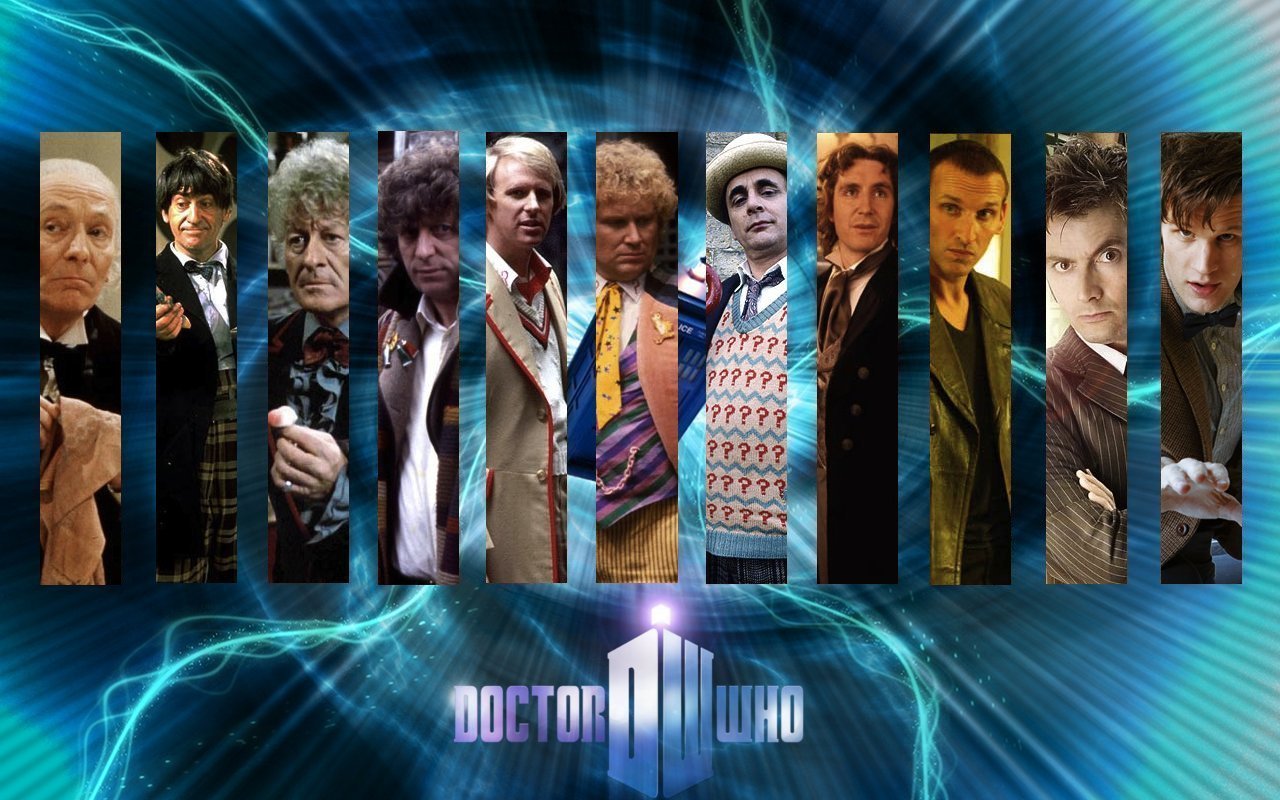
I’m a big nerd and long-time Doctor Who fan. For years my favorite was Jon Pertwee, and not just because he totally rocked a velvet jacket, ruffled shirt, and opera cloak. I was watching years before the BBC revived the show with Christopher Eccleston playing a decidedly dark and delicious doctor. I’ve got piles of DVDs with at least some of the adventures of all the doctors (William Hartwell, Patrick Troughton, Jon Pertwee, Tom Baker, Peter Davidson, Colin Baker, Sylvester McCoy, Paul McGann, Christopher Eccleston, David Tenant, Matt Smith, and even both of the 60s movies starring Peter Cushing as a Doctor Who that was not a time lord, but traveled in a Tardis and fought Daleks).

Okay, that’s still not complete. I don’t have a DVD of Doctor Who and the Curse of the Fatal Death,in which the Doctor was protrayed by Rowan Atkinson, Richard E. Grant, Jim Broadbent, Hugh Grant, and Joanna Lumley. I’ve seen it, they’ve just never released this parody special for charity on DVD.

I am an enormous Doctor Who fanboy. In the years since many of the old adventures have become available on disc, I have reached the point where I now frequently say that my favorite Doctor is whichever one I happen to be watching right now.

Despite that, I don’t think every episode or serial has been awesome. There has been more than once that I thought the new actor cast to play the Doctor was a terrible mistake. There have been companions that I wanted to strangle, stories that made me embarrassed on behalf of the actors, endings that made me want to drown the writers (or at least shake them by the throat and yell, “That really insipid, self-indulgent pile of refuse you spewed out there could have been saved with just two lines of dialog!”).

A picture of the cover of the VHS release of the special.
Doctor Who and the Curse of the Fatal Death.
So I’m a super fan, but not a blindly-love-anything-they-put-out fan.

I understand why I watched the announcement of the new actor who will take over the role at the end of the 50th anniversary Christmas special. I understand why I, and many other fans, may have been disappointed, or are feeling apprehensive about the new actor chosen.

What I don’t get are the people (and there was more than one being re-tweeted around the internet yesterday) who say they have never watched a single episode, and that they are angry about the actor who was cast.

Images of each actor who has played the doctor, over the current show's logo.
The eleven official Doctors.(Click to embiggen)
“Why do you care?” isn’t really the question, because they have an answer to that. They are upset that the actor cast was a white man. They wanted either an actor of color or an actress cast as the next Doctor. And I understand that, boy do I understand not feeling included when you don’t see actors who look like you in lead roles or even recurring roles.

I was not terribly happy when Matthew Smith’s casting was first announced specifically because I really wanted to see a comedienne cast. Someone like Jennifer Saunders was what I had in mind. I didn’t see any reason the Doctor couldn’t regenerate as a gal instead of a guy. Smith won me over, and I’ve been very sad since learning that he is leaving the show.

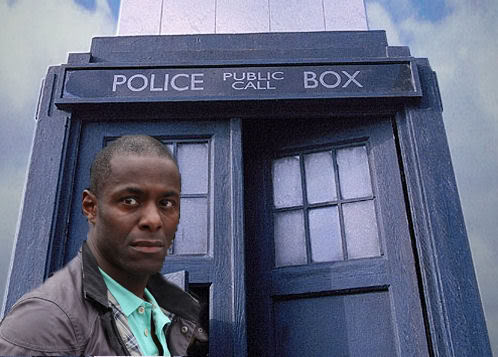
I’ve also wanted to see someone like Idris Elba or Adrian Lester or Paterson Joseph play him, because I like their work in other shows, and I don’t see why, even if the Doctor does regenerate as a dude, he has to be white.

I really do understand the diversity/inclusivity issue. For instance, even though at the time I was amazed that they let Eccleston flirt with and eventually kiss John Barrowman, I’ve grumped a bit since then at how little non-heterosexuality has been allowed (other than as a joke or misunderstanding) in the main Doctor Who show unless Captain Jack is visiting.

Acto Paterson Joseph standing in front of the Tardis.
Seriously, why couldn’t Paterson Joseph play the Doctor? (Click to embiggen)
So while I agree with the point that it’s disappointing that they haven’t gone outside the white dude box in the casting, I don’t understand why someone who has never, ever watched a single episode out of the 798 that have been made during its 50 year run, feels the need to express a public opinion on this casting decision.

What fuels your sense of entitlement? Seriously. I have plenty of friends and acquaintances who share your disappointment or outrage for exactly the same reason, and I sympathize with them. I share, to a lesser extent, their disappointment (not really the outrage, but I understand the outrage). I have absolutely no objection to them posting long screeds about it, tweeting about it, re-tweeting other disappointed fans comment about it, and so on.

But why expend time, effort, and bandwidth (not a lot of bandwidth to post, I know, but every one of your followers and the followers of your re-tweeters have also had to use bandwidth for this) for a show that you have never, ever watched? If you can’t be bothered to watch the show, even once, then please don’t bother those of us who have with your “opinion.”

Someone’s going to respond to this either accusing me of censorship or at the least harassing someone just for expressing an opinion. I’m not in a position to silence them, so the censorship argument doesn’t apply as a matter of definition. This is nothing to do with whether you have a legal right to express yourself. It does have to do with whether you ought to be commenting on something you’ve never seen.

Freedom of expression does not mean freedom from disagreement or from other people expressing the opinion that you are a complete and utter git.

Rejoice, spouse and spouse

I had a post about other things scheduled for today, but then I got caught up watching the live feed from city hall in Minneapolis, where same sex marriage became legal today. And I think it would be better if we all just rejoiced with these couples:

Photo gallery: Gays marry in Minnesota

Photo gallery: Weddings at Como Conservatory in St. Paul

Gay couples rush to wed as Minnesota, Rhode Island legalize same-sex marriage

I think my favorite from the live blogs is the tweet from sometime in the early morning from a person watching at City Hall: “I’ve got this down: cheer, clap, cry, repeat.”

Sentences that fill me with dread, part 2

“Oh! You work with computers?” or “You know about computers, right?”

In many ways this has gotten worse as computers become more ubiquitous.

The person most likely to ask this question is someone for whom computers are little more than magic totems. They don’t understand them. To the extent they use them, it is like a ritual. The only way they know how to do anything is to try to repeat the exact steps they have done before. If the machine reacts in a different way than it did before, they don’t stop to try to figure out what they did wrong, they just try to find a way to perform the next step in the ritual.

So they will click Okay or Continue or “that little X in the corner that makes things go away” without reading the message, and keep clicking hoping to see the thing they were expecting to see. And thus install all sorts of malware and bloatware and other things that eventually make their computer unusable.

That’s if they have a computer and programs that they have been using.

Worse are the ones (such as the last person who spoke the dreaded sentence to me) who have bought a computer “because they found a good deal” or took a hand-me-down from a friend of a friend, and now they want just a “little” help to set it up.

The particular person who most recently did this is a musician who is a new neighbor. She stopped me as I was walking past her place and asked the dreaded question. She explained that she had become very intrigued at things that another musician she met was doing in GarageBand on his iPad. He had explained that he had “the same program” on his computer, where he could do a lot more.

So she had bought a computer at a yard sale, and wanted me to show her how to put Garage Band on it so she could do the things he did.

As you have probably guessed, if you know anything about computers yourself, the machine she’d picked up at the yard sale was a really, really old PC. Probably not even one capable of running Windows. This thing was a brand I haven’t seen in decades. It probably was manufactured in 1989 or 1990, I don’t know if it would actually turn on (I didn’t let her get me past the stage where she was pointing to it through the window where it was piled up on a table).

I told her that any computer that old was either dead, or nearly so. That it would be nearly impossible to find software that would run on it. That GarageBand runs on Macs and iPads, only. It doesn’t run on Windows, and it certainly won’t run on DOS.

“But he told me I didn’t need a fancy computer…”

I tried to explain that she could pick up inexpensive used iMacs at several places that would run GarageBand. “But it needs to be a computer no more than five or six years old.”

She didn’t understand why I wouldn’t go into her house to look at the computer she had “just to be sure.” It didn’t have to be GarageBand, she could probably find some other music software, she said.

I tried to explain again that electronics that old fail, and because they’re so old, no one makes the parts any more. Also, none of the inputs will match any modern microphones or other accessories she would need for recording her music. And most importantly, the only software it could run (if all its parts were still working) was very old stuff that would have been sold, back in the day, on floppy disks. “Twenty-five year old floppy disks don’t work. The magnetic particles flake off. The plastic disk part loses its flexibility and even cracks and breaks.”

“I don’t mind a few cracks…”

I thought I was going to scream.

And it’s not just people buying really old (ancient) computers.

My husband works at a place that refurbishes and resells oldish computers. He frequently tells stories of people that buy a computer, then bring it back (sometimes months after the warranty period) complaining about problems that are always user error. Or trying to install something that it isn’t intended to run.

My friend, Mark, told the story of a co-worker who kept complaining about her iPod, that it wouldn’t take music from the Apple store, it couldn’t sync with iTunes, and it wouldn’t work with any iPod accessories she picked up. When he got tired of hearing her complain and offered to take a look, the first thing he said was, “That’s not an iPod.”

It was some very cheap, no-name music player. And no matter how he tried to explain it, she didn’t understand how he could claim it wasn’t an iPod. And when she was willing to admit that maybe it wasn’t an actual Apple-manufactured iPod, she still didn’t understand why it wouldn’t work with iPod things.

I suggested he should have told her that it was like this: a horse and buggy can get you from place to place on public roads not unlike a car, but if you try to pour gasoline down the horse’s throat, you’re going to regret it.

I don’t know if he ever got to use that analogy.

The Joi of Ponies

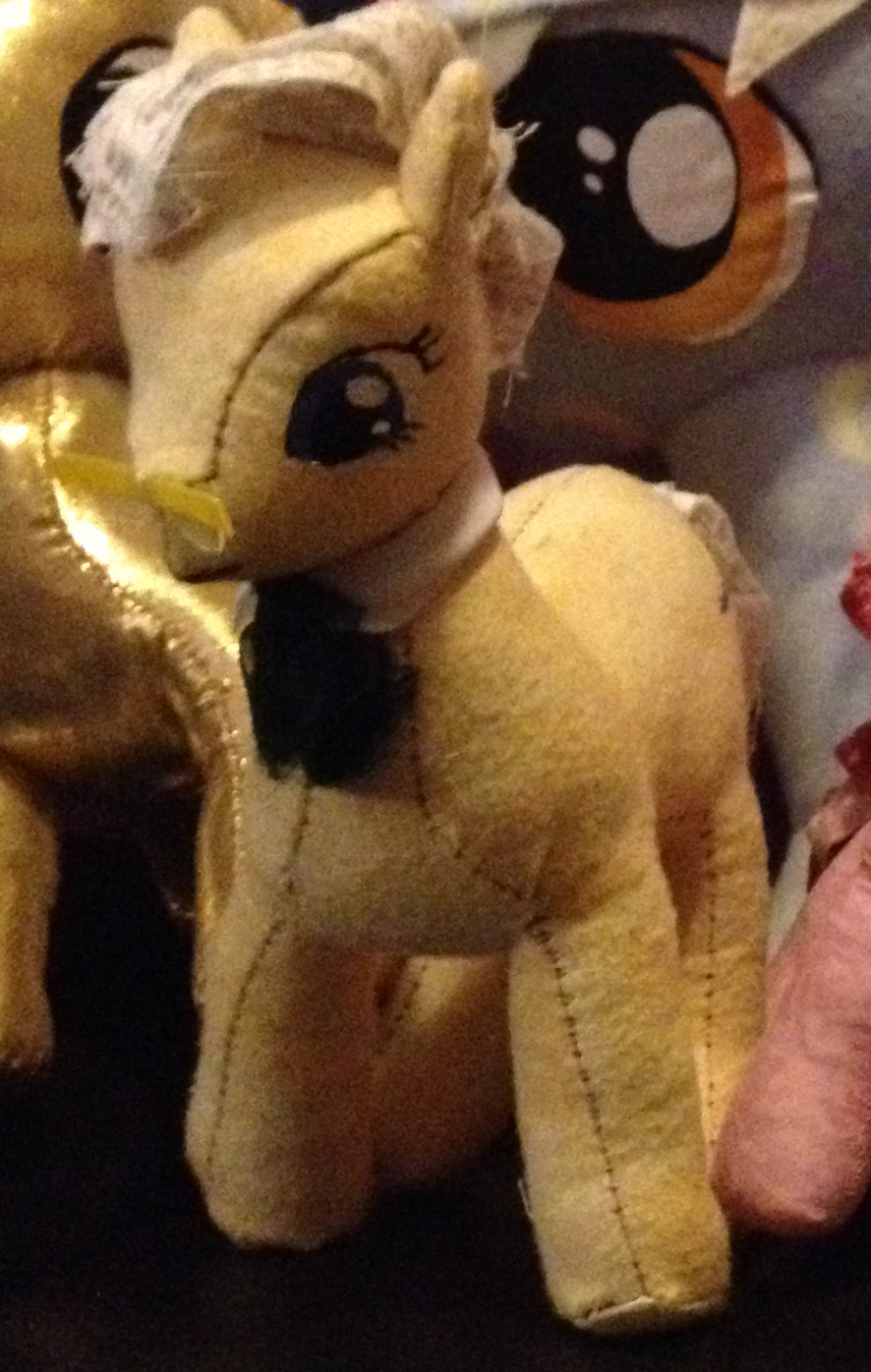
A gold lamé rag doll pony
Gold Dust Applejack, from Equestria Rags.
Yes, I’ve already posted a con report. Plus a couple of other blog posts related to the convention. But I always have more to say, and in this case there are some photos I still want to put up.

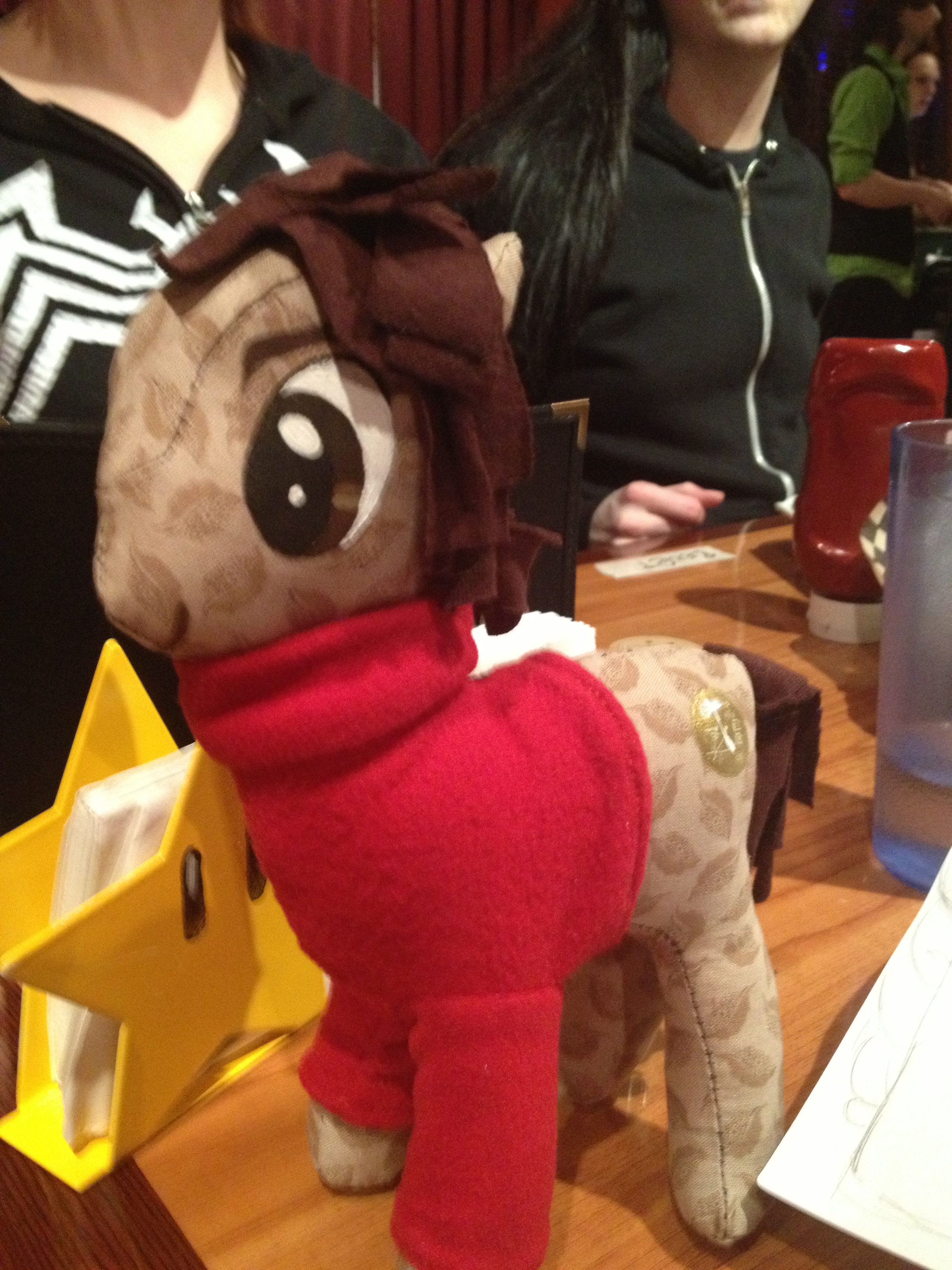
I’ve mentioned before my friend, Joi, who makes these fun rag doll ponies. She makes them from scraps. Her rules are that she only uses fabric from scrap bins, remainder piles, and thrift stores. So she finds fabric and says, “Oh, that would make an interesting Twilight Sparkle,” or what-have-you. She makes ponies based on characters in the series, or on original characters (by way of commission), and she makes ponies based on other things. I’ve seen her make a pony version of Carl Sagan, the classic Roman poet Virgil, Neil Gaiman’s Death, or the Mars Curiosity Rover. And she sells them online at Equestria Rags.

Cropped picture of prototype pony doll.
The Mayor Mare pony by Joi.
The first pony I bought from her wasn’t for me. It was a pony version of Mayor Mare from the My Little Pony: Friendship is Magic series. I had to plead a bit, because it was one of her early models where she was still figuring out how to make ponies, so she hadn’t started selling them, yet, and hadn’t planned to offer it for sale. But I really wanted to give it as a present to my husband, and I talked her into it.

A rag doll pony version of Carl Sagan.
A pony version of Carl Sagan that Joi made for Jared for his birthday.
We’ve bought more ponies since.

A few weeks before the convention, she posted pictures online of a new pony she had just finished: Applejack made from gold lamé-style fabric.

Of the characters on the show, Applejack is my favorite. Or most-favorite, since I’m the kind of person who always winds up with about five or forty favorite characters in any book or series that I get into. Anyway, of course I wanted to buy Applejack in shiny, shiny gold! Who wouldn’t?

But she was one of the ponies Joi was making explicitly for the convention. To be a successful vendor at any convention, you have to have a variety of stock. Since these are handmade (hand cut, hand stitched, hand painted, et cetera), each one is a serious investment in time. Since she makes them from scraps, that means it is very unlikely she’ll be able to make multiple ponies exactly the same.

I wanted that gold Applejack. But I also wanted her to have a successful sales experience at the con. So I had to wait until the convention to buy her, and technically I had to wait until the Dealer’s Room opened.

Another Derpy Hooves doll, with squeaker!
Squeaky Derpy was tempting me all day.
I had planned to just stand in front of her table starting a few minutes before the room opened (since I would be inside setting up my own table), just waiting there with money to hand her. This was before we discovered that we were at adjacent tables. Because of where we were, getting in and out from behind our table meant climbing over other people, so it would have been a bit awkward. At the two minutes ’til ten a.m. mark, I asked her if she was going to make me go to the other side of the table. She laughed and said we could just do the exchange now.

So for the rest of the day I had my golden Applejack on my table as a second mascot and to show folks. I had to tell several people she wasn’t for sale, but that Joi had lots of other ponies right there, and she takes commissions.

While sitting at my table, getting some writing done and occasionally selling buttons and pony toys to people, I kept watching a cute version of Derpy Hooves (a supporting character from the cartoon series) that had a squeaker. The squeaky fruit bats and ponies that Joi had were very popular. People kept squeezing them to show their friends while deciding which one to buy. I had already abused my position as a Vendor to buy one of her ponies out from under customers. And she was selling well. I figure the more people who buy her things and tell their friends, the more business she’ll get online, right?

A collection of the rag doll ponies.
Ponies I’ve gotten from Joi: Bedtime Derpy in the back, then (l to r): Gold Dust Applejack, Mayor Mare, Pinkie Pie, Gift Applejack, and Squeaky Derpy.
Michael and I also already own a lot of plushies: scores of teddy bears, tigers, otters, ponies, and so on. We didn’t really need more, right? But when I asked Michael in the evening whether it would be okay for me to buy another pony to take up room around the house, he said fine. So the second morning of the con, when I saw that Squeaky Derpy was still there, I asked if I could buy her. Which meant I had two Derpies as mascots on the table Saturday.

It’s an addiction, I know. But I ain’t going to rehab! (And these are just the ones I’ve acquired. My husband also has several!)

Defining me

I’m a member of several tribes.

I’m queer. I end up writing a lot about LGBT issues because:

  • I’m gay;
  • society is still pretty messed up in how it deals with lesbian, gay, bisexual, trans, and otherwise queer people;
  • many parts of society are becoming less biased about all of that, so there is frequently cool news to share about that;
  • and the parts of society that aren’t feel threatened by all this change and are going to ever more ridiculous efforts to make us go away, which also generates news items worth sharing (or ranting) about.

I’m a nerd. I write slightly less frequently about fantasy, science fiction, and related subjects. But a rather larger portion of my life is involved in pursuing various forms of the fantastic than everything else. It forms another of my tribes. Or a loose confederacy of a bunch of related tribes. Or something.

I’m a geek. I majored in mathematics in university, and took some classes that were supposed to be only for engineering and physics majors. I work with computers. I was a LAN administrator back when most companies didn’t have IT departments, I have racked and stacked, I’m reasonably fluent at the command line of UNIX and Linux systems, I’ve done a bit of programming, I design interfaces, and I routinely figure out (and by figure out, I mean digging into configuration files and scripts and sometimes compiled components and making the software do stuff they don’t tell you it can do) large complicated software systems without consulting manuals.

I’m a writer. By avocation I’m a storyteller. I’ve been lucky enough that my day job has been about writing/creating/designing documentation for a quarter of a century now. I’m at a point in my career where I do a lot more information architecture than actual typing of words, but it’s all about telling someone about something and how to use it. At home I write fantasy, science fiction, and mysteries. Sometimes I get them published. Sometimes I publish them myself.

I make art. I’m not great at drawing or painting, though I do both. I am pretty good at designing books and book covers. I’m inordinately fond of fonts. I sing, I compose music, I play some instruments. I assemble unrelated bits and pieces into weird wholes which some people find interesting.

I’m a collector:

  • Books
  • Dictionaries
  • Dice
  • Plushies
  • Gadgets
  • Pencils
  • Encyclopdias
  • Music
  • Tigers
  • Toys
  • T-shirts
  • Otters
  • Reference books
  • Sketchbooks
  • Ponies
  • Movies

I love purple. Of all the tribes to which I belong, the purple tribe is perhaps the hardest to explain to non-members. It isn’t just about the color, but purple is everything.

I believe. I believe that the universe makes sense on a fundamental level, even though it is also deeply weird and fuzzy. I believe in the power of mathematics, which is just a way of saying that I believe in the power of thinking, because mathematics is simply an extremely formalized way of applying our thinking processes. I believe that people are capable of breathtakingly beautiful acts of love and kindness. I believe that there are absolute matters of right and wrong, but an infinite variety of mitigation; and by absolute I do mean absolute—morality doesn’t come from a divine being, if divine beings exist he/she/they are subject to morality and just as capable as we are of screwing up.

Hi, I’m Gene, and I’m a ________.