Tag Archives: personal

…on my mind…

Just a bit over 26 years ago I met a boy…

He was 25 years old, so not really a boy, but then I was only 29. I wasn’t completely out of the closet, yet. I regularly went dancing at a gay country bar, and I had just started singing with a newly formed lesbian & gay chorus, so I wasn’t deeply closeted, either. But as far as I knew at the time, other than one cousin none of my family knew I was gay. And only a few of my long-term friends knew.

Ray and I met online on a gay BBS system, and after lots of chatting over several weeks, had finally agreed to meet at a restaurant. I had trouble finding him, because he forgot to tell me that he’d recently dyed his hair. I wasn’t looking for a redhead.

I suspected he was a keeper when I saw the small bookcase beside his bed. I knew he was a keeper when we talked about one particular worn hardback. Not because of which book it was, but because he had a favorite book that he re-read several times a year. And talking about it made him start talking very animatedly about a lot of his other favorite books.

We’d been officially dating for a few months when he first told me that he liked to write. He hadn’t mentioned it before because I earned my living as a technical writer, and while my fiction had mostly been published in small, non-paying ‘zines, he was a little nervous about showing me his work. Turned out he’d never shown anyone his writing before. He had a bit of an inferiority complex about his education: he’d dropped out of high school after his father died to go to work to help his mom support his younger siblings. He had since gotten his GED and taken some community college classes, but he wasn’t confident in his writing skills.

I asked him if he wanted my honest opinion. I admit I was a bit nervous, too. What if I hated his work and couldn’t hide it? Fortunately, the first story he showed me wasn’t bad. It needed work. But he was happy to receive critiques and borrow some of my books about the writing process.

He kept working at it. Revising, writing, reading. He started occasionally sharing his work with other people. He even managed to get a couple of stories published in small ‘zines.

Then he got sick. When the doctors first told us he had two years or less to live, I refused to believe it. I was certain we were going to beat this. For the next few years there were lots of tests, treatments, a few scary visits to the ER, and then chemotherapy.

One night just over three years after they had told us he had less than two years to live (seven years and three months after our first date) he had a seizure and fell into a coma. I spent the next several days sitting beside his bed in an intensive care unit, waiting for him to wake up. But it wasn’t to be.

During the weeks afterward I went through his things, with help from his mother and sister. In the cabinet under the night table on his side of the bed, inside an envelope that said, “No Peeking!” I found a small package wrapped with Christmas paper, with a gift tag that said, “To Gene, Love Ray.” I didn’t open it. But the package was the size of a paperback book. And in another envelope in the same cabinet were two identical copies of a paperback anthology, along with some correspondence from the editor of the anthology.

He had sold two short stories that were included in that anthology. He’d sold them the year before, and had received copies of the book nine months before he died. And he’d never said a word to me about it. He’d wanted it to be a surprise.

He had a deadline for another anthology with the same editor coming up. I couldn’t figure out which of the stories he had on his computer he had intended to submit. I wrote to the editor and explained that Ray had died. The editor sent a very thoughtful condolence note back.

Ray had made his first professional fiction sale—two stories! —a mere six years after shyly admitting he was afraid to show his work to other people, but didn’t tell me because he wanted to see the expression on my face when I opened the package Christmas morning. I wish I’d known. I wish I’d been able to tell him how proud I was of him. I wish I’d been able to grab a Sharpie, hold the book out to him, and ask for his autograph.

Make no mistake, I love my husband, Michael. Every time I see his smile, I feel like the luckiest man in world. But I loved Ray, too. I miss him. I wish he had lived to see the repeal of Don’t Ask, Don’t Tell, to see the citizens of our state vote to give same-sex couples the right to marry, to see the Supreme Court overturn the Defense of Marriage Act, and of course to see that same court make marriage equality the law of the land.

This week Michael and I are going through our things, hauling stuff to Goodwill and so forth. We’re both packrats from long lines of packrats, so we have to do these purges every year or so. I tend to hang onto things, and I get overly sentimental over a lot of those things. I had a couple of rough moments Monday. One was when I came across the book with Ray’s stories on a shelf. Another was when I was pulling plushies from another shelf and found a small, peach-colored Teddy Bear. Only a few weeks after we started dating, Ray had to fly to Georgia for a business obligation. He picked up the teddy bear for me and a coffee mug for himself in a souvenir shop. Yes, 26 years later, I still have the “Georgia On My Mind” mug, and I still think of it as Ray’s mug.
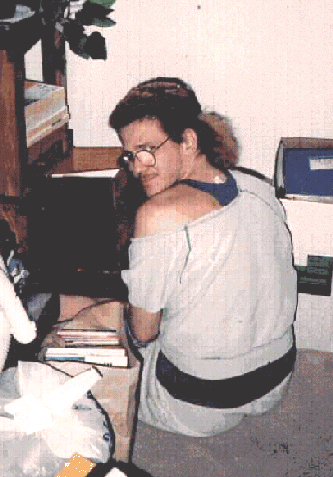
Ray unpacking after we moved into our second apartment.
If he’d lived, today would have been Ray’s 52nd birthday. That’s right, our birthdays were only two days apart. We usually wound up celebrating both birthdays together with his family, and then would celebrate just the two of us on our actual birthdays. I assume that that is the reason that I start getting a bit depressed and moody every September. I can’t think about my birthday coming up without thinking about his birthday that we don’t get to celebrate.

I would love to see his goofy grin over a cake covered with candles at least one more time.

Act my age?

I see NO good reason to act my ag
I see NO good reason to act my age!
Ah, September! That most blessèd month! When the oppressive, destructive heat of summer begins to abate, the leaves on deciduous trees turn to autumnal colors, a new school year begins (at least in the U.S.), and new network TV shows premiere. The autumnal equinox has come. My tomato plants are dying and many of the flowering plants have lost their blooms and are going to seed. Which means that decorating season approaches!

September also means my birthday… that’s right. Today I am officially another year older.

It isn’t one of the big, decade shift birthdays. The big five-oh was a half dozen years ago, and the bigger six-oh is still a few years off. But for some reason as this one approached, it was feeling more like a major turning point than usual. Maybe I was being a little bit psychic and knew that we’d find out just before the birthday that our building was going up for sale and there might well be very big changes in our living situation by the end of this lease period.

Or maybe my subconscious knew that my first birthday after Dad’s death would churn up feelings. Which would be understandable if we had had a normal parent-child relationship. But since he virtually never called or otherwise acknowledged my birthday (sometimes my stepmother would send a birthday card — at least once she made him sign it), is surprising. To be fair, I almost never sent a card on-time to him on his birthday, even though it was only six days after mine.

What usually happened is at some point in September I’d make a little promise to myself that this year I would buy and mail him a card by my birthday. And then I wouldn’t think about it again until several days after my birthday—sadly what would happen is I would realize I barely had time to get a birthday card in the mail to my grandmother, which would remind me that Dad’s birthday was a few days before her and that meant it was already too late to get a card to him by his day. So the few years he did get something from me, it would arrive a few days late.

Of course, because he’s gone, I probably won’t be asked a dozen times if I’ve heard from him. That has been a common occurrence on every birthday and major holiday for decades: relatives asking if I’ve heard from my Dad, then reacting with varying degrees of sadness, surprise, and disappointment to my reaction to the question. It didn’t seem to matter what my reaction was, whether I simply said, “no” or if I was a bit more forthcoming, “Naw, I haven’t talked to him in, uh, six years?” They were always dismayed. Even the few times when I could say, “I got a card in the mail” didn’t go over well.

I get it. These are relatives who go to the trouble to call all their siblings, children, nieces & nephews, et cetera on their birthdays and such. That’s why they’re contacting me to wish me a happy birthday, after all. My mom’s side of the family has always been big about birthdays and anniversaries. So I get why they’re always at least surprised.

It’s nice to be wished well and reminded that I’m loved. Which I have been.

So far what I’ve done to celebrate is get together with friends to go see a cool movie that opened on Friday: the remake of the remake of The Seven Samurai. Appropriately enough, the first American remake, The Magnificent Seven with Yul Brynner, Steve McQueen, James Coburn, Robert Vaughn, Charles Bronson, and Eli Wallach premiered in theatres just a couple weeks after I was born. It was a movie that was shown on TV many times during my childhood, and it seemed like everyone I knew loved it as much as I did. So when I saw a remake was coming out with Denzel Washington, Chris Pratt, Vincent D’Onofrio, and a bunch of other stars, I knew I had to go see it.

It was fun. It was great to meet friends for dinner, drinks, and a movie. Saturday Michael took me out to dinner at my favorite restaurant. Today we’re getting together with one of my gaming groups to do some Victorian sci fi adventuring. I have also taken Monday off from work, and I’m planning to pretend tomorrow is Sunday and watch the football game that my DVR will be recording while we’re gaming today.

I don't know how to act my age. I've never been this age before.
I don’t know how to act my age. I’ve never been this age before.
I’ve gotten some cool presents, which are always fun. Two different people got me wonderful socks. I love comfy, colorful socks! I’ve also gotten a hand knitted scarf, an old movie I love, cool figurines, my very own Tardis key, brilliant purple ink, some books. Getting anything is always great! I can’t show off the big present from my husband, yet. He had me try it on and pick out which model I wanted on Friday, but we had to order it and wait for it to be shipped.

Whenever I write a birthday post, I always feel like I should end with some words of wisdom. This year I’m feeling even less wise than usual. It has not been a pleasant year for, well, anyone that I know. I’ve been having a particularly difficult time not breaking the “Don’t be a dick” rule, myself—I’ve outright busted it several times, and that’s all on me. It feels like a year of broken things, especially connections.

So I guess this year’s advice is this: try. Try to be kind. Try to be forgiving. Try to pick up the pieces when you can. You never know which conversation with someone will be your last, so try not to let it be one you’ll regret.

Normal is an illusion

Myth: “People with mental health problems are different than normal people.” Fact: “We all have mental health, just as we all have physical health.”
The first time I experienced mental health therapy was under duress. I was in middle school, and one of the many times I was bullied that year had resulted in me being injured to a degree that the school nurse said I needed to be taken to the hospital. This ultimately led to the administration deciding that the only logical response to how often I was being bullied by other students was to threaten me, the victim, with expulsion unless I got therapy. And my ability to remain enrolled was contingent on the therapist reporting that I was making adequate progress. Whatever that meant.

The therapist spent all of our time together making me describe and then analyze specific incidents of bullying, trying to identify which of my behaviors had provoked the bully, then trying to teach me to act like a normal boy. I don’t think she ever used the phrase “normal” to my face, but she certainly did when explaining things to my parents. Just as school officials and teachers repeatedly told my parents in parent-teacher conferences and the like that these incidents would surely stop if I would just learn to act more like the other boys.

This experience did not instill much confidence that therapy was meant to help me.

Throughout my teens I was dragged into therapy several more times for various reasons. There was concern for a while that my migraines might have a psychological cause, for instance. Another time, I got into an argument with one of my Aunts because I refused to agree with her that I felt traumatized by my parents’ divorce, which eventually led to an ultimatum from Mom to start seeing a therapist. So I saw this guy once a week for a few months, though what the therapist wanted to talk about was very confusing and didn’t seem to have much to do with my feelings about my parents’ divorce (I was thrilled to no longer be living with a physically abusive man). It was many years later that I learned that my mom’s insistence that I see the therapist was related to the secret prayer meetings she was having with other church ladies because she was afraid I was gay.

Again, not an experience to inspire me with confidence.

Then there had been the continuing spectacle of watching my sister being diagnosed with various contradictory mental illnesses, going in and out of mental health facilities over decades. One of the early rounds for my sister happened while I was still a teen living at home, and Mom decided that we needed full family counseling. At least that therapist told Mom after a few sessions that it would be better use of the limited amount of time Mom and her insurance could afford to focus on my sister’s issues.

Many years later I sought out therapy on my own, and that time I found it helpful. Of course, it was the first time I had a therapist who didn’t treat either my being gay nor my love of science fiction/fantasy as a symptom (seriously—but that’s a story for another day). That alone was a big improvement. And it was the first time I had made the decision to seek help. I sought help because I was concerned I was turning into an abusive person, like my dad. I didn’t want to become him.

But it also helped me get over the lingering sense of distrust I had for the idea of mental health treatment. My bad experiences weren’t proof that mental health treatment is hooey, they were proof that prejudice and bias can happen anywhere, even in a profession that thinks of itself as objective.

No two people will experience the same illness the same way. What works for one person won’t necessarily work for another. Even more important, what works for a person for a few months or years, may not work as well later. We just have to do our best, try to adapt, and most importantly, try not to beat ourselves up over things.

Having lived with, loved, and otherwise been close to people with various mental health issues, I am very aware of the importance of getting treatment, getting the right treatment, and getting support and affirmation from your friends, family, and community. It’s hard to know, sometimes, how to be supportive. There isn’t a simple, one size fits all approach.

Try to be there. Listen if they want to talk. Don’t push. Let them know you care. Be willing to give them space. And take care of yourself: if you get stressed out and frazzled on their behalf, you aren’t actually helping.

Love them. Love yourself.

Diamonds, houses, bars of soap and what I almost mansplained

Which Generation Are You? According to click bait headlines, everyone is either a Boomer or a Millennial, but it's more complicated than that. © 2010 Price Consulting
Which Generation Are You? According to click bait headlines, everyone is either a Boomer or a Millennial, but it’s more complicated than that. (Click to embiggen) © 2010 Price Consulting
I’ve been seeing the clickbait headlines for some time now, things like “Why Aren’t Millennials Buying Homes?” or “Millennials Prioritize Home Life Over Career” or “Don’t Take Enough Vacation? Blame Millenials” and so on. More recently the clickbait headlines have begun with “Millenials Are Killing…” and then lists the real estate industry, or the golf industry, or the car industry, or the like.

Mostly I’ve ignored them. If someone I follow on social media makes a comment ridiculing one of those clickbait headlines I might re-blog it or click “Like.” I don’t have to read the articles or the commentary to know that rather than looking at the actual socio-economic forces at work, the article is just going to make a lame connection between some out of context statistics in a way that will make clueless people of a certain age nod and congratulate themselves on being a better, more mature person those “those darn kids!”

The one that broke me was soap. I kept seeing slightly outraged comments on Twitter about bar soap vs other kinds of soap that I didn’t quite understand. Clearly all these folks were commenting on some article or something that I hadn’t seen. Then I saw one comment tied the term millennials to soap, and I thought, “Oh, no! Now what?” So I had to go find the articles in question.

“Millennials Aren’t Buying Bar Soap and It’s Killing the Industry!” —it really isn’t any more ridiculous than the others, I suppose, but I found myself feeling a little outraged, too. The actual statistics buried in the article are this: sales of bar soap have been going down an average of 2.2 percent per year for the last five years or so, and the vast majority of bar soap that is still being sold is being purchased by people over the age of 60. But the other statistic buried right along in there: sales of soap overall have been increasing over the same period of time at a rate of 3% a year. And the same companies manufacture and sell body wash and liquid hand soap, so there actually isn’t any problem for the industry at all. But they tried to hide even that part by changing the time scale of how they described it.

Before I’d reached the point where the article undermines its own headline, I was already getting irritated because I’m under 60 and we buy bar soap regularly. And let’s be honest, it’s my husband, who is ten years younger than me who buys most of them because he prefers bars. I’m the older one who loves body wash and keeps multiple dispensers of liquid soap next to every faucet in the house. (Not because I believe the myth that soap bars harbor dangerous bacteria; it’s because I’m clumsy and drop bars all the time, and because I like having a choice of scents when I wash my hands or hair or whatever. The shower has four or five different scents of shampoo and matching conditioners and complimentary body washes because I’m a weirdo.)

So it’s ridiculous clickbait you can dismantle in a few minutes. I decided I’d already wasted enough time thinking about it and I should definitely not write a blog post about it. Then, this weekend, I couldn’t look at any social media stream (unless I used the filters that only showed me the tiny subset of those streams being written by people I know personally) without seeing all the backlash. There was a lot of backlash–joke after joke about how clueless Boomers are. Many were at least chuckle-worthy. But I kept seeing, again and again, jokes that mentioned specific ages. It was clear that a lot of the people posting them thought that the term Baby Boomer referred to anyone older than, say, mid-thirties.

That’s how I found myself typing out an explanation about the definition of the Baby Boom, the sociological arguments for why one of the definitions made more sense than others, the economic arguments why yet another definition was better, and so on. The fact is that the whole “generation” thing is a silly mess no matter how you look at it. And I was ranting about why these jokes were as intellectually-shallow to the situation as the original headlines and… and… and…

Of course the jokes are parodies. A parody is supposed to be even more ludicrous than the thing being parodied. Meanwhile, if I posted my mansplaining, I would be even more ridiculous, still!

But, there are a couple of things I do have to get off my chest. One of the academic definitions of the term, “Baby Boomer” puts both myself and my mother in the same generation. And it puts my father in the generation before the Baby Boom, yet he was only 10 months older than my mom. I know we’re a weird case. I was born six days before my father’s 18th birthday. My parents were both 17 years old when I was born. On the other hand, my dad was 34 when my youngest half-sister was born. Going strictly by the arbitrary dates some people use, then, dad was a Silent Generation man who married a two different Baby Boomers, sired another Baby Boomer, and sired a bunch of Gen X-ers.

If you, instead, use the dates on the info graphic I swiped from Price Consulting, well, we spread out a little more, with me landing smack in the middle of Generation Jones, my oldest sister almost getting in the same generation as me, and then the younger siblings all solidly in Generation X.

Any cut-off dates have to be arbitrary.

My childhood didn’t include any of the 1950s. That makes my culturally programmed expectations different than those of my parents’ generation, for instance. My childhood includes the assassinations of John F. Kennedy, Martin Luther King, and Bobby Kennedy. That gives me a slightly different impression of the world than my husband who was born after all three. I voted against Reagan—twice! And was close to tears the night he was re-elected. That gives me a different impression of the 80s than friends who were born while Bill Clinton was in the White House.

But, due to a variety of complications (including the fact that my father refused to sign financial aid applications) I didn’t go to university until I was in my mid-twenties. So friends I graduated from High School with came out of college practically debt-free, whereas I had student loans that added up to more than the assessed value (at the time) of my dad’s house or my grandparents’ house. Which means economically I have a bit more in common with the cliché Millennial than my own generation (whichever one you stick me in).

All of which is a really round-about way to get to this: the economy is f—ed up for almost everyone.

Maybe the stereotypical Boomer owns their own home, but not all of them by any means. And even the ones that do are finding themselves being buried under medical bills and the like, can’t afford to retire, and often are trying to help their own kids and grandkids keep their heads above water. Folks a bit younger than that are sandwiched between aging parents or other relatives whose failing health (and sometimes mental faculties) are throwing unexpected responsibilities on them while they’re still trying to get their own kids out of the nest. Folks a little younger still are stuck in jobs they hate, paying rent that keeps going up faster than their wages, trying to explain to their grandparents why they don’t feel the need to own (and try to pay upkeep, insurance, et al for) a car, trying not to be a burden on their parents who they see are spending a lot of time worrying about the grandparents, and don’t see how they’re ever going to get their heads above water to begin with.

And the clickbaiters have succeeded in getting us all making fun of each other. Meanwhile parasites like Donald Trump and Peter Thiel and Martin Shkreli are happily siphoning billions out of the pockets of middle and working class people of all ages, and into their off-shore tax-sheltered accounts.

Maybe we should find a way to unite against the actual enemy?

Lost Friends in the Dreamlands – more of why I love sf/f

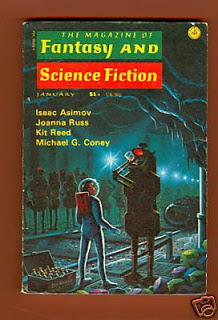
My Boat by Joanna Russ was published in Fantasy And Science Fiction Magazine, January 1976, cover by David Hardy.
“My Boat” by Joanna Russ was published in Fantasy And Science Fiction Magazine, January 1976, cover by David Hardy. (click to embiggen)
By January of 1976, I was midway through my freshman year in high school, living in a tiny town in northwestern Colorado. My parents had been separated for a few months and their divorce was underway. My physically and verbally abusive father wasn’t living with us any more, which was a plus, but everything from our finances to our daily routines were far less certain and predictable. I had had a big break-up of my own that no one knew about—because we were both extremely closeted boys in a very redneck town so of course we had been keeping it a secret. And another boy who had been one of my most consistent bullies throughout middle-school had recently coerced me into an even more covert non-consensual relationship. So to say my life at the time was a bit of a nightmare would not be inaccurate.

I still had a subscription to The Magazine of Fantasy and Science Fiction, thanks to my grandparents, and each time a new issue arrived in the mail, I would retreat to my room with it and stay up way past my bedtime devouring every page. These were the circumstances under which I first read the short story, “My Boat” by Joanna Russ… Continue reading Lost Friends in the Dreamlands – more of why I love sf/f

Asymptotic identities and contradictory infinities – more of why I love sf/f

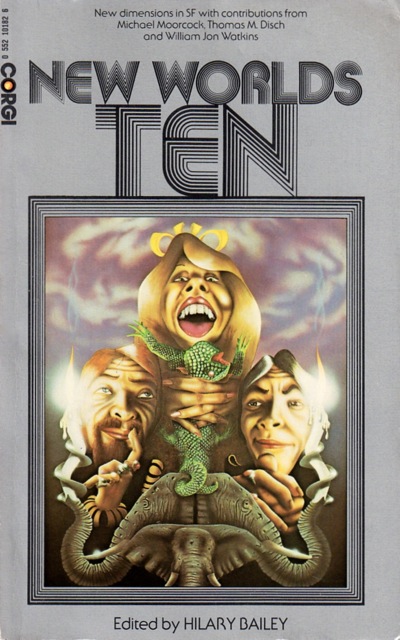
New World Ten, published August 1976. Cover artist not credited and no signature visible.
I first read “The Cabinet of Oliver Naylor” by Barrington J. Bayley in a used paperback copy of the The 1977 Annual World’s Best SF edited by Donald Wolheim that I bought in either late ’77 or early ’78, though it was originally published in New Worlds (sometimes titled New Worlds Quarterly, though they never managed to published more than twice a year), a magazine founded in 1964 by Michael Moorcock, borrowing a name from a sci fi zine that had originally been published in Britain from 1936 through 1963. Moorcock meant the magazine to focus more on experimental writing. It became the birthplace of the New Wave of sf.

None of which I knew when I read Bayley’s story. I was an American high school student whose exposure to sci fi had been dictated by what was available in libraries of various small towns and the pages of U.S. magazines such as Galaxy or The Magazine of Fantasy and Science Fiction.

“The Cabinet of Oliver Naylor” is a novella about a man living in a future where many technologies we would think of as impossible are commonplace. He is flying a personal craft at the velocity of c raised to the 186th power while fiddling with an invention of his own which he hopes will lead to the solution to a problem his society hasn’t yet tackled. He is accompanied by a sort of hitchhiker named Watson-Smythe who is trying to find an artist named Corngold.

Naylor’s invention is a thespitron: a device that constructs stories from all of the possible elements of fiction. Not just stories, it creates virtual worlds inhabited by beings that may be independently intelligent. The problem Naylor is hoping to solve with his experiments is navigation. In Naylor’s time it has been discovered that reality is far bigger than believed in the 20th century: the width of what we think of as the entire universe is simply a unit of measure for this reality. With those distances, the speeds at which advanced civilizations can move, and the fact that reality itself is expanding and changing while they’re zipping around at these impossible speeds means that no form of navigation is reliable. The very fabric of space changes between one’s origin and destination, so from time to time ships become lost.

Naylor has a theory that reality isn’t defined by matter, but by abstract concepts and relationships. He’s convinced if he can truly understand the nature of identity, how objects and beings relate to each other, such as in the structure of stories, that he can create a formula or algorithm to reliable rediscover any unique object one has observed before.

Which is all very cerebral and surreal compared to Watson-Smythe’s quest to find the artist. They do find the artist, his ship seemingly stranded on the edge of a vast stretch of unreality they call a matterless lake. At which point it’s revealed that Watson-Smythe is a government agent out to arrest Corngold, and that Corngold’s model is actually a victim of rape and kidnapping.

What happens next is in some ways far too predictable. When I first read it as a teen-ager I was rather angry that I saw what was going to go horribly wrong before it did, and couldn’t believe an interstellar spy would be stupid enough to fall for it. Even the dippy overly philosophical inventor, Naylor, should have seen it coming, I felt. I was also confused as to why the model/kidnap victim/rape victim seemed completely passive and apparently too afraid, even when essentially a cop arrives ready to rescue her, to do anything against her captor.

Re-reading it more recently, I was even more irritated when I realize that the author gives literally zero lines of dialog to the only woman in the story. Even while she is being abused in front of the officer who supposedly is there to arrest her assailant, the author tells us what she does, but doesn’t let her speak. It’s not that the author says she’s mute. No, the author says that she “responds noncommitally.”

Despite being frustrated with the story, I found a lot of it fascinating. The far future technology, which includes the ability to synthesize any matter one can name from a sort of quantum blob and back again when no longer needed, reminded me a lot of the Culture series by Iain Banks. So when I was reading up on Barrington J. Bayley, I wasn’t surprised to learn that Banks was one of the younger authors who listed Bayley as an influence on his work.

I was also not terribly surprised to find Bayley’s work described as gloomy and downbeat, which this story certainly was. While looking through the list of novels and short stories Bayley had published during his life, I was a bit surprised at how few titles I recognized. I think that this story is the only one of his that I’ve ever read.

While it isn’t a very satisfying read, I can’t say that it’s a bad story. It kept my attention and made me keep turning pages wondering how it would end. Admittedly, part of that was trying to figure out how the author would pull an interesting ending out of this mix of weird characterization and convoluted philosophy and mess of a plot. The story made me want answers, and it made me think about what clues I might have missed.

Is Bayley intentionally making the characters do stupid, and predictable things, to make a point about the reality of Naylor’s world and the unreality of his invention’s constructed worlds? I’m not sure. The intentions of the New Wave writers were to experiment by breaking the established rules of writing and try to find a new way to tell and experience stories. I do have to agree with Donald Wolheim’s comment in the introduction of this story in the anthology: this story crams more science fiction concepts and ideas into it’s novella length than many whole series of novels contain.

And maybe that piling up of ideas without a clear cut answer to any of the questions the central character raises is the point. Sci fi is supposed to be the genre of ideas, after all. And this tales serves up a whole lot!

Sausage making: my history with presidential nominees

party-imagePresidential campaigns in the U.S. are weird. Okay, let’s be honest, politics everywhere is weird, but the way Americans choose candidates has a particularly amazing number of eccentricities. We choose candidates through a patchwork systems of caucuses and primaries, which also generate the delegates who will eventually write state and national party platforms through an arcane series of district, county, and state meetings and conventions. And sometimes the arcane becomes literal (such as the time our state’s Republican party platform had multiple planks condemning witchcraft). Politics is supposed to be about compromise and finding solutions that a majority of people can get behind, which makes things very difficult for people who expect a candidate to agree with them on absolutely everything in order to get their support. The more voters involved, the less likely it is that you’re going to get your first choice. Which isn’t a pleasant realization. As I well know… Continue reading Sausage making: my history with presidential nominees

Advanced Civilizations and Clever Monkeys – more of why I love sf/f

Amazing Science Fiction, June 1976 issue, their 50th Anniversary issue. Cover art by Stephen E. Fabian.
Amazing Science Fiction, June 1976 issue, their 50th Anniversary issue. Cover art by Stephen E. Fabian. (click to embiggen)
I don’t believe I’ve ever actually read a copy of the magazine, Amazing Science Fiction which is a shame, seeing as apparently it was in business for more than fifty years. So I’m fairly certain that I first read Lester Del Rey’s short story, “Natural Advantage” when I bought the paperback of Donald Wolheim’s anothology, The 1977 Annual World’s Best SF in a used bookstore in 1978.

In the very first sentence Del Rey establishes that we are on a starship and that the viewpoint character, the captain, is not human—since he is looking through a set of trinoculars toward a small blue planet. The ship was on a cargo run to a colony world when they encountered a cloud of antimatter moving through deep space. In the course of mapping the cloud, the discovered radio signals coming for a star system they thought uninhabited.

It’s obvious that they are approaching Earth, which has an inhabited space station in orbit around it, so the story was meant to be set a short distance in our future. They establish contact with the strange two-eyed beings who call this world home, and in a few days the two species have managed to figure out how to communicate.

Del Rey gives some explanations for why this is so. The aliens have much larger and more complicated brains than humans. Because they evolved a way to delay signals from the third eye, they perceive time differently than we do. Their language expert is amazed to realize that humans only have a language of few tens of thousand words, since the most uneducated of the aliens has a vocabulary of several million.

All of this learning is just window dressing for the main problem of the tale. That cloud of anti-matter is moving toward the solar system, and when it arrives bad things will happen. Live on Earth will likely be wiped out by the gamma radiation caused by the light smattering that will his the Earth’s atmosphere, but then things will be much worse when the bulk of the antimatter cloud hits the sun.

The aliens came to warn them, but can’t really offer any help. Their ship is too small to carry more than a handful of humans, and it took them many years to get to Earth as it was, no other ships will be able to reach them before disaster hits.

The captain agrees to leave the humans all of the science books he can, even though he explains that his civilization’s technology couldn’t possibly be used to evacuate billions of people. Then the aliens goes on their way.

Fifteen years later, the captain and the cargo ship return to their home world, and are shocked when a high ranking government official is sent up to greet them. And with the government official is a human, the first person they met, the woman who was the Administrator of the space station.

The revelation at the end of the story is that humans figured out that the alien’s natural way of perceiving variable time had limited their ability to understand all of the implications of their warp drive technology. Thus in a few years, the humans had built engines and ships much more powerful than anything the aliens have, and have managed to save themselves.

This particular story didn’t wow me. Maybe it’s because I’ve read too many stories where the twist is that the obviously inferior humans turn out to be more clever than the superior aliens. Legendary editor John W. Campbell, Jr, used to insist that no story published in his ‘zine could ever show humans to be inferior. They always had to be better than the aliens one way or another.

The difference between this one and a typical Campbell-approved tale is that the aliens aren’t malevolent. The aliens want to save the humans, they just don’t believe it is possible to do more than warn them.

Besides the predictability (which might be more my fault because of the types of sci fi I had read during the years before), the other problem is there isn’t really any conflict in the story. Because it is from the point of view of the aliens who don’t believe they can do anything and who go about their business after the warning, all of the drama of a human population finding out impending doom, scientists and engineers struggling to master another race’s physics and engineering, et cetera, happens off screen. It’s all, “Poor monkeys. They seem nice enough, but they’re doomed because they aren’t advanced enough to have already colonized the stars.” Followed by, “Surprise! We’re more clever than you thought!”

That sort of “twist!” story is entertaining the first few times you encounter it, but after you’ve seen a dozen or more, the story needs to do a bit more to really stand out. The most interesting aspect of the story, as it is, is the notion that have a third eye would change the way a species perceives and understand time and temporal relationships. One of the almost throw away lines in the early part of the tale involves the language expert being flabbergasted that human languages only have a few tenses, and even then only the verbs!

That made me stop for a few minutes to think about how adjectives and nouns could work differently in English if we had different versions of the words for past, present, future, and so forth.

As I said a couple of weeks ago, not every story has to be a masterpiece. And even if the story is merely not bad, but it makes you think, that’s a good thing.

Got a dream we’ve come to share

An American and a gay pride flag waving in the windI do playlists, as I’ve mentioned a few times before. I’ve been working for the last week on a new Fireworks list. Digging back in my iTunes library I see I’ve got eleven previous ones each dated with the year I made, except the first one, which is merely called “Gene’s Fireworks List.” A lot of songs get repeated year after year. But this year I was having trouble, because America isn’t being it’s best. We often fall short of our ideals, but with the blatant racism, sectarianism, homophobia, and worse coming from the nominee of one of the major parties (I mean, how many times now has Donald Trump shared posts from literal white supremacist and neo-nazi sites so far?), well, I just feel as if we’re further from the aspirations of liberty and justice for all than we have been in a while.

So I wound up making two lists. One is fairly traditional, this one is just called 2016 Fireworks:

  1. “Star Spangled Banner” – Keith Lockhart & the Boston Pops Orchestra
  2. “God Bless American” – Kate Smith
  3. “America” – Neil Diamond
  4. “You’re a Grand Old Flag” – James Cagney & the cast of Yankee Doodle Dandy
  5. “Liberty Bell March” – United States Marine Corps Band
  6. “We Shall Be Free” – Garth Brooks
  7. “National Emblem March” – Keith Lockhart & the Boston Pops Orchestra
  8. “The Washington Post March” – United States Marine Corps Band
  9. “Born in the U.S.A” – Bruce Springsteen
  10. “The Thomas Jefferson March” – United States Marine Corps Band
  11. “An American Trilogy” – Elvis Presley
  12. “The Stars and Stripes Forever” – United States Marine Corps Band
  13. “What a Wonderful World” – Louis Armstrong
  14. “The Blue Danube Waltz” – United States Marine Corps Band
  15. “Star Spangled Banner” – Dolly Parton

Then this was is a little more… aspirational:

  1. “I Love the USA” – Weezer
  2. “Song of the Patriot” – Johnny Cash
  3. “This Land is Your Land” – Arlo Guthrie & Woody Guthrie
  4. “Someday We’ll All be Free” – Donny Hathaway
  5. “All-American Boy” – Steven Grand
  6. “God Bless American” – Kate Smith
  7. “Boogie Woogie Bugle Boy” – Bette Midler
  8. “Chimes of Freedom” – Bruce Springsteen
  9. “Oh, Freedom” – Harry Belafonte
  10. “Bridge Over Troubled Water” – Simon & Garfunkel
  11. “The Battle of New Orleans” – Johnny Horton
  12. “Living In America” – James Brown
  13. “The Star Spangled Banner” – Whitney Houston & The Florida Orchestra

Antique Books and Incongruous Pages, more of why I love sf/f

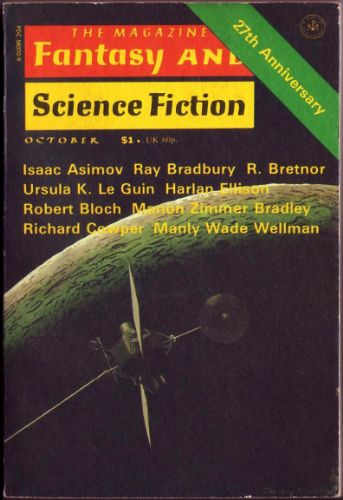
Cover of the October, 1976 issue of the Magazine of Fantasy and Science Fiction, cover by Chesley Bonestell.
Cover of the October, 1976 issue of the Magazine of Fantasy and Science Fiction, cover art by Chesley Bonestell. (click to embiggen)
There are some science fiction stories that you read, enjoy, but when you encounter them again months or years later, you don’t remember them until you have nearly completed re-reading them. Richard Cowper’s “The Hertford Manuscript” is one of those tales for me.

I think that I read it for the first time in the fall of 1976, shortly after my mother, oldest sister, and I had moved to southwest Washington some months after my parents’ divorce was finalized. My subscription to the Magazine of Fantasy & Science Fiction had lapsed not long before we moved, but I had been happy to discover that the public library in our new home town subscribed to the magazine. A couple times a month I spent a couple hours at the library reading the magazine, and I am fairly certain I read the October issue, which contained “The Hertford Manuscript” on one of those visits.

I definitely read the story a subsequent time when I bought the paperback of Donald Wolheim’s anothology, The 1977 Annual World’s Best SF a couple years later at the used bookstore. And since I re-read stories in that collection off and on over the next seven or eight years, I probably read it again several times.

Each time I’ve read the story, I began to suspect that the story was going to be a Lovecraftian tale, even with the hints in a completely different direction. And then each time there’s a point where I say to my self, “Oh! I think I remember this story…” Including when I re-read it this week.

The tale starts slow. Our narrator, Francis Decressie, tells of us of his eccentric Great Aunt Victoria, whose husband died in World War I, leaving her to run a rare books business, which she excelled at for many years. She occasionally told slightly scandalous stories of her youth when she was acquainted with H.G. Wells and Aldous Huxley. When his Great Aunt dies, her will bequeaths on him a 17th Century Registry—specifically a list of the admissions, discharges, and deaths of patients at a Franciscan Charity Hostel/Hospital in London.

In addition to the ordinary 17th century pages covered with small columns of very compact writing, are a number of pages that don’t match the others. The paper is just as old, but it is clearly manufactured using more modern methods, and the handwriting is very different than the rest of the register. And it appears to be a journal.

The narrator then reproduces the journal, and we find ourselves following Dr Robert Pensley, an acquaintance of H.G. Wells, as he recounts how, having completed his journey into the far future, meeting the Eloi and escaping the Morlocks to return to his own time and recount his findings to some friends, had undertaken a journey into the distant past. Except one of the quartz crystals in the mechanism of the machine breaks (he attributes this to damage inflicted by the Morlocks), trapping Pensley in 1665 England—right when the Plague is ravaging the land.

Pensley must find a jeweler or lens maker to create a replacement crystal, and has to deal with all of the problems of a nation in panic over an illness they do not understand. There are increasingly amusing attempts by Pensley to convince various authorities that the illness is spread by fleas on the rats. The lens-maker has difficulty tracking down a large enough piece of quartz, and various other things go wrong over the course of the tale.

The story ends with a few pages of the narrator explaining how he tried to prove that the pages were a hoax, but experts all agree the book has not be taken apart and restitched since the late 1600s, and he does find various bits and pieces of obscure historical evidence to back up some of the minor details the journal recounts.

And that’s it. The story ends with a philosophical observation about tragedy by the narrator.

The tale told in the enclosed journal was very engaging. The descriptions of the time traveler’s experiences in the mid-1600s pull you right into the tale. Cowper’s attention to historical detail is something that is seen in many of his other works, and serves him quite well here. The framing story is written in the style of a 19th century novel, evoking Dickens and Anthony Trollope and even a bit of Bram Stoker. Which is a little out of place given that the narrator is living in the late 20th Century, but is a nice homage to Wells.

As a kind of sequel to The Time Machine the story works well enough. The framing sequence is not quite as good as the time traveler’s journal. Especially the ending, which I found a little flat. I wanted more. I’m not sure how, exactly, but rather than leaving me wondering what happened next, it felt like he left out something.

So it was enjoyable, but not a mind-boggling revelation. Still, each time I read it, I recognize certain minor details that stuck with me, and have resonated with some of the ideas I’ve tried my hand at in my own stories. Every story we read doesn’t have to be a masterpiece. Sometimes merely good is good enough.