Tag Archives: personal

It’s a nerd, nerd, nerd, nerd world!

NorWesCon 39
NorWesCon 39
So I’m at NorWesCon. I really missed this con last year.

My plan had been to pack Wednesday night so I could load the car and leave relatively early in the morning. But I was so tired when I got home from work that I had to take a nap. I slept for several hours, woke up with a nightmare (a really nasty one, too; I was frankly surprised that I hadn’t woken my husband, since it was the sort where I often start talking loudly in my sleep). So I got up and tried to write for a bit, then went back to sleep. And had another nightmare. Then woke up to hear my husband in the shower (he’s working Thursday and Friday and isn’t joining me at the con until Friday evening). I said goodbye to him as he left for work at his usual oh-god-o-clock in the morning, fell asleep, and had yet another nightmare.

All different nightmares, none of them anything to do with anything that I can think of. The important part is that while technically I was mostly asleep for a total of about 13 hours, I didn’t really feel fully rested. So I hadn’t packed and I wasn’t at my best, mentally.

Then I had a weird problem with backing trying to back up the laptop before I left. The upshot was, I didn’t leave the house to head to the convention until almost noon. Still, I got to the con hotel while there were still parking spots available. I managed to get one very close to the wing where my room turned out to be totally by luck.

I found Kehf fairly quickly, got the room keys squared away, then went to get in line to pick up my badge and only when I got up to the cashier did I learn of the new-ish (since I haven’t been here for two years) policy about bringing your signed statement with a bar code, so I had to go get in another line to get that printed out, then get back in the original line. And I wouldn’t have been grousing when I got to the second line if I hadn’t gotten to witness a con staffer essentially yelling at another attendee for the horrible sin of having not seen the email telling them to bring the signed statement.

Having been a con staff member at several different-sized conventions, who once unloaded on a particularly bothersome attendee, I know that I live in a glass house–and therefore should not hurl stones. (In my defense, that incident happened when I came down very sick at the con, and it turned out I was running around doing my programming director job while running a 104º fever, but it still means I was less than professional while being staff, so I get it.)

Anyway, Matt and Sheryl commiserated in line with me, and invited me to meet them for some lunch when I got out of line. I think my grousing was at least as much due to a less-than perfect blood sugar situation as anything.

We ate, then went off to panels. Sheryl and I had picked the same panel at 5, while Matt and I had picked the same one at 6. One was on “Any Tool Can Be a Weapon” which was a good discussion. The other was a writing panel, specifically ways to figure out your own methods to be productive. Also a good panel.

I had accidentally said yes to two different people for dinner (I thought I was agreeing to Friday night in one). I wound up hanging in the bar with Keith, Juli sans-e, and Mark. We saw Edd and waved him over, then saw Kehf and Auntie and waved them over. I also got to visit with Julie avec-e and Mike. Amy dropped over for a bit and introduced me to “Adult Wednesday Addams” and how did I not know about this before!

After we had hung out for a while, I went back to the room intending to get some writing done, but mostly wound up catching up on social media and taking care of some of the Camp NaNoWriMo prep. Speaking of which, if you have a creative project that you would like to work on in April, you should look into Camp NaNoWriMo. It’s a little bit more low key than National Novel Writing Month. Unless you want it to be a competition. In which case, we can do that, too.

Friday was mostly about running to panels, though I did wander the dealer’s den with Mark. I picked up some cool sonic screwdriver earrings and also found birthday presents for two friends. Woo!

Most of the panels I went to during the day were writing related. I still think the most interesting new thing I learned was at the weapons panel Thursday afternoon. But I got useful and intriguing stuff at all of Friday’s panels, too.

My husband took the train from Seattle after he got off work Friday, so I feel a bit less disjointed. It is weird; we’ve only spent a few minutes alone at the con, but knowing he’s here at the hotel with me makes me feel less incomplete. It is weird being one of two introverts (who are learned extroverts) in a relationship. There’s probably several blog posts in there, now that I think about it.

The upshot is, I am really glad to be back at NorWesCon after skipping a few years. And there are still two days of awesomeness to go!
Names, labels, deadnames, signs, and portents

if-your-mother-wife-or-sister-dies-could-you-be-pu1I’ve written a few times about my name. The tl;dr version: when my parents named me, they gave me a first name that I shared with my dad, paternal grandfather, a great-great-uncle, and a first cousin-once-removed who all lived in the same small town where I attended middle school. Which led to me asking (then demanding) that I be called by my middle name, which was shortened and that I legally changed to my first name as an adult.

That version of the story puts the emphasis on the annoyance and confusion of sharing a first name that doesn’t have culturally acceptable diminutives. Certainly that was a big part (in seventh grade in very redneck America it is no fun having school teachers and administrators regularly call you “Paulie” in front of the other kids; especially if you’re already the kind of guy who gets called sissy and much worse). But it was more than just about a preference. And it was more than a whim.

I’m used to hearing the concept of the deadname when discussing transgender issues. Being deadnamed may be the most common microagression trans people deal with. I became quite familiar with the phenomenon long before I met my first trans friend. I had more than one relative tell me that Gene was not my real name. One insisted that the people who really loved me would never call me by anything other than my birth name. One uncle said he’d call me whatever he damn well pleased, and if I had a problem with that, he’d smack me around until I agreed.

Many years later imagine my utter mortification the first time I slipped and deadnamed a trans acquaintence… to his face. It really was a slip. And in my defense, it had been years since I had seen him, pre-transition, I had been told by another friend only recently what his new name was, and I hadn’t expected to run into him at the social event in question. But I still felt as if I were the scum of the earth a millisecond after the name left my lips.

But to get back to the original decision to change my name: there was also an element that the identity of “Paul Eugene” (which is what a lot of people called me to distinguish from all the other Pauls around all the time) simply didn’t feel like it fit me. In retrospect, I think it is no accident that I became most adamant about changing my name after the hormones of puberty made it absolutely clear that I was not straight. My sexual orientation wasn’t the only way I didn’t conform to the expectations of my family and peers. I had been a sci fi nerd for longer than I could remember—much more interested in reading than sports, I scandalously believed in evolution and that the universe was billions of years old despite being raised in an evangelical fundamentalist church, and my favorite subjects in school were all the things other kids hated.

Not everyone resisted my requests. My maternal grandmother switched right away, and was quick to correct other people. My Aunt Silly, who had grown up hating her given first name and long insisted on being called by her middle name was another instant champion of my cause. Surprisingly, my dad (who had resisted a little bit at first) completely switched sides when his brother-in-law threatened to smack me if I objected to what he called me.

Recently, when I inherited a subset of my maternal grandmother’s vast photo collect, I was struck by the fact that on the backs most of my childhood photos, Grandma had always written my name as “Paul Gene.” As a child that’s what she called me, but given her accent and the idiosyncratic way she pronounced a lot of words, I had always assumed that she was just squeezing the middle syllable of Paul Eugene so tight that it disappeared. Nope. Maybe she was being a little psychic. I don’t know. But I also saw that she had gone back through some of the pictures and crossed out the “Paul.” On a couple of them she wrote, much later when her handwriting had become shakier than it had been when the picture was first taken, “he changed his name.”

I think Dad’s original resistance was half just being stubborn and controlling, and half irritated because he’d grown up being called “Paulie” and hating it so I ought to toughen up and take it. And it was very clear, when the uncle said he’d call me what he wanted and smack me if I didn’t like it, that Dad’s anger was very much of the “no one can beat my kid but me” variety. Many years later, you could tell when he was mad at me because he would deadname with extra emphasis on the “Paul” syllable. 

I changed my name legally decades ago, and my maternal grandmother reacted to the news with a very enthusiastic, “Good for you! Gene fits you better, anyway.”

It wasn’t a totally unexpected reaction: Grandma always had my back.

So I try to abide by other people’s requests regarding names and pronouns, et cetera. And continue to be embarrassed when I mess up. Even though I do mess up, I will always defend their right to their identity. Not just because I know how it feels to be deadnamed, but also because I know how good it felt when Grandma defended me.

The Incredibly Slowly Shrinking Writer

img_0019I’ve never had the kind of body anyone would call heroic. Even back in middle school when I was active (and generally not terribly good) in various sports. Back then I was usually short for my age (other than a brief exception in 7th grade when I shot up to what would turn out to be my full adult height, but within two years all but two of my classmates were taller than me, again), and was usually painfully scrawny. Then, in my twenties, Still the same height I’d been since the age of 14, I started gaining weight and generally started to look like many generations of short, round, bald, hairy men on my Dad’s side of the family. Yes, bald. my hairline starting receding around the age of 15.

Despite having more than a bit of a belly, for most of my thirties and forties I had excellent blood pressure and more than excellent cholesterol numbers. That was probably helped by the fact that for most of my adult life I’ve walked, a lot. I currently live about five miles from the location of my office, and most nights after work I walk home, rather than take the bus. Even when I’m feeling sick, I walk a couple of miles to get to a bus stop along the way.

Every male descendant of my paternal great-grandfather with whom I am in contact developed adult onset diabetes by their mid-forties. A few in their thirties. And some of them didn’t follow doctor’s advice when diagnosed, and suffered various awful complications. So fifteen years ago (at age 41) when I received the official pre-diabetic diagnosis, I vowed to take it seriously. I went to the nutritionist my doctor recommended. I mostly followed the diet—for fourteen years. We got so used to following it, that recently when the new consult changed it, my hubby and I keep forgetting we’re allowed to buy beef, now.

About ten months ago, my blood sugar went really bad, after hanging in the “higher than optimal, but still not diabetic” range, and I finally gave in and let the doctor start me on insulin. At least I made the it into my mid-fifties before it fully hit! The initial treatment is to start at a very low dose and start edging up as you get used to checking your blood sugar regularly and learn how your body reacts. Standard procedure is to see the doctor two weeks after starting to get evaluated.

Now, after only two days on insulin, both I and my husband noticed that I was much more energetic. I hadn’t noticed a long slow drag to my overall energy level and feeling of well-being over the previous few years. The most dramatic discovery though happened at that first follow-up visit. I had lost about 11 pounds in two weeks.

My regular pharmacist had been telling me during the previous couple of years while we tried various non-insulin medications, that in her experience, when the patient found the right treatment, lots of things improved, including the patient’s weight. I hadn’t believed her.

In the months since, I have been steadily having, at odd intervals, to tighten my belt another notch. My work slacks got so baggy I gave in a few months ago and bought a couple pairs of smaller pants. I’ve even had to adjust the wrist band for the iPod Nano that I wear as a watch. I never thought I had fat wrists, but apparently there was some to lose there, too. I had to change which finger I wear my grandfather’s ring on, because it fell off the old finger. My wedding ring, which was a very tight fit for the last few years, isn’t in that danger, yet, but it slides off without much effort now.

Make no mistake, I have a lot of weight still to use. When I look  in the mirror, I still look just as fat to my own eyes as ever. But I hit another milestone today: I am on the last notch on this belt. Counting from the dent in the leather from the spot I was at for years, I’ve tightened this belt five times, now. It may be time to buy some smaller pants, again.

My new diet is still low carb, but I’m no longer doing the glycemic load calculation, where I get to have more carbs if I eat high fiber foods. Because doing that doesn’t keep my blood sugar down. The other change is that I’m allowed to eat fat again. I’m eating a much higher fat diet than I did for fourteen years, and only now am I losing weight. Also, my cholesterol never got bad, but it had left the unbelievably good range during that time I was pre-diabetic. But now that I’m on insulin, my cholesterol numbers are back to incredibly good. And remember, I’m eating more fat, now.

I’ve been feeling down a lot for the last two months because of these flu- and cold-like symptoms that would never completely go away. Yesterday, after another ten days on antibiotics (for the opportunistic bacterial ear-nose-throat infection on top of whatever the viral thing is) I finally felt better than “meh” after longer than I care to admit. I’m not feeling great, just okay.

But realizing this morning, when I tried to tighten my belt that I was actually having to pull it slightly past the last notch before it felt tight, that certainly was a great feeling!

Weekend Update 3/12/2016 – there’s always silence

CdSm6rvW8AAFaqQI already ranted last night about it: Blood stains on their hands, but it is really difficult to let it go. People I knew and loved went to early graves as a direct result of the indifference, contempt, and utter lack of compassion of an entire administration. It wasn’t just them, I know. One of the examples I gave last night was a preacher who had nothing to do with either one of the Reagans. But they were in a position of leadership. They were there when one of the world’s leading experts on epidemics made the case for why government action was desperately needed, and they responded by saying that it wasn’t actually a health crisis. Never mind that it is a virus, never mind that it was killing hundreds, then thousands of people. They laughed. Go listen to that recording I linked to last night, and think about it for a minute: hundreds of young people dying in horrible pain, and they laughed.

Why Is Hillary Clinton Trying to Rewrite Nancy Reagan’s Shameful Inaction on HIV/AIDS??

Hillary Clinton’s Reagan AIDS Revisionism Is Shocking, Insulting, and Utterly Inexplicable.

It’s hard for one ugly episode to stand out among so many ugly aspects of the Reagan administration, but Nancy and Ronald’s deliberate silence on one of the defining public health crises of the era is surely near the top of any list. What Clinton is saying isn’t just untrue, but erases the deadly legacy of the Reagan era.

I agree with each word of the headline. Especially the inexplicable part. Why? When Bill Clinton was running against George H.W. Bush for President in 1992, Bill and Hillary both talked publicly about the inadequate attention that the Bush and Reagan administrations had given to AIDS/HIV research, and assistance to people both inside and outside the U.S. suffering and dying because of HIV. Queers came out in unprecedented numbers to support and donate to Clinton’s campaign, because they made us believe that they saw us as human, which is something we didn’t see from either Bush or the Reagans. She knew that the Reagan administration had not just ignored AIDS, but actively impeded medical research and aid programs.

The Reagan Administration’s Unearthed Response to the AIDS Crisis Is Chilling.

Clinton Just Said Nancy Reagan Helped Start ‘A National Conversation’ About AIDS, Which Is Insane.

13 Times The Reagan White House Press Briefing Erupted With Laughter Over AIDS.

Former First Lady Nancy Reagan Watched Thousands of LGBTQ People Die of AIDS.

Hours later, Clinton offered a tepid apology: Hillary Clinton apologizes for praising Nancy Reagan’s response to HIV/AIDS. She misspoke? If it had been a brief comment where she had merely mentioned AIDS alongside Alzheimer’s and Parkinson’s disease, which were illnesses Nancy Reagan spoke out on later in life, breaking with Republican rhetoric against stem-cell research at the time, I might be able to believe that she misspoke. But Hilary had a long lead up to that. She said how difficult it was for anyone to talk about HIV/AIDS during the 80s, and so on. That wasn’t just a poor choice of words or a matter of mentioning one disease along with others. That was a well-thought out, planned talking point. And it was more than just a minor factual error, it was a whole pile of lies!

I know that there are other big things going on in the world that we could be talking about. The Nazi-salute throwing lady at the Trump rally, or the insane attempt by the big bully himself and his supporters to claim that their decision to cancel an appearance rather than face protestors means that they are victims (when they’ve been the ones literally attacking, punching, and violently tackling people who they only suspect might be protestors). Or people dying in floods in Louisiana and Texas. There are refugee crises and consequences and many more things to worry about, yes.

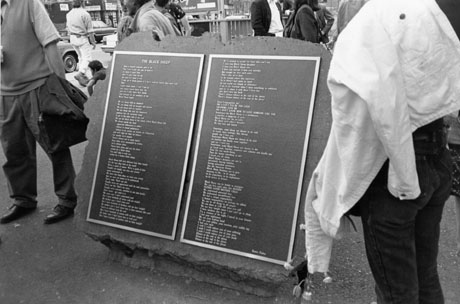
The Black Sheep. May, 1990 - April 1991, First Avenue between 1st Street and Houston. Photo © Dona Ann Mc Adams
The Black Sheep. May, 1990 – April 1991, First Avenue between 1st Street and Houston. Photo © Dona Ann Mc Adams
And I know if I keep giving in to my anger over this, it does me no good. Fortunately, I was reminded yesterday that there are other ways to remember and mourn those we lost. Other ways to indict those who sat silently by, or laughed, or offered public prayers thanking god for giving such pain and suffering to us. A friend reminded me of this poem, which was published on a bronze plaque mounted in a park in New York City for many months back in 1990-91, where it was erected by Creative Time, an organization that sponsors public art. The friend actually saw the bronze plaque while it was on display.

“Black Sheep” was written by Karen Finley and intended as a public poem. It opens with:

After a funeral someone said to me –
You know I only see you at funerals
it’s been 3 since June –
been 5 since June for me –
He said I’ve made a vow –
I only go to death parties if I know someone before
they were sick –
Why?
cause – cause – cause I feel I feel so
sad cause I never knew their life –
and now I only know their death
And because we are members of the
Black Sheep family –

In the middle it observes:

We’re related to people we love who can’t say –
I love you Black Sheep daughter
I love you Black Sheep son –
I love you outcast, I love you outsider
But tonight we love each other –
That’s why we’re here –
to be around others like ourselves –
So it doesn’t hurt quite so much –
In our world, our temple of difference –
I am at my loneliest when I have
something to celebrate and try
to share it with those I love but
who don’t love me back.
There’s always silence at the end
of the phone –
There’s always silence at the end
of the phone –

The full text is available at the Creative Time archive here.

Confessions of a cluttering packrat

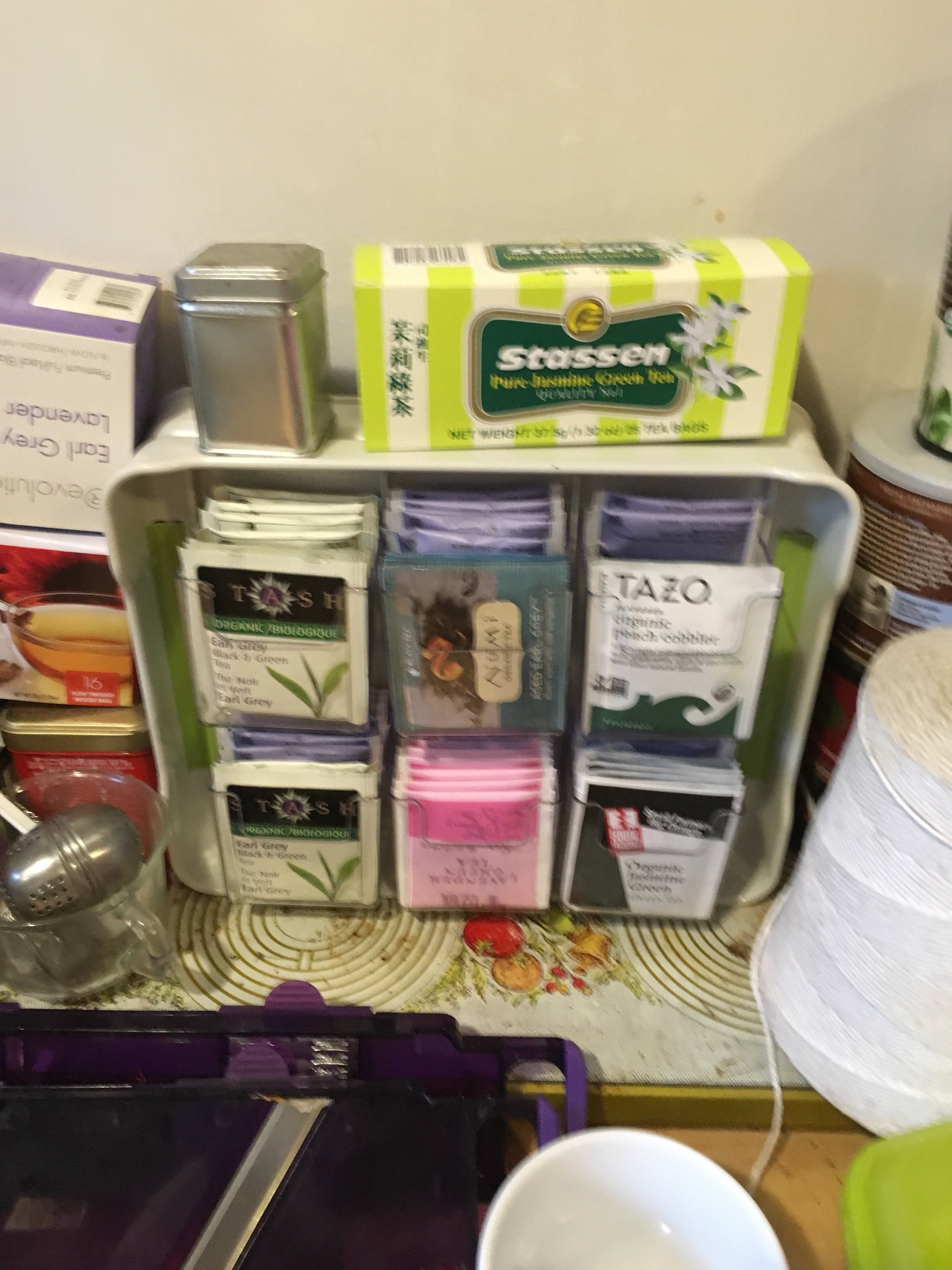
Fuzzy phone picture I took shortly after moving about 14 boxes of tea into this organizer.
I have mentioned many times that I am a packrat, son of packrats, grandson of packrats, great-grandson of packrats. On top of that, my husband is also a packrat son of packrats… so I hang onto things. I save things that other people would give away/take to Goodwill/throw away because “we might need that some day!”

It’s the reason we found multiple old microwave ovens hidden in the closets of my maternal grandmother’s house after she died. It’s the reason that clearing out the first bedroom in grandma’s house filled up the beds of three of my cousins’s pickup trucks more than four times each for trips to thrift stores and the dump. And it’s the reason that any time I replace an old appliance or gadget or household item with a new one, I hear that phrase, “you might need that some day!” in my Grandma’s voice. I essentially have to have an argument with Grandma’s ghost every single time I even contemplate discarding an item.

And Grandma’s ghost is stubborn!

Another eccentricity I have is They’re All My Favorite syndrome. For instance, I like tea. I admit to being a cultureless American who grew up on Lipton tea bags, I have made real tea with loose leaf teas, but 99.8% of the time I make tea from tea bags. And I have favorites. I love Numi Aged Earl Grey, for instance. And Stash Double Bergamot, and Stash Earl Grey Green & Black, and Revolution Earl Grey Lavender, and Numi Jasmine Blosson Green Tea, and Stash Lemon Ginger Green, and Twinnings Darjeeling, and Revolution Peach Ginger Black, and Revolution Dragon Eye Oolong, and Revolution Jasmine Blackberry Oolong, and Twinnings Orange & Cinnamon Spice, and let’s just admit that absolutely any blend that has Bergamot or Lavender in it will be bought by me and tried at least once, so there are always about ten Earl Greys of one sort or another…

And don’t get me started on Bigelow Raspberry Royale that used to be carried in all the grocery stores around here but I have to order it online—when it is in stock, which isn’t often!

The problem is, I love all of these teas, and I buy boxes of the teas, but I have tended to buy teas faster than I drink them. I take some boxes in to work, but I drink the free office provided coffee in the morning, switching to tea in the afternoon. Because I really need the strong caffeine hit of the coffee! Making tea with a kettle on the stove, particularly since most of the time I’m only making it for one, has always been more of a hassle than making a pot of coffee in the morning and reheating it as needed, or grabbing something premade out of the fridge if I want something other than water.

And for various health reasons, I’ve been cultivating a habit of drinking a glass or mug of plain water whenever I head into the kitchen looking for something to drink. As in, I don’t allow myself to pour some coffee or grab a bottle out of the fridge until I’ve drank water.

I have almost bought myself an electric tea kettle many times, but then feel guilty because the house is already cluttered everywhere, and do we really need another appliance that has only one purpose?

The last time our coffee maker died, my husband talked me into buying the model that had a separate tea maker. All it really is is a second separate water reservoir and separate heating element and so on that makes hot water that you can dispense in a cup in the separate location from the coffee pot. So now I make tea much more often.

Unfortunately, this had the effect of making me start buying even more tea. Thankfully, some weeks back my friend J’wyl sent me a link to a tea bag organizer thing that was selling pretty cheap on Amazon. Another friend she shared the link with bought it right away and waxed rhapsodic about how much it cleaned up his big pile of tea boxes. So I bit the bullet. I shared the picture at the top of this post with them the day after I moved tea bags out of boxes and disposed of about 14 boxes. I wish I’d taken a picture of the pile of empty boxes.

You can see in the picture I did take that I couldn’t get all of the tea bags into the organizer. For one thing, the larger Revolution bags don’t fit (and if you don’t keep them in their airtight resealable ziplock foil bag, they lose a lot of their flavor fairly quickly). But it does help. The compartments only hold about 12 bags each. The are another six compartments on the back side, so it holds about 144 tea bags, which I realize is a lot. Most of the teas I buy come in boxes of 18-24, so it would be nice if the compartments were a little bit bigger, but it is definitely an improvement over the pile of boxes. Particularly since a box that only has a couple of bags in it takes up just as much space as the brand new, completely full box.

It is a teeny, tiny step against the clutter. But an improvement!

Confessions of a keyboard addict

Cat with a manual typewriter.I learned to type on my mom’s Easter pink Smith-Corona Silent-Super typewriter. I was ten years old, when Mom decided that I since I couldn’t keep my hands off it, she should teach me the proper way to use it. So she set me up with her old How to Type book it wasn’t long before I was whizzing along, hitting about 60 words per minute on the little mechanical wonder.

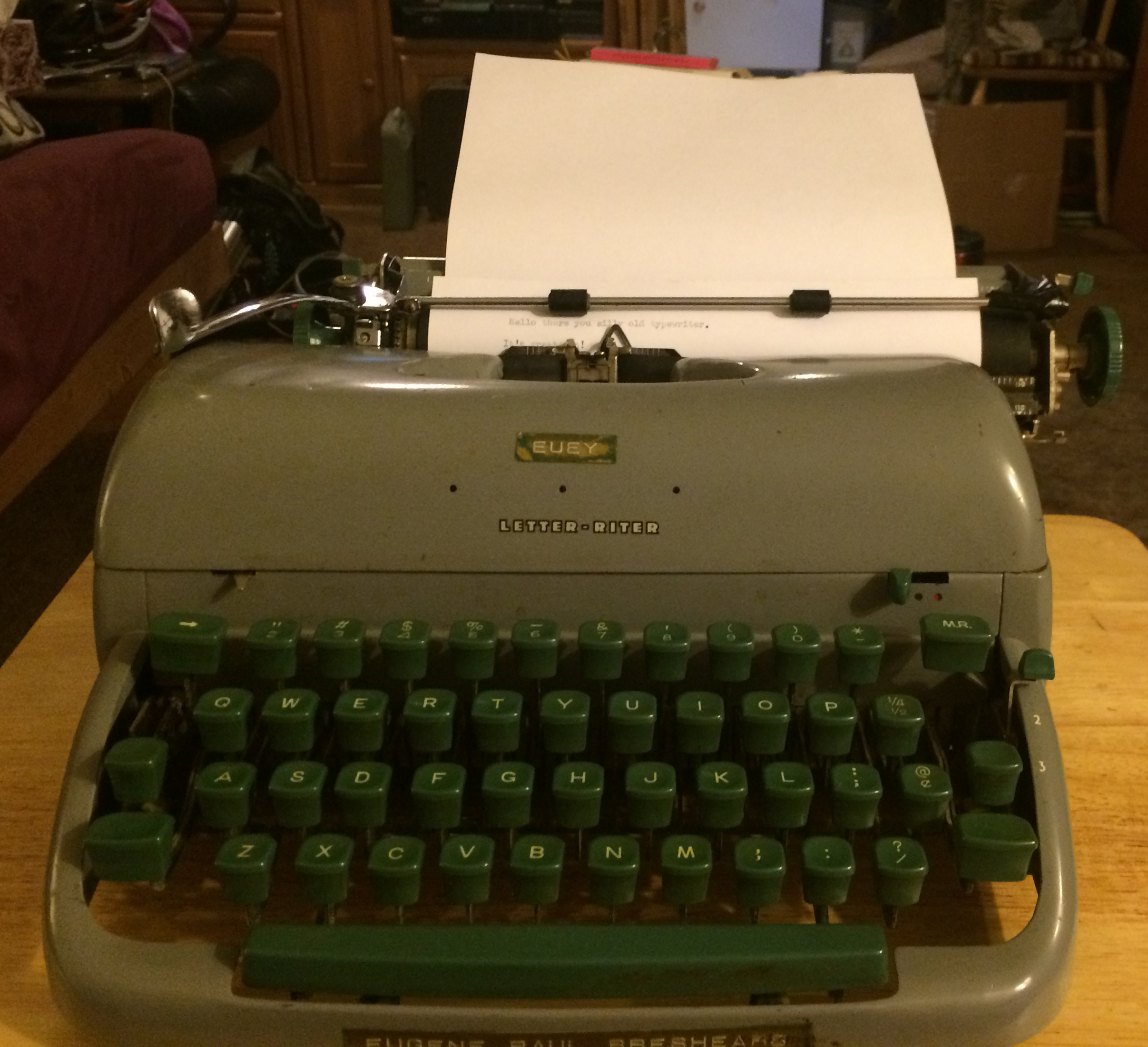
When I was twelve, my paternal grandmother gave me her 1952 Remington Letter-Riter. It was a much heavier typewriter than the Silent-Super in every way. Pushing the keys took more effort, and the typewriter was built like a tank. It also had a slightly different keyboard arrangement, more traditional than the Silent-Super. Older mechanical typewriters didn’t have a 1 (one) key. If you needed to type a 1, you’d use a lowercase l (el) instead. There also wasn’t an exclamation point. To type !, you would type a period, then backspace and type an apostrophe. There was no + (plus) sign or = (equals) sign, though it did have a key for ½ (half) and ¼ (quarter).

This is the 1952 Remington that once belonged to my grandmother, and then has been mine since about 1973 (click to embiggen).
If you click on the image, you might also notice that the symbols on the top of the number keys are different than a modern computer keyboard, as well. You got quotation marks by pressing shift-2 instead of being on its own key, while the apostrophe was shift-8, and underscore was shift-6. The @ symbol and ¢ (cents) sign were on their own key, over where modern computer keyboards usually put the quotation and apostrophe key.

This is not the Silent-Super I learned on, as Mom’s was lost under less than pleasant circumstances. This is one my hubby bought me for my birthday that I’m still restoring. (Click to embiggen)
The Silent-Super had a 1-key and exclamation point. The arrangement was otherwise the same, though the size and shapes of the keys—particularly the tab, backspace, and shift—were different. My grandmother had a newer typewriter that had a lot of special keys, such as a £ (pound currency) symbol, a ÷ (division) symbol, + and =, (greater-than) and even a \ (backslash). She was an accountant and that typewriter was aimed at financial offices. Anyway, I also occasionally typed on her machine, with its own slightly different layout, and I could got just as fast on any of them.

In high school I finally took an actual typing class, which was the first time I typed on an IBM Selectric keyboard. It wasn’t a manual typewrite. It was still mechanical in that a physical object had to strike an inked ribbon and sheet of paper to make the letters, but the force was delivered by an electric motor instead of my fingers. It was much more like a computer keyboard in that way. The amount of force to press the key was practically nothing compared to the manual typewriter. It is still the funniest thing to see when I run a Writers Round Robin event at a convention: people too young to have used a typewriter really freak out at how hard you have to press the keys to make the letters appear.

I didn’t need the typing class to learn to type, I was already proficient at touch typing, but back in the 70s you actually had to have passed a typing class to get into some journalism programs and the like when you moved on to university, so I took the class for the credit. The teacher was a little shocked with I did more than 100 words per minute on the first speed test. Since it was early in the course, I wasn’t typing real words, I was just typing groups of four letters from the home row from a slide she was showing us, something like: “jfjfj kkkk dddd jkjkj fdfd jkl; fdsa”

I told her I already knew how to type, so she grabbed a sample letter to copy and made me take the test again, this time reading the letter and transcribing it. I still was over 100 words per minute.

Over the years I’ve gotten used to various computer keyboards. The old clack-clack IBM Model M that many people still love, being just one of many. And many of them have some keys in unusual places. Some have keys that others don’t. And I take to all of them pretty quickly. I would be slightly surprised when some people complained about a couple of moved keys. It usually took me only a few minutes to acclimate to a new layout.

I was a little surprised, when my husband finally got me to use an iPod Touch, at how quickly I adapted to thumb-typing on a small keyboard where I couldn’t feel the keys at all. My favorite app for a long time was WriteRoom for iOS (it had its own automatic cloud sync back before services like Dropbox were around), and I would write scenes on the bus on my way to work each morning. One time while I was doing that, a bunch of the bus passengers all started turning around and staring at me. So much that I noticed and looked up.

It took me a couple of minutes to figure out what had happened. Somehow the settings had changed, and the iPod was making key noises through its speaker. I had my headphones on playing musc (also from the iPod), and couldn’t hear the keyclicks. I found the setting and turned it off. I said, “Sorry about that” sheepishly. One of the other passengers chuckled and said, “I just never heard anyone text that fast and that long before!” So I explained that I was actually writing a book. “On your phone?” And then I had to explain that it wasn’t even a phone.

It shouldn’t have surprised me, some years later, at how quickly I took to the iPad’s virtual keyboard. When Michael and I bought our first iPad (the iPad 2, we waited for the second model), we weren’t certain we would actually use it and not treat it as a temporary toy. So we only bought one to share. I would take it to work one day, he would take it the next, and so on. It wasn’t long before it was clear that both of us needed our own.

At the time, my employer-provided Dell laptop had become a faux laptop. The battery wouldn’t hold a charge for more than about 10 minutes (we never did get new batteries as promised, of course). So it was useless for taking to meetings. And I frequently need to take notes at meetings or look things up to answer questions, so that was a bummer. Except I started taking the iPad, instead, and I could look up some work things without even logging in a VM. But the part that surprised me was how easy I switched to typing long, detailed notes during the meeting on the virtual keyboard. I do find it slightly annoying switching between numbers, other symbols, and back to letters. Mostly because the key to move from numbers to symbols is not in the same location as the key to move from letters to numbers. But otherwise, I’m okay typing on the virtual keyboard.

I do have a bluetooth keyboard that I use if I know I’m going to do a really long typing session. My hubby gave me a nice solar-powered one a few years ago. It is really nice, but it requires me carrying around a bag, since it is bigger than the iPad.

So I’ve been looking at keyboard cases off and on. My husband has had a couple of them. I think his favorite is a fairly high end Logitech. I’ve tried his, and they’re pretty good.

My new keyboard case. Yes, the fact that the backlight could be set to purple was a selling point.
But I wasn’t convinced that I should spend the money on one for myself. But I keep wishing when I’m at conventions and similar events, that I had a more portable version of my Bluetooth keyboard. Then last week, I noticed that one of the models I’ve had in my private wishlist had come down in price a bit, and NorWesCon is coming up, so I bought it. It isn’t bad. Several reviews of it complained about the backspace being so tiny and the placement of a few other keys, but it only took me three tweets before I was hitting it correctly.

The keyboard itself feels fairly solid, but the case as a whole is a little flimsy. I suspect that if I carried it back and forth to the office in my backpack with this case that the keyboard would get enough wear and tear to account for the small number of reviews complaining about the keyboard dying after only a few months. I don’t currently plan to carry the iPad in the case most of the time. I can do the type of typing/note taking I do on the iPad at work just as easily with the virtual keyboard. It is definitely easier to type on than the virtual keyboard, and the keys feel nice enough. Not as good as my solar Logitech, but perfectly usuable.

It’s not as if I don’t already have multiple keyboards for just about every device. Because I am a keyboard addict.

Chariots of the Who? – part two

The cover of the 1973 paperback edition, as the drivel became a blockbuster.

I posted a bit of a ramble about how I first encountered the book Chariots of the Gods? back in 1971 and how by 1972 the book had infected the collective consciousness enough that multiple evangelical pastors were feeling the need to preach sermons against it. The first U.S. paperback edition was published either just before or during my fourth grade in elementary school. At that point, in the U.S., the book had not yet become a bestseller. So the ancient alien ideas, and specific references to Erich von Däniken’s hack history theories about how aliens had influenced the course of human history were just trickling into my life.

I promised a weird tale involving phosphorescent chalk and lime green three-piece suits, and that’s coming, I promise! So, fast forward to 1973… Continue reading Chariots of the Who? – part two

Chariots of the Who? – part one

Cover of the 1970 first American published paperback edition. Click to embiggen.
It’s all Solarbird’s fault. In the linked post, she plots possible family tree of the original Battlestar Galactica mythology, including a reference to Chariots of the Gods?, and in the course of typing a short comment about when Chariots… the book came out, and the weird in-roads it made into pop culture, I realized there’s at least one weird section of my evangelical fundamentalist Southern Baptist childhood I’ve never written about: the years that evangelical revival preachers felt compelled to make regular sermons deconstructing Chariots of the Gods.

It’s a strange tale involving a hack writer’s bad grasp of history and half-baked sci fi sensibilites, rural American evangelicals’ even shakier grasp of history and science, a Mormon community invaded by mostly southern oil worker families, the tent revival epidemic of the 1800s, black lights and phosphorescent chalk, one queer sci fi nerd, and a three-piece suit the color of lime sherbet. It’s a bit convoluted… Continue reading Chariots of the Who? – part one

Powerless, again

@CuteCatPictures
@CuteCatPictures
I was asleep when I heard the buzzing. It took a while for me to realize that it was a phone. Specifically my husband’s phone. My phone usually spends the night in the computer room, plugged into my Mac Pro tower to recharge and sync and so forth. Michael’s phone usually in on a charger on a shelf in one of the bookcases in another room. Anyway, by the time I woke up enough to realize it was my husband’s phone, it had stopped.

I looked at the nearby clock. It was just a bit after 3 a.m. I could hear Michael still awake up in the computer room. For a second I debated whether the phone had actually been ringing. Then it started buzzing again. I scrambled to my feet, grabbed the phone, and saw the name of his oldest sister. I knew it had to be bad news.

It was. There was a house fire not long after midnight at Michael’s mother’s house back in Oklahoma. The fire had completely engulfed the house. At that point, no one knew where his mom was, nor whether Michael’s youngest brother (who had moved back in with their mom a while back) had been home. Worse: one of our nieces (age 14) and one of our nephews (age 12), the children of Michael’s youngest sister, were supposed to be staying with their grandma for the weekend.

The firefighters were still trying to get the blaze under control so they could safely start looking for bodies.

A few hours later we got the news that all four of them had been home, and none of them had survived the fire.

Definitely bad news.

When you hear news like that, you want to be able to help. We feel like we should be able to do something. Everything we can do feels inadequate. We wonder how it could have been prevented. If we were directly involved in the lives of the people, we wonder what we did wrong. What we could have done differently.

I’m in a weird position on this. I never met any of the four people who died. I exchanged some messages with this brother-in-law on Facebook. I’ve had similar exchanges and a phone conversation or two with the mother of the niece and nephew. While I have met and love my husband’s other siblings and his father, the others have remained acquaintances—not helped by the fact that we’ve never gone back to visit. Just to be clear that it’s through no fault of theirs.

Except his mother… well, we’re not supposed to speak ill of the dead, so I’ll just say the one and only communication I ever received from her was enough to make me glad we live 2000 miles away. My husband’s family has a bit more dysfunction than most, to be honest. And every time that I assert my family is just as messed up, he always manages to come up with a story that is hard to top.

As my husband said to some friends offering condolences last night, to say that feelings are conflicted right now is putting it mildly.

It’s a sad situation. Powerless to avert all tragedies, the best we can do sometimes is love and support the survivors.

I is for Imagination – more of why I love sf/f

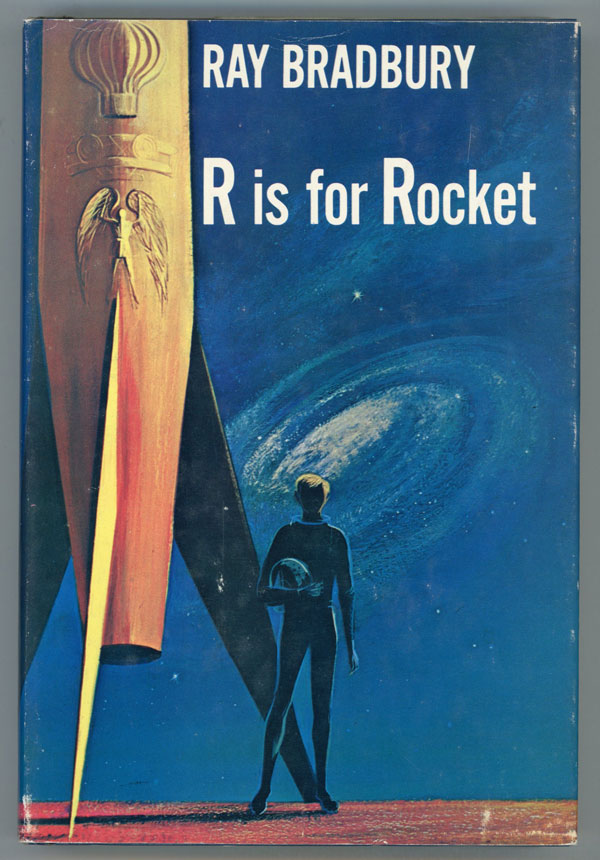
Dust jacker of the first edition of Bradbury's collection, R is for rocket.
Dust jacker of the first edition of Bradbury’s collection, R is for rocket.
I don’t remember when I first read a story by Ray Bradbury.

That’s not quite right. The sentence is true, but it doesn’t convey the full meaning. It’s equally true that I cannot remember a time when I didn’t know about Ray Bradbury’s incredible stories. He isn’t the only author who falls into the category. Since my Mom read to me from her favorite two authors: Agatha Christie and Robert Heinlein, since I was a baby as part of her plan to make sure I learned to talk correctly, I can’t remember a time when I didn’t know about Heinlein or Christie. And it’s more than slightly likely that Mom read some Bradbury in there at one point, so that might account for it… Continue reading I is for Imagination – more of why I love sf/f