I haven’t done a questionnaire or similar post in a while…
Name: Gene
Where are you from? The U.S. Narrowing it down further: ten elementary schools, four states. My father worked in the petroleum industry, so while I was born in northwest Colorado, and we returned to that same small town by the time I entered middle school, we lived in a bunch of small towns in Colorado, Nebraska, Wyoming, and Utah…
Favorite colours? Purple! Violet! Plum! Aubergine! Lavender! Lilac! Also various shades of pink, orange, and teal. And did I mention purple?
Write something in capitals: NASA
Favorite band / musician: As in many things, I have lots of favorites. I love, love, love Scissor Sisters, and wish that their “hiatus” would end sometime soon. Rufus Wainwright, Mika, Pet Shop Boys, Taylor Swift, Will Young, John Grant… and don’t get me started on the divas!
Favorite number: My favorite integer is 5. Which is also my favorite rational number. Though 3/5 is also good. Favorite algebraic irrational is the square root of 2. My favorite transcendental irrational is e. My favorite indeterminate form is ∞0…. I could go on (I majored in Math at university, can you tell?)
Favorite drink: In the morning, coffee. Afternoon, tea (especially Earl Grey with lavender). Current favorite cocktail is a Manhattan, straight up. But my old stand by is an extra dry martini (a real martini with gin; people who call vodka drinks martinis should be shot). Favorite wine is Montepulciano d’Abruzzo. Coconut water and Dry’s Lavender soda are also big faves.
Tag 8 people you want to know better: Everyone! Seriously, if you see this and you wanna post your answers, go for it. If you don’t, no worries!
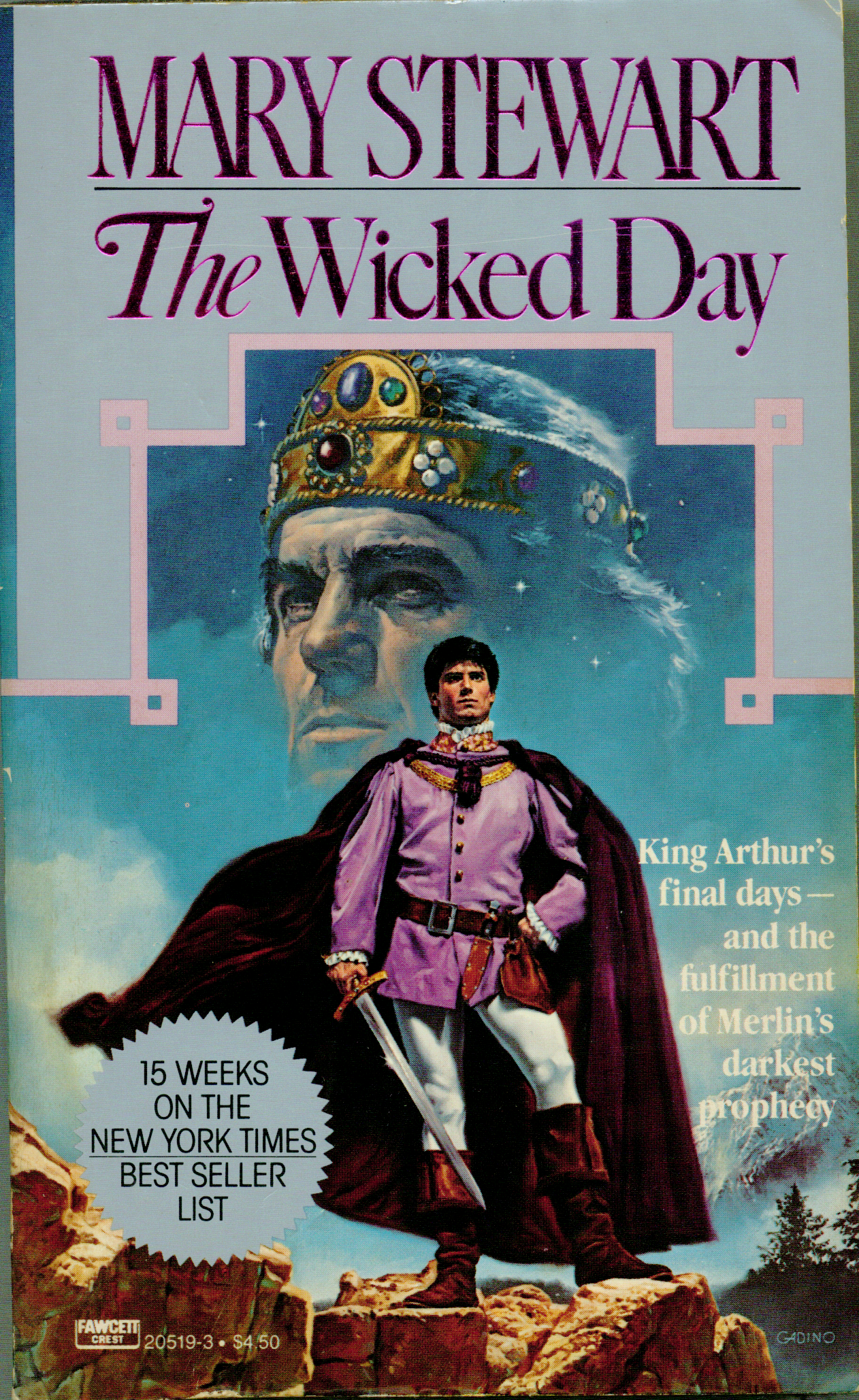
A scan of my own copy of The Wicked Day, by Mary Stewart, purchased back in 1983. (Click to embiggen)In the last two weeks I have written about the first three books in Mary Stewart’s Merlin series. The first three books are first-person narratives told from Merlin’s point of view, while the fourth book is told in third-person, mostly from both Mordred and Arthur’s points of view. Part this choice was necessitate by the fact that the crucial parts of Mordred’s story happen after the death of Merlin, so Merlin can’t narrate it. And if you’re familiar with the classic Arthurian legend, you know that both Mordred and Arthur die at the same time, so neither of them could be the narrator.
Even within the third-person narrative, Stewart shifts perspective. The opening of the book is told in an omniscient viewpoint, the narrator revealing the thoughts and feelings of all the characters. While the bulk of the book is subjective, in some chapters the reader is privy to Mordred thoughts but sees all the other characters through his eyes only. In other chapter’s we are in Arthur’s perspective. Then at the end, she moves t a more objective viewpoint, though not fully omniscient. Anyway, I’m spending so much time talking about this viewpoint stuff, which you might be inclined to think of as the mere mechanics of writing, because in a completely different sense, The Wicked Day is all about viewpoints. Several important plot points turn on the fact that one or more characters is operating on incomplete or completely mistaken understanding. And the theme is about perspectives…Continue reading Dark Prophecies and Evil Half-brothers – more of why I love sf/f→
When I set my goals for this year, I pledged to continue the things I thought worked last year and added some new things. One of the things that I think helped me achieve those goals was writing a monthly report on the blog on my progess. It’s a new month, so here’s the next report!
I couldn’t find a nice large image of the same cover art as my copy on line, so spent a while trying to scan the gold paperback. The best image I got was this one, even though you can see my hands and iPhone reflected in the cover. (Click to embiggen)Last week I wrote about the first two books in Mary Stewart’s Merlin trilogy and how they became the standard against which I measure all Arthurian stories. The third and fourth books in the series came along some time later, and consequently influenced me in very different ways.
Before I get into that, I want to remind you that voting for the Hugo Awards ends tomorrow. If you are a Sasquan (WorldCon 2015) member and haven’t completed your ballot online, do it now before the servers get bogged down with the rush. The ballot is here. If you aren’t a member, you can still buy a supporting membership to become a voter, but since processing a membership might take a while as more traffic hits the servers, time is running out!
Sometimes it feels as if my whole life consists of defending why I like something. When I was a kid, I was frequently called up to justify why I preferred reading books to playing with other kids my age. Even the notion that reading was educational wasn’t enough to satisfy some people (many of them teachers). And heaven forfend that I should mention how many times “playing” with kids my age actually meant being bullied, harassed, and ridiculed non-stop! As I got older, the kind of books I liked became the issue. “Reading too much make-believe is unhealthy!1” or “Aren’t you a little old to believe in all the space hooey?2”
My copy of Bleak House looked a lot like this one.Of course, it wasn’t just the science fiction and fantasy that set people off. If I was caught reading a book about science fact, or the hardcover of Charles Dickens’ Bleak House my grandma bought me at a library sale, or my well-worn paperback of Homer’s The Iliad, it was more proof that I was an “over-educated freak4.”
When I finally escaped to college and met people who valued reading over sports, I thought that I had left all of that behind. Oh, how naive I was! According to these literati wannabes, my tastes were quite low brow. How could I possible understand the meaning of serious art and literature if I actually enjoyed Hitchhiker’s Guide to the Galaxy or The White Dragon or Harpist in the Wind or Midnight at the Well of Souls? Or even worse, I watched television!?
It’s easy to dismiss those latter examples as either snobbery or hipster-ism. Except I can be just as guilty of judging other people for liking things that I don’t.
Who am I kidding? I have been incredibly worse about this. When I think a particular book or series or movie or what-have-you is not just unlikeable, but very badly made, it will completely boggle my mind when someone I know actually likes it. And I seem to be absolutely incapable of hiding my incredulity. I frequently have to remind myself that sometimes what I think of as one of a particular work’s mediocre-but-not-awful parts might be someone else’s fiction kink. And by fiction kink I mean, it’s something they like or identify with so much that it can be a redeeming quality. Such a redeeming quality makes the parts some of us see as glaring shortcomings, merely a small price to pay to get the other thing.
Goodness knows I have my own favorite books, series, and movies that I know are flawed, but I enjoy them anyway because they contain a particular character dynamic, or a type of plot line, or use a particular combination of mythic tropes which appeal to me. I try to make the distinction between something that I don’t like for reasons of taste as opposed to something I don’t like for reasons of actual quality. It is a subjective judgement, but not an impossible one.
I got tired of finding myself having to defend my preferred reading material. Eventually, I was saved by Leo Tolstoy. Tolstoy, the Russian author of such great classic novels as War and Peace and Anna Karenina. I have to confess that I tried to read War and Peace at least a couple of times, and just failed to plough all the way through it. And failing to get through it was one of the things that made me wonder if those people who said my tastes were too low brow to understand great works of art were correct. But then, when a similar sort of discussion happened in one of my college literature classes, the instructor5 quoted a bit from Tolstoy’s nonfiction book, What is Art? I think it was this passage:
The assertion that art may be good art and at the same time incomprehensible to a great number of people is extremely unjust, and its consequences are ruinous to art itself…it is the same as saying some kind of food is good but most people can’t eat it.
—Leo Tolstoy
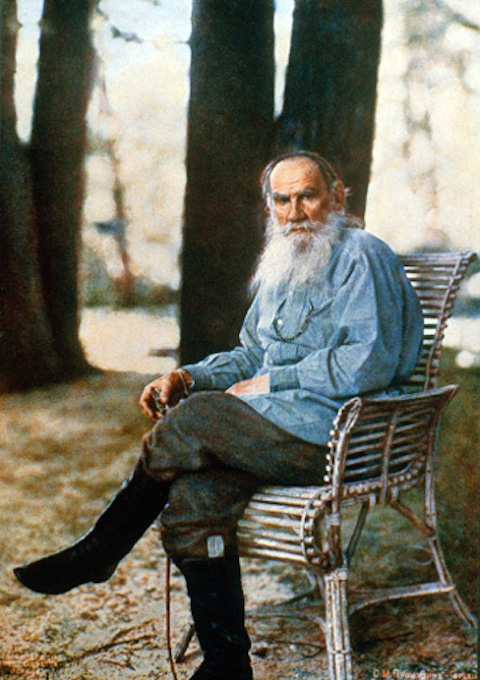
A portrait photograph of Tolstoy taken in 1908 by Sergei Prokudin-Gorsky, who had invented one of the early methods of color photography.Not long after that, I found a copy of the book in the library, which I wound up checking out and reading. There are a lot of Tolstoy’s arguments in the book which I don’t agree with. He had adopted, by the time he wrote it, a rather radical form of Christian anarchy. So he critiqued a lot of specific examples of art as being immoral in content—more often because he thought it promoted capitalism and classism than the sorts of things that get the modern religious right up in arms. He dissed Shakespeare and Dickens, for instance (though with a lot of caveats in Dickens’ case, since much of Dickens’ later work was critical of the dehumanizing effects of the industrial revolution).
Despite those parts of his thesis with which I still disagree, his arguments in favor of accessibility and sincerity in art helped me figure out that those literati wannabes had mistaken obscurity for superiority. They’ve fallen victim to the notion that if “ordinary” people enjoy something, it cannot possibly be high quality. If you define art by its difficulty to be comprehended, you’ve completely misunderstood what art is. That doesn’t mean that art can’t be challenging, but there is a difference between a piece that requires thought, afterthought, and re-visiting to tease out all the layers of meaning and something which hides its meaninglessness under layers of pretension.
Art is a human activity consisting in this, that one man consciously, by means of certain external signs, hands on to others feelings he has lived through, and that other people are infected by these feelings and also experience them.
—Leo Tolstoy
The way I usually try to sum up Tolstoy’s notion is: Art happens when the heart of the artist touches the heart of the audience, and the audience responds. The audience doesn’t have to like it; a piece of art that evokes intense dislike must be doing something right, or you wouldn’t feel so strongly about it. But art should never leave you unmoved.
Footnotes
1. The exact words said both to me (and later to my parents at a parent-teacher conference) by my seventh grade social studies teacher. He was not that only one who said things to that general effect.
2. The exact words said to me by a minister3 of another church who caught me reading during afternoon free time on a rainy day at Bible camp. Again, he was not the only person by any means to make similar comments about my penchant for both science fiction and science fact, particularly NASA.
3. Of course, this was the same preacher who thought it was funny, when teasing or disagreeing with a boy (he never would do such a thing to a girl, oh no!), to grab your pinkie, twist it into a stress position, and keep you there not only until you agreed with whatever he was trying to make you say, but that you cried sufficiently that he thought you had learned your lesson.
4. The favorite phrase one of my uncles like to use to describe me.
5. Several instructors quoted Tolstoy at me around this time. Another literature profession quoted the famous line, “All happy families are alike; each unhappy family is unhappy in its own way” but he completely misunderstood it. On the other hand, one of my mathematics professors quoted the exact same line, and then explained how the line was the perfect example of an important statistics concept. The concept is sometimes referred to as the Anna Karenina principle in honor of the Tolstoy novel from which the line comes. One way to think of the principle is this: in any system, there are a large number of ways that a given process can fail, and the only way to achieve success is to avoid every single possible failure. A successful outcome depends on every single requirement being met, whereas a single shortcoming in only one requirement can cause failure of the entire endeavor.
I’ve mentioned before that it’s my Mom’s fault that I am a fan of both science fiction and mysteries. From the time I was a baby, she would read aloud to me from whatever book she was reading (and when I got to the point I was trying to talk, she would cajole me into repeating back words and phrases and eventually whole sentences, which is how I learned to read at least a year before I was sent off to school). Since her favorite authors were Agathe Christie and Robert Heinlein, they made up a large proportion of what she read. But that’s a slight oversimplification. Because she read other books, too. The Christies and the Heinleins resonated with me in a way that the gothic romances she was also fond of did not. With one exception.
Mary Stewart wrote romances that weren’t always classified as romance. They were mysteries as well, and she integrated the two elements in a way where the solving of the mystery illuminated the character development as the characters fell for each other. So you’ll find some places classify her old books as thrillers, or mysteries, or romances, depending on the whims of the reviewer. Paperbacks my parents each bought tended to get taken back to used book stores to be traded in for store credit unless they were deemed worthy of multiple rereads. So there were only a couple of Stewart’s romances (most originally written in the 50s) that stayed on our bookshelves for years. One particular that I remember reading myself after pulling it off Mom’s shelf several times to look at the cover, was Stewart’s romance/thriller The Moon-Spinners.
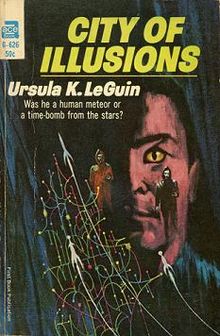
The cover of my paperback version is a bit more tattered than this image I found (Click to embiggen).I think I found my copy of Ursula K. LeGuin’s City of Illusions at the used book store that was in a town thirty miles away from the town I lived in for most of middle school. I know that I owned it before my folks split when I was 15. I don’t recall exactly where I acquired it, but I do know why I wanted to book: the character on the front of the cover had cat’s eyes, which I thought was really cool.
I don’t think this was the first sci fi novel I read that featured such a character. There are are so many sci fi books with characters that look mostly human, but have eyes like a cat or a bird of prey. But it was the eyes that really grabbed me.
The story begins with the man on the cover being found in the woods without any memory, not even a language, no clothes, and no clues as to who he is. The people who find him aren’t certain he’s human, because of the eyes, but they take him in, name him Falk, and teach him. We learn that this is Earth of a distant future, once part of an interstellar federation of some sort, conquered by aliens, and now severely de-populated and isolated from the rest of interstellar society. The aliens technically rule the world, but they keep to themselves in a single massive city.
Falk eventually sets out on a quest to try to discover who he is. This allows the author to show the reader other parts of the world before Falk finally is taken captive by the alien overlords who tell him he’s one of only two survivors of a crashed spaceship from another world. They introduce him to the other survivor, and offer to restore his memory—though it will mean erasing his current personality. Falk agrees, and the novel switches to the point of view of the restored personality, who doesn’t know what Falk knows about how the humans on earth are treated. The aliens want Falk to go back to his own people and tell them how they are running earth as a garden, keeping the humans happy.
Eventually the original personality is able to awaken Falk’s memories, which also means that he winds up with two personalities trying to work together.
I’ve left out an important detail: just about everyone seems to be telepathic, Falk, all the humans he meets, and the aliens. Telepathy was how the old Federation came to be, because no one can tell a lie in psychic communication. Except it turns out the alien invaders can. Falk and the restored original personality realize the aliens aren’t going to let him go if he remembers the truth about Earth, so he has to steal a spaceship and escape to his homeworld where he may be able to convince them to attempt to liberate Earth. There’s a cute telepathic trick that Le Guin uses at a crucial point in the climax, and the story ends on wit Falk on his way to his homeworld, but without the certainty that Earth will be liberated.
The novel straddles several categories of science fiction. The world is a post-apocalyptic world, even if the apocalypse happened a thousand years ago and a new, stable set of societies have developed. There’s also the aliens subjugating humans genre. And the isolated protagonist who has to discover who he is.
The novel is one of three loosely connected books (the others being Rocannon’s World and Planet of Exile) in which Le Guin was working out a single future history, in which humans have been seeded on many worlds, and they have diverged in various ways, but still consider themselves one race. This is where it encompasses another idea that was more popular in Golden Age science fiction: humans aren’t native to Earth, but were seeded there hundreds of thousands of years before our time.
Some of her much more famous later books, The Left Hand of Darkness, The Dispossessed, and The Word for World is Forest are sequels, in a sense, to these books. They all allude to the common history of these three, in any case, so a lot of people lump them all (along with a few others and some short stories) into a single saga called The Hainish Cycle. Le Guin herself has rejected the label, in part simply because the collective works don’t tell a single story. Another reason is that in the first three books she was trying to figure out how to do a future history, rather than having drafted a coherent future history as a grand backstory to it all. So there are contradictions and variances in the histories of all the books.
The City of Illusions is one of those stories that sticks with me in weird ways. I remember Falk, his struggle to discover himself, and especially the way that Le Guin portrays the two people living inside one head phenomenon at the end. I remember the notions and paradox of telepathic lying. But I forget things like what the aliens are like. I forget what any of the other human societies that Falk visits during his adventures are like. That’s not a bad thing. The story is, on one level, about isolation and discovery. And that part really resonated for me at that age. Some of her other ideas from this book I find myself incorporating into my own stories without consciously realizing where they came from. Which I think means that Le Guin conceived them and executed them well: they’ve become part of the fabric of how I think things would actually work.
Years later, I have read many other Le Guin books, and I own her translation of the Tao Te Ching, a holy book that figures in this novel’s plot. Which I think means that once I finish reading this last Hugo novel, I need to add City of Illusions to this year’s queue for a re-read.
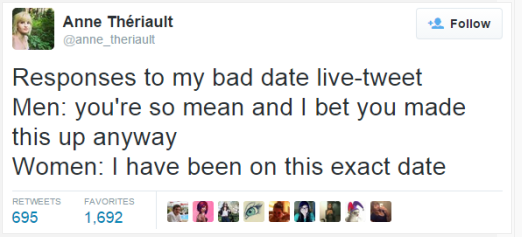
In one of the Discworld books, Terry Pratchett asserts the theory that there are only a small number of real people in the world, and the many people you meet are merely duplicates; that’s why you seem to meet the same kinds of people over and over again. I was reminded of this phenomenon by a string of tweets by Anne Theirault being shared around on Tumblr. They begin with her observation of a couple at the next table who seem to be on a coffee date that is not going well.
(Click to embiggen)She proceeds to live tweet the conversation she is overhearing. The guy talks about himself constantly, without ever asking his date about herself. Any time she volunteers something about herself, he has to turn it into something about him. Example, she mentions she likes to cook, he tells her that she must taste this exotic sauce that he makes that a friend who is a chef says is great. And so on. Eventually the woman on the date fakes getting a text from her mother as an excuse to escape.
(Click to embiggen)A little later Anne tweeted about all the reactions she was getting. Specifically, that most of the men who responded asserted that she’s being unfairly mean to the guy and/or accusing her of making the whole thing up. While the overwhelming majority of women respond that they have been on exactly the same date.
The Tumblr post has been shared nearly 200,000 times as of this morning. I noticed that I was not the only queer guy by any means to share it and comment that we had also been on this exact date. Other people have added the observation that they know it’s true not just because they’ve been on a similar date themselves, but because they know dates like that happen every single day.
I noticed that a lot of people sharing it on Tumblr make the observation that this proves you should never date a writer (the guy describes himself as a writer and says a lot of very cringe-worthy stuff about writing). Which means that these people completely misunderstand. First, Anne Theirault, who live-tweeted the exchange, is herself a writer. That wasn’t the observation she was making. The guy isn’t cluelessly obnoxious and self-absorbed because he’s a writer. He’s cluelessly obnoxious and self-absorbed because he’s a guy.
When I reblogged the Tumblr post, I observed that I had been on that exactly date back in the 90s, and had to fake coming down sick in order to flee. I was the writer in the conversation. The other guy was a performance artist. But I’ve had the exact conversation (not in the context of a date) with guys who are in marketing, guys who are software engineers, guys who are car mechanics, guys who run their own businesses, et cetera. And even worse, I know that there have been conversations I’ve been in when I was the cluelessly self-absorbed guy who only wanted to talk about myself and never let the other person get a word in edgewise.
Guys are socialized to be that kind of person. We’re supposed to assert ourselves, and dominate conversations. If we don’t all have the requisite extroversion streak to dominate, we’ve at least all been socialized to expect that our needs are always important, that of course anything we are involved in is going to be interesting to other people—not just interesting, but exceptionally interesting, because everything we do is special and unique and better than what anyone else is doing. Guys are taught to be entitled. We’re also taught that it is our job to win people over to our side. To be competitive even in a conversation. We’re taught that a date isn’t a chance to get to know another person, a date is an opportunity to conquer and take the other person as a prize.
Some of the specific assertions that Anne tweeted that the guy makes about how incredibly hard writing is, and how he has to struggle with his inner demons to write, even those are not something that is common to writers nor restricted to writers. The performance artist disaster of a date spent a lot of time explaining to me how very very hard it was to do what he did, how he had to dig into his worst childhood memories to infuse his performance pieces with meaning, and so on. It’s a product of the self-absorption and competitiveness. He was trying to impress me, to make me swoon over his great emotional depths and work ethic.
The only inner demons a writer needs to struggle with are Procrastination, Distraction, and the “But it’s not perfect yet!” urge. And those aren’t really demons. They are ordinary (and usually quite minor) imperfections. Our struggles aren’t exceptional. They are the same kinds of things that everybody struggles with.
Not all guys are like that all of the time. There are even some guys who are almost never like that. Some of us have realized we can be like that, that it isn’t good way to be, and we try not to let our arrogance bulldoze everyone else. I am also aware that there are even some gals who can be that way. Humans are not perfect.
Unfortunately, a lot of humans are imperfect in very similar ways.
When I set my goals for this year, I pledged to continue the things I thought worked last year (which includes posting regular updates) and added some new things. It’s a new month, so here’s the next report!
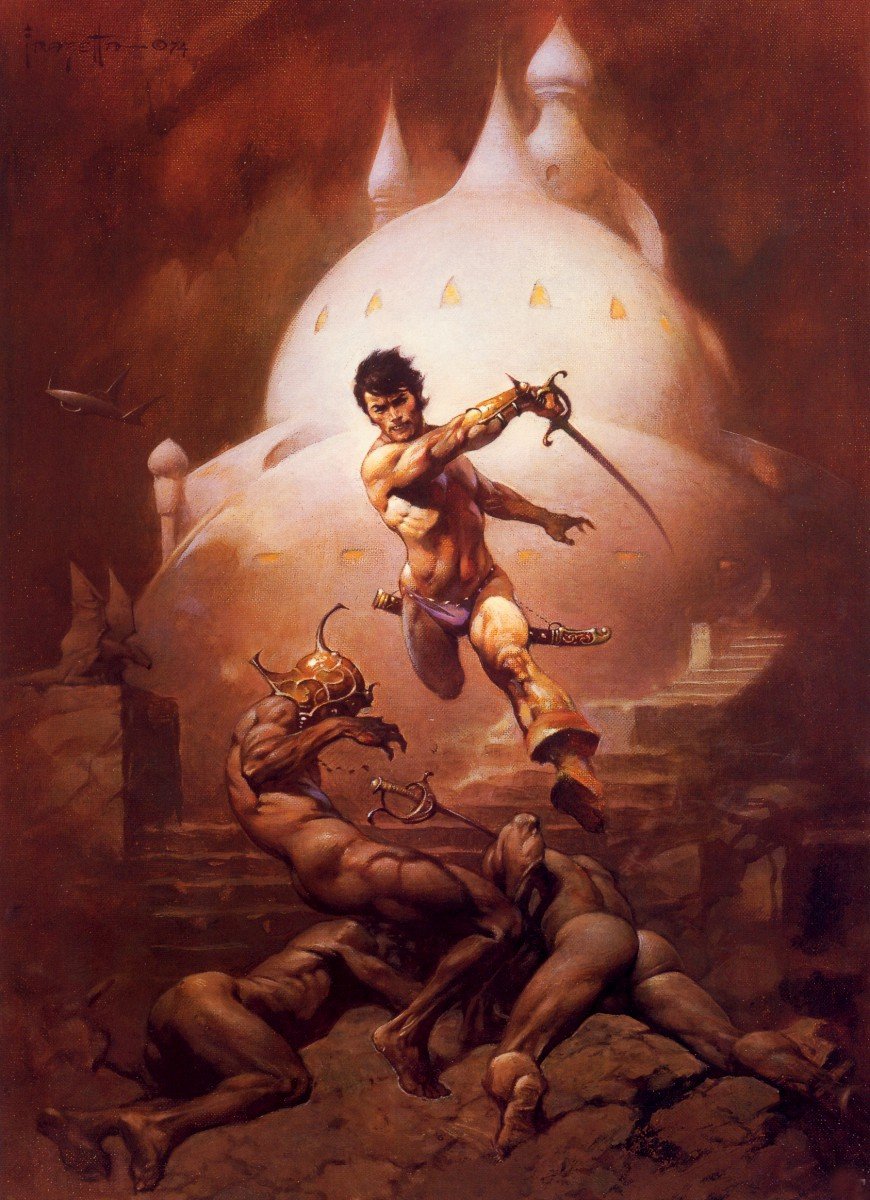
This Frank Frazetta painting, a cover for a John Carter of Mars paperback, hung on my bedroom wall throughout high school and college.(Click to embiggen)
I don’t know when I first saw a painting by Frank Frazetta adorning a book. He had worked for many years in the comics industry, then began doing movie posters in the early 60s, and by the mid 60s he was painting cover art for paperback editions of Conan the Barbarian, John Carter of Mars, and numerous other similar sorts of fantasy book series. He became the go-to guy for that sort of book. And soon rock bands were licensing images for album covers or sometimes commissioning him to do an original work for an album.
His fantasy art style was described as primal and potent. He liked to call his work rough. He also freely admitted he didn’t read the books he created covers for—even when he was also paid to create pen and ink illustrations for the interior. He insisted that most of the people who bought the books didn’t really read them, either. I’m not sure if that was supposed to be an egotistical claim that the book covers were so great that people who didn’t read would buy them, or if he thought that only illiterate people were interested in the types of stories in the books (but if they were literally illiterate, what were they doing even looking at books?), or what.
I know that most of the books I owned that featured his artwork were picked up at used book stores. And they were almost always very worn, having had their pages turned a lot. Lots of people buy books to read only once then pass on. My experience with the other fantasy fans I hung out with during my teen years was that the folks who bought these books read them, re-read them, and re-read them again. We became obsessed, and would go back again and again.
I was reading them for the sense of adventure. For a chance to imagine a different world, where the bad guys were obvious, and the good guys would get back up no matter how often they were knocked down.
But I also spent a lot of time staring at cover art. Thinking about the world and the story, yes, but also wondering why the artist made this choice, or that. What was that thing in the bad guy’s hand supposed to be? That sort of thing.
I also had other, much less noble reasons for staring at the artwork. And for buying posters of some of the artwork to hang on my bedroom wall. Though I didn’t admit it. The artwork, particularly Frazetta’s wasn’t merely primal, potent, barbaric, and rough—it was also erotic.
Frazetta’s cover painting for The Book of Paradox by Louise Cooper, published in 1973. (Click to embiggen)
My first week at university, the parents of my roommate showed up to visit. My roommate’s mother freaked out at this poster on my side of the room. I thought she was upset because of the naked man’s butt, or maybe she guessed that it was a “supernatural” picture (this was a Free Methodist university, and most folks there were quite rightwing conservative). The novel, The Book of Paradox was a sort of tarot-based fantasy, which I’m sure his mother would have labeled Satanic if she realized a battered paperback copy of it was sitting on the shelf above my bed in that same dorm room.
No, what she was angry about were the bare breasts on the winged creatures. I think I actually said out loud, “I forgot those were even there.” Because I literally had. They were obviously not the part of the painting that interested me.
“Atlantis” my very favorite Frazetta painting. I hung onto the poster long after all the others. (Click to embiggen)
My favorite Frazetta was “Atlantis,” which depicts a statue of some long forgotten warrior among flooded ruins. I know that part of my fascination was the presence of a near-nude male figure, as in so many others. But there was also something about the melancholy sense of determination in the face of great loss that spoke to me. The evocation of a great disaster that reduced the heroic exploits of generations of champions to a few vague remembrances alluded to in the stories of more recent adventurers. I wrote more than one story attempting to evoke the feelings that the picture gave me of a once mighty and noble people who had been stuck down by overwhelming, perhaps uncaring forces. I also used variants of this scene in a large number of roleplaying games I ran.
At the time I was doing everything I could to deny my attraction to other guys. Reading some of those hyper-masculine, pulpy adventures of barbarians and warriors seemed like the opposite of anything gay. Because, frankly, the only women who ever appeared in those stories were there as a prize to be won or a damsel to be rescued (or both). But I remember one friend commenting on just how often Edgar Rice Burroughs, for instance, mentioned that his various heroes were “half-naked.” At the time, I suggested that a lot of those stories had originally be written to be serialized in magazines. The writer had to re-introduce each character in each installment, for the benefit of readers just joining the tale, or to refresh the memories for those for whom it had been a month since reading the previous chapter.
Many years later, I’m not so sure. There were a lot of guys I knew back then who were all about my age that were really into these kinds of books. We lent each other copies of books we couldn’t afford or hadn’t found our own copy of. We talked about our favorite parts. Some of us bought posters of the book covers. We speculated about which ones would make good movies. We drew pictures of scenes from the stories. We tried to write similar stories of our own. In the years since, more than half of those guys have come out as gay or bisexual.
So maybe I wasn’t the only one who spent a lot of time staring at those cover paintings.







 Font Folly