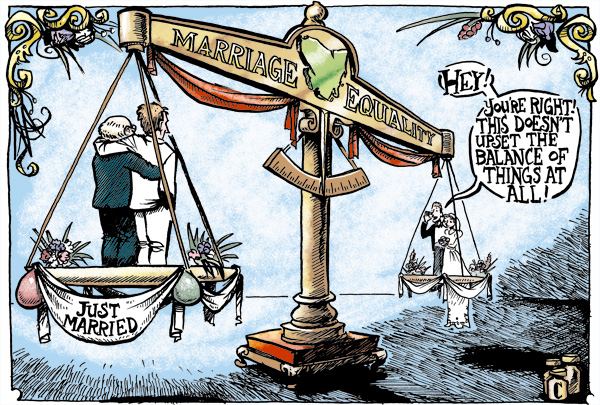
Freedom to marry doesn’t hurt anyone.So, the Hawaii legislature has passed marriage equality, setting the Aloha state to be the 16th that will allow all citizens, gay and straight, say “I do” to love and commitment.
It has been an extraordinary year. Think about it, just 18 months ago, the citizens of North Carolina, a state that already had a law banning marriage between same-sex couple, approved an amendment to their state constitution prohibiting the state from performing or recognizing either same-sex marriages or civil unions. Then, 12 months ago, on election night, the voters in Maine, Maryland, and Washington state all approved measures in favor of same-sex marriage (and the voters of Minnesota rejected an attempt to amend their constitution to prevent the marriages). That brought the number of states recognizing marriage equality to ten. And it was as if the floodgates had opened…
The Alternate NaNoWriMo, as proposed by Cafe Aphra (http://cafeaphrapilot.blogspot.com/2013/10/the-alternative-nanowrimo.html)Yesterday was day six of National Novel Writing Month (NaNoWriMo). On Wednesday I only wrote 1258 words of new content on my novel in progress. I lost a bit more time than usual researching some stuff for the book, as well as researching something because of a comment from a friend about another blog post. My total word count at the end of day six is 9789.
This isn’t my first year to do something NaNoWriMo-related, but it is the first year that I’ve actually set up an account at the site, and the first year that the alternative I’ve crafted for myself is so close to the spirit of NaNoWriMo.
I’m writing every day on one novel.
I have a daily word count target I’m aiming for.
I have the long-term goal of finishing the novel at the end of the month.
The only thing I’m doing that breaks the “rules” is that I didn’t start a new book from scratch on November 1.
Besides having several friends participating with whom I am checking periodically, this year I have recruited my mom to give it a try. She aspired to be a writer before I was born, and had a particularly traumatic experience when her new mother-in-law found mom’s unfinished first person romance novel and accused mom of having an affair. My paternal grandmother told anyone and everyone she had proof mom was having an affair, and she even coerced my dad into meeting with a divorce lawyer, among other things.
I only learned about that particular incident recently. Growing up, I knew my mom loved books, and she was quite supportive of my early interest in both reading and writing.
Anyway, for some years now I’ve been trying to encourage her to write, with only moderate success. Until I told her about NaNoWriMo. “Can anyone do it?” As soon as she said that, I knew she was hooked.
The first two days she did everything long hand. I can’t tell you how many times I’ve showed her how to use the word processor program on her Mac. For some reason it has just never sunk in that you can do something other than write a short note in those things.
So I walked her through it. I thought, given how she’s always talking about how much she likes having a laptop and how portable it is, that she’d want to write on it. Turns out that what seems to work best for her is typing on her iPhone. Yep, she now has not one but two Word Processors on her iPhone. I showed her how to set up the Dropbox synching with that, so she can work on the stories easily on either her computer or her iPhone.
And she’s writing away and so far having a ball.
The only pep talk I’ve had to give her was when she found herself worrying about some scenes she thought that maybe she should go back and edit. But she already knows that she has a tendency to get caught in unending revision loops on a single scene, so she knew it was a bad idea. I suggested that when the voice in her head started worrying about mistakes that needed fixing, that she just tell the voice that December is for revising.
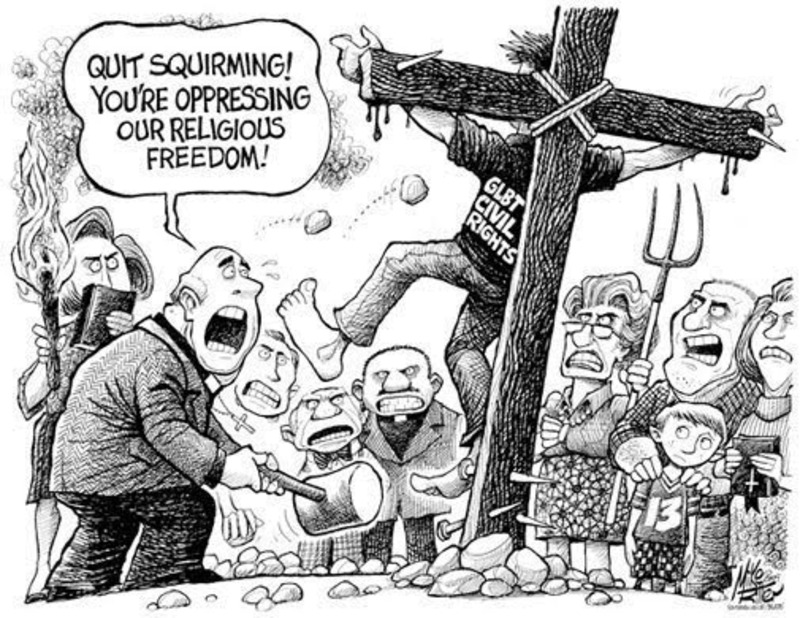
“Quit squirming!”So the U.S. Senate appears on the brink of passing the Employment Non-Discrimination Act which would bar businesses from taking into consideration sexual orientation when making decisions of who to hire, who to fire, and who to promote. And all the usual arguments are being trotted out as the usual suspects go into a frenzy. I’m not going to pick the overt haters’ arguments apart here, but what I really get tired of are the people who insist that they aren’t in favor of discriminating against anyone, for goodness sake. And then they say, “However…”
One wonders how I hit 105 wpm with those paws.Word count at the end of the third day: 5848. Average per day is not high enough to hit 50,000 by the end of the month, but my word count per day is ramping up. And so far I’ve exceeded my minimal goal each day.
Since I’m doing The Alternate NaNoWriMo this month, my blog posts are either going to be shorter and less meaty, or simply less frequent.
I will try to write about something else at least occasionally, since I know that simply reporting my word count and occasionally commenting on what I’m working on is probably not going to be that interesting.
So far (and I realize it’s only been three days), I’ve been finding it works better than my previous attempts to do an alternative version of the exercise. Previously I didn’t set a daily word minimum, so while I did try to keep track of how many words I wrote, I wasn’t focused on that. It was also a little difficult since I had given myself an open-ended assignment to finish “some stories that have been stalled.” Since I was jumping back and forth between tales, figuring out the word count was a little tricky (not impossible, just a multistep tedious process).
It also gave me a great way to procrastinate by doing something I could rationalize as “productive.” If I wasn’t making progress on one story, I could just open one of the other files, and waste time by re-reading what was there in order to orient myself. Some nights I opened and re-read a half dozen or more unfinished tales and got no writing done at all.
Limiting myself to this book in progress, and not any of the many short stories, et al, hanging out there (and not allowing myself to count anything I write in them toward my total) seems, so far, to be doing a good job of keeping me focused.
It wasn’t a complicated costume.For many years my Halloween costume has been driven by a party hosted by some friends of ours who have been hosting a Halloween party every year for more than 20 years.
It began way back when a sub-group of the Elfquest/sci fi fan groups we were associated with went to the Evergreen State College the weekend before Halloween to celebrate K’s birthday. Our friend, Mark, bought a piñata shaped like a Pokémon. I think more time was spent trying to figure out how to hang it from the window of the dorm/apartment and a nearby tree than anything else at the party. Though I also recall that the piñata was really difficult to break.
Anyway, K, D, and Auntie have been hosting Halloween parties ever since. The parties always have a theme, and one of the activities at the party is a piñata that matches the theme. There was a skull representing Horatio at the Shakespeare party, for instance, and a moon with little stars floating around it for one of the space themed parties.
There was never any requirement that one wear a costume that matched the theme of the party, but for those of us who are procrastinators and indecisive, having the theme could give you some ideas. The year the theme was “Antarctica” Michael and I showed up in shorts, Hawaiian shirts, leis, and sunglasses. We had a little act we did where we fumbled with a map of the Hawaiian islands. Our costume was “Lost Tourists.” I don’t remember what the theme was that had me dress as the Next Doctor and Michael dressed as his companion, a 1950s hard-boiled detective.
Anyway, having the deadline of our friends’ party pushed us to make a decision, and having the theme gave us something to either conform with, make a joke of, or just ignore.
Then, because of a series of events which culminated in a major appliance failure at their house and has kicked off a long-delayed kitchen remodel, they didn’t host a party this year. Which is understandable, but also a teensy bit of a downer.
So I thought I wasn’t going to be doing a costume this year.
Then one day at work I got an e-mail with the subject line “Top Secret!”
I don’t want to go into all the background, but during the last year among the changes and shakeups have been that the person who had been the VP of Sales for our group has been promoted to the head of our business unit. In some ways it was a very big change, as the guy who had been leading the unit had been in that position for well more than 10 years, and the company (like a lot of American corporations) didn’t have very many female executives. She’s not entirely conventional. She almost always wears black, for instance, and among her definitions of office attire (and not on casual days), is Levi jeans.
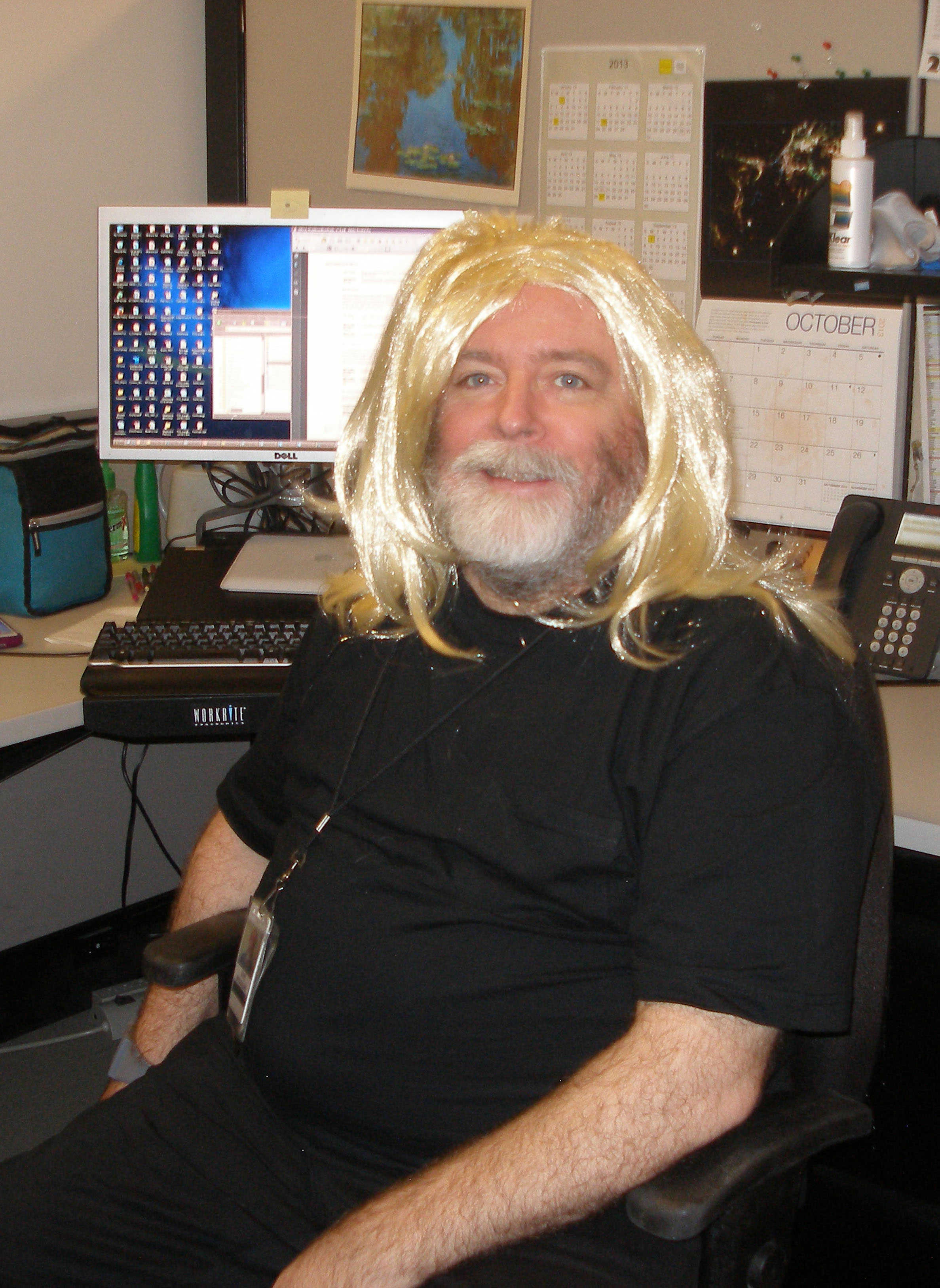
Anyway, it had occurred to someone that all of us could get long blonde wigs, and just show up wearing all black and with the wig. Then we could surprise her by coming into her office, all of us dressed as her. We even had “masks” that consisted of a printout of a photo of her that we could hold in front of our faces.
It wasn’t a very complicated costume, and it wasn’t something that anyone outside the company would recognize without an explanation, but it was fun, and silly, and what else is Halloween for?
Ant colonies in temperate regions will close off all the entrances to the colony at night to prevent the interior temperature from dropping to fatal levels. In order to properly seal the entrances, a small number of ants have to push material into the entrance and pack it down from outside. Trapped outside, they die when the temperature drops. Their sacrifice contributes to the ongoing survival of the colony, so from a genetics and evolutionary viewpoint, the death of a few members of the colony is a good thing.
Not that the ant actually thinks of that. They aren’t nobly volunteering to make this sacrifice for the rest of the colony. The species has evolved a series of behaviors in response to various stimuli, and they just do it when it’s time.
When a person like me—a very analytical guy prone to introspection, and who watches everything amd everyone looking for patterns and drawing conclusions—talks about the behavior of other people, the reasons I ascribe for their behavior are an awful lot like our academic analysis of the ants. We understand the benefit which the colony as a whole gains from the sacrifice of a few ants, but the ant doesn’t.
Most of people don’t spend a lot of time thinking about why we do the things we do. Even someone as notoriously over-analytical as me doesn’t spend much time thinking about why I’m doing something while I’m doing it. A person on the street asks me a question, and I answer. How I answer, from my tone of voice, to my body posture and facial expressions, are the result of a complicated process going on mostly unconsciously.
If I saw the person before they asked the question, likely part of my brain did an assessment of them based on how they looked and acted. I may be in a slightly defensive mode if my brain has seen similarities between them and people who have harassed me on the street in the past, for instance. I will be very defensive if my subconscious assessment has tagged them as a certain kind of prostelytizing jerk (lately more likely to be some sort of teabaggy political sort, but I’ve also been harassed by nuts of a religious variety).
I may feel quite friendly and welcoming if I recognize them—even if it is only as a stranger who has nodded and said, “good morning” when we’ve passed on that street before.
Similarly, how they behave toward me is going to be influenced by their own subconscious assessment of me based on the same sort of superficial features. I’m a short, overweight, grey-bearded white guy. Depending on the other person’s past experiences, that might mean I look harmless, or annoying, or potentially a source of unwanted attention.
So they might frown at me because I seem likely to cause them some annoyance or inconvenience. Or they may only appear to be frowning at me, but they are actually just trying to figure out what is written on the t-shirt of a person walking behind me. Or maybe they’re just squinting because of a blinding reflection from the windows on a building across the street.
So, if when they ask me a question, my tone of voice might sound annoyed or even angry, while inside I’m only aware that I’m worried that this person is going to make me late. And because I sound angry, they may give me a less than enthusiastic thank you after I give them directions to the place they can’t find.
And we both walk away thinking the other person was rude.
I try to remind myself of that when I rant about someone like the guy on the bus last week. I remember the experience from my perspective. Which has its own biases. Maybe I was the one giving off attitude and expecting other people to respect my wish to listen to my music and read my book.
The toadstools growing in a roughly circular formation in our lawn.Late Sunday afternoon I ran to the store to stock up on certain things. The local union is about to start a strike against a bunch of the stores (specifically several of the big chain stores) and I really don’t want to cross picket lines. The closest grocery store to us is a union store but it is not subject of the strike because it is part of a smaller, local chain that isn’t screwing over the workers in the way the big chains are. But said store, even though I like shopping there, has a smaller selection than the other stores.
When I got home, Michael came out to help me unload, and he pointed out something I had missed: a fairy ring! Toadstools coming up in a large ring on the lawn, right next to the car. So I had to take a picture…
Families in Russia faced actual religious persecution.Besides the incident I wrote about yesterday, the various anti-gay groups, a whole lot of the speakers at the so-called Values Voters Summit, have been getting more paranoid in their claims. They refer to things like the legal recognition of marriage equality as religious persecution. They refer to the enforcement of anti-discrimination laws that have been on the books for many years before the marriage equality movement as religious persecution, but only when it is used to combat discrimination against gays and lesbians. They refer to anti-bullying programs in schools as religious persecution.
None of that is religious persecution.
You know what is religious persecution? Having your grandfather and later your father arrested for leading a Bible study. Having the police show up at your school when you are nine years old and they take you into custody, put you in an interrogation room, and question you for hours about your parents’ religious beliefs, while your little sister is held in another room, and they tell you can see her again if you will just admit that your parents are preaching illegally.
I knew a woman whose childhood included those things. She was attending Seattle Pacific University and we had a class together. She was about ten years older than the rest of the students, wanting to finally get a degree, because she had spent her high school years (years) taking refuge in a U.S. Embassy in the Soviet Union.
My first iPod was pink.I was 19 years old when I got my first Walkman. It played cassettes, which while more compact than vinyl LPs (which was the dominant format for commercially purchased music at the time), they were large enough that carrying around more than a few albums worth of songs could be a bit awkward. So I usually had only one or two tapes with me at any time, and therefore tended to listen to the same album over and over again throughout a day.
One wonders how I hit 105 wpm with those paws.A couple days ago I wrote about authors who claim to write stories in order (Put one scene after another…), with some commentary on the accuracy of those claims. And while I talked about how I did things myself back in my typewriter-only days, I didn’t talk about my current process.
I don’t have one single approach. Each story is a bit different. In the typewriter days I tended to scribble thoughts and fragments in notebooks that I carried around with me until I reached a point I was ready to start. Sometimes I still write notes by hand, but more often they get typed into my phone. I have an app called WriteRoom which connects with my dropbox, so anything I type in the phone is available as a text file to access from my iPad, my laptop, or my desktop. The same company has a product called PlainText that works on the iPad and Mac. What I like about PlainText is that it has a good integration with Scrivener, which is my main writing tool.
If I’m at the point where I think the notes and ideas are turning into a story, I’ll set up a story file. Depending on how long I think the story will be, I may start a simple file and just start writing. If I know It’s going to be a longer piece, I’ll set up a Scrivener novel file, and copy all of the notes I’ve assembled elsewhere into the Research section of the Scrivener file before I start writing.
Often those notes I’ve scribbled or typed down include conversations between characters in the story. Sometimes they are complete scenes. I don’t always know where the scene falls in the story when it first comes to me. Sometimes, by the time I’ve finished the story, those scenes aren’t part of it. Even though I had to write them down in order to figure out the story, they don’t belong in it. They may be things that happen in between scenes that are merely alluded to. Sometimes they’re things that never “happened” in the fictional world at all.
For instance, one time I had a scene pop into my head, one of those Write me down! Write me down now or I’ll go away! scenes. Two characters were debating/arguing about the moral and practical consequences of a series of events they had been involved in. I eventually figured out the story and wrote it. It the middle of the story, during one of the events the characters had argued about in that scene, one of the characters is killed. And then some of the events the two characters had been debating happened after that character was dead. This particular story wasn’t set in a fantasy world where people might have conversations after death, so that scene couldn’t happen.
Most of the time, with short stories, once I start, I write most of it in order. I’ll write a scene, and that dictates what happens next and how the characters will act. I may end up going back to insert an extra scene. Or a scene may pop into my head that I know is close to the end, and I’ll write it to get the information down, then go back to where I left off and figure out how to get to the end.
Sometimes, I realize that I started the story in the wrong place. I had this one short story I had been working on for years. It just didn’t quite work. I would read a version at my writers’ group, and even before anyone said anything, I knew it still wasn’t working. Reading a story outloud, and feeling the non-verbal ways people are reacting to it sometimes is all the critique you need. When I finally realized that I’d begun it wrong, I fought for while. I loved that opening. I had read the opening, without the rest of the story, at several readings at conventions, and the audience had loved it.
But it was the wrong start. It happened at the wrong point in the emotional arc of the tale. It only worked from the point of view of the minor character who never appeared again in the story. It was a great opening—but it was an opening for a story starring that character. I had to look at which character it was that underwent the most change, or had the revelatory moment when the conflict resolved. She needed to be the protagonist, and then it was obvious where the story began: the moment she confronted the puzzle which her revelation would be about. Which was a very different opening. The events of that opening I had clung to for so long still happen in the story, they just happened in the middle, and from a different point of view. The scene is still a good scene, but the emotion and rhythm is very different.
Novels are a lot more complicated. For one thing, to sustain a novel length story you need subplots, in addition to the main story. Those subplots need to have some relationship to the main story line, some of them even feed into it. They get resolved at different times. And making all of that work requires me, at least, to go back and add new scenes, or move scenes (or parts of a scene) to a new location in the narrative.
In a novel-length story, there is often a point where I have to jump way ahead and write part of the ending. It’s usually a point where enough of the subplots have got going that I make some intuitive leaps about how some of them tie together. I write the scene, knowing full well that by the time I get to it I’m probably going to have to rewrite it a bit. But having it there it acts like a target, giving me something to aim at as I try to move all the characters and subplots across the finish line.
Calling it a finish line is misleading, of course. Because once I’ve finally gotten them all there, then I have to go back and fix things. But that’s a topic for another day.



 Font Folly