Tag Archives: personal

A once familiar land

I spent the weekend visiting my Mom for her birthday. Just under a year ago she moved back to the town where I attended High School—a town I haven’t lived in for 28 years.

I’ve visited regularly throughout that time. My grandma lived there until her death a few years ago, along with numerous cousins and my Aunt Silly. A few years ago my sister and her two kids moved back. So I have visited for various holidays, birthdays and the like, and/or stopped in on my way elsewhere. So it isn’t that I am completely unfamiliar with the place and the changes that have occurred since I left.

For some reason this weekend left me feeling more of a stranger to that place than any previous visit.

I’m not entirely sure why. I have some suspicions. This is the first time in many years that my husband, Michael, wasn’t with me (he had stayed in Seattle to rest and recuperate). He’s never lived in that town, so I was always more familiar with the place than at least one person I was hanging out it. Being with my husband anywhere is always like we’re carrying a bit of home around with us, so no strange place feels entirely alien if he’s with me.

This was also the first visit in a long time that I didn’t at least stop at Grandma’s house. My aunt moved into Grandma’s house after Grandma died, and so I’ve continued to have a reason to visit the house. While my aunt has changed a lot about the place, it’s still Grandma’s house on Grandma’s street. I saw my aunt this weekend (she came to Mom’s for cake and ice cream), but I didn’t go by her place.

This isn’t a case of me suddenly realizing the truth encapsulated by the cliché, “you can’t go home again.” When I left to finish my college degree, I had every intention of returning to that town, or a very similar community, to settle down. But I fell in love with the city. I can’t imagine living somewhere where there aren’t multiple supermarkets open 24 hours, for instance. Let alone living without multiple theatre companies, the opera, and all the other things that come with a culturally vibrant city. And while Seattle isn’t exactly known for its racial diversity, with about two-thirds of residents being white, that’s a big difference from the 92% white demographic in Mom’s community.

Maybe it is the slow accumulation of little changes over those 28 years, making once familiar places look less and less as I remember.

But I don’t think it’s about the town changing, it’s the other way around. I’ve changed a lot, yes, and even more importantly, the world has changed.

Coming out of the closet more than 20 years ago, and realizing how little freedom to be myself I would have if I returned, played a big role in the alienation of my affections for that town. I don’t remember anyone who was living as an openly gay person when I was attending high school and community college there (there were people that everyone suspected and whispered about, of course). Now there are several gay and lesbian people living there, and at least one gay teen support group that advertises meetings and activities. But it did not escape my notice that the recent referendum to extend marriage rights to same sex couples was rejected in that community by a margin of nearly 20%.

But it’s not just about me being gay and unsure how welcome my husband and I would be if we moved there. Nor is it just the practical financial matters (there aren’t many jobs that require my skills and specializations). It’s so much more. I like not having to bite my tongue as strangers make racial comments about the president. I like walking through a parking lot and not seeing dozens of deeply conservative political, religious, and anti-science bumper stickers, and absolutely none of the other kind. I like living in a community that believes in and enjoys investing in infrastructure and schools and social services. I like living in a community that knows that a lot of its tax dollars go out to less-populated parts of the state, without resenting the people who use them.

I’ve changed. That town as changed. One can argue about which one has changed the most, but it’s not just about how far down our paths we’ve gone, but also about direction.

And I know we’re not headed toward the same goal.
Juggling chainsaws

I often use the metaphor of juggling to describe my work load. Particularly since my work is often covered by multiple non-disclosure agreements, it’s best I keep things metaphorical and oblique.

Because of re-orgs and various forms of attrition, we no longer have a technical writing team, instead we’ve been separated so that divisions and/or groups of the company have one (singular) tech writer each. For months my boss (a director of software development in a group within a division) has been worried about my workload this summer, because when we plotted the projects, based on my estimate of the total hours required for the doc sets of each of the projects, their deadlines, and the typical distribution of my workload (for waterfall projects most of my time and effort is needed during the last two and a half phases), July and August looked like they would require more than 80 hours each week from me.

It hasn’t come to that, for several reasons (one being that I know what that kind of workload did to my health when I was stupid enough to do it in my thirties; I don’t want to find out how much worse it would make me feel in my fifties—so I found ways to pull a lot of the work into earlier phases), but I am running very ragged, juggling the six or seven full-sized chainsaws, a couple of lighter chainsaws, plus a couple of knives and at least one flaming baton.

I’m surprised I managed to keep the blog going as well as I did in July. Things may be very spotty for a while.

No monsters needed for Monster Croquet

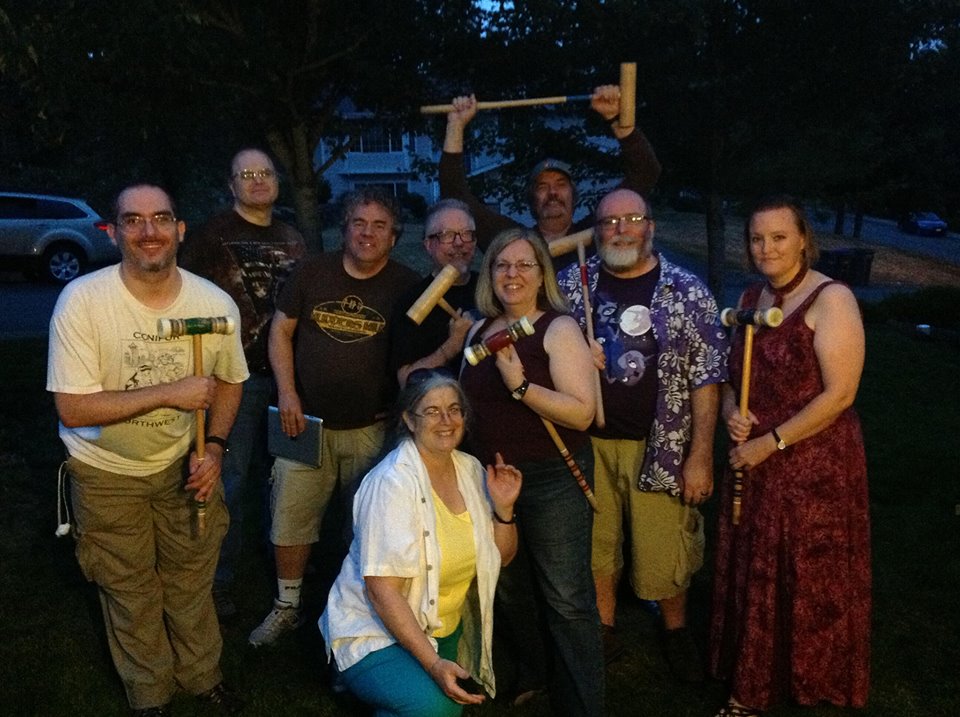
Nine people posing with croquet mallets.
The gang from this year’s Monster Croquet match (except for Lady K, the youngest player this year, who didn’t want to be in the picture with her parents are their old, weird friends)
Every summer the literary society of which I am a member has a barbecue/picnic hosted at a member’s home. And every year we play the Monster Croquet match.

I don’t know which year it was that we first played croquet at the barbecue, but I have photos of matches going back at least to 1996. That first time we were using an old set that had belonged to Auntie’s family on a yard that wasn’t flat. Like a typical Seattle-area lawn in the summer (when almost no one waters their lawn in the summer), there were odd patches of brown grass, and so forth. So most of the challenge of the game was the uneven ground and turf causes the balls to bounce, and take weird turns, or just go rolling down a hill.

Someone said it wasn’t a croquet match, but a monster croquet match. And the name stuck.

Over the years we’ve evolved a set of odd rules. David constructed a set of wooden wickets with large, easily-read numbers. We got in the habit of multiple people bringing croquet sets so there are enough mallets and balls for however many want to play.

Each year the course is different, and we take pains to make parts of the course treacherous. The uneven terrain and such proves to be a great leveler, so one’s skill level is often less important than luck. Which adds to the fun.

Sometimes the course if very different. When Julie (also known as “Julie with an e”) and Mike (also known as “Julie’s Mike”) hosted it at their new home a few years ago we knew it would be a challenge. Julie & Mike’s yard consists of an ornamental pebble stream bed, several decks, a couple of curved wooden bridges, various ornamental plants, and no grass. So we got a Nerf Croquet set and made the course go over the bridges and around the decks.

When Keith and Juli (also known as “Juli sans e”) first bought their house some years earlier, the backyard was devoid of any vegetation and was all slope. We thought that was perfect for treacherousness! But after many, many hours of grueling play, when no one had made it even halfway through the course, and the sun was setting, we realized it was too treacherous. We were debating calling the game because of darkness, when my godson (who was, I think, six at the time) finally went through the pair of wickets at the turn-around point. When he hit the turn-around stick, we unanimously declared him the winner, grateful that we could finally stop. We have often referred to that year’s match as the Death March Croquet Game.

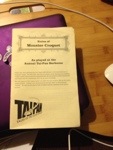
A booklet
Rules for croquet as played at the barbecue.
The rules have always been somewhat ad hoc, based on an aggragate of the collective memory of childhood croquet games, with an evolving set of modifications. Some years ago someone requested a rules reference, so Auntie and I created a rules booklet.

On the front page it says that the rules aren’t binding and can be modified midgame by consensus. Please note that consensus doesn’t mean majority vote, it means everyone has to agree. Usually the rules changes that hapen midgame are for weird situations that never come up again. Though the Notorious Incident of Wicket 12 on the Glacial Till is where we made the rule that if you miss a single wicket 12 times, you can then move on to the next as if you made it. Which we’ve since kept.

This last weekend was hosted at Juli-sans-e and Keith’s (I think this is the third time there), and having learned our lesson, we stuck to the front lawn. The wickets did a lot of criss-crossing and were not in order. And we had a pair the were several numbers apart, but physically next to each other at not quite right angles. We were starting to worry that we might have to call the game because of darkness, but everyone had made it to the turnaround and was more than halfway through, so it was nowhere near as bad as the Death March.

Then Chuck got back to the starting stake, becoming poison, and the race was on. I had been in last place for most of the game (I forgot to count, because no one expects trouble at the first wicket. But it took me a very long time to get through the first one), so I was the least threatening target. While Chuck was busy killing off everyone else, I did manage to get through three or four wickets. But I still got knocked out at the end.

It was a great way to spent a Saturday.

Cousins, part 2

Sometimes when I’m talking about my extended family, people express confusion at how many cousins I have. I have learned, in the course of these conversations, that a lot of people don’t know what the anthropological definition of a cousin is, and how many different types there are.

For a long time I was confused, as well. I had been told while growing up that my cousin, Sheila, who is the youngest child of one of my grandmother’s younger brothers, and was near my age, was a second cousin. I had also been told that the children of my mom’s cousin (themselves grandchildren of my grandmother’s oldest brother) were second cousins.

But only one of those is correct.

Most people, when asked, will usually define a cousin as “it’s like when your father has a brother, and your father’s brother has kids, those kids are your cousins.” That is correct, but is a little convoluted. And doesn’t help one understand the difference between a second cousin or a first cousin once-removed.

So, the anthropological definition of a cousin is: a person, other than a sibling, who shares at least one ancestor. A first cousin (which is what most people mean when they say “cousin”) is a person, other than a sibling with whom you share one or more grandparents. A second cousin is a person, other than a sibling, with whom you share one or more great-grandparents.

The once-removed part means that it is a cousin who is not of the same generation of descent from the common ancestor. So, for instance, the cousin I mentioned at the beginning, the daughter of my grandmother’s brother, is a first cousin once-removed. We are both descended from my Great-grandma S.J., but while S.J. is my great-grandmother, she is Sheila’s grandmother. So we are one generation out of synch. Her children are my second cousins. And if those second cousins have children, they would be my second cousins once-removed.

If that confuses you, I’ve barely gotten started.

What’s the difference between a half-cousin and a semi-cousin, for instance. Now, semi- as a prefix can mean “half” so you might think the terms are interchangeable. They refer to two difference relationships.

My Great-grandma I. married fairly young, as was common back then. She and her husband had two sons. Then her husband died. She remarried. She had several more children, the youngest of which was my Grandma P. Grandma grew up, married, and had several children, one of whom was my Mom. Grandma’s oldest brother (who was a half-brother), also married and had several children. Those children and Grandma’s children share a grandparent, making them first cousins, but because they only share one grandparent, rather than two, they could also be referred to as half-cousins (just as the previous generation are half-siblings).

My parents divorced with I was in my early teens, and he remarried. Thus I have a half-sister. My mom’s sister has several kids. The children of my mom’s sister are my first cousins, but they aren’t related by blood to my half-sister, but most everyone would agree that she falls into the definition of family. It would be even more strongly felt if we had all grown up together. So, a person who is a half-sibling of your cousin, but isn’t related by blood is sometimes referred to as a semi-cousin.

Feeling brave enough to take a guess as to what the term demi-cousin means? Demi- can also mean “half” but it doesn’t have anything to do with half-siblings.

A demi-cousin is a person, other than a sibling or half-sibling, who shares a grandparent with your cousin, but does not share a grandparent with you.

I think this one is easiest to understand if we return to the common informal definition of cousin. My mom’s sister has three children. They are all my first cousins. We share a pair of grandparents, Grandma and Grandpa P. My mom’s sister’s husband had a brother. And the brother had some children, and they are first cousins to the children of my mom’s sister. They share a pair of grandparents with my three first cousins, but that pair of grandparents are people they call Grandma and Grandpa H. I am not related by blood to the children of my mom’s sister’s husband’s brother… yet they are related by blood to my mom’s sister’s children, who are related by blood to me. So sometimes that relationship is referred to as demi-cousins.

Step-cousin is fairly straightforward, it is used to refer to someone who is a stepbrother or stepsister of a cousin. It is also used to refer to the niece or nephew of your own step-parent.

Then, of course, we have parallel cousins: a child of a parent’s same-sex sibling. And a cross cousin: the child of a parent’s opposite sex sibling.

Is your mind reeling, yet? Well, you better take a sip of a fortifying drink and buckle your seatbelt, but because we haven’t yet tackled double-cousins.

A double-cousin is someone, other than a sibling, with whom you share both sets of grandparents. In other words, imagine two brothers, James and John. James falls in love with a girl named Sue, who has a sister named Sarah. James and Sue get married, and during the course of all those social events leading up to the wedding, John finds himself falling for Sarah, so they get married. The children of James and Sue are first cousins to the children of John and Sarah, but they are cousins on both sides, therefore they are double-cousins.

That last one may sound too unlikely to contemplate, but hang onto your hat: during the 17th and 18th Centuries in England (and a ways into the 19th Century), it was thought extremely lucky to get married to a double-cousin. And it wasn’t just in England. That particular relationship has, at one time or another, figured prominently in the folklore of most cultures.

First cousin marriages weren’t just common for much of history, they were actually encouraged (I will get into why this isn’t as bad a thing, genetically, as a lot of people believe, in a subsequent post). In some cultures, parallel cousin marriages were considered off-limits, while cross-cousin marriages were not. On the other hand, some cultures considered father’s side parallel cousins particularly lucky or blessed, but not others.

I don’t have any double-cousins myself, but I did grow up living near and often going to school with: first cousins, second cousins, first-cousins once-removed, semi-cousins, half-cousins, step-cousins, and a dizzying number of demi-cousins.

Some of my demi-cousins called my Grandma P “Grandma.” Some of my second cousins called her “Aunt Gert”-as did some of the demi-cousins. Most of the demi-cousins all around referred to my step-cousins’ grandmother as “Nana.”

And generally, we just told friends and acquaintances we were cousins, and dispensed with all the demis, semis, and so forth. We might have said that it was simpler than trying to explain. I think sometimes we would forget exactly how we were related. My grandma would simply shrug and say, “We’re all just family.”

Better to stay silent and thought wise

I finished a long post last night. I’ve been working on it a few days. It’s highly personal, though I think it contains important information that I think people should hear.

Because most of the people in the story are members of my extended family (which is very extended), I even came up with fake names for everyone. But as I re-read the finished piece, I felt uncomfortable putting that much detail out there, even when it is somewhat anonymized. At least not without the permission of those involved.

And I know quite well some would never give permission.

Which left me wondering why I thought it was a good idea in the first place.

I know why this particular string of events, a story that meanders through a couple of decades of my life, has been on my mind this week. Maybe I just needed to process it all from today’s perspective, now that some years have passed since the “ending.”

Or maybe I needed a good reminder of why not everything is meant for public consumption.

No winners at all

I’ve written once or twice about a particular neighbor in the apartment building next door…

Continue reading No winners at all

Future events such as these

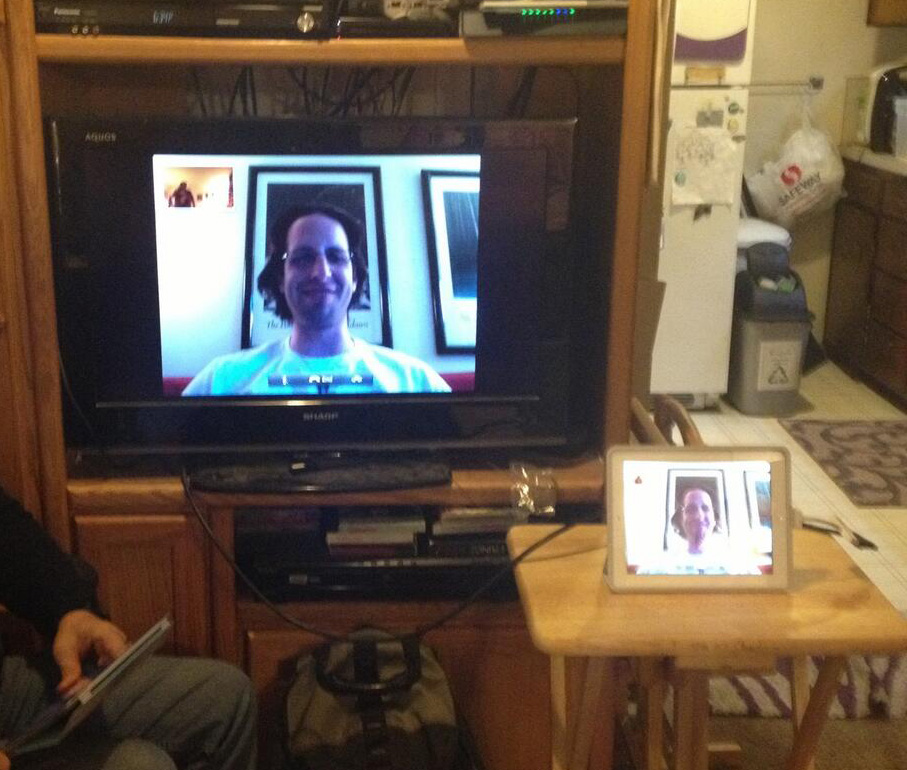
iPad connected to TV to show facetime on large screen.
Jared attending an editorial meeting via FaceTime. (Click to embiggen)
I like living in the future.

We had an editorial board meeting last night, and it being busy, crazy summertime, we almost didn’t have quorum. Fortunately, Jared was able to join us via FaceTime. We’ve done it a couple of times before, propping up my iPad so the person could see most of us. Chuck thought we should do it on the big screen, and I almost never hook the iPad up to the TV, so we did.

Now the future hasn’t quite turned out as we were promised. If I mention “flying cars” certain people will snarkily repeat a meme that’s been going around lately. The first variant I saw was, “Unless you’re 60 or older, you weren’t promised flying cars. You were promised an oppressive cyberpunk dystopia.”

That’s simply wrong, on many, many levels. The “we were promised {fill in the blank} in the future!” is a reference to things we learned during our childhood from popular culture about what the future would be like. The first appearance of cyberpunk, in any way, shape, or form, was the 1980 novel Web of Angels, by John M. Ford. Therefore, a person who is 59 now, would have been 26 years old when the first hint of a cyberpunk dystopia could have appeared in any popular culture. Twenty-six is not childhood.

The Jetsons, broadcast Sunday nights from 1962-63, reruns Saturday mornings from 1964-73.
I’m still a half-dozen years below 59, and I can assure you that my childhood pop culture did, indeed, promise me flying cars.

The Jetsons was the first show to be broadcast in color on ABC-TV. A cartoon set 100 years in the future, the show ran during primetime beginning in 1962. That’s right, it was not meant to be a children’s show. After it complete its primetime run, the existing episodes were re-run as a Saturday morning cartoon for nearly 10 years. The screen shot is a frame from the opening seconds of the opening theme song of the show. Right there, flying cars. The show depicted a fairly utopian future, with robot maids, devices that could create an entire new outfit, on your body, in seconds, and so forth.

If your childhood included any of the years from 1962-1974, you were, indeed promised flying cars. If we assume one needs to be a minimum of four years old to recall a television series, that means anyone 43 or older can legitimately claim that The Jetsons, at least, promised them a utopian flying cars future.

Jonny Quest floats in midair wearing a jet backpack.
Jonny Quest flying in a jet pack (some of his villains had flying cars).
That time period also included the iconic TV series Lost in Space, the original Star Trek, and Johnny Quest. Not to mention such films as 2001: A Space Odyssey. They didn’t all have flying cars (some had transporters—even better!), but their futures are each the opposite of an oppressive cyberpunk dystopia.

But let’s loop back to that first cyberpunk book. How many people who know what cyberpunk is have even heard of Web of Angels? Most people think of cyberpunk as beginning with either Blade Runner (1982) or Neuromancer (1984). And while Blade Runner is the greatest movie ever made, bar none, the sad truth is it didn’t do well in theaters the first time, and didn’t start developing a cult following until it started appearing on cable in late 1983. So I’m going to say that the beginning of the switch-over to cyberpunk dystopias becoming dominant in pop culture was 1984.

That means 1983 is the last year in which the flying car utopia was promised as a future to kids, so anyone who was at least four in 1983 would be the actual cut-off age, rather than 60, so that means the meme should state: “Unless you’re 34 or older, you weren’t promised flying cars. You were promised an oppressive cyberpunk dystopia.”

Movie poster from 1985's Back to the Future.
Marty McFly, trying to get back to the future…
But wait! That calculation assumes a very simple binary situation. Cyberpunk dystopias became one possible future in 1984, but it wasn’t the only one. Because in 1985 we got Back to the Future! While the movie primarily follows the adventures of our young hero, Marty McFly, trapped in the 1950s in a time traveling car, trying not to screw up his own future before getting back to his own time. At the end of the movie, Doc Brown goes 30 years into the future, and then comes back, showing off a much upgraded version of the time-traveling car. So, as my friend, Matt, pointed out, if your formative years include Back to the Future, then not only were you promised flying cars, you were promised time-traveling fusion-powered flying cars fueled by household garbage!

So, no, we were promised flying cars!


I’ve had more than one person bring up the fact that Blade Runner had flying cars. I know that. When I said that Blade Runner was the greatest movie ever? Implicit in that statement is the fact that I owned several different cuts on VHS back in the day, and I watched at least two of the tapes so many times that they wore out. I am well aware of the flying cars in Blade Runner. But as I explained on Twitter, the invalidity of the assertion of a dichotomy between flying cars and cyberpunk dystopias is worthy of a posting of its own.

It’s nice when they listen

Several years ago I was laying in a bed at the emergency room. The doctor who had triaged me was fairly certain it was my appendix. A nurse had been tasked to draw blood for some tests. So I told her what my regular doctor said I should always tell someone about to draw my blood: “My veins are troublemakers. They roll. They collapse. They move. They hide. The secret is to ignore the ones you can see, and go for Old Faithful here that you can feel, but can’t see.”

“Uh huh,” the nurse said. And proceeded to stick me about a half dozen times in that arm, move to the other arm to repeat it, move back to the first arm to try a couple more times before, in a very exasperated voice asking, “What was that advice, again?”

She got it on the next try. She apologized profusely.

A bit later, just as another nurse was giving me the pre-anesthetic prepping me for surgery (it was the appendix, and they got it before it burst, but only just), she came back to apologize again. “I just found out from one of the other nurses that your G.P. is Dr. Cahn. Dr. Cahn put himself through college and medical school working as a phlebotomist. Most doctors know nothing about drawing blood, and are always giving bad advice. I’m really sorry.”

Some years later I gave the usual advice to a lab tech about to draw my blood, and he said, “Oh, don’t worry about that!” A second later he said, “See! Got it on the first stick…” and his voice trailed off, because it was true that blood had started to flow into the first test tube right away, but it had suddenly stopped, before he could finish the sentence. He also apologized profusely for ignoring the advice, and then spent several minutes trying to follow the advice so we could get on with it.

I have lots of stories like these. Occasionally the people tasked with drawing my blood listen, but far more often, they don’t.

Once a year I see a specialist to evaluate my meds. The usual routine is that I go in for lab work, where they draw about 7 tubes (All different sizes with different color-coded tops; I used to be able to rattle off the colors, but a few years ago there was a change in the color-coding system and I haven’t quite got the new ones down). Then, three to five days later, I have the appointment with the specialist where she goes over the results, asks a lot of questions, we discuss some things, and so on. Occasionally she gives me a list of things to talk to my regular doctor about.

When I went in on Monday to get the lab work, I recited my usual advice. The woman listened to me, asked a couple of questions, then went to work. She spent a lot of time feeling around my arm before deciding she was ready to pick up the needle. It worked perfectly the first time. It was great.

I saw the doctor later in the week. I’ve been on the same meds for a long time, and everything has been nice and stable. This time there was one thing she’s a little concerned about. She immediately amended that to, “I don’t think it’s worrying, but I want to be certain we don’t need to be concerned.” So she ordered more tests, telling me to stop at the lab on the way out.

I got a different woman. I told her my advice. She laughed, “That’s what I do with everyone,” she said. “Lots of people who have the tricky veins don’t even know it. I just assume everyone has tricky veins. I never thought about calling the deeper vessel ‘Old Faithful,’ though. I like that.”

And she got it on the first try, too.

It’s nice when they listen.

It’s Friday. Have some links!

Opening the Skies to Everyone “…I have long advocated that the best way to hook someone on astronomy is to get them outside, and get them to look up. People see the stars all the time, but they don’t see them…”

Time at your own pace You may be familiar with the web comic, xkcd. Months back they posted a single panel black and with image of two stick figures on a slope. Not caption, no word balloons. If you hovered your mouse over the image you saw the alt-text said “Wait for it.” It took a while for people to figure out, but it slowly changed. It is an animated story posting one frame an hour. The first link will take you to a page the has all 3000+ frames gathered together. You can press play and watch it go. It will pause automatically at the frames that have word balloons. Or you can use the controls on the right and go through at your own pace. It’s very cool, with an interesting story. And it hasn’t come to an end, yet!

Why is the Gender-Swapped ‘Blurred Lines’ Video Is Suddenly Age-Restricted

Sea Otter endlessly mocks Australian Cattle Dog “A sea otter has some fun with an Australian Cattle Dog that seems less than amused, and a tad befuddled too.”

The co-opting of the Nerds

The Great Nerd Summit (also known as San Diego Comic-Con International, or SDCC) of 2013 has just happened.

I have only attended once, back in the mid-80s when attendance was a mere 6000 people. Yes, I said “mere.” Last year’s attendance was more than 130,000 people. I don’t believe that official figures are out, yet, for this year. While the convention (called the Golden State Comic Book Convention when it was founded in 1970) originally was about Comics, and the word “comic” is still in its name, it had expanded far beyond that realm to embrace sci fi/fantasy books, movies with any sci fi or superhero connection what-so-ever, and gaming back when I was there.

Of course, comics is a style or medium of storytelling. I grew up reading both Donald Duck/Uncle Scrooge comics and X-men and the like, so even I knew that as a child. Yes, I said grew up. My mom was an X-men fan in the mid-sixties. I have mentioned before that I’m a second generation fan, right? My point being that you can conceivably tell any kind of story in comic form. And there have been the extremely interesting and well done examples of memoirs, biographies, and other kinds of story that don’t fit the comic book stereotype.

That said, SDCC has gotten to the point where it is the trade show for just about the entire entertainment industry. I understand why there are events highlighting upcoming movies such as sequels to The Avengers, Captain America, and Thor, as they’re all based on comics. And I understand why there are events rolling out teasers for My Little Pony: Friendship is Magic. It’s a cartoon, not a graphic story (there are comics, but those are spin-offs, and the official MLP events were all about the cartoon), but animated cartoons are an allied artform of comics. I even understand all the video game stuff that happens at the con.

But, much as I love Benedict Cumberbatch and the current BBC Sherlock series, I think that Sherlock events at SDCC is stretching the definition a bit. Whereas the fact that there were events for How I Met Your Mother, Veronica Mars, and Community is just insane.

The official SDCC award (as opposed to Awards sponsored by other organization which are simply presented at SDCC), the Inkpot, is given out for “outstanding achievement in the Popular Arts industry.” Which makes me think the event should more properly be called the San Diego Popular Arts Con.

I’ve gotten into arguments with fellow nerds about why Sherlock Holmes, as in the original character and stories by Arthur Conan Doyle, has often been included in science fiction events. I have defended the inclusion because Holmes could be argued to be an archetype of a particular kind of nerd: hyper observant, possessed of encyclopedic knowledge of a vast range of topics, an uncanny ability to find relationships between the most minute details, and infamously incapable of relating to people empathically. Serious articles have been published in psychological journals debating (pro and con) whether the fictional Holmes had Aspergers syndrome, for goodness sake! The Holmes stories may not be sci fi, but both the character and the methodology by which he solves his mysteries are highly identifiable to a significant portion of the fan community.

While I have made that argument, and will continue to do so, I’m also the first to admit that all it provides is a reasonable rationale for stretching the envelope to include Holmes as an allied creation. It’s a stretch, and I admit it.

A sort of similar argument can be made for the specific television show, Community, because its ensemble includes some nerds. But it’s a much more tenuous connection to make based on a couple of supporting characters, as opposed to the main character and his primary activity.

I can think of even more tenuous (and ludicrous) arguments that might be made for shows such as How I Met Your Mother, but all of them would be a smoke screen. The truth is that, as I mentioned, SDCC is a trade show, not a fan convention. Its purpose is to advertise, generate buzz, and fan the flames of enthusiasm for any popular art property that can shoehorn itself into the convention. That isn’t a bad thing, per se. Certainly no one is forcing fans to get online at a particular time on the final day of the convention so that the entirety of the next year’s memberships can be sold out in less than two hours. No one is forcing people such as myself to track down stories and videos of the events to get some ideas of what movies and shows I should be looking for in the future.

If you want to fan the flames of enthusiasm, there is no better place than the heart or mind of a nerd or geek. We’re more politely called fans, which is short for fanatic. The one trait that most distinguishes us from the mundanes is how incredibly, obsessively enthusiastic we get about the things we like. So even though some of us are primarily enthusiastic about science and science fiction, if you can get us interested in your show— even one that doesn’t have any discernible science-y aspects—we’ll talk about it. We’ll set our DVRs to catch your premiere. We’ll mention that it’s coming out to our less nerdy friends. We’ll make and post fan art or create and share silly memes based on photos from your show.

We will be your viral marketing campaign. And because tens of thousands of us are willing to buy memberships at SDCC each year, that means some of us are paying for the privilege.

Apart from other branding considerations, I think that’s why for the foreseeable future they won’t be replacing the “Comic” part of the name.