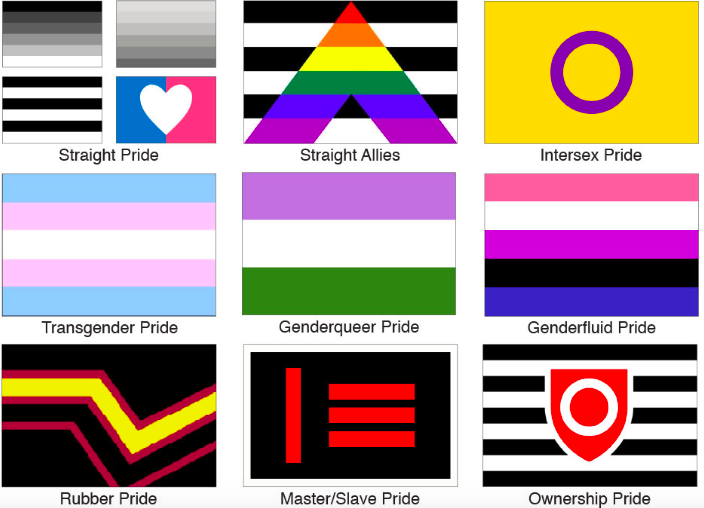
What-about-isms and false equivalencies abound. (Click to embiggen)When I first saw people referring to straight pride this week, I didn’t think much about it. It’s one of the least intellectually-sound critiques that is ever leveled at Pride or Queer rights in general. And I’ve already written about why LGBTQ Pride is still needed more than once. Since the day before I saw these first mentions, I also saw a huge number of clicks on one of those posts I wrote years ago, I thought, “Okay, some idiot somewhere has written about straight pride, it made the news, and people are googling related terms.” Turned out it wasn’t just that someone had written about it. In case you didn’t hear, the leader of an alt-right group has strong-armed the city of Boston into giving him a permit to hold a so-called Straight Pride Parade.
That’s correct! (click to embiggen)Given that the parade organizer has previously organized or been featured prominently in alt-right/neo-Nazi rallies that have turned violent before, I guess we can’t treat this as a joke. No matter how tempting it is. The truth is that nothing makes a certain kind of straight white man more angry than when they aren’t the center of the conversation. They are outraged someone they perceive as “other” gets treated equally.
And it isn’t even fair to say equally. There have been studies that show when women talk for more than 15% of a class or presentation or similar activity that the men perceive that the woman are dominating the conversation. Only 15%, the men describe it as “equal time.” I haven’t found similar studies about their perception of people of color or queers, but I have a life time of personal observation to say the participation of other marginalized people are perceived the same way. If queer characters exist in a story or movie or whatever in more than a restricted token manner, they scream “why are the gays ruining everything?!” And when it comes to people of color, well, a black actor was featured prominently in the first trailer for The Force Awakens and they lost their collective minds, calling for boycotts (and worse).
And I know it isn’t just angry straight white men. There are angry straight white women who make the same “why don’t we get a straight pride day?” arguments, too. Believe me, I know. I’ve had that one thrown at me by relatives at family get-togethers.
There are two different, completely true answers to the question of why there isn’t a straight pride day.
The first answer is: every day is straight pride day! Every day day society and strangers celebrate and cheer straight marriages. Every day society recognizes and approves of the existence of straight people. Every day thousands of television episodes are broadcast in which the straight characters are the protagonists and their stories and concerns are recognized, accepted, and celebrated. Every day little boys are described as future lady’s men, and little girls are called heart-breakers, and no one screams at the people who say it that the children are too young for that. 99% of all movies, books, songs, plays, and TV shows center straight people and their concerns.
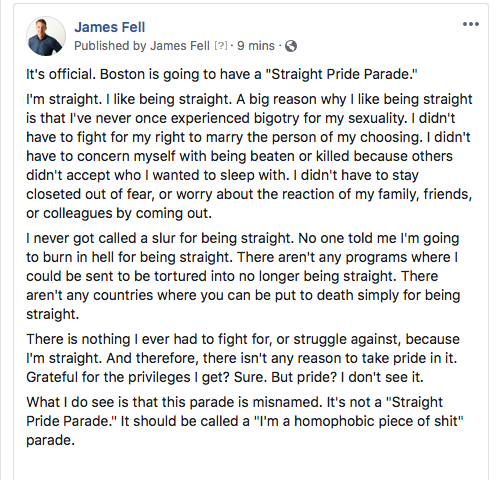
(click to embiggen)The second answer is: there is no systemic bigotry against straight people. There are no laws, and never have been, baring straight people from teaching or adopting children. There have never been laws against straight people getting married. No straight child has been thrown out on the streets by their family because they are straight. Straight people have never been barred from the military for being straight. No one has ever claimed that programs to stop bullying of straight children in schools is a violation of freedom of religion. No child or teen-ager has ever been forced into ex-straight therapy. People aren’t bashed and murdered for being straight. Straight couples holding hands in public have never been attacked by a mob and beaten for being straight. When a straight couple is depicted kissing in a movie no one organizes boycotts to stop straight sexuality being shoved down the public’s throat. No authorities have ever said that they don’t hate straight people, they just disapprove of their lifestyle. No medical associations or governments have ever officially defined being straight as a dangerous mental disease.
All that has happened is that when some straight people express bigoted opinions about queer people, society as a whole no longer chimes in to agree. Worse than that, some people actually point out the homophobia. In some circumstances the law doesn’t penalize queer people the way it used to. In some circumstances the law no longer privileges straight people to the detriment of queer people.
That isn’t the same as being oppressed. It isn’t the same as being bashed. It isn’t the same as being murdered. It isn’t the same as being forced into homelessness. You did not have to overcome adversity, bigotry, threats of violence, actual violence, family rejection, and more just to live as an openly straight person.
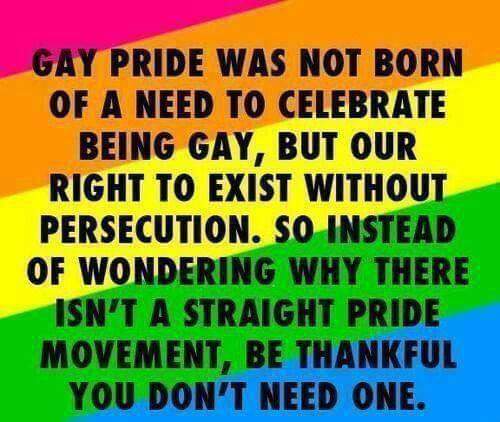
“Gay pride was not born out of a need to celebrate being gay, but our right to exist without persecution. So instead of wondering why there isn’t a straight pride movement, be thankful you don’t need one.”
Another in my series of posts recommending web comics that I think more people should read. Except this entry isn’t really about a web comic.
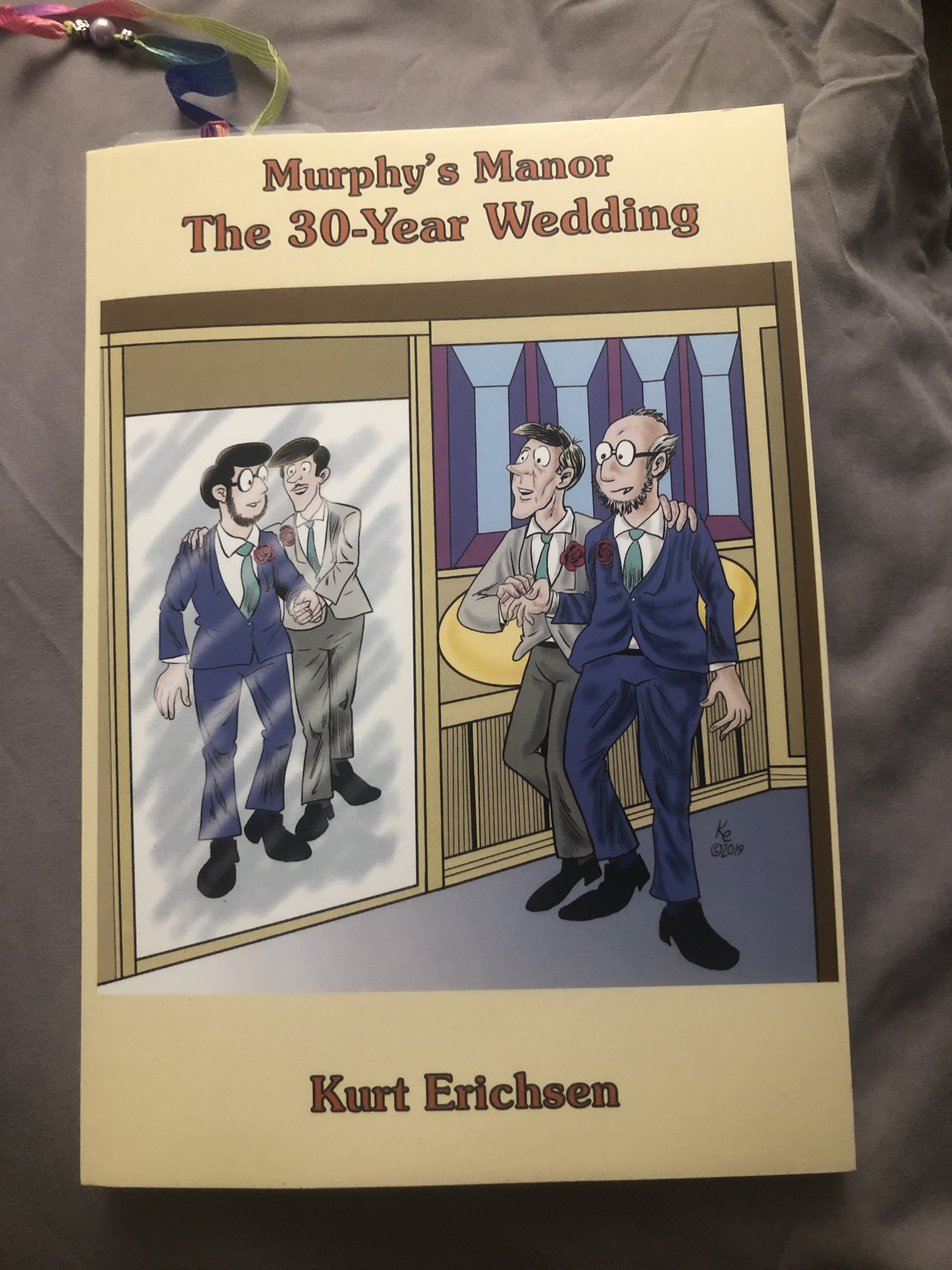
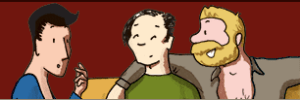
Murphy’s Manor: The 30-year Wedding by Kurt Erichsen. I first encountered Murphy’s Manor in an anthology of queer-themed comic strips that I picked up at one of two gay bookstores in the Capitol Hill neighborhood of Seattle, when I was only just starting to come out of the closet. As I got slightly more comfortable with people knowing that I wasn’t straight, I started hanging out (and learning to dance at) a (no longer existent) gay country bar called Timberline. And then led to me occasionally being at other gay bars semi-regularly. And one of the things most of those bars had in common was that there were piles of free papers somewhere in the bar. Seattle had one officially gay weekly newspaper at the time, and at least three or four other alternate weekly papers that were all at least somewhat gay friendly (a second explicitly queer weekly newspaper joined the line up a couple years later). One of those papers carried the Murphy’s Manor strips and so I started reading it more regularly.
Murphy’s Manor was a slice-of-life gay comic about Murphy (Murf) who owns a large house in the Black Swamp, Ohio, and the various people who rent rooms in his house, and their friends, significant others, et cetera. Erichsen drew the first six strips in early 1981 after a friend showed him an advertisement in a gay magazine called International Justice Monthly. Someone was trying to form a gay/lesbian comics syndicate. Kurt had one of his stories (published under a pseudonym) accepted for publication in a zine called Gay Comix, so he was interested. He sent in the six strips, but the syndicate idea fell apart. It occurred to him that he could try to syndicate his strip himself. As he explains:
“Nearly every city in North America had gay bars, each with a cigarette machine. On top of the cigarettes: local gay newspapers. It was the beginning of community infrastructure. There were two kinds of newspapers: ‘bar guides’ that advertised gay bars, published photos, listed social and political activities, and which bars had 2-4-` well drinks. They had minimal news. Larger cities had gay newspapers that were more journalistically ambitious. Remember, no internet at that time. Both types of paper were usually free, selling advertising space for bars, baths, and classifieds.”
Erichsen sent his sample strips to every one of these papers with the offer: they could run the samples he sent for free, and if they wanted to continue after that, he would sell the weekly strips. About 70 of the papers subscribed to his service, and his strip was suddenly appearing in a bunch of papers.
Over the next few decades Erichsen drew more than 1100 weekly strips. Murf, the title character, started dating Mark fairly early in the strip’s history.
In 2003, the fight for marriage equality his an interesting stage: various government officials starting decided that the ban on same sex marriage didn’t make sense. Various city, county, and state governments or officials would start issuing marriage licenses to same-sex couples. Other officials would intervene and stop the licenses after a while. Or, if it was an entire state, other states and the feds (thanks to the Defense of Marriage Act which had been passed years before) would simply refuse to honor the licenses. Every time one of those jurisdictions started handing out licenses, Erichsen drew a series of strips where Mark and Murf would run off to whereever it was and get married, having various funny misadventures along the way. This plot line continued off and on for the next few years.
In 2008, many of the papers where Erichsen had been selling his comic had either gone out of business, or moved most of their publication to the web, and it no longer made sense for them to pay for a comic strip that readers might be able to read elsewhere. So Erichsen discontinued the strip. Since then, marriage equality has become legal (at least until the Trump-appointed Supreme Court justices take it away, and that is definitely their plan). Erichsen decided he needed to finish Mark and Murf’s story. So he drew 22 new strips, set in the present, in which they decide that the 17 marriage licenses that were subsequently nullified that they collected between 2004 and 2008 needed to be replaced with a real one.
Which brings us to the book I am reviewing (the picture above is my copy). Erichsen went through those 1100+ weekly strips and pulled out a bunch to show the story of Mark and Murf’s relationship, with the final chapter being the 22 new strips about them finally getting hitched for real.
Throughout the book he adds some commentary to explain things in the strips that younger readers may not know where going on in the real world at the time, or just to explain why he went with that particular topic. He also comments on the fact that for the origin 27 year run (1981-2008) of the comic, while he did update the hair and clothes styles of the characters, he never actually drew them as aging. But he decided for the final 22 strips, that the sheer length of time that Mark and Murf had to wait for the marriage to be recognized under the law required him to show that aging. So the characters (with one exception) are all drawn to show the passage of time in the last chapter.
This collection tells a coherent story tackling some important issues, but because it was a weekly comedic strip, it is also funny. I think Erichsen did a great job of pulling together a novel-style tale out of the strips. And you may need a kleenix near the end–or maybe that’s just me.
Comics I’ve previously recommended: Some of these have stopped publishing new episodes. Some have been on hiatus for a while. I’ve culled from the list those that seem to have gone away entirely.
Check, Please! by Ngozi Ukazu is the story of Eric “Bitty” Bittle, a former junior figure skating champion from a southern state who is attending fictitious Samwell College in Massachusetts, where he plays on the men’s hockey team. Bitty is the smallest guy on the team, and in the early comics is dealing with a phobia of being body-checked in the games. He’s an enthusiastic baker, and a die hard Beyoncé fan.
“Manic Pixie Nightmare Girls” by Jessica Udischas is a hilarious web comic that tells of the adventures of Jesska Nightmare, a trans woman trying to make her way in our transphobic world. The comics are funny, insightful, and adorably drawn. The sheer cuteness of the drawing style is a rather sharp contrast to the sometimes weighty topics the comic covers, and I think makes it a little easier to keep from getting bummed out to contemplate that the strips aren’t exaggerations. If you like the strip, consider supporting the artist through her patreon.
Life of Bria by Sabrina Symington is a transgender themed comic that ranges from commentary to slice of life jokes and everything in between. Even when commenting on very serious stuff it remains funny—sharp, but funny. It’s one of the comics that I would see being reblogged on tumblr and lot and I’d think, “I ought to track down the artist so I can read more of these.” And I finally did. And they’re great! If you like Symington’s work, you can sponsor her on Patreon and she has a graphic novel for sale.
Nerd and Jock by Marko Raassina This is a silly webcomic about a Nerd and Jock who are good friends and like to have fun together. Frequently the joke of the strip is to take a cliché about jocks and nerds and twist it in some way. It’s cute. I happen to really like cute and low-conflict stories sometimes. If you like this comic, consider supporting the artist on Patreon.
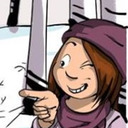
Assigned Male by Sophie Labelle is a cute story about a transgirl (we meet her at age 11) and goes from there. Some of the strips are more informational or editorial than pushing the narrative forward, but they are in the voice of the main character, so it’s fun. The artist also has a Facebook page of the site, and is in the process of moving to a domain of her own (though currently it still doesn’t have the actual comic strips available). I mention this so you will not be put off by the words “old website” she’s added to the banner. If you like her comic and would like to support her, she has an Etsy shop were four book collections of the comics and other things are for sale.
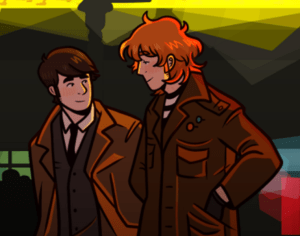
Stereophonic by C.J.P.“Stereophonic” by C.J.P. is a “queer historical drama that follows the lives of two young men living in 1960s London.” It’s a very sweet and slow-build story, with good art and an interesting supporting cast. But I want to warn you that the story comes to a hiatus just as a couple of the subplots are getting very interesting. The artist had a serious health issue which was complicated by family problems, but has since started posting updates to his blog and Patreon page, assuring us that the story will resume soon. If you like the 300+ pages published thus far and would like to support the artist, C.J. has a Patreon page, plus t-shirts and other merchandise available at his store.
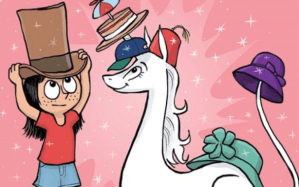
Phoebe and Her Unicorn by Dana Simpson concerns the adventures of 9-year-old Phoebe Howell. One day, Phoebe skipped a rock across a pond, and the skipping rock hit a unicorn named Marigold Heavenly Nostrils in the face. This happened to free the unicorn from her own reflection, so she granted Phoebe one wish. Phoebe wisely wished that Marigold would become her best friend. If you like the comic, you can buy the books here and enamel pins and other stuff here.
The Young Protectors: Engaging the Enemy by Alex Wolfson begins when a young, closeted teen-age superhero who has just snuck into a gay bar for the first time is seen exiting said bar by a not-so-young, very experienced, very powerful, super-villain. Trouble, of course, ensues.
“Deer Me,” by Sheryl Schopfer tells the tales from the lives of three friends (and former roommates) who couldn’t be more dissimilar while being surprisingly compatible. If you enjoy Deer Me, you can support the artist by going to her Patreon Page!
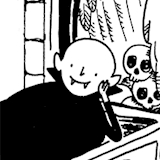
Madeline McGrane is a cartoonist and illustrator who is from Wisconsin and lives in Minneapolis. She posts vampire-themed comics and other art on her tumblr blog. My favorites are the vampire comics about three child vampires. They’re just silly. Her black and white comics are minimalist and really work well with her style of humor. Her color work is a bit more complex. If you like her work and want to support her, she has a ko-fi.
The Junior Science Power Hour by Abby Howard. is frequently autobiographical take on the artist’s journey to creating the crazy strip about science, science nerds, why girls are just as good at being science nerds as boys, and so much more. It will definitely appeal to dinosaur nerds, anyone who has ever been enthusiastic about any science topic, and especially to people who has ever felt like a square peg being forced into round holes by society.
Scurry by Mac Smith is the story of a colony of mice trying to survive a long, strange winter in a world where humans have mysteriously vanished, and food is becoming ever more scarce.
And I love this impish girl thief with a tail and her reluctant undead sorcerer/bodyguard: “Unsounded,” by Ashley Cope.
Fowl Language by Brian Gordon is a fun strip about parenting, tech, science, and other geeky things. The strips are funny, and he also has a bonus panel link to click on under the day’s strip.
The Last Halloween by Abby Howard is the creepy story of 10-year-old Mona who is reluctantly drafted to save the world on Halloween night. This is by the same artist who does the Junior Science Power Hour. She created this strip as her pitch in the final round of Penny Arcade’s Strip Search, which was a reality game show where web cartoonists competed for a cash prize and other assistance to get their strip launched. Though Abby didn’t win, she started writing the strip anyway. If you like the comic, you can support Abby in a couple of ways: she has some cool stuff related to both of her strips in her store, and she also has a Patreon.
Last Kiss® by John Lustig Mr. Lustig bought the publishing rights to a romance comic book series from the 50’s and 60’s, and started rewriting the stories for fun. The redrawn and re-dialogued panels (which take irreverent shots at gender and sexuality issues, among other things) are syndicated, and available on a bunch of merchandise.
Sharpclaw by Sheryl Schopfer. The author describes as “fantasy comic that blends various fairy tales into an adventure story.” The first story is about twin sisters who both have the potential to be sorceresses. One pursues magic power, the other does not. If you enjoy her work, you can support the artist by going to her Patreon Page!
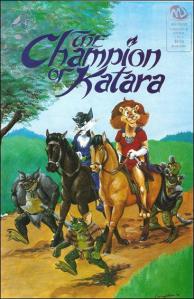
“Champion of Katara” by Chuck Melville tells the tale of a the greatest sorcerer of Katara, Flagstaff (Flagstaff’s foster sister may disagree…), and his adventures in a humorous sword & sorcery world. If you enjoy the adventures of Flagstaff, you might also enjoy another awesome fantasy series set in the same universe (and starring the aforementioned foster sister): and Felicia, Sorceress of Katara, or Chuck’s weekly gag strip, Mr. Cow, which was on a hiatus for a while but is now back. If you like Mr. Cow, Felicia, or Flagstaff (the hero of Champions of Katara) you can support the artist by going to his Patreon Page. Also, can I interest you in a Mr. Cow Mug?
Private I, by Emily Willis and Ann Uland is a comic set in 1942 Pittsburgh in which queer gumshoe Howard Graves is trying to sort out a collection of bewildering clues and infuriating eccentric suspects. It’s an interesting take on a lot of noir tropes. It handles the queer elements well—being outed or caught by the wrong people can spell the end of not just one’s career, but possibly life–without being all grim-dark. If you like the comic and want to support the creators, check out their Ko-fi.
The Comics of Shan Murphy As far as I can tell, Shannon Murphy doesn’t post a regular comic on the web. But among the categories of illustration on her site are comics. Her art styles (multiple) are really expressive. And she just writes really good stuff. If you like her work, considered leaving a tip at her ko-fi page.
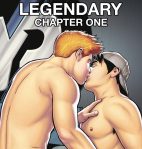
The Young Protectors: Legendary by Alex Woolfson. This is just a new story arc for the Young Protectors comic recommended above. However, Alex is changing up the artists he’s working with in this arc, and the focus is decidedly different. This new arc begins by exploring the changed relationship between our protagonist, Kyle (aka Red Hot) and one of his teammates, Spooky Jones. The story is NSFW, although unless you are a patron of Alex’s Patreon, you see a lot less of the explicit artwork. It isn’t porn, per se, and it isn’t a romance. If you check out the page, you’ll see that Alex has written several other comics, some of which are available to purchase in hard copy. And, as I mentioned, he’s got a Patreon account.
If you want to read a nice, long graphic-novel style story which recently published its conclusion, check-out the not quite accurately named, The Less Than Epic Adventures of T.J. and Amal by E.K. Weaver. I say inaccurate because I found their story quite epic (not to mention engaging, moving, surprising, fulfilling… I could go on). Some sections of the tale are Not Safe For Work, as they say, though she marks them clearly. The complete graphic novels are available for sale in both ebook and paper versions, by the way.
Note: Usually when I do one of these posts, I include the slightly shorter reviews of all the comics I’ve recommended previously. I do periodically go through those lists and remove comics that have vanished entirely. For now, I’m leaving in those that have stopped publishing new episodes but still have a web site.
But the list is getting awfully long, and I’m not sure how useful the older links are. I’m still thinking about it. Feel free to comment if you have strong thoughts on the topic.
Happy Pride Month!
It’s June! Pride Month! Let’s take a look at news that broke I assembled this week’s Friday Five (or that I didn’t see in time, or is an update to something previous linked).
Polis, the first openly gay man to be elected governor of a U.S. state, recognized the historic significance of the moment, saying Colorado has come a long way since being nicknamed the “hate state” in 1992, when voters amended the Constitution to prohibit protections for people on the basis of sexual orientation.
— Anna Staver, The Denver Post
Yeah, the constitutional amendment back in ’92 was pretty bad. It didn’t just ban counties and cities from enacting gay rights ordinances, it forbade counties, cities, all government agencies and school districts from enacting “any minority status, quota preferences, protected status or claim of discrimination” to anyone who was “homosexual, lesbian or bisexual orientation.” The amendment never went into law, because a state court issues an injunction against it, and the state supreme court ruled that the amendment violated equal protection, which the U.S. Supreme Court eventually agreed as well (by a 6-3 ruling, many years before the court would decriminalize gay sex).
I remember an awkward conversation with a relative who still lived in Colorado where they admitted they had voted for it, but also that they hadn’t realized what the amendment meant that it excluded gay people from all anti-discrimination laws, not just that no one could pass new laws.
Anyway, I’m happy for Colorado. Also: the other bill the governer signed yesterday allows transgender people to change their gender designation birth certificates and so forth without having to convince a judge that they have undergone specific medical procedures. That’s a big win for trans people!
Meanwhile: Gillibrand Unveils Sweeping LGBTQ Rights Agenda. Senator Kirsten Gillibrand is one of the 20-some people vying for the Democratic nomination for President, and according to this article she’s the first of those candidates to announce a specific agenda for securing gay rights. I take issue with that, because if you go to the web sites of most of the Dem wannabes you’ll find a list of very similar bullet points regarding LGBT rights.
I do like a lot of the specifics in this plan: specific things that can be done by the President by Executive Order, as well as trying to get congress to pass specific bills. And it is true that none of the others have dedicated an event to such an announcement. Oh, and she’s also the only candidate (so far) to hold one of her campaign events at a Drag Show, so, there’s that!
Anyway, speaking of the other Democratic hopefuls: A Few Thoughts On Pete Buttigieg’s Dick Brother-In-Law Who Doesn’t ‘Agree’ With Chasten’s ‘Gay Lifestyle’. So, Mayor Pete is running for President. He’s an openly gay man who happens to be married to another gay man. Some of the news organizations have interviewed Pete’s husband, Chasten, and during those interviews Chasten has spoken plainly about his family’s initial reject of him when he came out, how he wound up being homeless for a while because of it, and so on.
One of his brothers took umbrage at this, and managed to get a newspaper in his state to write a long, dramatic piece of BS article about how he loves his brother, he just disagrees with his “lifestyle” and thinks gay people should not have the right to marry and a bunch of other rights, et cetera. Several times that article (not the one I linked to) talks about the great pain the brother feels seeing his gay brother describe the family as unaccepting. So often the writers at the Wonkette say exactly the snarky thing I’m thinking:
“This is where we must cut in to point out that love is an action, not a feeling. Parents who tell their children they “unconditionally” love them, but that they don’t support their “lifestyles,” or who make their gay children feel unwelcome in their homes, are neither parenting nor are they loving their children. We, the gay kids of the world, honestly do not give a fuck if our families “unconditionally” love us, because all too many of us have learned that those statements are too often meaningless. And that counts for older brothers too.
Let’s be clear about another thing: Saying you disagree with somebody’s gay “lifestyle” is saying you don’t agree with their “life.” The scientific, medical and mental health communities have told us for decades now that being gay is not a choice or a lifestyle…”
Listen, you can’t get any further from loving your teen-aged child then kicking them out of the house when they tell you they’re gay. Similarly, saying that “a queer is no brother of mine” when your younger brother comes out to you is rejection of them as a person. It isn’t love. It sure as heck isn’t Jesus’ definition of love, either!
Let’s end on happier note: Taylor Swift Petitions US Senate On LGBTQ Equality Act: “Show Our Pride By Treating All Of Our Citizens Equally”. The headline is a little misleading. Most of her post is about how her fans can call their Senators and urge passage of the Equality Act: “Politicians need votes to stay in office. Votes come from the people. Pressure from massive amounts of people is a major way to push politicians towards positive change.”
It’s worth a try!
Taylor Swift & Brendon Urie – ME! (Live on The Voice / 2019):
Where are you on the Gay Spectrum? (click to embiggen)It’s the forth weekend of Pride Month, and this weekend there are three Pride parades or marches happening in Seattle (and lots of other cities also now have several parades).
My husband and I are, for the third year in a row, attending Locus Awards Weekend. And it just so happens that the con hotel is conveniently close to the part of the parade route and the Seattle Center where the big festival happens. So we’re going to have a fun few days of books and sci fi and fantasy and funny shirts and rainbows and lots of other fun.
Here I present this week’s Friday Five: the top five (IMHO) stories of the week of interest to queer people, five stories that made me go “What the f–k?”, top five general interest stories, and top five videos (plus a recap of my blog posts).
(click to embiggen)I’ve been to a lot of Pride parades and festivals since attending my first in 1990. One year I participated in the San Francisco Pride Parade one weekend, flew back home to Seattle where I marched in our parade the following week, and then in August I found myself in Vancouver, British Columbia where I hadn’t realized it was going to be their Pride Parade. San Francisco’s was like so gigantically larger and brasher than any other I had ever seen, while Vancouver’s was small but very enthusiastic.
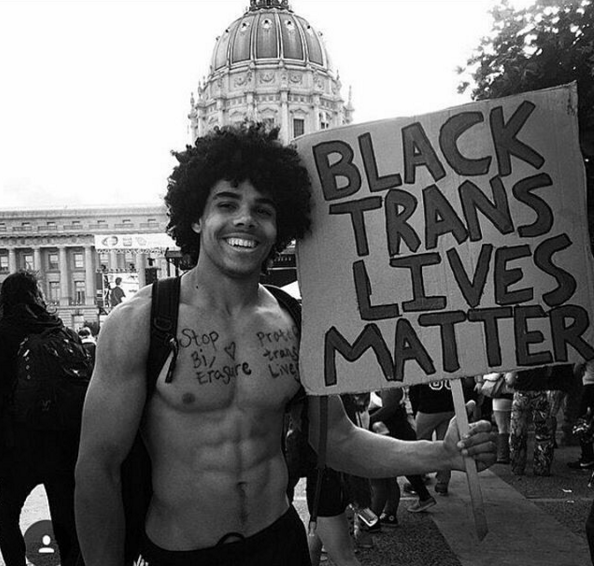
The reason for the parade, ultimately, is to declare our existence–our survival in a society that is less than welcoming. We’re here. We’re your daughters, your neighbors, your sons, your co-workers, your friends, your siblings, or your parents. We’re not mysterious creatures lurking in seedy clubs–we’re the guy sitting across from you on the bus reading a book, or the two gals sitting in that next pew at church, or the pair of guys in the grocery store discussing how many hot dogs to buy for the cookout, or the grey-haired guy trying to read a label on a bottle of cold tablets in the pharmacy, or that kid on the skateboard going past your bus stop, or that guy sipping a coffee at Starbucks, or that gal a couple table over at the same coffee shop laughing at something on her computer.
We’re real, we’re everywhere, and we have hopes and dreams and worries just like you. We’re not asking for special rights, we’re asking for the same rights you take for granted. We’re asking to live our lives as openly as you live yours.
I enjoy watching the parade to acknowledge that survival. I cheer while watching the parade to express my admiration, support, and love for all of these survivors.
I cheer for people who are being brave and marching in their first parade; we see you and welcome you to the tribe.
I cheer and applaud so that those whose families rejected them and told them never to come back will know they have another family, and we’re clapping for them right now.
I cheer so that group of teen-agers (half of them straight and there to support their bi, gay, lesbian, and trans friends) will get the recognition they deserve.
I cheer so the couple in their matching sequined costumes will know someone appreciates the work they spent (perhaps being up all night gluing those sequins on).
I cheer the older couples walking together holding hands; we see your love and we celebrate how long you and your love had endured.
I cheer the younger couples walking hand in hand; I wish I had felt free to do that at their age, but I hope they have a bright future.
(click to embiggen)I applaud and cheer so that the trans* gals and trans* men know they are seen for who they are and we think they’re beautiful, wonderful, and I am proud to call them brothers and sisters.
I cry when I see those who are carrying a photo or wearing the name of a deceased loved one; we see your loved one and share your grief.
I cheer for PFLAG so that straight parents who have spent countless hours explaining to friends and relatives that their queer kids have nothing to be ashamed of, and yes they are very happy, and no those things you’ve heard or read about their health and lifespan are all myths will know their efforts are appreciated by the whole community.
I clap and cheer and laugh and cry as the parade goes on and on showing how big and wonderful and diverse and amazing our community is.
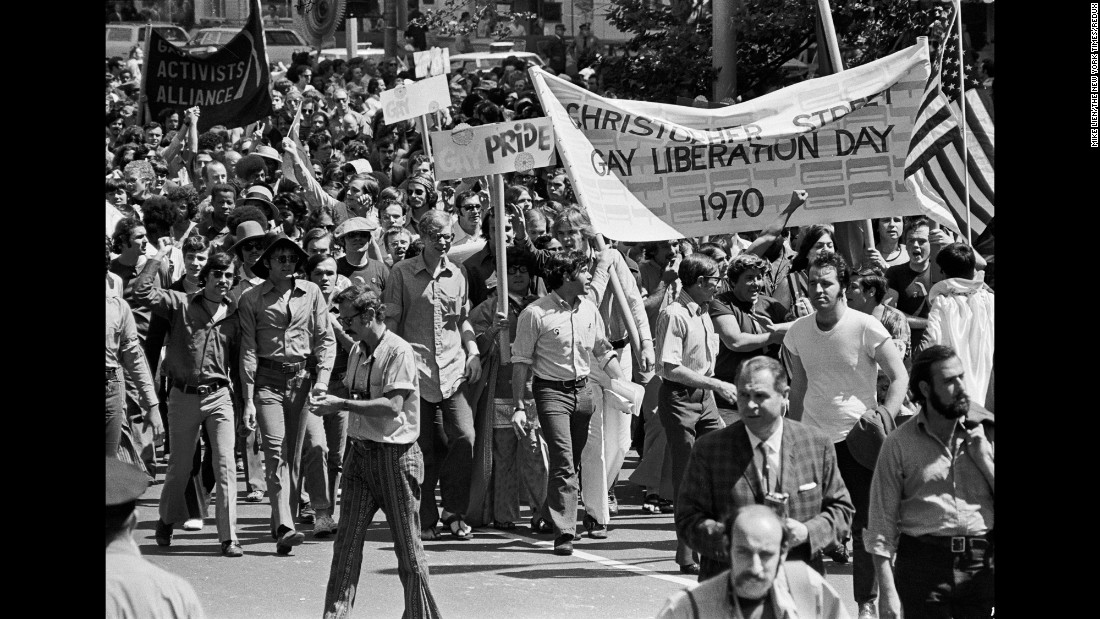
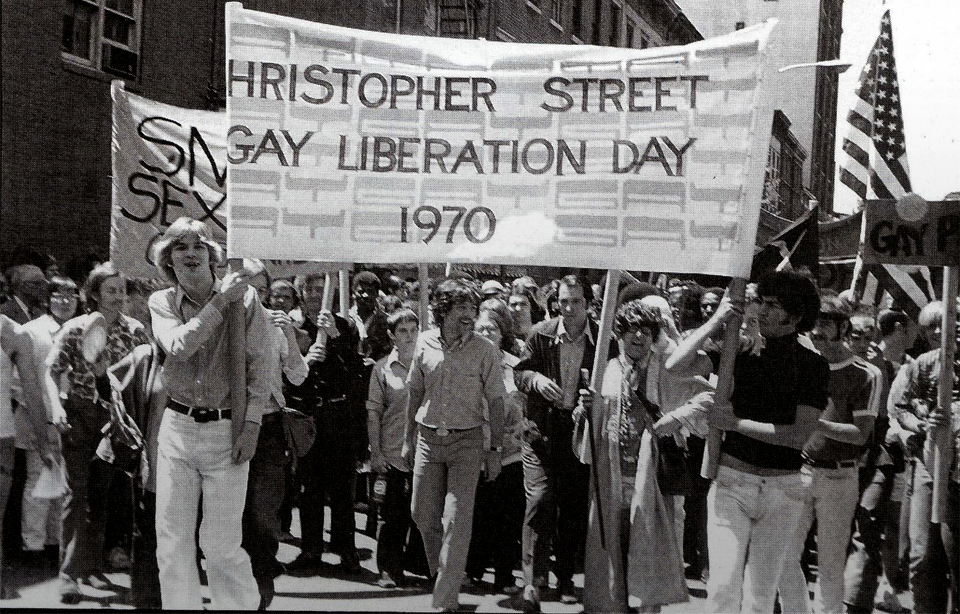
(click to embiggen)The very first Liberation Day Parade in New York City, was a protest march on the first anniversary of the Stonewall Riots (the first Pride was a riot). People were afraid of what would happen at the first march. Only a couple dozen people showed up at the starting point, with their protest signs. But they marched. And all along the announced route of the march, the sidewalks were lined with people. Street queens, and trans people, and gay men and lesbians and queers of many other stripes.
(click to embiggen)And then completely unplanned thing happened. As the small group of marchers went be, queer people and supporters started stepping off the curb and joining. By the time the marchers reached the Sheep’s Meadow in Central Park, the crowd numbered in the thousands.
It has been a tradition of Pride Parades ever since, that spectators step off the curb and join the march.
So when I march, there comes a point where I do that. I have cheered and applauded and made sure that others were seen. I have witnessed their love and courage and unique style. Until it is my turn to join the march. To be visible. To declare by my presence in that throng that I am queer. I’m here. And I will never go back into the closet.
(click to embiggen)I’ve written many times about the first time I watched a Pride Parade. Because of the lurid press coverage I had seen before that, and even some of the critical things I heard from certain queer acquaintances, I was expecting something very different that what I actually saw. So what did I see? Mostly a lot of very ordinary looking people. There was a group of people in shorts and t-shirts who were marching with their dogs on leashes. There was the group of people driving a particular small foreign car. The drivers were wearing matching t-shirts, and I suspect shorts, though it was hard to tell. There were many, many groups where most of the people were wearing matching t-shirts and shorts and walking behind a banner that declared they were with one non-profit organization or another. A lot of them.
There were a lot of pink triangles. There were also rainbows, some lambdas, and some labryses. A lot of people had pink or purple hair. Most of the groups had at least some members who had their children marching along beside them.
There were people dressed very scantily. There were banners and floats that had some sort of sexual innuendo as part of the theme. There wasn’t any actual nudity, but there were a few costumes that were very close to it. But the thing is, not quite a year before my first Pride Parade, I had attend my first Seattle Torchlight Family Seafair Parade with a bunch of co-workers. And at that parade—an official city parade with the word “family” in its title—I had seen a whole lot more near nudity, many more sexual innuendos as themes for floats, and a whole lot of drunken participants in the parade.
I should mention that there didn’t seem to be many queers in the pride parade who were under the influence. Certainly nowhere near as many as I saw at the Seafair Parade.
The difference was, that all of the sexual content and near nudity in the Seafair Parade was clearly aimed at the heterosexual male gaze. Just as I see a lot more sex in the typical set of Super Bowl commercials that I have ever seen at a Pride Parade. And that’s the thing: straight people are so used to straight male sexual desire used to sell everything from cupcakes to beer to automobiles, that they don’t even notice it any more.
Heck, in Seattle we have another annual parade called the Fremont Solstice Parade, and it is famous for have scores of nude bicyclists in it every year. Under Washington state law, if you have body paint on, it counts as not being nude. And it was a community parade put on by mostly straight people who was doing it for years before the queers in Seattle started doing it in our Pride Parade.
(click to embiggen)So if you’re one of those people who objects to Pride Parades because you think they’re too wild or sexy or whatever, I am just going to laugh at your cluelessness. I’ve written a few times about the people from within the community who hate it, and I have yet to meet one whose arguments didn’t boil down to being equivalent of the bigots. So if you’re one of those people you don’t get my laughter, you get my pity and a hope that someday you will stop being a self-loathing hater.
If you’re one of those people who think Pride isn’t needed because bigotry is somehow far behind us, please take this does of reality:
Finally, if you’re one of those people who asks, “If you’re born this way, what’s to be proud of?” First, look up at that list. Remember that that is barely scratching the surface of the hate, bullying, and oppression that every queer person has survived. So, what do we have to be proud of? Some people want us dead, but we’ve survived. Some people wish we were invisible, and we have stepped out into the light and shared our beautiful glittery freaky selves. We have been told we aren’t worthy of love, but we have found loving friends and chosen families and yes, even someone to call husband or wife. People have tried to bury us in hate, and we have shown the world our love. They have knocked us down again and again, and we have gotten back up, fiercer than ever. They have tried to force us into the shadows, and we have shown the world our light.
I’ve quoted before the old Jewish joke that the meaning of all Jewish holidays is, “They tried to kill us. We’re still alive. Let’s eat.” In the spirit of that sentiment:
They wish we were dead or invisible. We refuse to hide.
(click to embiggen)I was astonished, after I had been out of the closet for a bit, to look back on my previous life and realize how much of time and energy had been spent living in fear. Fear of being found out. Fear of being rejected by family and friends. Fear of being physically assaulted. Fear of living a life without love. Fear of dying alone. Fear of what would happen if the preachers were correct and a lake of eternal fire awaited me.
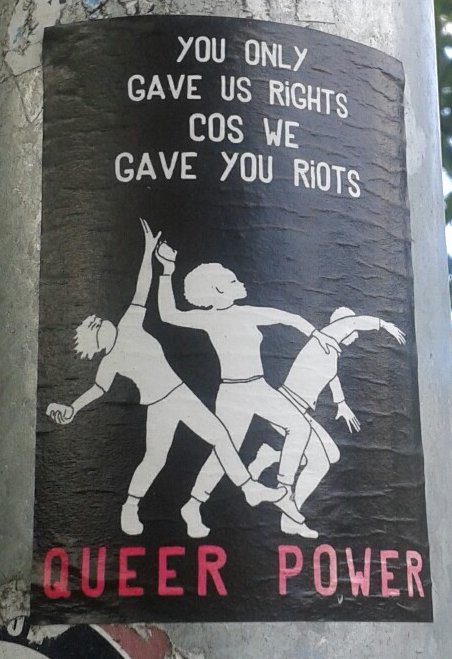
“You only gave us rights because we gave you riots. Queer Power” (Click to embiggen)All of those fears were based on real experiences. My dad’s most angry beatings were all accompanied with him calling me worthless, a faggot, and a cocksucker. And for several years I didn’t know what those last two words meant. The kids at school who bullied me (which often involved physical attacks) always called me a sissy or pussy while doing it. The teachers who verbally bullied me called me a sissy or faggot while doing so. In high school, a classmate I knew well was jumped by a group of jocks who were convinced he was gay (he wasn’t—years later he’s married to a great woman and they have two wonderful kids and we still chat online) and was in the process of being beaten up until a group of us found them and broke it up. Another classmate who I didn’t know very well was beaten so badly he was kept in the hospital for a few days. Again, it was because a group of guys at school thought he was gay (he was—last I heard, he and his partner of several years were living in Boston). A couple of other classmates who were outed in embarrassing ways were kicked out of their homes by their parents, and wound up living with relatives far away. One of my uncles (the same one who insisted that I was such a sissy because my parents let me own an action figure) said he would kill any of his sons if they turned gay.
So it wasn’t just anxiety. It wasn’t all in my head. The danger was real.
(click to embiggen)And because I’d been raised Southern Baptist, and I was the kind of nerdy kid who read the Bible all the way through on my own at least twice, I spent many, many hours begging god to take these feelings away from me. I spent a lot of time studying the guys that never got called out like I did, trying to figure out how to act more like them.
And while for many queer kids the world is a more tolerant place than it was for me in the 60s and 70s, thousands of teens in the U.S. are still thrown out on the streets every year by parents whose religion teaches it is better to drive the kid out than to “encourage their lifestyle.” Hundreds of children and teens still commit suicide every year because of bullying by people who suspect they are queer.
All the bullying, anxiety about being rejected, and so forth affects us. Studies show that most adult queers bear at least some of the neurological markers of PTSD—just like domestic abuse survivors. Coming out and finding communities that accept us doesn’t make that go away. We are always on the lookout for the next potential threat.
This is another variant rainbow flag that’s been around longer than the More Colors Flag.There were always moments when I would get angry because of the way I was treated. But particularly when I was a young kid, anger was never useful. I was physically unable to stand up to the bullies (for instance, the middle school bully who was enough bigger than me that he held me upside down for many minutes while his buddies kicked and spit on me).
Over the course of several years anger began replacing fear. There are many moments I can point to, but one that sticks out came in my early 20s. I was sitting in a church pew in a church where the musical ensemble I was directed had performed several songs for to support a revival meeting. The visiting preacher had delivered an unusual message for a revival: he had talked about unity and finding common ground among fellow Christians who didn’t always agree with us on every detail. It was conciliatory, rather than a fiery call to fight evil, which was a much more typical revival tone.
“Gay pride was not born out of a need to celebrate being gay, but our right to exist without persecution. So instead of wondering why there isn’t a straight pride movement, be thankful you don’t need one.”And then one of the pastors from the local church gave the closing prayer. That how I found myself with head bowed and eyes closed and suddenly shaking in fear as the pastor thank god for sending the scourge of AIDS to wipe out the evil homosexuals from the face of the earth. Oh, he went on and on about it. And because as far as I knew I was the only homo (very closeted) in that room, I half expected people to pull me aside for an intervention afterward. Or maybe that I would be jumped and beaten to within an inch of my life somewhere.
I realized some time later that the pastor wasn’t targeting he was arguing with the visiting pastor, using the passive-aggressive platform of a public prayer. But over the following days and weeks, as I realized that no one was targetting me, I began to get angry. And the more I thought about how that pastor had used a prayer to spew such hate, the more angry I became at the entire system.
That may have been the final nail in the coffin of my membership in the Baptist denomination—if not all of Christianity together.
“The only choice I made was to be myself.”There are many people who will tell you not to become an angry, militant advocate for anything. They will urge you to try to find middle ground, to compromise, to make peace with those you disagree with you. The problem is that there isn’t an acceptable middle ground between the propositions: “I want to live” and “you deserve death.” And the people who thank god for AIDS, who tell parents to kick their queer children out on the street, who argue that transitioning treatments are not medically necessary, and who argue we shouldn’t have marriage rights (which legally include the right to make medical decisions for one another and so forth)—they are all implying, if not outright saying, that queers deserve death.
Seriously, the only middle ground is that some queers deserve death. How is that a morally acceptable position for anyone?
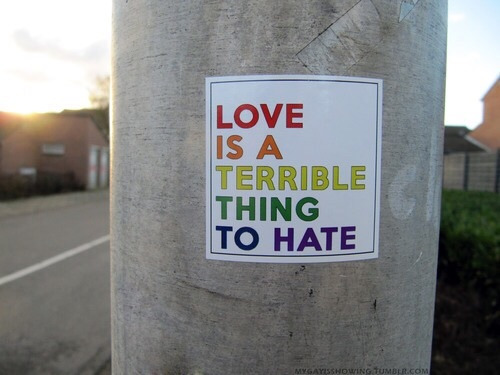
“Love is a terrible thing to hate.”So, yes, I am frequently an angry, militant queer. But all of the people on the other side are arguing in favor of murdering at least some queer people (or, I suppose you could argue that they are simply willing to allow some or most of us to die). That means that what I feel is righteous indignation. And if you don’t feel it at least a little bit on behalf of those kids bullied to death, the murdered trans people, and so on, well, I’m sorry to say, that means you’re on the side of the hateful murderers. I’m sure you have some rationalizations for why your position isn’t that, but you’re wrong. If you don’t believe our outrage is justified, then you’re not one of the good guys.
If that realization makes you unhappy, well, you have the power to fix it. Come over to the Light Side. Join the fight for justice, love, and life.
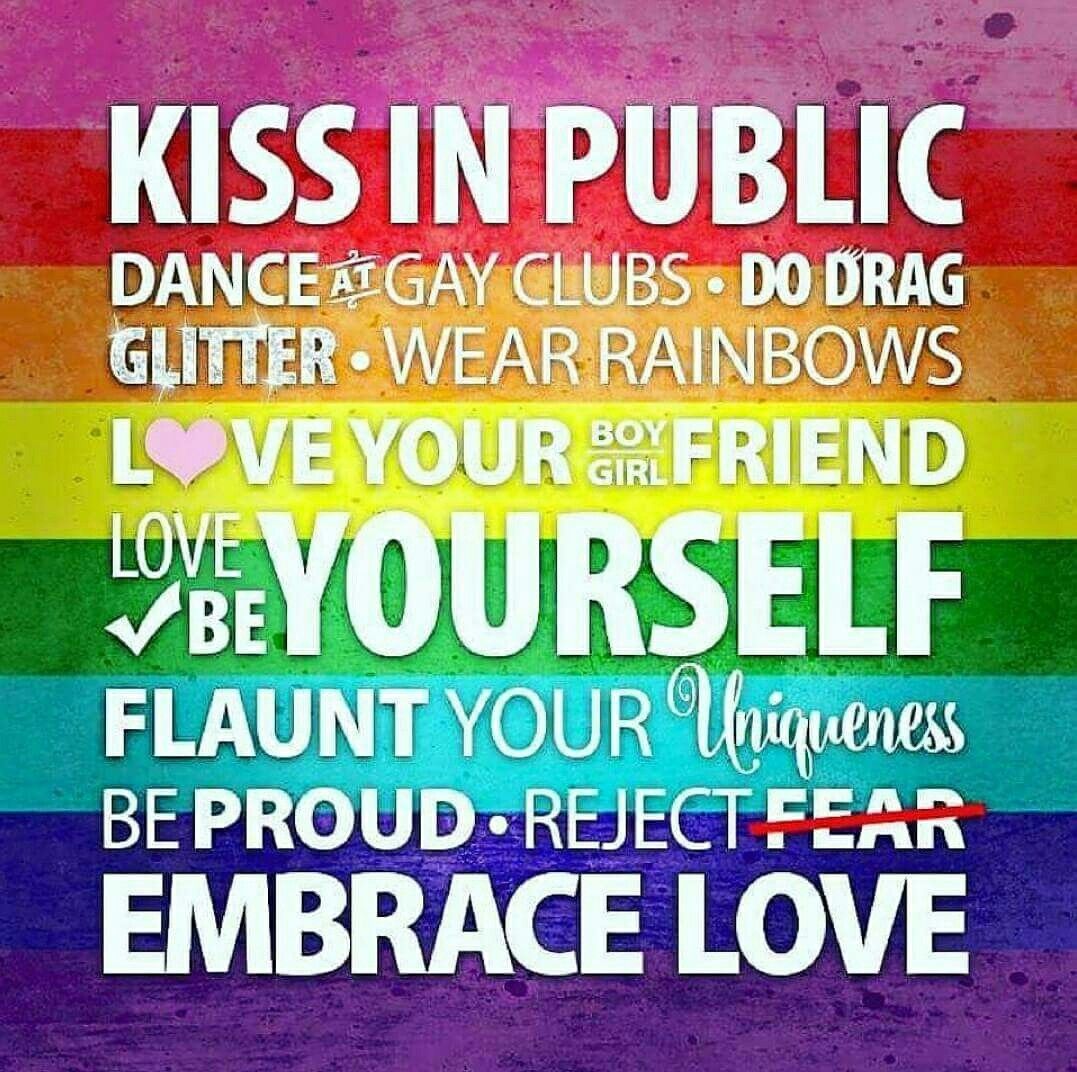
(click to embiggen)Pride Month hadn’t even started before complaints about why we even have Pride started crossing my various news and information streams. There are many, many reasons I can give, but the most important one is simply visibility. We still live in a society where queer kids are bullied by their own parents, thrown out on the streets at the encouragement of their churches, and told again and again that who they are and who they love is shameful and abnormal. And those messages don’t come just from overt bigots who spew anti-gay hate. That message also comes from so-called allies and even from other queer people who disparage those queers who dress outrageously or otherwise flaunt their uniqueness.
A couple months ago Newsweek used this picture to illustrate a story entitled, “The Street Skirmishes, Bar Brawls and Drunken Violence of American St. Patrick’s Day”The funny thing is that they never say such things about participants of St. Patrick’s Day parades. Even though a typical American Pride Parade is far less rowdy and has far less public drunkenness than the typical St. Patrick’s Day parade. Pride events have a whole lot less sexuality than typical Super Bowl commercials. Pride events have a lot less nudity than, say, Seattle’s annual Fremont Solstice Parade. But because the sexual innuendo and nudity in those other events are aimed at straight people, the outrageous costumes are being worn by straight people, and intoxicants are being publicly consumed by straight people, it seldom gets the same kind of coverage in the news, and certainly doesn’t provoke the public tut-tuting on social media that Pride events do. Remember that the original St. Patrick’s Day parades were political marches protesting discrimination against Irish people in America. When was the last time you heard of someone being fired for being Irish?
A person crossed my social media this week (I presume because I reblogged a bunch of pride comments and memes on my tumblr) to admonish me for provoking normal people by celebrating the freaks of the queer community. They claim that they aren’t at all homophobic, yet they use the same tactics and the same language as the rabid bigots. Just like the bigots, they say that being visible is flaunting our sex lives. They say we are freaks. As a certain famous man from Galilee once warned us to beware of people who claimed to be our friends: “by their fruits shall you know them.”
Since I promised that this would be an adventure in dictionaries, let’s look at that word, freak. I call your attention to the following excerpt from the Shorter Oxford Dictionary’s definition:
4 Something fanciful or extravagant; (more fully freak of nature) an abnormal or irregular occurrence, an abnormally developed person or thing, a monstrosity. b A person regarded as strange because of their unusual appearance or behaviour.
This so-called ally is hardly the first person to call me a freak. One of my uncles used to refer to me as an over-educated freak as early as age 9, for instance. It was one of the mildest insults my eighth grade Reading and Literature teacher called me. Other teachers and school administrators told my parents that the bullying I experienced was impossible to stop as long as I failed to act like a normal boy.
What was the behavior they were referring to? Was I showing up at school wearing bondage gear or dressed as a drag queen? No, of course not. The sorts of behavior that was called out were things like:
I would rather read a book by myself than play sports
In elementary school when most boys hated the girls in class, I got along great with them
I knew more about cooking than I did about horsepower and gear ratios
My favorite TV shows were things like The Carol Burnett Show or The Partridge Family or The Mary Tyler Moore Show instead of Gunsmoke or The Streets of San Francisco
My favorite books were mostly science fiction
In middle school I treated girls I talked with as friends, rather than as objects of desire (and didn’t understand for a long time what the difference was between the way I interacted with girls and the way most of the other boys did)
I liked to draw and write fiction
I laughed at the wrong things
I liked to wear clothes that were interesting colors
Some of that list will not strike many people as gender nonconforming, particularly the science fiction bullet. But you need to understand that before 1977 and the advent of the original Star Wars movie (when I was a junior in High School), normal boys did not like sci fi.
The first Freedom Day Marches didn’t happen until I was in fourth grade, and they were not being covered on news stations and the like until several years later. All the bullying and teasing I got for being a sissy or a freak or “not a normal boy” was deeply rooted in homophobia that was hateful and destructive long, long before the first Pride. So don’t tell me that Pride causes homophobia. Anti-gay hatred was around for centuries before Pride.
And kids like me—kids who could never figure out why the way we talked or the way we walked or the things we found interesting were wrong—were subjected to that hatred and bigotry without appearing in public in fishnet stockings or elaborate make-up. We were bullied and mocked and scorned and ridiculed because our behavior wasn’t the usual expected of our gender. I was bullied because I didn’t understand why it was unusual for a boy to think that a pair of burgundy pants was cooler to wear than plain blue jeans. I was bullied because I thought a girl’s ideas were more interesting than what was hidden by her clothes. I was bullied because I would rather sing along (and dance or pretend to be a member of the band) to the radio than play cops and robbers.
Not all queer kids are gender nonconforming (but studies show that at least 75 percent of boys who were consistently identified as “sissies” during childhood will come out as gay as adults), just as not all queer male adults are into show tunes. But the scant number of queer athletes who have come out of the closet, as well as the large numbers of “straight acting” and “non-scene” gays, have been free to do so because the nonconforming or freakish queers decided not to take the hate and loathing lying down. The freaks decided to stop being ashamed of who they were and who they loved. The freaks decided to stop pretending to be non-freaks.
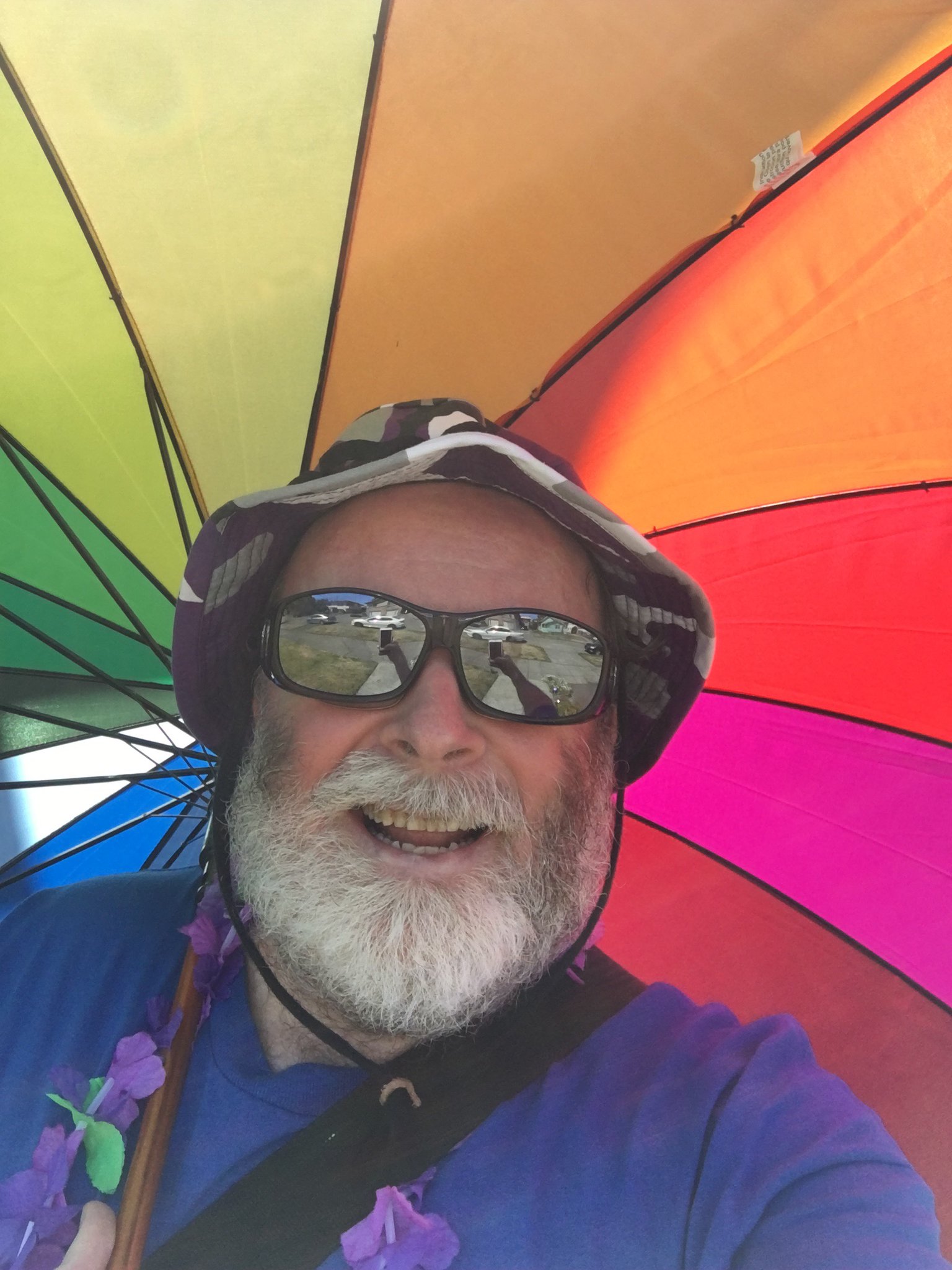
I’m not a drag queen and I don’t wear fetish gear to Pride. I wear my purple hats and various rainbow or unicorn-adorned t-shirts year round. I’m unashamed of my fabulous rainbow parasol and my purple earrings. But I cheer and clap for the people who do dress in drag or other outrageous clothes at Pride. I support their right to be there and be out and dress however they want without being harassed. Just as a woman wearing certain clothes in public doesn’t make it all right for someone to harass or sexually assault her, neither do queer and trans people wearing whatever they’re comfortable in make it right to exclude or denigrate them.
If my love of bright colors, glittery earrings, and silly t-shirts makes me a freak, I’m proud to join that fanciful and extravagant legion of the out and proud. If you’re going to call me a freak, fine, but that’s Doctor Freak to you, and don’t you forget it!
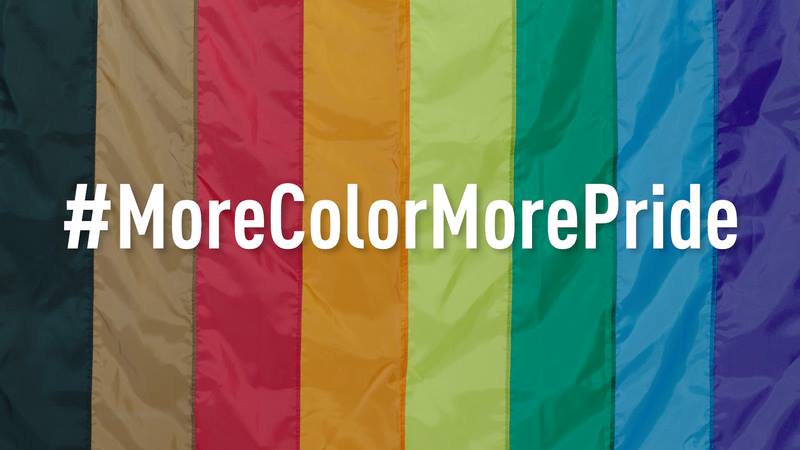
“#MoreColorsMorePride” Supporters of Philadelphia’s revamped version of the Pride flag say it’s meant to be more inclusive to nonwhite LGBTQ persons.When I first saw a link to an article about the More Colors More Pride campaign and their new flag, I admit I was a bit confused. My specific thought was, “But the black stripe goes at the bottom…” because I’m already very familiar with the Victory Over AIDS version of the Pride flag. In that flag, the black stripe represents our being in mourning for the loss of hundreds of thousands of members of the queer community due to AIDS, and it is the bottom stripe on that flag because the idea is that we are determined to be victorious over AIDS, right?
Anyway, my confusion lasted only milliseconds, because I hadn’t even finished reading the headline before I understood that for this flag, the new stripes represented Queer People of Color. Which made perfect sense. But, as an article that I included in the most recent Friday Links noted, the new flag wasn’t greeted enthusiastically by everyone: The Surprising Controversy Surrounding A More Inclusive Pride Flag.
I’ve seen some of the negative reactions on my own social media, and one thing I couldn’t help noticing was that every person I saw objecting, if you checked out their profile, they were white and male (Full Disclosure: I’m white and male, myself). And their objections are, to a one, ludicrous. I especially liked the guy who said something along the lines of “if you don’t see yourself included in the universal symbol of the rainbow, you need to do some soul searching.” Because first of all, it isn’t a universal symbol, is it? As just one example, we have all the whacko Christian fundamentalists who get all angry and in our face claiming that we’ve stolen the rainbow from god. When the flag was first created (and hand sewn) under the direction of artist Gilbert Baker in 1978, some people in the queer community didn’t like it for a variety of reasons.
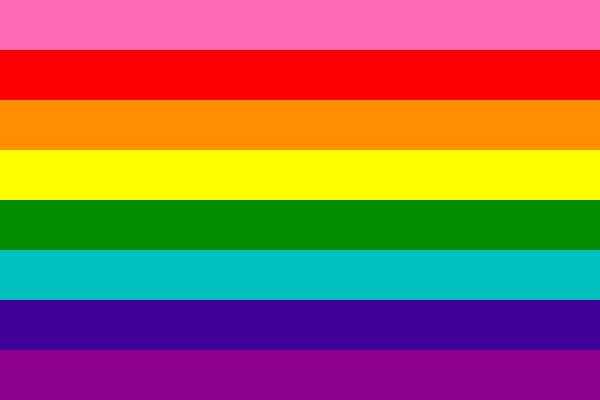
Gilber Baker’s original flag design had 8 colors: hot pink, red, orange, yellow, green, turquoise, indigo, and violet.And it isn’t as if the flag has remained completely unchanged since its original creation. In the fall over 1978, after the assassination of Harvey Milk, there was a sudden demand in the San Francisco area for more of the rainbow flags. To meet the sudden demand, Baker and a flag company decided to use existing stock rainbow fabric (red, orange, yellow, green, turquoise, blue, and violet), so they lost the hot pink and changed the indigo to a lighter blue. And a year later the official banners for the San Francisco Pride events switched to a six-color version ( red, orange, yellow, green, royal blue, and violet). There are two different explanations given for that change: some say it was because when the seven-color versions were hung vertically from street lamp poles the middle stripe wasn’t always visible, others say that there was difficulty getting both the turquoise and indigo fabric. The point is, the rainbow flag changed several times, with the original artist’s blessing, in the first few years of its existence.
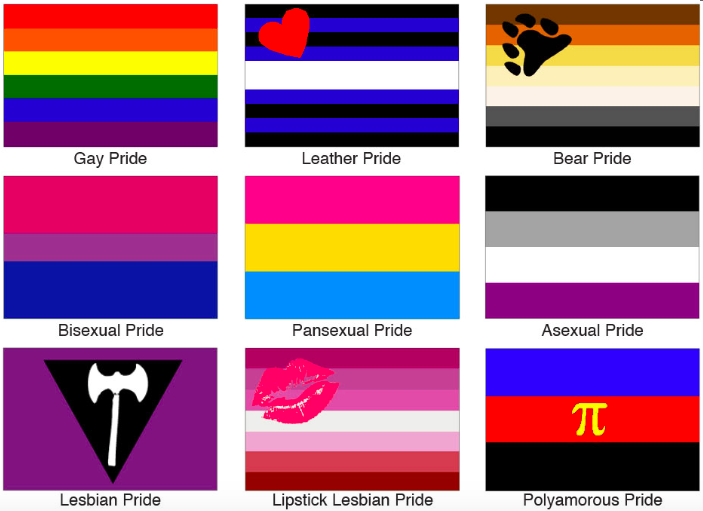
Many groups within the community have felt that the rainbow didn’t explicitly include them, and have opted for other flags to use either instead of the rainbow or along side it. (Click to embiggen)I mentioned above that not everyone was happy with it. Some weren’t happy because they thought the rainbow was two generic. Others because there were already symbols being used by lots of queer people (for example: a pink triangle or a labrys on a black triangle), and they thought we should stick to those symbols for various reasons. Other folks have made other variations. And a lot of people in the community didn’t think that the rainbow (or the Pride marches themselves) should include anyone other than exclusively gay men and lesbian women. I remember public arguments about whether the words bisexual or transgender should be added to the official name of the Pride Parade in Seattle during the 90s, for instance. There many other arguments still raging about who should be included.
Many, many more variants and alternatives to the rainbow flag.I wasn’t around the community for the arguments about the rainbow flag when it was first introduced, but in the late 80s and early 90s, when I was just coming out, the arguments about why the rainbow wasn’t a good symbol for LGBTQ+ people were still raging. I knew more than one person who was adamant that the Pink Triangle was a better symbol because it represented a time gay men were targeted for extermination in Nazi Germany, and we had taken the symbol back. Of course, there were plenty of people who didn’t like the Pink Triangle, either (some because it was considered to represent only men; others because of its origin as a symbol of our oppression). Or only liked it if it were used along with other symbols commonly associated with lesbians.
So claiming the current six-color rainbow flag is universally recognized as including everyone even within the community simply isn’t true.
There’s another big hint that something like the More Colors Flag is needed: white queers wouldn’t be offended (and the folks objecting are definitely offended) at the flag if the problems it addresses weren’t real. Not only that, all of the arguments I’ve seen used to explain why the More Colors Flag is unnecessary sound exactly like the homophobic arguments given for why queers don’t need representation in movies, books, TV and such or why laws against queer discrimination aren’t needed. And they also are exact parallels to racist arguments used to argue we don’t need laws about racial discrimination (among other things). As they say, if it looks like a racist argument and sounds like a racist objection…
None of this will sound unfamiliar to anyone familiar with discussions about intersectionality. In case you don’t know what intersectionality is, let’s start with the definition (I warned you in the title we would get to dictionary topics in this post!):
intersectionalitynoun the interconnected nature of social categorizations such as race, class, gender, and sexual orientation as they apply to a given individual or group, regarded as creating overlapping and interdependent systems of discrimination or disadvantage.
So another reason that you can’t claim that the rainbow is a universal symbol that applies to all queer people is because the experience of being queer isn’t the same for all categories of queer people. It’s kind of like the people who make that argument that you shouldn’t let a black actor portray James Bond or a woman portray Doctor Who because that would make the shows political. Insisting that the hero must be a white male is just as much a political statement as asking why the hero can’t be something else. Similarly, suggesting we should do something to make people of color feel more welcome is not racializing the Pride flag any more than resisting that inclusion is.
I’m a cisgender white man. I also happen to be queer. I have faced discrimination (and worse) because I’m a gay man. But I also know that I have been shielded from certain types of discrimination because I’m a guy and because I’m white. I don’t know all of the times that this happened, but I understand how systemically racism and sexism are baked into our culture, and therefore there are times when I experience no obstacles, where a person of color or a woman would find things less welcoming. The types of discrimination I experience and the ways I encounter discrimination as a gay man are often very different from the types and ways experienced by queers of color. The same kind of discrimination that I might be able to somewhat sidestep because of a bit of white male privilege I don’t even notice at the time can be a much more devastating experience to someone who does not have those two advantages.
“If your profile says: No Latinos, Blacks, Asians, Fats or Fems then you SHOULDN’T BE HERE.”
PHOTO BY BOOMER BANKS (Click to embiggen)Recognizing this isn’t about trying to decide who is more oppressed. This isn’t the Oppression Olympics. The truth is, that a lot of white queer people are unaware of their own racism. Most insist that they aren’t at all, which is literally impossible. You can’t grow up in a racist society without being conditioned to the assumptions of racism. Asserting that the rainbow already includes everyone ignores the fact that there is a lot of racism within the queer community, some of it really subtle because it is just a manifestation of the systemic racism of the whole society, and others of it quite blatant. It’s blatant while also being rationalized away. The photo here of the sign that was seen at the Equality March earlier this month talks about one of those examples. Please note that this sign was at an Equality March, not a Pride March. But it underscores a real truth: a lot of queers, particularly certain white gay men, have these racist attitudes. And yes, it absolutely is racist to say in your dating profile “no blacks” or “no asians” or “no latinos.” The usual counter argument is that they’re just talking about a preference.
No.
I have a preference for redheads. Yet I have never refused to date a non-redhead. And a good thing, too, since neither my late partner, Ray, nor my husband Michael are redheads. I lusted after and occasionally dated redheads, but I wound up falling in love with two different men for reasons other than their hair color. That’s because while I have an attraction toward redheads, I recognize that’s all it is, and that there are other reasons to like or dislike a person than their hair color. The same holds true for race. If you completely exclude someone from consideration because of their race, there is no word other than racism to describe it. And while we’re on the subject: fat-shaming and fem-rejection aren’t any better, and if you’re doing that you’re just being a different kind of bigot, but no less of a bigot than the racist, so don’t do it.
This is another variant rainbow flag that’s been around longer than the More Colors Flag.Nobody’s free until everyone is. And one of the steps to setting everyone free is recognizing that not everyone is as free as everyone else. We have to find a way to actually be inclusive, not to simply say that being inclusive is a good thing. And being inclusive requires us to recognize intersectionality. To understand that there are different degrees of discrimination. Society imposes different types of disadvantage on people based on categories of race, gender, sexuality, economic class, and other things. Those differences are real. The pain and suffering they cause is real. And the benefits that other categories of people receive at the expense of that pain and suffering is also real. Fighting for equality means not just giving lip service to inclusivity and intersectionality, it means taking steps to do something about those problems. You have to look for the people who are having trouble getting into the freedom tent and work to help them inside and to feel welcome. That requires first listening, really listening to try to understand–not pretending to listen while we’re really just waiting for our turn to talk.
If my queer kindred of color tell me that they don’t feel welcome in many queer spaces, then I have to take that seriously and ask what I can do to help. And then I have to actually help. Which is why I say that intersectionality isn’t just a noun. Because those of us who have some privilege, however little it may be, have to stick our necks out and use that privilege to help those who don’t.
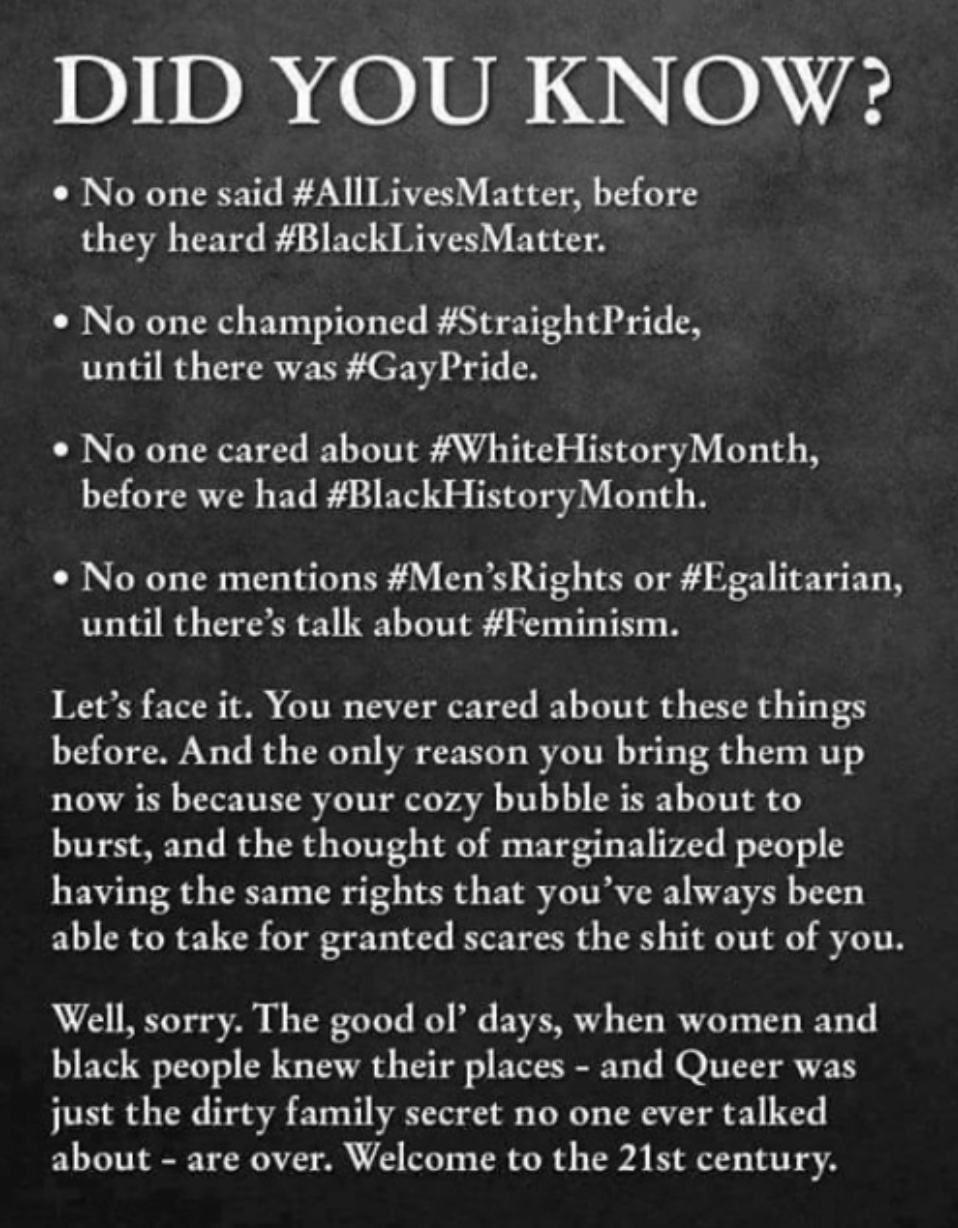
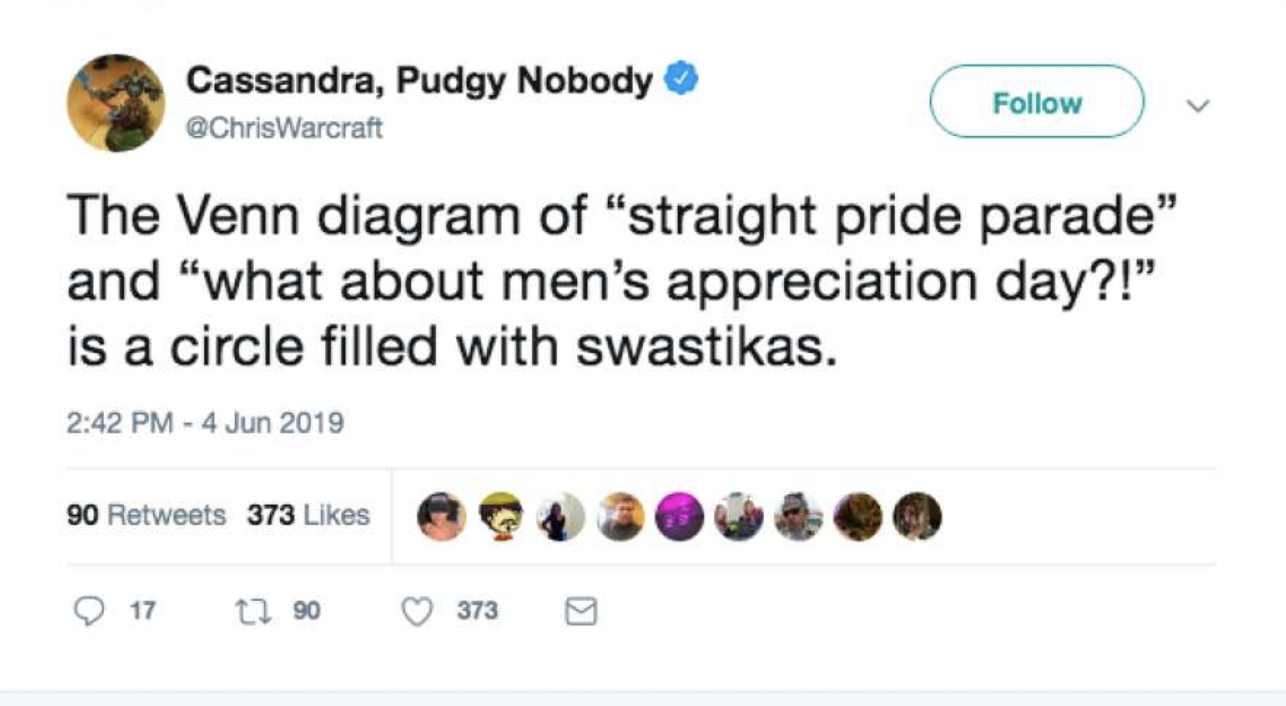
“Gay pride was not born out of a need to celebrate being gay, but our right to exist without persecution. So instead of wondering why there isn’t a straight pride movement, be thankful you don’t need one.”It’s that time of year again. The perennial question arises: “If you get a Gay Pride Parade, why can’t we have a Straight Pride Parade?” I can’t decide which is the saddest aspect of this question: 1) that they think this tired old canard is clever, 2) that they don’t understand that 99.9% of all television, movies, news, and other public discourse is geared toward affirming heterosexual life, including straight sexuality (so every day is already Straight Pride Day), or 3) that they don’t understand that Queer Pride events are about our very right to exist—an act of defiance against those who want us to be invisible or dead—not merely our right to party?
And some people seem to be most hung up about the fact that we have parades and festivals. Especially the parade seems to bug them. They are always quick to say that they don’t have a problem with gay people, but the truth is that what bothers them is us being visible. When they ask us why we have to flaunt who we are, what they are really saying is why can’t he be quiet and stay hidden and not remind them that anyone who is different than they exist.
And you know how you can prove this? Ask them if they have ever raised the same objections to St. Patrick’s Day parades. The earliest St. Patrick’s Day parades in colonial times were about Irish Nationalism, since all of Ireland was under British rule at the time. By the mid- and late 1800s the St. Patrick’s Day parades were about Irish equality in the U.S., since anti-Irish and anti-Catholic sentiment was quite high, and yes often encoded in laws and government policy. While the anti-discrimination purpose of the parades has faded away, the parade is still about taking pride in one’s Irish heritage. If a person doesn’t object to Irish pride parades (which is exactly what St. Patrick’s Day parades are), but they do object to LGBTQ+ Pride parades, the only logical reason can be that they object to the Lesbians, Gays, Bisexuals, Trans, and all other Queers in particular, and not the idea of a parade celebrating identities in general.
I can pretend that the question isn’t a passive-aggressive exercise of bigotry and give you some simple answers. Why do we need Pride?
We need Pride because people still target gender non-conforming children in schools, and now adults aren’t just making excuses for the bullying and discrimination, they are writing it into law!
We need Pride because people will go to great lengths to take away any rights we managed to get.
We need Pride because queer kids are born everywhere, not just into families and communities that love and accept them, but often into families where they are bullied (sometimes bullied until they kill themselves) and they need to know that they aren’t alone.
We need Pride because the world tries to make us hate ourselves, tries to make us be ashamed to love, and most importantly tries to convince us we are utterly alone.
None of those reasons apply to straight people. No one bullies straight children just because they are straight or gender conforming. No parents kick their straight children out on the street because they are straight. No one is targeting sports bars to kill straights because they saw a man kiss a woman somewhere. No preachers are going on the air to say that straight people deserve death. No one is passing laws saying gender conforming children aren’t allowed in public school bathrooms. No one is passing laws trying to ban straight people from adopting children or getting medical benefits for their partners. Straight people and straight people’s sexuality (ever seen a romantic comedy?) is the subject of at least 99% of all movies, television shows, et cetera. So straight people don’t need pride. But if you really think you do, no one is stopping you from organizing your own parades (though I’ve argued before that you already have those, too).
The reason queers like me have been able to stand up and be ourselves is because other queers before us were brave enough to be out and brave enough to protest when necessary. Be it staging sip-ins to protest laws that made it illegal for a bartender to knowingly allow two homosexuals be served in the bar, or fighting back when police raided a gay club, or picketing in front of federal buildings, or boycotting industries whose spokespeople lobbied for laws to take away our rights, or protesting laws making it a crime for us to be intimate with the person of our choosing, or marching in the first ever Pride event in June 1970. Those of us who can stand up for ourselves now owe a debt to those earlier generations of queers. We can’t pay them back directly, so we have to pay it forward. We do that by standing up and being counted and being visible for all of the people (especially kids) who can’t safely be out themselves, yet.
We need Pride not because we’ve come so far, but because there is still a long, long way to go.






















 Font Folly