 Last week I mentioned that Heinlein’s later writing, when compared to his earlier writing, was like a completely different man. That was both true, and misleading. Heinlein’s writing career spanned from the 1940s into the 1990s, and society underwent more than a few changes as to what was allowed in mainstream publications during that time. Through most of the 40s and 50s, for instance, anything remotely sexual was almost completely taboo in fiction, while racial topics could usually only be broached in metaphor. Then there was the legendary John W. Campbell, who edited the magazine Astounding Science Fiction (now known as Analog) from 1937 until his death in 1971. Campbell allowed absolutely no sex in stories he published. Campbell also insisted that humans always be superior to any aliens they met. Campbell seems to have been slightly more racist than the average white american during the 30s—which did not change at all even though he lived through the civil rights movements of the 60s. Continue reading The Moon Harshed My Mellow: more of why I love sf/f
Tag Archives: sci fi
Citizen of the (two-fisted) Galaxy: more of why I love sf/f
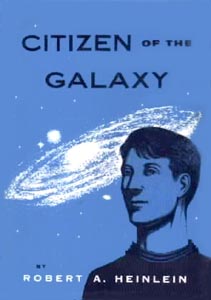 I can’t remember the first Robert Heinlein science fiction book I ever read. My mom (who had been teased as a child because of the way she spoke) was determined that I would learn to speak correctly, and decided the best way to teach me proper grammar was to read to me from her favorite authors. So before I could talk, she would read aloud from her Agatha Christie murder mysteries and her Robert Heinlein science fiction books. Later, when I could talk, she would make me repeat back whole sentences as she read. Besides turning me into a lifelong fan of mysteries and sci fi, this project also accidentally taught me how to read long before I got to school.
While I don’t remember the first, I do remember several that I read during elementary school and into middle school… Continue reading Citizen of the (two-fisted) Galaxy: more of why I love sf/f
Tom Puppy and the Visitor from Planet Clueless
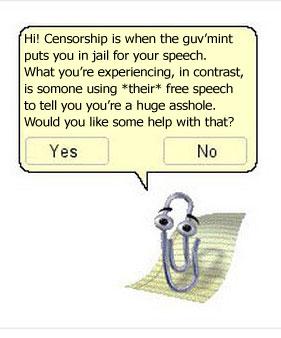 A Sad Puppy/Rabid Puppy supporter posted an op-ed on the men’s rights site Return of the Kings (he links to and heavily paraphrases one of the Sad Puppy podcasts), “How Female-Dominated Publishing Houses Are Censoring Male Authors” that is a great example of several of the issues that I believe underpin the Sad Puppy position. Never mind that the statistics show that men make up more than 65% of the annual publishing lists of most of the publishing houses, and male-authored books comprise more the 80% of books reviewed in the major publications, this guy is here to tell us that men are being censored!
His proof is an anecdote told to him by a veteran who had written a book about his experiences while serving in Iraq and Afghanistan who claimed to have gotten his book through several phases of the publishing process, only to be rejected at the last step because a senior editor who happened to be a woman was offended by one line in the book and said, “he’s an asshole, we don’t want to work with him.” I have a hard time swallowing the story as stated. But even if we take it at face value, the story boils down to an editor deciding that someone who is difficult to work with wasn’t worth the time, effort, and stress required to work with them.
He’s a first-time author, never been published before, has no name recognition, no proven track record. I don’t believe for a moment that it was a single line in the book that set anything off. I suspect that the author had behaved abominably to several people in the process up to that point and the book itself was of only middling quality. An important part of an editor’s job is to recognize which stories their readers will enjoy reading. Another important job is to weigh the costs and benefits of working with a specific story and author. If a particular book does not look like a blockbuster that will sell zillions of copies, it isn’t worth the time and effort to put up with a lot of assholery through the process of re-writes, galley proofs, et cetera.
That isn’t anti-male prejudice, that’s good business practice.
The fact that this anecdote is swallowed without examination—without considering the possibility that one could try to figure out what behaviors led to the characterization of asshole and try changing those behaviors—shows just how big the privilege blinders are on these guys. Imagine! If you’re nice to people they’re willing to help you. If you aren’t, they have no motivation to stick their necks out for you. And deciding to expend your employer’s money and the time of yourself and other employees on turning a manuscript into a published book and then distributing it is sticking your neck out.
This is one of the fundamental blind spots of the various puppies: they are convinced that the only reason their stories aren’t bestsellers and award winners and the only reason that they aren’t met at every convention by crowds of screaming fans must be the result of a conspiracy. It isn’t possible that their writing is mediocre. It isn’t possible that their subject matter isn’t of interest to anyone but angry misogynist racist homophobic men such as themselves. It isn’t possible that their predilection for making outrageous statements comparing gay people to termites in need of extermination might make anyone who knows or loves a gay person less than thrilled to hear more of what they have to say. It isn’t possible that characterizing some woman’s clothing as an all-day slut walk might be off-putting to anyone who is or loves a woman. It isn’t possible that characterizing people of color as half-savages might make people of any ethnicity less than enthusiastic about cheering everything you say.
Instead of exercising our own judgement about what works to read and who to be fans of, apparently we should all feel grateful that they would deign to allow us to bask in the glow of their wit and wisdom.
Time Travellers Strictly Cash: more of why I love sf/f
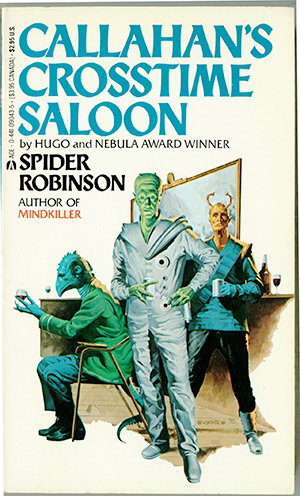
It was in the pages of Galaxy that I first “met” Spider Robinson, who wrote their book review column at the time. The books he reviewed were books that either had just come out in hardback or were going to be coming out soon, so they were never books I would be seeing in a while. If a book wasn’t purchased by the local public library, my only option back then was to happen upon a paperback book when the family took a trip to the larger town (across the state line) where they actually had bookstores!
Even though I often didn’t see the books he reviewed until years later, his book reviews gave me a sense of belonging to the sci fi tribe. And they were just fun to read!
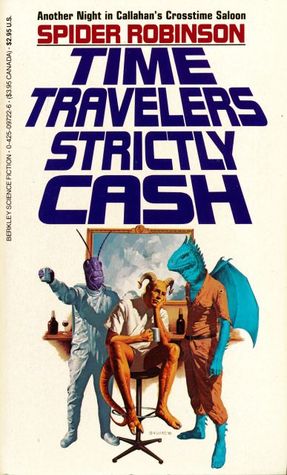 Robinson wrote his own science fiction, too. I believe I read a few of the Callahan’s short stories out of order as they appeared in the magazines. It wasn’t until I was in college when I found a copy of Time Traveler’s Strictly Cash in a used bookstore that I read a bunch of them in order. I immediately became an even bigger Spider Robinson fan.
It’s hard to describe the Callahan’s stories. Most of them are set in a bar that somehow manages to attract aliens, time travelers, and various mythical creatures each lost in different ways. They were sort of like Twilight Zone episodes… except (almost) always uplifting. Originally, the Callahan stories were semi-standalone stories, most of which were published in the magazine Analog Science Fiction. The stories often illustrated the Law of Conservation of Pain and Joy (also known as Callahan’s Law): “Shared pain is lessened; shared joy, increased—thus do we refute entropy.” Robinson wrote the Callahan’s stories as ideas occurred to him, so he didn’t have a grand plan for continuity. So in the later books as he transitioned from short stories to novels things occasionally went off the rails. But even then, the stories had more than enough heart to patch over the plot holes.
He’s also written novels outside of the Callahan’s universe. My particular favorites are Mindkiller and Telempath, though he is probably more famous for the Stardancer series written in collaboration with his wife, Jeanne Robinson. He’s won three Hugo Awards, a Nebula, the John W. Campbell Award, and the Robert A. Heinlein Award for Lifetime Achievement. So I’m not the only one who likes his work.
I read pretty much every single thing he wrote from 1970s, through the 80s, and a bit into the 90s. He kept writing and still is writing. His most recent novel was published in 2008; he’s been reporting off and on about progress on his next novel on his web site, but he’s also been dealing with serious health issues (both his own and in the family), which has slowed him down.
As I said, I kept reading everything he wrote into the 90s. Around 1993 or ’94 I found myself drifting away from Robinson. Some of it was just issues in my life. I finished coming out of the closet, I got divorced, and a lot of family upheaval happened. This is also the time period when, in my opinion, the Callahan stories started going off the rails. I had also come to the conclusion that I just didn’t agree with the philosophy that seemed to underpin every story he wrote: if only people could communicate more clearly, all conflict would cease. So I stopped reading his new material. I would still pull out my old favorites from time to time to re-read.
In 2000, I read a book review by someone else (unfortunately I don’t remember who) of a new Callahan novel, Callahan’s Key. The reviewer mentioned a similar dissatisfaction that had caused him to stop enjoying Robinson’s writing around the same time I had quit. And the review said that this novel captured at least some of the old magic. The reviewer said the new novel was a joy to read.
So I picked it up. And I read it, and it did have a lot of the fun of the earliest stories. It was not, in any way, a rehashing of them, though most of the characters make an appearance (and team up to save the world, literally). It reminded me of why I had loved his writing to begin with.
I think what appeals to me most about Spider is his unabashed enthusiasm for the idea of science fiction itself. That came through in his book reviews, of course, but also in other essays, introductory material he wrote for the short story collections, but also in the stories themselves. I still remember one comment about Dune Messiah, the first sequel to Frank Herbert’s Dune: it had plot holes you could drive a truck through, but you didn’t care, because the rolling grandeur of Herbert’s vision swept you along.
And he was right.
Robinson’s work epitomizes the giddy hope for a better tomorrow that is at the heart of some of the best science fiction. That exuberant expectation of better things to come is what first drew me to the genre. I’m grateful to have had Spider has a guide and companion in my own search of that wonderful tomorrow.
Marooned off Vesta: more of why I love sf/f
 My dad’s idea of a vacation was to go camping and catch fish. Unfortunately, these trips not only never involved a camper, they also never included tents. We slept in sleeping bags under the stars gathered around the dying embers of the fire we’d cooked dinner on. If it was raining, the whole family would crowd inside the cab of Dad’s pickup and try to sleep sitting up all squeezed together.
I wasn’t terribly good at any “outdoorsman” sorts of skills, and Dad never missed an opportunity to tell me just what a clumsy, stupid, sissy I was whenever I did anything incorrectly. Though, for the record, he never called me anything as nice as “sissy.”
So I didn’t much enjoy those vacations.
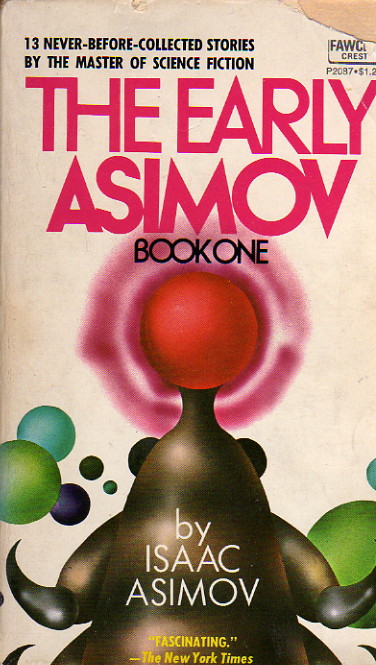
The last one we took, before my parents’ marriage took its final turn for the worse, was when I was 13 or 14 years old. Shortly before we had left on the trip, I had acquired a paperback copy of The Early Asimov, Volume 1, and had packed it along. I’m not sure why that particular book had jumped out at me in the small bookstore that we had visited with my Great-grandma on a weekend trip to a nearby town that was large enough to have an actual bookstore. My best guess is that, since Asimov was at that time the author of a monthly science essay that appeared in each issue of The Magazine of Fantasy & Science Fiction that I had recognized his name.
I remember waking up early in the morning several times on that camping trip, my parents and sister still asleep, and going to the pickup to retrieve the paperback book from my bag. Then I sat and read until Dad woke up. Just looking at the cover of my worn old copy of the book brings back memories of the early morning light, the sounds of wind in the leaves overhead, and the nearby creek.
The Early Asimov was first released as a hardcover, single volume book a couple of years before I found the paperback. It is a collection of a bunch of Isaac Asimov’s short stories from the first nine or ten years of his career; specifically stories that had not already been included in any other anthologies. But the book isn’t merely an anthology—in between each story, Asimov wrote about how he came to write the story, along with describing other stories he wrote at the time that either had never been published, or had been and were in other collections. These interludes were much more than mere introductions to the story, they amounted to an autobiography. And the story this autobiography told was how a Russian-Jewish kid from Brooklyn discovered science fiction in the magazine rack of his family’s candy store, and became a published professional sci if writer before he exited his teens.
Isaac’s personal story gave me at least as much hope and wonder about the possibilities of the future as his science fiction did. The stories themselves were entertaining and thought-provoking. Asimov clearly loved science, and he was perpetually optimistic that great things could be accomplished with the proper application of knowledge.
And he wrote good stories.
Not just a few stories. He published over 300 books. He wrote science fiction novels, of course, and collected his short stories into anthologies, but he also wrote science fact books, history books, books on literature, and so much more. I mentioned his monthly science column—he wrote 399 of those from 1958 until his death in 1992. About every year and a half he collected the last 15 to 17 of them into a book, wrote additional introductory information, and published them (Janet Todd Rubin gives a great explanation of the importance of Isaac’s science columns here: (Almost) Everything I learned about science I learned from Isaac Asimov). And then there were the many limerick collections…
But back to the sci fi:
His Foundation series, besides being the first collection of novels to be awarded a Hugo as a collection, established the concept of psychohistory: a science of applying mathematical formulas to the actions of large populations to predict various outcomes. His Robot stories were the first to posit artificial intelligences that did not turn on their masters, and he was the first person to coin the word “robotics” which has become the name of the real engineering discipline he described in the books.
And then there were his mysteries. Science fiction mysteries at first (including the Wendell Urth science fictional science mysteries), but also a series of mystery short stories set in contemporary setting (Tales of the Black Widowers, and sequels), and two straight murder novels. Though my favorite of those, Murder at the ABA which was set at a booksellers convention, isn’t entirely serious. One of the supporting characters in that one is Asimov himself, and he portrayed himself very self-deprecatingly, making his character the comic relief of an otherwise serious murder investigation.
I didn’t really know all of that at the time, but reading that book over the course of several mornings on that vacation, Isaac Asimov gave me hope that I could write science fiction and get it published, too. Hope not only that I could write and get published, but that there were people out there interested in the things I was interested in. I didn’t have to remain trapped, like the protagonists of “Marooned off Vesta” stuck with no propulsion, no radio, a limited amount of air, and a year’s supply of water. I could rig up a propulsion system from the things I had, and get to a safer place.
His writing style was described as unadorned. Some people complained that he very seldom described his characters or the settings. I think that was a strength. His stories focused on the plot. His characters were defined by their words and deeds. He described only those things that needed to be described to understand the story, leaving the rest to the reader’s imagination. Allowing the reader to imagine characters who weren’t always white, for instance.
He raised questions, and answered them with a mix of science and humor that made the future seem like a very inviting place. And his willingness in many anthologies and essays to share anecdotes of his encounters with other writers (not to mention the many stories of the times he was Toastmaster at a Hugo Award ceremony) made the world of science fiction writers and fandom seem an even more welcoming place.
He was quick to laugh, and quicker to make others laugh. Sometimes too quick. He had to have thyroid surgery at one point in his life, and when they gave him the tranquilizer before they move the patient into the operating room, he began singing and joking with everyone. When the surgeon came into the operating room, Isaac sat up, grabbed the doctor’s scrubs in both hands, and blurted out, “Doctor! Doctor! In green coat! Doctor, won’t you cut my throat? And when you’re finished, Doctor, then, Won’t you sew it up again?”
The nurses got him back down and the anesthesiologist put him under. The nurses later told Isaac’s wife that the doctor couldn’t stop laughing for nearly five minutes. When he included this story in one of his essays, he noted, “They say I’ll do anything for a laugh, but I think that making a surgeon about to take a scalpel to me laugh so hard he can’t hold an instrument may have been a step too far.”
I could easily ramble on and on about Asimov, the awards he won, the records he set, the serious science circles he moved in, and the many, many bookshelves in our house filled with his books. He loved knowledge and he loved explaining things (two traits that I know more than a little about), and he wrote in a way that encouraged you to think, to be curious, and to meet challenges with confidence and a smile.
Assessments, plans, and implementations: a metapost
Some parts of this post may fall too far into the “what I had for breakfast” zone for some of you, but it helps me to stick to plans if I share them with people. Not that I get nagged often by my readers, I just am more motivated to do things I have said I would do than to follow through on plans that I keep to myself.
So I’ve been making some changes to my routines in an attempt to improve my writing productivity, and I’m thinking about some changes for this blog…
Continue reading Assessments, plans, and implementations: a metapost
It bothers some people that we exist, part 2
Logic is the beginning of wisdom, not the end
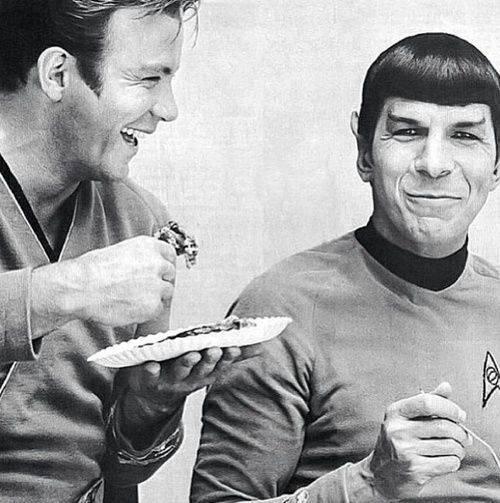
RIP @TheRealNimoy you showed us how to become whole people even when we felt like we were a mix of random parts.
Or, as writer and Manga Editor Stacy King put it:
Spock was the “it gets better” symbol for 70s nerd kids: a brilliant alien caught between cultures who still managed to find home & friends.
Some people say that we’re conflating a character with the actor that played him. Yes, Gene Roddenberry should get the credit for creating Spock—and when the network executives wanting to dump the “guy with the ears” after seeing the first pilot, for fighting fiercely to keep the half-alien/half-human character on the show. Similarly, credit is due to all of the writers who wrote him (especially Dorothy Fontana). But while characters in movies, television shows, and plays are the product of the creative work of writers, directors, costume designers, or so on, you can’t completely dismiss the contribution of the person who spoke those lines, wore the costume, and actually played the part.
Nimoy could communicate volumes in a cocked eyebrow or the tilt of his head. He’s the one who made us believe that this character that was a hybrid of a cold, emotionless alien and a much less logical human was a real person.
It doesn’t hurt that the man himself seemed quite likable. Whether he was playing Sherlock Holmes on stage, recording some truly awful music, directing movies, voicing parodies of himself in various animated (and not) shows, or being interviewed about any of his work, he always seemed to be having a good time. He took his craft quite seriously, but didn’t seem to take himself too seriously.
If George Takei is everyone’s favorite gay uncle, Nimoy became every nerd’s favorite grandpa. One of my friends retweeted one of Nimoy’s tweets from 2013 where he said that anyone who wanted him to be their honorary grandfather, should consider it done.
When he was diagnosed with chronic obstructive pulmonary disease, which may have been the result of his smoking in his younger days, he started campaigning against smoking, by posting statements like: “I quit smoking 30 yrs ago. Not soon enough. I have COPD. Grandpa says, quit now!! Live Long and Prosper.”
Given his age and the illness, I thought I was prepared for this news. But I wasn’t. By the time I heard the news last week that he was hospitalized, he had already been released and gone home. I heaved a sigh of relief. He even posted to twitter afterward, so everything must be okay, right?
In retrospect, when you read the tweet, it’s obvious he knew. I guess I just wanted to be in denial. I know I cry easily, but I didn’t expect it to hit me quite like this.
I just posted the text of his final tweet yesterday, but it’s a good thought, and worth re-reading:
“A life is like a garden. Perfect moments can be had, but not preserved, except in memory. [Live Long And Prosper]”
Leonard Nimoy, 1931-2015
Live long and prosper
“A life is like a garden. Perfect moments can be had, but not preserved, except in memory. [Live Long And Prosper]”
Leonard Nimoy, 1931-2015
(Source: Leonard’s final tweet after leaving the hospital four days ago.)
Tribal allegiances
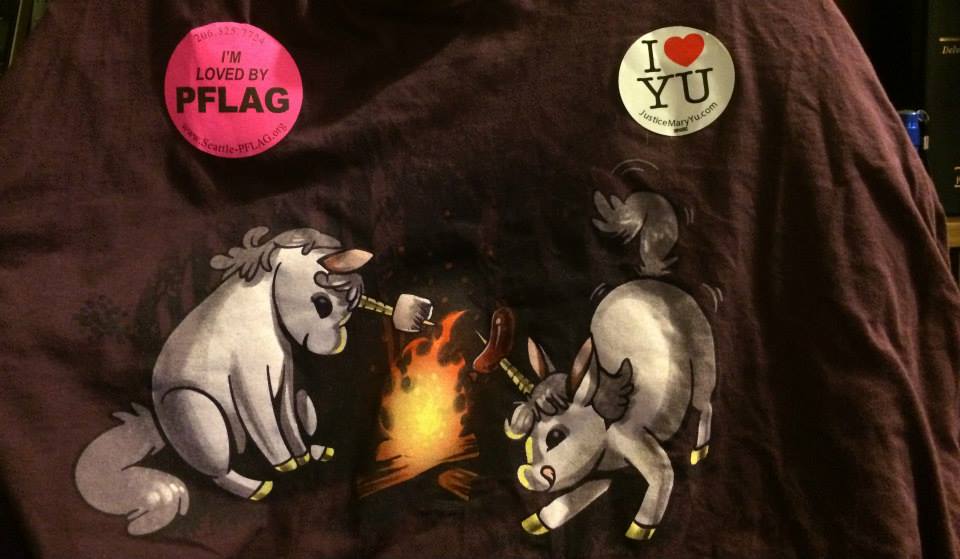
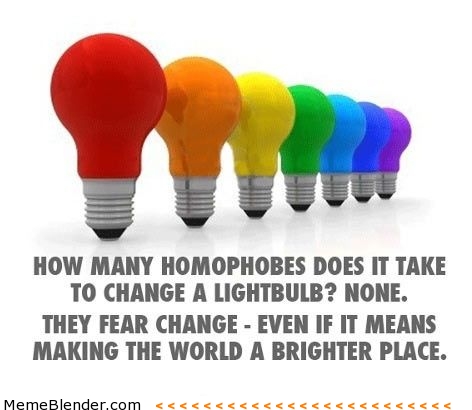
I belong to a lot of tribes that don’t always get along. And I continue to be naively surprised when I discover new evidence of this. I still feel more than a bit of shock when I meet a homophobic sci fi fan, for instance. How can you be an enthusiast for science, the triumph of knowledge over ignorance, and the hope of a better tomorrow while clinging to such small-minded backwards thinking?
When I’ve used this particular example in the past, I’ve been told that I’m assuming that these folks are into science fiction for the same reasons that I am; but I’m not talking about their reasons for becoming sci fi fans. I’m talking about what science fiction is. You can’t claim to be a fan of science fiction yet reject the entire premise of science fiction. Rejecting the fundamental premise makes you the opposite of a fan.
The other argument I’ve heard is that being an enthusiast for sci fi is a choice to read or watch certain types of stories and to embrace other cultural aspects of those kinds of stories, whereas being gay is merely a sexual preference. So it is as irrelevant to anyone’s participation in sci fi as another person’s dislike of chocolate. But again, this argument misses the point. My point is if you’re an enthusiast for sci fi stories, you should be knowledgeable enough to recognize that despising someone for their sexual orientation is illogical. Besides, even under the reasoning of this argument, rejecting a gay person is the equivalent of saying that a person who doesn’t like chocolate can never be an astrophysicist.
And not to make it seem one-sided, there are plenty of gay guys who absolutely loathe sci fi nerds.
Similarly, a lot of science geeks look at the sci fi fans within their own ranks with a bit of suspicion or condescension. Just as some Star Wars fans dislike Babylon-5, and some Lord of the Rings fans can’t understand why anyone likes Star Trek, and so on.
I’m always going to be nerd, and not just a nerd, but a geeky nerd. I love physics and engineering and mathematics. I can’t help but see just about everything I observe in terms of causes and effects. So science and science fiction will always intrigue me.
And I love to explore “what if” questions and take them to their ultimate logical conclusion, so all kinds of fantasy—whether it’s about elves and wizards or talking rabbits and conniving ducks or flying heroes and scheming masterminds—is also going to fascinate me.
And I’m a gay man, living in a world where masculinity and femininity are mistakenly believed to correlate with all sorts of personality traits. For instance, there are people who are surprised that I’m a Seahawks football fan, because gay men supposedly aren’t into sports (tell that to all the athletes competing in the Ninth Gay Games this week). Of course they’re probably at least as surprised because science geeks and sci fi nerds aren’t supposed to be into sports, either. I certainly can attest, having worked with engineers and computer geeks for nearly three decades, that there are considerably fewer sports fan in those offices than in other kinds of workplaces.
It is true that I have had a very ambivalent relationship with sports my whole life. In middle school I participated in basketball, wrestling, and track, and in the first year in high school I did cross country and track. But I was never terribly good in any of those sports. One way that was made clear when I moved to a larger town was that I wasn’t good enough to make any of the sports teams (I did intramural soccer for a while, but that was it). And, of course, the best athletes in my schools tended to be the same guys who were most likely to bully me (which didn’t get any better once I became a debate and drama nerd).

And while generally I try not to worry about it, sometimes it feels like the kind of reaction I used to get when I was still trying to be active in church whenever the subject of gay people came up. Or when certain political topics used to come up around my conservative relatives.
I know what full-fledged rejection feels like, and don’t want to go through it again. Try to think about that the next time you’re hanging with a group of friends who share one of your enthusiasms when another group comes up. No matter how horrible of an experience you may have had with that other group, don’t go on and on about how horrible those people were. You’re probably sitting next to one.
 Font Folly