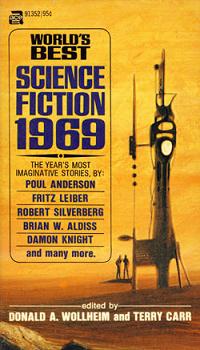
Cover of the first edition paperback, World’s Best Science Fiction 1969 edited by Donald A. Wollheim and Terry Carr.I was either 13 or 14 years old when I acquired my copy of the 1969 edition of the World’s Best Science Fiction. As was so often the case, I picked up my copy at a used bookstore. I recognized several of the authors in the table of contents, though I don’t believe I had read any of the stories. That was the point! One book, a whole bunch of stories! Brilliant!
Once I got the book home, I read through the titles in the table of contents again, and one jumped out at me: “Time Considered as a Helix of Semi-Precious Stones.” It was just an interesting image: a helix of gemstones and the like as some sort of analogy or metaphor for time. And the author’s name, Samuel R. Delaney, seemed familiar, though I couldn’t think of any stories I had read by him.
A few weeks back when one of the serious news sites reported that people of color have only recently become involved in reading comics and science fiction, Arab-American past Hugo-nominated science fiction author Saladin Ahmed shared this historical photograph showing a bunch of African-American kids reading comics in the 1940s.So, one of the official new Star Wars universe novels came out last week, STAR WARS: AFTERMATH by Chuck Wendig, and it is getting flooded with one-star reviews. About a third of those reviews are along this line: “I don’t like the inclusion of so many gay characters because my personal opinion is that sodomy is not normal and I am tired of the liberal media trying to make me accept this lifestyle.”
Oh, dear. A galaxy that includes countless species and droids and races acknowledged the existence of homosexuality? WHAT WERE THEY THINKING? Can we PLEASE get back to giant slugs with a fetish for other species, green muppets, blue elephant people, and giant walking carpets? You know, characters who are normal.
Conservative pundit Earl Hall (here’s a DoNotLink link if you want to subject yourself to it) weighed in (including a really bad attempt to write some Yoda dialog), asking why there are suddenly so many gay characters everywhere: “Is there all of a sudden way more LGBT people in our population than we once thought? Is this really about diversity, or is it more about forcing a story line and lifestyle down our throats?”
First of all, yes, Mr Hall and all the bigoted one-star reviewers: there are more queer people in the population than you thought. But it isn’t suddenly. I’ve quoted before the CDC study in the 1990s about sexual activity that found that while Americans would rather admit to being heroin addicts than bisexual, if you just went by their sexual activity rather than asking them to identify their sexual orientation, about 45% of the population regularly engaged in sexual activity with both men and women. That and other studies indicate that only about 6% of the population engages primarily in sexual activity with members of the same gender. But that means that just (45% + 6 % = 51%) a bit over half the population of the planet is non-heterosexual.
That means that in the U.S. about 19,800,000 (that’s more than nineteen million) people are exclusively gay, while about another 148,500,000 (that’s over 148 million) people are bisexual/pansexual/whatever you want to call it.
And worldwide, the combined number would be 3,570,000,000 (that’s more than three-and-a-half billion) non-heterosexual people.
So, yes, a lot more than you think. And we’ve always been here. There was a wonderful scholarly article I read once that was dissecting clues in various documents and diaries and so forth from the 1890s that put forward a really good argument that men were having sex with other men more often in the U.S. in the 1890s for at least part of their adult lives than was happening in the 1990s. Just as an example.
If you can imagine a world where Luke Skywalker would be irritated that there were gay people around him, you completely missed the point of Star Wars. It’s like trying to picture Jesus kicking lepers in the throat instead of curing them. Stop being the Empire. Join the Rebel Alliance. We have love and inclusion and great music and cute droids.
And a bit later in the post:
And if you’re upset because I put gay characters and a gay protagonist in the book, I got nothing for you. Sorry, you squawking saurian — meteor’s coming. And it’s a fabulously gay Nyan Cat meteor with a rainbow trailing behind it and your mode of thought will be extinct. You’re not the Rebel Alliance. You’re not the good guys. You’re the fucking Empire, man. You’re the shitty, oppressive, totalitarian Empire.
Wendig also points out all the women and people of color appearing prominently in the trailers for the new movie, in case that kind of inclusion also upsets the one-star reviewers.
Finally, one last note about all those one-star reviews. Amazon’s algorithms push books to the top of recommendation queues based in part on the number of reviews, total. It does not take into account whether the reviews are good or bad. The algorithm cares only that lots of people feel strongly enough about a book to review it. And sales statistics seem to bear that out: readers are more willing to take a chance on a book that has lots of reviews, negative or positive.
I suspect a lot of those people read the negative reviews, see what the reasons a person dislikes a book are, and say, “Well, they may not like books like that, but I do!”
Regardless of that phenomenon, there’s an actual campaign on some conservative fan sites asking people who haven’t even read the book to go give it a one-star review. I don’t think the understand that just means that more people who haven’t heard of the book will have it recommended to them by Amazon.
But then, bigots have seldom been known for the brilliance.
It’s Friday! The final Friday in August. Most of my news reading was dominated by the aftermath of WorldCon, so there’s a bit more sci fi and fandom news in this week’s links than usual. There was just so much that had to be shared!
Anyway, here is a collection of some of the things that I ran across over the course of the week which struck me as worthy of being shared. Sorted into categories with headings so you can skip more easily:
Trump-ward, Christian Soldiers? “Let me get this straight. If I want the admiration and blessings of the most flamboyant, judgmental Christians in America, I should marry three times, do a queasy-making amount of sexual boasting, verbally degrade women, talk trash about pretty much everyone else while I’m at it, encourage gamblers to hemorrhage their savings in casinos bearing my name and crow incessantly about how much money I’ve amassed?”
Hugos & Puppies: Peeling The Onion. “When it comes to debating strangers with radically different perspectives, you sometimes encounter what I refer to as Onion Arguments: seemingly simple questions that can’t possibly be answered to either your satisfaction or your interlocutor’s because their ignorance of concepts vital to whatever you might say is so lacking, so fundamentally incorrect, that there’s no way to answer the first point without first explaining eight other things in detail.”
On the SF/F genre and a-holes. “We all have conservative friends and acquaintances who aren’t a-holes, and we don’t seem to have a big problem with them unless they’re crazy bigots like [Vox Day]. We have a problem with a-holes.”
On the Hugo Awards controversy, Sad Puppies, and why there are no winners here. “I haven’t voted in several years, when I did I voted for stories that I loved (plus, to be honest, stories written by my friends)—as do most readers. If readers deliberately voted for stories about gay characters and people of color, perhaps it’s because [those stories] speak of “alienation,” which a great many readers of science fiction happen to have experienced (readers of science fiction tend to be natural outsiders).”
“Unfortunately for your side George R.R. Martin was caught.” “If you think George was “caught” doing something illicit or furtive, at a party to which he invited hundreds of people, many of them merrily live-tweeting and texting and posting photos online, you’re a moron.”
ON THE HUGOS, SAD PUPPIES, GAMERGATE, GAY MARRIAGE, BLACK LIVES MATTER, AND THE CONFEDERATE FLAG. “In the face of changing demographics and shifting conversations about equality, a small but furious minority of people with a vested interest in defending the status quo are able to project an overblown presence on social media and in the press, claiming to represent some sort of silent majority that has been intimidated into silence at the hands of ruthless progressives who eat their young, or something… But, instead of waking the silent majority to rally around their flag, the opposite keeps happening.”
Things I wrote:
And the Hugo goes to…. Not just the Hugo winners, I also list all the other awards announced that night.
It isn’t that complicated…. In which I drew a lesson from my experiences with an award, which sadly some others have not…
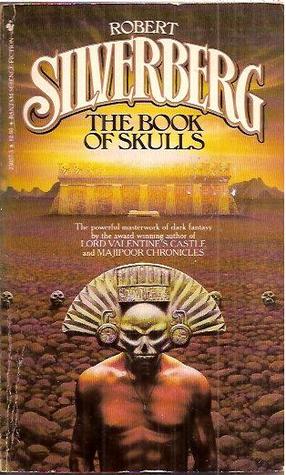
Cover for one of the paperback editions of The Book of Skulls by Robert Silverberg. (Click to embiggen)I was 16 when I found the Book of Skulls in a used book store. The cover blurb talking about four young men on a quest to find a mysterious cult and obtain immortality. I’d read some of Silverberg’s short fiction in both Galaxy magazine and The Magazine of Fantasy & Science Fiction and had generally enjoyed it. Plus it had a cool cover.
The novel is told in rotating first-person viewpoint from each of the four characters: Eli, the Jewish bookworm; Ned, the flaming homosexual; Timothy, the rich boy; and Oliver, the farmboy/jock. They are students at the same college who have formed somewhat unlikely friendships. Eli, who has a gift for languages, found and translated a book about the mysterious Brotherhood of the Skull and their secret of immortality. The book says that four people must present themselves together, and work together to endure the trials of the Brotherhood. Even if they succeed, only two will gain mortality. The other two lives are forfeit: one must willingly commit suicide, and the other must be sacrificed by his fellows…Continue reading Mortality, Im- and Otherwise: more of why I love sf/f→
Since we now have the rest of the nomination results, it is possible to see what works would have been on the ballot if not for the slates. Here is one such guess: Alternate Timeline Hugo Awards. This list includes some very interesting things that I wish we had had a chance to vote on.
The next headline isn’t entirely accurate. While George disapproves of any slate voting scheme, the purpose of his reviving his Hugo Losers party and this year handing out his own awards was to try to protest the deep schism and animosity: George R.R. Martin Holds Additional Ceremony After the Hugo Awards to Protest ‘Sad Puppies’. Years ago Martin founded the original Hugo Losers party, where people who were up for a Hugo that year could get together and tell each other they should’ve won… to wallow a little, yes, but also to commiserate, laugh at themselves and each other, et cetera. He let other people take over organizing it for years, but this year because of all the animosity flying around from every direction, decided to take it back. He rented a bar, invited anyone who has ever lost to the party. This year’s winners were also invited, but had to wear a conehead if they stayed. George had a bunch of trophies made, which he called Alfies, in honor of the late great Alfred Bester, and handed them out to people who would have been on the ballot, based on the nominating numbers, if you remove the slates. He handed out a few additional ones of his own choosing. By all reports, people had a good time.
Why We Need Queer Escapist Lit. I get tired of having to defend wanting to see characters that are like me in my favorite genre. But we have to keep doing it.
Equally problematic is that the frame of reference of people on one side is so utterly disjoint from the frame of reference of people on the other side, that a lot of our attempts to debate have merely resulted in us talking past each other. Hugos & Puppies: Peeling The Onion.
“When it comes to debating strangers with radically different perspectives, you sometimes encounter what I refer to as Onion Arguments: seemingly simple questions that can’t possibly be answered to either your satisfaction or your interlocutor’s because their ignorance of concepts vital to whatever you might say is so lacking, so fundamentally incorrect, that there’s no way to answer the first point without first explaining eight other things in detail.”
“We all have conservative friends and acquaintances who aren’t a-holes, and we don’t seem to have a big problem with them unless they’re crazy bigots like [Vox Day]. We have a problem with a-holes.”
“…I haven’t voted in several years, when I did I voted for stories that I loved (plus, to be honest, stories written by my friends)—as do most readers. If readers deliberately voted for stories about gay characters and people of color, perhaps it’s because [those stories] speak of “alienation,” which a great many readers of science fiction happen to have experienced (readers of science fiction tend to be natural outsiders).”
This may be my favorite read today: How the 2015 Hugos proved against all odds that SF is becoming more international and more diverse. There is just so much here to like. She links to some of the same posts I have above, but also to a whole lot of others. She pulls long quotes from people and does some analysis and rebuttal. One of my favorites is in response to a Sad Puppy supporter who agreed to be interviewed for one of the news site’s stories, but didn’t want his name used:
“In many ways this quote by the unknown puppy clearly illustrates the attitudes that already became obvious in Brad Torgersen’s infamous “Nutty Nuggets” post. A lot of puppies don’t just want works they don’t like to be excluded from the Hugos, they deny works they don’t like the right to exist period. They don’t want these works to be published, they don’t even want them to be written at all.”
She segues away from the Puppies and spends most of her post talking about the works that did win. I especially like this point:
[B]oth Hugos in the two fiction categories that actually were awarded went to translated works by non-anglophone writers, which is a first in Hugo history. Coincidentally, both are also the first Hugo wins for their respective countries of origin… I’m happy that they won, because their wins show that the Hugos are becoming a more truly international award. And yes, it’s problematic that a white Dutchman and a Chinese man, two writers who have nothing in common apart from the fact that English is not their first language, are both subsumed under the header “international SF”. But given how Anglo-American dominated the Hugos and WorldCon have traditionally been, it’s still a great step forward.
I’m skipping a lot. Her full post is really worth that read. I hope you give it a look.
Those of us who love science fiction and fantasy are going to be talking about this a lot over the course of the next year. Both the Sad and Rabid Puppies are vowing to be back. Vox Day, leader of the Rabids, is specifically threatening to leave a “smoking hole” where the Hugos once were. So the rest of us are going to have to make sure we participate in both the nomination portion and voting portion of the process next year.
Because the avalanche may have already started, but contrary to the Vorlon proverb, in this landslide, each pebble has a vote, and we can make them count.
Many years ago the fanzine I edit won an award. It was not anything as prestigious or as well-known as the Hugos. It was an Ursa Major Award, a fan-nominated and fan-voted award which was consciously set up to be an anthropomorphics-fandom version of the Hugos. And because I also write stories that are published in those sorts of ‘zines, I have had one or two of my tales receive enough nominations to make it onto the ballot some years. I didn’t win, but it was an honor just to be nominated. And that isn’t just something I say to be polite, it really was an honor.
I would have been much more excited to win, obviously. I certainly was very pleased when the fanzine won the award. But, the two years my ‘zine won, there were other publications on the ballot who didn’t win, which was a disappointment for their editors, I’m sure. That’s what happens with any kind of award. Someone wins, and a bunch of people don’t.
It so happens that when you make it on the ballot but don’t win, you often find yourself receiving a lot of condolences from friends, acquaintances, and random fans on the internet which include some variant of the statement: “I can’t believe you didn’t win! I voted for you, and know several other people who did, too!”
And that is flattering. It makes you feel at least a bit better about not winning. Obviously, you received enough nominations to make it onto the ballot, so you already knew that there were people who liked your work. But something about having a person tell you directly is even more of an ego boo.
It so happens that one of the years that I didn’t have any story make the ballot, I received a lot of those sorts of condolence messages. After the award winners were announced months later, the committee that administers the award published voting and nomination statistics. Foolishly, I looked at them, only to discover that the only one of my stories published that year which was nominated received a grand total of exactly 3 nominations. I confess, that when I nominated that year I had voted for my own story (and I was fairly certain my husband had, as well). Which meant that only one person other than myself or my husband had nominated me.
But far more than just one person had seemingly sincerely told me—they had volunteered the information without any prompting from me—that they had nominated me. Which means that most of those fans told a little white lie. It wasn’t malicious. In some of the cases, the person probably had meant to participate in the nominating process but put it off until it was too late. A few of them may have been misremembering: they had nominated me, but it was the year before. Others simply were trying to be nice, having noticed that I didn’t make the ballot and assuming that I was disappointed.
When you realize something like that has happened, what can you do but laugh, shrug it off, and try to move on?
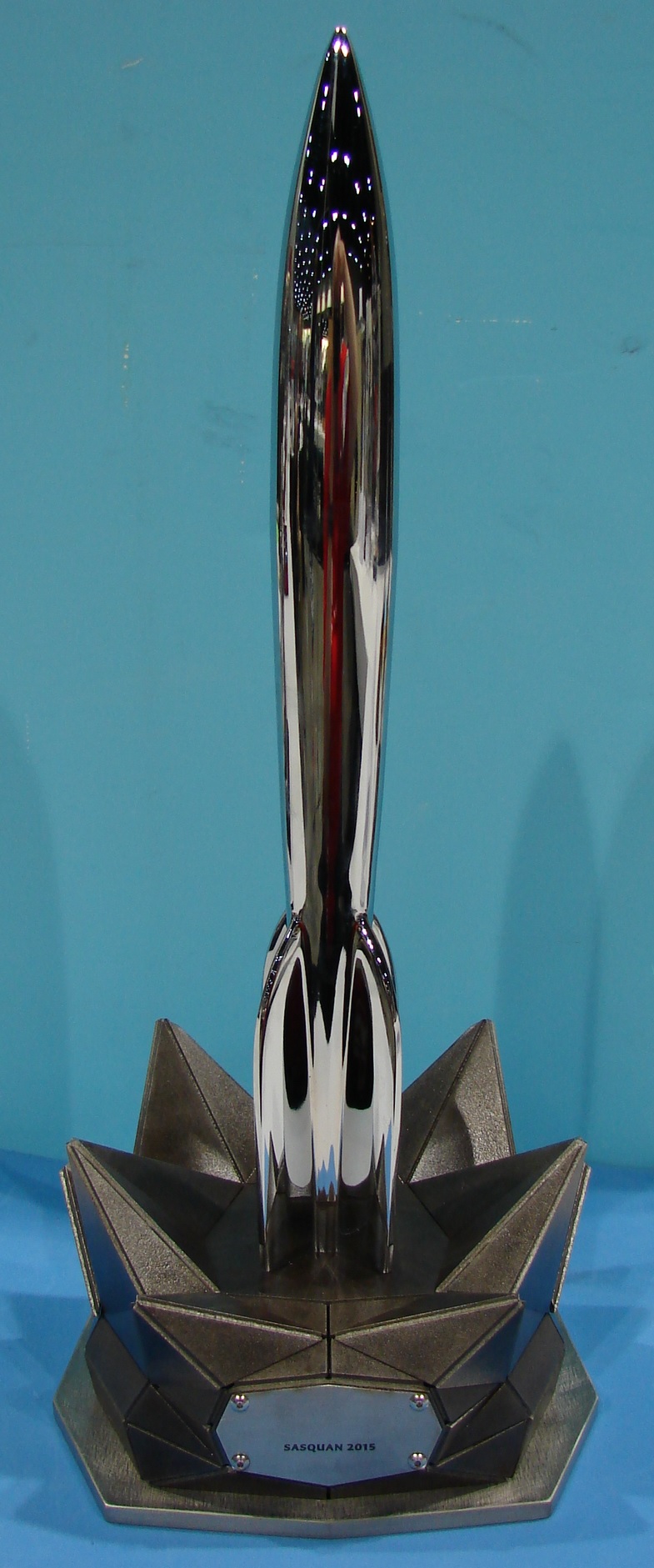
The Hugo trophy given out last night. Designed by Matthew Dockrey, photo by Kevin Standlee. (Click to embiggen)The 2015 Hugo Awards were announced last night at a ceremony at Sasquan, the 73rd World Science Fiction Con, held in Spokane, Washington. The hosts were David Gerrold and Tananarive Due.
First, congratulations to the Helsinki Worldcon Bid Committee! They’re hosting WorldCon 2017 in Helsinki! So at least one of the votes being counted at WorldCon this weekend went the way I voted. Woo hoo! Onneksi olkoon! Congratulations!
In other updates to things that I’ve included in recent Friday Links posts, a lot of people I follow have been posting a link to a Vocativ post about how very, very white the winners of the Hugo Awards have been over the years: Science Fiction Is Really, Really White. The article has graphs and some statistics and seems legit, right?
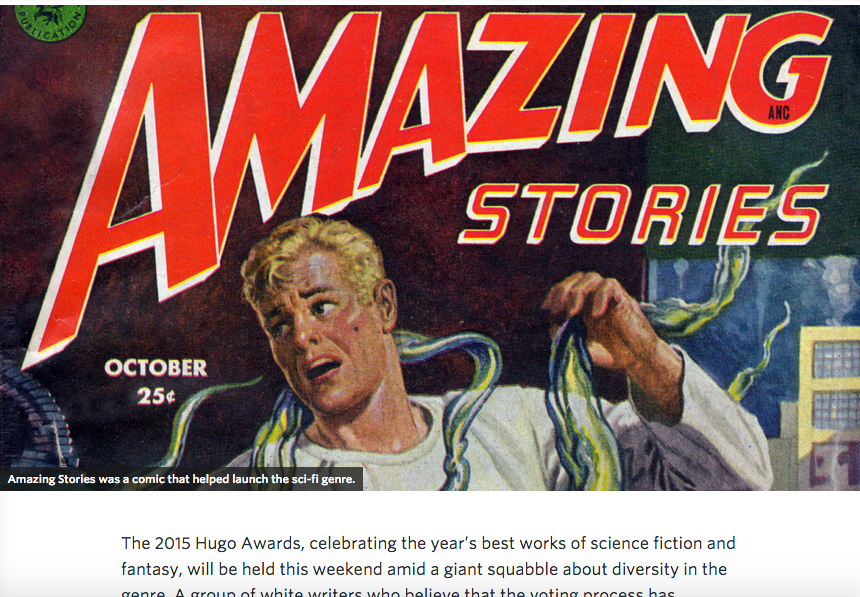
Screenshot of the graphic, caption, and a bit of the article.The first thing that made me wary about simply retweeting the link is something really minor: the caption on the picture that they illustrate the story with. “Amazing Stories was a comic that helped launch the sci-fi genre.” No. Amazing Stories was a magazine that printed literary stories founded in 1926 by Hugo Gernsbeck. It was not a comic book. While it is often credited with launching the pulp version of the genre science fiction, so that part is true, but it wasn’t a comic.
Bar graph as originally published.Now, ordinarily that would be a quibble, but this article is about statistics, so seeing in the caption that they have already gotten a fact wrong made me a teeny bit apprehensive. Then we get to the most dramatic graph, and I think, “That can’t be right.” What about Saladin Ahmed, author of Throne of the Crescent Moon, Best Novel nominee in 2013? Shouldn’t there be a bar labeled “Arab” with at least 1 person it it?
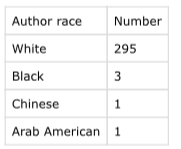
This only just barely qualifies as data…Amusingly, I started this post early this morning, then had to go to a nearby clinic for some scheduled medical tests, and while I was sitting in the waiting room, Mr. Ahmed’s tweet commenting on being erased from the data came through my feed. Since then, one of Vocativ’s editors sent out a tweet that they’re correcting the article. The bar graph now does list one Arab-American. That’s a bit better, but that’s the thing. Now how do we trust them about the other 295 authors they claim are white? You might think that clicking on the “Get data” link under the graph would give you a spreadsheet of all the nominees, right? Nope. You get a spreadsheet, all right, but it just says “White 295, Black 3, Chinese 1, Arab American 1.”
This may seem really petty and nitpicky, but here’s the thing: if you are trying to make a statistical argument to back up a claim, you have to get every fact right. And you have to give us confidence that you are likely to get every fact right. There is a big argument to be had about what we mean by race. Race is a social construct with no basis in biological science, so there will be lots of people who will want to nitpick the data if we did have a big spreadsheet that listed all 300 nominees. I suspect that the graph now is close enough to correct to still illustrate the point that the Hugo Awards have hardly been a paragon of diversity. Even more importantly, the ludicrous charge that the Hugos have been being somehow secretly controlled by a liberal cabal that has imposed political correctness onto the ballot for many years is demolished by facts such as this.
But to the next person who wants to compile something like this: quadruple check your results before publishing!
Hugo Awards Announced Tonight!
The award are tonight! From the official Hugos website:
The 2015 Hugo Awards Ceremony is scheduled for Saturday, August 22, 2015 at 8 PM Pacific Daylight Time in the INB Performing Arts Center in Spokane, Washington. The Hugo Awards web site will once again offer text-based coverage of the 2015 Hugo Awards ceremony via CoverItLive, suitable for people with bandwidth restrictions. For those with the bandwidth for it, Sasquan will also offer live video streaming of the 2015 Hugo Awards ceremony via UStream. In addition, Sasquan will present “The Road to the Hugos”, a livestreamed Internet pre-and-post Hugo broadcast featuring hosts Stephen Schapansky and Warren Frey of Radio Free Skaro, as part of the coverage, starting one hour before and ending one hour after the ceremony.
No Award will take maybe two categories, causing cheering from some and more threats from the Überpuppy,
At least two nominees from one of the Puppy slates will walk home with a Hugo,
Some people on both sides will claim victory,
Some people on both sides will claim it is a defeat for all that is right and just in the world,
Regardless, science fiction will survive!
I plan to have a mini Hugo Watching Party here tonight.
Now matter what happens, please offer congratulations to the winners and please console any nominee (and I mean anyone) who does not get a trophy. Similarly, offer condolences to anyone you know who is disappointed that their favorite in any category didn’t win.
And for the future: if you are a fan, read and watch good science fiction and fantasy (however you define it) and support the writers and artists who make it. If you are one of those writers or artists: in the immortal words of Neil Gaiman, I urge you to make good art.
Lost in Space, 20th Century Fox Television & CBS Broadcasting (Click to embiggen)The first episode of Lost In Space aired on CBS in September of 1965, and I was glued to my set. It debuted less than two weeks before my fifth birthday, so I don’t remember a lot about my feelings about the first episode. If you aren’t familiar, the show follows the adventures of the “space family Robinson” (Professor John Robinson, his wife Dr. Maureen Robinson, their grown daughter Judy, and younger children Penny and Will; their pilot, Major Don West, and their robot called B-9 in the early episodes) who were sent off to be the first colonists of the Alpha Centauri system, except their ship is thrown off course due to the bumbling actions of the stowaway/saboteur Dr. Zachary Smith, who ends up trapped on the ship when it takes off.
Lost In Space is not remembered as being serious science fiction, or even as a serious series. Though this is primarily because of the second and third season. The first season was intended as a serious action adventure series giving a science fictional spin to the early 19th Century novel, The Swiss Family Robinson, which had itself been inspired by the 18th Century novel, Robinson Crusoe. Like those novels, the early episodes focused on the crew as castaways trying to survive in a hostile environment. Some of the sci fi notions of some first season episodes were pretty silly by modern standards, but mostly because they were attempts to adapt the sort of complications that might appear in a western series or a contemporary slice-of-life series and put a spacey spin on it…Continue reading Computerized Clods and Squeamish Scoundrels: more of why I love sf/f→
Hardcover copy of the original version of David Gerrold’s When Harlie Was One.I was thirteen or fourteen years old when I found the copy of When Harlie Was One in the public library. The book jacket described an intelligent machine that has to prove he is a person or be shut down. It sounded really cool. This was during a period in my life where I was literally reading at least one entire book every day. I visited the library constantly, turning in a pile of books I’d finished every few days and checking out more. I read during every free moment. I even read while I was walking to school or while walking home. Yep, I was that kid, walking down the sidewalk with my nose stuck in a book. Books weren’t my only friends, but they were my best friends.
Thinking back, I’m sort of surprised that particular public library in that tiny town had this book. It had only been published a year or two previously. Most of the science fiction they had was stuff that had been around for much longer. Of course, When Harlie Was One had been nominated in the best novel category for both the Nebula Award and the Hugo Award (it won neither) not long before the library acquired it, so maybe that’s why the librarian who ordered new books picked it. I don’t know…Continue reading Thinking Machines and Thoughtless People: more of why I love sf/f→







 Font Folly